Because February shouldn’t be the only Hawaiian Language month… 1948.

THE MOTHER TONGUE

We frequently speak to our dear readers about our Mother tongue, not about our teaching them the Hawaiian language, but that the light of our beloved language from our forefathers is being extinguished.

Being that this is a new era, and we see and realize that there is a drastic reduction in the number of our generations capable in our mother tongue. There are many of our youths these days who have no knowledge of our language, but when you listen to them singing, they sing Hawaiian songs. Sometimes when our children speak Hawaiian, their production of the language is so strange, and sometimes our naau [gut, heart] aches at their mispronunciation of words.

There are many Hawaiian songs sung with incorrect pronunciation. Our children are neglecting trying to acquire knowledge and proficiency in speaking the mother tongue. Look at the other ethnicities like the Filipinos and the Japanese, they haven’t forgotten their language. If parents spoke in their own language then the children would hear; and when we talk to them, they’ll ask, “he aha kau e olelo mai nei? [what are you saying?]”

Some people bewail, “If only Hawaiian-Language Schools were reopened, that would be a good thing because we’d get knowledge and proficiency in the Hawaiian language and it would revive our language.”

That is astonishing. Should a young Hawaiian have the desire to acquire knowledge and competency in the Hawaiian language, he should try to get this competency by studying diligently by himself and to get together with an adult for help and there would be great progress. Some say that Hawaiian can be gotten just like that, not like the languages of other people. Perhaps it is true, but if you go back and think with great seriousness, you will see that the Hawaiian language is not easy.

Within the many Hawaiian words, spellings might be the same, but the pronunciation and meanings of those words are different.

One thing that will give every youth proficiency is the reading of Hawaiian newspapers and Hawaiian books like perhaps the bible. Those things will give knowledge and competence in our native language.

We point out that because of the great love of a certain father, Joseph N. [Nihiaumoe] Koomoa, for the Hawaiian language, he thought it would be important to publish some Hawaiian songs and Hawaiian Hula and print some booklets, and through that someone could make time to read the Hawaiian language and perhaps that way the person could pronounce the words while understanding the kaona [underlying meanings].

This man sent those Hawaiian songs and hula to a Newspaper company to be printed in booklets, and it will be sold to the person or persons who want those books. This is a good idea of Joseph Koomoa’s, and we hope that your books that are being printed will become books that give knowledge to the Hawaiian youths of this age and of the future. Aloha to us, O Hawaiians.

Should you want one of those books, they will be available at the shop of that Hawaiian on Waianuenue Avenue, and also the former fire station [?] According to what was announced, the books will probably cost 35 cents each.

We want our youngsters to get a hold of this and and improve themselves to the best of their ability so that they can get proficiency in our mother tongue. Letting these go would be like forgetting our own selves.

“RISE YOUNG HAWAIIANS, GRASP OUR MOTHER TONGUE AND GO FORTH AND LET US BE TRIUMPHANT BY BEING PROFICIENT IN THE HAWAIIAN LANGUAGE.

Forge forward with no fear. So that you can get knowledge and proficiency in your own language—that will be your triumph.

We give our congratulations to you, Mr. Joseph Koomoa, for you attempt to revive the prized language of ours. You will be helping for all times [E kokua mau ia mai nohoi oe i na wa apau. ?]

Help ourselves Hawaiians, and don’t let the benefits go to those others [E kokua iho nohoi ia kaua Hawaii, aole hoi hoolele aku i na pomaikai ia lakou ma. ?]

[Anyone know of any copies of these music booklets by Joseph N. Koomoa still in existence???]

(Hoku o Hawaii, 2/11/1948, p. 2)
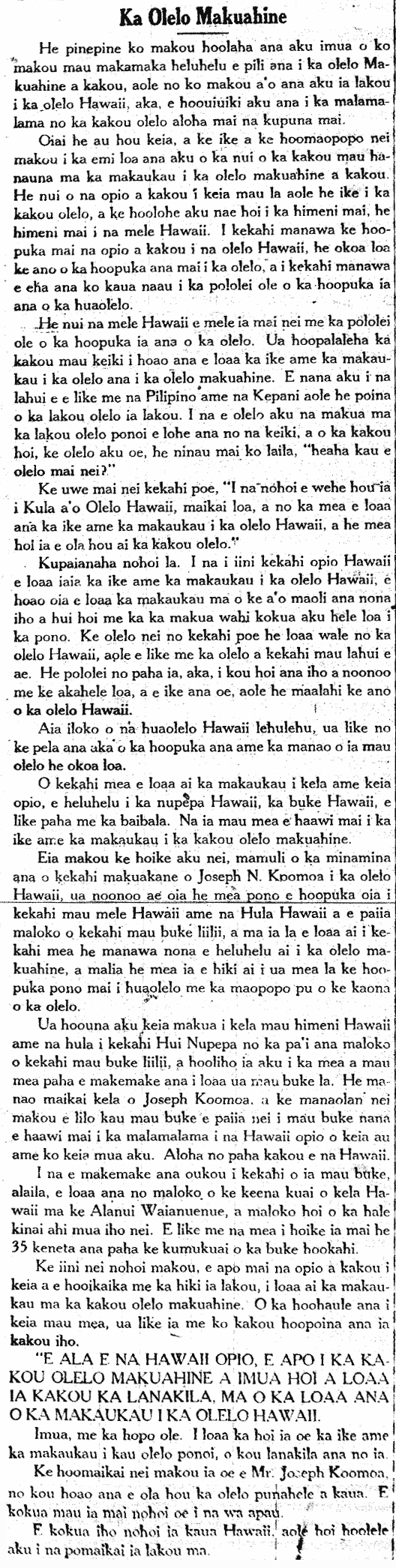
Ka Olelo Makuahine.

Ka Hoku o Hawaii, Volume XLI, Number 19, Aoao 2. Pepeluali 11, 1948.
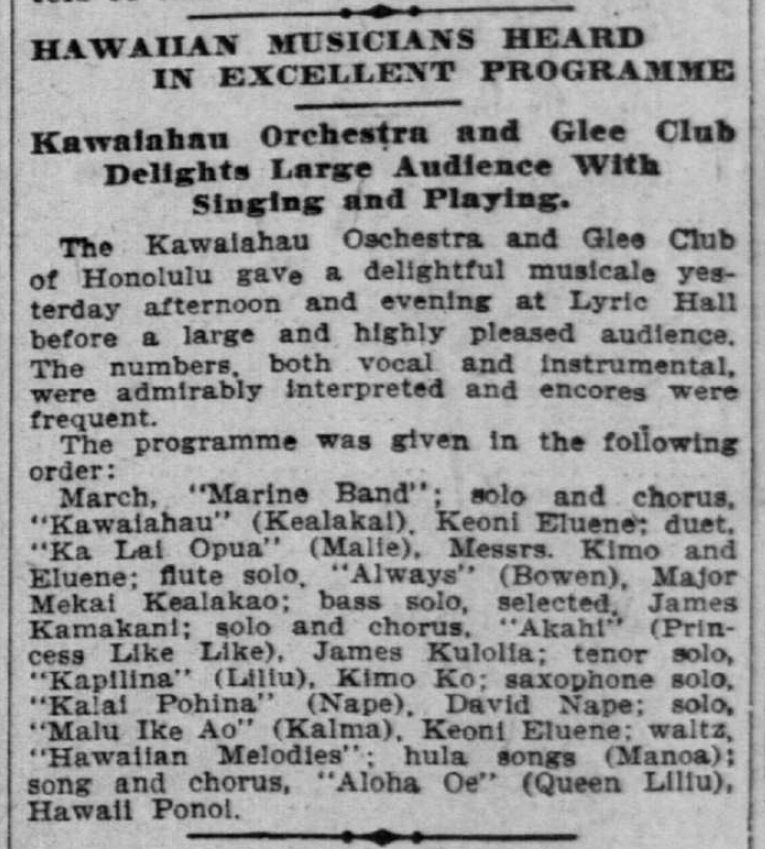
Kawaihau Orchestra and Glee Club in SF. 1905.

HAWAIIAN MUSICIANS HEARD IN EXCELLENT PROGRAMME

Kawaiahau Orchestra and Glee Club Delights Large Audience With Singing and Playing.

The Kawaiahau Orchestra and Glee Club of Honolulu gave a delightful musicale yesterday afternoon and eveing at Lyric Hall before a large and highly pleased audience. The numbers, both vocal and instrumental, were admirably interpreted and encores were frequent.

The programme was given in the following order:

March, “Marine Band”; solo and chorus, “Kawaiahau” (Kealakai), Keoni Eluene; duet, “Ka Lai Opua” (Malie), Messrs. Kimo and Eluene; flute and solo, “Always” (Bowen), Major Mekia Kealakao [Kealakai]; bass solo, selected, James Kamakani; solo and chorus, “Akahi” (Princess Like Like [Likelike]), James Kulolia; tenor solo, “Kapilina” (Liliu), Kimo Ko; saxophone solo, “Kalai Pohina” (Nape), David Nape; solo, “Malu Ike Ao” (Kalima), Keoni Eluene; waltz, “Hawaiian Melodies” ; hula songs (Manoa); song and chorus, “Aloha Oe” (Queen Liliu), Hawaii Ponoi.

[Because of its location, The San Francisco Call had much Hawaii coverage.]

(San Francisco Call, 10/7/1905, p. 16)

HAWAIIAN MUSICIANS HEARD IN EXCELLENT PROGRAMME

The San Francisco Call, Volume XCVIII, Number 129, Page 16. October 7, 1905.

Kawaihau Glee Club performs in Washington State. 1905.

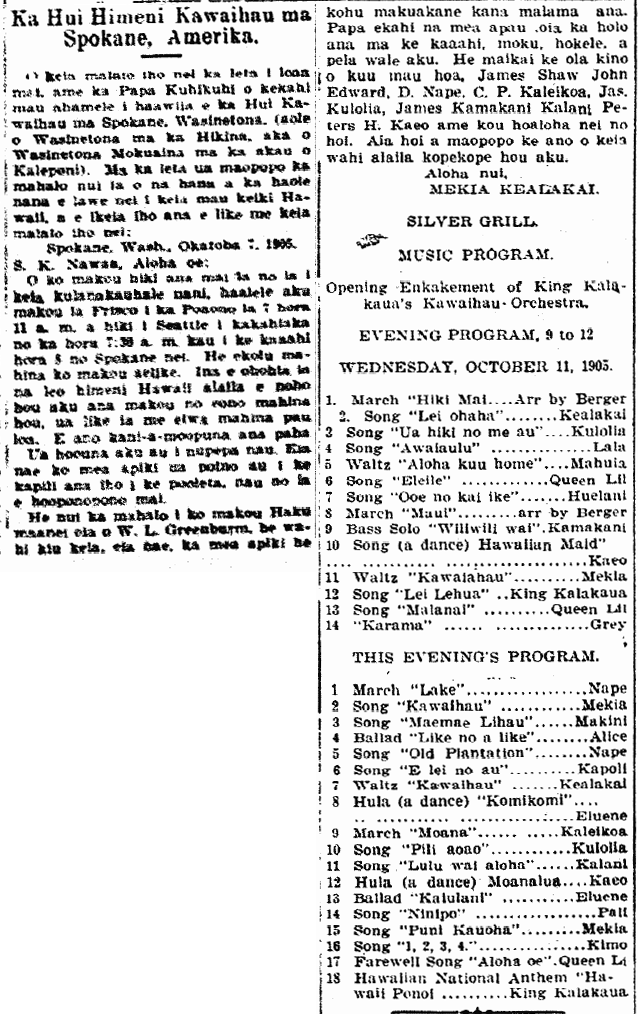
The Kawaihau Glee Club in Spokane, America.

Here below is a letter received as well as a program from some performances given by the Kawaihau Glee Club at Spokane, Washington (not Washington in the East, but Washington State to the North of California). It is apparent from the letter that the actions of that haole taking these Hawaiian boys around is much appreciated, and this is seen as below:

Spokane, Wash., October 7, 1905.

S. K. Nawaa, Aloha to you:

We’ve arrived in this beautiful town, we left Frisco on Saturday the 7th [?] at 11 a. m. and got to Seattle in the morning, at 7:30 a. m. boarded the 8 o’clock train for Spokane. Our contract is for 3 months. If they are taken by the sound of Hawaiian music, we will stay on for another 6 months, which would make 9 months total. Perhaps we will be like old grandparents by then.
I have sent a newspaper to you. But here is the thing, I had problems with the postage, so you will have to take care of it.
We really are thankful for our Boss here, W. L. Greenburn [?], he is an investigator. The one problem is that he treats us as if he is our father. Everything is first class, from the train, to the boat, to the hotel, and so forth. My friends, James Shaw, John Edward [Edwards?], D. Nape [David Nape], C. P. Kaleikoa, James Kulolia, James Kamakani, Kalani Peters, H. Kaeo and me, your friend as well, we are all in good health. As soon as I get acclimated to how it is here, I will write again.
Much Aloha,
Mekia Kealakai.

SILVER GRILL
MUSIC PROGRAM
Opening Enkakement of King Kalakau’s Kawaihau Orchestra.
EVENING PROGRAM, 9 to 12

WEDNESDAY, OCTOBER 11, 1905.

1 March “Hiki Mai” Arr by Berger
2 Song “Lei ohaha” Kealakai
3 Song “Ua hiki no me au” Kulolia
4 Song “Awaiaulu” Lala
5 Waltz “Aloha kuu home” Mahuia
6 Song “Eleile” Queen Lil
7 Song “Ooe no kai ike” Huelani
8 March “Maui” arr by Berger
9 Bass Solo “Wiliwili wai” Kamakani
10 Song (a dance) Hawaiian Maid” Kaeo
11 Waltz “Kawaiahau” Mekia
12 Song “Lei Lehua” King Kalakaua
13 Song “Malanai” Queen Lil
14 “Karama” Grey

THIS EVENING’S PROGRAM.

1 March “Lake” Nape
2 Song “Kawaihau” Mekia
3 Song “Maemae Lihau” Makini
4 Ballad “Like no a like” Alice
5 Song “Old Plantation” Nape
6 Song “E lei no au” Kapoli
7 Waltz “Kawaihau” Kealakai
8 Hula (a dance) “Komikomi” Eluene
9 March “Moana” Kaleikoa
10 Song “Pili aoao” Kulolia
11 Song “Lulu wai aloha” Kalani
12 Hula (a dance) Moanalua Kaeo
13 Ballad “Kaiulani” Eluene
14 Song “Ninipo” Pali
15 Song “Puni Kauoha” Mekia
16 Song “1, 2, 3, 4.” Kimo
17 Farewell Song “Aloha oe” Queen Li
18 Hawaiian National Anthem “Hawaii Ponoi King Kalakaua

[I am assuming that they copied the program as it was printed out in Washington…]

(Kuokoa, 11/3/1905, p. 5)

Ka Hui Himeni Kawaihau ma Spokane, Amerika.

Ka Nupepa Kuokoa, Buke XLIII, Helu 44, Aoao 5. Novemaba 3, 1905.

Kawaihau Glee Club off to San Francisco. 1905.

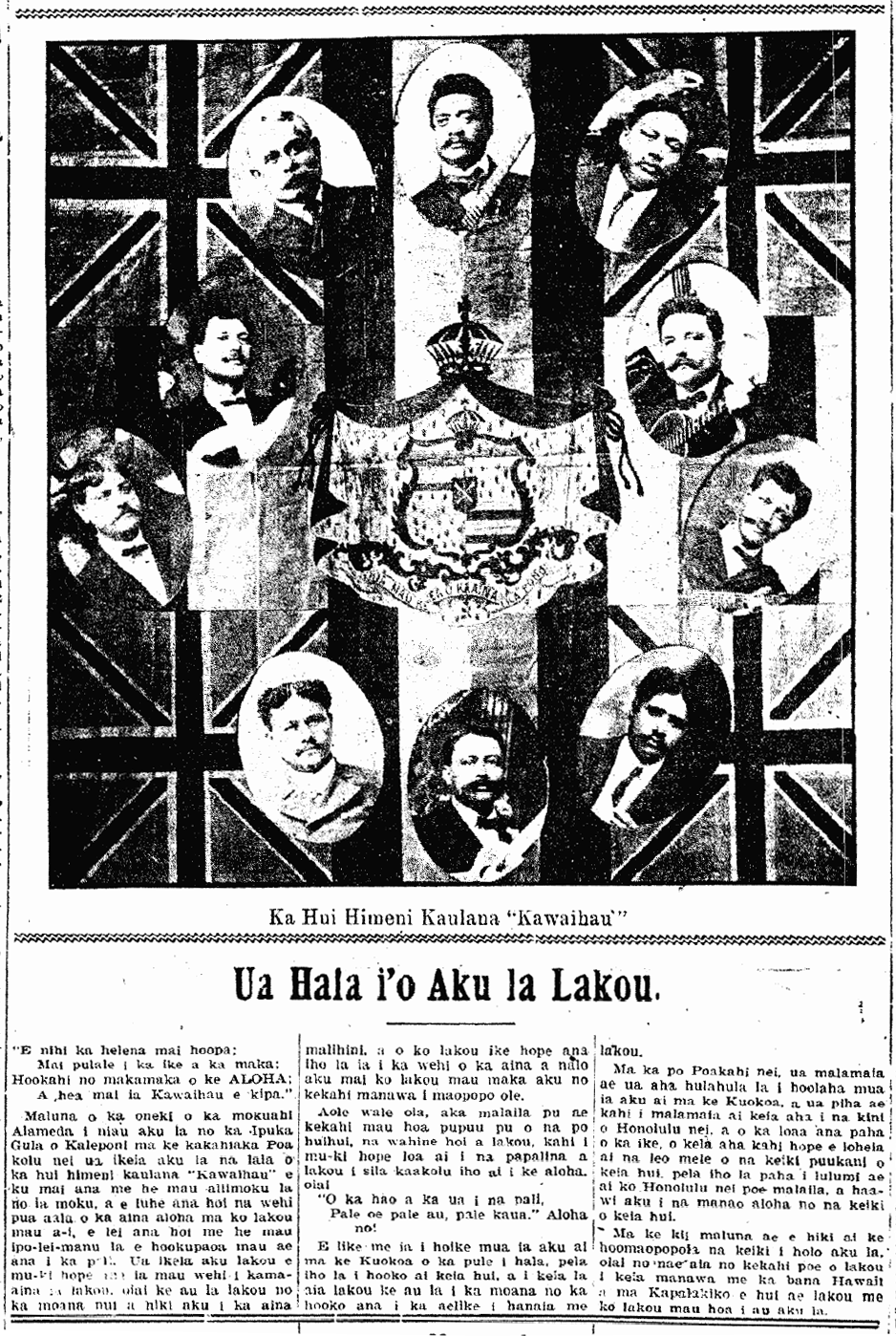
The Famous Singing Group “Kawaihau”

They Left for Afar.

“E nihi ka helena mai hoopa; [Tread carefully, don’t touch;]
Mai pulale i ka ike a ka maka [Don’t get excited by what the eye sees:]
Hookahi no makamaka o ke ALOHA [There is but one companion, that is ALOHA];
A hea mai ia Kawaihau e kipa. [Calling out to Kawaihau to come visit.]”¹

Aboard the deck of the steamship Alameda that moved swiftly on to the Golden Gate of California on the morning of Wednesday was seen the members of the famed singing group “Kawaihau” standing like officers of the ship while garlands of fragrant flowers of the beloved land hung about their necks; they wore the lei like a beloved sweetheart ever imbuing fragrance in their bosom. They were seen inhaling for the last time the adornment familiar to them as they were leaving for the great sea headed for foreign lands; and they were seeing for the last time the verdure of the land which disappeared from their eyes for who knows how long.

Not just them, but also there were the companions to curl up together in the cold nights—their wives, there to kiss their cheeks for the last time, which they sealed threefold with love, as

“O ka hao a ka ua i na pali [The assault of the rain in the cliffs]
Pale oe, pale au, pale kaua.” Aloha no! [I fend off, you fend off, we both fend off.”² Aloha!]

Just as reported earlier in the Kuokoa of last week, so did this group carry out, and today they are travelling over the ocean to fulfill the contract made with them.

This past Monday that dance advertised earlier in the Kuokoa was held, and the venue where the event took place was filled with the multitudes of Honolulu; perhaps they knew that this gathering would be the last they’d hear the singing of the performers of this group, and that is probably why Honolulu’s people thronged there and gave their aloha to the boys of the band.

In the picture above, you can see the boys who went, although some of them are currently with the Hawaiian Band in San Francisco and will meet up with their companions who left.

¹Play on the chorus of Kalakaua’s “E Nihi ka Hele.”
²Anyone know what mele this might come from?

[This is who played at that huge wedding celebration in Pauoa attended by Kaiulani in 1898 (the articles posted yesterday)]

(Nupepa Kuokoa, 9/22/1905, p. 1)

Ua Hala i'o Aku la Lakou

Ka Nupepa Kuokoa, Buke XLIII, Helu 38, Aoao 1. Sepatemaba 22, 1905.

More on that wedding celebration up in Pauoa. 1898.

WEDDING PARTY IN PAUOA.

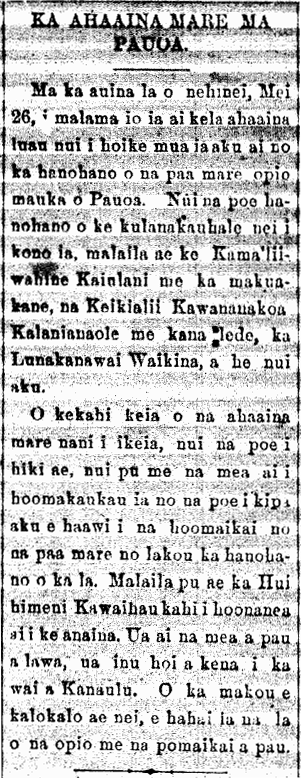
Yesterday afternoon, May 26, that grand luau was indeed held that was mentioned earlier, to honor the wedded couples in the uplands of Pauoa. There were many important people of Honolulu that were invited; attending was Princess Kaiulani and her father, Princes Kawananakoa and Kalanianaole and his wife, Judge Waikina [Whiting], and many more.

This was one of the beautiful wedding celebrations seen; there were many people who came, along with the abundant foods prepared for the guests who gave their congratulations to the wedded couples who were being honored that day. There too was the Kawaihau Glee Club who entertained the crowd. Everyone ate their fill, and drank till satiated of the waters of Kanaulu. We pray that the days following the youths be full of blessings.

[This is the wedding celebration mentioned earlier.

Also, does anyone know what the “wai a Kanaulu” is a reference to? It seems that it is a phrase that is used widely… ]

(Aloha Aina, 6/4/1898, p. 7)

KA AHAAINA MARE MA PAUOA.

Ke Aloha Aina, Buke IV, Helu 23, Aoao 7. Iune 4, 1898.

Death announcement found outside of the Vital Statistics column, 1898.

THAT HAWAIIAN MOTHER HAS GONE.

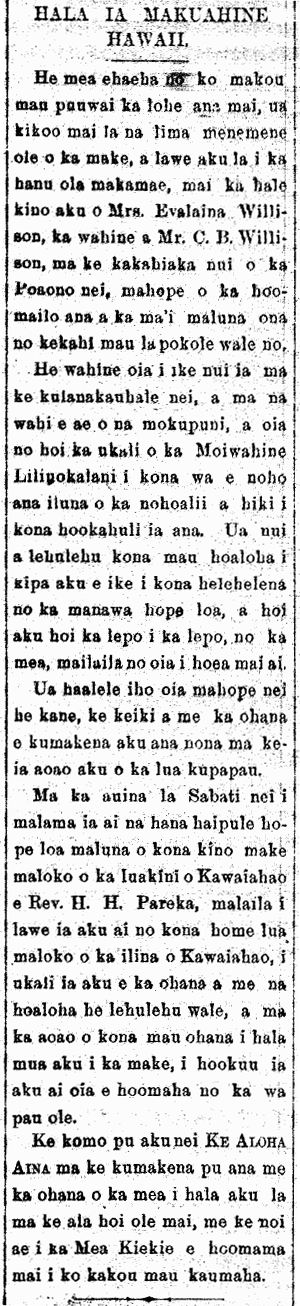
It was a painful thing for our hearts to hear that the uncompassionate hand of death reached out and took the precious breath of life from the body of Mrs. Evalaina Willison [Wilson], the wife of Mr. C. B. Willison [Wilson], in the early morning of this Saturday, after she began to waste away of sickness for just a few short days.

She was a well-known woman here in town, and elsewhere on the island, and she was the attendant of Queen Liliuokalani while she was on the throne until her overthrow. There were many, many friends who visited to see her for the last time, and then dust returned to dust, for that is where it came from.

She leaves behind a husband, child and family who grieve for her from this side of the grave.

In the afternoon of this Sunday, the last services over the body were held at Kawaiahao Church by Rev. H. H. Parker, and from there the body was taken to its home in the ground at the cemetery of Kawaiahao, accompanied by the family and numerous friends, and next to her family who passed before she was put to rest for all times.

Ke Aloha Aina joins in the mourning with the family of the one who left on that road of no return, while asking the Almighty to lessen our grief.

(Aloha Aina, 5/28/1898, p. 5)

HALA IA MAKUAHINE HAWAII.

Ke Aloha Aina, Buke IV, Helu 22, Aoao 5. Mei 28, 1898.

Marriage information found outside of the Vital Statistics column, 1898.

A LARGE LUAU.

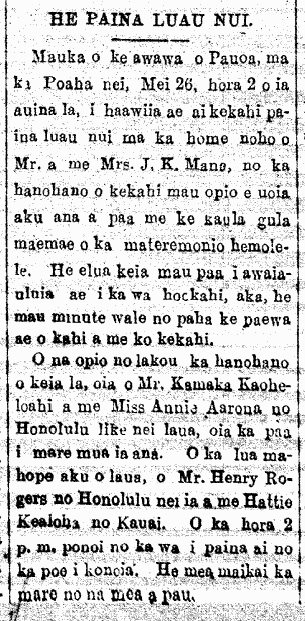
Up in the valley of Pauoa, on this past Thursday, May 26, at 2 in the afternoon, a great party was given at the residence of Mr. and Mrs. J. K. Mano, to celebrate the binding tightly with the gold cord of holy matrimony, some youths. There were two secure unions that happened at the same time, but there were perhaps just a few minutes separating one from the other.

The youths to whom belonged the honor of the day were Mr. Kamaka Kaoheloahi and Miss Annie Aarona, both of Honolulu; they were the couple married first. The second following them were Mr. Henry Rogers of Honolulu and Hattie Kealoha of Kauai. It was 2 p. m. exactly when those invited began to dine. Marriage is a good thing for all people.

(Aloha Aina, 5/28/1898, p. 5)

HE PAINA LUAU NUI.

Ke Aloha Aina, Buke IV, Helu 22, Aoao 5. Mei 28, 1898.

Kamehameha III, Kauikeaouli’s birthday, a little late. 1907.

Day of Remembrance

of the

King Kauikeaouli

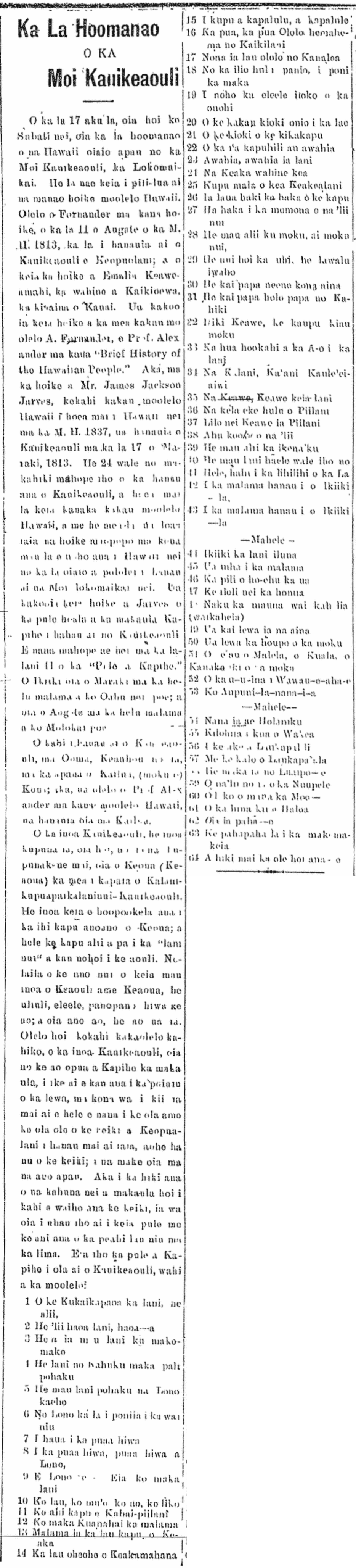
This past 17th, Sunday, was the day of remembrance for all true Hawaiians, of the King Kauikeaouli, the Benevolent one. There are two different historical accounts of this day. Fornander states in his account that Kauikeaouli was born of Keopuolani on 11 August 1813, and that this information was from Emalia Keaweamahi, the wahine of Kaikioewa, the governor of Kauai. This date of A. Fornander is supported by Prof. Alexander in his “Brief History of the Hawaiian People.” However, in the account of Mr. James Jackson Jarves, a scholar of Hawaiian history who arrived here in Hawaii nei in 1837, Kauikeaouli was born on 17 March 1813. This historian arrived here but 24 years after the birth of Kauikeaouli, and it would seem that he obtained clear information about the true birth date of the Benevolent King, while he was living here. This statement by Jarves is supported by the reviving prayer that Kapihe offered for Kauikeaouli. Look below at line 11 [42?] in the “Pule a Kapihe.” Ikiiki is the month of March according to the reckoning of Oahu people, and according to Molokai people it is August.

Kauikeaouli was born at Ooma, Keauhou, in Kailua, in the moku of Kona. However, Prof. Alexander, in his history of Hawaii, says Kauikeaouli was born in Kailua.

The name Kauikeaouli is a name from his ancestors, that being the name of his grandfather, Keoua (Keaoua), the one called Kalanikupuapaikalaninui Kauikeaouli. This name puts on high the sacred kapu of Keoua–his chiefly kapu extends above and touches the great heavens, and rests upon the dark clouds. So therefore, the importance of the names Keaouli and Keaoua, is the dark, black, thick, esteemed cloud. This cloud is a rain cloud. A Orator of the old times said that the name Kauikeaouli is the bank of clouds that Kapihe, the prophet, saw spread high in the heavens when he was called to go to see if the child that Keopualani gave birth to was alive or not alive. He was not breathing and was totally lifeless. However, when this kahuna and prophet arrived to where the child was placed, he offered this prayer while waving a coconut frond in his hand. This is the prayer by which Kapihe made Kauikeaouli live, according to the story:

1 O ke Kukaikapaoa ka lani, ae alii,

2 He ‘lii haoa lani, haoa—a

3 He a ia m u lani ku makomako

4 He lani no Kahuku maka pali pohaku

5 He mau lani pohaku na Lono kaeho

6 No Lono ka la i poniia i ka wai niu

7 I haua i ka puaa hiwa

8 I ka puaa hiwa, puaa hiwa a Lono,

9 E Lono—e. Eia ko maka lani

10 Ko lau, ko mu’o, ko ao, ko liko

11 Ko alii kapu e Kahai-piilani

12 Ko maka Kuanahai ka malama

13 Malama ia ka lau kapu o Keaka

14 Ka lau oheohe o Keakamahana

15 I kupu a kapalulu, a kapalule

16 Ka pua, ka pua Ololo hemahema no Kaikilani

17 Nona ia lau ololo no Kanaloa

18 No ka ilio hulu panio, i poni ka maka

19 I noho ka eleele iloko o ka onohi

20 O ke kakau kioki onio i ka lae

21 O ke kioki o ke kikakapu

22 O ka i’a kapuhili au awahia

23 Awahia, awahia ia lani

24 Na Keaka wahine kea

25 Kupu mala o kea Keakealani

26 Ia laua haki ka haka o ke kapu

27 He haka i ka momona o na ‘lii nui

28 He mau alii ku moku, ai moku nui,

29 He nui hoi ka uhi, ka lawalu iwaho

30 He kai papa neenekona aina

31 He kai papa holo papa no Kahiki

32 I iki Keawe, ke kaupu kiau moku

33 Ka hua hookahi a ka A-o i ka lani

34 Na Kalani Ka’ani Kauleleiaiwi

35 Na Keawe, Keawe keia lani

36 Na kela eke hulu o Piilani

37 Lilo nei Keawe ia Piilani

38 Ahu kooka o na ‘lii

39 He mau alii ka ikena ‘ku

40 He mau lani haele wale iho no

41 Hele, hahi i ka lihilihi o ka La

42 I ka malama hanau i o Ikiiki—la

43 I ka malama hanau i o Ikiiki—la

—Mahele—

44 Ikiiki ka lani iluna

45 Ua uiha i ka malama

46 Ka pili o ho-ehu ka ua

47 Ke iloli nei ka honua

48 Naku ka mauna wai kali lia (waikaheia)

49 Ua kai lewa ia na aina

50 Ua lewa ka houpo o ka moku

51 O e au o Malela, o Kuala, o Kanaka ki o a moku

52 O ka u-u-ina i Wawau-e-aha-o

53 Ko Aupuni-la-nana-i-a

—Mahele—

54 Nana ia ae Holaniku

55 Kilohiia i kua o Wakea

56 I ke ake a Laukapalili

57 Me ke kalo o Laukapalala

58 He maka ia no Luaipo—e

59 O na ‘lii no ia o ka Nuupele

60 O I ko o maua ka Moo—

61 O ka hina kai o Haloa

62 Oia ia paha—e

63 Ke pahapaha la i ka makemakeia

64 A hiki mai ka ole hoi ana—e

[Amazingly, this is the only issue of this entire year that seems to have survived! If this newspaper could be reshot nicely, we could get a clear/clearer reading of this important mele!

And I put up the mele as is (although the image is not clear in some areas, so there are some questionable lines), so that words and phrases will be searchable on this blog or on google right now, instead of having to wait for some time in the future…]

(Kuokoa Home Rula, 3/22/1907, p. 4)

Ka La Hoomanao O KA Moi Kauikeaouli

Kuokoa Home Rula, Buke V, Helu 12, Aoao 4. Maraki 22, 1907.

Vital Statistics. 1862.

BIRTHS.

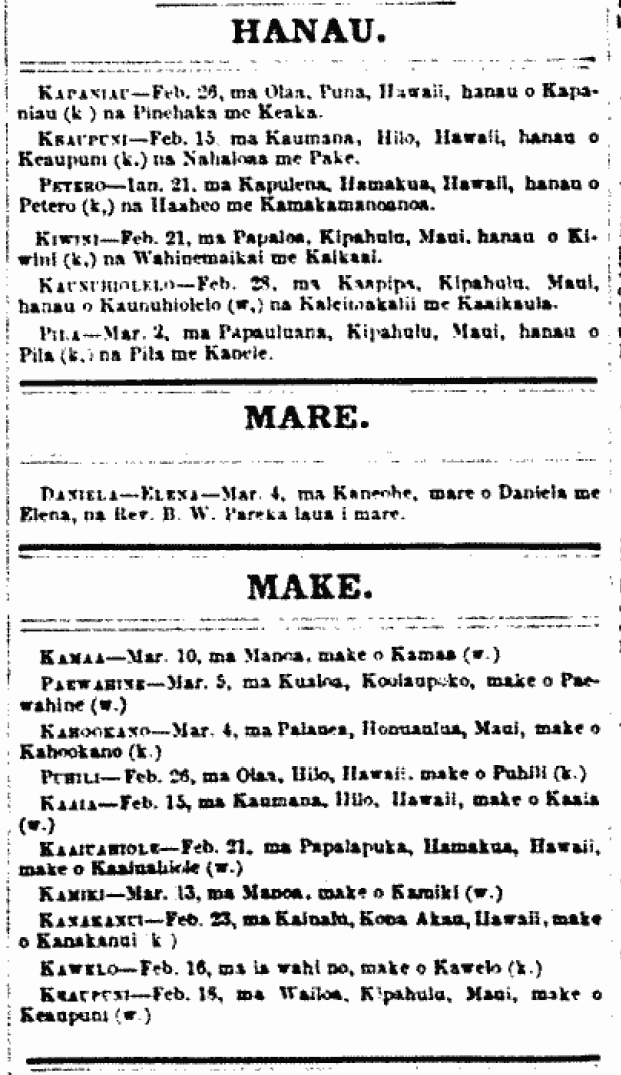
Kapaniau—Feb. 26, at Olaa, Puna, Hawaii, Kapaniau (m) was born to Pinehaka and Keaka.
Keaupuni—Feb. 15, at Kaumana, Hilo, Hawaii, Keaupuni (m) was born to Nahaloaa and Pake.
Petero—Jan. 21, at Kapulena, Hamakua, Hawaii, Petero (m) was born to Haaheo and Kamakamanoanoa.
Kiwini—Feb. 21, at Papaloa, Kipahulu, Maui, Kiwini (m) was born to Wahinemaikai and Kaikaai.
Kaunuhiolelo—Feb. 28, at Kaapipa, Kipahulu, Maui, Kaunuhiolelo (f) was born to Kaleimakalii and Kaaikaula.
Pila—Mar. 2, at Papauluana, Kipahulu, Maui, Pila (m) was born to Pila and Kanele.

MARRIAGES.

Daniela—Elena—Mar. 4, at Kaneohe, Daniela married Elena; the two were wed by Rev. B. W. Parker.

DEATHS.

Kamaa—Mar. 10, at Manoa, Kamaa (f) died.
Paewahine—Mar. 5, at Kualoa, Koolaupoko, Paewahine (f) died.
Kahookano—Mar. 4, at Palanea, Honuaulua [Honuaula], Maui, Kahookano (m) died.
Puhili—Feb. 26, at Olaa, Hilo, Hawaii, Puhili (m) died.
Kaaia—Feb. 15, at Kaumana, Hilo, Hawaii, Kaaia (f) died.
Kaaiuahiole—Feb. 21, at Papalapuka, Hamakua, Hawaii, Kaaiuahiole (f) died.
Kamiki—Mar. 13, at Manoa, Kamiki (f) died.
Kanakanui—Feb. 23, at Kainalu, North Kona, Hawaii, Kanakanui (m) died.
Kawelo—Feb. 16, from the same place, Kawelo (m) died.
Keaupuni—Feb. 18, at Wailoa, Kipahulu, Maui, Keaupuni (f) died.

[Notice how this vital statistics column is not the same as the one appearing in the earlier post of Hoku o ka Pakipika which comes out at the same time…]

(Kuokoa, 3/15/1862, p. 3)

HANAU. / MARE. / MAKE.

Ka Nupepa Kuokoa, Buke I, Helu 16, Aoao 3. Maraki 15, 1862.

Vital Statistics. 1862.

MARRIAGES.

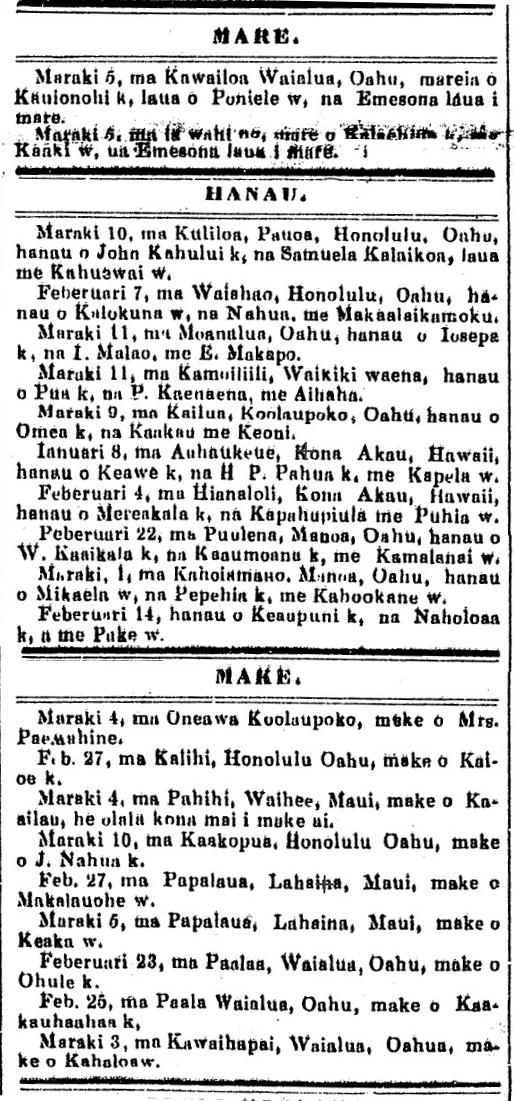
March 5, at Kawailoa, Waialua, Oahu, married was Kauionohi (m) and Poniele (f); Emerson married them.
March 5, at the same place, married was Kalaehina (m) and Kaaki (f), Emerson married them.

BIRTHS.

March 10, at Kuliloa, Pauoa, Honolulu, Oahu, John Kahului (m) was born to Samuela Kalaikoa and Kahuawai (f).
February 7, at Waiahao [mostly known today as Kawaiahao], Honolulu, Oahu, Kalokuna (f) was born to Nahua and Makaalaikamoku.
March 11, at Kamoiliili [mostly known today as Moiliili], Waikiki Waena, born was Pua (m) to P. Kaenaena, and Aihaha.
March 9, at Kailua, Koolaupoko, Oahu, born was Omea (m), to Kaakau and Keoni.
January 8, at Auhaukeue, North Kona, Hawaii, born was Keawe (m) to H. P. Pahua (m) and Kapela (f).
February 4, at Hianaloli, North Kona, Hawaii, born was Mereakala (m) to Kapahupiula and Puhia (f).
February 22, at Puulena, Manoa, Oahu, born was W. Kaaikala (m), to Kaaumona (m) and Kamalanai (f).
March 1, at Kahoiamano, Manoa, Oahu, born was Mikaela (f), to Pepehia (m) and Kahookane (f).
February 14, born was Keaupuni (m) to Naholoaa (m) and Pake (f).

DEATHS.

March 4, at Oneawa, Koolaupoko, Mrs. Paewahine died.
Feb. 27, at Kalihi, Honolulu, Oahu, Kaioe (m) died.
March 4, at Pahihi, Waihee, Maui, Kaailau died of olala [wasting away?].
March 10, at Kaakopua, Honolulu, Oahu, J. Nahua (m) died.
Feb. 27, at Papalaua, Lahaina, Maui, Makalauohe (f) died.
March 5, at Papalaua, Lahaina, Maui, Keaka (f) died.
February 23, at Paalaa, Waialua, Oahu, Ohule (m) died.
Feb. 25, at Paalaa, Waialua, Oahu, Kaakauhaahaa (m) died.
March 3, at Kawaihapai, Waialua, Oahu, Kahaloa (f) died.

[Some newspapers ran vital statistics columns, while others did not. Also the above is an example of a vital statistics column appearing in one paper at the same time another paper prints their own column. They are not the same. See the following post of the Kuokoa column.

Also, there are other articles in this issue giving vital statistics information:

p. 1—”He kanikau no Apuiki,” gives information on Apuiki who died in January, like the parents are Kaiho and Keaka, and elder sibling (of same sex) was named Keliihelela…

p. 1—”He wahi moolelo no J. Kaihupaa,” gives a nicely detailed biography of J. Kaihupaa, who dies on 2/26/1862. He was intimately involved in the royal court. Kamehameha IV took care of much of the funeral. The article is written by J. W. Iaukea (father of Curtis Piehu Iaukea)…

p. 3—”OLELO HOOLAHA, (by Mrs. Napapai),” is a personal announcement speaking of Kahinahina of Honolulu who just died, who is the true child of Kapau who also died, who was a member of the King’s Hulumanu. She claims all lands of Kaaihinahina, which are listed…

p. 3—”OLELO HOOLAHA, (by JNO. E. BARNARD),” is an official announcement saying that Kamaha asked to be the executor of the estate of Maau of Honolulu who died…

And on and on…]

(Hoku o ka Pakipika, 3/13/1862, p. 3)

MARE. / HANAU. / MAKE.

Ka Hoku o ka Pakipika, Buke I, Helu 16, Aoao 3. Maraki 13, 1862.