Unknown's avatar

About nupepa

Just another place that posts random articles from the Hawaiian Newspapers! It would be awesome if this should become a space where open discussions happen on all topics written about in those papers!! And please note that these are definitely not polished translations, but are just drafts!!! [This blog is not affiliated with any organization and receives no funding. Statements made here should in now way be seen as a reflection on other organizations or people. All errors in interpretation are my own.]

Alii of Fatu Hiva, 1867.

[Found under: “LOCAL NEWS: OAHU”]

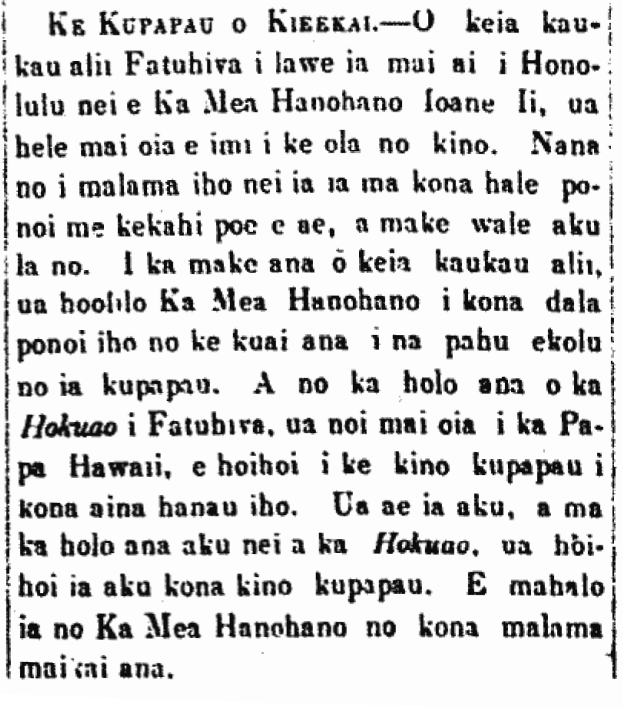
The Body of Kieekai.—This kaukau alii from Fatu Hiva [Fatuhiva] to Honolulu by the Honorable John Papa Ii [Ioane Ii], and he came here in search of health. It was Ii who cared for him at his own home along with some others, and Kieekai died. At the death of this kaukau alii, The Honorable One spent his own money to purchase the three caskets for the body. Being that the Hokuao is on its way to Fatu Hiva, he asked the Hawaiian Board of Missions [Papa Hawaii] to return the body to the land of his birth. It was agreed to, and when the Hokuao left, the body was taken. The Honorable One is appreciated for his fine care.

(Kuokoa, 3/30/1867, p. 2)

Ke Kupapau o Kieekai.

Ka Nupepa Kuokoa, Buke VI, Helu 13, Aoao 2. Maraki 30, 1867.

Mele for Royal Order of Kamehameha by Mrs. Pa, 1925.

HE MELE NO KA AHAHUI KAMEHAMEHA.

Hanohano e ka Hui o Kamehameha,
Lei haaheo nei i ka mokihana,
Aia i ka la’i o Ahukini,
Ua hele a piha lulu ka makani,
Kau aku i ka hope o Maunakea,
E haawi ke aloha ani hainaka,
Hilinai ae ana ma ka palekai,
E nanea malie i ka oneki,
Ulumahiehie i ka ehukai,
Me ka piha hauoli i ka puuwai,
Au aku o ke kai o Kaieie,
A hoea i ka wehi o ke kaona,
Hala ae e ka hale ipukukui,
Halekuke ka uwapo a e pili ai,
Kau aku i ka oto oni ka huila,
Aia ka ilina Iana Hokele,
Ilaila oukou ike iho ai,
I ke ala haaheo a he alaweta,
Ike aku i ka nani me ka maluhia,
Na rumi kapu o ka ona hokele,
Ua nani na hana a ka ahahui,
Ua ai a lawa me ka maemae,
Haina ka puana nona ka lei,
E ola e ka hui o Kamehameha.

Hanohano e ka Hui o Kamehameha,
Lei haaheo nei i ka mokihana,
Aia i ka la’i o ke kaona,
I ka wehi o ka Uakukalahale,
Kaapuniia a puni ke kaona,
Na kihi eha o halealii,
Leiia i ka lei o ka lanakila,
Papahi i ka lei o ka hanohano,
Hanohano na hana a ka ahahui,
A ke Kilauea e hii mai nei,
Hiiia i ke kai a o Mamala,
A Maunakea a e pailaka nei,
Ike maka i ka nani a o ka uwila,
Ka hoku hele o ka Pakipika,
Ua hanaia a ku i ka nani,
Me na waihooluu like ole,
He kinohinohi ke ike aku,
I ke aka o ka wai hoohinuhinu,
Hala ae Daimana Hila mahope,
A he nani Ihiihilauakea,
Au la oukou i ke kai loa,
Aloalo ehukai a o ka moana,
Alo ae o ka Lae o Kalaau,
Kunihi Molokai me Lanai,
Kaulana o Maui no e ka oi,
I oi wale no ia Haleakala,
Mahalo i ka nani o Kahului,
Na hoohiwahiwa a ka ahahui,
Ua lawa ka ikena e a’u lei momi,
Ua ike i na Hono a Piilani,
Heleia i ka loa me ka laula,
Ma na pali Koolau o Maui,
Mahu’i aku ana e ike lihi,
I ka wai kapu mai o Keanae,
E hoi na pua a Kamehameha,
Ke la’i mai nei malino ke kai,
Hookuku au puni Hawaii,
Kauai ka oi o na ailana,
Aina i ka nani me ka maluhia,
Lei hanohano nei i ka mokihana,
Haina ka puana nona ka lei,
E ola e ka hui o Kamehameha.

Hakuia e MRS. PA.

Ka Poli Lauae o Makana.

(Kuokoa, 10/15/1925, p. 2)

HE MELE NO KA AHAHUI KAMEHAMEHA.

Ka Nupepa Kuokoa, Buke LXIV, Helu 42, Aoao 2. Okatoba 15, 1925.

Poisonous seaweed, 1877.

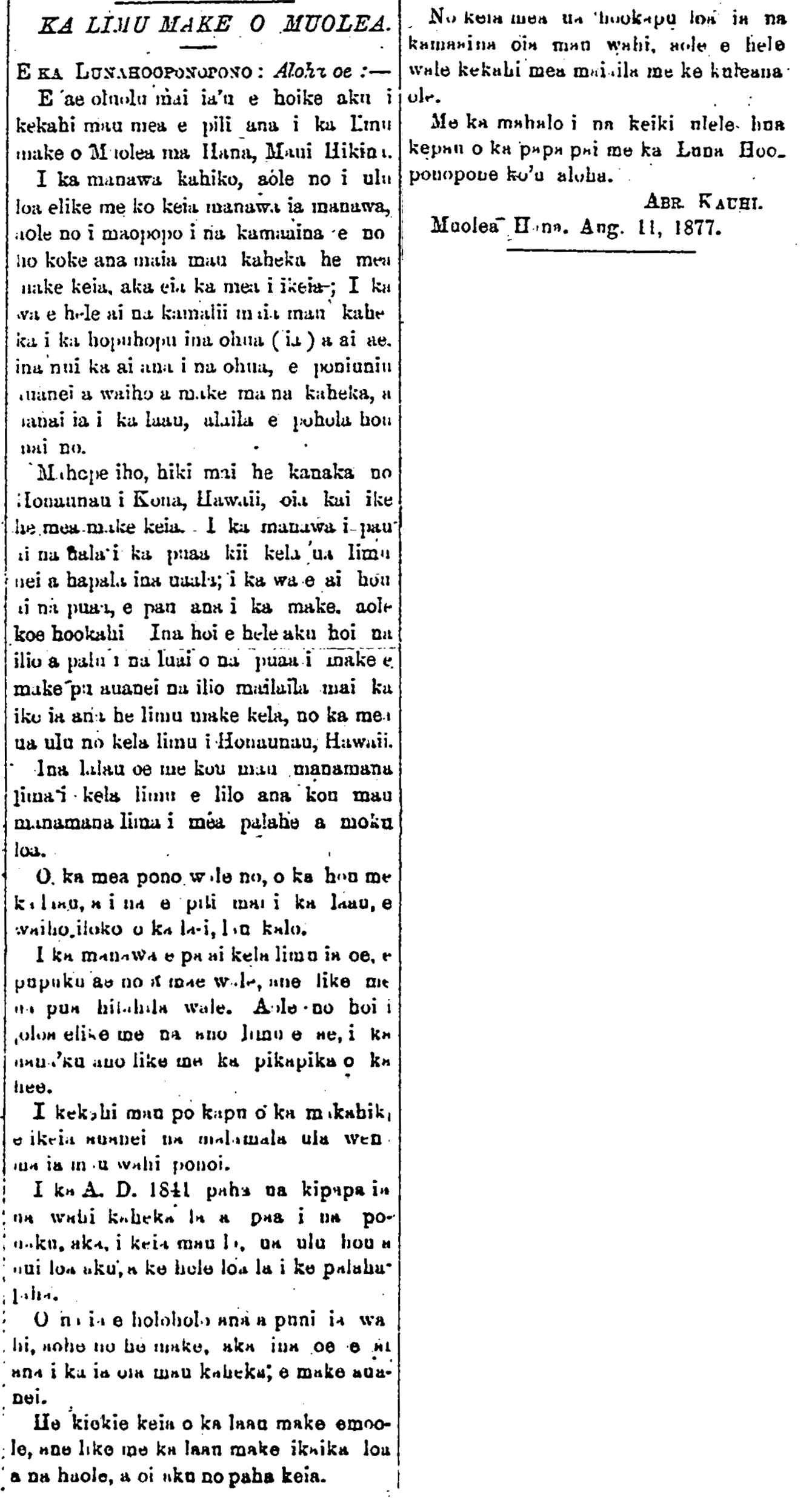
POISONOUS LIMU OF MUOLEA.

Dear Mr. Editor: Aloha oe:—

Please allow me to talk about some matters dealing with the poisonous limu of Muolea in Hana, East Maui.

In ancient times, it did not grow profusely like it does now, and the kamaaina living near those tide pools didn’t know this was poisonous, however, this is what is known; When the children went to those tide pools and gathered the small fish [ohua] and ate them, if they ate a lot of the ohua, they grew dizzy and lay unconscious by the tide pools, and after being given medicine, they revived.

Later, a man from Honaunau in Kona, Hawaii arrived, and it was he that found that this was poisonous. After all the sweet potato was eaten by the pigs, he fetched some of the limu and smeared it over sweet potato and when the pigs ate again, they died, and not one of them lived. If dogs came and licked the vomit of the dead pig, the dogs died as well; it is from this that the limu was known to be poisonous, for that limu grows in Honaunau, Hawaii as well.

If you grab the limu with your fingers, your fingers will rot and fall off.

The proper thing to do is to prod at it with a stick, and if it sticks to the stick, place it in ti leaves or taro leaves [?].

When that limu is touched, it shrinks and wilts, somewhat like sleeping grass [pua hilahila wale]. It is not long like the other limu, but when you look at it, it somewhat resembles the suckers of an octopus.

On some sacred nights of the year, a red light is seen from those places.

In the year 1841 perhaps, those tide pools were paved over with rocks, but these days, they are growing wild again and is spreading.

The fish that go around that place, they don’t die, but should you eat the fish from those tide pools, you will end up dying.

This is a strong poison taking effect immediately, similar to the powerful poisons of the haole, and perhaps even stronger.

For this reason, the locals of that place have restricted access to that place, not allowing anyone without authority to go there.

With appreciation to the typesetting boys of the press and to the Editor goes my aloha.

Abraham Kauhi.

Muolea, Hana, Aug. 11, 1877.

[The image of this article is very hard to read. The original newspapers need to be rescanned before it is too late!]

(Lahui Hawaii, 8/23/1877, p. 2)
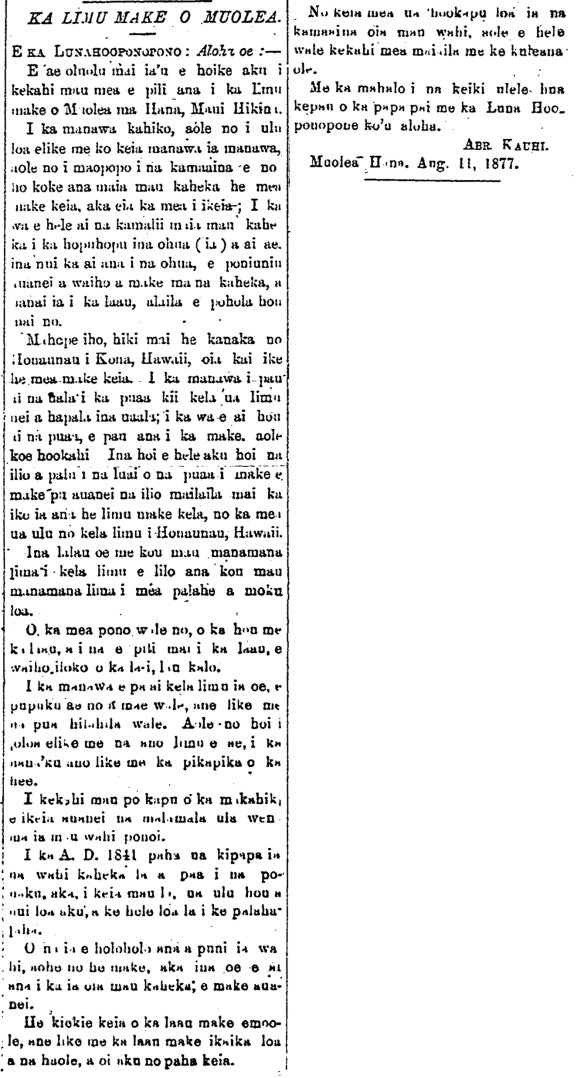
KA LIMU MAKE O MUOLEA.

Ka Lahui Hawaii, Buke III, Helu 34, Aoao 2. Augate 23, 1877.
More on “Prince,” 1924.

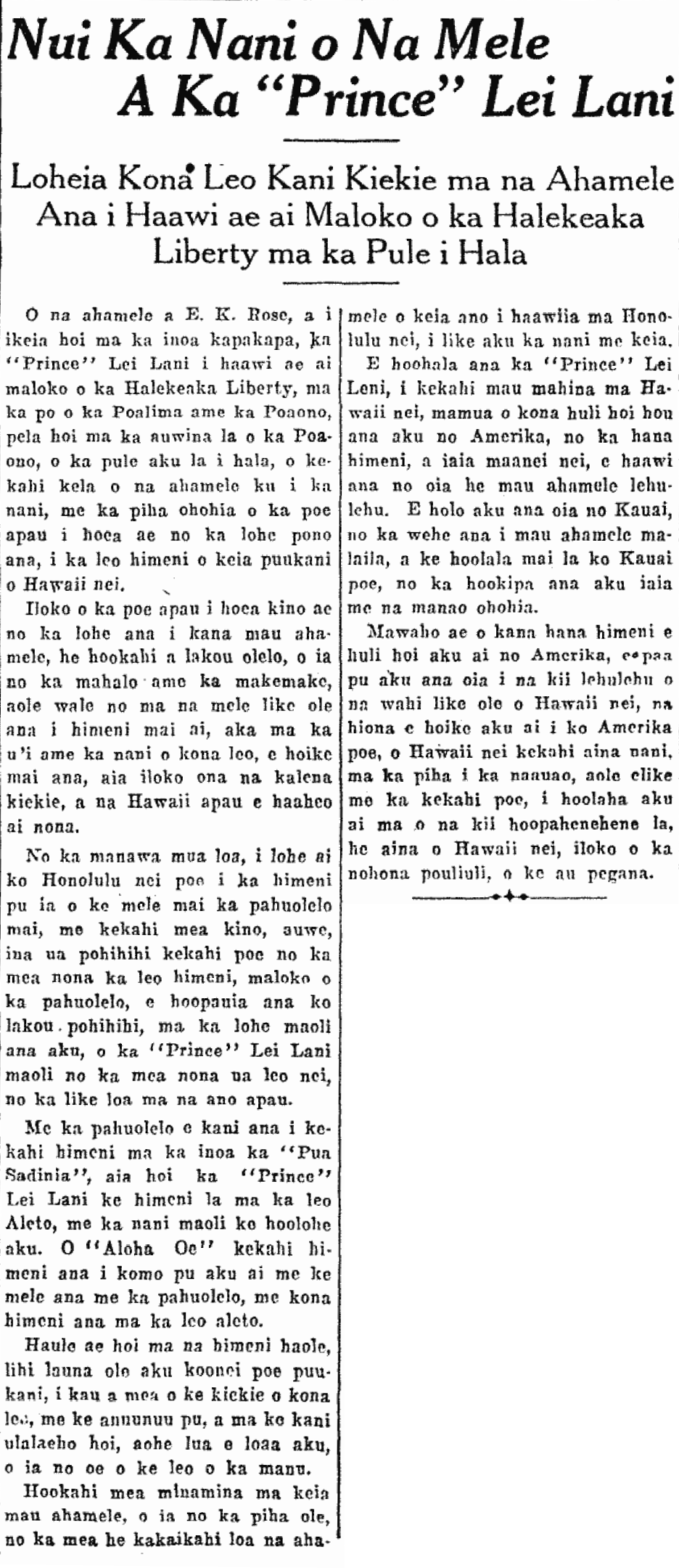
The Songs of “Prince” Lei Lani Were Just Beautiful

His Falsetto Voice Was Heard at the Concerts He Gave in the Liberty Theater Last Week.

The concerts given by E. K. Rose, known by the stage name “Prince” Lei Lani [Leilani], in the Liberty Theater on the nights of Friday and Saturday, and the afternoon of Saturday of this past week, those were some of the most beautiful concerts, filling all those who attended with delight at hearing in person, the singing voice of this musician of Hawaii nei.

Amongst all of the people who attended to hear his concerts, they said but one thing; that being of their appreciation and desire, not just for all of the different mele sung, but for the loveliness and beauty of his voice, showing that within him are the high talents for which all Hawaiians have pride in him.

For the first time, Honolulu’s people heard singing live along with a phonograph [pahuolelo], auwe, if people weren’t clear about who the singer was on the phonograph, this lack of clarity was put to an end by them hearing the real “Prince” Lei Lani’s voice, being that they were the same in every way.

While the phonograph was playing a song called “Pua Sadinia,” “Prince” Lei Lani sang it in Alto, and it sounded beautiful. “Aloha Oe” was another number played on the phonograph while he sang in alto.

The local singers pale in haole songs, and cannot match the high range of his voice along with the modulation, and yodeling; there is no match, like the voice of a bird.

There was one unfortunate thing in the concert, that was that it was not filled, for there are not many concerts of this sort put on here in Honolulu that are as beautiful.

“Prince” Lei Lani will spend a number of months here in Hawaii nei before turning back to return to America to sing, and while he is here, he will be giving many concerts. He’ll be going to Kauai to perform concerts there, and Kauai’s people are planning a reception for him with excitement.

Other than to sing, he is returning to America, taking with him many photographs of all sorts of places here in Hawaii nei, scenes showing the people of America that Hawaii is a lovely place full of intelligence; not as was shown by some people using ridiculing pictures, saying that Hawaii is in the dark of pagan times.

[I wonder where the pictures ridiculing Hawaii were printed, and who it was that did it.

The internet is pretty amazing. Some ninety years later, we can hear Prince Lei Lani singing “Pua Sadinia” and “Aloha Oe”! Mahalo to cdbpdx for putting it up on youtube!!]

(Kuokoa, 4/10/1924, p. 1)

Nui Ka Nani o Na Mele A Ka "Prince" Lei Lani

Ka Nupepa Kuokoa, Buke LXIII, Helu 15, Aoao 1. Aperila 10, 1924.

Voice from the past, 1924.

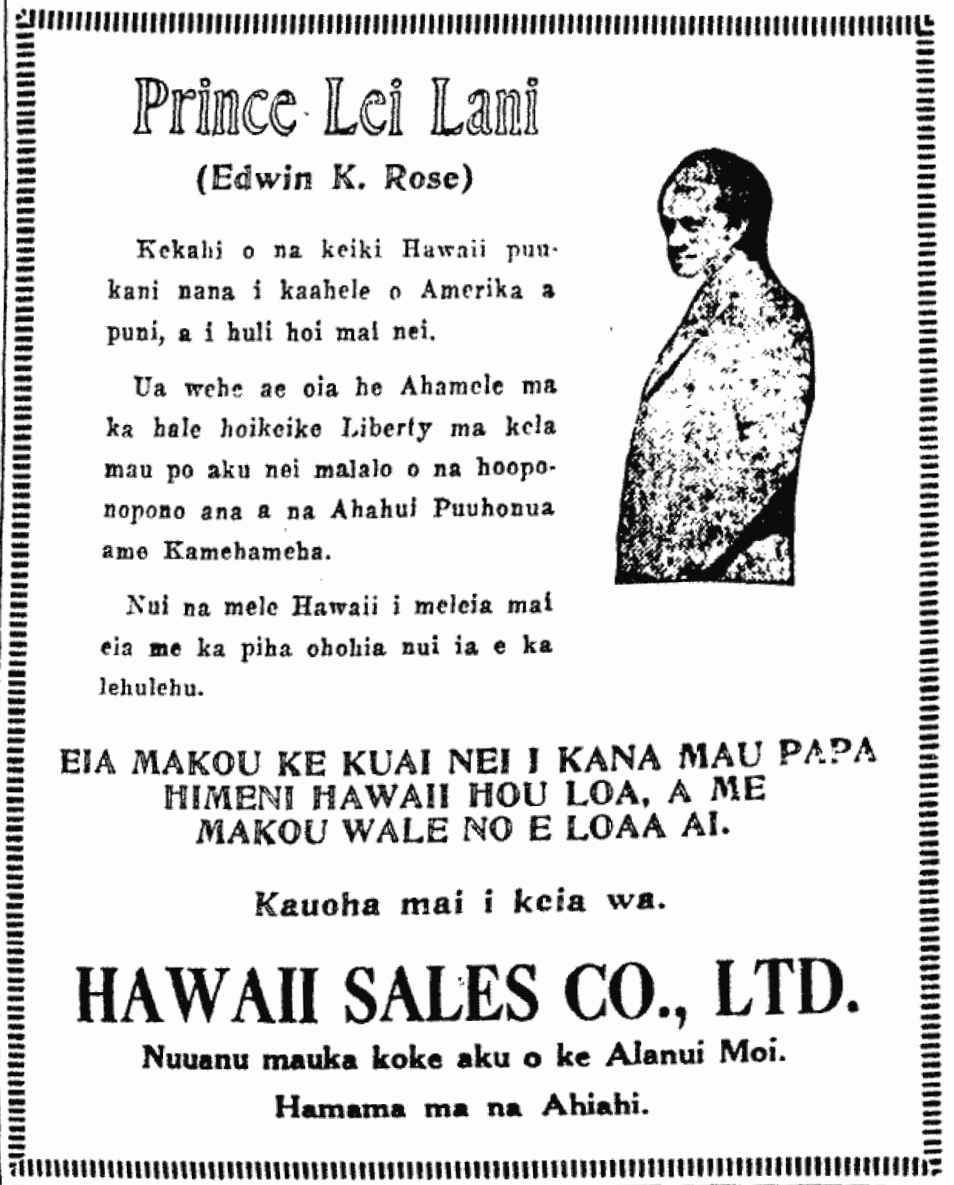
Prince Lei Lani

(Edwin K. Rose)

One of the Hawaiian singers who is touring all over America, and returned home.

He held a Concert at the Liberty Theater the other night organized by the Hawaiian Protective Association [Ahahui Puuhonua] and the Royal Order of Kamehameha [Ahahui Kamehameha].

There were many Hawaiian songs sung by him which were highly acclaimed by the crowd.

WE ARE SELLING HIS BRAND NEW HAWAIIAN RECORDS, AND WE ARE THE ONLY ONES WHO HAVE THEM.

Put in your orders now.

HAWAII SALES CO., LTD.

Nuuanu mauka near King Street.

Open in the Evenings.

(Kuokoa, 4/10/1926, p. 6)

Prince Lei Lani

Ka Nupepa Kuokoa, Buke LXIII, Helu 15, Aoao 6. Aperila 10, 1924.

Honorable Lydia Kamakaeha Paki weds Adjutant General Major J. O. Dominis, 1862.

MARRIED—At the hour of 8 in the evening of Tuesday, the 16th of this month, the Honorable Lydia Kamakaeha Paki married Adjutant General Major J. O. Dominis, at Haleakala, the Residence of the Honorable C. R. Bishop and his Chiefess. The two were married in the Anglican faith.

Present were the King; Her Highness Princess V. K. Kaahumanu; His Highness Prince L. Kamehameha; the Honorable M. Kekuanaoa, the Chiefly Governor of Oahu; Colonel Peter Young Kekuaokalani; there also were the parents of the woman, and the mother of the man, and his cousins.

Rev. Samuel C. Damon was who married them. There was much appreciation for how fine and honorable it was. With the two of them is the aloha of this paper.

[It seems Queen Emma was not present at this wedding. Ka Haku o Hawaii had only passed away a few weeks earlier…]

(Kuokoa, 9/20/1862, p. 3)

MAREIA...

Ka Nupepa Kuokoa, Buke I, Helu 43, Aoao 3. Sepatemaba 20, 1862.

Vital Statistics, 1912.

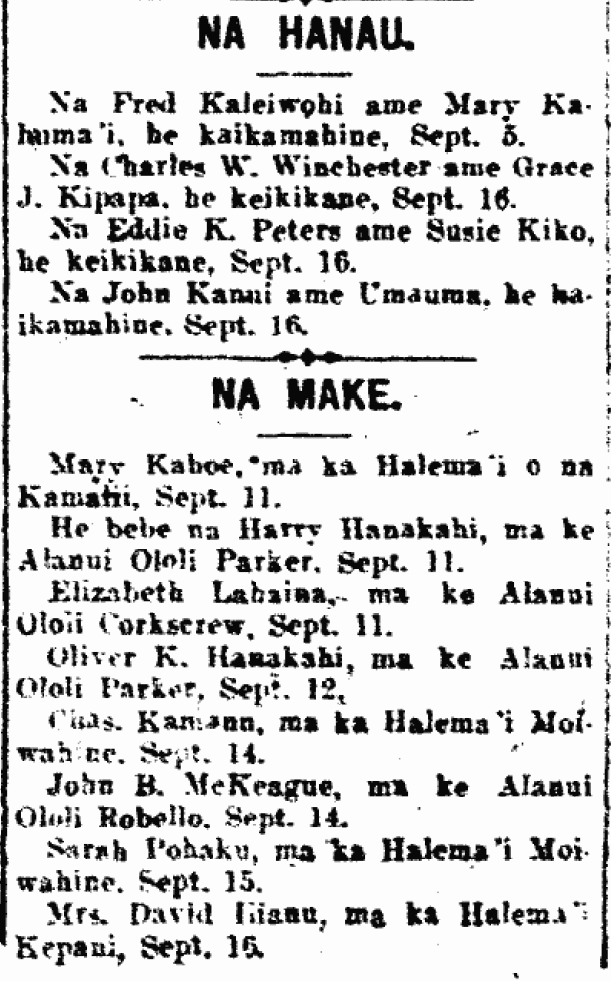
BIRTHS.

To Fred Kaleiwohi and Mary Kahuma’i, a daughter, Sept. 5.

To Charles W. Winchester and Grace J. Kipapa, a son, Sept. 16.

To Eddie K. Peters and Susie Kiko, a son, Sept. 16.

To John Kanui and Umauma, a daughter, Sept. 16.

DEATHS.

Mary Kahoe, at the Children’s Hospital, Sept. 11.

A baby of Harry Hanakahi, on Parker Lane, Sept. 11.

Elizabeth Lahaina, on Corkscrew Lane, Sept. 11.

Oliver K. Hanakahi, on Parker Lane, Sept. 12.

Charles Kamanu, at Queen’s Hospital, Sept. 14.

John B. McKeague, on Robello Lane, Sept. 14.

Sarah Pohaku, at Queen’s Hospital, Sept. 15.

Mrs. David Ilianu, at the Japanese Hospital, Sept. 16.

[There were no Marriage Announcements in this issue.]

(Kuokoa, 9/20/1912, p. 8)

NA HANAU. / NA MAKE.

Ka Nupepa Kuokoa, Buke XLVIII, Helu 38, Aoao 8. Sepatemaba 20, 1912.

Patients of the leprosy settlement present gift to the Waipa Trio, 1922.

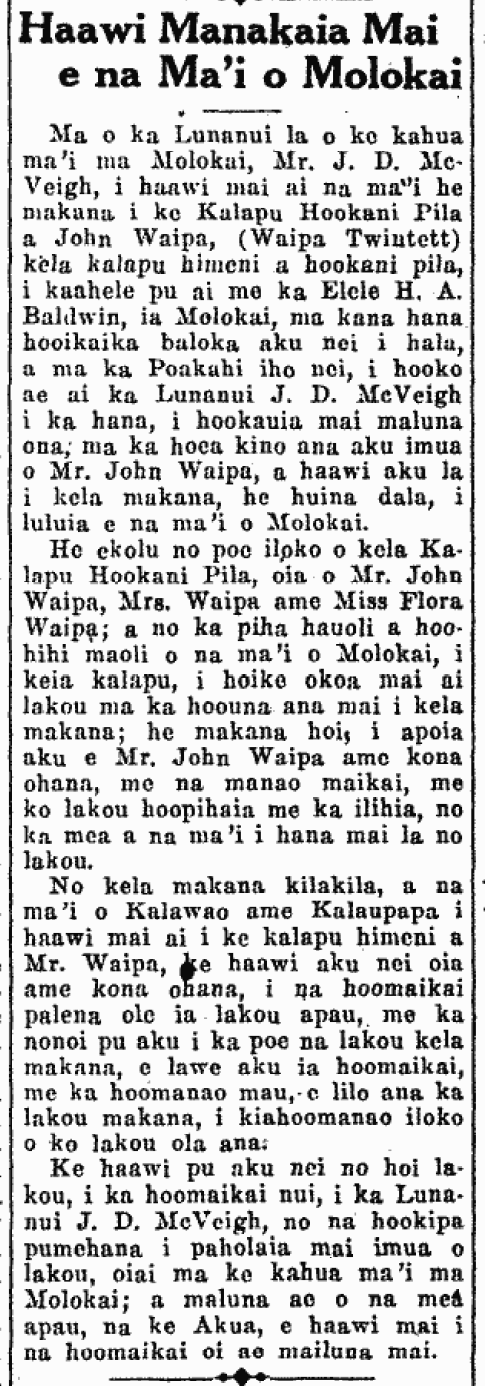
Presented by the Patients of Molokai

By way of the director of the leprosy settlement on Molokai, Mr. J. D. McVeigh, the patients gave a gift to the Band of John Waipa (The Waipa Twintett) [Waipa Trio]; that singing and musical group that travelled with Representative H. A. Baldwin, to Molokai, in his effort to increase voting; and on this past Monday, Director J. D. McVeigh carried out the duty given to him, by him appearing before Mr. John Waipa and presenting him with this gift, a sum of money donated by the patients of Molokai.

There are three people in that band: Mr. John Waipa, Mrs. Waipa, and Miss Flora Waipa; and because of the great joy and admiration that the patients had in the band, they showed this through the sending of this present; the gift was grasped by Mr. John Waipa and his family with pleasure, and they were filled with awe at this act done for them by the patients.

For this esteemed gift given by the patients of Kalawao and Kalaupapa to the singing group of Mr. Waipa, he and his family extend the endless appreciation to all of them, along with their request to all those who gave the gift, to accept their thanks and to always remember that their gift will be something for them to remember throughout their lives.

They also give their great appreciation to Director J. D. McVeigh for the warm hospitality extended to them while they were at the settlement on Molokai; and above all else, it is God who gives his highest blessings from above.

(Kuokoa, 4/28/1922, p. 1)

Haawi Makanaia Mai e na Ma'i o Molokai

Ka Nupepa Kuokoa, Buke LXI, Helu 17, Aoao 1. Aperila 28, 1922.

Another blog to keep an eye on, 2012.

Here is another blog you might want to check out:

Kuamoolelo

Related to our posts this morning of death announcements by Sam M. Nihipali which are very descriptive and seem almost more poetry than prose… Kuamoolelo just posted a number of kanikau, which are mele written at the death of someone dear that one feels much aloha for. From these kanikau you can perhaps get a deeper feel for the emotion the composer felt for the deceased, and also often times detailed biographical information as well.

By any means, check them out and see what you can see.

Lahapa Smith passes away, 1925.

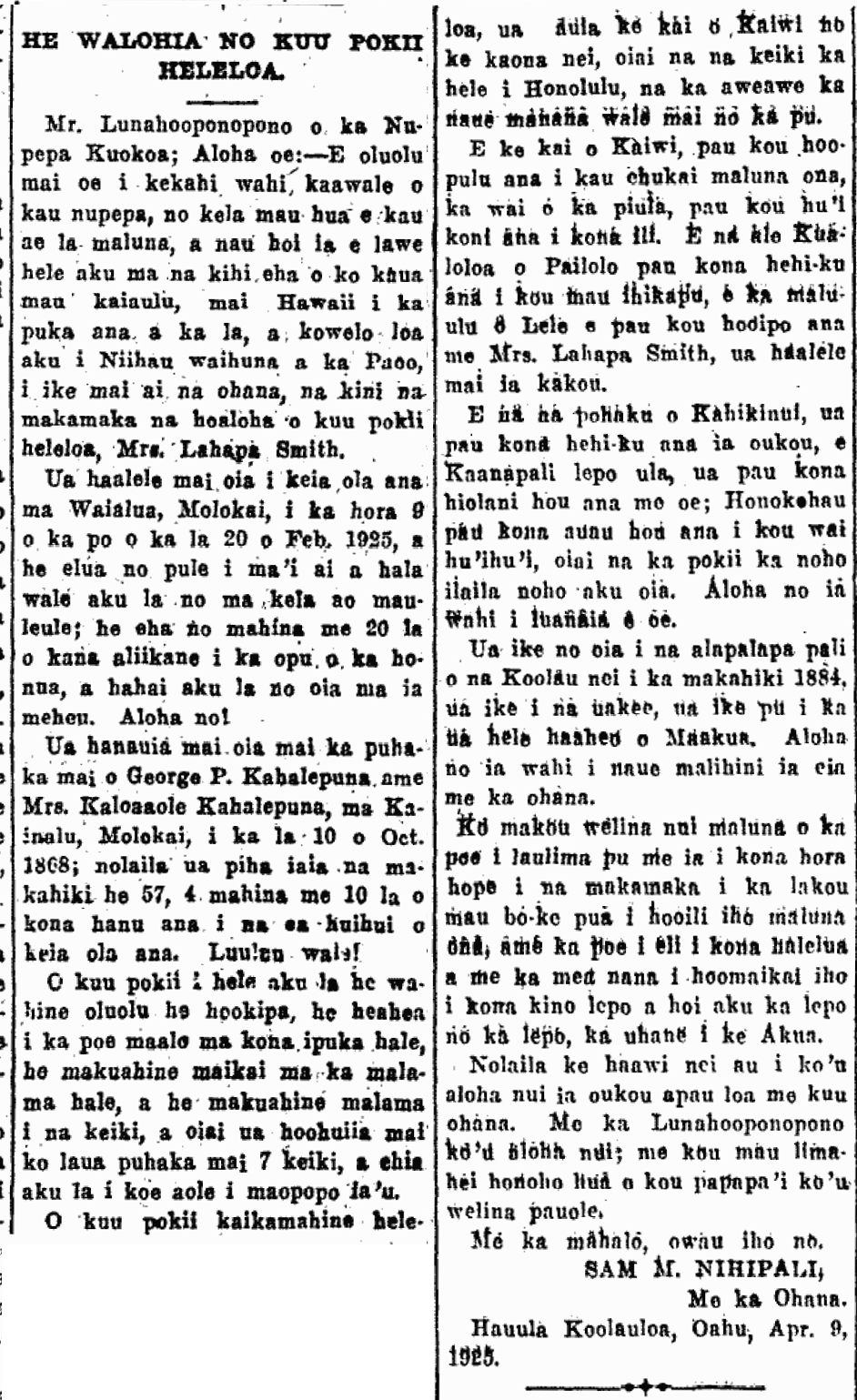
A EULOGY FOR MY YOUNGER SIBLING WHO HAS GONE.

Mr. Editor of Ka Nupepa Kuokoa; Aloha to you:—Please let me have some space in your newspaper for those words above, and you will be the one to take them to the four corners of our commuity, from Hawaii where the sun rises to where it trails to in Niihau with its hidden waters of the Paoo fish; so that the family and the many aquaintances and friends of my lost younger sister, Mrs. Lahapa Smith will know.

She left this life at Waialua, Molokai, at 9 at night on the 20th of Feb. 1935, and she was sick two weeks after which she left to that faint realm; her husband was four months and 20 days in the bowels of the earth, when she followed in his footsteps. How sad!

She was born from the loins of George P. Kahalepuna and Mrs. Kaloaaole Kahalepuna, at Kainalu, Molokai, on the 10th of Oct. 1868; so she had 57 years old, 4 months, and 10 days of breathing the cool air of this life. How depressing!

My younger sister who left was a kind woman, and welcoming woman, she called out to those who passed before her door; she was a fine mother, and took care of the house, and she was a mother who cared for her children; although their loins brought forth 7 children, I don’t know how many still remain.

My younger sister who is gone, she traversed the Kaiwi channel for the town here, because her children came to Honolulu, her connection to them drew her here.

O Kaiwi channel, gone are the days where you drench her with your sea spray, never more will you chill her skin. O great swelled Pailolo, no more will she tread on your sacredness; O ulu shelter of Lele [Lahaina], no more are the days where you will love Mrs. Lahapa Smith; she has left us.

O stones of Kahikinui, no more are the days where she will tread on you; O Kaanapali of red earth, she will no longer lounge with you; O Honokohau, she won’t again bathe in your cool waters; because my younger sister lives lives over there. Aloha to that place where you enjoyed yourself.

She saw the ridged pali of the two Koolau in the year 1884; she saw the uakee [?], and she also saw the proudly travelling rain of Maakua. Aloha to the places traversed as malihini by her and her family.

Our great affection to those people who helped her in her last hours; those friends for their flower bouquets for her; and to the people who dug her grave; those who blessed her body, and the dust to dust, and the spirit to God.

Therefore, I give my aloha to all of you and my family. My great aloha to the Editor; and to your typesetters of your press, my endless affections.

With my thanks, sincerely,

SAM M. NIHIPALI,

And the Family.

Hauula, Koolauloa, Oahu, Apr. 9, 1825.

(Kuokoa, 4/23/1925, p. 5)

HE WALOHIA NO KUU POKII HELELOA.

Ka Nupepa Kuokoa, Buke LXIV, Helu 17, Aoao 5. Aperila 23, 1925.