The Queen and the alalaua, 1917.

QUEEN LILIUOKALANI.

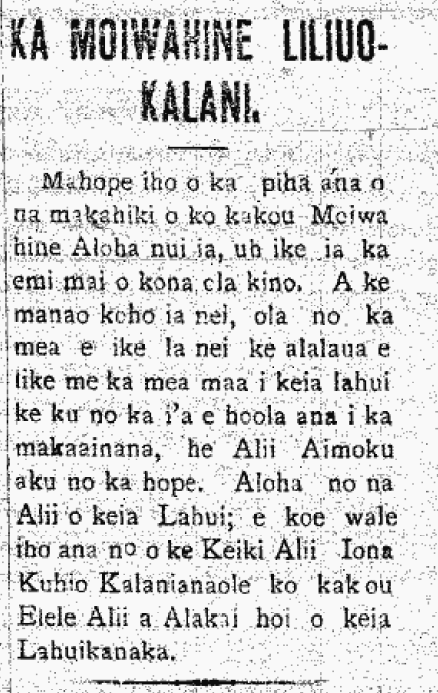
Following the birthdays of our dearly Beloved Queen, her weakening health was noticed. And we guess that this is the reason for the appearance of the alalaua, like what is usual for this lahui, that when this fish to save the people runs, the Ruler will follow. Aloha for the Chiefs of this Lahui; left is Prince Jonah Kuhio Kalanianaole, our Chiefly Representative and the Leader of this People.

(Puuhonua, 9/28/1917, p. 4)

KA MOIWAHINE LILIUOKALANI.

Ka Puuhonua, Buke IV, Helu 39, Aoao 4. Sepatemaba 28, 1917.

Mahalo to Elinor Langer for her comment on trial of participants of the January 6, 1895 Counter Revolution. 1895.

Elinor Langer says:

And it was on January 17, 1895, the second anniversary, that the Republic opened the trials of the people arrested for “treason” in the revolt. Has anyone seen accounts in the Hawaiian papers about what happened on January 24, the day the Queen signed her forced abdication statement? According to “The Friend” (February 1, 1895) “On the 24th, while engaged in the trial of a company of natives, the Court was startled by the fall upon the table around which they sat of a massive bar of plaster from the lofty ceiling [of the Throne Room, where the trials were taking place.] The bar was nine feet long, forming part of a decorative panel. It fell upon the center of the table, precisely fitting the length of it. Col. Whiting had a narrow escape, his face being grazed, although protected by his military hat. The plaster had been loosened by a sharp shake of earthquake the night before.” The Queen signed the statement at 11 a.m. in the rooms directly above –perhaps even at the same time?

[See the original article, “The Story of the Insurrection” in The Friend, Volume 53, Number 2, Pages 9–11. February 1895.

Comment to Writing on the wall, 1894.]

A New Year’s Gift: a Genealogy of Rulers, 1874.

A NEW YEAR’S GIFT.

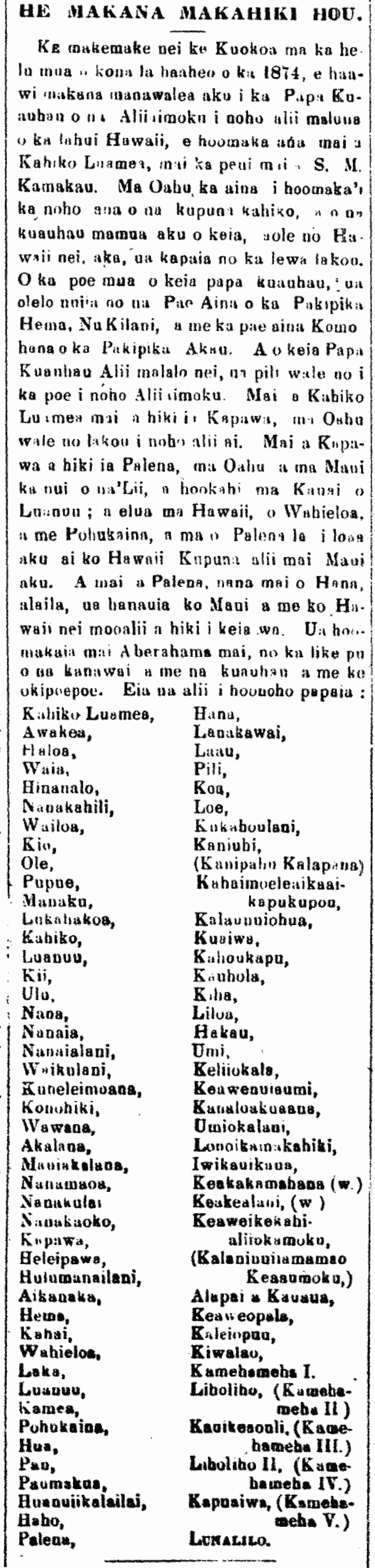
The Kuokoa, on this first issue of its proud days of 1874, wants to gift this Genealogical List of the Rulers over the Hawaian people, starting from Kahiko Luamea, from the pen of S. M. Kamakau. It was upon Oahu that the ancient ones first lived, and the genealogy from before this is not from here in Hawaii, but it is said that they were from the sky [lewa]. The first people in this genealogy, it is widely stated that they are from the Islands of the South Pacific, New Zealand, and the islands to the Western North Pacific. And the listing of Alii Genealogy below just pertains to those who were Aliiaimoku. From Kahiko Luamea to Kapawa, they just ruled on Oahu. From Kapawa to Palena, most of the Alii were on Oahu and Maui; one was from Kauai, Luanuu; and two on Hawaii, Wahieloa and Pohukaina; and from Palena is where Hawaii’s royal Ancestry from Maui come from. And from Palena was born Hana, thereafter Maui’s and Hawaii’s chiefly line have been born until this time. It began from Abraham, being that the laws were the same, the genealogy was the same, and the circumcision was the same. Here are the alii listed out:

Kahiko Luamea,
Awakea [Wakea],
Haloa,
Waia,
Hinanalo,
Nanakahili,
Wailoa,
Kio,
Ole,
Pupue,
Manaku,
Lukahakoa,
Kahiko,
Luanuu,
Kii,
Ulu,
Nana,
Nanaia,
Nanaialani,
Waikulani,
Kuheleimoana,
Konohiki,
Wawana,
Akalana,
Mauiakalana,
Nanamaoa,
Nanakulai,
Nanakaoko,
Kapawa,
Heleipawa,
Hulumanailani,
Aikanaka,
Hema,
Kahai,
Wahieloa,
Laka,
Luanuu,
Kamea,
Pohukaina,
Hua,
Pau,
Paumakua,
Huanuiikalailai,
Haho,
Palena,
Hana,
Lanakawai,
Laau,
Pili,
Koa,
Loe,
Kukahoulani,
Kaniuhu,
(Kanipahu Kalapana)
Kahaimoeleaikaaikapukupou,
Kalaunuiohua,
Kuaiwa,
Kahoukapu,
Kauhola,
Kiha,
Liloa,
Hakau,
Umi,
Keliiokala,
Keawenuiaumi,
Kanaloakuaana,
Umiokalani,
Lonoikamakahiki,
Iwikauikaua,
Keakakamahana (w [wahine])
Keakealani (w),
Keaweikekahialiiokamoku,
(Kalaninuiiamamao Keeaumoku),
Alapai a Kauaua,
Keaweopala,
Kaleiopuu,
Kiwalao,
Kamehameha I.
Liholiho (Kamehameha II),
Kauikeaouli (Kamehameha III),
Liholiho II (Kamehameha IV),
Kapuaiwa (Kamehameha V),
Lunalilo.

[This seems to be a little different from what is seen in the appendix of Kamakau’s “Ruling Chiefs of Hawaii”.]

(Kuokoa, 1/3/1874, p. 2)
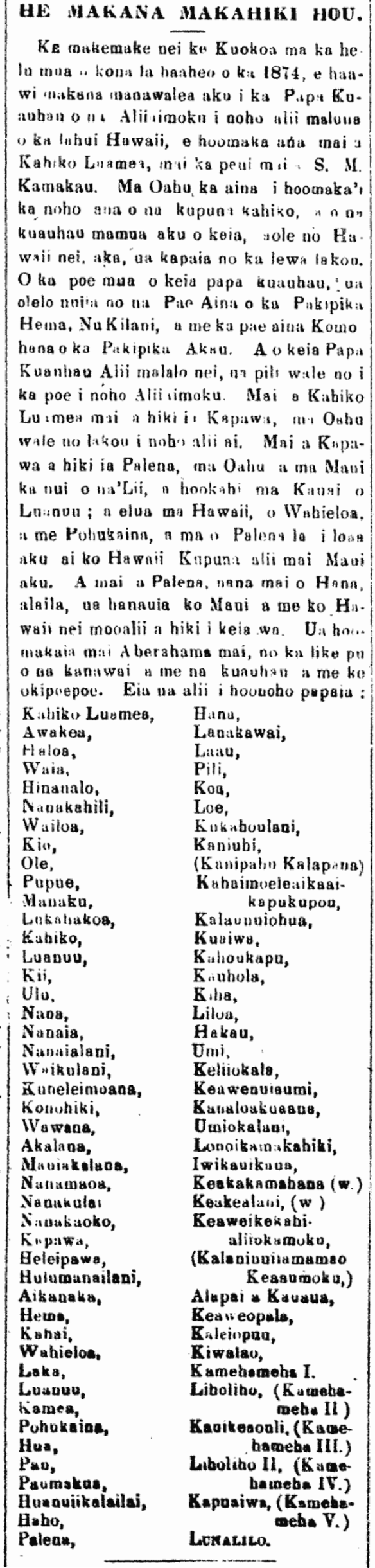
HE MAKANA MAKAHIKI HOU.

Ka Nupepa Kuokoa, Buke XIII, Helu 1, Aoao 2. Ianuari 3, 1874.

More on the Boston, in English, 1893.

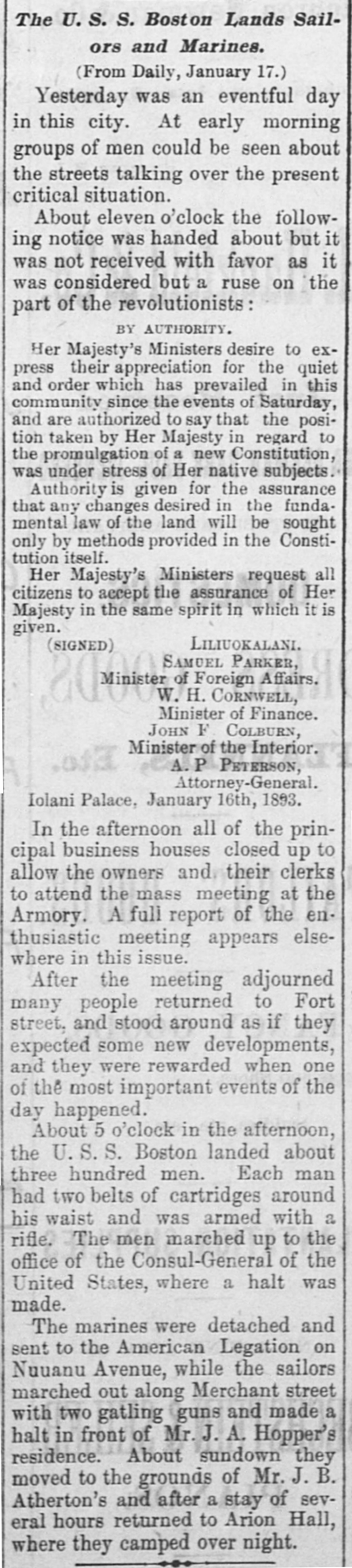
The U. S. S. Boston Lands Sailors and Marines.

(From Daily, January 17.)

Yesterday was an eventful day in this city. At early morning groups of men could be seen about the streets talking over the present critical situation.

About eleven o’clock the following notice was handed about but it was not received with favor as it was considered but a ruse on the part of the revolutionists:

BY AUTHORITY.

Her Majesty’s Ministers desire to express their appreciation for the quiet and order which has prevailed in this community since the events of Saturday, and are authorized to say that the position taken by Her Majesty in regard to the promulgation of a new Constitution, was under stress of Her native subjects.

Authority is given for the assurance that any changes desired in the fundamental law of the land will be sought only by methods provided in the Constitution itself.

Her Majesty’s Ministers request all citizens to accept the assurances of Her Majesty in the same spirit in which it is given.

(SIGNED) Liliuokalani.

Samuel Parker,
Minister of Foreign Affairs.

W. H. Cornwell,
Minister of Finance.

John F. Colburn,
Minister of the Interior.

A. P. Peterson,
Attorney-General.

Iolani Palace, January 16, 1893.

In the afternoon all of the principal business houses closed up to allow the owners and their clerks to attend the mass meeting at the Armory. A full report of the enthusiastic meeting appears elsewhere in this issue.

After the meeting adjourned many people returned to Fort street, and stood around as if they expected some new developments, and they were rewarded when one of the most important events of the day happened.

About 5 o’clock in the afternoon, the U. S. S. Boston landed about three hundred men. Each man had two belts of cartridges around his waist and was armed with a rifle. The men marched up to the office of the Consul-General of the United States, where a halt was made.

The marines were detached and sent to the American Legation on Nuuanu Avenue, while the sailors marched out along Merchant street with two gatling guns and made a halt in front of Mr. J. A. Hopper’s residence. About sundown they moved to the grounds of Mr. J. B. Atherton’s and after a stay of several hours returned to Arion Hall, where they camped over night.

[The “Daily” here mention at the top refers to the Daily Pacific Commercial Advertiser.]

(Hawaiian Gazette, 1/24/1893, p. 6)

The U. S. S. Boston Lands Sailors and Marines.

Hawaiian Gazette, Volume XXVIII, Number 4, Page 6. January 24, 1893.

More on the landing of the Boston, 1893.

OPPOSED.

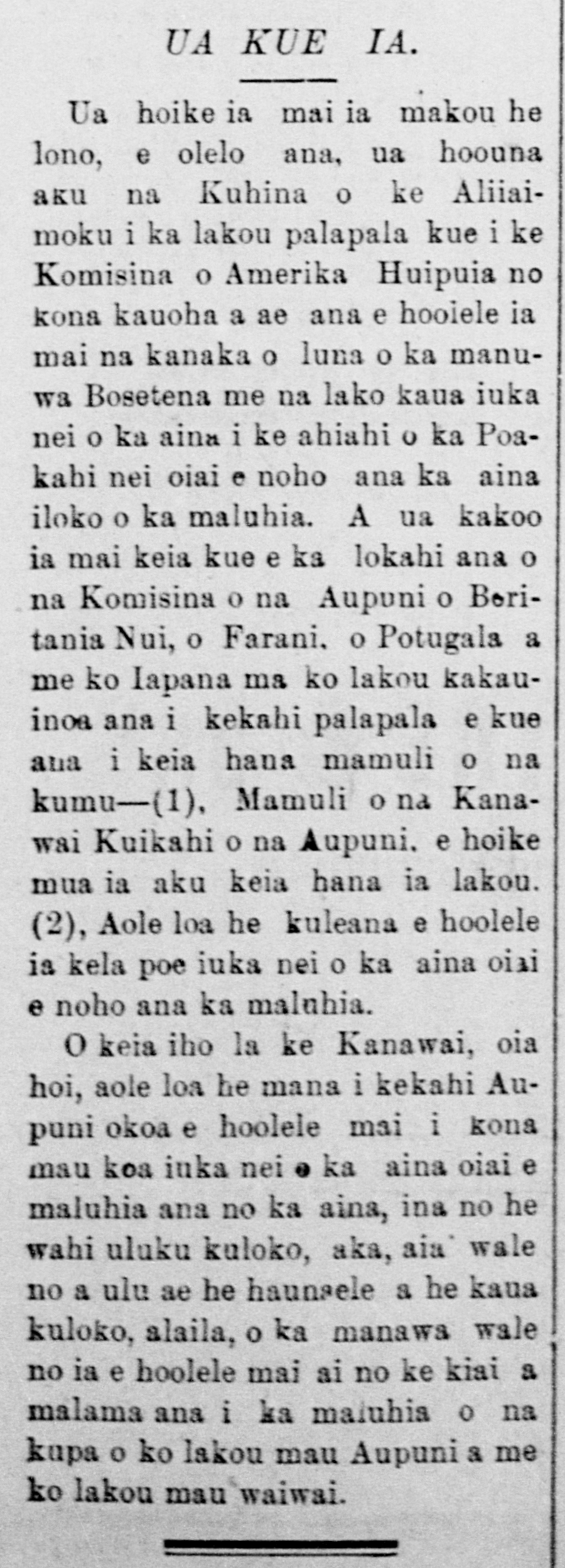
We have received news that the Ministers of the Queen sent their written protest to the Minister of the United States for his ordering the landing of the armed men from the man-of-war Boston on the evening of this Monday notwithstanding that there was peace on land. And this objection was jointly supported by the Commissioners of the Nations of Great Britain, France, Portugal, and Japan, by them signing a document opposing this action over these reasons—(1), Because of the agreement under law between the Nations to give prior notice. (2),  There was no cause to land the troops being that there was peace.

This is the Law, that being there is no other Nation that has any right to land its troops while there is peace; were there internal problems, but only if there was an uprising or a civil war, only then could there be troops landed to watch over and protect the safety of their citizens as well as their property.

(Hawaii Holomua, 1/18/1893, p. 3)

UA KUE IA.

Hawaii Holomua, Buke III, Helu 141, Aoao 3. Ianuari 18, 1893.

More on the Boston, 1893.

[Excerpt from the article: “OVERTHROW IN HAWAII NEI: The Queen Attempts to Push a New Constitution”]

At perhaps 5 oʻclock in the afternoon, the American warship Boston [Bosetona] landed its officers and sailors who were armed. When they came ashore, the marines were split up to go and guard the residence of the American Minister Stevens on Nuuanu Avenue, and the American Consulate on Merchant Street, and the sailors were sent to King Street and stood before the residence of J. A. Hopper, and later they were sent to the residence of Mr. J. B. Atherton. They stayed there for some time, and then all came back and slept in Arion Hall [Ariona Holo] makai of the Opera House. They are still on shore to the present.

(Kuokoa, 1/21/1893, p. 2)

I ka hora 5 paha o ke ahiahi...

Ka Nupepa Kuokoa, Buke XXXII, Helu 3, Aoao 2. Ianuari 21, 1893.

Coverage of the landing of the USS Boston, 1893.

The American Troops Come Ashore.

Without knowledge of the Government, and regardless of the agreement of the American Minister that the soldiers from the warship would not come ashore, being that the Government was prepared to uphold the peace; the American Minister ordered the soldiers of the Boston to to take control. This is an apparent act of aggression, and if that nation learns of the truth of this act by its official, it will be grounds for him to be condemned.

[This article and the following are coverage of the landing of the U. S. S. Boston 120 years ago today by different newspapers. Just as we see today, back then there was different coverage depending on what you read.]

(Leo o ka Lahui, 1/17/1893, p. 2)

Ua Lele Mai na koa Amerika.

Ka Leo o ka Lahui, Buke II, Helu 624, Aoao 2. Ianuari 17, 1893.

Competing rallies, 1893.

O HAWAIIAN LAHUI!

Today, there is a rally being called by the Missionaries of the Reformist Party [Poai Hoomaemae] and those who favor them, at Manamana, with the intent to bring harm to the Queen for Her aloha she has for the lahui, in Her proclaiming a new Constitution; by ending Her reign and making this nation a republic. Therefore, patriots, those born of this land, stand strong behind this nation; there shall not be a single true Hawaiian who will participate in this gathering, should they be invited. All of you true Hawaiians, let us stand behind our Sovereign and give our lives for the rights of our Queen and peace over the land. Those citizens who love their alii are called to join together to march straight to the rally fronting the Opera House [Hale Mele Hou] at 2 o’clock in the afternoon. With one heart of aloha and breasts side by side all across the land, you descendants of Kamehameha.

(Leo o ka Lahui, 1/16/1893, p. 2)

E KA LAHUI HAWAII!

Ka Leo o ka Lahui, Buke II, Helu 623, Aoao 2. Ianuari 16, 1893.

King Kalakaua gifts some 200 kii¹ to the National Academy of Sciences. 1887.

A Gift from the King.

The alii, the King, sent a number of beautiful pictures [kii] and old godly images [akua kii] of Hawaii to the hands of Mr. F. L. Clarke² in San Francisco, a gift from Him to the National Academy of Sciences [? ke kula ao Akeakamai o ia Repubalika]. There were a great many images sent which are well attested to as seen in the old accounts written by the great explorer Captain Cook and the faint recollections of those who have slight knowledge of that era.

The gift of the King was greatly appreciated and it was accepted with much thanks. When Queen Kapiolani arrived in San Francisco, she met with Mr. F. L. Clarke, the representative sent for this gift. There were two hundred or more images, from images that were printed on paper, to wooden idols. It’s been heard that they will go all the way to the city of Paris for the great exposition to be held next year.³

¹”Kii” refers to any image or representation of something, whether it be printed on paper, painted on canvas, carved out of wood, or cast in metal.

²See Clarke’s short history of Hawaii, “Hawaii’s Real Story,” which appeared in The Forum, July 1900, pp. 555–565.

³Exposition Universelle, 1889. See “Catalogue of the Hawaiian Exhibits at the Exposition Universelle, Paris, 1889.” by John A. Hassinger, Department of the Interior.

[Does anyone know of what happens to all of this?]

(Kuokoa, 5/14/1887, p. 2)

He Makana mai ka Moi aku.

Ka Nupepa Kuokoa, Buke XXVI, Helu 20, Aoao 2. Mei 14, 1887.

Pauahi and Likelike and the edible mud of Kawainui, 1872.

[Found under: “LOCAL NEWS”]

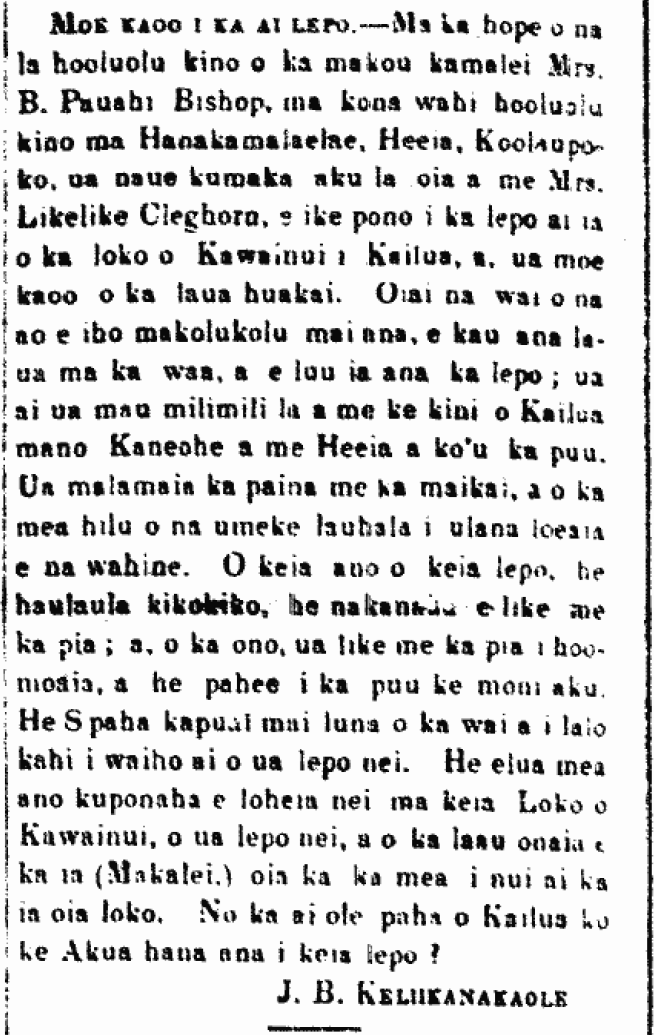
Excursion to eat the mud.—During the most recent days of rest and relaxation of our royal one, Mrs. B. Pauahi Bishop, at her vacation place, Hanakamalaelae, Heeia, Koolaupoko, she and Mrs. Likelike Cleghorn went to see for themselves the edible mud of the pond of Kawainui in Kailua, and they formed an excursion. While precipitation from the clouds fell heavily, the two of them boarded a canoe and the mud was dove for; the beloved ones, as well as the multitudes of Kailua, Kaneohe, and Heeia ate heartily. The feast went nicely and the attractive items there were the pandanus-frond [lauhala] bowls that were woven expertly by the women. The characteristics of this mud is that it is speckled pink and gelatinous like pia; it’s taste is like cooked pia and it is so smooth going down. It is perhaps 8 feet to the bottom from the surface of the water where this mud is found. There are two amazing things heard of in relation to this Kawainui Pond: this mud, and the fish entrancing stick (Makalei) which was why the number of fish increased in the pond. Maybe it is because Kailua had no food that God made this mud?

J. B. Keliikanakaole

[Does anyone know if Hanakamalaelae is documented on any map? And also does anyone have information on J. B. Keliikanakaole?]

(Kuokoa, 10/26/1872, p. 2)

Moe kaoo i ka ai lepo.

Ka Nupepa Kuokoa, Buke XI, Helu 43, Aoao 2. Okatoba 26, 1872.