More on Aberahama Kaikioewa Palekaluhi, 1912.

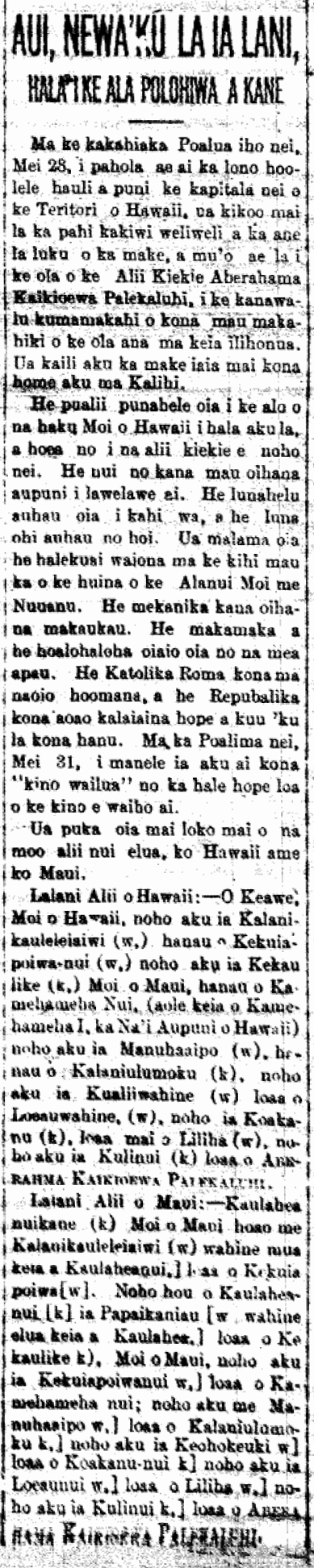
THAT HEAVENLY ONE PASSED BY, STAGGERED AWAY,

GONE ON THAT DARK PATH OF KANE

On the morning of this past Tuesday, May 28th, the shocking news spread all over the capital of the Territory of Hawaii, that the terrifying sickle of the angel of death was stretched out and cut short the life of the High Chief Abraham Kaikioewa Palekaluhi, at eighty-one years of living on this earth. Death took him from his home in Kalihi.

He was a favorite chiefly descendant in the court of the past Kings of Hawaii, all the way until the high chiefs living now. He had many positions in the government. He was a tax assessor at one point, and a tax collector as well. He managed a bar at the corner mauka of the corner of King Street and Nuuanu Avenue. He was a skilled mechanic. He was a friend and a ally of all. He was a true believer in the Roman Catholic faith, and he was in the Republican party until his last breath. This Friday, May 31st, his remains [kino wailua] was carried to the last abode where his body would be laid.

He descended from two royal lineages, from Hawaii and from Maui.

Hawaii Island Lineage:—Keawe, the King of Hawaii, “wed” [noho] with Kalanikauleleiaiwi (f) and Kekuiapoiwanui (f) was born, who wed Kekaulike (m), the King of Maui, and Kamehameha Nui was born (which was not Kamehameha I, Ka Na’i Aupuni of Hawaii), who wed with Manuhaaipo (f) and Kalaniulumoku (m) was born, who wed Kualiiwahine (f) and born was Loeauwahine (f), who wed Koakanu (m), and Liliha (f) was born, who wed Kulinui (m) and Aberahama Kaikioewa Palekaluhi was born.

Maui Island Lineage:—Kaulaheanuikane (m), King of Maui wed [hoao] with Kalanikauleleiaiwi (f), which was his first wife, and Kekuiapoiwa (f) was born. Kaulaheanui (m) married again to Papaikaniau (f), his second wife, and born was Kekaulike (m), the King of Maui, who wed Kekuiapoiwanui (f), and born was Kamehameha Nui, who wed Manuhaaipo (f), and born was Kalaniulumoku (m), who wed Keohokeuki (f) and born was Koakanu Nui (m), who wed Loeaunui (f), and born was Liliha (f), who wed Kulinui (m), and born was Aberahama Kaikioewa Palekaluhi.

(Aloha Aina, 6/1/1912, p. 1)

AUI, NEWA'KU LA IA LANI, HALA I KE ALA POLOHIWA A KANE

Ke Aloha Aina, Buke XVI, Helu 22, Aoao 1. Iune 1, 1912.

Aberahama Kaikioewa Palekaluhi passes away, 1912.

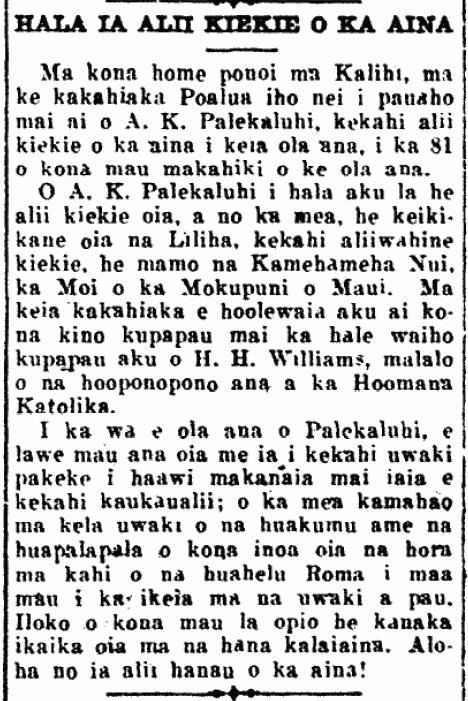
THAT HIGH CHIEF OF THE LAND HAS GONE.

At his residence in Kalihi, on this past Tuesday morning, A. K. Palekaluhi, one of the high chiefs of this land grew weary of this life, at 81 years of age.

A. K. Palekaluhi, who died, was a high chief, as he was a son of Liliha, a high chiefess, a descendant of Kamehameha Nui, the King of the Island of Maui. On this morning, there will be a funeral over his body from the mortuary of H. H. Williams under the administration of the Catholic faith.

While Palekaluhi was living, he always carried with him a pocket watch given to him as a present by a kaukau alii; the amazing thing about that watch was that the initials and letters of his name were the hours in place of the Roman numerals you normally see on all watches. During his youth, he had much power in politics. Greatly loved is that native chief!

[Notice how this has much more information than just what was given in the Vital Statistics column in the same issue of Kuokoa.]

(Kuokoa, 5/31/1912, p. 4)

HALA IA ALII KIEKIE O KA AINA

Ka Nupepa Kuokoa, Buke XLVIII, Helu 22, Aoao 4. Mei 31, 1912.

Pauli K. Hosea Iwiula, 1912.

My Beloved Husband Has Gone, Undoing Our Bond

PAULI K. HOSEA IWIULA.

O Kuokoa Newspaper, Aloha to you:—Please extend your patience and allow me space in one of your columns for my parcel of my parent in my youth, and perhaps many of our friends will see it, and our companions in the Lord living from where the sun rises at Kumukahi all the way to where it shimmers into the sea of Lehua.

Pauli Kaoleiokukaiakauilani Hosea Iwiula was born in Kamoiliili¹, Oahu, on the 26th of June, 1862, from the loins of Iwiula (m) and Kapolei (f); according to the history of Iwiula, he was a descendant of the chiefly family of Kamalalawalu of Maui, and of kaukau alii rank in the court of the fathers of kings [Makualii, Makua Alii], Kekuanaoa and Kanaina, and the monarchs of the time; and the line related to Pauahi Kaoleioku Hosea Iwiula’s mother, that being Kapolei, she was closely related to the chiefly blood of Kekaulike Nui of Molokai, and being that Molokai is where Kapolei (f) was born, it is believed by the locals here in Kamoiliili that Hosea Iwiula is a chief for whom this eulogy is for.

While Kapolei was young, following the death of Kahuloa, her first husband, she married the aforementioned Iwiula. At that time, Kapolei’s was regularly a singing teacher for the young chiefly women of those days. And Kamoiliili’s handsome prince and gentleman of the time was Pauli Kaoleioku, the first born of the alii Haumea of the serene lands of Ehu, the land where water lies in the face of the cloud banks [epithets for Kona, Hawaii]. And as what happens when people grow up, there is a craving for the great fish that passes before one’s eyes, and that is perhaps why Kapolei and Pauli Kaoleioku were mixed up together, and Hosea was conceived, a son from the loins of Kapolei, and thus Hosea Iwiula was said to be a child of Pauli, and an alii.

During the days when we lived as man and wife, he became a parent to me, and so also me for him. My dear husband was very skilled in singing, and it was he who always lead the Sunday School classes of Kamoiliili for almost thirty or more years, and he was the elder [luna kahiko] of the Kamoiliili Church for almost twenty-four years and also is a long-time member of the Kawaiahao Church, then he left that position in the hands of Hiram Kaaha who is still there now. Hosea was a member of the leaders of Kawaiahao Church from his branch church of Kamoiliili. During the days when he was the leader of the Sunday School for Kaawili, he assisted his Sunday School students immensely, by clothing them with their uniforms, shoes and hats; he helped the children a lot.

I was joined with him on the 16th of January, 1882, at Kamoiliili, and we had ten children, and six of them are still living: one daughter and five sons; and four of them have gone before and he has gone in search to be with them.

On Tuesday, the 25th of January, he went to Kauai for the building of the home of Sam Kaeo, the Kauai county attorney, which he would be painting; and in the last week of December, the 29th, he returned to Kamoiliili, and joined in to lead the Sunday School class of Kamoiliili at the last quarterly congregational convention of 1911, and on January 25, he went back to Nawiliwili where his job was, and there after a few weeks began a sickness in his body, and it progressed until he passed from me in that unfamiliar land, on April 29, 1912, and he and I travelled over the great Kaieie Channel for here in Honolulu aboard the Malulani on the 30th of April, and my beloved lei, my husband was left at the funeral home of M. E. Silva, and on the following Thursday, he was carried to Kamoiliili, and within this church where the two of us along with the friends of this place would always gather to worship God, his funeral service was held and he was returned to the place of all men, and the saying was fulfilled: “Man goes to his eternal home, and the spirit returns to its maker.” For “He gave and He hath taken away, blessed be the name of Jehovah.”

O Lililehua Rain of Palolo, you shall no more buffet the cheeks of my beloved; and you as well, O Kuahine Rain which treads upon the fringes of the lehua of Manoa, you will no more soak him and his lashes; O Royal Capitol of Honolulu, he shall not see your fairness; and O Shores which I was with my beloved, your rocky banks will never again be glided over by his loving feet, and O Seas of Kaalawai and Keauau where me and my loving husband were as one, you will not see him again passing by with me.

Alas, there is only love for my husband of my youth, my parent of my uneducated days. I am yours, O My Beloved, that did [lueuele?], wandering the streets in tears.

Me with sorrow,

MRS. RAHELA [Rachael] HOSEA.

Kamoiliili, May 11, 1912.

¹Kamoiliili is known today generally as Moiliili.

[I have found no other usages of the word “lueuele”. Unless the newspapers are accurately typescripted, we won’t know if lueuele is a typo, or if it is indeed a word. The more examples of usages and context found, the clearer the meaning of the word will be. Does the acceptance of inaccurate typing indicate that these words are not important?]

(Kuokoa, 5/17/1912, p. 4)

KUU ALOHA HE KANE UA HALA, UA WEHE MAI I KA MAUA PILI

Ka Nupepa Kuokoa, Buke XLVIII, Helu 20, Aoao 4. Mei 17, 1912.

More coverage on Liliuokalani’s baptism into Anglican Faith.

The Queen was baptized and there was a laying on of hands that morning by the Head Bishop of Honolulu, in Saint Andrew’s Cathedral, during a special prayer service held at 6:30. Through this, she became a brethren of that Church. The baptismal font was bedecked with flowers and greenery.

(Makaainana, 5/18/1896, p. 8)

Ua bapetizoia a kaulimaia ke Aliiaimoku...

Ka Makaainana, Buke V—-Ano Hou, Helu 20, Aoao 8. Mei 18, 1896.

Liliuokalani and the Anglican Church, 1896.

Liliuokalani Becomes a Member of the Anglican Church.

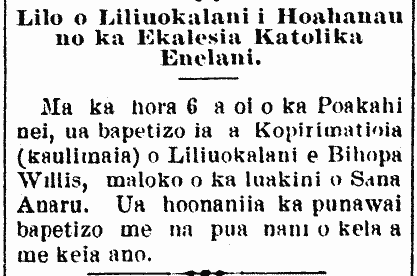
At 6 o’clock or so on this Monday, Liliuokalani was baptized and there was a laying on of hands (Kopirimatio) by Bishop Willis, in St. Andrew’s Cathedral. The font was festooned with flowers of all sorts.

[We found this small mention about Liliuokalani’s baptism because of response by Corrine Chun Fujimoto on yesterday’s post about the Anglican Church in Hawaii!

Also, can help me with the word that “Kopirimatio” comes from?]

(Kuokoa, 5/22/1896, p. 2)

Lilo o Liliuokalani i Hoahanau no ka Ekalesia Katolika Enelani.

Ka Nupepa Kuokoa, Buke XXXV, Helu 21, Aoao 2. Mei 22, 1896.

Kamehameha Statue, 1882.

[Found under: “LOCAL NEWS”]

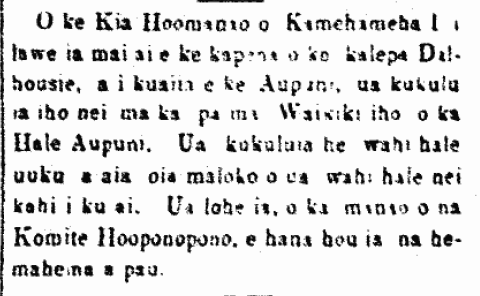
The Kamehameha I Statue brought by the captain of the clipper ship Dalhousie [Earl of Dalhousie], and purchased by the Government, was set up on the Waikiki side of the grounds of the Government Building. A small structure was built and the statue stands within it. It is heard that the plan of the Managing Committee is that all the flaws be redone.

(Kuokoa, 5/6/1882, p. 3)

O ke Kia Hoomanao o Kamehameha I...

Ka Nupepa Kuokoa, Buke XXI, Helu 13, Aoao 3. Mei 6, 1882.

Another Wooden Kii found, 1868.

Akua Kii of Kalia.

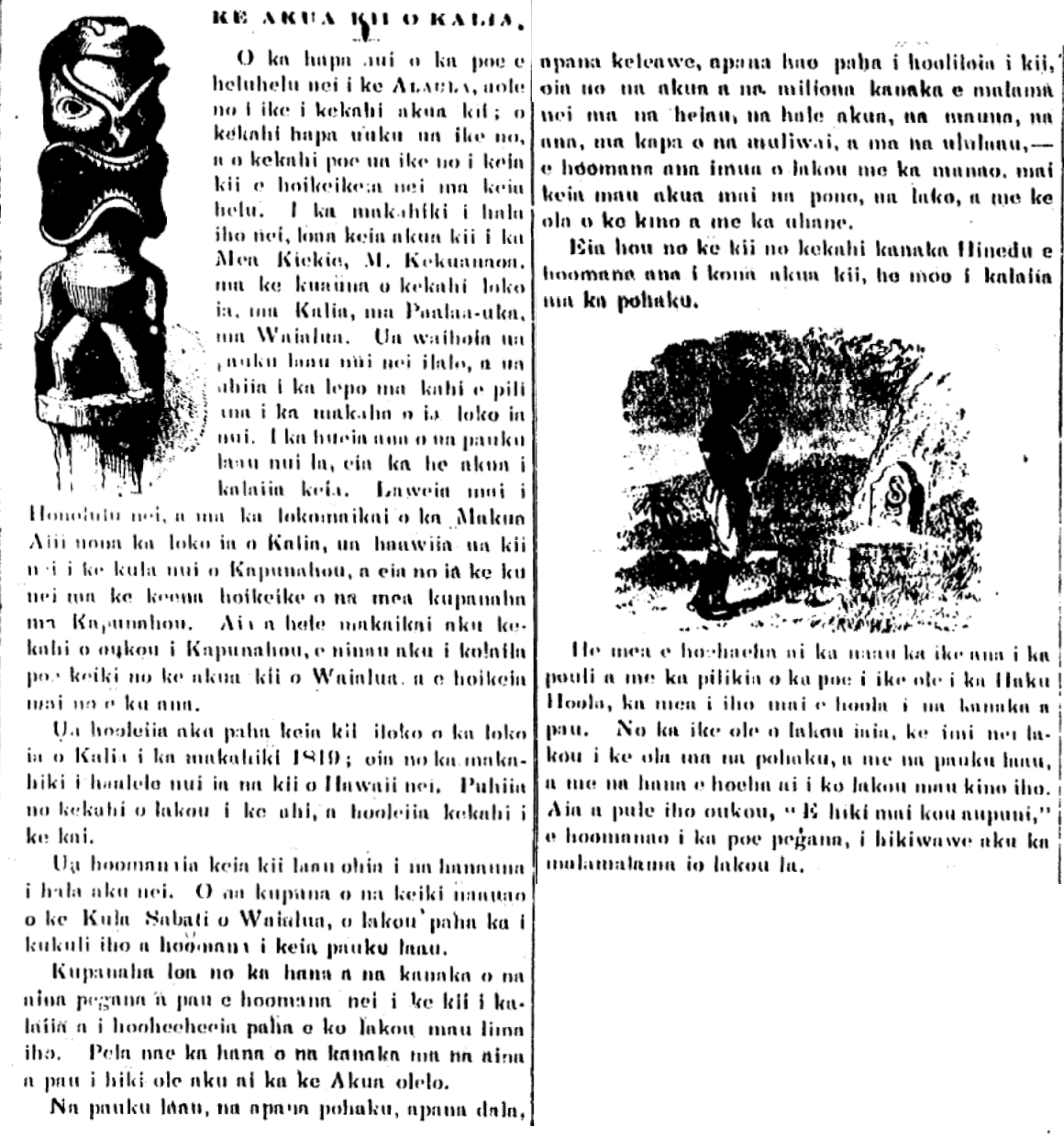
Most of the people reading Ke Alaula have not seen an akua kii, but a small fraction have seen one, and some of you saw this image that is shown here in this issue. Last year, this god idol was found by the Honorable M. Kekuanaoa on the banks of a fish pond at Kalia in Paalaa Uka in Waialua. That large piece of wood was set down and covered with soil near the sluice gate of that large fish pond. When that big piece of wood was unearthed, lo and behold, it was a carved god. It was brought to Honolulu nei, and through the goodwill of the Alii Elder who owns Kalia fishpond, that kii was given to the college of Kapunahou [Punahou], and there it stands in the exhibition room of curiosities at Kapunahou. When some of you go to visit Kapunahou, ask the children there about the kii from Waialua, and it will be shown to you where it stands.

This kii was probably thrown into the pond of Kalia in the year 1819; that is the year when there was the kii of Hawaii nei were greatly abandoned. Some of them were burnt in fire and some were thrown into the sea.

These ohia wood images were worshiped by previous generations. The kupuna of the educated children of Waialua Sunday School were probably those that knelt down and worshiped this piece of wood.

How astonishing are the actions of the people of all of the pagan lands, who worship idols that are carved or molded by their own hands. That is how all lands are where the word of God has not reached.

Pieces of wood, fragments of rock, chunks of silver, chunks of metal, or perhaps chunks of iron turned into images—those are the gods cared for by millions of people, in heiau, houses of god, mountains, caves, banks of rivers, and in forests; they worship before them thinking that from these gods come well being, wealth, and life in body and spirit.

Here also is a picture of a Hindu man worshiping his godly image; it is a snake carved into a rock.

This is something that pains the heart to see the darkness and trouble of those that don’t know of the God the Savior, the one who came down to save all man. Because they don’t know him, they seek salvation from rocks and pieces of wood and from actions that hurt their very own bodies. When you pray, “Thy kingdom come,” remember the pagans so that the light reaches them quickly.

[Could this Akua Kii be the one now at the Bishop Museum which was found in Waialua and presented to Punahou?]

(Alaula, 1/1868, p. 39)

KE AKUA KII O KALIA.

Ke Alaula, Buke II, Helu 10, Aoao 39. Ianuari, 1868.

Here you’d be looking at a long strings of @@@@@@@@@ instead of information on Queen Kapiolani and Puna. 1876.

NEWS ITEMS FROM PUNA.

Please let us shake hands, your Captain and I, and insert my small contribution in an empty space of your delicate body.

On the evening of the 12th of Nov., Queen Kapiolani and her younger sister Kapooloku, Hon. L. Kaina, and the other companions of the Queen left Hilo Hanakahi and the Kanilehua rain. And the land travelling canoes that evening were pointed towards the seas of the rustling pandanus groves, and they reposed at the home of R. Lyman, Esq., along with the woman who lives in the sea of Haena in Keaau.

And the next morning, the entourage of the Queen travelled on to see the sounding pebbles of Aalamanu, and from there, to Keauhou and the shelter of coconut fronds. And aloha was shown between the Queen and her humble subjects.

And here the Queen asked for someone to take them to see the Waikoolihilihi and and the tall Hopoe Lehua, and the writer of this article patiently took them. We saw the hollow pahoehoe [uha pahoehoe?] of Hopoe, and inhaled the lima [?] and the seaweed growing upon it. And we soon looked upon the famous pool Ka Wai Koolihilihi; but there was no water in the pool as it was sucked up by the heat of the sun, for it has been months of nice weather here in Puna; there was no water to drink. There too were the lehua @@@@
@@@@@@@@@@@@@@@@@@@@@@@@@@@@@@@@@@@@@@
@@@@@@@@@@@@@@@@@@@@@@@@@@@@@@@@@@@@@@
@@@@@@@@@@@@@@@@@@@@@@@@@@@@@@@@@@@@@@
@@@@@@@@@@@@@@@@@@@@@@@@@@@@@@@@@@@@@@
@@@@@@@@@@@@@@@@@@@@@@@@@@@@@@@@@@@@@@
@@@@@@@@@@@@@@@@@@@@@@@@@@@@@@@@@@@@@@
@@@@@@@@@@@@@@@@@@@@@@@@@@@@@@@@@@@@@@
@@@@@@@@@@@@@@@@@@@@@@@@@@@@@@@@@@@@@@
@@@@@@@@@@@@@@@@@@@@@@@@@@@@@@@@@@@@@@
@@@@@@@@@@@@@@@@@@@@@@@@@@@@@@@@@@@@@@

@@@@@@@@@@@

@@@@@@@@@@@

@@@@@@@@@@@@@@@@@@@@@@@@@@@@@@@@@@@@@@
@@@@@@@@@@@@@@@@@@@@@@@@@@@@@@@@@@@@@@
@@@@@@@@@@@@@@@@@@@@@@@@@@@@@@@@@@@@@@
@@@@@@@@@@@@@@@@@@@@@@@@@@@@@@@@@@@@@@
@@@@@@@@@@@@@@@@@@@@@@@@@@@@@@@@@@@@@@
@@@@@@@@@@@@@@@@@@@@@@@@@@@@@@@@@@@@@@

When you look at the works reported by the church officials accomplished in their districts, the work of the Lord has progressed in some places but regressed in others. As for the pastor himself, the father’s work has been deft, there is nothing to fault, there is no obscene names to apply, his actions before his flock has been lively; and during the late evening hours of the day mentioned above, the meeting was adjourned. This group will meet again at Olaa on the 2nd of January, 1877. The church officials were hosted well at the home of Kalahiki with food for the body, and the aloha given by the locals was splendid. S. K. Po-opio

Keaau, Puna, H., Nov. 27, 1876.

[This paper was not typed from the unclear images available online, but from the originals. So luckily, all of those @@@@@@@@@@ portions have been transcribed and are available online. Still, it would still be worth getting the best images even of these pages, so that the typescript can be compared to the original for questionable phrases.

Now consider all of thousands of pages of newspaper with bad images that are being typescripted today. Now is the time to take clear images of them. Before typescripts are done. Why do double or triple the work? And perhaps more important, why risk having the pages touched again and again by people wanting to know what this @@@@ and that @@@@ are… Once the papers fall apart, it will be too late.]

(Lahui Hawaii, 12/21/1876, p. 2)

HUNAHUNA MEA HOU O PUNA.

Ka Lahui Hawaii, Buke II, Helu 52, Aoao 2. Dekemaba 21, 1876

More on Liliuokalani and her support of education. 1895.

HYPOCRITICAL REMEMBRANCE.

The celebrating and remembering of the birthday of someone is not a bad thing, or something to criticize. And this applies when the person whose birthday that is being remembered has died, it is a good thing, should that person have done a famous deed or left an important legacy for her trustees to carry out, like the Alii, Pauahi-a-Paki.

We are not opposing the remembrance of her trustees and the heads of the Kamehameha Schools, like what was done this past Thursday, on the birthday of this Alii of this land, who showed her true aloha for her lahui by leaving her great estate for the good and welfare of the new generations of her own people, so that the their thoughts and actions are bettered. We do however oppose and criticize the attempt to deify, and it is almost to the point where the missionaries and teachers of those places of learning are making her, the deceased Alii, into a god [akua? ahua?] to be worshiped. In the presentations on that day mentioned, the girls performed before a huge audience of all sorts of people who attended, where they all knelt before an image of the Alii, and thereafter placed lei and flowers upon that picture. This is not a good lesson for the children.

Pauahi has died, she has gone, she is no more in body, but she still lives through her glorious deeds, perhaps the greatest amongst the Hawaiian Chiefs who left on the “Dark Path of Kane”. It is for her trustees and her representatives that were empowered in her will, which the Supreme Court will fill should there be a vacancy amongst those people, they are they ones carrying out these remembrances without her knowledge of what is being done, and that is why we call it—a hypocritical remembrance.

For here is the Queen, still living, and she is not honored by those missionaries for her good works that are exemplary for the benefit of her people, before and since her ascending the throne. She took up the Liliuokalani Educational Society, with its two divisions, and greatly assisted its funds from her own earnings and property. There were many girls who received an education because of this society, and the girls’ school of Kawaiahao, that grounds of learning of the missionaries, saw benefits, and this cannot be denied in the least.

She is sill living and has followed through on her good works which were established under her very own leadership, not by other like with the late Pauahi. And yet these haughty missionaries of her days don’t at all remember her great deeds which show her true aloha for her lahui while she is alive and not after her death. Aye, she is still living, and we see the fruits of her good labors, and perhaps she mistakenly put her faith in her weak fellow lahui for whom she felt much aloha, and she fell from her position on high; and now she sees clearly those who are steadfastly loyal to her and those who are traitorous, abusive, and speak badly about her.

The missionaries themselves are the true witnesses to her good deeds. They have no words for Pauahi, hers were seen before. They go to her [Liliuokalani] and ask for money from her, and they are not given just a trifle, but they are given great amounts. And yet, those people do not think a bit of her, or thank her, not at all; they instead abuse and fling and besmear her with filth, in return for the good that was done, and given to, and received by them. This is a time to tell tales, to rouse, ask for rudely, to beg, to abuse, to curse, to insult, and that list goes on and on, just filled with indolence.

[How sad that even today, her namesake, Queen Lydia Liliuokalani Elementary School has been shut down. Today there was a celebration of the 100th anniversary of the laying of the cornerstone of the school on the grounds of Liliuokalani Elementary School! Let us remember her always along with her great love for her people!]

(Makaainana, 12/23/1895, pp. 4 & 5.)

HOOMANAO HOOKAMAEMAE.

Ka Makaainana, Buke IV----Ano Hou., Helu 26, Aoao 4 & 5. Dekemaba 23, 1895.

Bathing Pool of Kamehameha V on Molokai filled in? 1922.

Honolulu, Apr. 4. George P. Cooke reported that a Hawaiian of Molokai recalls [???] the large bathing pool of King Kamehameha V, while the king was living in Kaunakahakai, and this pool is filled with dirt now; and that Hawaiian recalls some springs near that pool of Kamehameha V. There are reservoirs being dug in the area near where that man spoke of, and [???]; the water from these places is well suited for the growing crops. There is a water pump pumping [??] thousand gallons of water every 24 hours. This is a great help [?] to Molokai.

[More potentially @-filled information …]

(Hoku o Hawaii, 4/6/1922, p. 3)

Honolulu, Apr. 4...

Ka Hoku o Hawaii, Buke XV, Helu 45, Aoao 3, Aperila 6, 1922.