Inez Ashdown and Queen Liliuokalani, 1939.

Was Friend of Liliuokalani

INEZ ASHDOWN

Ka Hoku’s Maui Corresponent.

This picture was taken at the time Mrs. Ashdown’s father Angus MacPhee was manager of the Ulupalakua ranch for Dr. Raymond. She had just returned from Dana Hall school at Wellesley and, as she says, “‘rarin’ to be a cowboy like him and all his Hawaiian paniola.”

“My people brought me here in 1907 when Dad was champion roper of the world and came to take part in Eben Low’s first wild west show,” writes Mrs. Ashdown. “Ikua went back to Cheyenne, our home town, the following year and took the title for that year, but no one has ever broken Dad’s time for that sort of roping. The first year we were here my parents were guests many times at the home of Queen Liliuokalani and I loved her very much. I was only a kid, but even then it made me boil because the people had taken her crown away.”

Mrs. Ashdown has lived on Maui most of the time since 1907, except for the years she was away at school. Her husband, C. W. Ashdown, is office manager for the Baldwin Packers at Lahaina. They have two sons and writing is Mrs. Ashdown’s hobby. She hopes some day to write some real good novels. She used to rope wild cattle, ride race horses and break colts, but says “that was a long time ago.”

(Hoku o Hawaii, 4/26/1939, p. 6)

Was Friend of Liliuokalani

Ka Hoku o Hawaii, Volume XXXIII, Number 52, Aoao 6. Aperila 26, 1939.

Pretty darned romantic, 1881.

Kalakaua to Kapiolani!

The King of the Archipelago to His Queen.

Composed aboard the Oceanic, Feb. 16, 1881.

On the Meridian of Honolulu,

At 33° Latitude, 157° 30′ Longitude.

O ka ike lihi aku i na ae one ma o,
Ka ko’u mau maka e ake nei,
Me ka pule e hoea hou au ilaila,
Mai ae i ka’u upu e ko ole!

O na nalu huakea lelehuna,
O ia ae one; he aloha au,
A ke huli kuu alo no ka huakai home,
E nalo na manao hele auwana.

E kuu aloha e kali ala, nou ko’u haupu,
Me ka lei maile ma kou a-i!
O, e hai mai, e ke kai kupikio inaina,
A hea pau kau kokohi ana ia’u?

Ano, o ka hui me oe, he mea hiki ole,
Oiai ua okia e ke kai nui,
E puana aku nae au e ka ipo aloha,
He manaolana ko’u e hui hou kaua.

O kou aloha me ka manao oiaio,
Ke kiai ma ko’u alahele,
A ke ike au i ka poepoe honua,
I makana na’u ia aloha.

[A glimpse of the sandy strand beyond,
Is what my eyes now long for,
With a prayer that I arrive there once more,
Do not allow my hopes to go unfulfilled!

The white misting waves,
Of that sandy shore; is my love,
I turn and face the road home,
Gone are my thoughts of roaming.

O My dear that waits, for you are my recollections,
With a maile lei about your neck!
Oh, tell me, O Angry wild sea,
When will you stop restraining me?

I cannot be with you right now,
For we are separated by the great ocean,
But I proclaim, O Dear sweetheart,
I hope to be with you again.

Your aloha and your faith,
Guide me on my path,
And as I see the world,
A gift to me is that aloha.]

(Elele Poakolu, 4/20/1881, p. 5)

Kalakaua ia Kapiolani!

Ka Elele Poakolu, Buke II, Helu 7, Aoao 5. Aperila 20, 1881.

Crown Room of Iolani Palace, 1936.

THE CROWN ROOM OF IOLANI PALACE TO BE REDONE

ACTING GOVERNOR HITE REVEALED HIS THOUGHTS

This past Thursday, June 25, acting Governor [kokua Kiaaina] Charles M. Hite revealed his thoughts to redo the crown room of Iolani Palace in the upcoming days to bring back once again the commemoration of the alii of Hawaii who passed on; the pulo’ulo’u, the paintings hanging upon the walls, the throne, and also the other chairs which decorated the crown room. Continue reading

Hanaiakamalama rules, 1916.

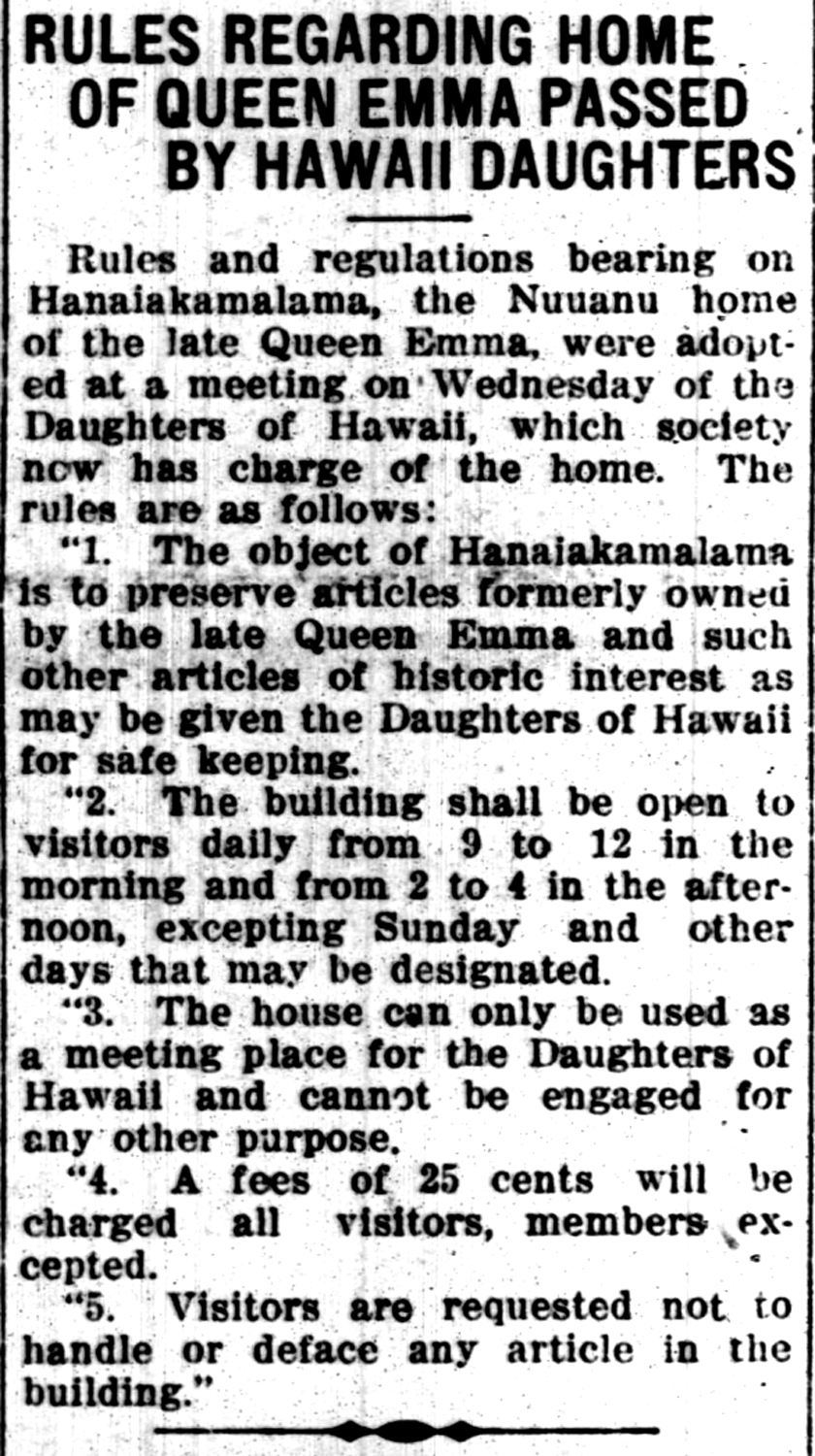
RULES REGARDING HOME OF QUEEN EMMA PASSED BY HAWAII DAUGHTERS

Rules and regulations bearing on Hanaiakamalama, the Nuuanu home of the late Queen Emma, were adopted at a meeting on Wednesday of the Daughters of Hawaii, which society now has charge of the home. The rules are as follows:

“1. The object of Hanaiakamalama is to preserve articles formerly owned by the late Queen Emma and such other articles of historic interest as may be give the Daughters of Hawaii for safe keeping.

“2. The building shall be open to visitors daily from 9 to 12 in the morning and from 2 to 4 in the afternoon, excepting Sunday and other days that may be designated.

“3. The house can only be used as a meeting place for the Daughters of Hawaii and cannot be engaged for any other purpose.

“4. A fee of 25 cents will be charged all visitors, members excepted.

“5. Visitors are requested not to handle or deface any article in the building.”

(Star-Bulletin, 10/19/1916, p. 3)

RULES REGARDING HOME OF QUEEN EMMA PASSED BY HAWAII DAUGHTERS

Honolulu Star-Bulletin, Volume XXIV, Number 7651, Page 3. October 19, 1916.

Samuel K. Kekoowai on the Daughters of Hawaii and Hanaiakamalama, 1923.

HANAIAKAMALAMA

This is a building near the end of the route of the electric car, and it stands on a hill.

As a result of the graciousness of one of the members of the Daughters of Hawaii [Ahahui o na Kaikamahine o Hawaii], this writer [Samuel K. Kekoowai] was introduced to Mrs. J. Swanzy, the leader of this association, and by her kindness I was welcomed to see the walls of that house which is filled with beautiful decorations of the monarchy, and their images hanging from the walls, set up almost like the museum of Kamehameha [Bernice Pauahi Bishop Museum].

This group, the Daughters of Hawaii, upholds the name of Queen Emma Kaleleonalani, and her birthday is cherished by them, and the writer observed the commemoration held by the association which holds dear the name placed upon them, the Daughters of Hawaii.

In the story told to me within the house, Kaleleonalani was raised by her hanai guardian [kahu hanai], Dr. Rooke [Kauka Luka], until she married Liholiho Kamehameha 4, however, there is another version that I have been told by another.

On that 20th day of this June, I saw the back room totally filled with those who came, from the members to visitors, and most were whites and there were a few Hawaiians [??? a o-a na Hawaii].

The story of the circuit of Queen Emma Kaleleonalani around Oahu nei was told, beginning at Waimanalo at the place of John Cummins [Keoni Kamaki], and to Kaneohe at the place of Wainui Pii, and then on to Waikane at the place of Kameaaloha; at Kahana there was a Chinese named Apakana, on to Punaluu there was Naili, to Laie at the place of Kupau, to Kahuku at the place of Kaluhi, to Waialua at the place of Kaiaikawaha. Continue reading

Traditional place names and the Daughters of Hawaii, 1918.

OLD HAWAIIAN NAMES TO BE PRESERVED.

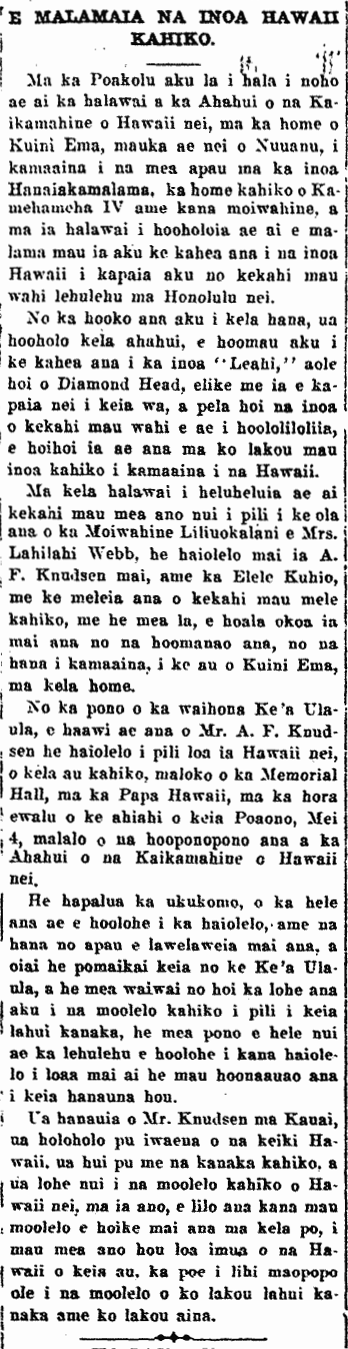
This past Wednesday the Daughters of Hawaii [Ahahui o na Kaikamahine] held a meeting at the home of Queen Emma in the uplands of Nuuanu, known by all by the name Hanaiakamalama, the old home of Kamehameha IV and his queen; and at that meeting it was decided that the calling of many places in Honolulu nei by their Hawaiian names will be preserved forever.

To carry out this endeavor, the organization decided to continue calling the name “Leahi,” and not Diamond Head, as it is being called now, and so too with other names that have been changed; they will be returned to their old names that Hawaiians are familiar with.

At that meeting several things were read pertaining to the life of Queen Liliuokalani  by Mrs. Lahilahi Web, a speech by A. F. Knudsen, and Representative Kuhio, along with the singing of some old mele, just as if they were recreating memories of familiar deeds from the time of Queen Emma in that home.

For the treasury of the Red Cross, Mr. A. F. Knudsen will give a speech specifically pertaining to Hawaii nei of the olden days, at Memorial Hall of the Hawaiian Evangelical Association [Papa Hawaii], at eight o’clock on the evening of this Saturday, May 4, under the direction of the Daughters of Hawaii nei.

The entrance will be half price to go and listen to the speech and for all activities that will be put on, and being that it is a benefit for the Red Cross, and that it is beneficial to listen to this history pertaining to the Hawaiian lahui, all the people should go to hear his speech so that the new generations can get some education.

Mr. Knudsen was born on Kauai and went around amongst the Hawaiian children, and met the old people, and listened to the old stories of Hawaii nei; and because of this, the stories he tells that night will be something totally new for Hawaiians of today, the people who know hardly any of the stories of their lahui and their land.

(Kuokoa, 5/3/1918, p. 4)

E MALAMAIA NA INOA HAWAII KAHIKO.

Ka Nupepa Kuokoa, Buke LVI, Helu 18, Aoao 4. Mei 3, 1918.

Petition from Koloa, Kauai, supporting King Kalakaua, 1880.

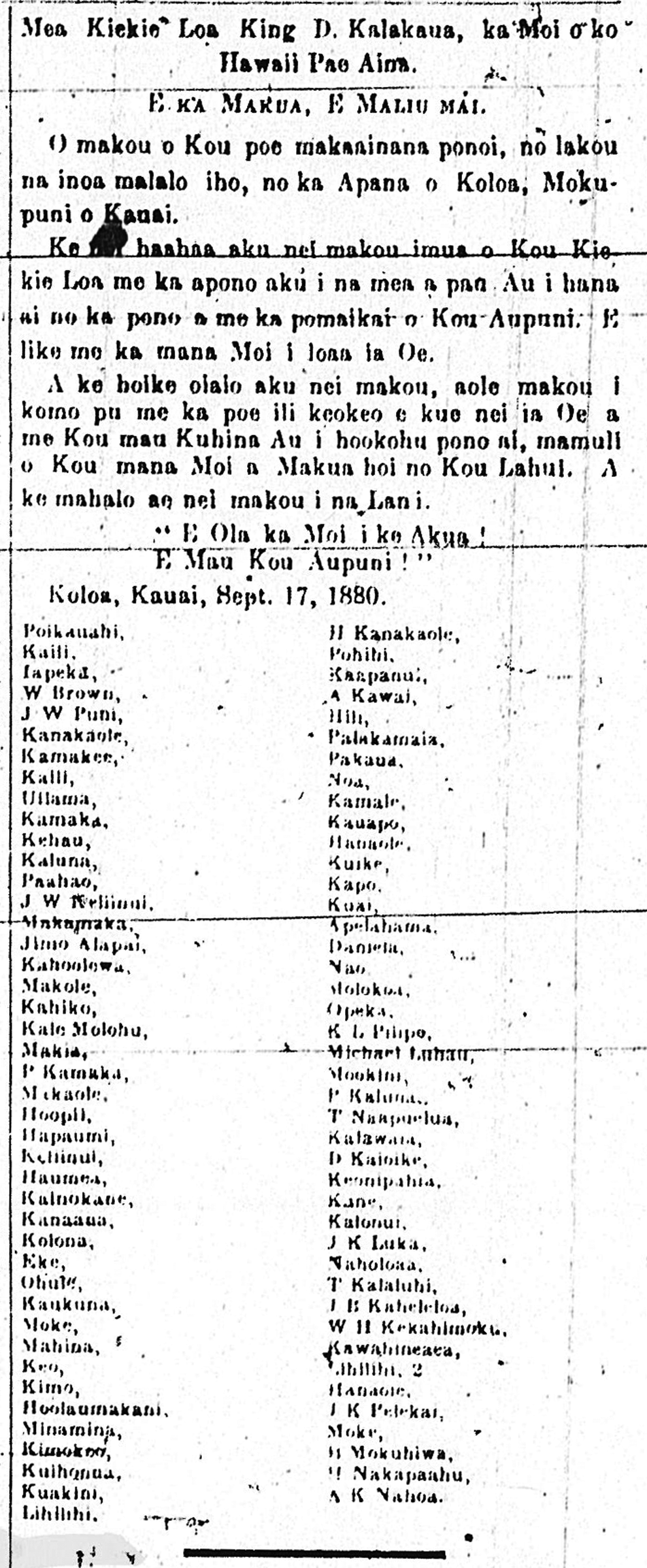
His Most Highness King D. Kalakaua, the Moi of the Hawaiian Archipelago.

O Father, Give us heed.

We are Your own citizens, named below, from the District of Koloa, Island of Kauai.

We humbly ask before Your Most Highness, while approving of all which You have done for the rights and the benefits of Your Nation. Just as the Royal rights that You have.

And we truthfully state that we do not join with the white skins [ili keokeo] who oppose You and Your Ministers that You rightly selected, as per your power as King and Father of Your Lahui. And we thank the Heavens.

“Long Live the King in God!
Long Live your Kingdom!”

Koloa, Kauai, Sept. 17, 1880.

Poikauahi,  H. Kanakaole,
Kaili,  Pohihi,
Iapeka,  Kaapanui,
W. Brown,  A. Kawai,
J. W. Puni,  Hili,
Kanakaole,  Palakamaia,
Kamakee,  Pakaua,
Kaili,  Noa,
Uilama,  Kamale,
Kamaka,  Kauapo,
Kehau,  Hanaole,
Kaluna,  Kuike,
Paahao,  Kapo,
J. W. Keliinui,  Kuai,
Makamaka,  Apelahama,
Jimo Alapai,  Daniela,
Kahoolewa,  Nao,
Makole,  Molokoa,
Kahiko,  Opeka,
Kale Molohu,  K. L. Pilipo,
Makia,  Michael Luhau,
P. Kamaka,  Mookini,
Makaole,  P. Kaluna,
Hoopii,  T. Naapuelua,
Hapaumi,  Kalawaia,
Keliinui,  D. Kaioike,
Haumea,  Keonipahia,
Kainokane,  Kane,
Kanaana,  Kalonui,
Kolona,  J. K. Luka,
Eke,  Naholoaa,
Ohule,  T. Kalaluhi,
Kaukuna,  J. B. Kaheleloa,
Moke,  W. H. Kekahimoku,
Mahina,  Kawahineaea,
Keo,  Lihilihi 2,
Kimo,  Hanaole,
Hoolaumakani,  J. K. Pelekai,
Minamina,  Moke,
Kimokeo,  H. Mokuhiwa,
Kuihonua,  H. Nakapaahu,
Kuakini,  A. K. Nahoa,
Lihilihi.

[This newspaper is not available online as of yet. Hopefully a clear copy will be put up soon. Some of the names in this image are difficult to decipher.]

(Elele Poakolu, 9/29/1880, p. 3)

Mea Kiekie Loa King D. Kalakaua, ka Moi o ko Hawaii Pae Aina.

Ka Elele Poakolu, Buke I, Helu 4, Aoao 3. Sepatemaba 29, 1880.

A pair of patriotic mele by John G. M. Sheldon, 1893.

KE KUOKOA PUKA LA.

He malihini hoi keia,
E auwana hele ae nei,
Aihemu manienie,
Ai uhini o ka nahele.

O ke ano iho la no ia,
Malimali i kinohou,
A ku ae i ka moku,
Ko-we-iu-Kanaka.

O ko lakou ano iho la ia,
O hoolilo aina ma,
Mai punihei aku,
I ka mali hoohui aina.

[The Daily Kuokoa Newspaper¹

This is a newcomer
Wandering about
Devouring until barren
Eater of grasshoppers in the wilderness.

That’s its nature
Sweet words at first
Then taking rule of the land
“Go away you Kanaka.”

That is how they are
Those who will turn over the land
Don’t get tricked
By the sweet-talking annexationists.

¹Nupepa Puka La Kuokoa me Ko Hawaii Pae Aina i Huiia was a daily pro-annexation Hawaiian-Language newspaper that ran from 1/26/1893 through 1896.

KA’U MELE.

Pehea la e hiki ai,
Ia’u ke uumi iho,
I ko’u aloha e ka aina hanau,
Nau wau i hoohua mai.

O kou kuakoko no’u ia,
Eha oe, no’u ia eha,
Mailani oe ia’u, he milimili,
I ole ai kakou, ma o ka Haku.

E ka Haku—e—Puuhonua,
Kalahea o ko ke ao nei,
Ina ua hewa au, ke noi nei au,
Ma Ou ‘la, e ola au.

Kahikina Kelekona.

[My Song

How would it be possible
For me to hold back
My aloha, O Land of my birth,
You gave birth to me.

Your birth pangs are for me
When you are pained, those pains are for me
You treasure me, as something dear
We live through the Lord.

O Lord, O Refuge
Redeemer of this world
If I am wrong, I beseech
Through You, let me live.

Kahikina Kelekona.]

(Hawaii Holomua, 1/25/1893, p. 2)

KE KUOKOA PUKA LA.

Hawaii Holomua, Buke III, Helu 446 [146], Aoao 2. Ianuari 25, 1893.

“You are not permitted to use your own judgement but are blandly told that you don’t know what you are talking about when you venture to express an opinion that is contrary to what is said to be an established fact,” Clarence E. Edwords, 1896.

The Hawaiian Situation.

They protest too much.

This is the conclusion that is reached by the careful observer who talks with the adherents of the present Government [the Provisional Government] of the Hawaiian Islands.

They seem too anxious to impress upon you the fact that it is a most serene and peaceful atmosphere. You are not permitted to use your own judgement but are blandly told that you don’t know what you are talking about when you venture to express an opinion that is contrary to what is said to be an established fact. Of course no fault can be found with such procedure. It is a part of politics. They want certain conditions to obtain and the desire is so great that by long effort to fool others the “P. G.’s” eventually fool themselves. It may seem presumptuous for one who spent but a month in the island republic to give an opinion as to the real political status of the island, but there is so much evidence obtainable that such opinion can easily be formed, even if it does happen to be against the desire of those who now hold the reins of Government.

The stranger who visits Honolulu almost immediately feels that he is surrounded by an air of uneasiness. Things evidently are not as they seem. There is an indefinable something in the atmosphere that makes one feel as if he should be watching over his shoulder. Where the impression comes from it is difficult to say, but if you will talk politics for five minutes with any resident you cannot help but notice the lowered tone of voice, the careful watch of passers-by or the graurded manner, as if there were a constant fear of spies. Nor is this noticeable alone when talking with royalists. The adherents of the Republic are just as guarded and just as careful.

It looks as if they feared a change of Government and as if their expressions might be treasured up against them.

Yet the Republicans and the papers are persistent in their declarations that the islands were never more peaceful than at present.

Perhaps this is true, but if the the present Government is not sitting over a smouldering political volcano, then the signs are wrong, and this same Government has not failed to realize this fact. Nor has it failed to prepare a soft place to light after the explosion.

What is this soft place?

When a man who had been a resident of the islands but ten months made the public announcement of a new Government, that announcement was successful because of the American Minister, who backed up the revolutionists with the force of an American warship and the naval support of the United States. Liliuokalani was dethroned and the Re-…

(Independent, 7/11/1896, p. 1)

The Hawaiian Situation.

The Independent, Volume III, Number 323, Page 1. July 11, 1896.

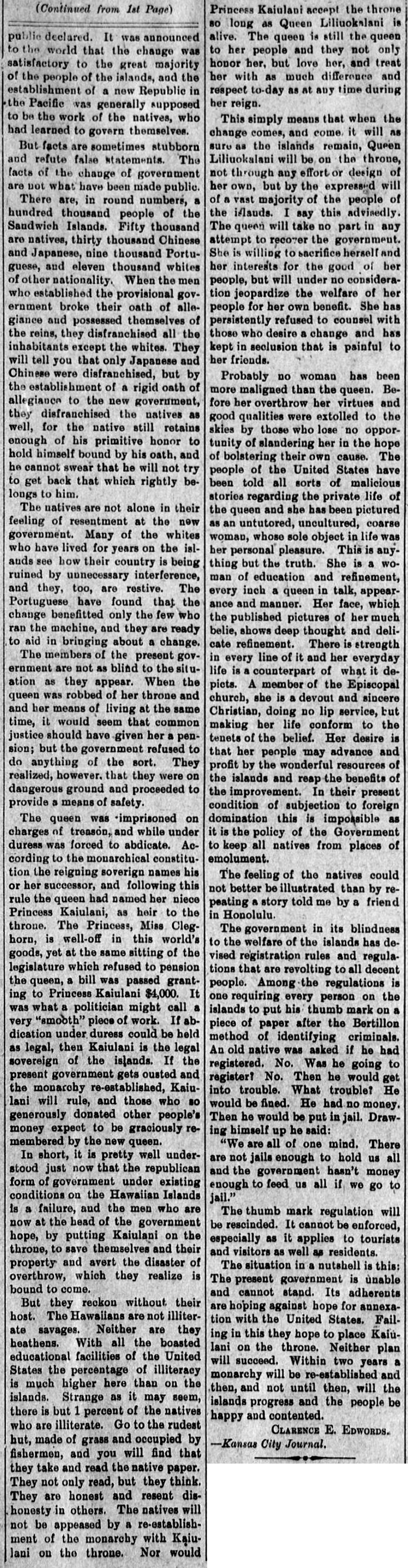
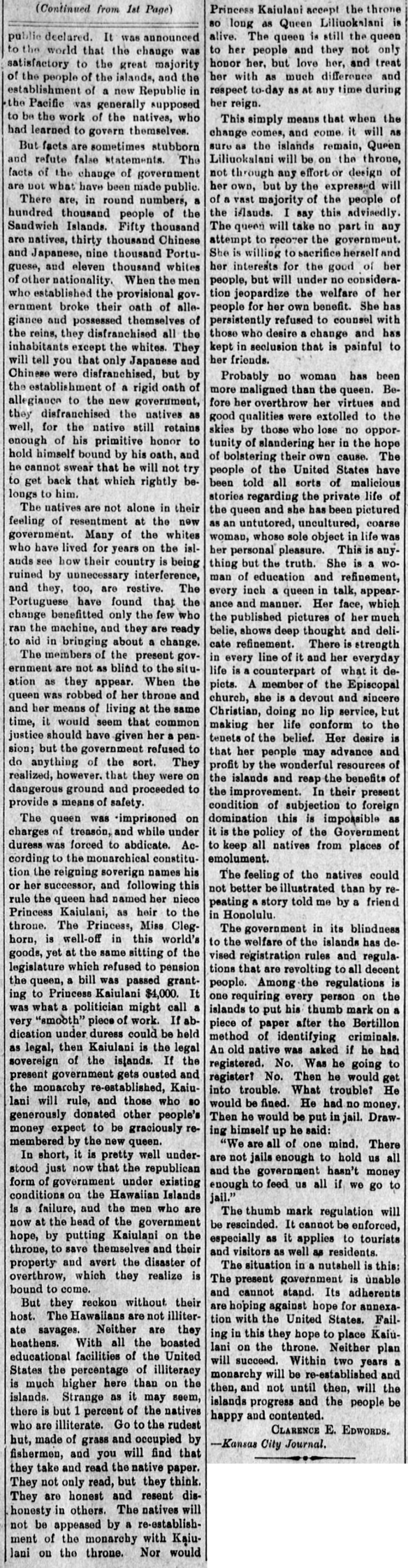
…public declared. It was announced to the world that the change was satisfactory to the great majority of the people of the islands, and the establishment of a new Republic in the Pacific was generally supposed to be the work of the natives, who had learned to govern themselves.

But facts are sometimes stubborn and refute false statements. The facts of the change of government are not what have been made public.

There are, in round numbers, a hundred thousand people of the Sandwich Islands. Fifty thousand are natives, thirty thousand Chinese and Japanese, nine thousand Portuguese, and eleven thousand whites of other nationality. When the men who established the provisional government broke their oath of allegiance and possessed themselves of the reins, they disfranchised all the inhabitants except the whites. They will tell you that only Japanese and Chinese were disfranchised, but by the establishment of a rigid oath of allegiance to the new government, they disfranchised the natives as well, for the native still retains enough of his primitive honor to hold himself bound by his oath, and he cannot swear that he will not try to get back that which rightly belongs to him.

The natives are not alone in their feeling of resentment at the new government. Many of the whites who have who have lived for years on the islands see how their country is being ruined by unnecessary interference, and they, too, are restive. The Portuguese have found that the change benefitted only the few who ran the machine, and they are ready to aid in bringing about a change.

The members of the present government are not as blind to the situation as they appear. When the queen was robbed of her throne and and her means of living at the same time, it would seem that common justice should have given her a pension; but the government refused to do anything of the sort. They realized, however, that they were on dangerous ground and proceeded to provide a means of safety.

The queen was imprisoned on charges of treason, and while under duress was forced to abdicate. According to the monarchical constitution the reigning soverign names his or her successor, and following this rule the queen had named her niece Princess Kaiulani, as heir to the throne. The Princess, Miss Cleghorn, is well-off in this world’s goods, yet at the same sitting of the legislature which refused to pension the queen, a bill was passed granting to the Princess Kaiulani $4,000. It was what a politician might call a very “smooth” piece of work. If abdication under duress could be held as legal, then Kaiulani is the legal sovereign of the islands. If the present government gets ousted and the monarchy re-established, Kaiulani will rule, and those who so generously donated other people’s money expect to be graciously remembered by the new queen.

In short, it is pretty well understood just now that the republican form of government under existing conditions on the Hawaiian Islands is a failure, and the men who are now at the head of the government hope, by putting Kaiulani on the throne, to save themselves and their property and avert the disaster of overthrow, which they realize is bound to come.

But they reckon without their host. The Hawaiians are not illiterate savages. Neither are they heathens. With all the boasted educational facilities of the United States the percentage of illiteracy is much higher here than on the islands. Strange as it may seem, there is but 1 percent of the natives who are illiterate. Go to the rudest hut, made of grass and occupied by fisherman, and you will find that they take and read the native paper. They not only read, but they think. They are honest and resent dishonesty in others. The natives will not be appeased by a re-establishment of the monarchy with Kaiulani on the throne. Nor would Princess Kaiulani accept the throne so long as Queen Liliuokalani is alive. The queen is still the queen to her people and they not only honor her, but love her, and treat her with as much difference and respect to-day as at any time during her reign.

 This simply means that when the change comes, and come it will as sure as the islands remain, Queen Liliuokalani will be on the throne, not through any effort of design of her own, but by the expressed will of a vast majority of the people of the islands. I say this advisedly. The queen will take no part in any attempt to recover the government. She is willing to sacrifice herself and her interests for the good of her people, but will under no consideration jeopardize the welfare of her people for her own benefit. She has persistently refused to  counsel with those who desire a change and has kept in seclusion that is painful to her friends.

Probably no woman has been more maligned than the queen. Before her overthrow her virtues and good qualities were extolled to the skies by those who lose no opportunity of slandering her in the hope of bolstering their own cause. The people of the United States have been told all sorts of malicious stories regarding the private life of the queen and she has been pictured as an untutored, uncultured, coarse woman, whose sole object in life was her personal pleasure. This is anything but the truth. She is a woman of education and refinement, every inch a queen in talk, appearance and manner. Her face, which the published pictures of her much belie, shows deep thought and delicate refinement. There is strength in every line of it and her everyday life is a counterpart of what it depicts. A member of the Episcopal church, she is a devout and sincere Christian, doing no lip service, but making her life conform to the tenets of the belief. her desire is that her people may advance and profit by the wonderful resources of the islands and reap the benefits of the improvement. In their present condition of subjection to foreign domination this is impossible as it is the policy of the Government to keep all natives from places of emolument.

The feeling of the natives could not better be illustrated than by repeating a story told me by a friend in Honolulu.

The government in its blindness to the welfare of the islands has devised registration rules and regulations that are revolting to all decent people. Among the regulations is one requiring every person on the islands to put his thumb mark on a piece of paper after the Bertillon method of identifying criminals. An old native was asked if he had registered. No. Was he going to register? No. Then he would get into trouble. What trouble? He would be fined. He had no money. Then he would be put in jail. Drawing himself up he said:

“We are all of one mind. There are not jails enough to hold us all and the government hasn’t money enough to feed us all if we go to jail.”

The thumb mark regulation will be rescinded. It cannot be enforced, especially as it applies to tourists and visitors as well as residents.

The situation in a nutshell is this: The present government is unable and cannot stand. Its adherents are hoping against hope for annexation with the United States. Failing in this they hope to place Kaiulani on the throne. Neither plan will succeed. Within two years a monarchy will be re-established and then, and not until then, will the islands progress and the people be happy and contented.

Clarence E. Edwords.
—Kansas City Journal.

(Independent, 7/11/1896, p. 4)
...public declared...

The Independent, Volume III, Number 323, Page 4. July 11, 1896.
“Kuu Moi,” a patriotic mele by Clarence E. Edwords, 1896.

Kuu Moi.

Oh Lydia, Heaven born child of the sun!
Liliuokalani, aloha, kuu Moi!
True sovereign of the sun kissed isles of the sea,
Let it not be said that they race is now run.
How shall the intruders for their crimes atone?
For the vile indignities cast upon thee?
Oh, what, indeed, should the fit punishment be
For those who so basely robbed thee of thy throne?
Even now with stones they children are fed;
Aye, but it were better that they should be dead
Than pledged allegiance to the foreign born band,
Or take subsistence from their accursed hand.
Akua mana loa forbid it be said
That thy people deserted their native land.

Clarence E. Edwords.

[Does anyone know the story of Clarence E. Edwords?? There are some nice references to what is happens with the patriots of the Royal Hawaiian Band choosing to eat stones before pledging allegiance to the Provisional Government. Ellen Predergast composes “Mele Ai Pohaku,” and Clarence E. Edwords composes “Kuu Moi.”]

(Makaainana, 7/13/1896, p. 1)

Kuu Moi.

Ka Makaainana, Buke VI—-Ano Hou, Helu 2, Aoao 1. Iulai 13, 1896.