Birthday of King Kamehameha III, 1846.

By the Government.

AGREEMENT BY THE PRIVY COUNCIL.

At the meeting of the Privy Council [Poe Kukakuka Malu], on the 27th of February 1846, this was agreed to.

The birthday of the King will be commemorated on the coming 17th of March; the flag of the land will be flown at all of the forts from the morning until nightfall; and at noon the fort at Honolulu and all the forts in Hawaii nei will fire their guns. The Hawaiian flag will be flown from all of the ships of this Archipelago, and we believe that it will be good for the Governors and others to throw parties as they see fit, but with propriety and honor, loyal to the King of this independent Nation.

(Elele, 3/3/1846, p. 183)

Elele_3_3_1846_183.png

Ka Elele, Buke I, Pepa 24, Aoao 183. Maraki 3, 1846.

Joseph Kapaeau Aea passes on, 1911.

JOSEPH AEA PASSES AWAY

Joseph Aea, agent of Her Majesty Liliuokalani, died last evening about ten o’clock at his home in Pauoa. He had been associated with the queen’s family for many years. He leaves a widow and two sons. One of them is the protege of Queen Liliuokalani and is also the stenographer and assistant clerk in the city clerk’s office.

Joseph Aea was for many years connected with the old Royal Hawaiian band. He was the solo viol player and was an excellent musician. He became attached to the household of Queen Liliuokalani, and attended Liliuokalani when she was one of the official guests at the jubilee of Queen Victoria in London. He also attended the queen when she visited Washington in 1903. His wife was also one of the queen’s closest personal attendants, and has been particularly attentive to her since the overthrow of the monarchy.

In 1907, upon the death of Hon. J. O. Carter, Liliuokalani appointed Mr. Aea as her business agent, but the Liliuokalani Trust, formed about two years ago, transferred this important office to Col. C. P. Iaukea, who is one of the trustees under the Liliuokalani Trust.

Aea was a delegate to the Democratic territorial convention in 1900, and was nominated for the legislature by the Home Rulers in 1902, and again in 1904, by the Democrats.

(Hawaiian Star, 1/26/1911, p. 7)

HawaiianStar_1_26_1911_7.png

Hawaiian Star, Volume XVIII, Number 5866, Page 7. January 26, 1911.

John Wise on Hawaiian Homes and more, 1921.

The Question about the Work Ethic of Hawaiians.

Your writer [John Wise], continues to defend the Hawaiian lahui from being attacked by that question above.

The Hawaiians have perhaps become much talked about amongst those who do not know them and who are not familiar with their accomplishments of today and of the past. And maybe mostly these days for the land being given to us. Your writer frequently clashes with all kinds of other people who protest the giving of land to Hawaiians, because of the ridiculous idea that they don’t know how to work or that they are lazy.

In these attacks, we can see, O Lahui, that they are carried with criticisms and that it is would be a waste to confirm their misbeliefs. But so that the Hawaiians may answer these questions, your writer wants to be made known for all times the sound justification for our side. The readers of past issues of the Kuokoa have seen the responses given by the Commissioner in Washington, and they have seen also the other justifications given, in the newspaper.

The ultimate representation of the skill of a people is their supplying themselves with food and the things necessary for their livelihood. There perhaps is no better response than that. This lahui was living by  themselves for centuries, supplying themselves with everything, and received no assistance from the outside.

But there are things made by this lahui, things that attest to their fine craftsmanship, that will serve as a measure of their skills. Those that see Hawaiian canoes and their manufacture and how they can get Hawaiians through great gales, remaining solid in the dangers of the pounding of waves; how they could make beautiful canoes by using stone adzes; the distance they were taken from mountain to the sea; the patience of the canoe makers. All of these things will show, without being contradicted, that just by seeing the quality of the canoes can one see that this is a lahui that knows how to work. We see the canoes of today being made by people from other lands, and the canoes made by Hawaiians are far more well made and beautiful.

The beauty of things crafted by a people are undeniable proof of the work ethic of that people. Where will you find things more beautiful, O Hawaiians, if you travel all over the world, than the ahuula that are preserved at the Museum of Kamehameha School. Where is the lahui that lives on today, or perhaps has disappeared, that can make these outstanding works, with a beauty second to none, with fine craftsmanship, and patience; with a true sense of work ethic. Snaring birds is a great task all in itself, the inserting [kuku ana] of the feathers is a big job. One mamo feather cloak was said to have been started during the time of Umi and completed during the time of Kamehameha. For this ahu, the entire ahu were done with mamo feathers. And by our counting back, we see that ten generations of ancient kings passed on before the completion of this ahu; showing that it took from about 250 to 300 years of work. Where is there a great work that was completed by a people taking hundreds of years to construct? We perhaps can think of huge things, but as for something of this nature which required the knowledge and patience of men, there is no equal. Continue reading

The meeting of Kalaniopuu and Cook, 1867.

[Found under: “KA MOOLELO O KAMEHAMEHA I.”]

The Era of Kalaniopuu, 1779. Pertaining to the Death of Captain Cook, that is Lono.

On the 24th of January, Kalaniopuu and his warriors returned from Maui and landed at Awili in Kaawaloa, and stayed at Hanamua at Keaweaheulu’s place, but they were also on Maui at war with Kahekili.

Kalaniopuu saw the many women were at the ocean on the ship to prostitute themselves [hookamakama], so Kalaniopuu forbade women from going down to the ship. And the haole saw that the women were not coming to the ship, so the haole went into the uplands of Napoopoo and at Kahauloa, and on this side of Kaawaloa to solicit prostitution, and the women received a great amount of foreign rubbish [opala]. Continue reading

More on Kalaniopuu’s ahuula and mahiole, 1887.

Captain Cook Relics.

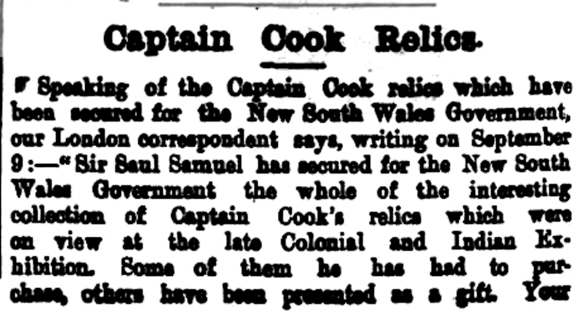
Speaking of the Captain Cook relics which have been secured for the New South Wales Government, our London correspondent says, writing on September 9:—”Sir Saul Samuel has secured for the New South Wales Government the whole of the interesting collection of Captain Cook’s relics which were on view at the late Colonial and Indian Exhibition. Some of them he has had to purchase, others have been presented as gift. Your…

(Sydney Mail, 10/22/1887, p. 868)

SydneyMail_10_22_1887_868

The Sydney Mail, Volume XLIV, Number 1424, Page 868. October 22, 1887.

Continue reading

Kamakau’s story of Lonoikamakahiki, 1871.

[Found under: “KA MOOLELO HAWAII: NA S. M. KAMAKAU.”]

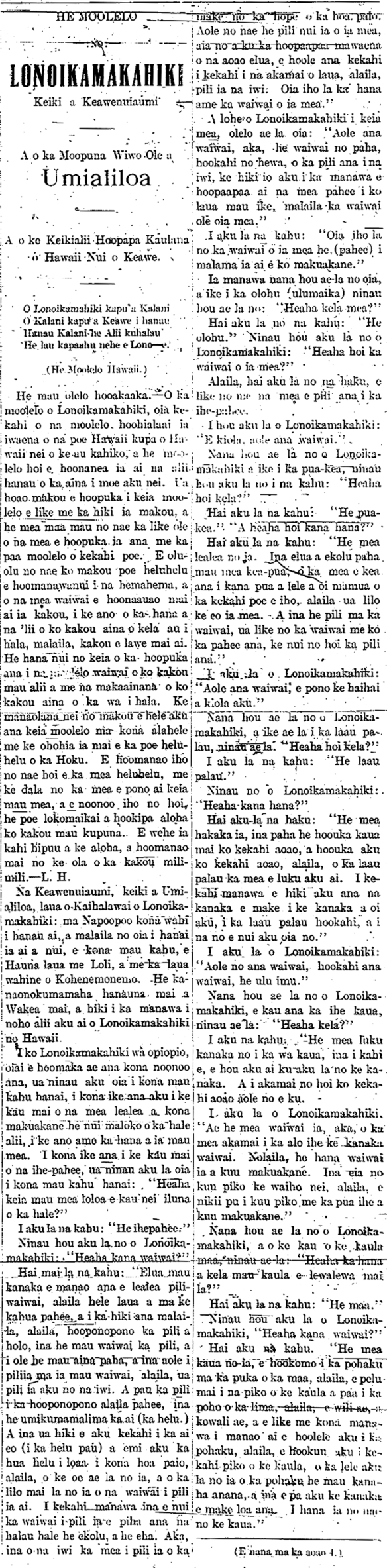
Pertaining to Lonoikamakahiki: Lonoikamakahiki was the child of Keawenuiaumi, the alii of Kau and Puna, and reigned over the entirety of those sections of Hawaii. He married a chiefess, Kaikilanikohepanio, from amongst the granchildren of Laeanuikaumanamana, and from the two of them were born the sons, Keawehanauikawalu and Kaihikapumahana, and the two of them became ancestors of chiefs and commoners. When Lono ruled, he was a chief who did not listen to nor heed the advice of his kahuna and counselors [kakaolelo], so some of his counselors left to find a good master [haku]. And that is why Lanahuimihaku folks left, to find a master who would follow and listen to their advice; they searched for a haku for themselves, and they lived went to live with Kailikapuakuihewa on Oahu, believing that he was a chief who was upright and who listened to everything the kahuna and kakaolelo instructed….

[S. M. Kamakau’s telling of the story of Lonoikamakahiki ran from 1/12/1871 to 2/2/1871 in the newspaper Au Okoa. It can be found in Ruling Chiefs, pp. 47–63.]

(Au Okoa, 1/12/1871, p. 1)

AuOkoa_1_12_1871_1.png

Ke Au Okoa, Buke VI, Helu 39, Aoao 1. Ianuari 12, 1871.

Lonoikamakahiki, unattributed, 1909.

A STORY

OF

LONOIKAMAKAHIKI

Son of Keawenuiaumi

And Fearless Grandson of

Umialiloa

And the Famous Riddling Chief of Great Hawaii of Keawe.

O Lonoikamakahiki kapu a Kalani
O Kalani kapu a Keawe i hanau
Hanau Kalani he Alii kuhalau
He lau kapaahu nehe o Lono—e.

[Lonoikamakahiki, the sacred one of Kalani
Sacred Kalani, born of Keawe
Born was Kalani, a expansive Chief
O Lono, a rustling of a heap of mats.]

(A Hawaiian Story.)

Words of clarification.—The story of Lonoikamakahiki is one of the stories delighted in by the native Hawaiians of Hawaii nei of the olden days, and it is a moolelo that was enjoyed by the alii born in this land who have passed on. We have endeavored to print this story to the greatest of our ability, but it is a common thing for there to be discrepancies from what is published with what is memorized by some people. May our readers please be patient with the mistakes, and take the valuable things that will teach us of the nature of the deeds of the alii of our land of days past. Publishing the valuable stories of our alii and makaainana of our land of the past is of great importance. We hope that this story will travel its path, delighting the readers of the Hoku. But do remember, O Readers, that money is what makes this possible, and consider that our kupuna were generous and welcoming people. Open the purse of aloha, and remember the life of our beloved.— Editor.

[This story of Lonoikamakahiki appears in Hoku o Hawaii from 7/8/1909 to 12/9/1909. Unfortunately, the first 11 buke of the Hoku, from 5/3/1906 to 5/24/1917 are not available yet online.]

(Hoku o Hawaii, 7/5/1909, p. XXX)

HokuoHawaii_7_8_1909_1.png

Ka Hoku o Hawaii, Buke IV, Helu 10, Aoao 1. Iulai 8, 1909.

Z. P. Kalokuokamaile’s Lonoikamakahiki, 1924.

ENJOYMENT TO PASS THE TIME.

THE STORY OF LONOIKAMAKAHIKI, THE EXPERT ALII WHO HAD NO EQUAL AT CONTESTS OF WIT, AND AT WAR.

CHAPTER I.

(Written by Z. P. K. Kawaikaumaiikamakaokaopua)

Lonoikamakahiki was born in the land of Napoopoo, at the base of the cliff of Manuahi, South Kona, Hawaii. Keawenuiaumi was the father, Koihalawai was the mother; and it was in Napoopoo where he was raised until adulthood; his caretakers were Hauna and his younger brother Loli.

These two men had one wife. They did not want two wahine, and they were both very nice; they did not fight or argue and there was no dissension between them over this one woman. When Lonoikamakahiki was young, he began to think.

When Lonoikamakahiki was looking at the many items of entertainment of his father placed in the royal house, and he saw the ihe pahee placed there, he looked for a long time and after a while he asked his caretakers:

“What is that long thing hanging up there in the house?” Continue reading

Story of Lonoikamakahiki as told by Wille Sepe. Kawa Jr., 1887–1888.

A STORY OF

Lonoikamakahiki

THE

High Chiefly Offspring of Kalani.

The Great Alii of Hawaii.

[WRITTEN FOR THE KUOKOA NEWSPAPER.]

(The Author should make clear that although this Lahuikanaka was accustomed to memorizing things, there nonetheless are variations between what this person and that memorized. And it is from what is memorized by this Writer, it is on that path that he will travel until this Moolelo is complete.)

I must clarify the ancestors of the alii who this moolelo is about. So that the new generations of the Hawaiian People know the kupuna and makua and older brothers and younger brothers and the sisters of their alii for whom this famous story rises.

Kiha (m) lived with Kaohikinuiokalani (f), and born between them were the chiefly children, five in total. Here are each of their names:

Liloa (m), after him there were twins, Laeanui (f), Kaumanamana (f), Kalani (m), Pinea (f).

Liloa lived with his own sister, Pinea, and born was Hakau (m), that being Hakaualiloa. It is said that Hakau was a Pi’o Chief. Continue reading

B. L. Koko tells the story of Lonoikamakahiki, 1865.

STORY OF LONOIKAMAKAHIKI

PART 1.

Kalani was the father and Haumea the mother, born was Lonoikamakahiki from Haumea and Kalani; He was taken as hanai by Hauna of Kaikilanialiiwahineopuna [?? Hauna o Kaikilanialiiwahineopuna] until he was grown; the chiefs went to bathe in the ocean, and after they had bathed, the two of them went upland to warm themselves.

While the two of them were warming themselves, Kaiklanialiiwahineopuna said to Lonoikamakahiki, “let’s play konane (the konane played with pebbles).” “Yes,” said Lonoikamakahiki, and they laid out the pebbles upon the board and the two began to play [uhau], and in that first match, he lost to his sister; the two played once again, and he lost once again to his sister; they played for the third time, and that Chief lost once more; after this third loss of Lonoikamakahiki, the Chief grew irritated for just losing…

[This is the opening of one of the stories of Lonoikamakahiki found in the Hawaiian Language Newspapers. It was written by B. L. Koko of Kaualaa, Wailupe, Oahu, and runs in Au Okoa from 9/4/1865. There is criticism of his telling and Koko ends his story on 10/23/1865. He states at his closing that what he wrote is all he knows, but those who know the story well most likely know more things. And if his kupunakane know more, that he will submit it.]

(Au Okoa, 9/4/1865, p. 4)

AuOkoa_9_4_1865_4.png

Ke Au Okoa, Buke I, Helu 20, Aoao 4. Sepatemaba 4, 1865.