Autobiography of Joseph Kawai Opunui, 1929.

THE STORY OF JOSEPH KAWAI OPUNUI AND HIS DESCENDANTS

Joseph Kawai Opunui was born on June 16, 1853 of Hapuku Opunui (m) and Kauhailama Waiwaiole (f) at Kalapana, Puna, Hawaii; and when he grew older, he would go around Kapoho, Puna; and when he was 15, came to Honolulu. Here he entered the English school at Kawaiahao in 1868, on the 3rd day of the month of May; David Malo was the teacher there. He stopped attending that school on July 20, 1870, and entered the Royal School of Kehehuna [Kula Alii o Kahehuna] in 1871. He left that school on April 6, 1872 and went to work for C. P. Ward [Ka Pepee] at Old Plantation as a grass cutter, as a pond worker at the pond of Koula, and as a coconut tree planter of the coconut grove growing there to the present.

He took a wife on October 6, 1873, and had his first child on September 29, 1874. My wife gave birth in Honolulu.

I took care of the jitney cart [kaa kika-ne] for my boss, Mr. Ward, for wages of four dollars a week. That was a lot of money in those days. After that, I went to work for Henry May & Co., food purveyors, weighing coffee, rice, sugar, potatoes, and so forth. They pay was ten dollars per week. I stayed with that employer until they merged with J. T. Waterhouse and McIntyer under the company name of Henry May & Co. It is still in operation today.

From there, I went to work for the government on roads for $1.25 a day, for 15 years. This was under the territory, and then 12 years under the county. I am retired now, but am receiving a pension.

This past 16th of June, I made 76 years old.

We have 1 son and 3 daughters from our loins;

Philamina, Joseph, Christina and Kealohapauole.

Philamina had 17 children. She was married twice. Her first husband was Herman Kaouli, and the second was William Keiki. With him she had six children, and with H. K. Ha’o she had eleven children.

The second child of Joseph Jr. died at the age of three.

One child is living in China. Kealohapauole is childless.

Between Philamina and Herman Kaouli, 2 children are living; with H. K. Ha’o, 2 children are living.

The first child is Margaret; the second child is Victoria. Margaret married J. Kaakua, and they had two children: Mary Laniwahine (deceased) and the second child, Hiram K. Kaakua.

Victoria married Isaac K. Kaawa and they had three children: Thomas K., Margaret Kahalelaulani, and Victoria.

The one living child of William K. Keiki is Clara, and she has five children: Philamina Nohokula, Manuel Kawai, Clara Hiilani, William Weheikekapu, and Frank.

Andrade is the name of Clara’s husband, and he is the father of those children.

I have three generations. With aloha.

Joseph Kawai Opunui

1805 Kalani St., Honolulu.

[I came across this interesting autobiography the other day. Usually, this type of information is submitted by someone else when a person dies, but here, Joseph Kawai Opunui is telling his own story.]

(Alakai o Hawaii, 6/27/1929, p. 4)

HE MOOLELO NO JOSEPH KAWAI OPUNUI AME KANA MAU MAMO

Ke Alakai o Hawaii, Buke 1, Helu 9, Aoao 4. Iune 27, 1929.

Keahu Kealiiaukai, an awesome biography, 1941.

Recalling the Days of Kamehameha V.

KEAHU KEALIIAUKAI

Keahu Kealiiaukai is one of the last Hawaiians left who is not proficient in English. He is a Hawaiian famous for his knowledge of plants, and he is 82 years old. He lives in Lahaina, Maui, the capital of Hawaii in days of yore. Kealiiaukai is now living with his daughter, Mrs. Juliette Pali.

When Kealiiaukai was born in Kaupo, Maui, on the road going to the crater of Haleakala, in the year 1859, this was the fifth year of Kamehameha IV’s reign over Hawaii nei. Kealiiaukai was 4 when that monarch died. He does not recall this.

Remembering the King.

However, Kealiiaukai does in fact remember Kamehameha V, or King Kapuaiwa, his given name; and the last of the Kamehamehas. Kapuaiwa went to Lahaina numerous times, where he was welcomed warmly by his makaainana.

In Kealiiaukai’s eighty and two years of life, he witnessed the passing of the monarchs of his homeland, closing with the overturning of the nation under Queen Liliuokalani’s protection, in 1893. Then the establishing of the provisional government and the Republic of Hawaii, and the joining of the Islands to the United States and the formation of this Territory of America, 40 years ago.

A Religious Man

Kealiiaukai is an important man in Lahaina for the kamaaina there. His wife left this world eight years ago, but she did not however leave behind children. Kealiiaukai is still strong and active. He participates often in works of this Father in Heaven. He spent his life being a member of the Faith of the Latter Day.

Perhaps he is the last medicine man living and practicing from before the times when there was licensing of those in that profession. During his time, it is said that Kealiiaukai practiced healing with plants amongst his own people and healed them due to his expertise in the use of plants growing in the forests of Hawaii, for all types of illnesses.

(Hoku o Hawaii, 3/5/1941, p. 1)

Hoomanao Ina La O Kamehameha V

Hoku o Hawaii, Volume XXXV, Number 45, Page 1. Malaki 5, 1941.

The Kings of Hawaii, 1876.

This is from an issue of “The Friend,” which includes a short biography in English of the ruling monarchs of Hawaii nei, written by S. C. Damon. As for this page of illustrations, they say:

The illustrations accompanying this number of the Friend we could wish were better executed. The plate was made in New York, from the best photographs we could procure in Honolulu. The original of Kamehameha 1st was executed in 1817 by a Russian artist, who accompanied Kotzebue in his voyage, and may be seen by referring to the third volume of his voyage. The original of Kamehameha 2d was executed in England in 1824, in the style of the dress of George 4th’s reign. We think those of Kamehameha 3d, 4th and 5th are very good, but not quite so good those of Lunalilo or His Majesty Kalakaua.

[For the biographies, find them here: The Friend, February 1, 1876.

Although it is clunky to maneuver, most of this series of news letters is available from the Mission Houses Museum here: The Friend.]

(Friend, 2/1/1876, pp. 9–13)

[Monarchs]

The Friend, New Series, Volume 25, Number 2, Page unnumbered. February 1, 1876.

Biography of Henry Opukahaia, 1865–1866.

Here is one of a number of times where the Hawaiian-Language Newspapers run the biography of Heneri Opukahaia. This is a translation of the book, “MEMOIR OF HENRY OBOOKIAH, A NATIVE OF THE SANDWICH ISLANDS, WHO DIED AT CORNWALL, CONNECTICUT, FEBRUARY 17, 1818, AGED 26.” by Rev. E. W. Dwight. The story runs in the Kuokoa from 9/9/1865 until 3/24/1866.

This is not the same text as the book published later in Hawaiian in 1867 in New York: “KA MOOLELO O HENERI OPUKAHAIA, UA HANAUIA MA HAWAII, M. H. 1787, A UA MAKE MA AMERIKA, FEBERUARI 17, 1818. OIA KA HUA MUA O HAWAII NEI.” The published book is based on the same English story, but is edited for errors, and includes further information gathered by Rev. S. W. Papaula in Kealakekua. That being said, most books in Hawaiian were first printed as a serial in the newspapers first, and then published as a book.

It opens this way:

The Story of Henry
Opukahaia

NUMBER 1.

HIS STORY PRIOR TO HIS
ARRIVAL IN AMERICA.

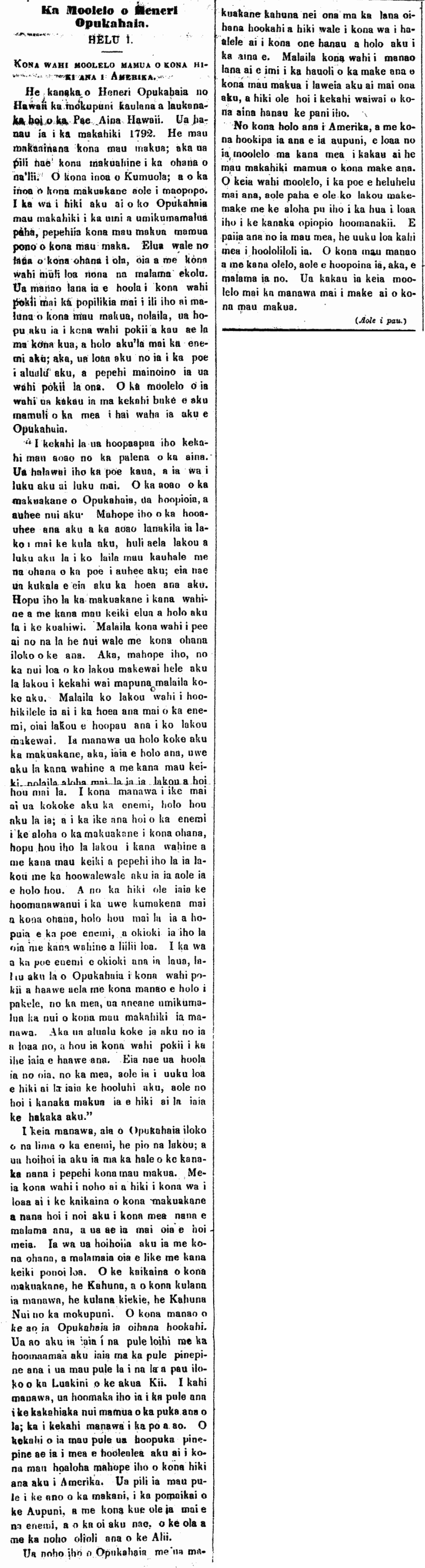
Heneri Opukahaia is from Hawaii, the famous and densely populated island of the Hawaiian Archipelago. He was born in the year 1792. His parents were makaainana, however, his mother was connected to chiefly circles. Her name was Kumuola, and the name of his father is not known. When Opukahaia reached the age of perhaps ten or twelve, his parents were killed before his eyes. There were but two in his family that survived, he and his youngest sibling who was three months old. He hoped to save his young sibling from the tragedy which befell upon his parents, so he grabbed his little sibling and placed it upon his back and ran from the enemy; however, he was found by those chasing after them, and the younger sibling was cruelly killed. That telling of that account is written in another book according to what was told by Opukahaia…

[If you are in or around Hilo this Monday, consider checking out the talk by Deborah Liʻikapeka Lee on Opukahaia at the Lyman Museum. For more information see the Lyman Museum page.]

(Kuokoa, 9/9/1865, p. 2)

Ka Moolelo o Heneri Opukahaia.

Ka Nupepa Kuokoa, Buke IV, Helu 36, Aoao 2. Sepatemaba 9, 1865.

Abraham Lincoln, 1906–07.

ABE LINCOLN
—°—THE AMERICAN COUNTRY BOY—°—
THE REDEEMER OF THE BLACK SLAVES

CHAPTER I.

HIS FIRST DAY AT SCHOOL.

One fine day, when the hills and vales were covered with the light of the morning, this little child came out of a log cabin. Log cabins were the houses of the poor country people of this area, and this is how they are built….

[This is the opening of one of several biographies of Abraham Lincoln published throughout the years in the Hawaiian-Language Newspapers. This particular one runs in the Kuokoa from 7/27/1906 to 1/18/1907.  Linekona was followed closely through life and death and beyond in the Hawaiian-Language Newspapers. Perhaps of any president of the United States, he is the one most written about and most respected for his stance and for the actions he took to promote these beliefs.

There is an article announcing the beginning of this story appearing in the previous issue of the Kuokoa, 7/20/1906, p. 4: “PERESIDENA LINEKONA, KE KEIKI KUAAINA”.]

(Kuokoa, 7/27/1906, p. 6)

ABE LINEKONA: KE KEIKI KUAAINA AMERIKA

Ka Nupepa Kuokoa, Buke XLV, Helu 30, Aoao 6. Iulai 27, 1906.

Harper’s New Monthly Magazine and Kekuanaoa, 1871.

Here is the short piece described in the last post:

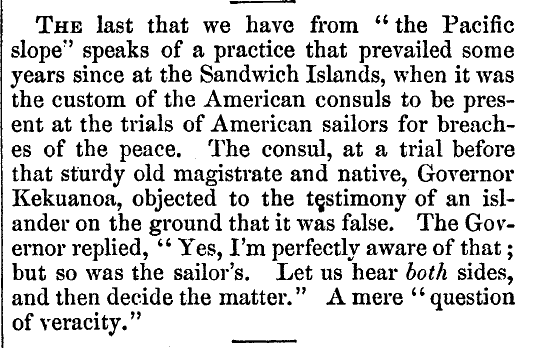
The last that we have from “the Pacific slope” speaks of a practice that prevailed some years since at the Sandwich Islands, when it was the custom of the American consuls to be present at the trials of American sailors for breaches of the peace. The consul, at a trial before the sturdy old magistrate and native Governor Kekuanoa [Kekuanaoa], objected to the testimony of an islander on the grounds that it was false. The Governor replied, “Yes, I’m perfectly aware of that; but so was the sailor’s. Let us hear both sides, and then decide the matter.” A mere “question of veracity.”

(Harper’s New Monthly, 4/1871, p. 797)

The last that we have from...

Harper’s New Monthly Magazine, Volume 42, Issue 251, Page 797. April 1871.

Rose Kanewanui of Hanalei passes, 1912.

MY BELOVED HAS GONE.

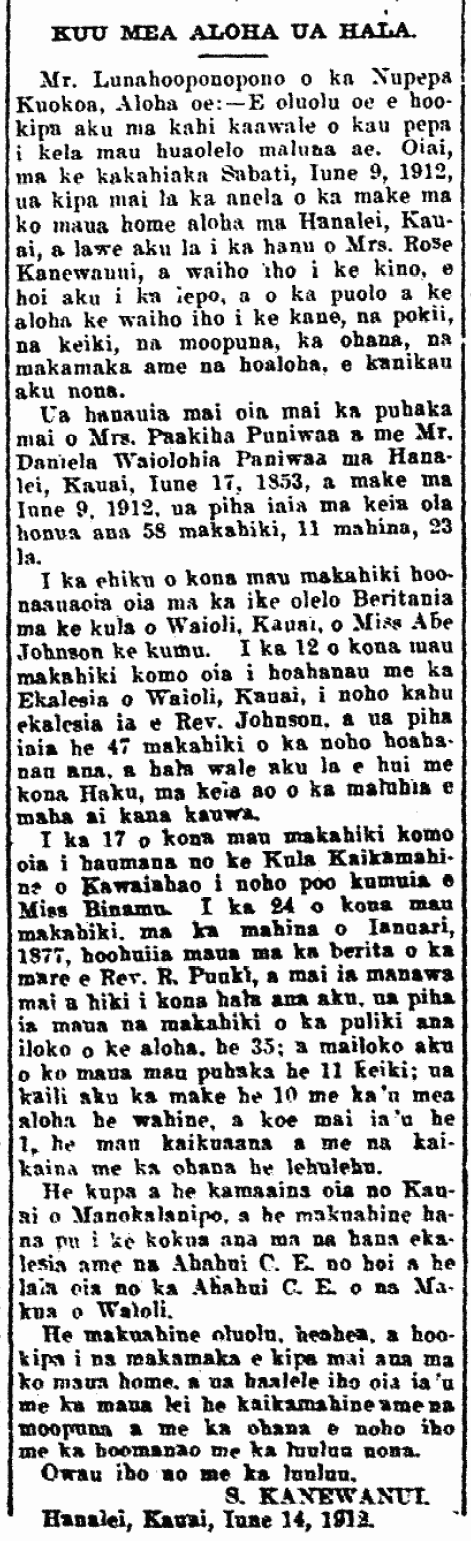
Mr. Editor of the Kuokoa Newspaper, Aloha oe:—Please be so kind as to welcome to a free space in your paper, the words above. Being that on the morning of the Sabbath, June 9, 1912, the angel of death visited our loving home in Hanalei, Kauai, and took the breath of Mrs. Rose Kanewanui, and left behind the body to return to the earth; and the puolo¹ of love is left with the husband, the younger siblings, the children, the grandchildren, the family, the intimates, and friends who grieve after her.

She was born from the loins of Mrs. Paakiha Puniwaa and Mr. Daniela Waiolohia Paniwaa at Hanalei, Kauai, June 17, 1853, and died June 9, 1912, she lived on this earth 58 years, 11 months, and 23 days.

At age seven, she was educated in the English language at the school of Waioli, Kauai, and Miss Abe Johnson was the teacher. At 12, she entered as a brethren of the Church of Waioli, Kauai, under the direction of Rev. Johnson, and she was a member for 47 years, until she died and met with her Lord in that realm of peace where his servants rest.

At 17, she entered into the Kawaiahao Girls’ School which was under the principal Miss Bingham. At 24, in the month of January 1877, we were joined together in the covenant of marriage by Rev. R. Puuki, and from then forth until her passing, we were joined together in the embrace of love for 35 years; and from our loins came 11 children; death snatched 10 and my beloved wife, and I am left with one, and a elder brother and younger brother, along with many relatives.

She was a native and familiar of Kauai of Manokalanipo, and a mother who volunteered her time with church duties and Ahahui C. E. [Christian Endeavor] and she was a member of the Ahahui C. E. of the elders of Waioli.

She was a kind mother, inviting, and welcomed friends to visit our home, and she left me and our child [lei], a daughter and grandchildren and the family to remembering and grieving for her.

Me with sadness,

S. KANEWANUI.

Hanalei, Kauai, June 14, 1912.

¹Puolo is  a bundle, and is used here figuratively.

[One should not just stop at the regular Vital Statistics Column when looking for kupuna. Rose Kanewanui’s death does not appear in the regular column, but this sweet remembrance by her husband is filled with so much more of her life story than would be given in the Vital Statistics Column. There are so many of these throughout the pages of the Hawaiian-Language Newspapers!]

(Kuokoa, 6/21/1912, p. 6)

KUU MEA ALOHA UA HALA.

Ka Nupepa Kuokoa, Buke XLVIII, Helu 25, Aoao 6. Iune 21, 1912.

Samuel Kauahipaula, 1940.

A Man of Patience

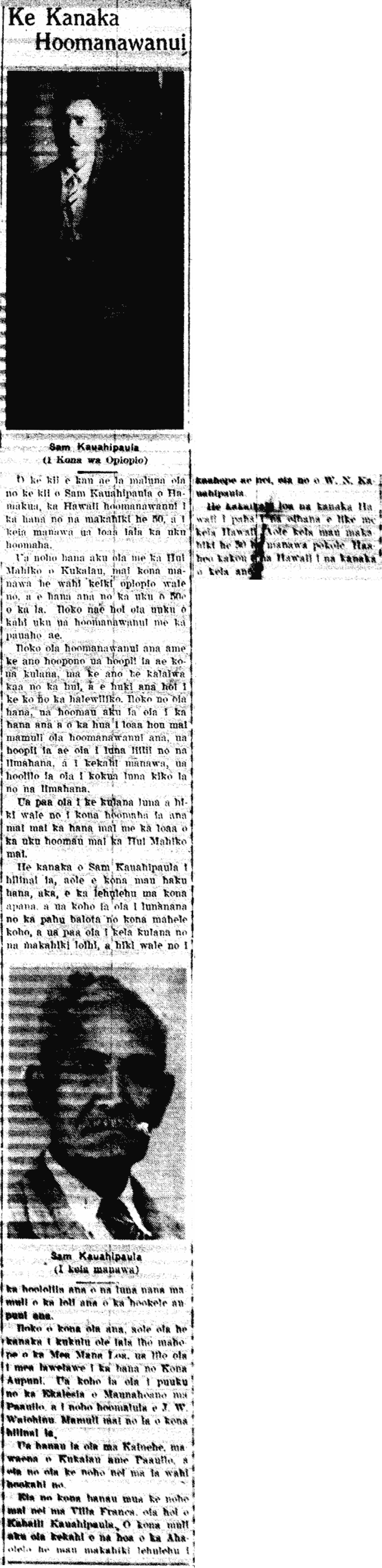
Sam Kauahipaula
(In His Youth)

The picture placed above is a picture of Sam Kauahipaula of Hamakua, a man who patiently worked for 50 years, and who currently is receiving retirement pay.

He worked at the Kukaiau Sugar Plantation from when he was just a young boy and worked for the pay of 50¢ a day. Although receiving such a pittance, he worked patiently without giving up.

While putting up with adversity and having a good attitude, he was promoted to company driver, where he hauled cane to the mill. He continued at working at this position and the fruit of his patience was that he was promoted to sub-foreman [luna liilii] in charge of the laborers, and at a certain point, he was made assistant timekeeper [kokua luna kiko la] for the workers.

He held on to the position of foreman until he was retired, whereupon he received a pension from the sugar plantation company.

Sam Kauahipaula was a trusted man, not by his bosses, but by the people of his area, and he was chosen as the inspector of elections of his voting district, and he held that position for a great many years, until …

Sam Kauahipaula
(At this time)

the inspectors of election were changed because of the change in government leadership.

Throughout his life, he was never a man that did not put himself behind the Almighty, and became a servant of His Kingdom. He was elected as treasurer of Maunahoano Church in Paauilo that was presided over by J. W. Waiohinu. This is because he was trusted.

He was born in Kainehe, between Kukaiau and Paauilo, and he still lives at the same place now.

His first born, Kahaili Kauahipaula, is living in Villa Franca [Villafranca]. The next born was a member of the Legislature for a number of years gone by, that being W. N. Kauahipaula [W. N. K. Kauahipaula was of the Home Rule Party]

There are very few Hawaiians who continued at a profession like this Hawaiian. 50 years is not a short period of time. Let us Hawaiians be proud of that kind of man.

(Aloha Aina Hoku o Hawaii, 6/12/1940, p. 1)

Ke Kanaka Hoomanawanui

Ke Aloha Aina Hoku o Hawaii, Volume XXXV, Number 7, Page 1. Mei Iune 12, 1940.

And yet more on Aberahama Kaikioewa Palekaluhi, 1912.

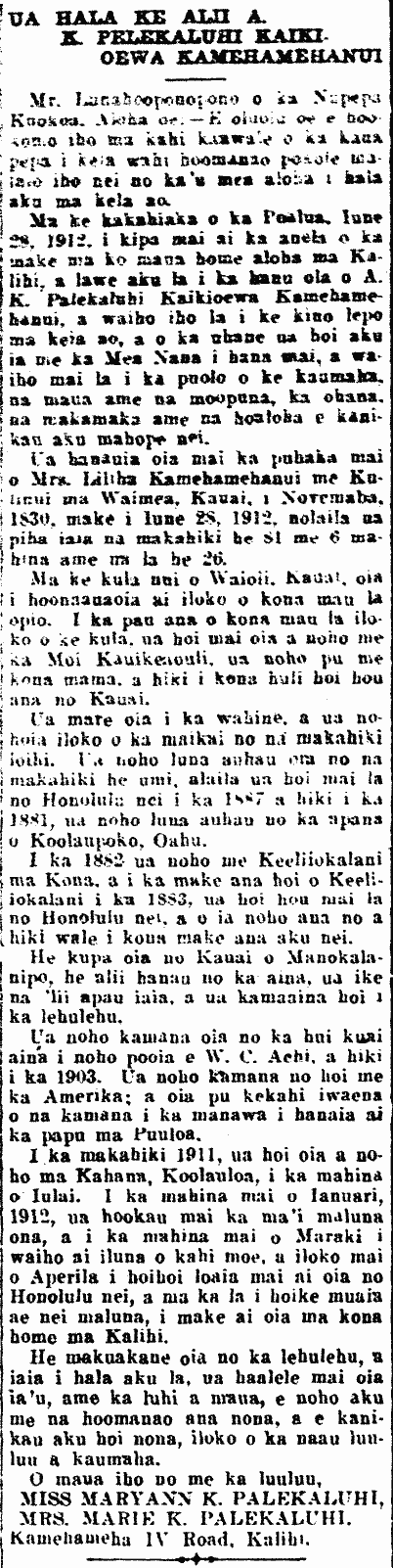
THE ALII HAS GONE, A. K. PELEKALUHI KAIKIOEWA KAMEHAMEHANUI

Mr. Editor of the Newspaper Kuokoa. Aloha to you:—Please be so kind as to insert in some open space in our paper, this short remembrance below for my beloved who passed over to that world.

On the morning of Tuesday, June 28 [?], 1912, the angel of death visited our beloved home in Kalihi, and took the living breath of A. K. Palekaluhi Kaikioewa Kamehamehanui, and left his earthly body here in this world, and his soul returned to the One who created it, leaving the bundle of sadness behind for us and the grandchildren, the family, the intimates, and friends to grieve over.

He was born from the loins of Mrs. Liliha Kamehamehanui and Kulinui at Waimea, Kauai, on the 1st of November, 1830, and died on June 28, 1912; therefore, he was 81 years and 6 months, and 26 days old.

He was educated at the college of Waioli, Kauai, in his youth. After his days at that school were over, he returned to live with the King Kauikeaouli; he lived with his mother until he went back to Kauai.

He married his wife, and they lived well for a great many years. He was employed as a tax assessor for ten years and then returned to Honolulu in 1887 [?] until 1881, and was the tax assessor for the district of Koolaupoko, Oahu.

In 1882, he resided with Keelikolani in Kona, and at her death in 1883, he came back to Honolulu and remained there until his recent death.

He was a native of Kauai of Manokalanipo, and a hereditary chief which all the alii knew of and also the general public was familiar with him.

He worked as a carpenter for the real estate company headed by W. C. Achi until 1903. He worked as a carpenter for America, and he was one of the carpenters when the fort at Puuloa was being built.

In 1911, he went back to live at Kahana, Koolauloa, in the month of July. From January 1912, he became ill and in March he was bedridden, and then in April he was brought back to Honolulu, and on the day shown above he died at his home in Kalihi.

He was a father for the multitudes, and with his passing, he leaves me and our child with memories of him, and grieving for him, with a sad and heavy heart.

We with grief,

MISS MARYANN K. PALEKALUHI,

MRS. MARIE K. PALEKALUHI.

Kamehameha IV Road, Kalihi.

(Kuokoa, 7/12/1912, p. 6)

UA HALA KE ALII A. K. PELEKALUHI KAIKIOEWA KAMEHAMEHANUI

Ka Nupepa Kuokoa, Buke XLVIII, Helu 28, Aoao 6. Iulai 12, 1912.

Even more on Aberahama Kaikioewa Palekaluhi (if it could be read), 1912.

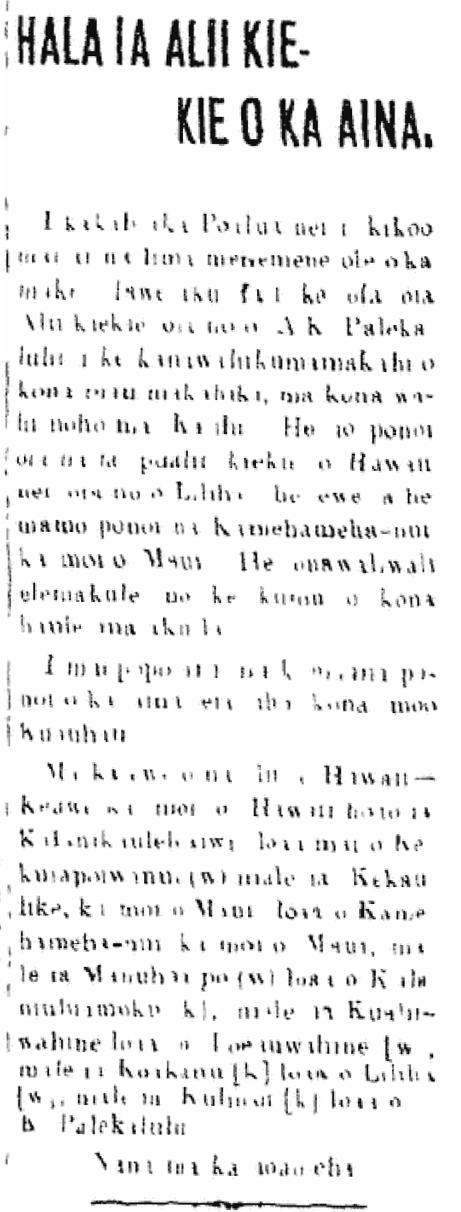
THAT HIGH CHIEF OF THE LAND HAS GONE.

On Tuesday morning the merciless hand of death stretched out and took the life of that high chief, A. K. Palekaluhi at eighty-one years of life, at his residence in Kalihi. He is a true high chiefly descendant of Hawaii, of Liliha, who is of the lineage and a descendant of Kamehameha Nui, the king of Maui. His died because of the infirmities of old age.

To understand @@@@@, here is his genealogy.

In the lineage of the alii of Hawaii—Keawe, the king of Hawaii wed with Kalanikauleleiaiwi and born was Kekuiapoiwanui (f) who married [male] Kekaulike (m), the king of Maui, and born was Kamehameha Nui, the king of Maui, who married Manuhaaipo (f) and born was Kalaniuluamoku (m), who married Kualiiwahine and born was Loeauwahine (f), who married Koakanu (m) and born was Liliha (w) who married Kulinui (m) and born was A. K. Palekaluhi.

See page four.

[If you look below, most of this first column is hard to decipher, and much of the volunteer input would have likely been @@@@@ @@@@@. Hopefully people will think seriously about how much priceless information will be lost if the original newspapers are not clearly photographed before typescripts are done.]

(Kuokoa Home Rula, 5/31/1912, p. 1)

HALA IA ALII KIEKIE O KA AINA.

Kuokoa Home Rula, Buke X, Helu 22, Aoao 1. Mei 31, 1912.

THAT HIGH CHIEF OF THE LAND HAS GONE

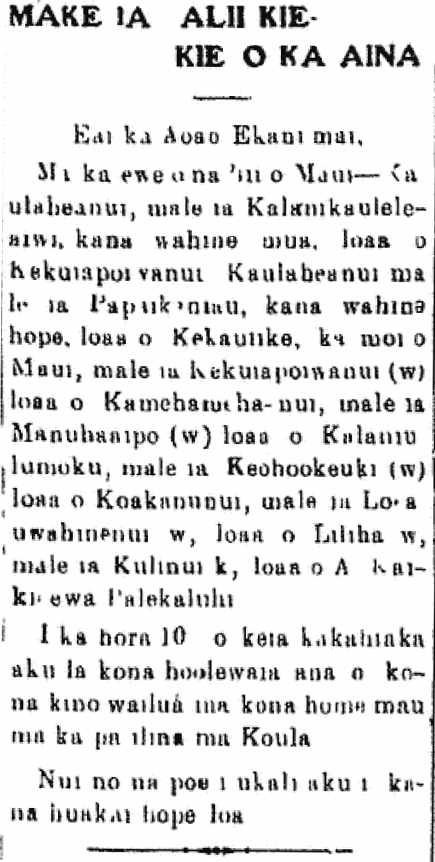
From Page One.

In the lineage of the alii of Maui—Kaulaheanui married Kalanikauleleaiwi, his first wife, and born was Kekuiapoiwanui. Kaulaheanui married Papaikaniau, his following wife, and born was Kekaulike, the king of Maui, who married Kekuiapoiwanui (f), and born was Kamehameha Nui, who married Manuhaaipo (f) and born was Kalaniulumoku who married Keohookeuki (f), born was Koakanunui who married Loeauwahinenui (f), and born was Liliha (f), who married Kulinui (m), and born was A. Kaikioewa Palekaluhi.

At 10 o’clock this morning, was the funeral over his remains at his eternal home at the cemetery at Koula.

There were many people who joined his last procession.

[It is interesting to see how different newspapers have different information in their coverage of the same event!]

(Kuokoa Home Rula, 5/31/1912, p. 4)

MAKE IA ALII KIEKIE O KA AINA

Kuokoa Home Rula, Buke X, Helu 22, Aoao 4. Mei 31, 1912.