New Hawaiian Language Textbook, 1939.

Hawaiian Language Book

A BOOK EDITED BY HENRY P. JUDD

A book completed in the Hawaiian language is being published by the press next month.

It was written by Rev. Henry P. Judd (Kauka), a professor of the Hawaiian language at the University of Hawaii.

The writing and editing took two years, and it was 30 years of learning and practicing of the language.

Kauka (Judd) says there are three sections to this book. The first part is the studying and the giving of rules of Hawaiian expression; the second is reading lessons; and the third is the translation of 3,000 words.

Mr. Judd has taught and travelled here and there in the islands obtaining what he was after. His kupuna came to Hawaii nei 111 years ago, and therefore, he has the appropriate place for his work. Every Sunday, he gives his sermons in Hawaiian to Hawaiians in Kaneohe.

He gained his knowledge and proficiency in the Hawaiian language through his becoming a translator [Maheleolelo] in the courts, the [Evangelical] Conferences, and other gatherings.

This book is being published by the Newspaper Company of Honolulu, that is the Star-Bulletin of Honolulu.

With Mr. John F. G. Stokes, one of the first trustees of the Bishop Museum, Mr. Judd is now in the process of making a word list in English and Hawaiian, which will be completed in a few months.

[This is referring to the book: Judd, Henry P. The Hawaiian language. Honolulu: Honolulu Star-Bulletin, Ltd., 1939.]

(Hoku o Hawaii, 7/26/1939, p. 1)
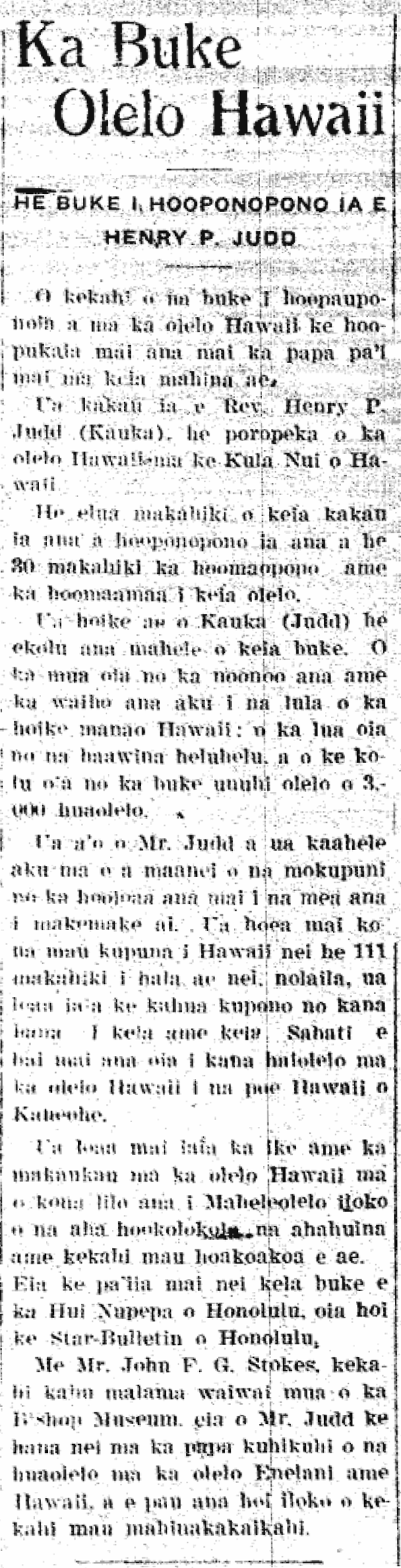
Ka Buke Olelo Hawaii

Ka Hoku o Hawaii, Volume XXXIV, Number 13, Aoao 1. Iulai 26, 1939.
Another “Memoirs of Obookiah” translation, 1867.

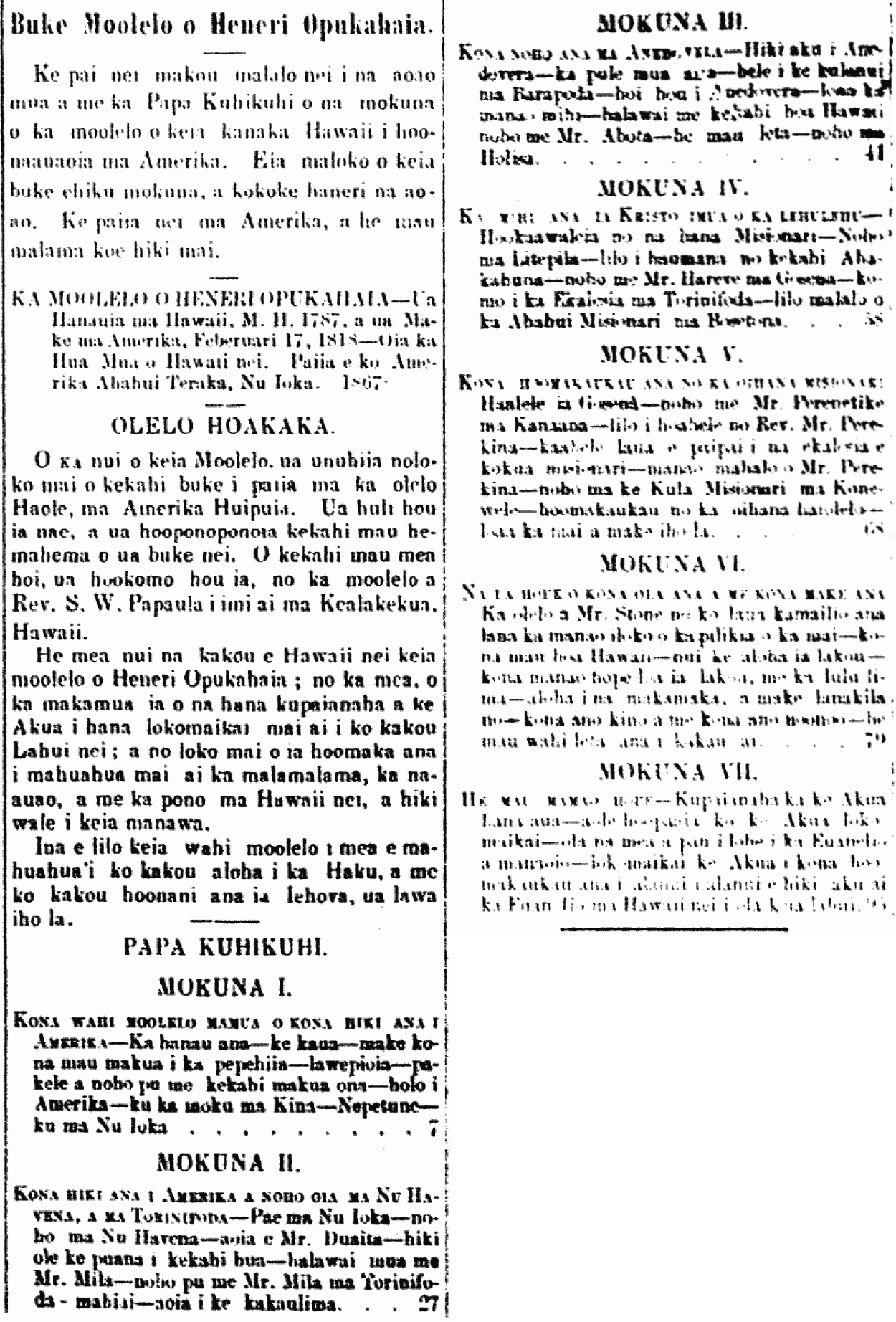
Book of the Moolelo of Heneri Opukahaia.

We are printing below the first pages of and the Table of Contents of the Chapters of the story of this Hawaiian that was educated in America. In this book is seven chapters, and it is almost a hundred pages. It is being printed in America and it will be here in a few more months.

THE STORY OF HENERI OPUKAHAIA—Born in Hawaii, A. D. 1787, and Died in America, February 17, 1818—The First Fruit of Hawaii nei. Printed by the American Tract Society [Amerika Ahahui Teraka], New York, 1867.

INTRODUCTION.

The majority of this Moolelo was translated from a book published in English in the United States of America. However, information was researched, and some of the errors of the book was corrected. Some things were added from the moolelo that Rev. S. W. Papalua investigated at Kealakeakua, Hawaii.

This story of Heneri Opukahaia is something important to us Hawaiians; for this is the first of the miracles that God performed benevolently upon our People; and through this start, the enlightenment, the knowledge, and the righteousness of Hawaii has increased until this day.

Should this moolelo become something which increases our love for God and our glorification of Jehovah, that will be enough…

[A couple of years later in 1867, the original translation was appended to and corrected with the information collected by that same S. W. Papaula of Napoopoo, and published in book form under the title: “KA MOOLELO O HENERI OPUKAHAIA, UA HANAUIA MA HAWAII, M. H. 1787, A UA MAKE MA AMERIKA, FEBERUARI 17, 1818. OIA KA HUA MUA O HAWAII NEI.”]

(Kuokoa, 5/18/1867, p. 3)

Buke Moolelo o Heneri Opukahaia.

Ka Nupepa Kuokoa, Buke VI, Helu 20, Aoao 3. Mei 18, 1867.

More on Liliu’s marriage, 1862.

I was engaged to Mr. Dominis for about two years and it was our intention to be married on the second day of September, 1862. But by reason of the fact that the court was in affliction and mourning, our wedding was delayed at the request of the king, Kamehameha IV., to the sixteenth of that month; Rev. Dr. Damon, father of Mr. S. M. Damon, at present the leading banker of the Islands, being the officiating clergyman. It was celebrated at the residence of Mr. and Mrs. Bishop, in the house which had been erected by my father, Paki, and which, known as the Arlington Hotel [Haleakala], is still one of the most beautiful and central of the mansions in Honolulu. To it came all the high chiefs then living there, also the foreign residents; in fact, all the best society of the city.

[This is what Queen Liliuokalani had to say about her marriage in Hawaii’s Story by Hawaii’s Queen, first published in 1898. Mahalo to Heather Wilkinson Rojo for her response on the previous post, saying she posted an image of their marriage certificate on her blog. This is one of the many priceless treasures cared for by the Bernice Pauahi Bishop Museum!]

(Hawaii’s Story by Hawaii’s Queen, 1988. p. 22.)

On the importance of maintaining connections, 1874.

Blessed are the Hawaiians.—In the past months of this year, a certain good woman of this town gathered together all sorts of Hawaiian newspapers and books, and sent them by way of a friend to Oregon for Hawaiians living amongst that unfamiliar people. And just recently in the past few weeks, this good woman of town received a barrel of salmon from the Hawaiians of Oregon with words like this: We are presenting you with this small gift, along with our warm aloha. We are delighted to see the Newspapers and Books you sent by way of _________.

(Lau Oliva, 12/1874, p. 1)

Lokomaikai ka Hawaii Maoli.

Ka Lau Oliva, Buke IV, Helu 12, Aoao 1. Dekemaba 1874.

A music book gifted to the Honorable Lilia K. Dominis, 1868.

[Found under: “LOCAL NEWS: Oahu”]

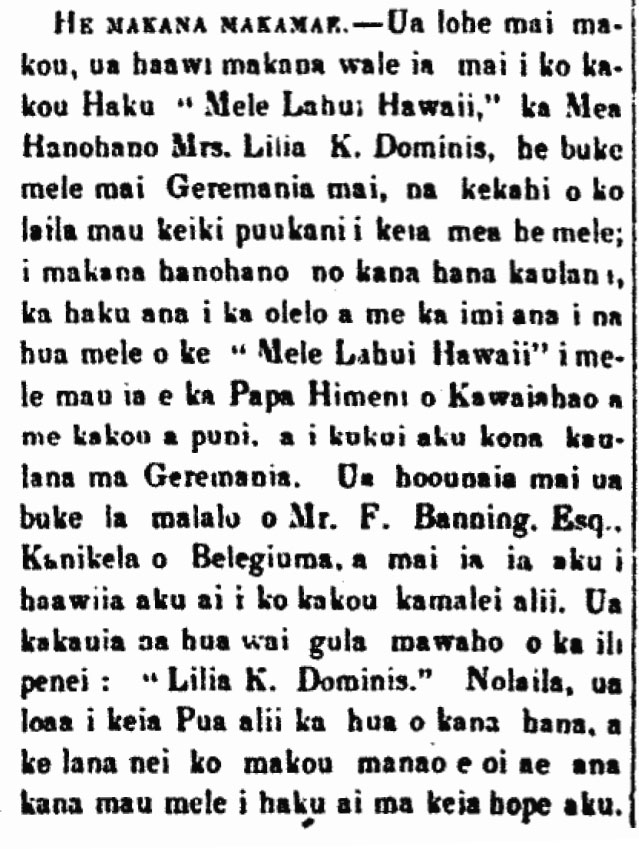
A Precious Gift.—We have heard that our Composer of “Mele Lahui Hawaii,” the Honorable Mrs. Lilia K. Dominis, was gifted a music book from Germany, by one of their singers; it was presented with honor for her famous accomplishment: the composition of the lyrics and the searching for the music of “Mele Lahui Hawaii,” which is sung all the time by the choir of Kawaiahao and by all of us everywhere and its fame has been heard of in Germany. The book was sent by way of Mr. F. Banning, Esq., Consul of Belgium, to our precious alii. Printed in gold lettering on the cover was: “Lilia K. Dominis.” This young alii has thus received the fruits of her labors, and we hope that there will be more of her compositions here after.

[Anyone know what this book is and where it is located today?]

(Kuokoa, 3/28/1868, p. 2)

He Makana Makamae.

Ka Nupepa Kuokoa, Buke VII, Helu 13, Aoao 2. Maraki 28, 1868.

Book of the story of Leinaala, 1891.

[Found under: “Hawaii News.”]

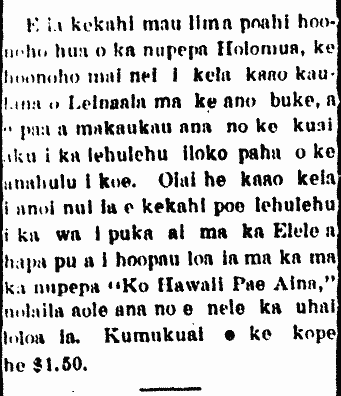
There are some typesetters of the [Hawaii] Holomua Newspaper setting type of that famous kaao, Leinaala, as a book; it will be ready and for sale to the public perhaps within ten days [anahulu]. Being that this was a story that was beloved by many people when it was published half in the “Elele” and finished in the newspaper “Ko Hawaii Pae Aina,” it will certainly be much sought after. The cost per copy is $1.50.

[Does anyone know of any library where this book might be found?]

(Kuokoa, 8/29/1891, p. 3)

E ia kekahi mau lima poahi hoonoho hua...

Ka Nupepa Kuokoa, Buke XXX, Helu 35, Aoao 3. Augate 29, 1891.

Recipes brought to you by Royal Baking Powder, 1920.

Royal Baking Powder Biscuits

There is nothing to compare for breakfast, lunch, or tea; it is easy to make with the help of

ROYAL

Baking Powder

ABSOLUTELY PURE

Here is the recipe for Royal Baking Powder Biscuits—famous around the world—clip this out and try them. But use Royal Baking Powder. Cheap substitutes won’t do. Only by using Royal, will you see the proper results which made Royal famous around the world.

Biscuits [Palaoa Liilii]

2 cups flour
4 teaspoons Royal Baking Powder
1/2 teaspoon salt
2 tablespoons shortening
3/4 cup milk or half milk and half water

Sift together flour, baking powder and salt, add shortening and rub in very lightly; add liquid slowly; roll or pat on floured board to about one inch in thickness (handle as little as possible); cut with biscuit cutter. Bake in hot oven 15 to 20 minutes.

Here is a fine recipe for Cheese Biscuits:

Cheese Biscuits [Palaoa Waiupaa]

1-1/2 cups flour
2 teaspoons Royal Baking Powder
1/4 teaspoon salt
1 teaspoon shortening
6 tablespoons grated cheese
5/8 cup milk

Sift together flour, baking powder and salt; add shortening and cheese; mix in lightly; add milk slowly, just enough to hold dough together. Roll out on floured board about 1/2-inch thick; cut with biscuit cutter. Bake in hot oven 12 to 15 minutes.

Level off all measurements.

In many of the recipes, there are a lot of eggs; you will however get fine results if you lessen the eggs by half and add one teaspoon of Royal Baking Powder in place of each egg left out.

Write for the Free Recipe Book. A recipe book that is economical with eggs and other expensive material will be sent by mailbag at no cost. Write to

Royal Baking Powder Co., 135 William St., New York, U. S. A.

[These recipes were part of a series of ads in the Kuokoa (and in papers across the United States as well). It is a good way to get cooking descriptions in Hawaiian!

The English for the main parts of the recipes came from “The New Royal Cookbook” put out by the Royal Baking Powder Company in 1920 (which is the cookbook mentioned in this ad which they are giving away free if you mail away for it). It is provided online by Project Gutenberg!]

(Kuokoa, 3/12/1920, p. 3)

Palaoa Liilii Royal Baking Powder

Ka Nupepa Kuokoa, Buke LVIII, Helu 11, Aoao 3. Maraki 12, 1920.

“All subjects were handled for what he believed to be the best interests of the Hawaiians…” 1902.

Ka ʻOihana Lawaiʻa: Hawaiian Fishing Traditions

Ka ʻOihana Lawaiʻa: Hawaiian Fishing Traditions

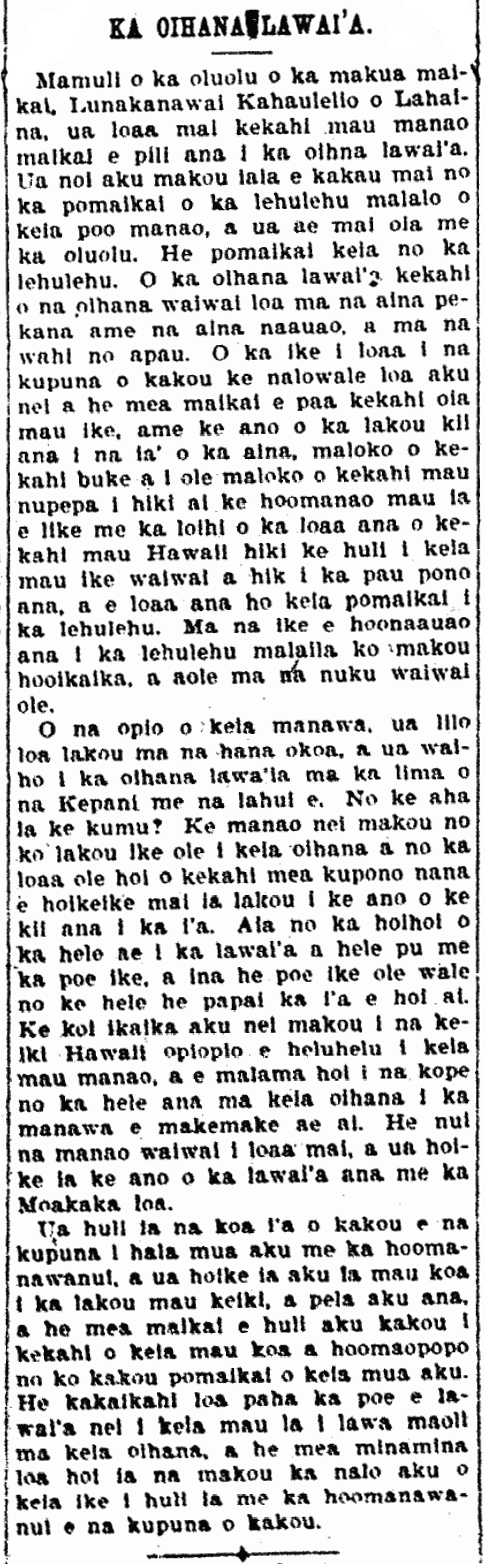
If you haven’t seen this book on fishing and so much more by Daniela Kahaulelio yet, it is one of the stories David Kanewanui, editor of the Kuokoa, knew was important for him to print for the youths of his time, and perhaps more importantly, for those of today and tomorrow. Kanewanui writes:

“…O ka ike i loaa i na kupuna o kakou ke nalowale loa aku nei a he mea maikai e paa kekahi oia mau ike, ame ke ano o ka lakou kii ana i na ia o ka aina, maloko o kekahi buke a i ole maloko o kekahi mau nupepa i hiki ai ke hoomanao mau ia e like me ka loihi o ka loaa ana o kekahi mau Hawaii hiki ke huli i keia mau ike waiwai a hik i ka pau pono ana, e loaa ana no keia pomaikai i ka lehulehu. Ma na ike e hoonaauao ana i ka lehulehu malaila ko makou hooikaika, a aole ma na nuku waiwai ole.”

“The knowledge possessed by our kupuna is disappearing, and it is good to record some of that knowledge, along with how they caught the fish of the land, within a book or within some newspapers, so that they can always be recalled as long as there are Hawaiians who can seek this treasured knowledge until it is exhausted, and its benefits will be for all. Through knowledge will the public be educated, and this is our focus, and not worthless complaining.”

(Kuokoa, 2/28/1902, p. 2)

KA OIHANA LAWAIA

Ka Nupepa Kuokoa, Buke XL, Helu 9, Aoao 2. Feberuari 28, 1902.

Bound years of the Kuokoa for sale, 1865.

BOUND KUOKOA.

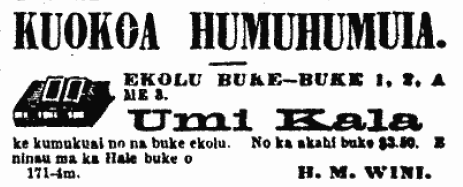
THREE BOOKS—VOLUMES 1, 2 AND 3.

Ten Dollars

is the price for the three books. For one book is $3.50. Inquire at the Book store of H. M. WHITNEY [H. M. WINI].

[For a fee, you could take your year of newspapers to be bound at the end of the year, or they would be sold bound like these Kuokoa. Thanks the this binding, we are left with many full sets of newspapers! However, when they microfilmed the bound newspapers years ago, many were so tightly sewn that the bound side of the pages are illegible because they fall in a shadow. Hopefully funding can be found to have these newspapers unbound by an expert so the pages can be photographed clearly!]

(Kuokoa, 3/16/1865, p. 3)

KUOKOA HUMUHUMUIA.

Ka Nupepa Kuokoa, Buke IV, Helu 11, Aoao 3. Maraki 16, 1865.

Hawaii’s Story by Hawaii’s Queen, in the Hawaiian Language, 1898.

WE WILL SATISFY.

Because we are constantly asked by our readers to print the story which our Queen wrote in Washington and that was just published in Boston, therefore, we are spreading the news to our readership that we will translate and print the story in the columns of the newspapers the daily and weekly Ke Aloha Aina, on the first week of this coming month for the benefit of our readers. Therefore, do take up Ke Aloha Aina so that you can see the one story written by Queen Liliuokalani and published in foreign lands, with statements full of sentiment and aloha dealing with Her overthrow. Aloha for Her.

(Aloha Aina, 3/19/1898, p. 5)

E HOOKO AKU ANA MAKOU.

Ke Aloha Aina, Buke IV, Helu 12, Aoao 5. Maraki 19, 1898.

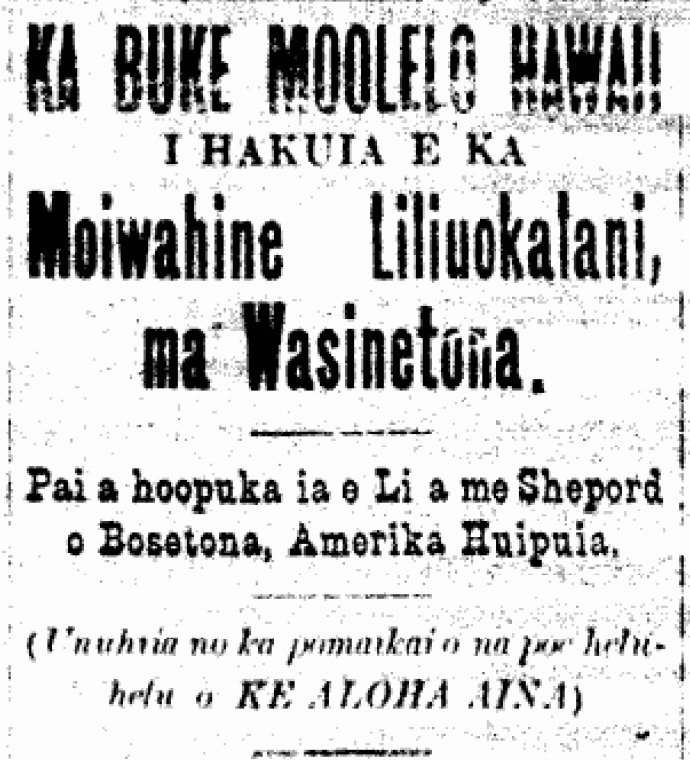
Here, by the way, is what the heading of that running column looked like:

HAWAIIAN HISTORY

WRITTEN BY

Queen Liliuokalani,

in Washington.

Published by Lee and Shepard

of Boston, United States of America.

(Translated for the benefit of the

readers of KE ALOHA AINA)

(Aloha Aina, 4/2/1898, p. 6)

KA BUKE MOOLELO HAWAII

Ke Aloha Aina, Buke IV, Helu 14, Aoao 6. Aperila 2, 1898.