People suspected of having leprosy held in jail, 1872.

The leprosy patients taken to Kalawao!

O Kuokoa Newspaper: Aloha kaua:—

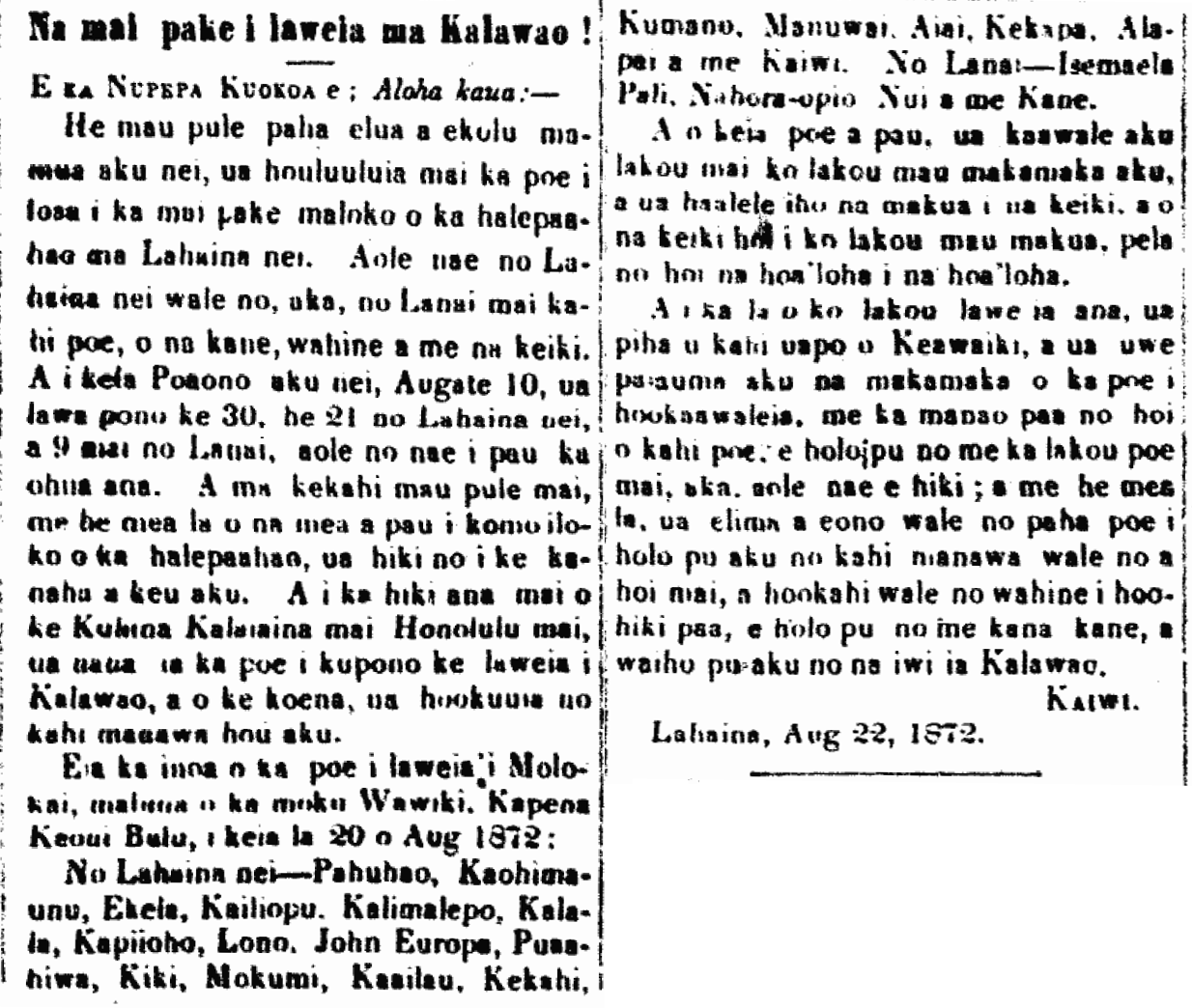
Perhaps some two or three weeks ago, those afflicted with the “Chinese disease” were assembled in the jail here in Lahaina. And it wasn’t just people from Lahaina, but some were also from Lanai: men, women, and children. And on this past Saturday, August 10, they totalled 30; 21 from Lahaina nei and 9 from Lanai; but the gathering is not over. And in the coming weeks, it seems as if the total of all those put in the jail will reach forty or more. And when the Minister of the Interior [Hutchison] arrives from Honolulu, they are examined for those who should go to Kalawao, and the rest are released for another time.

Here are the names of those taken to Molokai aboard the ship Warwick [Wawiki], Captain Keoni Bulu, today, the 20th of Aug. 1872:

From here in Lahaina—Pahuhao, Kaohimaunu, Ekela, Kailiopu, Kalimalepo, Kalala, Kapiioho, Lono, John Europa [? Europe], Puaahiwa, Kiki, Mokumi, Kaailau, Kekahi, Kumano, Manuwai, Aiai, Kekapa, Alapai, and Kaiwi. From Lanai—Isemaela Pali, Nahora opio, Nui, and Kane.

All of these people, they were separated from their companions, and parents left their children, children left their parents, and so too did friends leave friends.

On the day they were taken, the pier of Keawaiki was packed, and the friends of those who were being separated wailed in grief, while some of them were determined to go along with their sick, but that was not possible; and it seemed that there were but five or six who went along for just a while then returned; and there was only one woman who swore that she’d go with her husband and leave her bones in Kalawao.

Kaiwi.

Lahaina, Aug. 22, 1872.

(Kuokoa, 8/31/1872, p. 2)
Na mai pake i laweia ma Kalawao!

Ka Nupepa Kuokoa, Buke XI, Helu 35, Aoao 2. Augate 31, 1872.
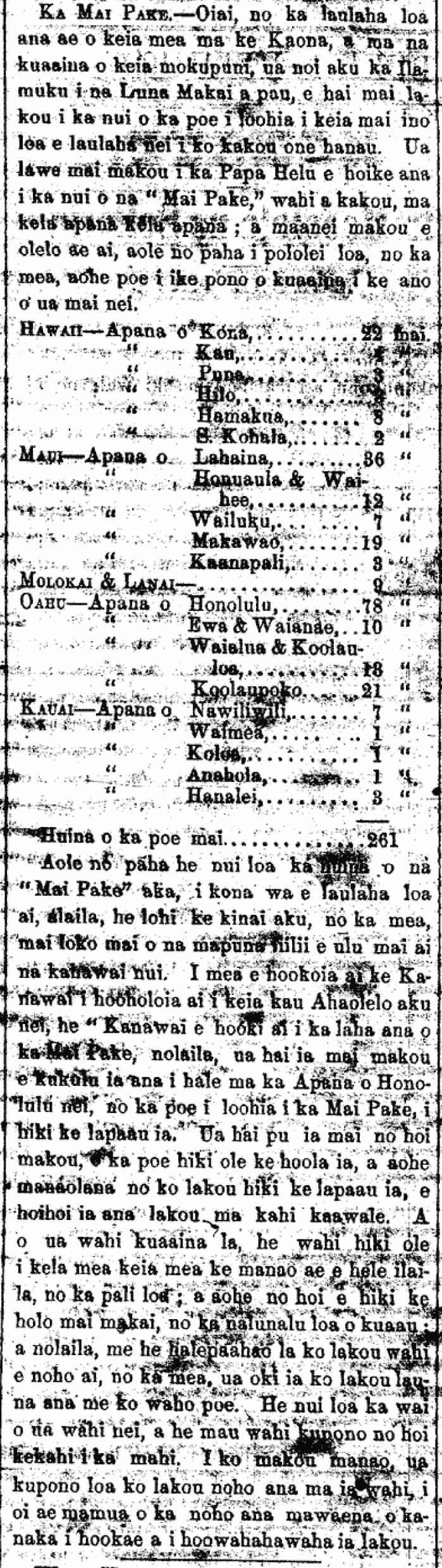
The “Chinese Disease,” 1865.

Leprosy [Mai Pake]—As this is greatly spreading about Town and in the country of this island, the Sheriff [Ilamuku ?] has requested that all of the District Sheriffs [Luna Makai ?] to report the number of people inflicted with this horrible sickness that is spreading in our homeland. We have taken the List showing the number of “Chinese Disease,” as we call it, in each district; and we say here that this is probably not accurate, because there is no one in the country who knows for certain what the symptoms are.

Hawaii—District of Kona, . . . 22 sick.
” of Kau, . . . 4 ”
” of Puna, . . . 3 ”
” of Hilo, . . . 3 ”
” of Hamakua, . . . 8 ”
” of S. Kohala, . . . 2 ”
Maui—District of Lahaina, . . . 36 ”
” of Honuaula & Waihee, . . . 12 ”
” of Wailuku, . . . 7 ”
” of Makawao, . . . 19 ”
” of Kaanapali, . . . 3 ”
Molokai & Lanai— . . . 9 ”
Oahu—District of Honolulu, . . . 78 ”
” of Ewa & Waianae, . . . 10 ”
” of Waialua & Koolauloa, . . . 18 ”
” of Koolaupoko, . . . 21 ”
Kauai—District of Nawiliwili, . . . 7 ”
” of Waimea, . . . 1 ”
” of Koloa, . . . 1 ”
” of Anahola, . . . 1 ”
” of Hanalei, . . . 3 ”
Total of sick . . . 261
Maybe the total of the number of “Mai Pake” is not so great, but when it truly spreads, then it will be too late to extinguish, for it is from tiny springs which great rivers grow forth. In order to comply with the law which was passed this last session of the legislature, “An Act to Prevent the Spread of Leprosy,” we are told that structures will be built here in Honolulu for those inflicted with leprosy so that they may be treated. We are also told that for those who are incurable, and for those for whom there is no hope in treating, they will be sent to a place set apart. And that country side will be a place that no one will think about going to, because of great cliffs; and it cannot be accessed by sea because of the rough conditions of the lagoon. So where they live will be like a prison, for their association with those on the outside will be cut off. There is much water there, and it is also a place suitable for farming. In our opinion, it is better for them to live there than for them to live amongst people who hate and scorn them.
(Au Okoa, 6/26/1865, p. 2)
Ka Mai Pake

Ke Au Okoa, Buke I, helu 10, Aoao 2. Iune 26, 1865.

The latest from Kalawao, 1909.

News From the Land of the Suffering.

To the Editor of the Aloha Aina Newspaper, Aloha:

Please allow my small parcel a space in your newspaper which is greatly enjoyed, and that is what is down below; let the paper take it proudly around so that our multitudes of friends may see.

Movies come regularly every Wednesday, and are shown on the evenings of Wednesday, Thursday, and Friday; and every Saturday in Honolulu. There has been a building erected for the patients to watch the movies. The patients are thrilled. They donated money to buy a first-class phonograph [pahu olelo]. They are very happy with singing, the sweet sound of the strings and the blare of the brass instruments.

There was an announcement made to the ones without the sickness or those partially afflicted that wanted to be examined by the Doctors who are coming into the settlement.

Some went to sign up, and some just looked on because they did not want to go back to where they came from, being there might be difficulties waiting ahead for them. And because of the small number of those going to sign up, the Superintendent of the settlement ordered someone to go to the houses to sign people up; the total of those people number 58, but I don’t have their names; the only names I have are those who went to sign up, and they number 55, along with their doctor.

THE PEOPLE WHOSE DOCTOR IS DR. WAYSON

[Names difficult to make out.]

THE PEOPLE WHOSE DOCTOR IS DR. GOODHUE.

The Men

[Names difficult to make out.]

The Women

[Names difficult to make out.]

The total number told to the writer is 108. This includes the people chosen by the Legislature [?]

With much aloha for my Lahui.

Sincerely,

S. K. MAIALOHA.

Kalawao, Molokai, Aug. 2, 1909

[Here is just another example of why the original newspapers need to be reshot clearly before the acid in the paper consumes all of the words, leaving us with crumbs…]

(Aloha Aina, 9/4/1909, p. 3)

Na Mea Hou o ke Kahua Ma'i.

Ke Aloha Aina, Buke XIV, Helu 36, Aoao 3. Sepatemaba 4, 1909.

Hawaiian with leprosy sent back from California? 1906.

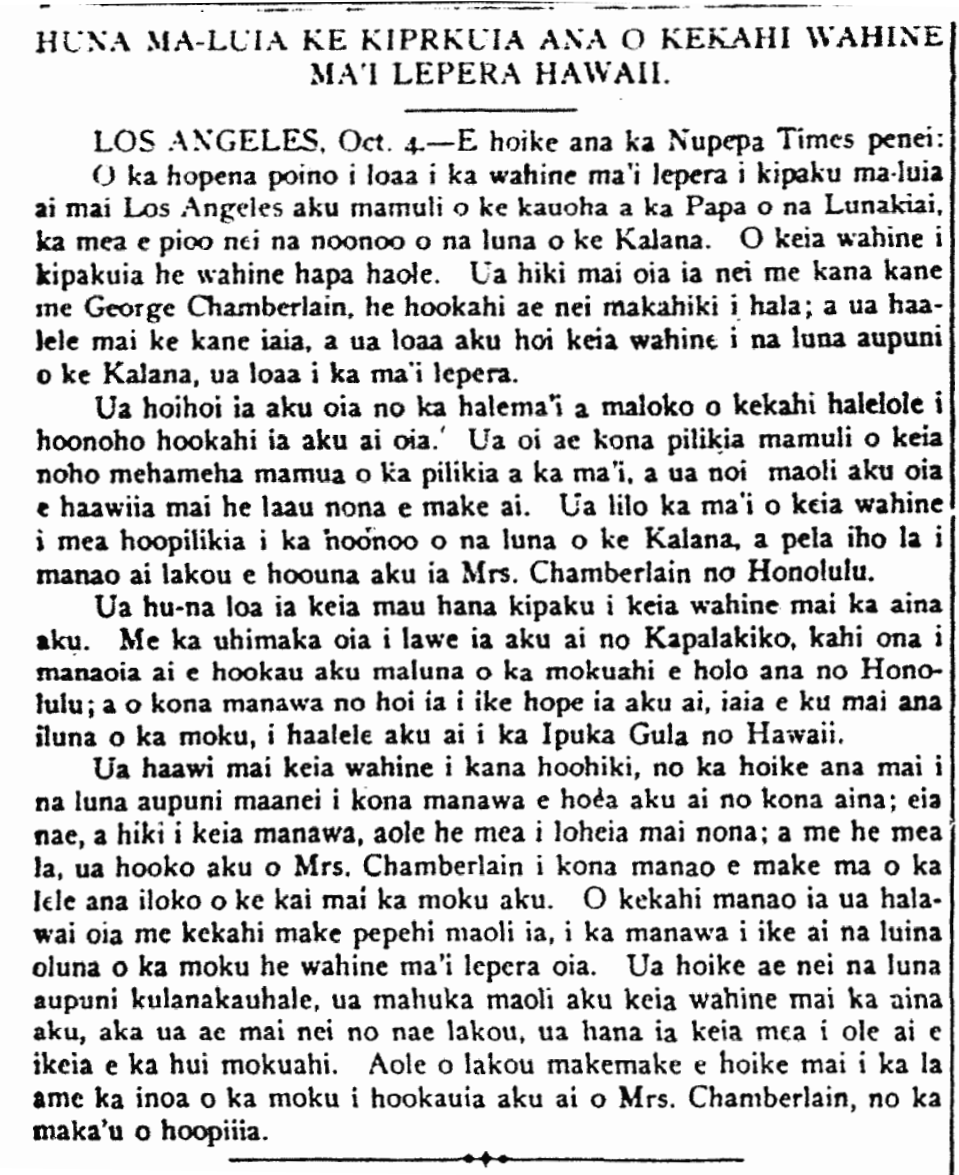
THE DEPORTATION OF A HAWAIIAN WOMAN WITH LEPROSY IS KEPT SECRET.

LOS ANGELES, Oct. 4.—The Times Newspaper reported thus:

The sad fate of a woman with leprosy deported secretly from Los Angeles because of an order by the Board of Supervisors [Papa Lunakiai] is what has gotten the heads of the County perturbed. This woman that was sent away is a hapa haole. She arrived with her husband, George Chamberlain, one year ago; her husband left her, and this woman was found with leprosy by the government officials of the County.

She was sent to the hospital and she was kept alone in a laundry room. She was more troubled by being kept in solitary more than by the disease, and she pleaded them to give her a medicine to kill her. This woman’s ailment was something that was problematic for the heads of the County, and so they decided to send Mrs. Chamberlain to Honolulu.

This deportation from the land was kept a strict secret. She was sent blindfolded to San Francisco, where she was to be put aboard a steamship for Honolulu; and that was the last time she was seen, as she stood atop the ship leaving the Golden Gate for Hawaii.

She gave her word that she would present herself to the government officials here when she arrived in her land; however, until this moment, there has been nothing heard from her; and it would seem that Mrs. Chamberlain carried out her thought to die by jumping off the ship into the sea. One thought is that she was murdered when the sailors aboard the ship found out that she was afflicted by leprosy. The town officials said that she escaped, but however they admit that this was done so that the ship company would not find out. They do not want to say what day and the name of the ship which Mrs. Chamberlain was placed upon, because they are afraid of being sued.

(Kuokoa, 10/26/1906, p. 6)

HUNA MA-LUIA KE KIPRKUIA ANA O KEKAHI WAHINE MA'I LEPERA HAWAII.

Ka Nupepa Kuokoa, Buke XLV, Helu 43, Aoao 6. Okatoba 26, 1906.

Poi made from wheat flour in Kalawao and Kalaupapa, 1879.

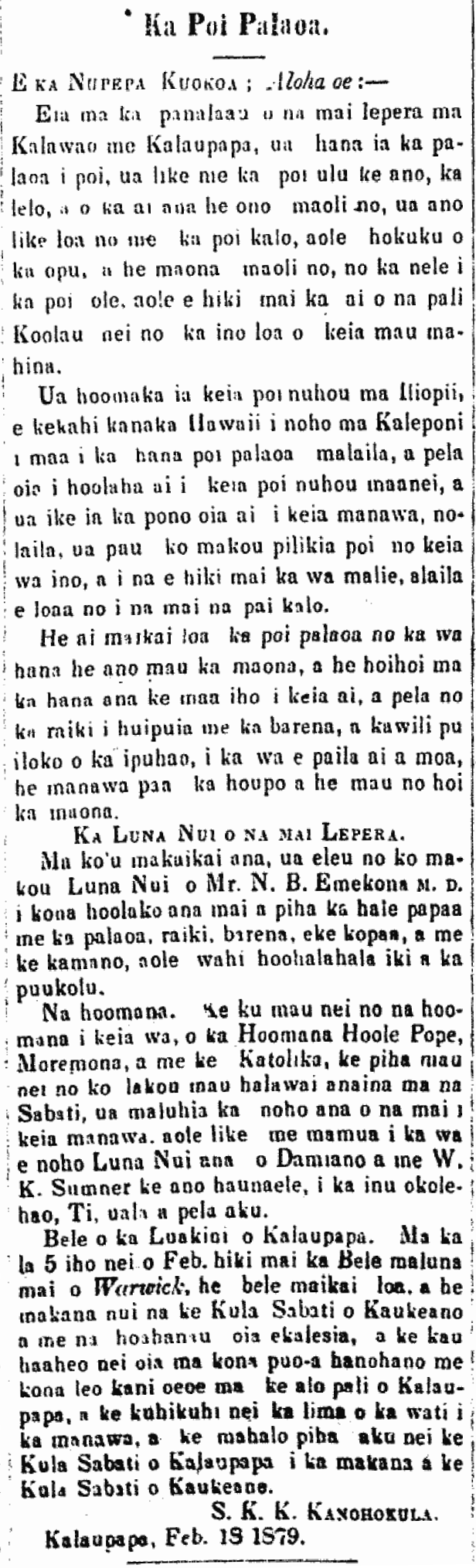
Poi Palaoa.

O Kuokoa Newspaper; Aloha oe:—

Here in the colony of the leprosy patients in Kalawao and Kalaupapa, flour is used to make poi [poi palaoa]; it is similar to poi made of breadfruit [poi ulu] in the yellow color, and it is truly delicious; it is a lot like taro poi [poi kalo]: your stomach doesn’t get sore, and you become full indeed; we have no poi because the taro won’t arrive to these Koolau cliffs because of the terrible weather during these months.

This new poi began at Iliopii, by a Hawaiian who lived in California who was used to making it there, and that is how he spread this new poi here; and the benefits of this poi is now known, and therefore, our poi problems are over during this stormy period, and should calm weather return, the patients will get their paʻi ʻai¹ [pai kalo].

Poi palaoa is very appropriate when working because you stay full, and it is fun to make when you get used to it, and so too with rice mixed with crackers and stirred up in a pot; when it boils and is cooked, it is time for to fill the stomach, and you will be always full.

The Superintendent of the Leprosy Patients.

In my observations, our Superintendent, Mr. N. B. Emerson [Emekona], M. D. is quick with filling the storehouse [hale papaa] with flour [palaoa], rice [raiki], crackers [barena], bags of sugar [eke kopaa], and salmon [kamano]; there is nothing to complain of Kapuukolu.²

Worship. Worship always happens now: Protestants [Hoole Pope], Mormons [Moremona], and Catholics [Katolika]; their meetings on Sundays are always full; life of the patients is peaceful now, not like before when Damien [Damiano] and when W. K. Sumner were Superintendent; there were uprisings from drinking okolehao and other alcoholic drinks made of ti, sweet potato [uala], and so forth.

Bell of the Church of Kalaupapa. On the 5th of Feb., the Bell arrived on the Warwick; a very fine bell which was a gift from the Sunday School of Kaukeano and the brethren of that church; and now it hangs proudly in its honored steeple with its ringing voice in the cliff faces of Kalaupapa, and it points out the movement of the hands of the clock, and the Sunday School of Kalaupapa fully appreciates the gift of the Sunday School of Kaukeano.

S. K. K. Kanohokula.

Kalaupapa, Feb. 18, 1879.

¹Although i tend not to use ʻokina and kahakō, i marked “pai ai” here for added clarity.

²Kapuukolu is a place on Kauai, figuratively used to represent abundance of good food.

(Kuokoa, 3/15/1879, p. 2)

Ka Poi Palaoa.

Ka Nupepa Kuokoa, Buke XVIII, Helu 11, Aoao 2. Maraki 15, 1879.

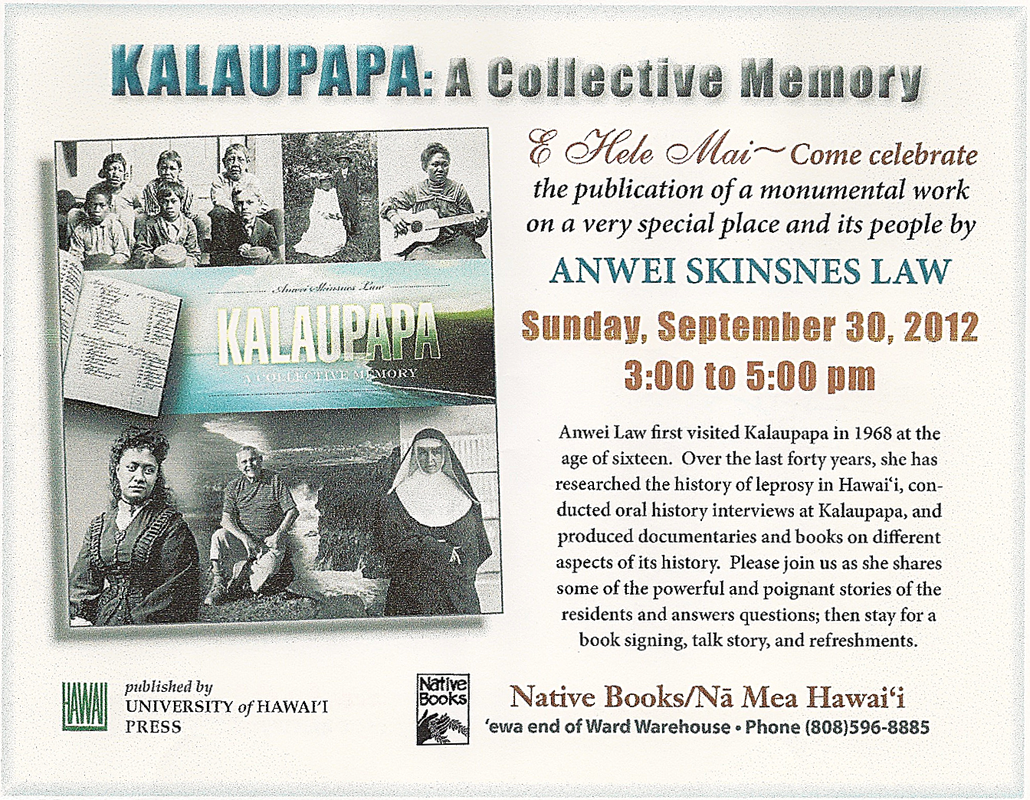
Post Brown Bag: “The People of Kalaupapa as Active Participants in Their Own History.” 2012.

Much appreciation goes out to all the good people at the Center for Biographical Research at UHM! And to Anwei Skinsnes Law and Henry Law for their presentation today!! I came out of it feeling upbeat, and excited that there are people out there looking at Hawaiian-Language source material for a window into the past (outside of the University).

I encourage people to go check out the talk, questions and answers, and book signing put on by Native Books from 3 to 5 in the afternoon this Sunday.

Kalaupapa: A Collective Memory

Kalaupapa: A Collective Memory

Nelson P. Watson’s son dies at Kalaupapa, 1924.

AN EXPRESSION OF LOVE FOR MY DEAR CHILD MANLEY DEDRICK WASTON.

Mr. Solomon Hanohano, Editor of the Newspaper Kuokoa, Aloha oe:—Please be so kind as to insert in some vacant space of your paper, so that the family, intimates, and friends may know that my dearly beloved child, Manley Dedrick Waston has left this life.
He was ill for just a few days, when on the 28th of Friday in the month of this past May at dawn, he grew weary of this life in Kalaupapa, Molokai.
He was born in Kahana, Koolauloa, Oahu on the 27th of December 1906, therefore, he made 17 years, 4 months, and 5 days.
Within one year or so of life after he was born…

MANLEY DEDRICK WATSON

…his mother left him and his two sisters, Lillian and Emma Waston.
From the loins of mine and my wife, there were 4 children: 2 were taken away, and 2 girls are left living. So he was burdened by me without a wife for almost 14 years.
He was separated from me because of the “disease which separates families” [mai hookaawale ohana]. Alas for my grief for my dearly beloved child! My burden that I bear alone; who’d be without aloha; he is with me wherever I go.
Aloha to that blossom who began to bloom but faded soon after!
O Kalaupapa, you all will never see the youthful face of my son again, passing before your faces; I sit with grief and sadness, but I find solace in the Lord Jesus, for he is sleeping in the Lord Jesus, for I know that one day I will be with him again in this body, in that life, and we will kiss, with all of my children, and their mother, after that great terrifying day of Jehovah.
I am grateful for all those who attended his funeral and for all their assistance.
Sincerely,
Nelson P. Watson,
Colburn Street, Honolulu.

(Kuokoa, 6/5/1924, p. 6)

HE HOALOHALOHA NO KUU KEIKI MANLEY DEDRICK WASTON.
Ka Nupepa Kuokoa, Buke LXIII, Helu 23, Aoao 6. Iune 5, 1924.

Commentary on the state of leprosy, 1879.

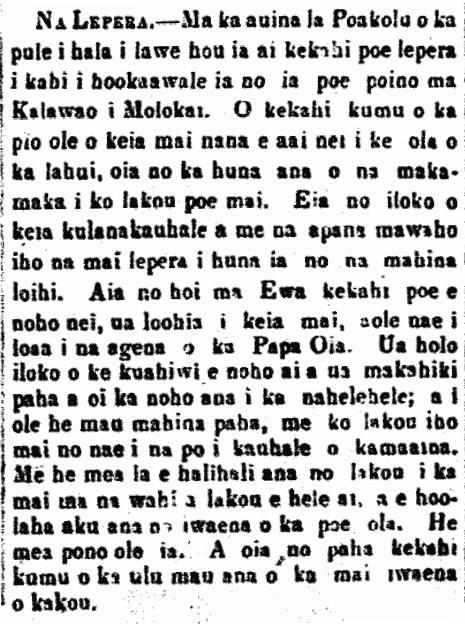
Those with Leprosy.—In the afternoon of this past Wednesday, more leprosy patients were taken to a place set apart for those unfortunate people, at Kalawao, Molokai. One reason for the lack of eradication of this disease eating away at the lives of our people, is that friends hide away their sick. Here in this town and areas right outside are those with leprosy who were hidden for many months. In Ewa there are people living, afflicted with this disease but have not been found by the agent of the Board of Health [Papa Ola]. They went into the mountains to live, and perhaps it has been over a year that they have lived in the forests; or maybe some months, descending to the houses of friends at night. It is as if they are carrying the disease where they go and are spreading it amongst the healthy people. This is not right. And that is perhaps one of the reasons that this disease keeps multiplying between us.

(Kuokoa, 7/19/1879, p. 4)

Na Lepera.

Ka Nupepa Kuokoa, Buke XVIII, Helu 29, Aoao 4. Iulai 19, 1879.

Kalawao bodies exhumed for study, 1884.

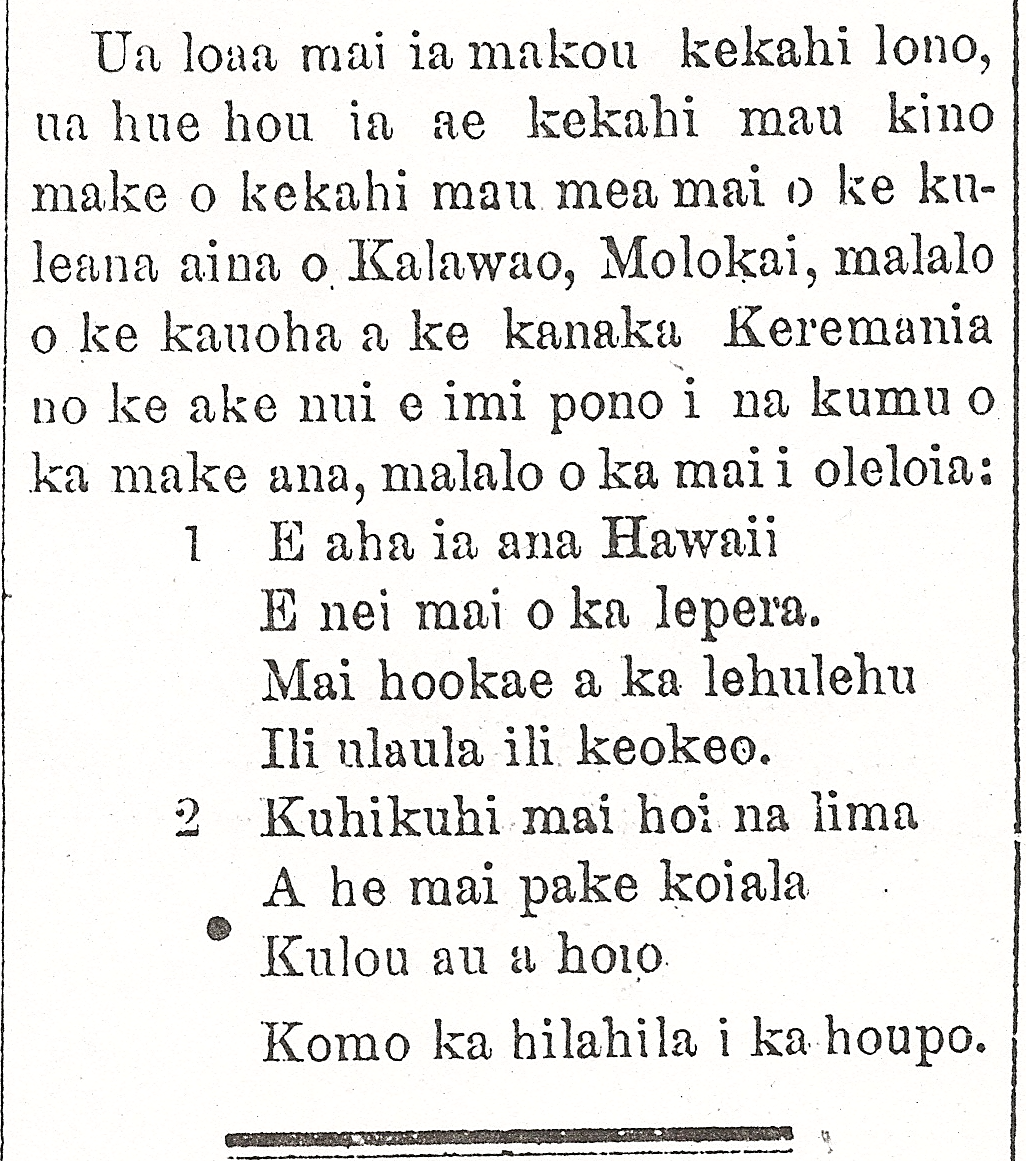
We’ve received word that more bodies were exhumed of patients in Kalawao, Molokai, under the orders of the German [Eduard Arning], because of his great desire to find the reasons for the deaths by the disease of which it is said:

1 E aha ia ana Hawaii
E nei mai o ka lepera.
Mai hookae a ka lehulehu
Ili ulaula ili keokeo.

2 Kuhikuhi mai hoi na lima
A he mai pake koiala
Kulou au a holo
Komo ka hilahila i ka houpo.

[1 What is up with Hawaii
With this disease, leprosy
Disease hated by the masses
By the dark skinned and the white skinned.

2 The hand points this way
“That one there has leprosy [mai pake]”
I look down and flee
Shame filling my heart.]

[“Ke Ola o Hawaii” is yet another newspaper that is available on microfilm that ulukau for some reason chose not to digitize. Hopefully this will be corrected soon!]

(Ola o Hawaii, 3/22/1884, p. 3)

Ua loaa mai ia makou kekahi lono...

Ke Ola o Hawaii, Buke I, Helu 11, Aoao 3. Maraki 22, 1884.

Listing of earliest deaths in Kalawao, 1868.

Those who died of Leprosy

ON MOLOKAI.

O Kuokoa Newspaper; Alohe oe:—

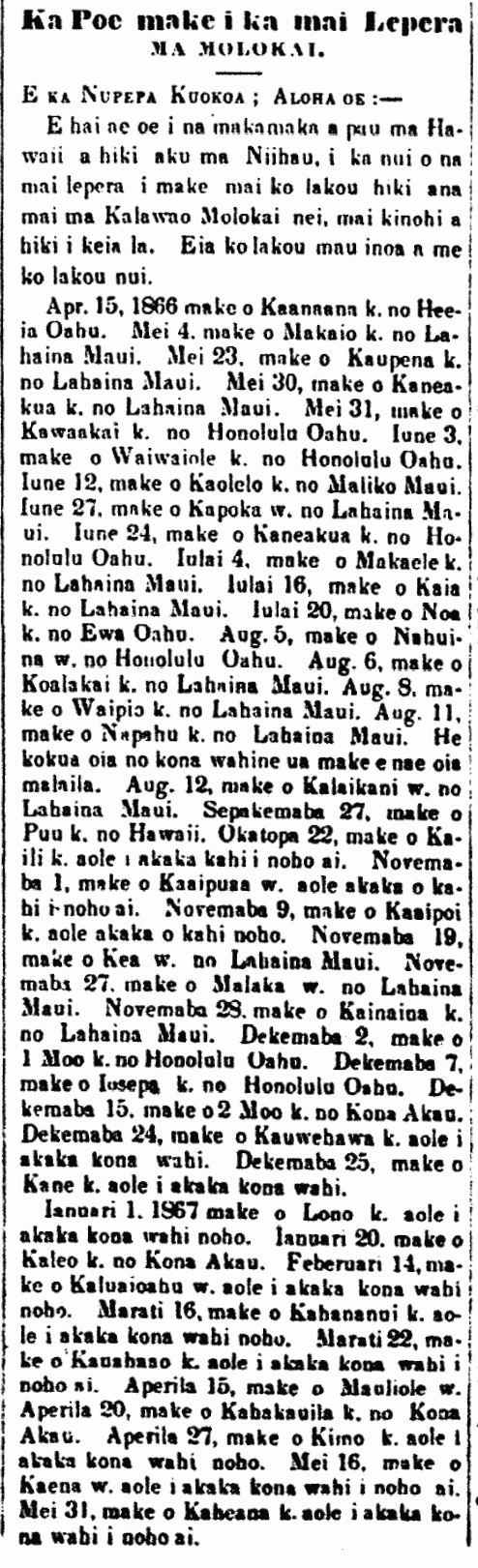
Tell all friends, from Hawaii to Niihau, the number of leprosy patients who died from their arrival here in Kalawao, Molokai, from the beginning until today. Here are their names and their total.

Apr. 15, 1866, Kaanaana m. died, from Heeia, Oahu. May 4, Makaio m. died, from Lahaina, Maui. May 23, Kaupena m. died, from Lahaina, Maui. May 30, Kaneakua m. died, from Lahaina, Maui. May 31, Kawaakai m. died, from Honolulu, Oahu. June 3, Waiwaiole m. died, from Honolulu, Oahu. June 12, Kaolelo m. died, from Maliko, Maui. June 27, Kapoka f. died, from Lahaina, Maui. June 24, Kaneakua m. died, from Honolulu, Oahu. July 4, Makaele m. died, from Lahaina, Maui. July 16, Kaia m. died, from Lahaina, Maui. July 20, Noa m. died, from Ewa, Oahu. Aug. 5, Nahuina f. died, from Honolulu, Oahu. Aug. 6, Koalakai m. died, from Lahaina, Maui. Aug. 8, Waipio m. died, from Lahaina, Maui. Aug. 11, Napahu m. died, from Lahaina, Maui. He was a helper [kokua] for his wife, but he died before her there. Aug. 12, Kalaikane f. died, from Lahaina, Maui. September 27, Puu m. died, from Hawaii. October 22, Kaili m. died, it is not clear where he lived. November 1, Kaaipuaa f. died, it is not clear where she lived. November 9, Kaaipoi m. died, it is not clear where he lived. November 19, Kea died, from Lahaina, Maui. November 27, Malaka f. died, from Lahaina, Maui. November 28, Kainaina m. died, from Lahaina, Maui. December 2, 1 Moo m. died, from Honolulu, Oahu. December 7, Iosepa m. died, from Honolulu, Oahu. December 15, 2 Moo m. died, from North Kona. December 24, Kauwehawa m. died, it is not clear where he lived. December 25, Kane m. died, it is not clear where he lived.

January 1, 1867, Lono m. died, it is not clear where he lived. January 20, Kaleo m. died, from North Kona. February 14, Kaluaioahu f. died, it is not clear where she lived. March 16, Kahananui m. died, it is not clear where he lived. March 22, Kauahaao m. died, it is not clear where he lived. April 15, Mauliole f. died. April 20, Kahakauila m. died, from North Kona. April 27, Kimo m. died, it is not clear where he lived. May 16, Kaena f. died, it is not clear where she lived. May 31, Kaheana m. died, it is not clear where he lived.

(Kuokoa, 2/29/1868, p. 3)

Ka Poe make i ka mai Lepera

Ka Nupepa Kuokoa, Buke VII, Helu 9, Aoao 3. Feberuari 29, 1868.