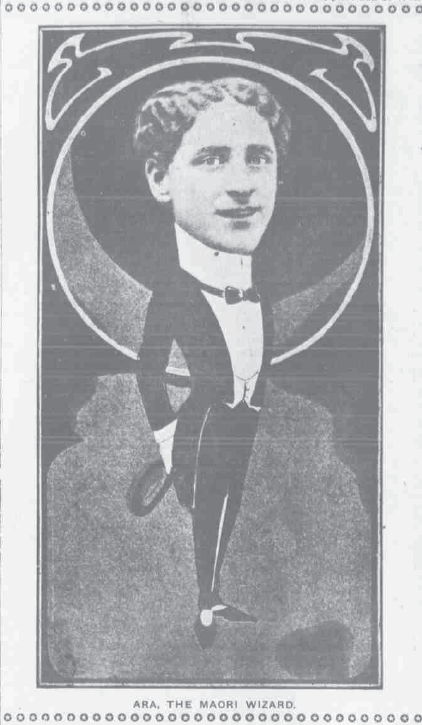
ARA, THE MAORI WIZARD
[Here is an image of Ara, mentioned in the previous post. See the rest of the article here: A Trip Around the World.
Also see more English-language coverage in Chronicling America!]
(Hawaiian Star, 2/10/1912, p. 12)
[Here is an image of Ara, mentioned in the previous post. See the rest of the article here: A Trip Around the World.
Also see more English-language coverage in Chronicling America!]
(Hawaiian Star, 2/10/1912, p. 12)
A New Zealand theater troupe under the leadership of Ara, a man from the Maori people who performs astonishing acts, arrived in Honolulu. After they left their own land, they visited the lands of the South: New Guinea, Fiji, Samoa, the Solomon Islands, and then arrived here. They are taking beautiful shots of Hawaii nei, and when they perform, they have some nice scenes of these islands.
They will also show some pictures of New Zealand, the lifestyle of the Maori, the Hot Volcanic Springs, Palorous Jack [Pelorus Jack], that astonishing piloting fish that guides the way before sailboats when they enter into the harbor of Wellington, and for which a law was made protecting its life, as well as some other lovely pictures of New Zealand. One day in March, they will hold their performance at the Hale Mele Hou [Opera House].
(Aloha Aina, 2/17/1912, p. 1)
[The issue of this Aloha Aina is misprinted as 1/11/1912, but it should be 1/11/1913! This sort of thing happens once in a while, and if you are not careful, it can lead to wild goose chases. Case in point: i don’t know how long i spent looking for the English article that this was taken from because i was looking in 1912… This article originates from the Honolulu Star-Bulletin (1/4/1913).
See the Star-Bulletin article here.]
(Aloha Aina, 1/11/1912 [1913], p. 1)
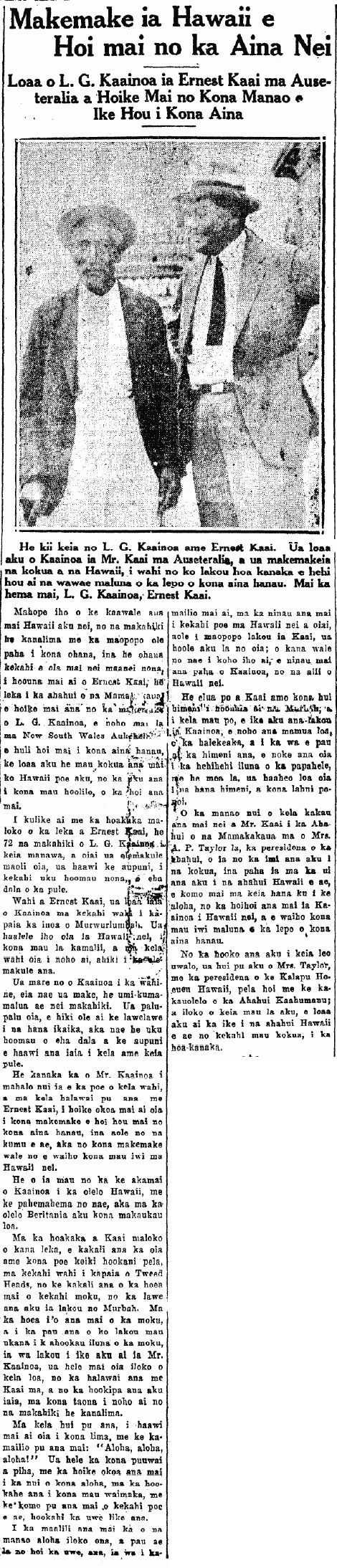
Ernest Kaai Finds L. G. Kaainoa in Australia, and He Tells of His Desire to See Once Again His Land
This is a picture of L. G. Kaainoa and Ernest Kaai. Mr. Kaai found Kaainoa in Australia, and he wants the help from Hawaiians to provide him a means for him to once again tread upon the land of his birth. From the left, L. G. Kaainoa, Ernest Kaai.
L. G. Kaainoa has been away from Hawaii for 50 years now without his family’s knowledge, or knowing even if he has ohana left alive here; Ernest Kaai sent a letter to the Ahahui Mamakakaua [Sons and Daughters of Hawaiian Warriors] telling them of the desire of Kaainoa (who now lives in New South Wales, Australia), to return to his homeland were he to receive assistance from Hawaii’s people to pay his expenses for the return.
According to the explanation in the letter of Ernest Kaai, L. G. Kaainoa is now 72 years old, and being that he is very old, the government provides him a pension of 4 dollars a week.
Ernest Kaai says he found Kaainoa at a place called Murwillumbah. He left Hawaii nei in his youth and it is there that he lived until his old age.
He married a woman, but she died 12 years earlier. He is infirm and cannot do hard labor. But he is given benefits by the government of 4 dollars every week.
Kaainoa is well liked by the people there, and when he met with Ernest Kaai, he made clear his hope to return to his homeland, if not for any other reason, but for his desire to leave his bones in Hawaii nei.
He is still very good at Hawaiian, yet is somewhat clumsy, but he is most fluent in English.
According to Kaai in his letter, he was staying along with his fellow musicians at a place called Tweed Heads, where they were waiting for the arrival of a ship to take them to Murbah. When the ship arrived, and after they loaded their belongings aboard, it was then they saw Mr. Kaainoa. He came all the way to meet with Kaai folk, and to welcome him to his town where he has lived for 50 years.
At their meeting, Kaainoa gave his hand, saying, “Aloha, aloha, aloha!” His heart was full while he expressed his great aloha as his tears flowed, while some others joined in with him.
After those feelings of aloha calmed within him, and his crying stopped, it was then that he began to speak, asking about some people in Hawaii nei. And as Kaai did not know them, he told him so. All he could think of that Kaainoa could ask of was the alii of Hawaii nei.
Kaai and his musical group spent two nights at Murbah, and on those two nights, they saw Kaainoa sitting way up front of the theater house. And when the singing was over, he continued to stomp on the floor as if he was so proud of this singing of his very own people.
The main reason Mr. Kaai wrote to the Ahahui Mamakakaua by way of Mrs. A. P. Taylor, the president of the Association, was to look for assistance; if she could ask the other Hawaiian associations to join in on this charitable endeavor to bring Kaainoa back to Hawaii nei for him to leave his bones in the soil of his homeland.
To follow through on this plea, Mrs. Taylor met with the president of the Hawaiian Civic Club [Kalapu Hoeueu Hawaii], and the secretary of the Kaahumanu Society; and in the upcoming days, the other Hawaiian organizations will learn about this assistance of their fellow Hawaiian.
(Kuokoa 3/5/1925, p. 1)
Last evening, Professor Ernest Kaai of the town of Honolulu nei left for the island of Kauai along with his fellow musicians to hold concerts in the places where they will visit, and they will not be left without being welcomed by the people of Kauai.
Travelling along with him are Mrs. Nane [Nani] Alapai, the singer of the Royal Hawaiian Band; Miss Keala; Mr. Holokahiki; and John Noble, Jr., a youth skilled on the flute [hoopiopio?]. They number five in total, and they are members of that band that is moving quickly through the places they visit.
After arriving on Kauai, Lihue is the first port where they stop, and it is there that they will hold their first concert tomorrow. After that, their tour will go all the way to Koloa where they will have a concert on the coming Monday, the 6th.
Then their musical tour will move on to Eleele, where they will have a musical assembly on the next Tuesday, the 7th. From there they will arrive at Waimea, and they will open another concert on Tuesday [Wednesday] the 8th. And then onto Makaweli where they will have another concert on the next day, the 9th.
Ernest Kaai and his band mates will spend a number of days on Kauai, and when they reach Makaweli, and hold a concert there on the day shown, it is then that they will know where their tour will move to next.
On this tour, Professor Kaai has time to give benefit concerts for good causes if it will be beneficial, but this all depends on the scheduling.
Mr. Kaai is a young Hawaiian that is well known in this town among the Hawaiians and among the haole that love playing music, for the regular job of that young man is teaching music. There are many haole women and haole men and Hawaiians as well who were taught by him and graduated in music.
[If this post looks familiar to some of you, it is because I posted it some time ago on the old Hoolaupai Facebook page. I found that it is not easy to find anything on that page, so started the blog at http://nupepa-hawaii.com, where it is a whole lot easier to find posts! So I will be on occasion reposting articles so that they will be findable in one location. They will all be under the category “Repost”.]
(Kuokoa, 8/3/1906, p. 8)
Led by Ah Choy Tim Sin.
Front row—R. K. Kumulala [Kumululu? Kumuliilii?], D. W. Waipa, Ah Choy Tim Sin, R. M. Kamaunu, F. W. Keao. Back row—S. Kanekoa, J. Kahikina.
This Singing Group will arrive in the districts of North Kohala, South Kohala, Hamakua, Hilo, and Puna, should they not meet with any troubles on their road. This group is under the direction of Ah Choy, a skilled youth [line hidden by fold].
[Line hidden by fold?] with the melodic flute, and included in this group is the skilled hands of Mr. Waipa, the prince of Kona and Kohala.
Therefore, rise, O Friends, join hands with the sweet beloved of Kohala and sing along to this song of aloha for his birth land:
“Maikai ka makani o Kohala,
I pa ia e ka Inuwai,
Ka wai no ia pono kaua,
Ka wai kaulana o ka aina,
He aloha, he aloha ka’u mea nui,
He makana, he makana na ka puuwai.”
Please fill their singing audience; they will arrive in North Kohala on August 5, 1911.
[This is one of many pages of the Hawaiian-Language Newspapers that are difficult to read because the image originally taken was not clean. These need to be reshot before it is too late. You can’t get much information from something that is illegible.]
(Kuokoa Home Rula, 7/28/1911, p. 1)
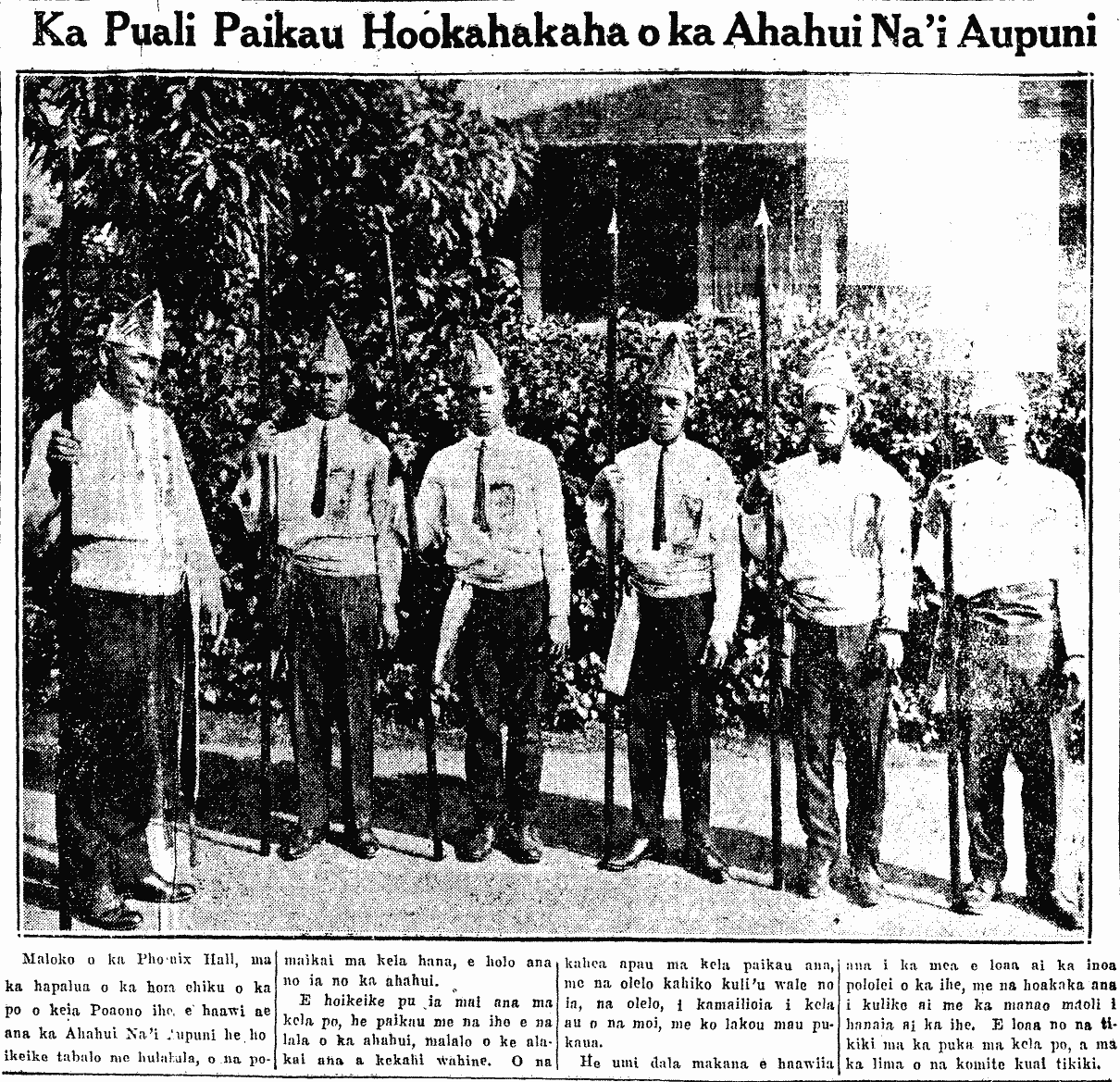
[Here is the same image found in the Evening Bulletin. Perhaps this is not such a great image, but it is way better than the one from Kuokoa Home Rula! And yet, the information given pales to what is found in the Hawaiian article…]
In Phoenix Hall, at half past seven on this Saturday night, the Na’i Aupuni Association will hold a play and dance, and the profits from this endeavor will go to the association.
Also shown on that night will be marching with ihe [spears] by the members of the association under the direction of a woman. The drill commands will all be in the old language—the language spoken during the monarchy, by their war leaders.
A prize of ten dollars will be awarded to the one who knows the correct name of the spear, along with the explanation of the true circumstances under which the spear was made. Tickets are available at the door on that night, or directly from the members of the ticket selling committee.
(Kuokoa, 4/23/1925, p. 2)
The people of China were finely adorned as they celebrated their New Year; the Chinese were seen from Friday, going to the shops of their own countrymen to purchase new year’s items, from the day until evening, and purchasing all sorts of flowers, like crown flower, koniako [?]³, chrysanthemum, and some other blossoms to decorated their tables.
When the hands of the clock reached the point where the year staggered away and the New Year was born, the popping sounds of the firecrackers reverberated along with their huge pu ie [some kind of shooting firework?]⁴ on Nuuanu Avenue between the streets of King and Hotel. Amidst that popping along with the deafening huge pu ie that were lined up straight in a row; as the Chinese of the shops in the area were lighting those huge pu ie, one of the pu ie went off and flew straight through the entrance of the hat shop of Uyeda on the Ewa side, and broke the glass without this misfortune being noticed while the activities were going on, and it was with the coming of day that this damage was discovered by someone, and seen also was the ie of that pu ie lying on the floor. The one good thing was that the ie that went inside was not on fire, if not there would have been a “side dish” to the new year of the Chinese, a house fire.
¹”Konohi” is the Hawaiian word for Chinese New Year, coming from “kong-hee” [恭喜]…
²Aina Pua [Land of Flowers] is a poetic name for China.
³I don’t know what kind of flower a “koniako” is.
⁴I have yet to find out exactly what type of firework a “pu ie” is.
(Kuokoa Home Rula, 1/23/1912, p. 1)
Being that a law was passed in this past legislative session giving the responsibility to the board of supervisors of each county to make laws to approve showing movies on the Sabbath; the Consolidated Amusement Company put a request before the board of supervisors of the City and County of Honolulu at the meeting of that board on this past Tuesday night, to ask for approval to show movies on Sundays.
But the request by that company was placed in the hands of a committee to consider, and to give its findings at the next meeting of the board; however Supervisor Arnold made his opinion clear that the only means by which those sorts of requests will be approved is by making an announcement of the law for which the board will spend much time holding meetings, before it is clear whether or not a law of that kind will pass or not.
From what is understood, Mayor Lane opposes the approval of movies being shown on Sunday, but some of the board members do not disapprove, but they believe that it is more important to give to the public all things that will make them happy on Sundays.
[Consolidated was entertaining Hawaii before 1917? That classic movie trailer we all are familiar with: Consolidated Amusement.]
(Kuokoa, 5/14/1915, p. 5)