Fishing for oopu and wi in Puepaku, Hilo, 1878.

[Found under: “NA MEA HOU O PUEPAKU, HILO.” by J. Kanaeholo]

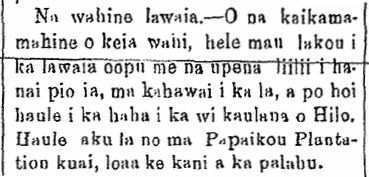
Fishing women.—The girls of this area [Pueopaku, Hilo], go fishing often for oopu with small arched nets at the river in the daytime, and at night they go down to pick the famous wi of Hilo. They head down to Papaikou Plantation to sell them, and they come into the cry of the turkey [palahu].¹

¹Whereas the cry of the nene, “unele, unele,” is associated with lacking, the cry of the turkey, “pokeokeo,” is associated with riches.

(Ko Hawaii Pae Aina, 10/26/1878, p. 1)

Na wahine lawaia.

Ko Hawaii Pae Aina, Buke I, Helu 43, Aoao 1. Okatoba 26, 1878.

Description of the Nene by Kepelino, 1863.

THE STORY

—OF—

The Birds of Hawaii nei

NUMBER 5.

Nene Bird.

The Nene is a bird from the high uplands, and it is a big bird; it resembles a Turkey [Pelehu] and it is that height, its legs are long, and its toes are flat, its neck is nicely slim, its head is small, its eyes are like the eyes of a Chicken [Moa], its beak is short, it has a fine loud voice, and its call sounds like, “unele, unele, unele.”

It is said in the old Hawaiian stories, that the Nene and the Fly [Nalo] were deprived of their wealth, and that is why the Nene cries in that manner, “unele, unele” [“without, without”] and the Nalo chose its place to live as Kapalapilau [“Rotting dab of excreta”], and that is still what they do.

The Nene does not eat Rats [Iole] and other things like the Hawk [Io], and the Owl [Pueo], it only eats leaves of vegetation and flowers of grasses. Continue reading

Nene being cared for by Herbert Shipman, etc. 1941.

[Found under: “Hunahuna Meahou o Hamakua Ame Kohala” by Mrs. Reinhardt.]

Last week, two men living and working at the Kilauea National Park came to Honokaa School, their names being Gunther Olsen and friend. The school was filled with its 496 students from 1st grade to 6th, to see pictures of the mountains of this island. Olsen described the different birds while his companion showed pictures of the birds on a white cloth. Truly beautiful were the pictures of the mamo, O-o, Elepaio, Iiwi, Apapane, and so forth. The names of the birds of ours were clearly pronounced in Hawaii by that man.

According what was said by this man, in Keaau is being cared for at the home of Herbert Shipman, NENE birds, which are believed to be going extinct, but they are increasing. Our birds were much more beautiful in the olden days before other birds were imported from all over, the birds that are a problem for the crops growing in our gardens. They eat flowers of the peppers [nioi], and that is why the nioi doesn’t fruit as they did in years past.

After the pictures of the birds were shown, pictures were shown of the burning fires of Pele atop Mokuaweoweo last year. These men climbed up Mokuaweoweo on horseback and when they reached a certain point, the horses were left and they went on foot until the crater. Where they were was scorching. While the fires were boiling, snow was seen on both sides covering the ground. Continue reading

Coconut crab in Hawaii, 1897.

[Found under: “LOCAL BREVITIES”]

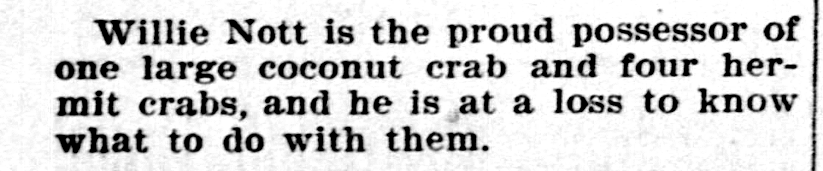
Willie Nott is the proud possessor of one large coconut crab and four hermit crabs, and he is at a loss to know what to do with them.

(Pacific Commercial Advertiser, 7/27/1897, p. 7)

Willie Nott...

The Pacific Commercial Advertiser, Volume XXVI, Number 4670, Page 7. July 27, 1897.

Escaped coconut crab, 1877.

[Found under: “NA ANOAI.”]

Last we we were shown by Kalua, a coconut-eating crab, which he found in the yard of the Senior Alii C. Kanaina, in a deep hole dug into the earth. Its whole appearance is strange indeed. Its legs are huge, and its pincers are scary to look at, and its whole body is remarkable. Where did it come from? Continue reading

Rabbits for the Prince, 1861.

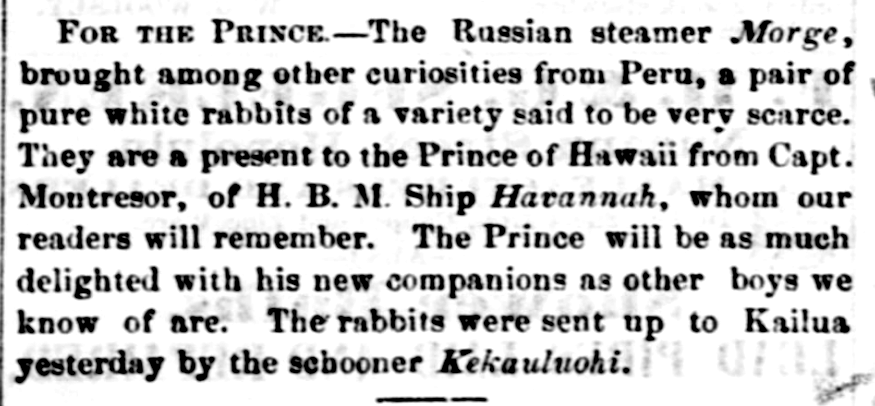
For the Prince—The Russian steamer Morge, brought among other curiosities from Peru, a pair of pure white rabbits of a variety said to be very scarce. They are a present to the Prince of Hawaii from Capt. Montresor, of H. B. M. Ship Havannah, whom our readers will remember. The Prince will be as much delighted with his new companions as other boys we know of are. The rabbits were sent up to Kailua yesterday by the schooner Kekauluohi.

[It is very interesting to compare this article with a Hawaiian-Language one found in the Kuokoa on 12/16/1861!]

(Pacific Commercial Advertiser, 12/5/1861, p. 2)

For the Prince.

The Pacific Commercial Advertiser, Volume VI, Number 23, Page 2. December 5, 1861.

Goat hunting on Kahoolawe, 1911.

Goat Hunters to go to Kahoolawe.

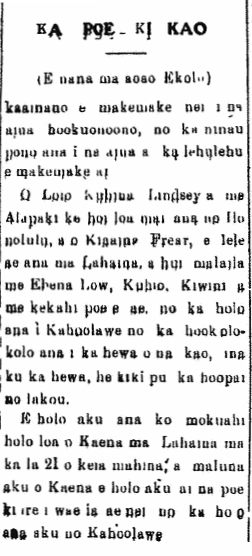
Aboard the Maunaloa of this Friday, Governor Frear, Attorney General Lindsey [Lindsay], and Land Commissioner Alapaki opio [Charles Sheldon Judd] left for the island of Hawaii to look at the homestead lands there. On this trip, the Governor took along an automobile for them to travel mauka side of Hawaii. They get off at Kailua and get on the car to go to Kau, and from there to the volcano until Hilo and from there to Kohala until Waimea, and in two weeks the Maunakea will be there in Kawaihae and they will return to Honolulu nei. On this tour of the Governor and his companions, they will meet with the…

(Kuokoa Home Rula, 9/8/1911, p. 1)

NA POE KI KAO NO KAHOOLAWE.

Kuokoa Home Rula, Buke IX, Helu 36, Aoao 1. Sepatemaba 8, 1911.

makaainana who want homestead lands, to ask them first-hand what lands the public desires.

Attorney General Lindsey and Alapaki will make the return trip to Honolulu while Governor Frear will get off at Lahaina, and there meet up with Eben Low, Kuhio, and Kiwini [S. L. Desha], as well as with some other people, to go to Kahoolawe to judge the damages done by the goats, and if they are found at fault, shooting will be their punishment.

The long-distance steamship, the Kaena, will go to Lahaina on the 21st of this month, and by the Kaena the selected jury will go to Kahoolawe.

[See this related story, “Brother Low Recalls 1895–1920” on Hamakua Times’ website!]

(Kuokoa Home Rula, 9/8/1911, pp. 4)

KA POE KI KAO

Kuokoa Homer Rula, Buke IX, Helu 36, Aoao 4. Sepatemaba 8, 1911.

More on the state of taro, 1911.

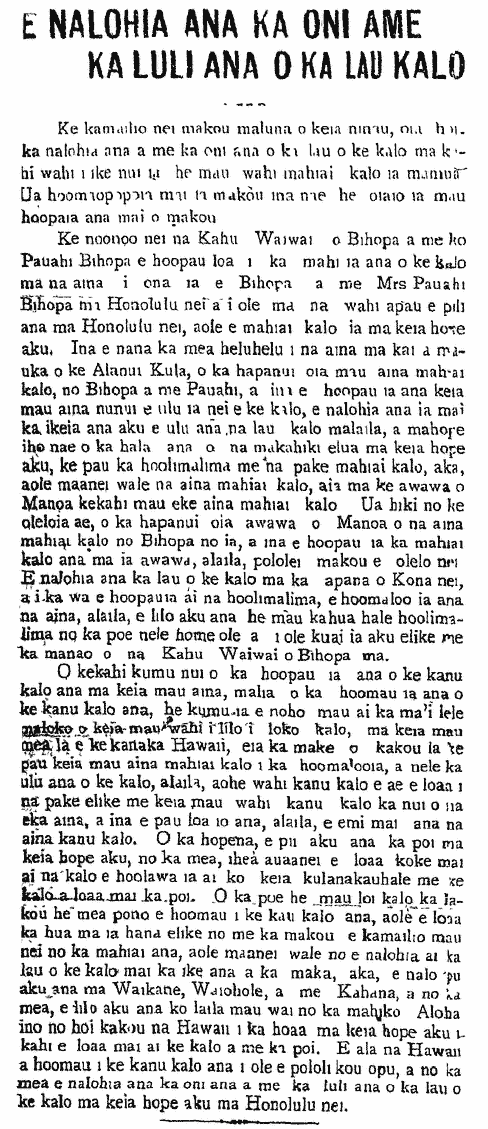
Don’t Neglect the Planting of Kalo

It is to you, O Hawaiians, who we strongly encourage in regard to this question about kalo here forward, for large kalo-growing lands here in Honolulu will be dried out and put an end to by those who own them. Should those lands where kalo is being grown today truly be left to dry out, by our estimation, nearly 300 acres of kalo lands will be lost here in Honolulu, or perhaps four hundred or more acres of kalo lands will not be planted anymore. Therefore, to make up for this lost acreage, it is for all of you people outside of Honolulu to plant dry-land taro in fields and small patches, or in large loi where taro can constantly be cultivated.

If you have an abundance of kalo, then feed the sows, the hens, the turkeys, the ducks, and animals from which a person who plants a lot of taro can benefit; for you can eat the kalo, and the animals can eat the stalks [haha kalo], the leaves [luau], the watery residue from poi making [kale ai]; all these things are of great help to the farmer of kalo. Therefore, O Hawaiians, don’t be weary to grow kalo, and don’t neglect this lively endeavor on the land.

(Kuokoa Home Rula, 8/18/1911, p. 2)

Mai Hoopalaleha i ke Kanu Kalo

Kuokoa Home Rula, Buke IX, Helu 33, Aoao 2. Augate 18, 1911.

Mild hula ku’i and California Midwinter International Exposition, 1894.

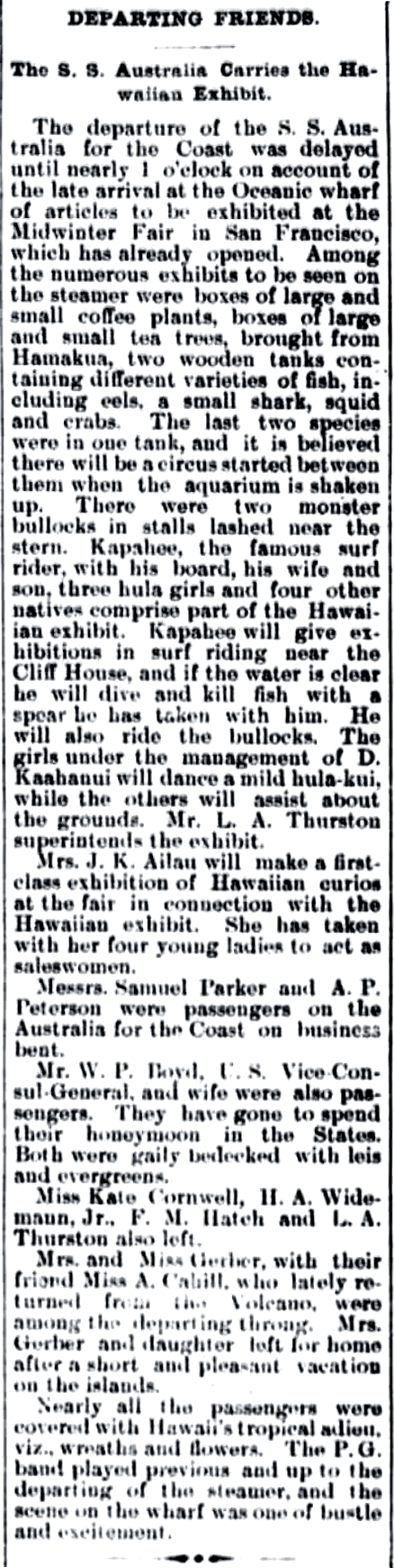
DEPARTING FRIENDS.

The S. S. Australia Carries the Hawaiian Exhibit.

The departure of the S. S. Australia for the Coast was delayed until nearly 1 o’clock on account of the late arrival at the Oceanic wharf of articles to be exhibited at the Midwinter Fair in San Francisco, which has already opened. Among the numerous exhibits to be seen on the steamer were boxes of large and small coffee plants, boxes of large and small tea trees, brought from Hamakua, two wooden tanks containing different varieties of fish, including eels, a small shark, squid and crabs. The last two species were in one tank, and it is believed there will be a circus started between them when the aquarium is shaken up. There were two monster bullocks in stalls lashed near the stern. Kapahee, the famous surf rider, with his board, his wife and son, three hula girls and four other natives comprise part of the Hawaiian exhibit. Kapahee will give exhibitions in surf riding near the Cliff House, and if the water is clear he will dive and kill fish with a spear he has taken with him. He will also ride the bullocks. The girls under the management of D. Kaahanui will dance a mild hula-kui, while the others will assist about the grounds. Mr. L. A. Thurston superintends the exhibit.

Mrs. J. K. Ailau will make a first-class exhibition of Hawaiian curios at the fair in connection with the Hawaiian exhibit. She has taken with her four young ladies to act as saleswomen.

Messrs. Samuel Parker and A. P. Peterson were passengers on the Australia for the Coast on business bent.

Mr. W. P. Boyd, U. S. Vice-Consul-General, and wife were also passengers. They have gone to spend their honeymoon in the States. Both were gaily bedecked with leis and evergreens.

Miss Kate Cornwell, H. A. Widemann, Jr., F. M. Hatch and L. A. Thurston also left.

Mrs. and Miss Gerber, with their friend Miss A. Cahill, who lately returned from the Volcano, were among the departing throng. Mrs. Gerber and daughter left for home after a short and pleasant vacation on the islands.

Nearly all the passengers were covered with Hawaii’s tropical adieu, viz., wreaths and flowers. The P. G. band played previous and up to the departing of the steamer, and the scene on the wharf was one of bustle and excitement.

(Daily Bulletin, 1/6/1894, p. 2)

DEPARTING FRIENDS.

The Daily Bulletin, Volume VII, Number 924, Page 2. January 6, 1894.
In honor of Honey Bee Day, 2013.

[Found under: “BITS OF NEWS OF HAWAII NEI.”]

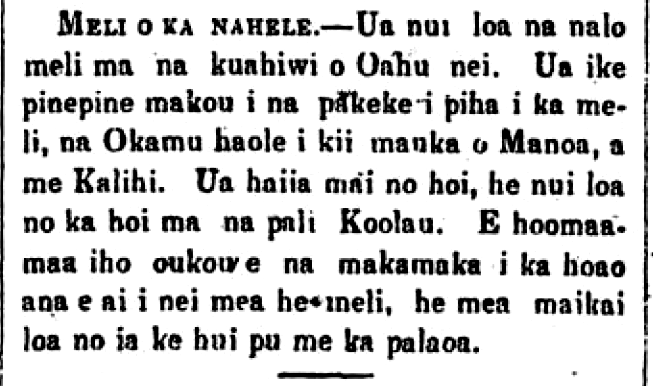
Honey in the mountains.—There are a lot of honey bees in the mountains of Oahu nei. We see all the time buckets full of honey that is gotten in the uplands of Manoa and Kalihi by the haole man, Okamu. It is said that it is abundant in the cliffs of the Koolau. Friends, do try tasting this thing called honey; it is very good with bread.

[It seems today is Honey Bee Day. There are many articles dealing with bees and honey from early on in the Hawaiian-Language Newspapers. I posted some earlier and they should be easily found by doing a search on the top of the right-hand column…

Also, if you are lucky enough to be on Kauai today, according to the Garden Isle Press, there are fun and educational activities being put on by the Kauai Beekeepers’ Association at Kauai Community College! Go check it out!!]

(Kuokoa, 11/25/1865, p. 2)

Meli o ka nahele.

Ka Nupepa Kuokoa, Buke IV, Helu 47, Aoao 2. Novemaba 25, 1865.