Sending mynahs to the Philippines, 1928.

PHILIPPINES TELEGRAPH TO SEND OVER BIRDS

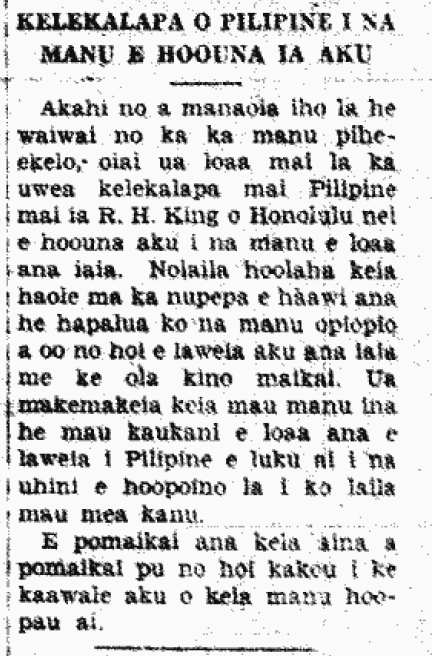
For the first time it is believed that the mynahs have value, being that there was received a telegraph from the Philippines from R. H. King of Honolulu to send birds caught to him. This haole is advertising in the newspaper that he will give a half dollar for young and adult birds brought to him if they are alive and healthy. These birds are wanted in the thousands to be taken to the Philippines to kill off the locusts destroying the crops there.

This land and we as well will be blessed to be rid of these birds that take away food.

[This sounds a little messed up…]

(Alakai o Hawaii, 6/28/1928, p. 4)

KELEKALAPA O PILIPINE I NA MANU E HOOUNA IA AKU

Ke Alakai o Hawaii, Buke 1, Helu 9, Aoao 4. Iune 28, 1928.

Governor to veto bills protecting native wildlife? 2013.

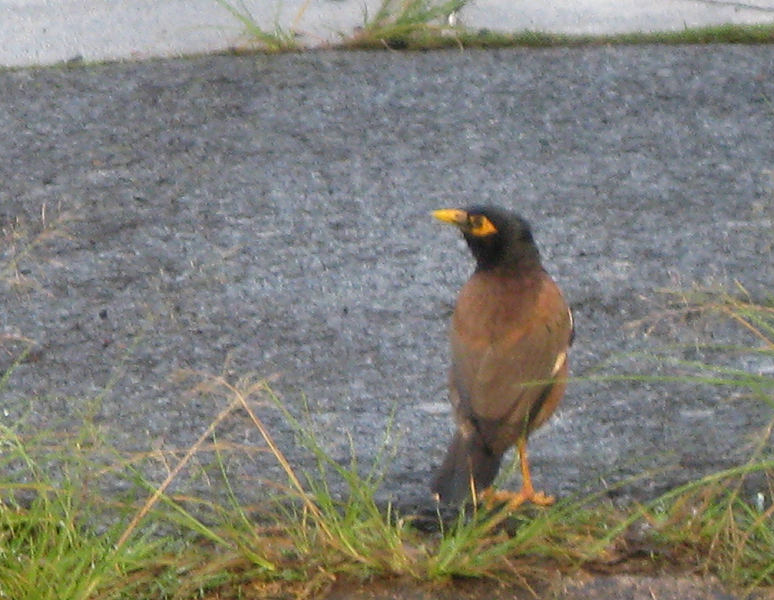
Mynah bird.

Manu piheekelo, 2013.

It seems that the governor decided to veto a bill making petroleum distributors more responsible for protecting native wildlife (HB988) and another bill making the feeding of feral birds a nuisance (HB619). This reminded me of a couple of previous posts:

A description of life before the invasion of foreign birds.

and

A look back at the folly of introducing foreign animals.

New birds introduced, 1865.

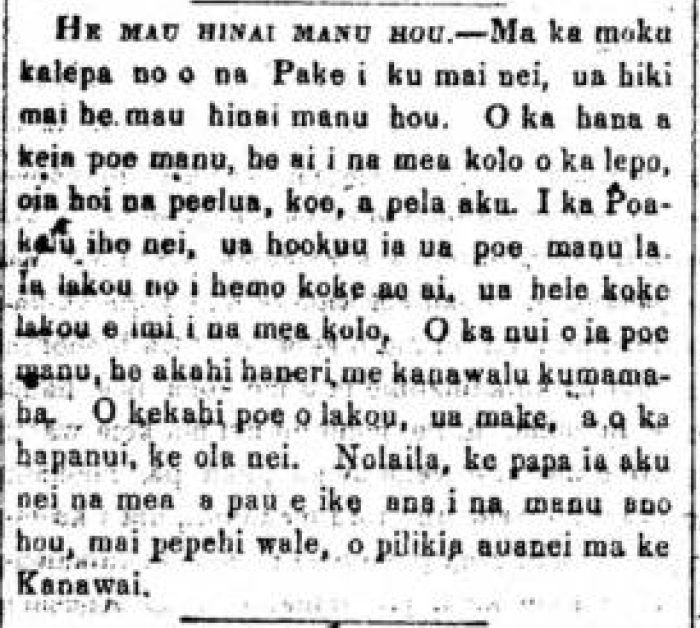
Containers of New Birds.—Aboard the trading ship of the Chinese that arrived were brought containers of new birds. The purpose of these birds are to eat bugs found in the dirt like caterpillars [peelua], koe [worms], etc. Last Wednesday, the birds were released. When they were immediately released, they quickly went in search of bugs. The number of those birds was one-hundred and eighty-four. Some of them died, but the majority are living. Therefore, anyone who sees these new birds is prohibited from killing them lest they be in trouble with the Law.

[This article most likely refers to the manu pihaekelo—mynah bird, now seen everywhere across the archipelago…]

(Au Okoa, 10/2/1865, p. 2)

He mau hinai manu hou.

Ke Au Okoa, Buke I, Helu 24, Aoao 2. Okatoba 2, 1865.

1836, the beginnings of sericulture on Kauai. 1843.

SILK. NUMBER 2.

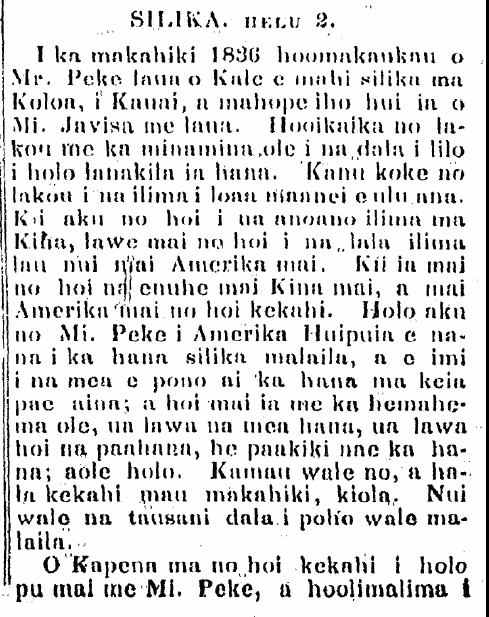
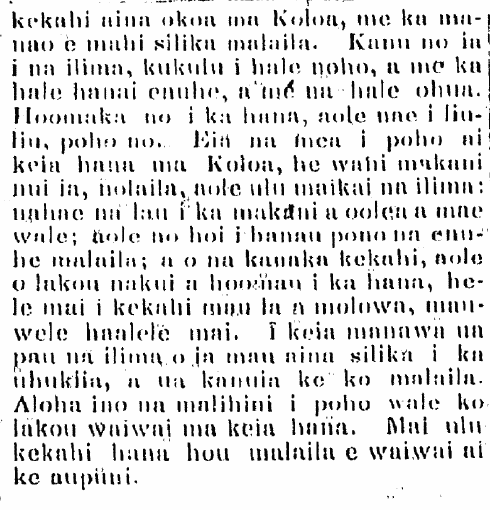
In the year 1836, Mr. Peke and Kale made ready to farm silk [silika] in Koloa, Kauai, and afterwards the two were joined by Mr. Jarvis [Mi. Javisa]. They put much effort into this without caring about money spent to make it a success. They immediately planted ilima found growing here. They went to get ilima [? mulberry] seeds from China and brought back branches of the ilima lau nui from America. Mr. Peke went to the United States of America to see silk production there, and to find what it took to raise them in this archipelago; he returned without anything lacking, with the necessary gear, and sufficient workers, but the work was difficult and did not move forward. They kept at it, and some years went by, and they gave up. Many thousands of dollars was wasted on it.

Kapena and others also came with Mr. Peke, and leased other lands in Koloa, with thoughts of raising silk there. He planted ilima, built a residence, a building to raise the worms, and a house for the workers. They began the work, but in not much time, it was a bust. Here are the reasons that it was a waste of time in Koloa: there is a strong wind so the ilima does not grow well as the leaves are torn in the strong wind and wilt, the worms don’t grow well there; and the people also, they are not eager and do not keep at the work; they come some days and slack off, are lazy and leave. Today, the ilima of those silk lands are all pulled out and sugar is planted there. So sad for those foreigners who wasted their money in this endeavor. A new enterprise almost started there to make the nation rich.

(Nonanona, 1/3/1843, p. 78)

SILIKA. HELU 2.

Ka Nonanona, Buke 2, Pepa 16, Aoao 78, Ianuari 3, 1843.

(Nonanona, 1/3/1843, p. 79)

...kekahi aina okoa ma Koloa...

Ka Nonanona, Buke 2, Pepa 16, Aoao 79. Ianuari 3, 1843.

More on honey, 1861.

[Found under: “This and That of Hawaii nei.]

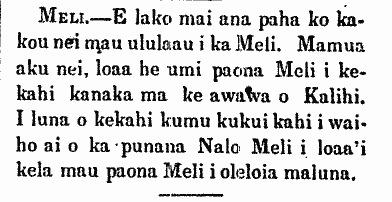
Honey [Meli].—Our forests will perhaps be filled with Honey. Earlier, a certain person in Kalihi valley had ten pounds of Honey. The Bee [Nalo Meli] hive was atop a kukui tree where that amount of Honey mentioned above was gotten.

(Kuokoa, 11/1/1861, p. 2)

Meli.

Ka Nupepa Kuokoa, Buke I, Helu 2, Aoao 2. Novemaba 1, 1861.

Near tragedy caused by Kamehameha V’s deer, 1868.

[Found under: “LOCAL NEWS: Maui”]

Life saved from deer.—P. Kawelakawai of Kawela, Molokai wrote to us like this: On the 29th of April, I saw Kaukino, the one who barely survived. Here is the reason; one of the animals of our King, a deer set loose on his ranch, entered the sweet potato patch of at Kalamaula to eat the uala, and this man saw this and went to shoo it off; the animal rushed forward but he saw it coming, and it was but a few feet away and it caught him and thrust its antlers, whereupon he fell down, face thrown back. He was jabbed in the armpit, and the antler pierced through. His wife saw this happen and she brought him back to the houses and the man was very weak. We are relieved at the news following that letter that he has recovered.

[See earlier articles on the deer gifted to Kamehameha V. Deer imported from Japan in 1867. and Deer of Kamehameha V., 1867.]

(Kuokoa, 5/23/1868, p. 3)

Pakele ke ola i ke dia.

Ka Nupepa Kuokoa, Buke VII, Helu 21, Aoao 3. Mei 23, 1868.

And more on the Maori, 1920.

Comparison of New Zealand and Hawaii, the Hawaiian People and the Maori.

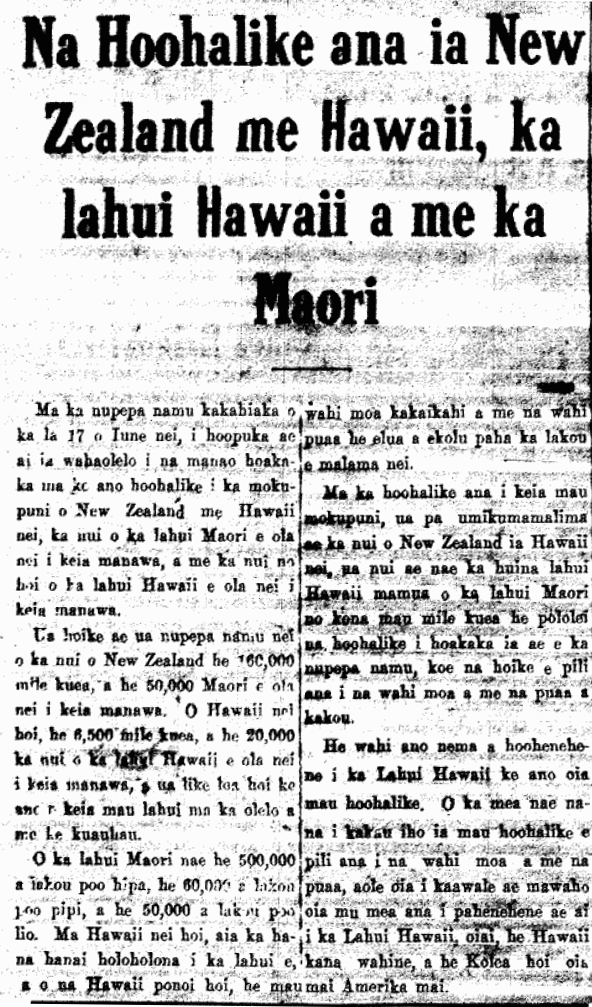
In the English morning newspaper [Pacific Commercial Advertiser] of the 17th of June, that mouthpiece published a clarification between the island of New Zealand and Hawaii, the population of the Maori lahui living today and that of the Hawaiian lahui.

That English paper said the area of New Zealand is 160,000 square miles, and that there are 50,00 Maori living today. As for Hawaii, it is 6,500 square miles, and there are 20,000 of its lahui living currently; and these two people are very much alike in language and genealogy.

However, the Maori have 500,000 heads of sheep, 60,000 heads of cattle, and 50,000 heads of horses. In Hawaii nei, the job of raising livestock is left to the other ethnicities, and the Hawaiians themselves, they raise a few chickens and a couple or three pigs.

In comparing these islands, New Zealand is fifteen times as big as Hawaii nei, but the total Hawaiians are more than the Maori per square miles; the comparisons put forth by the English paper are correct, all but what was said about our few chickens and pigs.

That comparison criticizes  and ridicules the Hawaiian people. But the one who wrote these comparisons pertaining to the chickens and pigs is not far from these things of which he mocks the Hawaiian people about, for his wife is a Hawaiian, and he is a Kolea bird¹ from America.

¹The kolea is the migrating plover, that is used to symbolize people who come to Hawaii, and like these birds, feed off of the riches only to leave after getting fat.

[I will have to check on who the writer was. Too bad the Advertiser is not online!]

(Aloha Aina, 7/4/1920, p. 4)

Na Hoohalike ana ia New Zealand me Hawaii, ka lahui Hawaii a me ka Maori

Ke Aloha Aina, Buke XXXX, Helu 43, Aoao 4. July 3, 1920.

Deer of Kamehameha V., 1867.

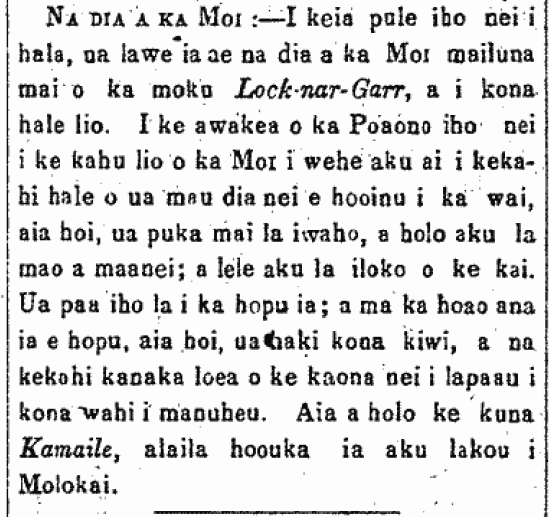
The King’s Deer:—This last week, the King’s deer were taken aboard the ship Lock-nar-Garr [Lochnagar ?] to his stables. At midday on this past Saturday, when the King’s stableman opened a stall where the deer were kept to give them water, come to find out, they got out and ran here and there and jumped into the ocean. They were caught; but while they were being caught, its antler was broken, and someone skilled from town tended to its injury. When the schooner Kamaile sails, they will be taken to Molokai.

(Au Okoa, 12/26/1867, p. 2)

Na dia a ka Moi...

Ke Au Okoa, Buke III, Helu 36, Aoao 2. Dekemaba 26, 1867.

Different view of the seal of the republic, 1896.

Great Seal of the Republic of Hawaii.

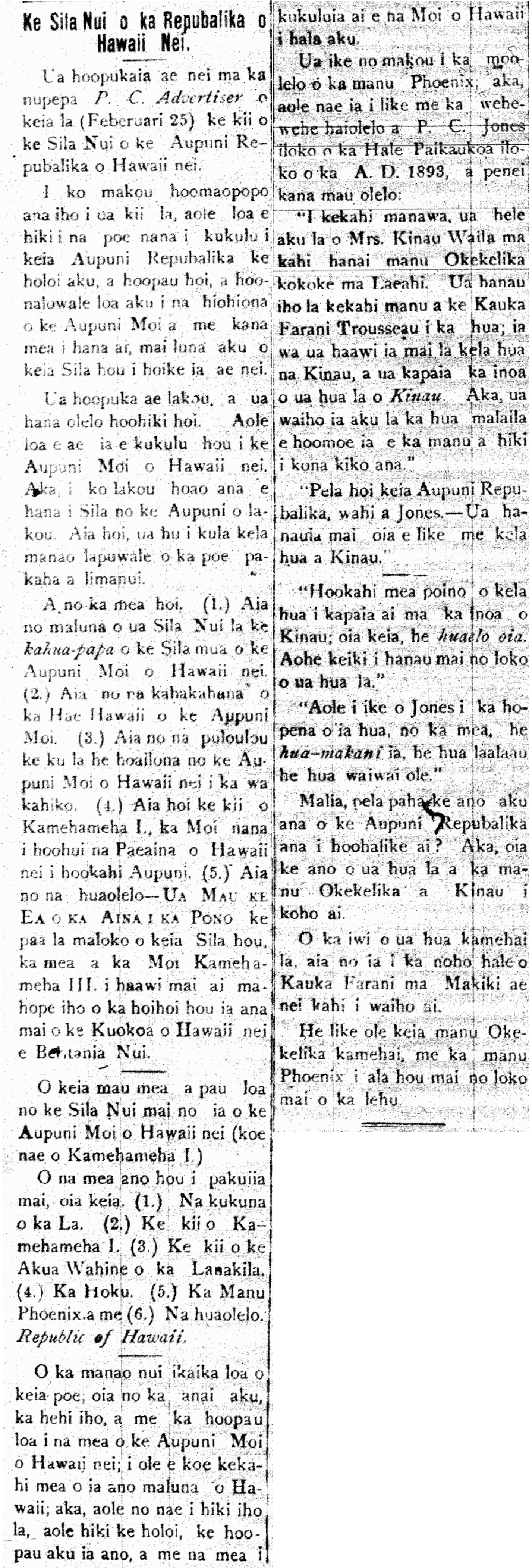
In today’s P. C. Advertiser (February 25), a picture of the Great Seal of the Republic of Hawaii was printed.

By our understanding of that image, there is no way that those who established this Republic can erase or end or eradicate visages of the Monarchy and its accomplishments, from the seal mentioned above.

They stated and vowed that there will be no way that the reestablishment of the Kingdom of Hawaii nei will be allowed. However, when they set out to create a Seal for their Government. And now, that foolish idea of the plunderers and thugs has gone awry.

Being that, (1.) On that Great Seal, is the foundation of the first Seal of the Monarchy of Hawaii nei. (2.) There is the stripes of the Hawaiian Flag of the Monarchy. (3.) There stand puloulou, a symbol of the Hawaiian Monarchy of old. (4.) There is an image of Kamehameha I., the King who unified the Hawaiian Archipelago into one Nation. (5.) There are the words—”Ua Mau ke Ea o ka Aina i ka Pono” affixed onto this new Seal, the words given by King Kamehameha III after the restoration of the Independence of Hawaii nei by Great Britain.

All these things were from the Great Seal of the Monarchy of Hawaii nei (except Kamehameha I.)

The new things added are these. (1.) Rays of the Sun. (2.) The image of Kamehameha I. (3.) The image of the Goddess of Victory. (4.) The Star. (5.) The Phoenix Bird, and (6.) The words, Republic of Hawaii.

Their intense desire is to rub out, to stomp out, and to end for all time, things of the Monarchy of Hawaii nei, lest vestiges of that sort remain in Hawaii; but that is not possible: there is no erasing, nor putting end to deeds done by the past Monarchs of Hawaii.

We know the story of the Phoenix, but it is not the same as the explanatory speech by P. C. Jones at the Armory [Hale Paikaukoa] in the year 1893, and these are his words:

“Once, Mrs. Kinau Wilder [Waila] went to where Ostrich were raised near Diamond Head [Laeahi]. One of the birds of the French Doctor Trousseau laid an egg, and it was on that occasion given to Kinau, and the egg was called Kinau. However, it was left there to be sat on by a bird until it hatched.

“This is similar to this Republic,” according to Jones. “It was born like that egg, Kinau.”

There is one unfortunate thing about that egg called by the name of Kinau, that being, it was a rotten egg [huaelo]. There was no chick born from that egg.

Jones didn’t know of the outcome of that egg, for it was but a yolk-less egg [hua makani], a hua laalaau?, a worthless egg.

Perhaps this will be the outcome of the Republic to which he compares it to? But at any rate, that is the kind of Ostrich egg that Kinau chose.

The shell of that astonishing egg is kept at the residence of Trousseau [Kauka Farani] in Makiki.

This astonishing Ostrich is not the same as a Phoenix which rises from the ashes.

(Aloha Aina, 2/29/1896, p. 4)
Ke Sila Nui o ka Repubalika o Hawaii Nei.

Ke Aloha Hawaii, Buke II, Helu 9, Aoao 4. Feberuari 29, 1896.