Queen Liliuokalani, 1902.

SUPPORTS THE DELIVERER OF THE PEOPLE.

QUEEN LILIUOKALANI.

THE PICTURE ABOVE IS THE NEWEST OF QUEEN LILIUOKALANI, TAKEN RECENTLY BY MR. DAVEY, THE PHOTOGRAPHER OF THIS TOWN.

THE ROYAL AUNT LILIUOKALANI REVEALED HER THOUGHTS TO THE ALII KUHIO, SAYING: “IF YOU KNOW THAT THIS IS THE MEANS TO GAINING OUR WELL-BEING, THEN DO IT.”

(Kuokoa, 10/24/1902, p. 1)

KAKOO I KA HOOPAKELE O KA LAHUI.

Ka Nupepa Kuokoa, Buke XL, Helu 43, Aoao 1. Okatoba 24, 1902.

Lahaina, and Hawaii through history, 1941.

OLD LAHAINA PRISON
and
ANCIENT LAHAINA

By INEZ ASHDOWN

According to information gleaned from the Bishop Museum records and the Archives of Mr. E. Bryan Jr., curator at the Museum, the old Lahaina Prison was built in 1851 and completed in April 1852. This was during the reign of Kamehameha III, who ruled until 1854.

For “local color” at that time I have talked with old Hawaiians who are from 70 to 80 years of age, and have also spent many hours at the Wailuku library reading old volumes supplied by Mrs. Juliette Davis, Librarian. Continue reading

Political prisoners released by the Provisional Government, 1895.

Political Prisoners.

This past Thursday, Independence Day [La Kuokoa] and also Day of Thanksgiving to God for the deceitful ones, some political prisoners were released, they being W. H. Rickard [W. H. Rikada], T. B. Walker [T. B. Waka], Toma Pule, Kauai, D. Damien [D. Damiena], R. Palau, and Apelahama. As for the haole, after the two of them were read their pardons,  they were given the thanks of President Dole and some Hawaiians as well.¹ Some other political prisoners were no released, but perhaps will be released some time in the future.

¹See correction in comment below.

(Makaainana, 12/2/1895, p. 1)

Na Pio Kalaiaina.

Ka Makaainana, Buke IV—Ano Hou, Helu 23, Aoao 1. Dekemaba 2, 1895.

Sun Yat Sen arrives, 1903.

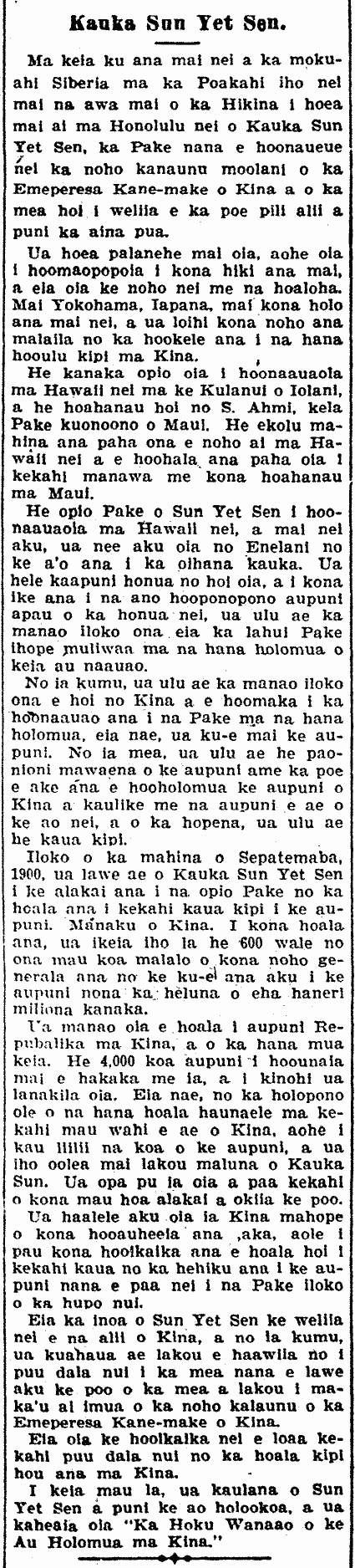
Doctor Sun Yet Sen [Sun Yat Sen].

With the arrival of the steamship Siberia this past Monday from the ports of the East, Doctor Sun Yat Sen arrived in Honolulu, the Chinese man who is shaking the hereditary throne of the Empress Dowager of China, and the one who is feared by those  loyal to the throne all over China [aina pua].

He came quietly; it was not known that he was coming, and here he is staying with a friend. He came from Yokohama, Japan, where he was living for a long time to plan an uprising in China.

He is a young man educated in Hawaii nei at the College of Iolani, and he is a cousin of S. Ahmi, that wealthy Chinese man of Maui. He will perhaps be here for three months in Hawaii, and he will maybe spend some time with his cousin in Maui.

Sun Yat Sen is a young Chinese educated in Hawaii, and from here, he moved to England to study medicine. He travelled around the world, and after seeing the different governments of the world, he realized that here are the Chinese at the rear of progress in this age of enlightenment.

Because of this, within him grew the thought to return to China to start to educate the Chinese in things of progress, however, the government resisted. Therefore, there grew a struggle between the government and the people who want the nation of China to move forward and be equal to the other countries of the world; and this resulted in the start of a revolution.

In the month of September 1900, Sun Yat Sen took the leadership of young Chinese in starting a revolutionary war against the government. The Manchu [Manaku] of China. When he began the uprising, it was found that he only had 600 soldiers under his leadership for this revolution against the government with a population of four hundred million people

He decided to create a Republic in China, and this was his first act. 4,000 soldiers were sent to fight against him, and in the beginning, he was winning. However, because the inciting of uprisings in other places in China did not go well, the government soldiers were not dispersed, and so they came down in force upon Doctor Sun. He was crushed and some of his fellow leaders were captured and beheaded.

He fled from China after being routed, however, this did not end his efforts to incite a revolution to crush the government which holds the Chinese people in stupidity.

This name of Sun Yat Sen is feared by the royalty of China, and therefore, they proclaimed that a great sum of money will be given to the person who brings the head of that person who they fear before the throne of the Empress Dowager of China.

He is putting effort into raising substantial funds to start a new revolution in China.

These days, Sun Yat Sen is famous all over the world, and he is called the “Morning Star of the Progressive Era of China.”

(Kuokoa, 10/16/1903, p. 8)

Kauka Sun Yet Sen.

Ka Nupepa Kuokoa, Buke XLI, Helu 42, Aoao 8. Okatoba 16, 1903.

Queen Victoria letter to Sanford Dole, 1894.

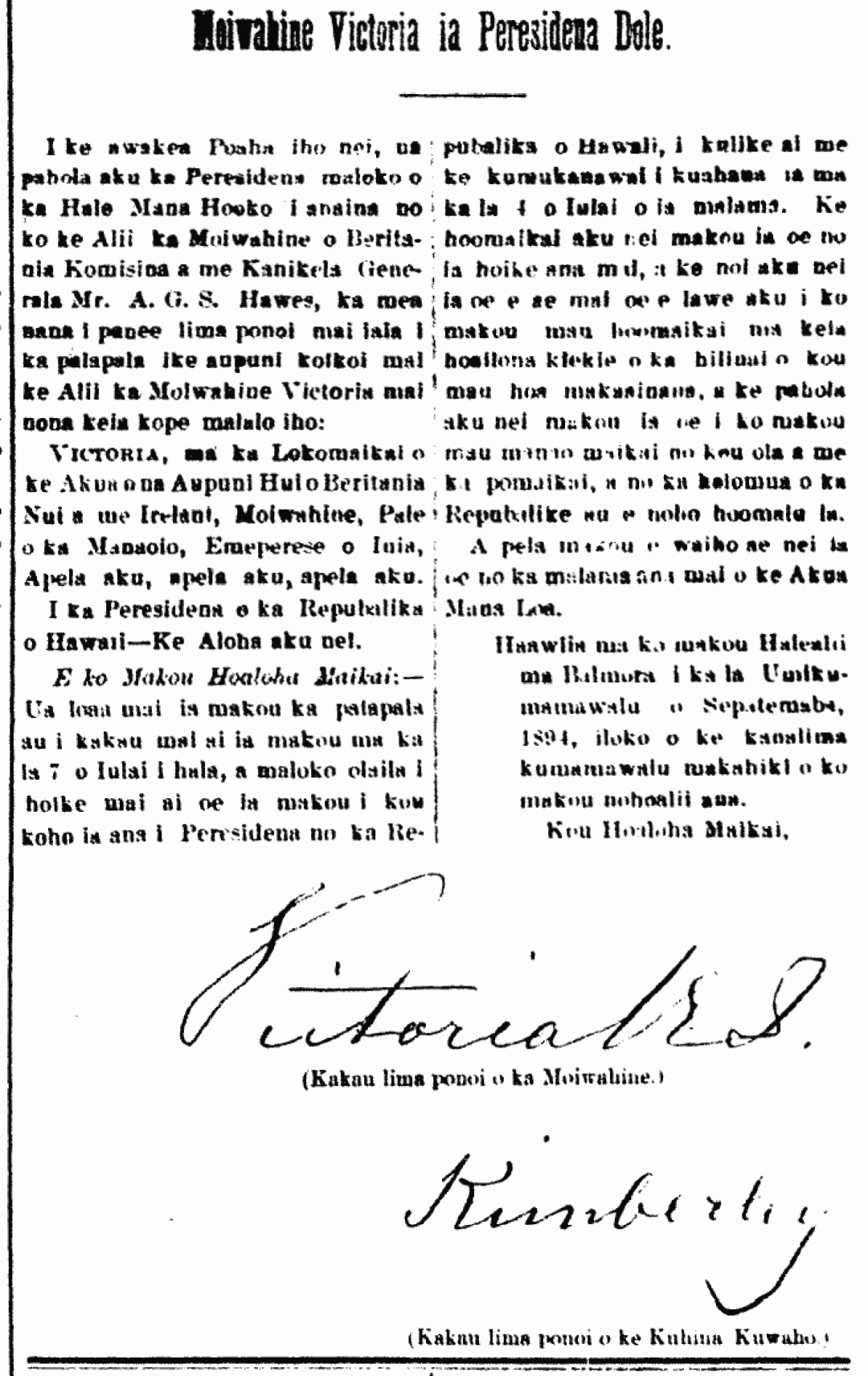
Queen Victoria to President Dole.

At midday of this past Thursday, the President gave an audience in the Executive Building [Iolani Palace] for the Queen of Britain’s Commissioner and Consul General, Mr. A. G. S. Hawes, who handed over to him personally this important national greeting from the Royal one, Queen Victoria.

Victoria, by the grace of God, of the United Kingdom of Great Britain and Ireland, Queen Defender of the Faith, Empress of India, and so forth, and so forth, and so forth.

To the President of the Republic of Hawaii, Sendeth Greeting!

Our Good Friend! We have received the letter which you addressed to us on the 7th day of July last, in which you informed us that you had been elected President of the Republic of Hawaii, in accordance with the constitution which was proclaimed on the 4th of that month. We thank you for this communication, and we request you to accept our congratulations on this distinguished mark of the confidence of your fellow citizens;and we offer you our best wishes for your health and welfare, and for the prosperity of the Republic over which you preside.

And so we commend you to the protection of the Almighty.

Given at Our Court at Balmoral the nineteenth day of September 1894, in the 58th year of our reign.

Your good friend,

(Signed by the Queen’s own hand.)

(Signed by the Minister of Foreign Affairs’ own hand.)

[The queen seems to have been led to believe that Dole had the support of “his fellow citizens”…]

(Kuokoa, 11/17/1894, p. 2)

Moiwahine Victoria ia Peresidena Dole.

Ka Nupepa Kuokoa, Buke XXXIII, Helu 46, Aoao 2.

Criticism on the purchase of Keoua Hale, 1895.

The stupidity of the Board of Education has been made clear. The Legislature has not approved the money to purchase Kaakopua and Keoua Hale. This is a huge sum of money, and it is better if they purchased some other land and built buildings for the high school, and not that beautiful house which will cost a lot to clean it up, as a place for a few people to live haughtily and snobbily off the money of the Government. It is true!

(Makaainana, 8/12/1895, p. 8)

Ua akaka loa aenei hoi ka hupo...

Ka Makaainana, Buke IV—-Ano Hou, Helu 7, Aoao 8. Augate 12, 1895.

Kaiulani, the heir to the throne, 1891.

MA KE KAUOHA.

Olelo Kuahaua.

O makou o LILIUOKALANI, ma ka lokomaikai o ke Akua, Moiwahine o ko Hawaii Paeaina, i kulike ai me ka Pauku 22 o ke Kumukanawai o ko Hawaii Paeaina, ke hookohu aku nei, ke nele makou i ka Hooilina o ko makou kino ponoi iho, i ko makou kupa i aloha nui ia a kaikamahine hoi, ka Wohialii Kiekie VICTORIA KAWEKIU KAIULANI LUNALILO KALANINUIAHILAPALAPA Continue reading

Let Hawaiian Language be not something just remembered in February, 1920 / 2014.

THE HAWAIIAN LANGUAGE

O Mr. Editor of the Kuokoa Newspaper, Much Aloha to you:—Please allow me a column, for the title placed above.

When I read on page 8, column 2, about the Hawaiian language, I was ecstatic about what was published by the Kuokoa Newspaper on the topic of Mr. Coelho pertaining to the Hawaiian language.

This is seen on the streets, at pleasant gatherings, at meetings, and at the homes; these are just Hawaiians that I am talking about; they just speak English.

Hear me, O My flesh and blood, My beloved people: you are known as a Hawaiian and a lahui by your language; should you lose your mother tongue, you will end up like the Negroes and the Indians; they’ve no lahui and no language.

Pio ka oe ahi,
Pau ka oe hana;
I ikeia mai no oe,
I ka wa moni o ko eke;
Nele ae kahi mea poepoe,
Pau ka pilina ma ka aoao.

You light is extinguished,
Your work has come to an end;
You are acknowledged,
When there is money in your purse;
When the round objects are gone,
You have no place by her side.

Therefore, this writer is calling out to you: do not squander your gold and silver—your mother tongue. Your language is how it is known that you are an educated and superior people, like the great nations of the world. Look at Britain, France, Italy, Germany, Japan and America. Every nation learns their own language; why? For glory, for knowledge; it is known that one is British by the language he knows. The writer of the Psalms says: “That glory may dwell in our land.” How is our nation to have glory?

By abandoning our mother tongue and speaking the language of the malihini, are we knowledgeable, skilled and prepared in that language?

Are you not the foremost, O Tiny Hawaii, by way of the mother tongue of Opukahaia who travelled to America to explain the troubled existence of his lahui, and asked with tears streaming down to send missionary parents for Hawaii nei?

Did he go to America speaking English? No; he went with his own mother tongue. And when the missionaries arrived here in Hawaii, it is through the Hawaiian language that you received education, knowledge, honor, peace, justness, prosperity, righteousness, faith, and aloha.

What nation to the north or south latitudes of the equator is in peace like that of Hawaii? None, there is not a one; it is just Hawaii!

Therefore, this writer calls out: Don’t abandon your mother tongue so that glory may always dwell in Hawaii nei. We must build Hawaiian schools, and teach Hawaiian curriculum. Not just one eye, or one hand and foot. [? Aole i hookahi wale no maka, a i hookahi wale no lima a wawae.] When the legislature meets again the representatives and senators should make a law for teaching the Hawaiian language.

I give my thanks to the Honorable H. M. Kaniho, the first one to submit this bill in his first year there. It did not pass because some of the representatives just watched and did nothing. And I give my thanks to D. M. Kupihea who continually submits this bill.

Honolulu’s people should reelect the Hon. Kupihea so that this bill will once again be submitted; and should it be passed, then both eyes will be gotten: both Hawaiian language and English; and this writer will boast in advance that glory will indeed forever dwell in our land, for all times.

This writer is not saying that we should only teach these languages, but this responsibility is yours to teach knowledge and glory for your life. To be taken up at another time!

To the typesetting boys goes my love, and my unending aloha to the Editor.

[This is probably written in response to the article, “KA OLELO HAWAII.” written by Mrs. Kikilia P. Kealoha of Kaimuki, in Kuokoa on 6/18/1920, p. 8, which in turn was a response to an article of the same title written by W. J. Coelho in the Kuokoa on 5/21/1920, p. 2.

Although we have come a far way from 1920, there is still far to go. There are still those who seem to believe that losing Hawaiian is nothing to be alarmed about.

Z. P. K. Kawaikaumaiikamakaokaopua, is another name for the great historian Z. P. K. Kalokuokamaile (as well as Z. P. K. Lionanohokuahiwi).]

(Kuokoa, 6/18/1920, p. 3)

KA OLELO HAWAII.

Ka Nupepa Kuokoa, Buke LVII, Helu 24, Aoao 3. Iune 18, 1920.

More on Mrs. Heleluhe going to take the place of Kahele Nahaolelua, and name variations, 1897.

MRS. HELELUHE HEADED FOR AMERIKA.

Because Mrs. Kahele Nahaolelua has been away from the presence of the Queen due to her illness, Mrs. Vakeki Heleluhe has been ordered to  seek out the Royal One in Washington; she will be leaving the mother land on the Australia of this next Wednesday, May 5th, for the skin-nipping cold of America, and while she is treads through San Francisco, her care will be under the guidance of J. A. Palmer [Pama], the Queen’s secretary. And for you, O Mrs. Vakeki Heleluhe, is our prayer, that your ocean voyage be accompanied by God’s protection and may he put you ashore on dry land in good health, and may he be with you on water and on land. And when you meet with the Heavenly Alii of the lahui, give the royal one our great aloha.

[According to David Forbes, from the new edition of “Hawaii’s Story,” Mrs. Heleluhe was sometimes referred to as “Waikiki”. Here we see her as “Vakeki”.

See another article on Mrs. Heleluhe’s departure here.

Also, to be added to the index of the new edition should be:

Heleluhe, Wakeke Ululani, 106, 258, 338, 385, 391]

(Aloha Aina, 5/1/1897, p. 6)

MRS. HELELUHE NO AMERIKA.

Ke Aloha Aina, Buke III, Helu 18, Aoao 6. Mei 1, 1897.

Seizaburō Shimizu, 1908.

After finding out what the given name of the Consul General from Japan was in 1895, it was easier to find other information about him, like this picture from the Chicago Daily News. It seems he served as Japanese Consul in Chicago a few years after leaving Hawaii.

Seizaburo Shimizu, Chicago Daily News negatives collection, DN-0006102. Courtesy of Chicago History Museum, found on “American Memory from the Library of Congress.”

This can be found here: http://memory.loc.gov/cgi-bin/query/D?cdn:1:./temp/~ammem_yyAd::