Grand is the Royal One
RETURNING
IS
LILIUOKALANI
TO RULE
THE LAND
This is our hope.
[This is a running announcement in the Loea Kalaiaina.]
(Loea Kalaiaina, 12/16/1899, p. 2)
Ka Loea Kalaiaina, Buke III, Helu 49, Aoao 2. Dekemaba 16, 1899.

[This is a running announcement in the Loea Kalaiaina.]
(Loea Kalaiaina, 12/16/1899, p. 2)
Ka Loea Kalaiaina, Buke III, Helu 49, Aoao 2. Dekemaba 16, 1899.
To the Editor of the Aloha Aina Newspaper, Aloha:
Please allow my small parcel a space in your newspaper which is greatly enjoyed, and that is what is down below; let the paper take it proudly around so that our multitudes of friends may see.
Movies come regularly every Wednesday, and are shown on the evenings of Wednesday, Thursday, and Friday; and every Saturday in Honolulu. There has been a building erected for the patients to watch the movies. The patients are thrilled. They donated money to buy a first-class phonograph [pahu olelo]. They are very happy with singing, the sweet sound of the strings and the blare of the brass instruments.
There was an announcement made to the ones without the sickness or those partially afflicted that wanted to be examined by the Doctors who are coming into the settlement.
Some went to sign up, and some just looked on because they did not want to go back to where they came from, being there might be difficulties waiting ahead for them. And because of the small number of those going to sign up, the Superintendent of the settlement ordered someone to go to the houses to sign people up; the total of those people number 58, but I don’t have their names; the only names I have are those who went to sign up, and they number 55, along with their doctor.
THE PEOPLE WHOSE DOCTOR IS DR. WAYSON
[Names difficult to make out.]
THE PEOPLE WHOSE DOCTOR IS DR. GOODHUE.
The Men
[Names difficult to make out.]
The Women
[Names difficult to make out.]
The total number told to the writer is 108. This includes the people chosen by the Legislature [?]
With much aloha for my Lahui.
Sincerely,
S. K. MAIALOHA.
Kalawao, Molokai, Aug. 2, 1909
[Here is just another example of why the original newspapers need to be reshot clearly before the acid in the paper consumes all of the words, leaving us with crumbs…]
(Aloha Aina, 9/4/1909, p. 3)

Ke Aloha Aina, Buke XIV, Helu 36, Aoao 3. Sepatemaba 4, 1909.
Before the Legislature is a bill put forth by the Honorable W. J. Sheldon of Waimea, Kauai, which seeks to perpetuate the mother tongue of this land; but the committee announced that the bill will be tabled; to which the father of the bill asked that they wait for a bit until the following Saturday, April 1.
The intent of the bill is to allow for time in some schools to teach the Hawaiian language. “Here are the Japanese,” said the Honorable One, “they are caring for their mother tongue, and so too of the Chinese; but we, the native children of this land, our native language is disappearing from our own land. It is imperative that we try to perpetuate our beautiful language even just a little longer. I feel remorse in letting the beautiful language of our ancestors go. The government pays for travelling instructors to teach singing and lace making [hana lihilihi ?] in public schools, so why not choose people like that to go and teach for one hour every school day? It will not be a great expense like what is imagined by the committee.”
We believe that these are very wise responses by the Honorable One of Waimea, and if indeed means are not sought to perpetuate the beloved language of our birth land, then it will not be long before the Hawaiian language will disappear completely.
The Hoku gives its mahalo to the Honorable One of the Waiula Iliahi¹ of Waimea for his consideration and aloha for the beautiful language of the Paradise of the Pacific Ocean.
¹Waiula Iliahi is one of the two branches of the Waimea River, and the other being Waikea, and they merge at Kikiaola.
(Hoku o Hawaii, 3/30/1911, p. 2)
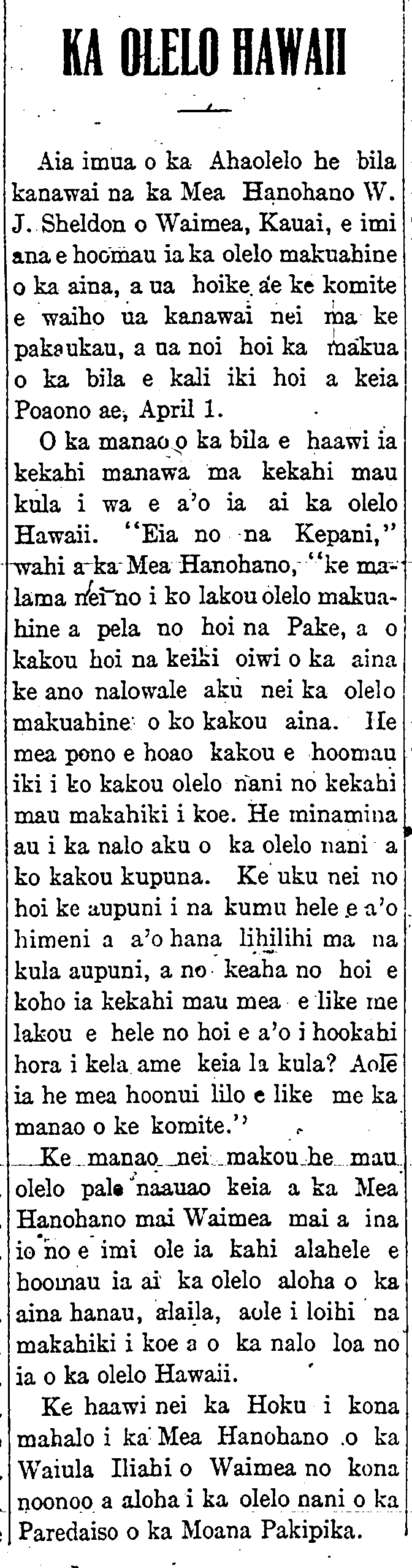
Ka Hoku o Hawaii, Buke 5, Helu 47, Aoao 2. Maraki 30, 1911.
Here is a group picture of the seventh legislature of the Territory in 1913. Poepoe is in the back row, forth from the left.
The caption reads:
The Seventh Legislature of the Territory of Hawaii Nei Opens
Top from the left to right—E. J. McCandless, D. Kupihea, J. K. Paele, J. M. Poepoe, J. S. Kalakiela, Dr. A. Irwin, H. L. Kawewehi, E. K. Kaaua, John Wilcox, P. J. Goodness, C. K. Makekau, E. da Silva, C. H. Cooke, N. Watkins, S. S. Paxson, D. K. Kaupiko, W. R. Kinslea, A. Robertson, J. W. Asch, R. P. Spalding, J. K. Lota, G. P. Cooke, H. M. Kaniho, W. J. Sheldon, Vice-Speaker J. H. Coney, Speaker H. L. Holstein, E. Waiaholo, Dr. G. D. Huddy. Not pictured—A. F. Tavares and N. K. Lyman.
(Kuokoa, 2/21/1913, p. 1)
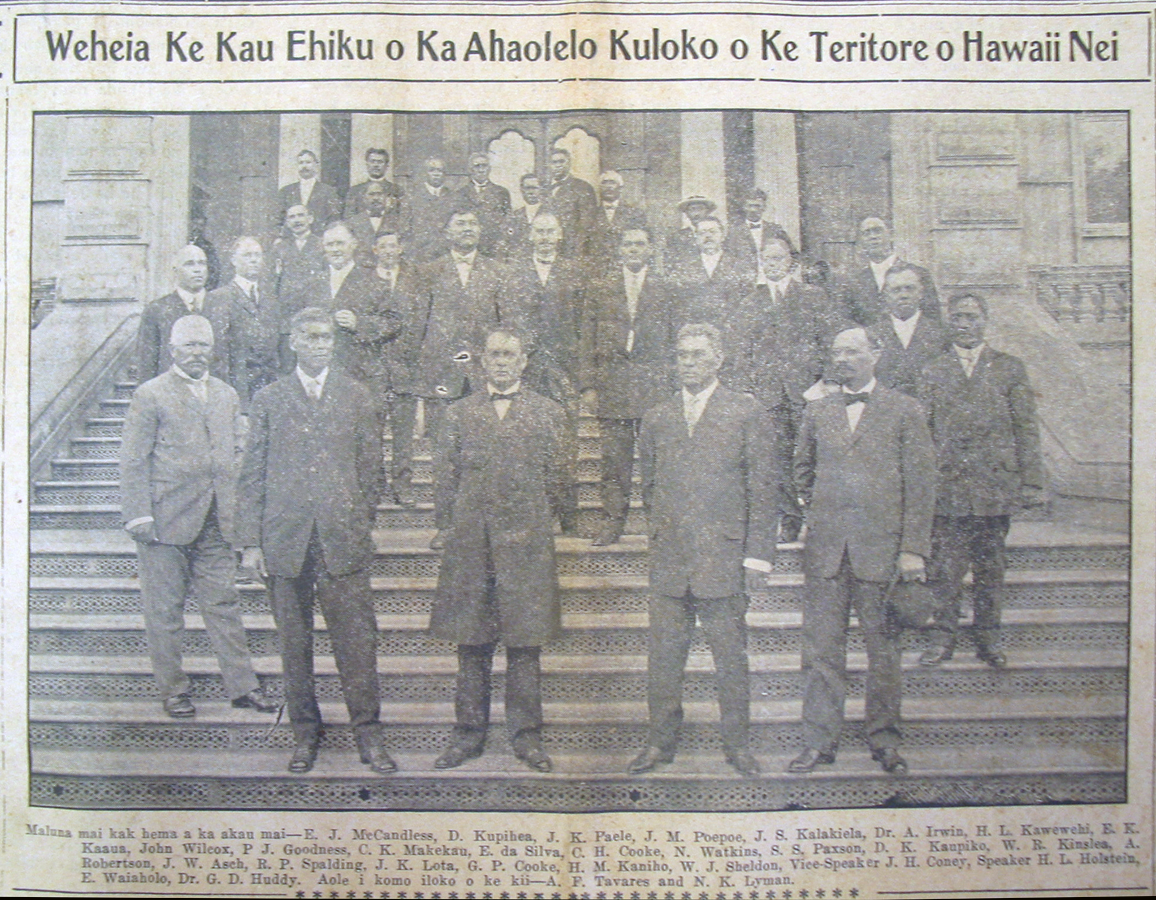
Ka Nupepa Kuokoa, Buke L, Helu 8, Aoao 1. Feberuari 21, 1913.
And this one is published upon his passing.
(Kuokoa, 4/18/1913, p. 1)
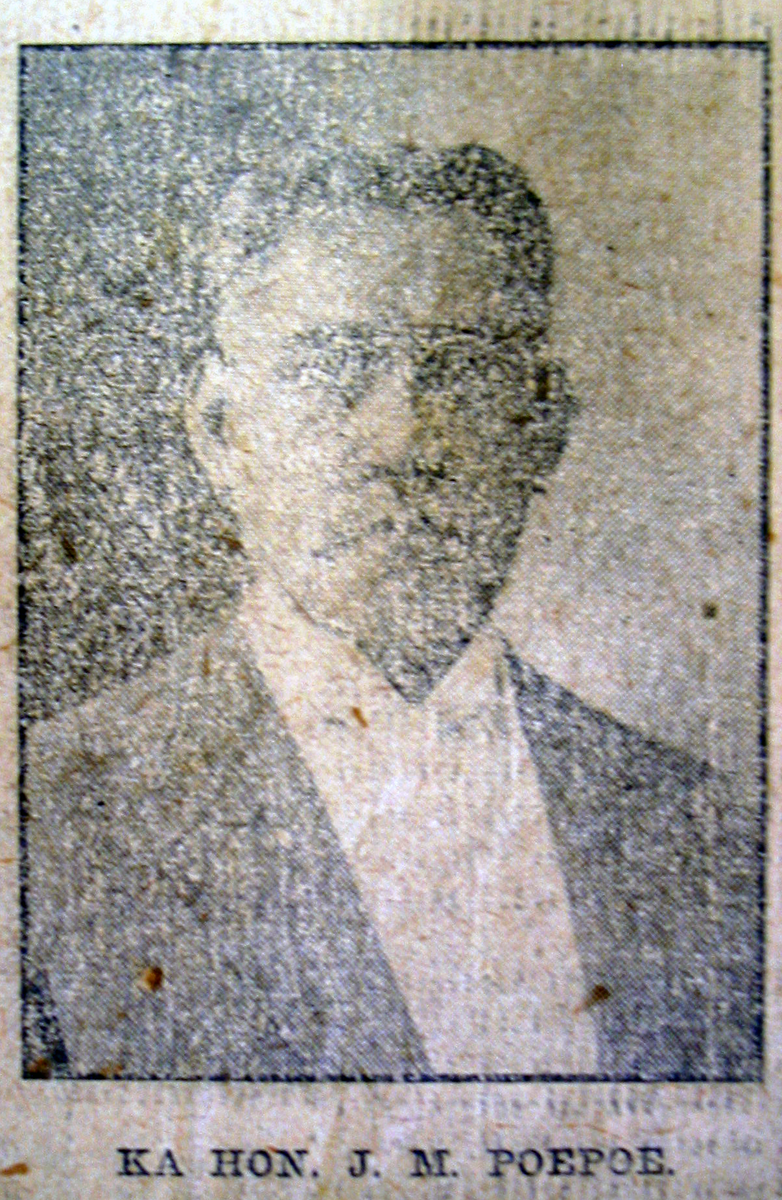
Ka Nupepa Kuokoa, Buke LI, Helu 15, Aoao 1. Aperila 18, 1913.
[Anyone know of any other pictures of Joseph M. Poepoe?]
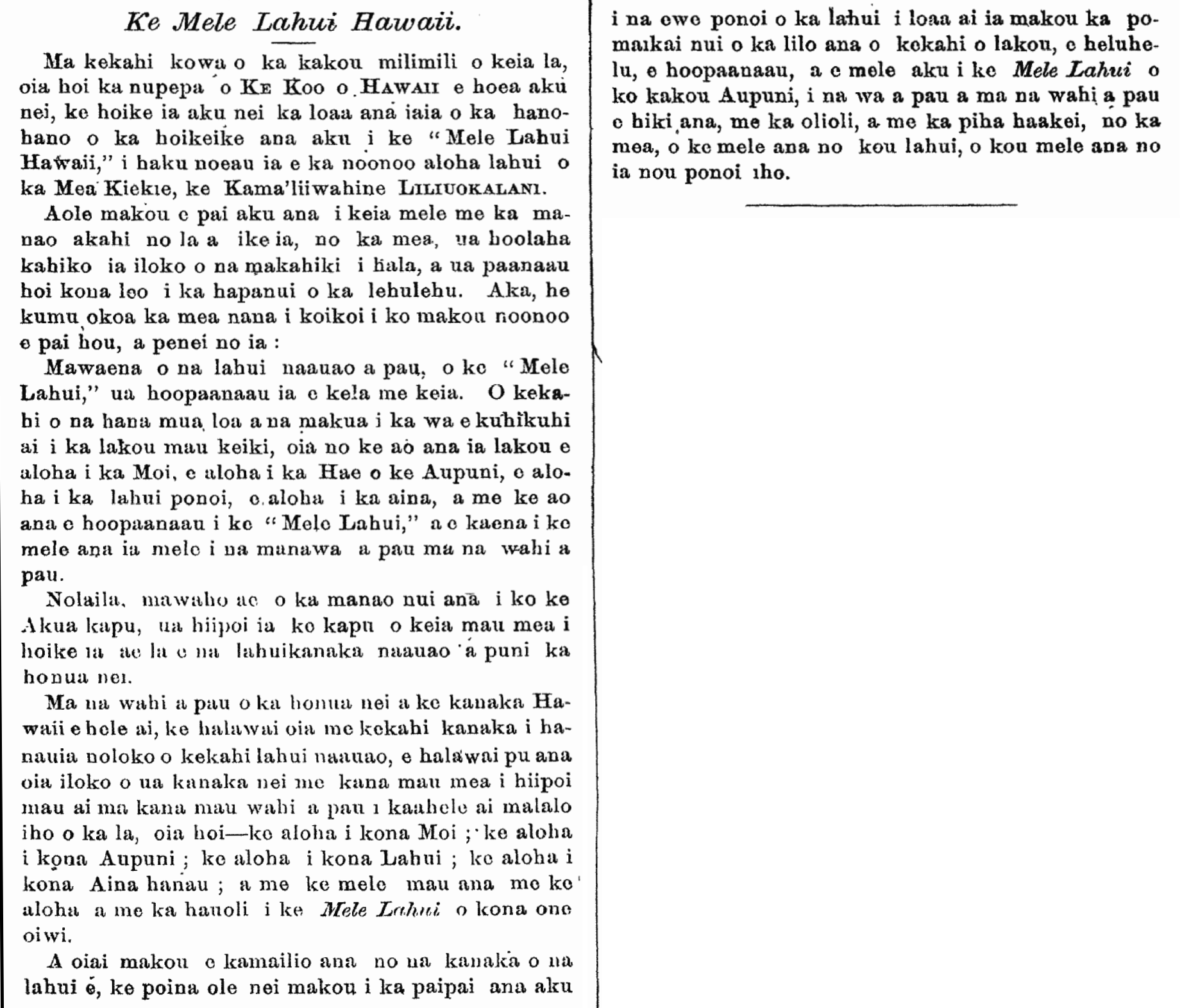
In an open space in our beloved one of this day, that being the newspaper “Ke Koo o Hawaii,” that is coming to you, it is being shown that we have the honor of putting before you the Hawaiian National Anthem [“Mele Lahui Hawaii”] which was skillfully composed with feelings of aloha for her people by Her Highness, Princess Liliuokalani.
We are not printing this mele thinking that this is the first time it will be seen, for it was printed a long ago in years past, and its melody is memorized by most. However, there is a different reason we thought it was important to reprint it, and that being:
Amongst all enlightened people, the “National Anthem” is memorized by everyone. One of the first duties of a parent when instructing their children is to teach them to love their Monarch, to love the Flag of their Nation, to love their own people [lahui], to love their land, and to memorize their National Anthem and to be proud to sing this mele at all times and at all places.
Therefore, besides respecting God’s laws, the sacredness of those things mentioned above are cherished by enlightened nations all over the world.
In all places on this earth travelled by Hawaiians, whenever he meets up with someone born in an enlightened nation, he meets also within that person [e halawai pu ana oia iloko o ua kanaka nei ?] with what he constantly cherishes in all places travelled by him under the sun, that being—love for his King; love for his Nation; love for his People, love for his Land of birth; and the singing always with love and joy of the National Anthem of his homeland.
And while we speak of those of other nations, we do not forget to encourage our own natives of this lahui who we have the great fortune to have some of them read, memorize, and sing the National Anthem of our Nation, at all times and at all places they go, with joy and filled of pride, because singing for your lahui is singing for your very own self.
(Koo o Hawaii, 8/15/1883, p. 5)
Ke Koo o Hawaii, Buke 1, Helu 1, Aoao 5. Augate 15, 1883.
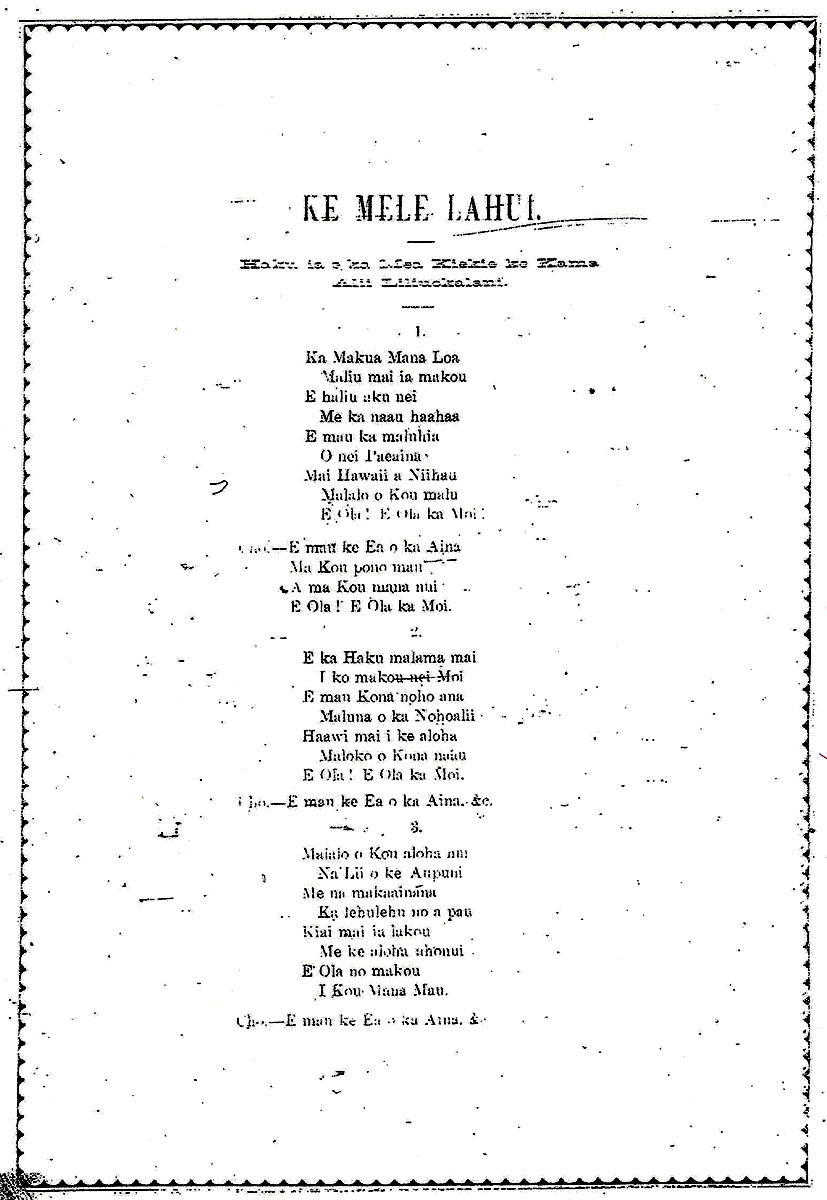
Composed by Her Highness
Princess Liliuokalani.
1.
Ka Makua Mana Loa
Maliu mai ia makou
E Haliu aku nei
Me ka naau haahaa
E mau ka maluhia
O nei Paeaina
Mai Hawaii a Niihau
Malalo o Kou malu
E Ola! E Ola ka Moi!
Cho.—E mau ke Ea o ka Aina
Ma Kou pono mau
A ma Kou mana nui
E Ola! E Ola ka Moi.
2.
E ka Haku malama mai
I ko makou nei Moi
E mau Kona noho ana
Maluna o ka Nohoalii
Haawi mai i ke aloha
Maloko o Kona naau
[A ma Kou ahonui]
E Ola! E Ola ka Moi.
Cho.—E mau ke Ea o ka Aina, &c.
3.
Malalo o Kou aloha nui
Na’Lii o ke Aupuni
Me na makaainana
Ka lehulehu no a pau
Kiai mai ia lakou
Me ke aloha ahonui
E Ola no makou
I Kou Mana Mau.
Cho.—E mau ke Ea o ka Aina, &c.
(Koo o Hawaii, 8/15/1883, p. 11)
Ke Koo o Hawaii, Buke 1, Helu 1, Aoao 11. Augate 15, 1883.
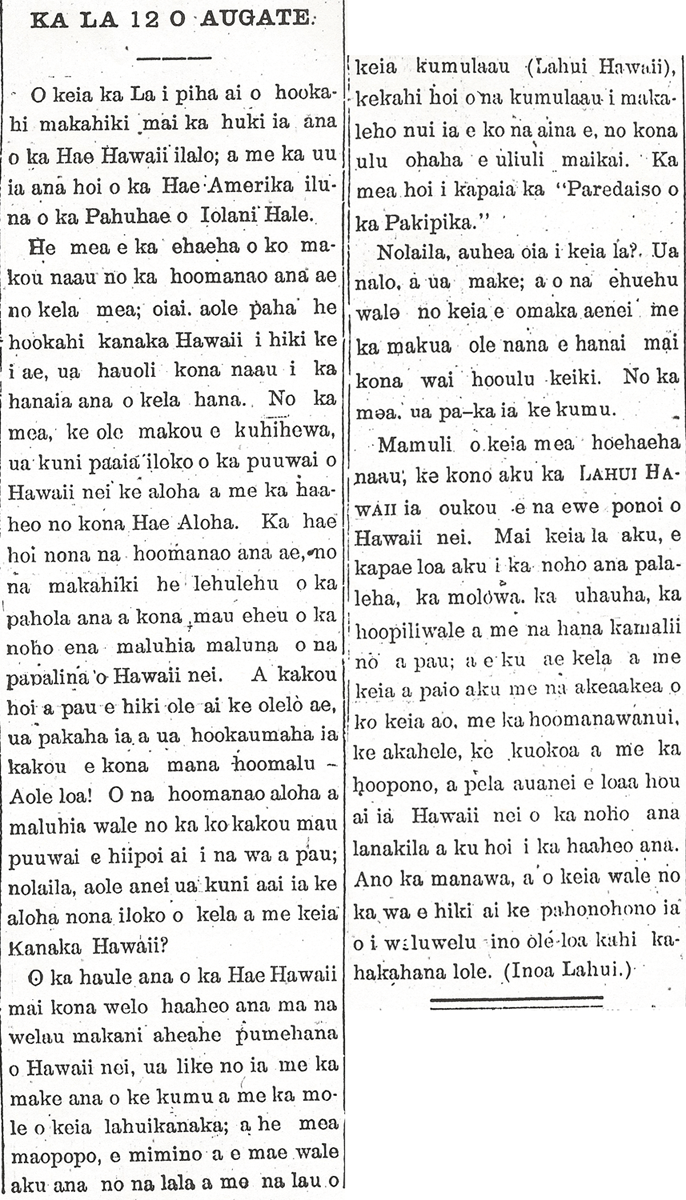
This is the Day that made a year since the day that the Hawaiian Flag was taken down and the American Flag was raised on the flag pole of Iolani Palace.
The hurt down in our guts [naau] is unimaginable when remembering this; for there is no Hawaiian that can say that his naau is happy with what was done. Because if we are not mistaken, branded withing the hearts of Hawaiians is the love and pride for his Beloved Flag. The flag which holds memories of many years spreading its wings in peace over the cheeks of Hawaii nei. And for which none of us can say that we were robbed and saddened under its protection. Not at all! Our hearts will only cherish for all times, the loving memories and peace; and as such, are not each and every Kanaka Hawaii burning with aloha for it?
The falling of the Hawaiian Flag from where it proudly fluttered on the tips of the warm breezes of Hawaii nei, is like the death of origin and foundation of this people [lahuikanaka]; and it is clear that the branches and leaves of this tree (The Hawaiian Nation) will wither and fade, a tree that was greatly admired by other nations for its lush and verdant growth. What was called the “Paradise of the Pacific [Paredaiso o ka Pakipika].”
Therefore, where is it today? It has gone, and died; and it is but the wisps that are budding, without a parent to feed its nourishing waters. For the trunk has been chopped.
Because of this heart-wrenching thing, the Lahui Hawaii invites all of you, native Hawaiians. From this day forward, to discard your living indifferently, lazily, wastefully, off others, and all of your childish ways; and for each and everyone of you to stand and fight against the obstructions in this world with patience, caution, independence, and righteousness; and it is through this that Hawaii nei will once again regain its success and pride. Now is the time, and it is only now that we can do the mending while this striped cloth has not become too ragged. (Inoa Lahui.)
(Lahui Hawaii, 8/12/1899, p. 4)
Ka Lahui Hawaii, Buke 1, Helu 29, Aoao 4. Augate 12, 1899.
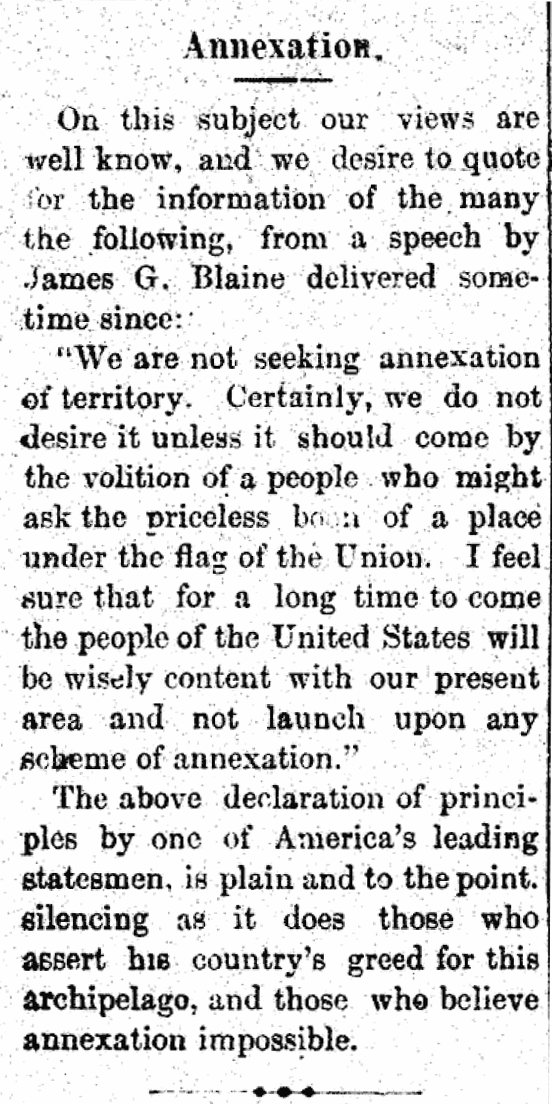
On this subject our views are well known, and we desire to quote for the information of the many the following, from a speech by James G. Blaine delivered sometime since:
“We are not seeking annexation of territory. Certainly, we do not desire it unless it should come by the volition of a people who might ask the priceless boon of a place under the flag of the Union. I feel sure that for a long time to come the people of the United States will be wisely content with our present area and not launch upon any scheme of annexation.”
The above declaration of principles by one of America’s leading statesman is plain and to the point, silencing as it does those who assert his country’s greed for this archipelago, and those who believe annexation impossible.
(Leo o ka Lahui, 9/11/1891, p. 4)
Ka Leo o ka Lahui, Buke II, Helu 278, Aoao 4. Sepatemaba 11, 1891.
Design Submitted by the “Anglo-Dane.”
A FINE PIECE OF WORK.
Some Features of the Old Seal. The Old and the New Blended. The Lone Star of the Pacific. To be Considered on Wednesday.
Representative Robertson and Senators Schmidt and McCandless, the committee appointed to secure designs for a great seal yesterday recommended the one submitted by “Anglo-Dane,” who turns out to be Viggo Jacobson, the well known penman.
Mr. Jacobson’s design embodies some of the features of the old seal and includes others that are new to Hawaii in the matter of scrolls or escutcheons.
In working out his ideas he seems to have been animated by a desire to retain from the old coat-of-arms as much as possible and to modify it only sufficiently to meet the exigencies of the new order of things.
He evidently had good reasons for this, for the old design has much to commend it, having been executed by the College of Heraldry in London, England, upon suggestions made by the late Haalilio, a man whose abilities were held in high esteem by foreigners and natives alike.
Mr. Jacobson considered that it was a sound principle to refrain from making a very radical change, thereby avoiding the confusion which would be caused by the adoption of a perfectly new composition, however beautiful in itself, which would be unfamiliar to persons at home and unrecognizable to anyone abroad. The fact that the Government had in its request for designs shown some regard for traditions gave the designers ample scope in laying out their work and in embodying some of the essential characteristics of the old seal in the new.
Mr. Jacobson’s design serves the purpose of illustrating the evolution of Hawaiian history, past, present and future. Proceeding on these lines the original great seal, the keystone of the whole fabric, has been preserved in its entirety.
That the eight bars of the national banner represent the eight inhabited islands under one rule is known, the world over, and in this connection Mr. Jacobson submits that the eight stars in the second and third quarter of the present seal are superfluous and lacking in originality, and the retention of the distinctly typical staff of authority in the fields is more justifiable. The peculiar significance is forcibly set forth in Thrum’s Annual in an article descriptive of the seal: “The white ball, etc., with which the second and third squares are charged was an ancient emblem of the country called Puloulou, and they were placed at the right and left of the gateway, or door, of the chief’s house to indicate protection, or a place of refuge, to which persons might flee from danger and be safe.”
The substitution, on the other hand, in the center of the single star of Hawaii (whose ultimate destiny it, probably, is to become engrafted upon the escutcheon of the greatest of all the Republics) for the ancient embellishments, triangular banner, argent, leaning upon a cross saltire, the exact meaning and origin of which are, to a large extent, shrouded in obscurity, and not likely to meet with any strong objection, while, from an aesthetic point of view, it must be considered a decided improvement.
The difficult problem of devising two human figures as supporters has been happily solved by introducing Kamehameha I. and the Goddess of Liberty, both representing important epochs in the history of Hawaii—the old and new respectively. The contrast of color and sex suggesting not only reconciliation, but the fusion of the races with one another.
The irradiating sun above the shield is symbolic of the new era which dawned upon Hawaii with the advent of the Republic, while the fabulous bird “Phœnix” is Hawaii nei herself, rising, rejuvenated, from the ashes of the monarchy. The taro leaves, ferns, etc., are suggestive of the fruitfulness of the soil and the tropical verdure of the country.
The fact that the committee was of the opinion that the old motto should be retained induced Mr. Jacobson to give it greater prominence than theretofore, and, in this particular, he followed the plan carried out in all of the seals in the American States.
(Pacific Commercial Advertiser, 2/25/1896, p. 1)
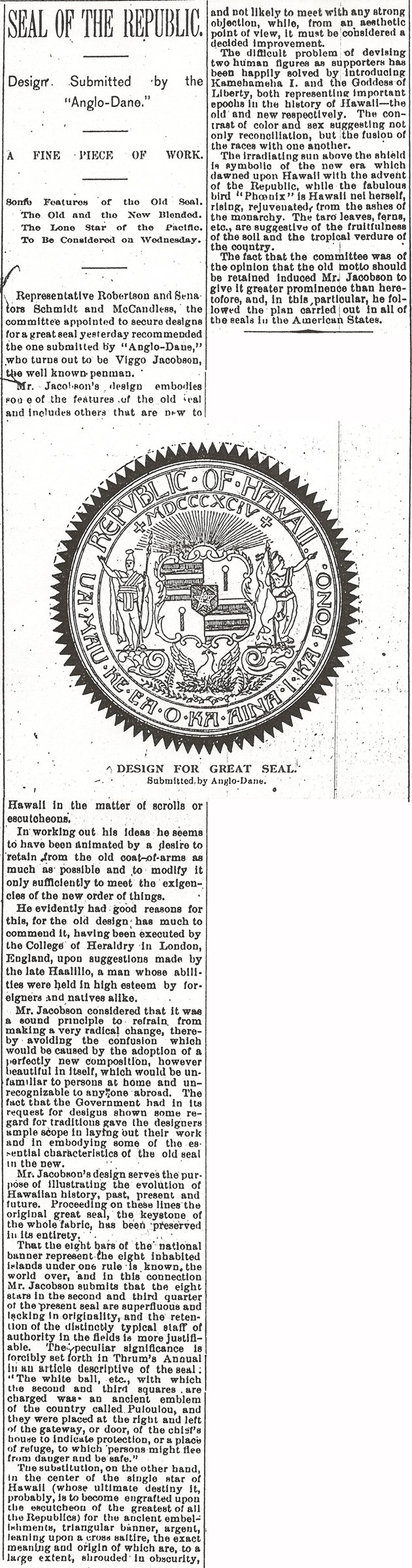
The Pacific Commercial Advertiser, Volume XXIII, Number 4234, Page 1. February 25, 1896.
I was at a presentation tonight by DeSoto Brown of the Bishop Museum on some of their treasures held in the Museum’s archives. Of particular interest to you all might be the number of new material that is available online and is word searchable!
Here is the search page for their Government and Governance: A Digital Initiative page.
One of the great many topics of interest is Leprosy.
 nupepa