There would be no trouble over translating bills if the Legislature would obey the law and conduct its proceedings in English.
(Hawaiian Gazette, 3/2/1909, p. 4)

Hawaiian Gazette, Volume LII, Number 19, Page 4. March 2, 1909.

There would be no trouble over translating bills if the Legislature would obey the law and conduct its proceedings in English.
(Hawaiian Gazette, 3/2/1909, p. 4)
Hawaiian Gazette, Volume LII, Number 19, Page 4. March 2, 1909.
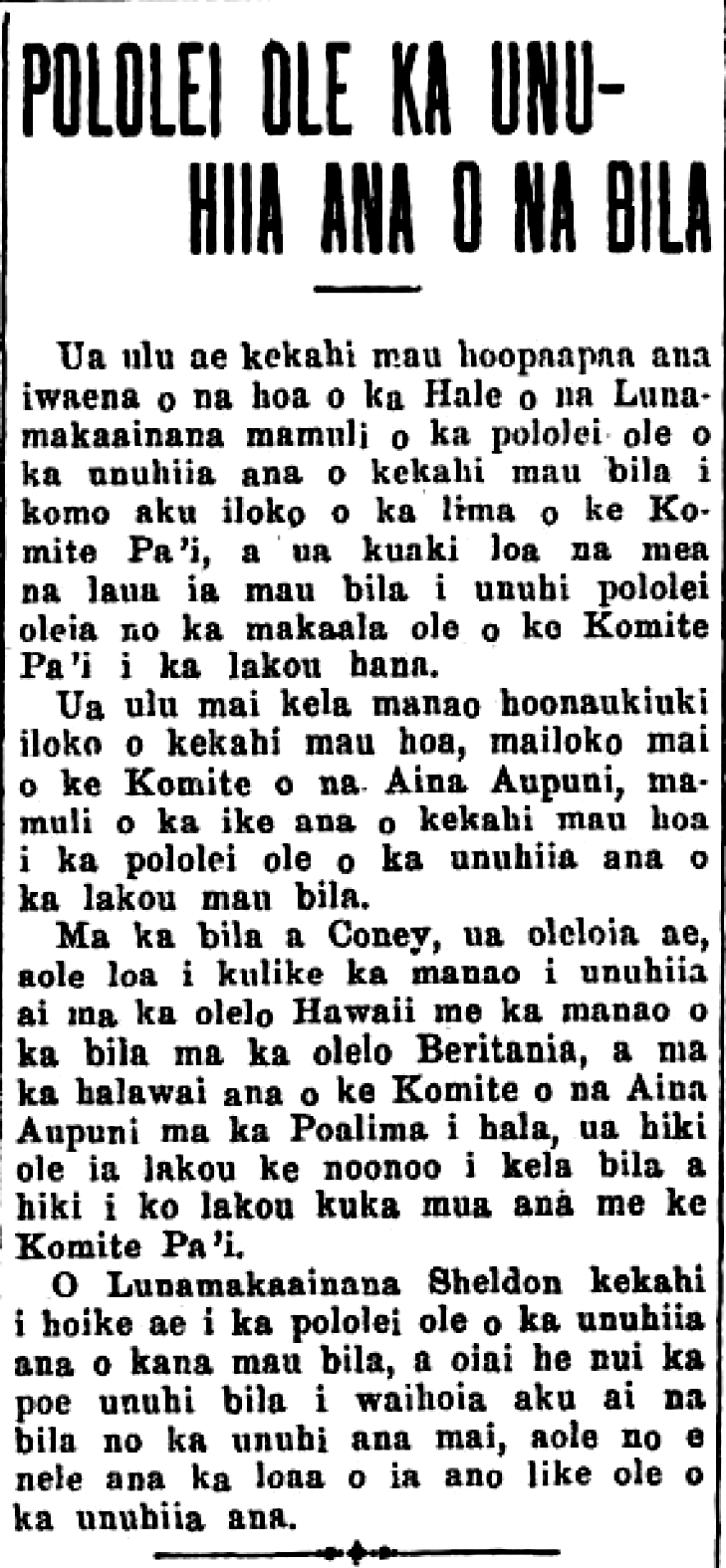
Altercations arose between members of the House of Representatives over the incorrect translations of bills which were placed in the hands of the Publication Committee [Komite Pa’i], and the two from whom the incorrectly translated bills originated were upset at the inattentiveness of the Publication Committee in their work.
This anger of some of the members originated with the Public Lands Committee [Komite o na Aina Aupuni], because some of the members noticed the incorrect translation of their bills.
For the bill of Coney, it is said that the translation in Hawaiian is not at all like the idea of the bill in English, and at the meeting of the Committee on Public Lands on this past Friday, they could not consider that bill until they consult with the Publication Committee.
Representative Sheldon was one who made known the incorrect translation of his bills, and being that there are many bill translators with whom the bills were left with for translations, there will be no shortage of those types of divergent translations.
(Kuokoa, 3/5/1909, p. 1)
Ka Nupepa Kuokoa, Buke XLVI, Helu 10, Aoao 1. Maraki 5, 1909.
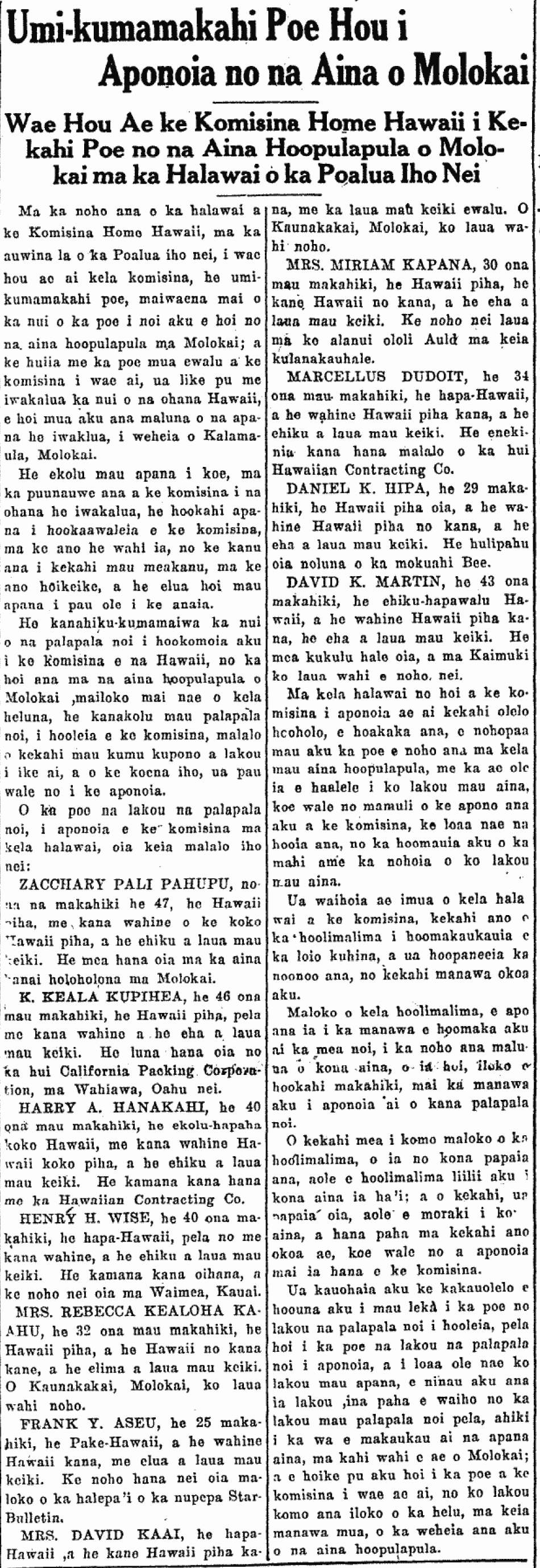
At the meeting of the Hawaiian Homes Commission on the afternoon of this past Tuesday, the commission selected eleven more people from amongst the many who applied to return to the homestead lands [aina hoopulapula] on Molokai; and added to the eight who the commission previously selected, that makes twenty Hawaiian families total who will be the first to go back to the twenty parcels opened up in Kalamaula, Molokai.
There are three parcels left to be divided up by the commission for twenty families and one section is set aside by the commission as an area to grow plants as a sample, and there are two pieces of land left to be surveyed.
There were seventy-nine applications submitted to the commission by Hawaiians, to return to homestead lands on Molokai, abut from amongst this number, there were thirty applications denied by the commission for appropriate reasons as deemed by them, and as for the rest, they were all approved.
The people whose applications were approved by the commission in that meeting are these below:
ZACCHARY PALI PAHUPU, who is 47 years old, a full Hawaiian, whose wife is also full Hawaiian, and they have seven children. He is employed at the ranch on Molokai.
K. KEALA KUPIHEA, who is 46 years old, a full Hawaiian, and so is his wife, and they have four children. He is a supervisor at the California Packing Corporation [CPC] in Wahiawa, Oahu.
HARRY A. HANAKAHI, who is 40 years old, three-fourths blooded Hawaiian, along with his wife who is full-blooded Hawaiian, and their seven children. He is a carpenter for the Hawaiian Contracting Co.
HENRY H. WISE, is 40 years old, a hapa Hawaiian, as well as his wife, along with their seven children. He is a carpenter by trade, and is living in Waimea, Kauai.
MRS. REBECCA KEALOHA KAAHU, is 32 years old, a full Hawaiian, and her husband is a Hawaiian as well, and they have five children. They reside in Kaunakakai, Molokai.
FRANK Y. ASEU, is 25 years old, Chinese-Hawaiian, and he has a Hawaiian wife, with two children. He is employed at the press of the Star-Bulletin Newspaper.
MRS. DAVID KAAI, is a hapa Hawaiian, and she has a full-Hawaiian husband, and they have eight children. They live in Kaunakakai, Molokai.
MRS. MIRIAM KAPANA, is 30 years old, she is full Hawaiian, she has a Hawaiian husband, and they have four children. They live on Auld Lane in this town.
MARCELLUS DUDOIT, is 34 years old, a hapa Hawaiian, and his wife is full Hawaiian, and they have seven children. He is an engineer working under the Hawaiian Contracting Co.
DANIEL K. HIPA, is 29 years old, a full Hawaiian, and he has a full-Hawaiian wife, and they have four children. He is a second mate aboard the ship the Bee.
DAVID K. MARTIN, is 43 years old, he is seven-eighths Hawaiian, and he has a full-Hawaiian wife, and they have four children. He is a house builder, and they reside in Kaimuki.
During that meeting of the commission, a resolution was passed clarifying that those who live on the homesteads must live there permanently and not be allowed to move away from their land, except with approval from the commission with their promise that they will continue to farm and live on their land.
Put before the meeting of the commission were some terms of the lease drawn out by the attorney general and considerations of these were postponed until another time.
In the lease, it will specify the time when the person who applied must begin living on his land, that being within one year of his application being approved.
Another thing included in the lease is that it prohibits them from releasing out sections of their land to others; also, they are not to mortgage off their land, or do else wise other than what is approved of by the commission.
The secretary was instructed to send out letters to those whose applications were denied; as well as to those whose applications were approved but did not receive a parcel, asking them if they will leave their applications in until land is made available elsewhere on Molokai; and also to notify those who the commission selected that they will be put in a lottery [? komo ana iloko o ka helu] in the future when the homesteads open up.
(Kuokoa, 8/17/1922, p. 1)
Ka Nupepa Kuokoa, Buke LXI, Helu 33, Aoao 1. Augate 17, 1922.
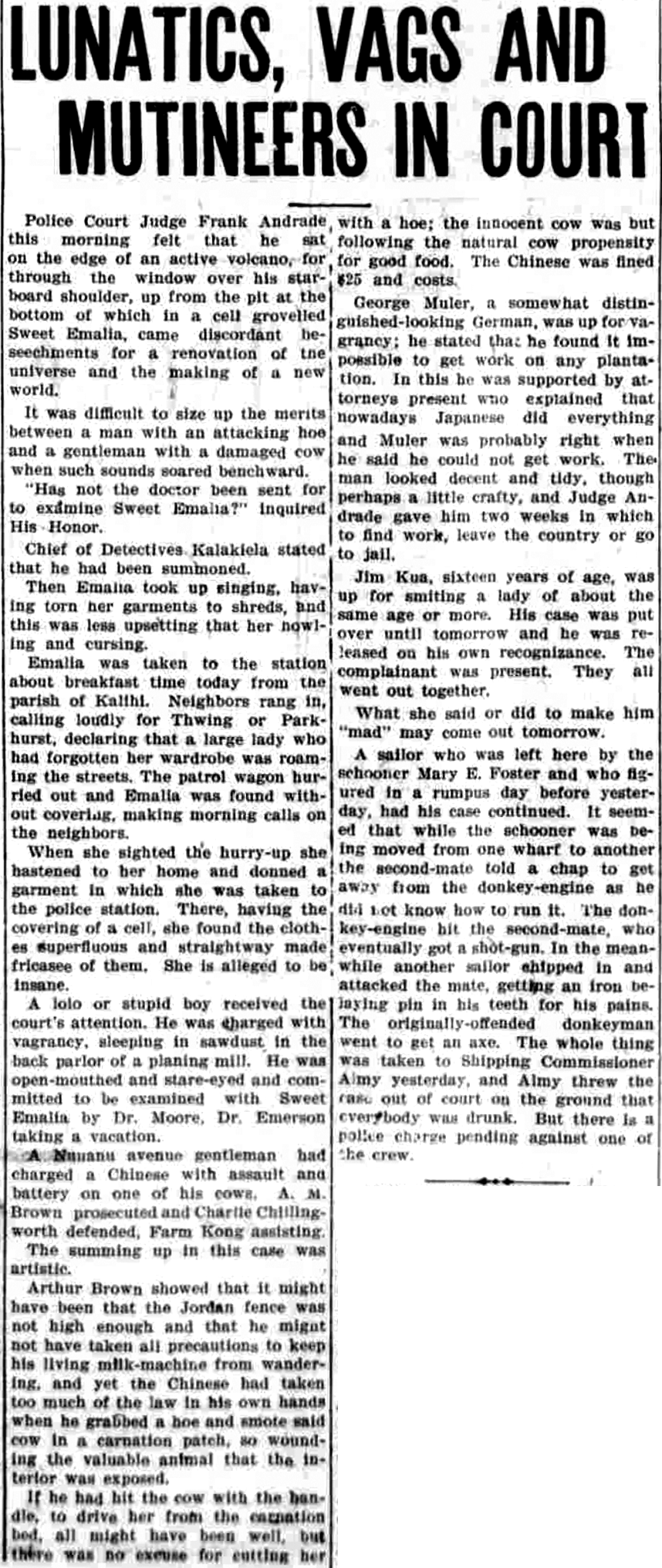
Police Court Judge Frank Andrade this morning felt that he sat on the edge of an active volcano, for through the window over his starboard shoulder, up from the pit at the bottom of which in a cell grovelled Sweet Emalia, came discordant beseechments for a renovation of the universe and the making of a new world.
It was difficult to size up the merits between a man with an attacking hoe and a gentleman with a damaged cow when such sounds soared benchward.
“Has not the doctor been sent for to examine Sweet Emalia?” inquired His Honor.
Chief of Detectives Kalakiela stated that he had been summoned.
Then Emalia took up singing, having torn her garments to shreds, and this was less upsetting that her howling and cursing.
Emalia was taken to the station about breakfast time today from the parish of Kalihi. Neighbors rang in, calling loudly for Thwing or Parkhurst, declaring that a large lady who had forgotten her wardrobe was roaming the streets. The patrol wagon hurried out and Emalia was found without covering, making morning calls on the neighbors.
When she sighted the hurry-up she hastened to her home and donned a garment in which she was taken to the police station. There having the covering of a cell, she found the clothing superfluous and straightway made fricasee of them. She is alleged to be insane.
A lolo or stupid boy received the court’s attention. He was charged with vagrancy, sleeping in sawdust in the back parlor of a planing mill. He was open-mouthed and stare-eyed and committed to be examined with Sweet Emalia by Dr. Moore, Dr. Emerson taking a vacation.
…..
[After coming across this article from 1908 showing Sweet Emalia out in Honolulu, I am now thinking that the Emily Kaihumua sent to Kalawao in 1906 and being examined there in 1909 by Dr. Goodhue might not be the same person…
Hopefully one day soon, all the Hawaiian-Language Newspapers will be rescanned clearly so that if there is ever enough money to do once again an OCR project, or a hand transcription project, it can be done accurately so that hopefully we can find each and every available article that could clarify what became of Emalia, or any other person or event in Hawaiian history for that matter!!]
(Hawaiian Star, 8/13/1908, p. 5)
The Hawaiian Star, Volume XVI, Number 5708, Page 5. August 13, 1908.
E hoololi ai i ka Pauku 2 o ka Mokuna LVI o ke Kanawai Hoopai Karaima, a e hoopau loa ai i na Pauku 3, 4 a me 5 o ia Mokuna, me na hoololi a pau i ua Mokuna nei.
E hooholoia e ka Moi a me ka Ahaolelo o ko Hawaii Paeaina.
Pauku 1. E hoololi ia a ma keia ke hoololi ia nei ka Pauku 2 o ka Mokuna LVI o ke Kanawai Hoopai Karaima, a penei e heluhelu ia ai:
“Pauku 2. E ninaninau ia, e hoolohe ia, a e hooholo ia e ka Lunakanawai no ia hihia, a ina he mea hiki e hoopau ia ka noho kue ana o laua; aka, ina aole hiki e hoopau ia ko laua kue ana, e hoopau wale ia no ka hoopii. Ina e hoopau wale ia kekahi hoopii, e hooholo ka Lunakanawai e hookaa ia na koina e like me ka mea ana i manao ai oia ka pono.”
Pauku 2. Ma keia ke hoopau loa ia nei na Pauku 3, 4 a me 5 o ka Mokuna i olelo ia a me kekahi a me na hoololi o ia Mokuna i olelo ia.
Apono ia i keia la 10 o Sepatemaba, M. H. 1888.
KALAKAUA REX.
Na ka Moi:
L. A. Thurston,
Kuhina Kalaiaina.
To amend Section 2 of Chapter LVI. of the Penal Code and Repeal Sections 3, 4 and 5 of said Chapter with all Amendments thereto.
Be it Enacted by the Kind and the Legislature of the Hawaiian Kingdom:
Section 1. That Section 2 of Chapter LVI. of the Penal Code be and is hereby amended so as to read as follows:
“Section 2. Said Justice shall examine into, hear and determine the complaint and shall secure if practicable, a reconciliation between the parties; but if no reconciliation can be effected, the complaint shall be dismissed. In case of such dismissal the Justice shall adjudge the costs to be paid as in his opinion justice shall demand.”
Section 2. Sections 3, 4 and 5 of said Chapter and any and all amendments thereof be and are hereby repealed.
Approved this tenth day of September, A. S. 1888.
KALAKAUA REX.
By the King:
L. A. Thurston.
Minister of the Interior.
On the 30th of March, between the hours of 1 and 6 in the afternoon, the representative Pilipo Kamai of here in Hana held a meeting of the makaainana in the old school house adjacent to his residence at Puuomaiai, Kaupo. There were fifty-four Hawaiians, one Portuguese, and one American that showed up. Rev. Mr. Kailioha of Huelo called for the light from the Heavens to shine down. The meeting began peacefully, and our representative revealed his path for the upcoming Legislative session, and the number of his objectives is twenty-three. And here they are, without my clarifications; the 3rd objective is the one he is passionate about.
And this is how he began, “When my feet are firmly planted amongst my fellow law makers, your humble servant will strive to fulfill these objectives:
1. To maintain our nation’s independence.
2. To pay off our nation’s debt.
3. To restore all power of the King.
4. To lessen the wages of all the nation’s officials, from the first to the last.
5. To have the government lands sold at low cost only to Hawaiians who have no land.
6. To block the entrance of the Chinese, Japanese, and Portuguese.
7. To continue the Treaty with the United States of America.
8. To repeal for good the desertion of marriage law passed during the last Legislative Session.
9. To make Arbor Day (La kanu laau) into a day that is recognized.
10. To have voting for the Monarch done by all.
11. To have the Cabinet of Ministers be made up of two Hawaiians and two haole.
12. To lessen taxes.
13. To pay only $25.00 to representatives who win and not to those who lose.
14. To have juries for Hawaiians be Hawaiian, and juries for haole be haole.
15. To bring an end to pensions [uku hoomau].
16. To have clergy teach School children about religion everyday, during school hours.
17. To have makaainana petition to their Representatives of their problems by way of Committee of thirteen selected members, it being signed by fifty names.
18. To get funding for the jail in Kipahulu.
19. To have children under 17 years not be taxed.
20. To get Hana two Judges.
21. To get Hana two Representatives.
22. To have street taxes levied in each town remain with each respective town, and not be turned over to the Street Funds of the district.
23. These objectives above will be considered carefully before the representatives brings them to motion in the Legislature.
A Committee was selected, and here is who were chosen: Paele, Chairman; Kala, Secretary; Anakalea; Kamoau; Kanamu; Helio; Naehu; Karolo; Nehemia; Haleauki; Anton Paiko; and Kalima. The committee will meet this coming week, on April 12, to think on the problems here in Kaupo, and the entire district.
Before the meeting was adjourned, a letter was read from Ulupalakua asking our representative to go there for a grand party given to honor Mister Wilcox [Wilikoki]. The meeting was adjourned.
Kahupo.
Kaupo, March 31.
(Ko Hawaii Pae Aina, 4/19/1890, p. 1)

Ko Hawaii Pae Aina, Buke XIII, Helu 16, Aoao 1. Aperila 19, 1890.
We’ve heard that the District Sheriff [Luna Makai] of Koolauloa went to Waimea this past Saturday, and saw the condition of Kaleiwahea, and according to him [the sheriff], he [Kaleiwahea] has no sickness. A haole also stated that he has no signs of the sickness upon him, and that he met with Kaleiwahea many times these past two years.
(Lei Momi: Oili Pule, 8/5/1893, p. 8)
Ka Lei Momi, He Nupepa Oili Pule, Buke I, Helu 1, Aoao 8. Augate 5, 1893.
Kaleiwahea has been a kamaaina of the uplands of Kalihi for many years. He has some blemishes by his eyes and mouth. While he was living this way, he was made an adversary by some people and they went to the Board of Health as witnesses saying he had leprosy. A warrant was issued for his arrest and he was captured and taken to the quarantine station of Kalihi. He told some people that he was confined there for six weeks without being examined, along with some other patients. One day some people told him that he was going to be taken to Molokai without being examined.
Therefore, one day a thought grew within him without considering the power of the Board of Health, and thinking of his own accord that he did not have leprosy, he escaped and ran away to free himself and went to the mountains, until the valley of Waimea. Later it was heard that he fled, and the order was given to the Deputy Sheriffs in response to his escape, to capture him if found. He was constantly hunted like a wild animal. He said that he didn’t want to be taken alive. Previously, he did not carry weapons, but after he heard that he was being hunted by the officers, he ran and swam in the ocean, while being chased by officers aboard a canoe, and when the officers were close behind, he grabbed on to the outrigger float [ama] and flipped the canoe, and the officers were thrown into the ocean. The two officers returned to shore without the object of their chase. When it became dark, Kaleiwahea came to shore at Waialua.
From that time, Kaleiwahea was seen carrying a rifle and other weapons, and when the officers came to arrest him once more, he was prepared. The officers told him that they’d come at night to capture him, so he fled to live in the mountains. He said that as long as he was hunted like an animal, he’d not give up. According to some news received, he was living in a very good area in the mountains of Kahuku, where it was better than where Koolau¹ was living, and he could toy with all who appeared before him.
When he heard that he was to be captured again, he fled to the mountains, even if just a few months ago he was living by the sea and working at the dock of Waimea. He was very skilled at that kind of work. But he surmised that the order was given to the District Sheriffs of Waialua and Koolau, not to arrest him, but to let him be until the time was right, then maybe he could be assuaged and his appearance could be looked at. Because according to the people who knew, there were no signs of that disease that separates families [leprosy] upon him.
This below is the letter he wrote to one of his friends, and let it be read with great relish [? onoi nui]:
Camping Place in the Mountains
Kahuku, July 29,
To _______
I received your letter of aloha, and it gave me much hope and happiness, and for the first time, I’ve have an appetite here in my mountain home. I’ve received a lot of news that I’m being hunted after, and last week I was greatly saddened upon hearing that the haole police were coming along with the government troops to go against me, and that they’d shoot me if they can; what is the wrong I have committed that I should be treated that way like an animal? When I heard this, aloha welled up within me for my wife and our newborn baby of two weeks, as well as for my family. I attempted to go once again and escape my mountain home and give my wife and family my last aloha; and to my wife i said, “The time has come for me to go like a wild animal and return to my mountain home, until i meet with those of which I hear, and it will be then that I fight for life or death, until the very last puffs of smoke from my rifle.” With these words above, I left my home depressed, but when I received your letter to me, it gave me good hope that there will be end to the years of persecution. I shall rest like a man, and my deed done as a man, and not like a beast running through the forest.
With much aloha, me, your humble servant,
Jack Kaleiwahea.
¹The famous one written of in “Ka Moolelo Oiaio o Kaluaikoolau” or “The True Story of Kaluaikoolau,” which is available from the Kauai Historical Society, or a bookstore near you!
[I wish the digital images of this paper were better. This article is even cut off on the left, so I had to guess at many of the words… It is definitely time to rescan the Hawaiian-Language Newspapers!]
(Lei Momi, 8/5/1893, p. 5)
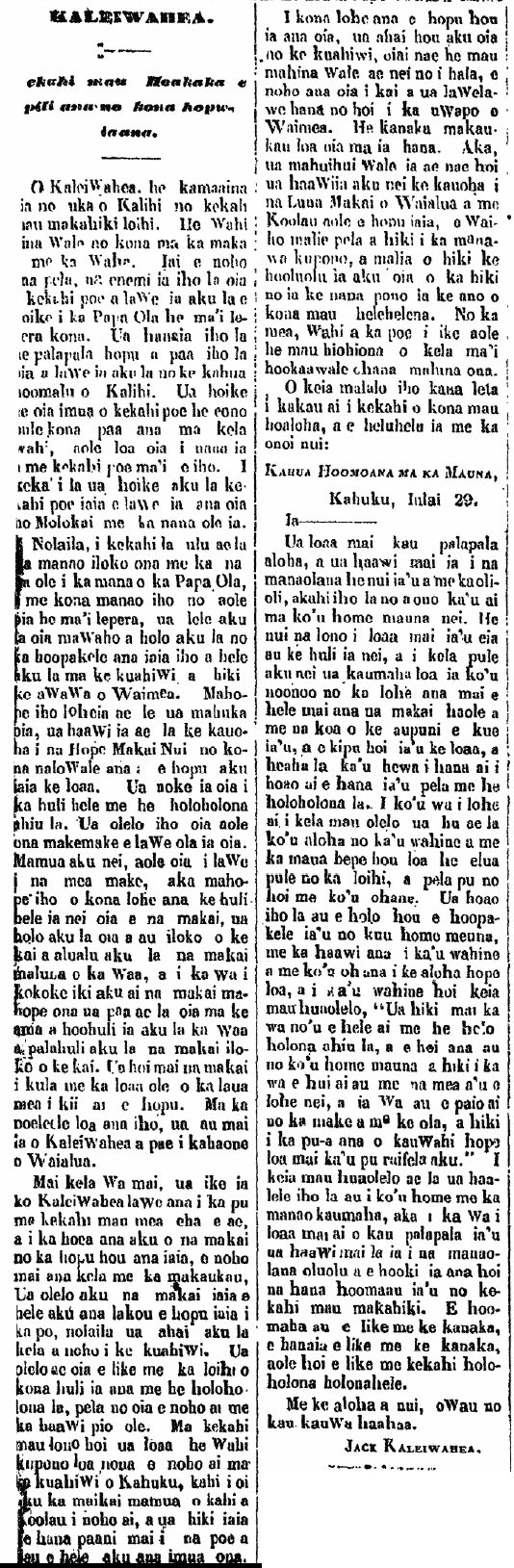
Ka Lei Momi Oili Pule, Buke I, Helu 1, Aoao 5. Augate 5, 1893.
After reading the previous article in the Kuokoa signed D. Baldwin, read this statement from the same man dated just seven days after the article appeared, which is quoted on pp. 16–17 of “LEPROSY IN HAWAII: A Supplement to the Report of the President of the Board of Health,” 1886. Also, I just noticed that the original English of the Kuokoa article is shown, along with the places where portions were edited out (marked by asterisks) on pp. 15–16.
“We have a foul and dangerous disease among us, and must, therefore, not quiet the fears of the public beyond what the truth will bear. The native population are not too much alarmed. In this region the healthy are often seen mingling with the leprous, which thing ought not so to be. In some of the extracts (of my letter in the Kuokoa) which you made, I have expressed myself strongly in favor of the curability of our Hawaiian leprosy, because I wished to turn the attention of natives from their ignorant and dangerous practitioners to foreign physicians. By extracting the paragraphs which utter this opinion, and omitting others, you make me seem to speak more confidently of future success in curing this disease than I intended to do; and therefore, I wish to add a few remarks by way of explanation; and,
“1. * * * The cases I was able to report are sufficient, I think, to encourage us to persevere in efforts to cure the frightful malady, and to banish it from the land. They should lead natives to look to those for help who alone can be supposed to have any means of combating so fearful a disease. They may be permanent cures, or the disease may break out more unmanageable than ever. Similar cures reported in other countries should encourage us.
“2. While I write thus hopefully, I am aware that men of the highest medical talent have studied the disease of leprosy, and they have sought for remedies, and many of them have pronounced it utterly incurable. It is certainly not a little staggering to our hopes in this matter, that while eminent physicians have bestowed so much attention, for many hundred years, and while the very remedies I have now been using have been used for ages in Asia and elsewhere, still there is a widespread belief that leprosy is an incurable disease. But there are authorities on the other side. An English medical dictionary has the finest descrip- I have ever met with of leprosy of the middle ages, which spread over Europe. The author says, recent cases may be cured. An eminent French physician says he has seen a multitude of cases of this disease treated without a single failure to cure. There is no way of accounting for such opposite opinions of great men, only by supposing that they are speaking of different species of the disease. * * * *
“As your China correspondent well observes (Feb. 25), we have now only a mild form of leprosy. But, it will, doubtless, in time assume more terrible features. Indeed, we have already had, in this place, some horrible cases. The disease has been considered in all countries, contagious. It has been so in Lahaina, though it does not appear in a new subject till a long time after exposure to its infection; and we have the proof of it in several families. We are beginning to have a crop of leprous young children.”
[It is important to read the information read by Hawaiians in the Hawaiian-Language Newspapers, but it is also important to read the English documents for a wider perspective on what happened historically.]
On this day, those who took our beloved land by force rejoice, and it makes a full years since they’ve feasted wastefully of the fertile soil of our mother land. This day is one of happiness for the circle of missionaries, plunderers of land, and overthrowers of the Hawaiian Kingdom, as well as for those who enter join their circle.
It is true, they will indeed rejoice; however, along with this joy, there is hurt within. Look at Belshazzar [Belehazara] the one whose boast went, “Am I not Belshazzar, the builder of the Great Babylon? Look at its shiny walls, its beautiful images, and its Throne has authority and might.”
However, let us recall, O Hawaiian Lahui, his story; what is known? it is this: That night, everyone was joyous, and drinking wine from cups sacred to Jehovah, Almighty God; and they praised Belshazzar for his great beauty. However, while the rejoicing was going on, there was seen part of a hand writing some words on the wall of the house—Mene, Mene, Setela, Uparesina; You have been weighed on the scales and have been found wanting. It was these astonishing words which caused a fear to fall over everyone in the house; and as for the king Beshazzar, he was shaking with trepidation at this amazing portion of a hand.
And that is what we are saying: the day of joy of the Government of the P. G. [Provisional Government], is the day that sadness will come; for we have seen their actions done over the past year. They were not actions done to move this land forward, but actions that were clearly harmful as well as squandering. Therefore O Pious Ones, do not forget to remember Jehovah, God, and he shall help us.
Puuwaialoha [“Loving-heart”]
(Leo o ka Lahui, 1/17/1894, p. 2)
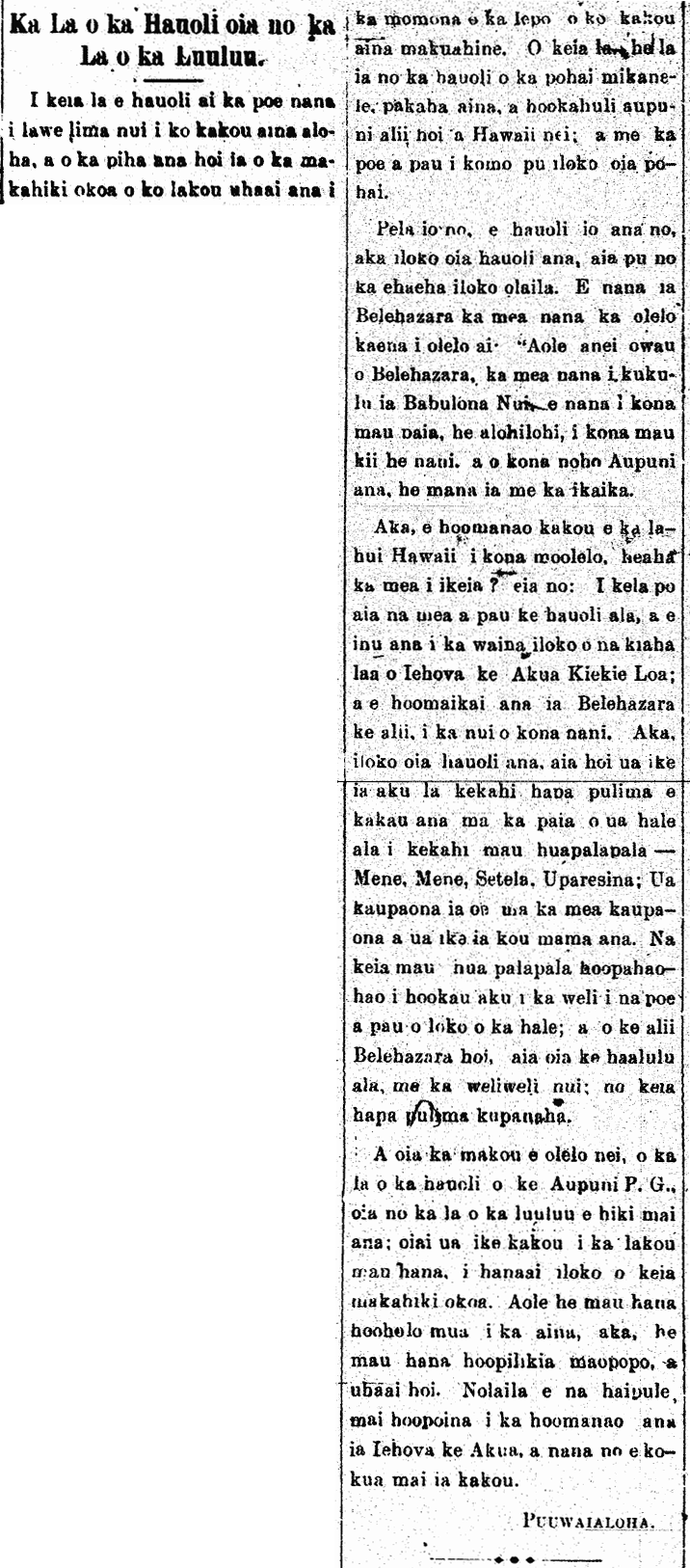
Ka Leo o ka Lahui, Buke II, Helu 856, Aoao 2. Ianuari 17, 1894.
 nupepa