Royal Order of Kamehameha: the early days, 1903.

The Secret Society of the True Natives.

On the 11th of this month, on the day of Ka Na’i Aupuni [Kamehameha Day], a number of native youths established a secret society called “Kamehameha Order”. There are many respected Hawaiians who joined this association, and Prince Kalanianaole is the head of this group.

It is stated that this association will be spread across this Archipelago, and native Hawaiians will be allowed to join, should they be fitting.

One of their major functions will be trying to search out and to care for things from times of old, and the designating of the storied places [wahi pana] all over these islands.

Currently, there is a Historical Society [Ahahui Moolelo o ke Au Kahiko]¹, and they have a lot, but the oiwi Hawaii themselves must do something so that the famed ones of times past will live on, and also to foster things that will let the name of Hawaii live on in perpetuity.

¹The roster of active members of the Hawaiian Historical Society of 1903 read:

“Ables, L. C.; Achi, W. C.; Alexander, S. T.; Alexander, W. D.; Allen, S. C.; Allen, W. F.; Baldwin, H. P.; Banning, B. R.; Beckwith, Rev. E. G.; Beckwith, Miss Martha; Bertram, Bro. G.; Bishop, Rev. S. E.; Bolte, C.; Bowen, W. A.; Boyd, J. H.; Brown, Cecil; Brown, C. A.; Bryan, Wm. A.; Carter, A. W.; Carter, G. R.; Carter, Mrs. H. A. P.; Carter, J. O.; Cartwright, Bruce; Castle, G. P.; Castle, J. B.; Castle, W. R.; Catton, R.; Cooke, A. F.; Cooke, C. M.; Cooke, Jos. P.; Cunha, E. S.; Damon, F. W.; Damon, S. M.; Day, Dr. F. R.; Dayton, D.; Desha, G. L.; Dickey, C. H.; Dickey, L. A.; Dillingham, B. F.; *Dimond, W. W.; Dole, E. P.; Dole, Hon. S. B.; Dowsett, J. M.; Emerson, J. S.; Emerson, Mrs. J. S.; Emerson, Dr. N. B.; Emerson, Rev. O. P.; Emmeluth, J.; Fisher, J. H.; Frear, Hon. W. F.; Giffard, W. M.; Goodale, W. W.; Graham, W. M.; Haalelea, Mrs. A. A.; Hackfeld, J. F.; Hall, W. W.; Hartwell, A. S.; Hatch, F. M.; Henriques, E.; Herrick, C. F.; Hobron, T. W.; Ho Fon; Humphreys, A. S.; Hustace, C.; Irwin, W. G.; Jones, P. C.; Judd, Albert F.; Lewers, Robert; Logan, D.; Lowrey, F. J.; Lucas, George; Lyle, James; Lyons, C. J.; Mclanahan, E. B.; McGonagle, Chas.; McIntyre, H. E.; Mackintosh, Rev. A.; Magoon, J. A.; May, Thos.; Mott-Smith, E. A.; Nakuina, M. K.; Nolte, H. J.; Parke, W. C.; Peacock, W. C.; Pearson, Arthur W.; Pond, Percy M.; Potter, Geo. C.; Rhodes, C. L.; Robinson, M. P.; Rodgers, Dr. C. T.; *Ropert, Rev. F. G., Bishop of Panopolis; Rowell, W. E.; Schaefer, F. A.; Schmidt, H. W.; Searle, J. C.; Sedgwick, T. F.; Smith, G. W.; Smith, Henry; Smith, Walter G.; Smith, W. O.; Stokes, John; Swanzy, F. M.; Timmons, L. D.; Towse, Ed.; Thrum, T. G.; Thurston, L. A.; von Holt, H.; Walker, T. R.; Wall, W. E.; Waterhouse, H.; Weaver, P. L.; Westervelt, Rev. W. D.; Whiting, W. A.; Whitney, Dr. J. M.; Wichman, H. F.; Wilcox, A. S.; Wilcox, C.; Wilcox, G. N.; Williams, H. H.; Wilson, W. F.; Wodehouse, E. H.; Wood, Dr. C. B.; Wood, Edgar; Wundenberg, F.
*Deceased.

(Kuokoa, 6/26/1903, p. 1)

Ka Hui Malu o na Oiwi Ponoi.

Ka Nupepa Kuokoa, Buke XLI, Helu 26, Aoao 1. Iune 26, 1903.

Alika, South Kona, 1886.

The story of how Alika was named.

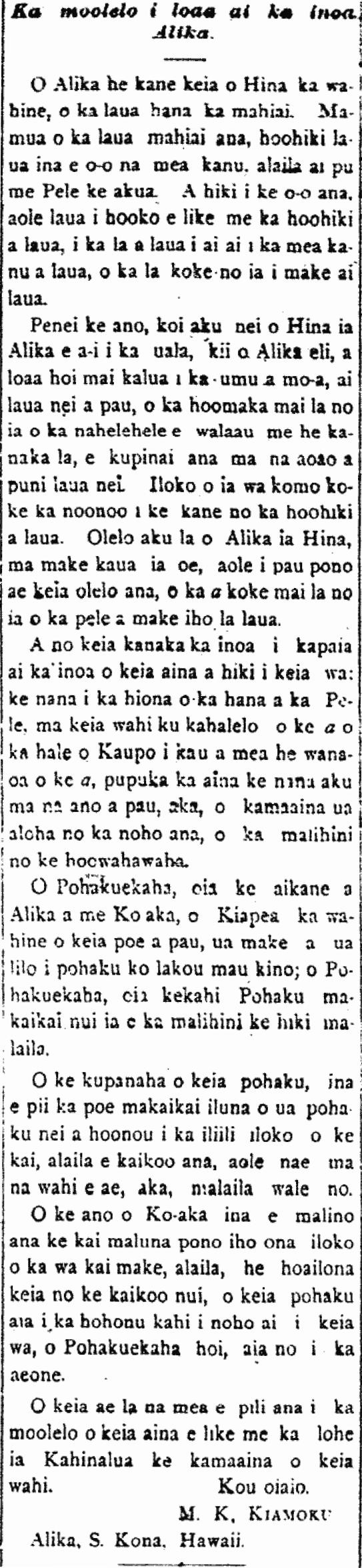
Alika was a man and Hina was his wahine, and their occupation was farming. Before they would begin farming, they would vow that should their crops mature, they would consume it along with Pele, the god. But when the crops reached maturity, the two of them didn’t carry out their promise, and the day that they ate of their crops, that was when they soon died.

This is how it happened: Hina urged Alika to eat sweet potato, and so Alika went to dig up some, and after finding some, he baked it in the umu¹ until done and then they ate it all; then the forest began to speak as if it were a man, echoing all about them. During which time, the man soon thought of their vow. Alika said to Hina, “We will die because of you,” and before he was done speaking, lava soon flamed forth and they perished.

And it is for this man that this land is called by that name until this day; if you look at the aftermath of the lava, in this area, the burnt homes of Kaupo stand jagged because of the spreading flames²; the land is horrid in appearance in every way; but the kamaaina love it here, and it is only the malihini who disparage it.

Pohakuekaha was the aikane of Alika and Ko-aka; Kiapea was the woman of all of them; they died and their bodies transformed into rocks; Pohakuekaha is a stone that is visited often by malihini who are in the area.

The amazing thing about this rock is that if the visitor climbs atop of the rock and throws pebbles into the sea, the sea will turn rough, but not in any other area, just right there.

As for Ko-aka, if the sea is calm right above it, during low tide, this is a sign that will be rough seas; this rock is now located in down in the deep, while Pohakuekaha is on the sand.

These things above deal with the story of this land as was heard by Kahinalua, the kamaaina of this place.

Yours truly,

M. K. KIAMOKU

Alika, S. Kona, Hawaii.

¹Umu is another word for imu, the underground oven (as in the name, Kaumualii).

²I am not sure if this is a reference to the actual place called Kaupo in South Kona, or to the famous saying “Kū ke ʻā i ka hale o Kaupō” from the story of Pāmano…

(Kuokoa, 8/7/1886, p. 3)

Ka moolelo i loaa ai ka inoa Alika.

Ka Nupepa Kuokoa, Buke XXV, Helu 32, Aoao 3. Augate 7, 1886.

If everyone took care of their kuleana instead of looking for the easiest way out of it… 1899/2012.

THE OLD FARMING MEN

AND THE

OLD FISHERMEN

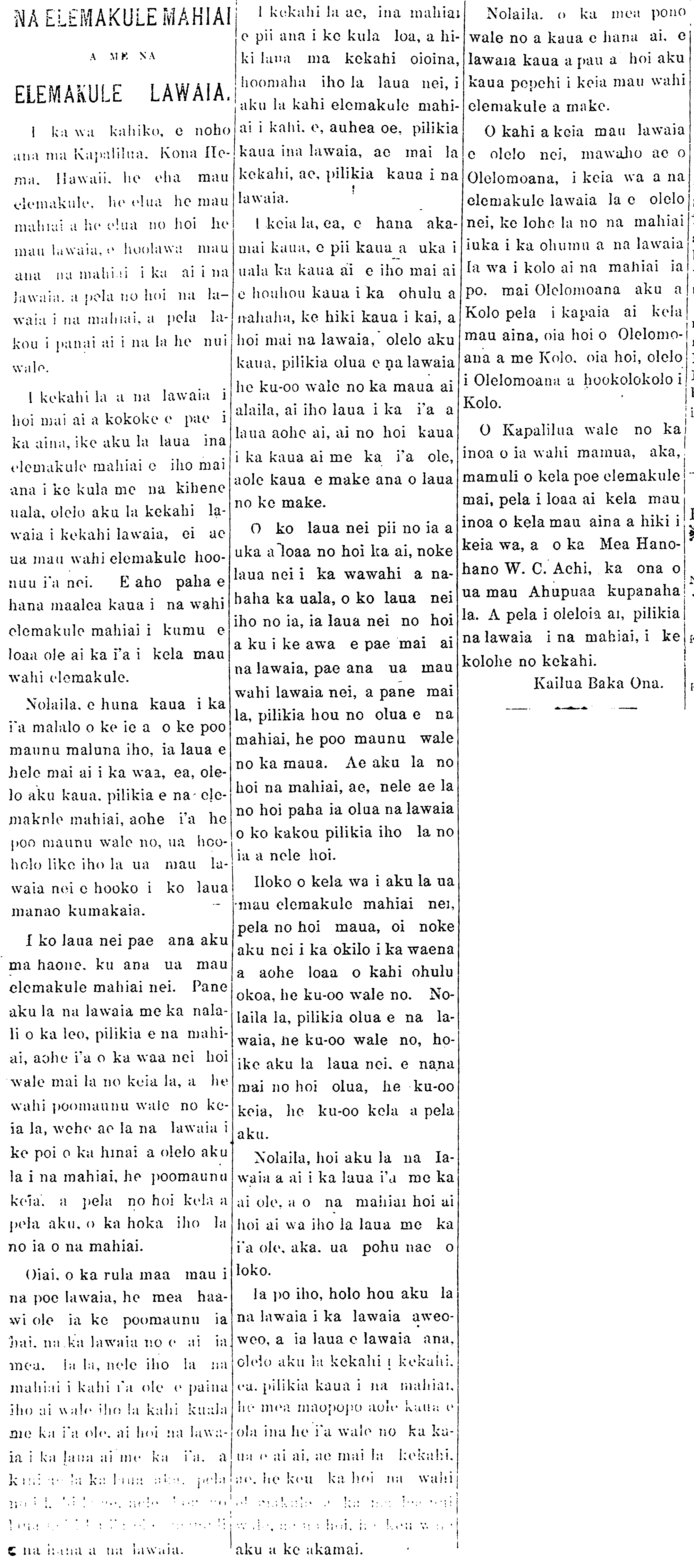
In times long ago, there lived in Kapalilua, South Kona, Hawaii, four old men; two of them were farmers and the other two were fishermen; the farmers would always supply the fishermen with their vegetable foods, and so too the fishermen would provide for the farmers, and so they shared for a long time.

One day when the fishermen were returning and almost ready to land, they saw the farmers coming down to the plains with a basket of sweet potato; one fisherman said to the other, there are those farmers who gorge on fish. It would be good if we acted cunningly to those old farmers so that those old men don’t get our fish.

So let’s hide the fish under the fish trap [ie] and place the leftover bait [poo maunu] on top, and when they approach the canoe, we’ll say, “O Farmers, we’ve got a problem, we’ve no fish, only the leftover bait;” the two fishermen decided to carry out this treacherous idea.

When they got to the beach, there stood the elderly farmers. The fishermen said in a smooth [nalali ?] voice, “O Farmers, we’ve got a problem, there’s no fish on this canoe, we’ve just turned back for today, with just the leftover bait for this day;” the fishermen opened the cover of the trap [hinai] and said to the farmers, “this is the remaining bait, and so it that,” and so forth, and the farmers were left disappointed.

It was a rule for fishermen not to give away the leftover bait to others; it was something that the fishermen ate. And so that day, the farmers went without fish and ate only some taro [kuala] without any fish, while the fishermen had their vegetable food and fish as they laughed; so it went the next day; the farmers were left without fish because of the actions of the fishermen.

On another day, while the farmers were headed up to their fields, they arrived at a resting point where they took a break, and one said to the other, “Hey, listen to this, we are being troubled by the fishermen.” “Yes, the fishermen are troublesome.”

“Today, let us act wisely; let’s go upland for sweet potato for us to eat, and when we descend, let’s stick in the vines growing from broken pieces of sweet potato [ohulu] and when we get to the shore, and the fishermen return, let’s say, ‘You fishermen have a problem; we only have broken bits of potato [ku-oo] to eat;’ then they’ll eat their fish without vegetable, and we’ll have our vegetable without fish; we will not die, it is they that will die.”

The two of them went into the uplands and got their food, and commenced breaking and crumbling up the uala; they then walked down and when they came to the harbor where the fishermen came ashore, they landed and said, “You two are in a bind again, O Farmers; we only have leftover bait.”  The Farmers replied, “Yeah, should you two fishermen have nothing, that is a problem for us, and we have nothing.”

Then, the old farmers said, “That goes for us as well, we kept searching our patch, and there was no whole potatoes, just pieces. So you fishermen are in trouble, there are only pieces;” showing them, “Look, these are only pieces, those are pieces,” and so forth.

So the fishermen went home and ate their fish without vegetable, and the farmers ate their vegetable without fish, but the farmers were satisfied.

That night, the fishermen went fishing for aweoweo, and while they fished, one said to the other, “We are being troubled by the farmers; it is certain that we cannot live if we just have fish to eat;” the other agreed, “Yes, those old men are so crafty, yes, they are so clever.”

“So the right thing for us to do is to fish, and when we’re done, we come back and kill those old men.”

The place these fishermen were talking was outside of Olelomoana, and while these old fishermen were talking, the plot of the fishermen was heard by the farmers in the upland. At that, the farmers crawled that night from Olelomoana until Kolo, and that is why those places are called Olelomoana [Ocean Talking] and Kolo [Crawl], being that there was talking at Olelomoana and there was crawling to Kolo.

Kapalilua was the only name before, but because of these old men, those places are named these names until this day, and the Honorable W. C. Achi is the owner of those amazing land sections [Ahupuaa]. And so it is said that the fishermen were troubled by the farmers because of the mischief they did to the other.

Kailua Baka Ona

(Lahui Hawaii, 9/16/1899, p. 2)

NA ELEMAKULE MAHIAI a me na ELEMAKULE LAWAIA.

Ka Lahui Hawaii, Buke 1, Helu 34, Aoao 2. Sepatemaba 16, 1899.

Makalei Cave, North Kona, Hawaii, 1924.

ENJOYMENT OF TIME

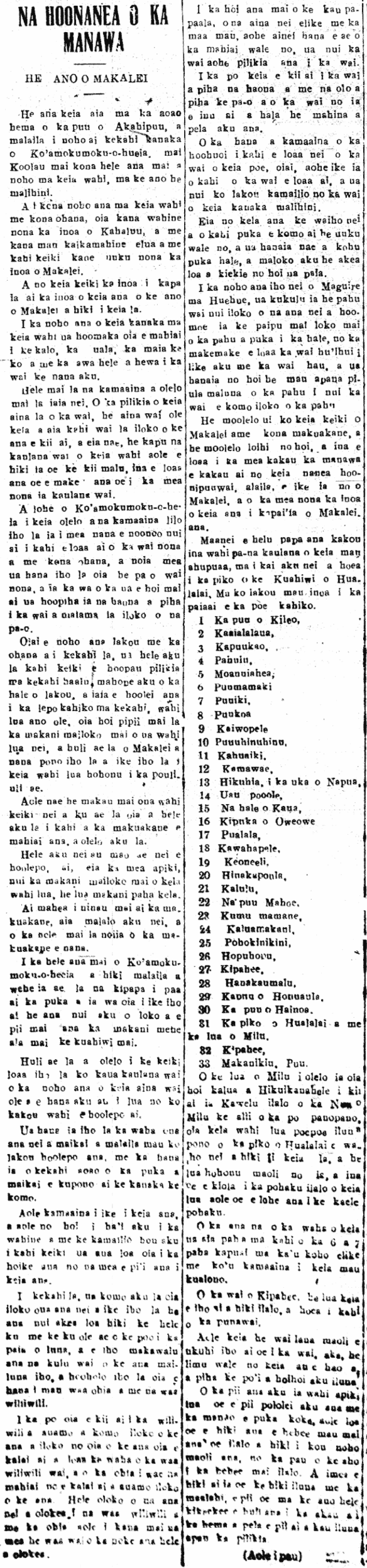
DESCRIPTION OF MAKALEI

This is a cave to the south of the hill of Akahipuu, and it was there that a man named Ko’amokumoku-o-hueia [Ko’amokumokuoheeia] lived, who came from Koolau and settled here, living as a newcomer.

And he lived here with his family: his wife, whose name was Kahaluu; and their two daughters; and one young son named Makalei.

And it was for this boy that this cave is called the cave of Makalei until this day.

While this man was living here, he began to farm taro, sweet potato, banana, sugar cane, and awa; and it all appeared to be well watered.

The natives of the area came to him and said, “The problem with this land is the water; it is a land without water, and you have to get water from the cave, but the places to store water here are kapu and cannot be fetched from in secret; if you are caught, you will be killed by the one who the water belongs.

Ko’amokumoku-o-heeia heard this talk of the locals, and this caused him to contemplate about where he and his family could get their water; and therefore, he made a reservoir [pa-o wai ?] for himself, and when the rains returned, water would fill receptacles [haona] then be held in the reservoir.

While living there with the family, one day, the boy went to relieve himself at a ravine behind their house, and while he was throwing the old waste into a plain old hole, right then wind blew out from that hole, and Makalei examined it and saw this deep, dark hole.

This boy was however not frightened at all; he stood up and went to where his father was farming and said:

“I went over there to defecate, but this is the astonishing thing, there was a lot of wind coming from that pit, maybe it is a hole of winds.”

“Where?” the father asked. “Down there,” and the father went to see.

When Ko’amokumoku-o-heeia reached the area and cleared away the stones covering the hole, he saw that it was a deep cave and wind rose from it as if it came from the mountains.

He turned and said to the child, “We have our place to hold water for our life here in this land without water, and I will make a hole for us to defecate in.”

The mouth to the cave was finished off nicely and there they defecated; while one side of the opening was made so that a person could enter.

No kamaaina knew of this cave, and he did not tell his wife, and nor did he talk of it again to his son; he totally refused to speak of the things pertaining to this cave.

One day, he entered the cave and saw the great vastness, and that he could walk upright without his head touching the wall above, and there was a lot of water dripping down; he decided to make containers [waa] of ohia, and containers of wiliwili.

In the night he fetched wiliwili and carried it on his back inside the cave, and it was inside of the cave that he dug until he made the opening of the wiliwili water container; the ohia chosen was dug out by the farmer and he carried it on his back into the cave. The inside of the cave grew criss-crossed with water troughs of wiliwili and ohia; there was just so many of the water containers that continued to be fitted inside.

When the dry season of this land returned as always, he did nothing other than farm, and he had ample water and had no problems with it.

It was at night that he fetched water and filled containers and gourds [olo], until the reservoir was full, and this was their drinking water for the month, and so forth.

The locals were suspicious about where these people go their water from, being that they did not see the source of their water, and they spoke often about the water of these malihini.

This cave still remains, and the entrance is very small but made like the entrance to a house, but within is very spacious and the walls are very tall.

When Maguire lived at Huehue, a great water catchment was built inside of the cave and a pipe was laid from the catchment until his house because he wanted cold water like ice water; also, pipes were laid above the catchment so that more water would go into it.

The story of this boy, Makalei is a beautiful one, along with his father, and it is a very long story; and should the writer have time to write this touching entertainment, then Makalei will be seen, the one whose name this cave is named after, Makalei Cave.

Here we will list the famous storied places [wahi pana kaulana] of these ahupuaa, from the sea until the summit of the mountain of Hualalai. With their names that they were called by the people of old.

1. Kileo hill.

2. Kaaialalaua.

3. Kapuukao.

4. Pahulu.

5. Moanuiahea.

6. Puumamaki.

7. Puuiki.

8. Puukoa.

9. Kaiwopele [Kaiwiopele].

10. Puuuhinuhinu.

11. Kahuaiki.

12. Kamawae.

13. Hikuhia, in the uplands of Napua.

14. Uau pooole [Uaupooole].

15. Na hale o Kaua [Nahaleokaua].

16. Kipuka o Oweowe.

17. Pualala.

18. Kawahapele.

19. Keoneeli.

20. Hinakapoula.

21. Kalulu.

22. Na puu Mahoe [Napuumahoe].

23. Kumu mamane [Kumumamane].

24. Kaluamakani.

25. Pohokinikini.

26. Hopuhopu.

27. Kipahee.

28. Hanakaumalu.

29. Kapuu o Honuaula [Honuaula Hill].

30. Ka puu o Hainoa [Hainoa Hill].

31. The summit of Hualalai and the pit of Milu.

32. Kipahee.

33. Makanikiu, Hill.

The pit of Milu [lua o Milu] spoken of is the pit which Hikuikanahele went to fetch Kawelu under the [Nuu ?] of Milu, the chief of the dark night; this is the round pit atop the summit of Hualalai which still remains to this day; it is a very deep hole and if you drop a rock down the pit, you will not hear the rattling of the rock.

The width of the mouth of this pit is perhaps about 6 to 7 feet in my estimation as I am familiar with those regions.

The water of Kipahee is a pit which goes down and reaches a spring.

It is not rippling water from which to scoop water out of, but it is moss [limu] which you collect until the container is full and then return to the top.

Climbing back up is troublesome; should you try to go straight up thinking you will exit immediately, you won’t be able to because you will keep sliding back until you are sitting after exhaustion from sliding down. In order to return to the top with ease, you have to climb zigzag, turning to the right and then to the left, and that is how you climb back to the top easily.

(Not complete.)

[This article continues into the next issue (6/5/1924, p. 4) and is signed: “Ka Ohu Haaheo I na Kuahiwi Ekolu. Kona Hawaii, April 30 1924.”]

(Hoku o Hawaii, 5/29/1924, p. 4)
NA HOONANEA O KA MANAWA

Ka Hoku o Hawaii, Buke XVIII, Helu 1, Aoao 4. Mei 29, 1924.

It is best to be truthful and just admit when you are wrong before you dig yourself into a bigger hole. 1912.

LOSE YOUR HEAD, DIE; LOSE YOUR FEET, LIVE.

The statements placed above are from a couple of men in the olden days of Hawaii nei, and this is the story:

There were two men, and one day, the two of them climbed up the mountain to cut house thatching [aho hale] which was a regular thing in those days of ours. They cut thatch until evening, and their work for the day was over, and they went to somewhere suitable and started a fire to warm themselves and prepared their meal for that night, and after they were done eating, they were about to sleep.  One of them lay down with his head to the fire and his feet away, while the other slept with his feet toward the fire and his head away; and when the one who had his feet toward the fire noticed his friend with his head toward the fire, he spoke the words placed above, saying:

E, what say you my friend, LOSE YOUR HEAD, DIE; LOSE YOUR FEET, LIVE, so why don’t you move your head away from the fire and move your feet close to it; and when the one whose head was close to the fire heard this, he replied:

LOSE YOUR FEET, DIE, for if you lose your feet to the fire, then where are your feet to go back home with to see the faces of your wife and children; therefore, because of the different choices made by the two men, they stuck to their decisions and both fell asleep; in the middle of the night, the first man smelled the smell of burning hair, and thus being startled, he saw his friend whose head was on fire; at this, he got up and made ready to head back to the home of their families and as the first man neared their houses, he turned back and saw his companion running behind him with his head on fire, the first man knew that this was a spook [uhane lapu] and not a live person, and as this first one entered the house the spook passed by the house, going around with his head still on fire; the first man told their story from beginning to end, while telling those in his household that his friend died because of his stubbornness, for he warned him to move his head away from the fire and yet he did not listen [much less heed]. So pigheaded.

This story is perhaps similar to people of these times; they stick their heads [hou poo] into stubborn ideas that are caused by false pride [uilani kuhihewa] and the results of this mistaken pride is what we have seen above.

(Hoku o Hawaii, 7/25/1912, p. 3)

PAU POO MAKE, PAU WAWAE OLA

Ka Hoku o Hawaii, Buke 7, Helu 8, Aoao 3. Iulai 25, 1912.

Tarzan in the Hawaiian-Language Newspapers, 1917–1931.

Just as the previous “Tarzan of the Apes” advertisement said, Kuokoa was running a Tarzan story while the movie was playing! Tarzan stories were apparently very popular as they were translated in the papers for many, many years.

Kuokoa

“He Moolelo no Tazana, a i ole, Ka Hiena o na Ululaau Anoano o na Kapakai o Aferika” 11/30/1917–5/10/1918 (Tarzan of the Apes),

5/10/1918–11/8/1918 (Return of Tarzan)

11/8/1918–3/7/1919 (The Beasts of Tarzan)

“He Moolelo no Keaka Tazana: Ka Weli o na Ululaau Mehameha o Aferika a o ka Hoaloha o na Holoholona Ahiu” 11/7/1919–5/21/1920 (The Son of Tarzan)

“He Moolelo no Tazana a i ole, Ka Hiena o na Ululaau Anoano o na Kapakai o Aferika. Mahele II” 5/21/1920–10/8/1920 (Tarzan and the Jewels of Opar)

Hoku o Hawaii

“He Moolelo no Tarzan me ka Liona Gula” 3/22/1923–9/11/1924 (Tarzan and the Golden Lion)

“He Moolelo no Tarzan: Ke Alii o na Mabu ao ka Mea Laka Ole” 9/18/1924–3/1/1927 (Tarzan the Untamed)

3/8/1927–6/18/1929 (Tarzan the Terrible)

6/25/1929–12/22/1931 (Return of Tarzan) [Retranslated]

Ola o Hawaii

[Unfortunately, this publication is not online. I need to check for dates and title.]

Tarzan and Chaplin! 1919.

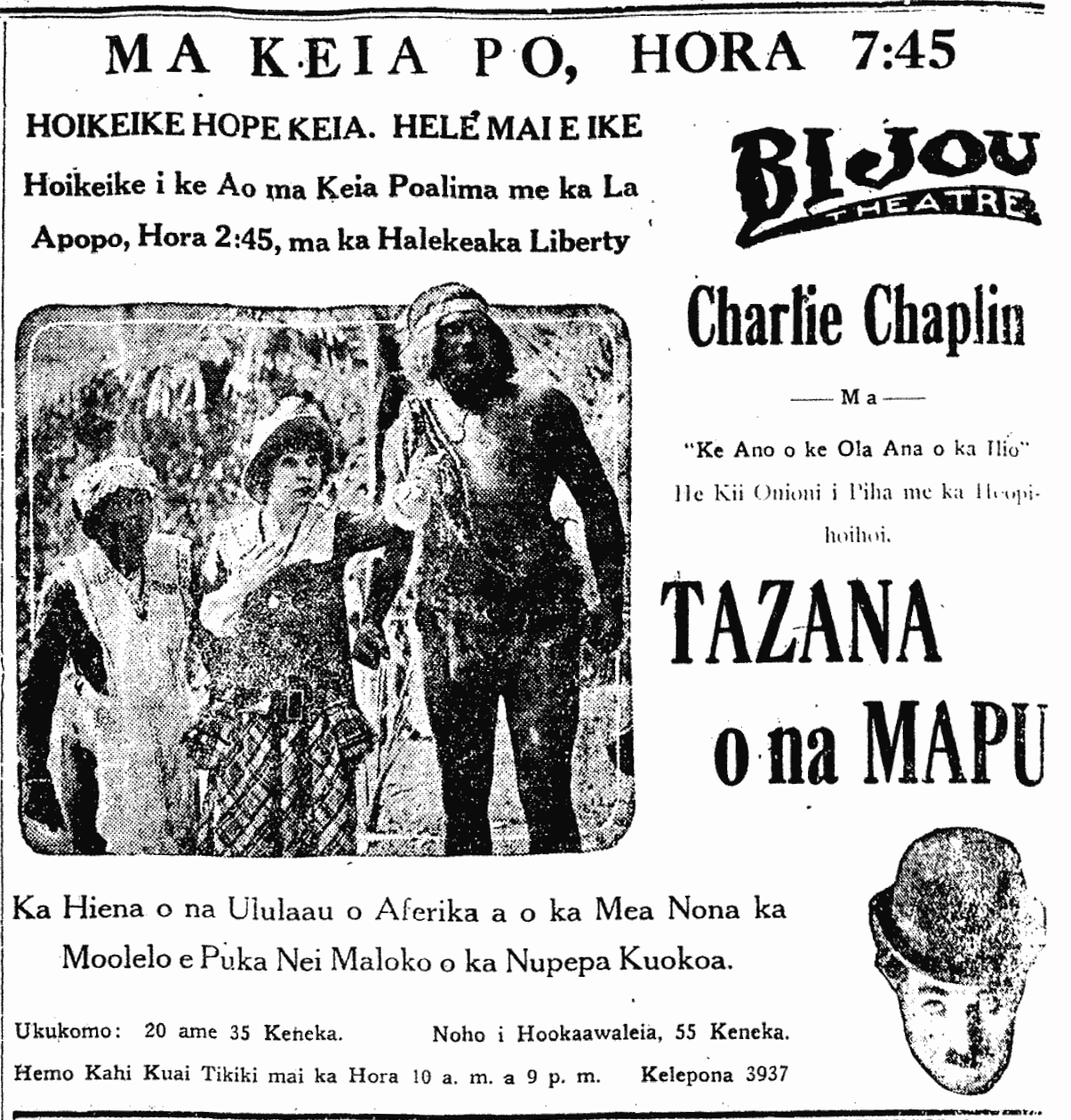
TONIGHT, 7:45

THIS IS THE LAST SHOW, COME WATCH

Shown at Day on This Friday and Tomorrow,

2:45, at Liberty Theater

BIJOU THEATRE

Charlie Chaplin

—In—

“A Dog’s Life” [“Ke Ano o ke Ola Ana o ka Ilio”]

A Movie Full of Excitement.

TARZAN of the APES [TAZANA o na MAPU]

The Hyena of the Jungle of Africa and the One Whose Story is Being Run in the Kuokoa Newspaper.

Entrance: 20 and 35 Cents. Reserved Seats [Noho i Hookaawaleia], 55 Cents.

Ticket Box Open from the Hours of 10 a. m. to 9 p. m. Telephone 3937

[It is interesting to see that this ad is in Hawaiian, when the movies themselves were in English.]

(Kuokoa, 1/17/1919, p. 2)

MA KEIA PO, HORA 7:45

Ka Nupepa Kuokoa, Buke LVII, Helu 3, Aoao 2. Ianuari 17, 1919.

Hawaii’s Story by Hawaii’s Queen, in the Hawaiian Language, 1898.

WE WILL SATISFY.

Because we are constantly asked by our readers to print the story which our Queen wrote in Washington and that was just published in Boston, therefore, we are spreading the news to our readership that we will translate and print the story in the columns of the newspapers the daily and weekly Ke Aloha Aina, on the first week of this coming month for the benefit of our readers. Therefore, do take up Ke Aloha Aina so that you can see the one story written by Queen Liliuokalani and published in foreign lands, with statements full of sentiment and aloha dealing with Her overthrow. Aloha for Her.

(Aloha Aina, 3/19/1898, p. 5)

E HOOKO AKU ANA MAKOU.

Ke Aloha Aina, Buke IV, Helu 12, Aoao 5. Maraki 19, 1898.

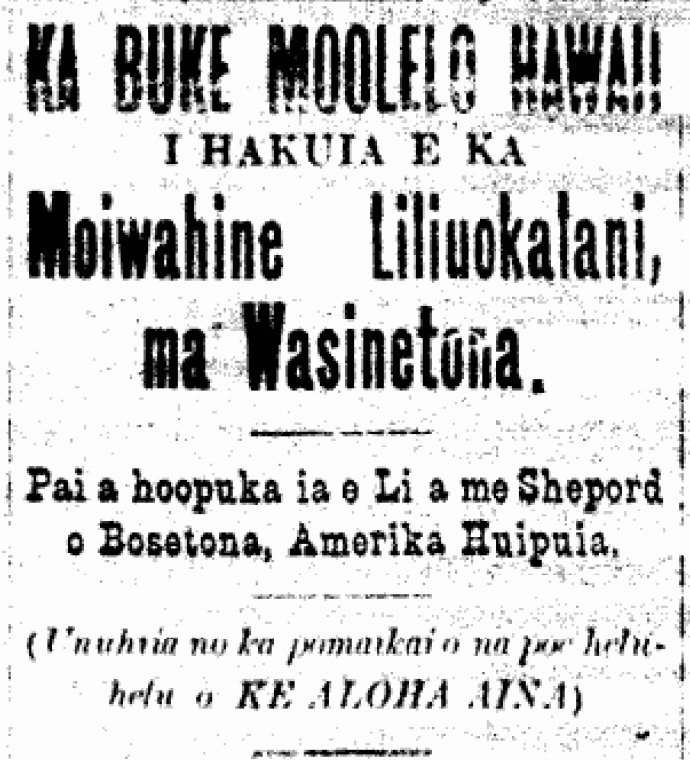
Here, by the way, is what the heading of that running column looked like:

HAWAIIAN HISTORY

WRITTEN BY

Queen Liliuokalani,

in Washington.

Published by Lee and Shepard

of Boston, United States of America.

(Translated for the benefit of the

readers of KE ALOHA AINA)

(Aloha Aina, 4/2/1898, p. 6)

KA BUKE MOOLELO HAWAII

Ke Aloha Aina, Buke IV, Helu 14, Aoao 6. Aperila 2, 1898.

Kaluaikoolau, the book. 1912.

[Found under: “Local News”]

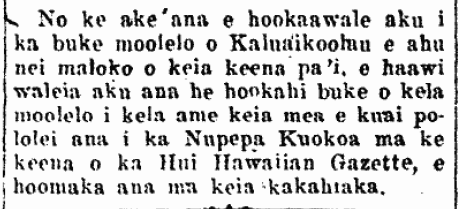
Because of the desire to liquidate the story book of Kaluaikoolau which are stacked up in the publishing office, one of those books will be given away for free to each person who buys the Kuokoa directly from the office of the Hawaiian Gazette Company, beginning this morning.

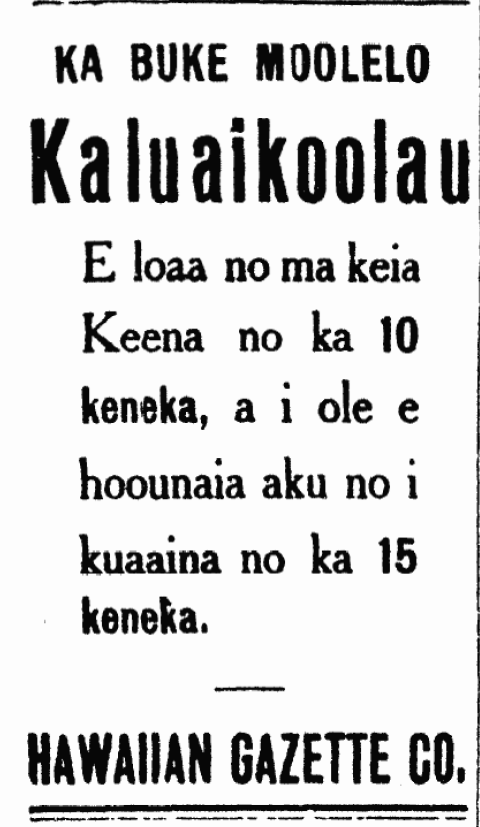
[Up until this time, the books were going for 10 cents each, if you picked them up at the Hawaiian Gazette Co. office, or 15 cents if you wanted them sent to the country. See ad below.]

(Kuokoa, 3/29/1912, p. 8)

No ke ake ana e hookaawale...

Ka Nupepa Kuokoa, Buke XLVIII, Helu 13, Aoao 8. Maraki 29, 1912.

THE STORY BOOK

Kaluaikoolau

Can be picked up at this Office for 10 cents, or they will be sent to the country for 15 cents.

HAWAIIAN GAZETTE CO.

(Kuokoa, 3/22/1912, p. 6)

KA BUKE MOOLELO

Ka Nupepa Kuokoa, Buke XLVIII, Helu 12, Aoao 6. Maraki 22, 1912.

Hawaiian-Language Newspapers and the past and the future, 1906.

The History of Your Native Land.

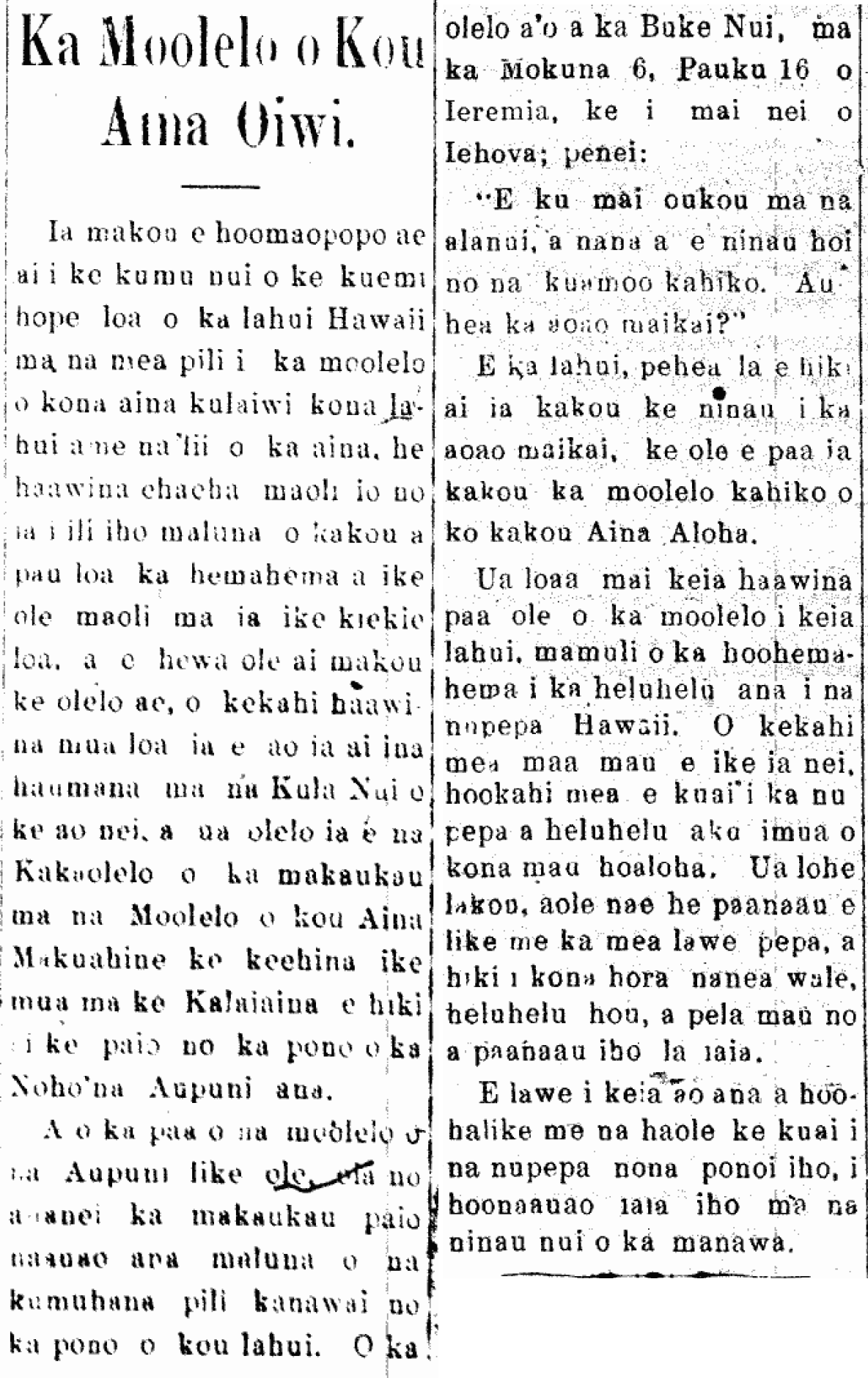
As we contemplate the main reason for the falling far behind of the Hawaiian people in matters dealing with the history of their homeland, their lahui, and the alii of the land, we are all racked with intense pain at the haphazard and total lack of knowledge in this terribly important study; and it would not be wrong for us to say that it should be one of the first subjects that should be taught to the students at schools of higher education across the world; and it is said by the Orators that being knowledgeable in the History of your Motherland is the first step in Politics where you’d be able to fight for the good of the Rule of the Nation.

And understanding the histories of all Nations is what will prepare you to fight intelligently on legal grounds for the benefit of your lahui. In the teachings of the Great Book, in Jeremiah 6:16, Jehovah says to us:

“Stand ye in the ways and see and ask for the old paths. Where is the good way?”

O Lahui, how will we be able to ask of the right way if we do not know the old history of our Beloved Aina?

This lack of knowledge of the history of this people comes from not consistently reading the Hawaiian newspapers. Something frequently seen is one person buying a paper and reading it before his friends. They hear it but they don’t retain it like one who subscribes to the paper, who can re-read it at his leisure and thus commit to memory the information.

Learn from this instruction, and do as the haole, who buys his very own newspapers to educate himself in current events.

[The Hawaiian-Language Newspapers is a massive history book—a history on the most part told by Hawaiians living while the “history” was happening. As it was argued more than a hundred years ago, in order to fight for things like Sovereignty, Land, and Water, shouldn’t we know the history as told by Hawaiians? Perhaps we shouldn’t focus solely on what is written down in law books, but also on what Hawaiians actually said and did about these laws, about water rights, about land ownership, about fishing bans, etc., etc. etc.?

For sure this is no easy task. The original newspapers aren’t going to last forever. The current images for many of them are not totally clear (if there are images at all). They need to be word-searchable so that if you search for something, you will find it. There needs to be more people doing translations of them. But then again, Kamehameha Paiea didn’t exclaim, “Forward my younger brothers and drink of the sweet waters”…]

(Na’i Aupuni, 1/17/1906, p. 2)

Ka Moolelo o Kou Aina Oiwi.

Ka Na'i Aupuni, Buke I, Helu 44, Aoao 2. Ianuari 17, 1906.