Special piano built, 1901.

PIANO MADE WITH HAWAIIAN WOOD.

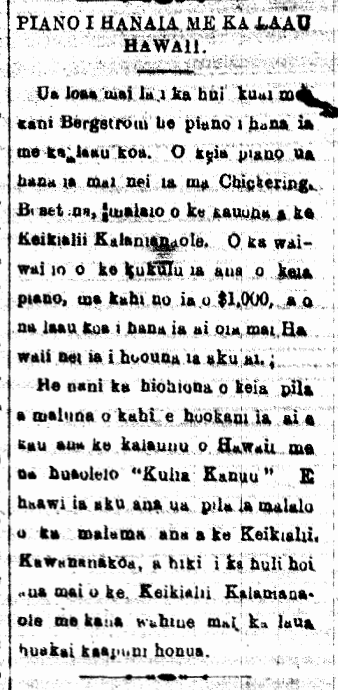
Bergstrom Music Company [hui kuai mea kani Bergstrom] received a piano made with koa wood. This piano was made in Chickering, Boston under the order of Prince Kalanianaole. The cost for the building fo this piano was about $1,000, and the koa wood it was made from was sent from Hawaii nei.

The look of this instrument is lovely, and above where it is played is placed the crown of Hawaii and the words “Kulia Kanuu.” The instrument will be placed under the care of Prince Kawananakoa when the Prince Kalanianaole and his wife returns from their trip around the world.

[Does anyone know if this piano still exists? I sure hope so.]

(Aloha Aina, 2/2/1901, p. 5)

PIANO I HANAIA ME KA LAAU HAWAII.

Ke Aloha Aina, Buke VII, Helu 5, Aoao 5. Feberuari 2, 1901.

Restoration Day celebration, day number 3! 1844.

THIRD DAY, AUGUST 2D.

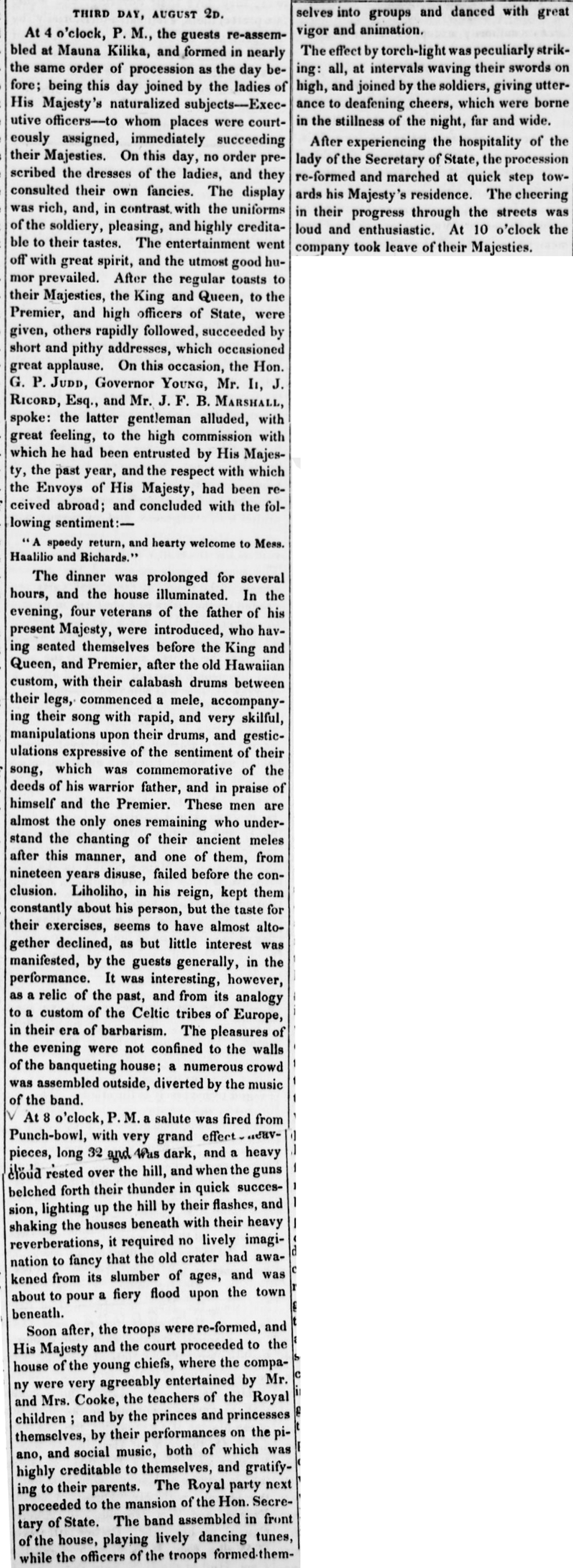
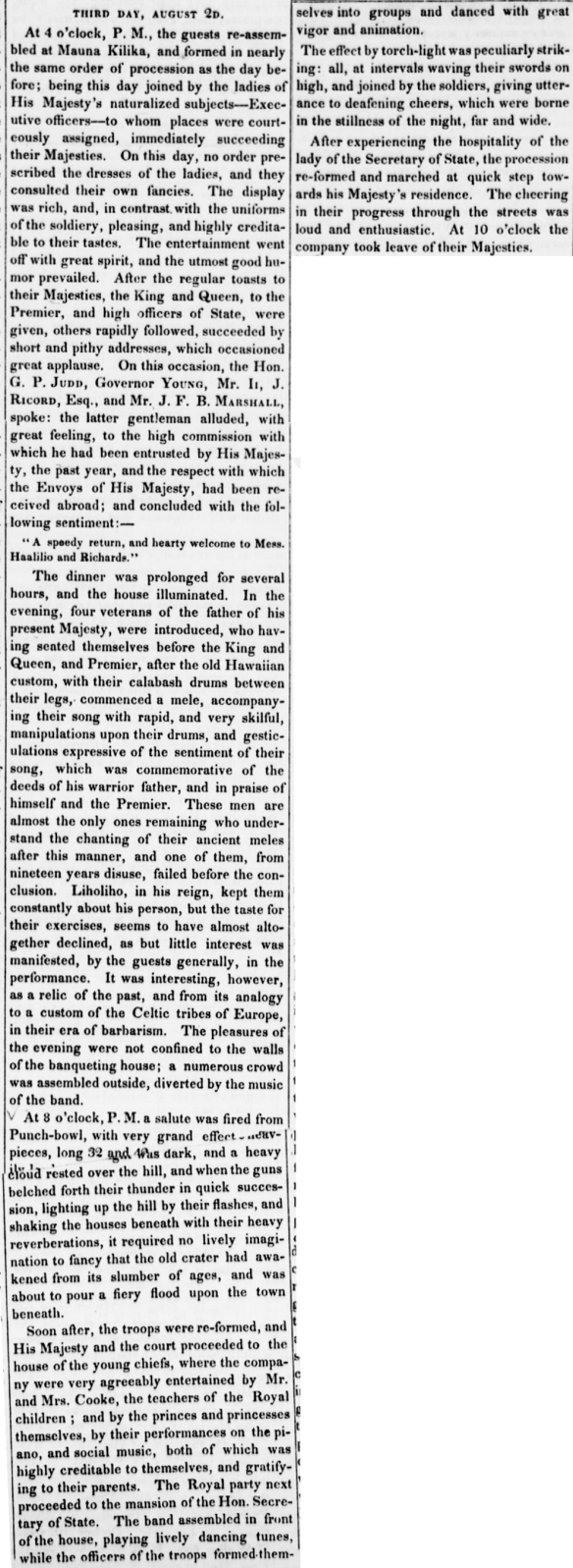
At 4 o’clock, P. M., the guests re-assembled at Mauna Kilika, and formed in nearly the same order of procession as the day before; being this day joined by the ladies of His Majesty’s naturalized subjects—Executive officers—to whom places were courteously assigned, immediately succeeding their Majesties. On this day, no order prescribed the dresses of the ladies, and they consulted their own fanices. The display was rich, and, in contrast with the uniforms of the soldiery, pleasing and highly creditable to their tastes. The entertainment went off with great spirit, and the utmost good humor prevailed. After the regular toasts to their Majesties, the King and Queen, to the Premier, and high officers of State, were given, others rapidly followed, succeeded by short and pithy addresses, which occasioned great applause. On this occasion, the Hon. G. P. Judd, Governor Young, Mr. Ii, J. Ricord, Esq., and Mr. J. F. B. Marshall, spoke: the latter gentleman alluded, with great feeling, to the high commission with which he had been entrusted by His Majesty, the past year, and the respect with which the Envoys of His Majesty, had been received abroad; and concluded with the following sentiment:—

“A speedy return, and hearty welcome to Mess. Haalilio and Richards.”

The dinner was prolonged for several hours, and the house illuminated. In the evening, four veterans of the father of his present Majesty, were introduced, who having seated themselves before the King and Queen, and Premier, after the old Hawaiian custom, with their calabash drums between their legs, commenced a mele, accompanying their song with rapid, and very skillful, manipulations upon their drums, and gesticulations expressive of the sentiment of their song, which was commemorative of the deeds of his warrior father, and in praise of himself and the Premier. These men are almost the only ones remaining who understand the chanting of their ancient meles after this manner, and one of them, from nineteen years disuse, failed before the conclusion. Liholiho, in his reign, kept them constantly about his person, but the taste for their exercises, seems to have almost altogether declined, as but little interest was manifested, by the guests generally, in the performance. It was interesting, however, as a relic of the past, and from its analogy to a custom of the Celtic tribes of Europe, in their era of barbarism. The pleasures of the evening were not confined to the walls of the banqueting house; a numerous crowd was assembled outside, diverted by the music of the band.

At 8 o’clock, P. M. a salute was fired from Punch-bowl, with very grand effect [not legible because of fold in paper] cloud rested over the hill, and when the guns belched forth their thunder in quick succession, lighting up the hill by their flashes, and shaking the houses beneath with their heavy reverberations, it required no lively imagination to fancy that the old crater had awakened from its slumber of ages, and was about to pour a fiery flood upon the town beneath.

Soon after, the troops were re-formed, and His Majesty and the court proceeded to the house of the young chiefs, where the company were very agreeably entertained by Mr. and Mrs. Cooke, the teachers of the Royal children; and by the princes and princesses themselves, by their performances on the piano, and social music, both of which was highly creditable to themselves, and gratifying to their parents. The Royal party next proceeded to the mansion of the Hon. Secretary of State. The band assembled in front of the house, playing lively dancing tunes, while the officers of the troops formed themselves into groups and danced with great vigor and animation.

The effect by torch-light was peculiarly striking: all, at intervals waving their swords on high, and joined by the soldiers, giving utterance to deafening cheers, which were borne in the stillness of the night, far and wide.

After experiencing the hospitality of the lady of the Secretary of State, the procession re-formed and marched at quick step towards his Majesty’s residence. The cheering in their progress through the streets was loud and enthusiastic. At 10 o’clock the company took leave of their Majesties.

(Polynesian, 8/10/1844, p. 47)
THIRD DAY, AUGUST 2D.

The Polynesian, New Series, Volume 1,—Number 12, Page 47. August 10, 1844.
Grand performance on Maui by the Hawaiian Woman’s Club, 1922.

“A Night in Hawaii” Will Prove a Beautiful Picture

Pageants wherein the characters will be clad in the costumes of the old days in Hawaii, tableaux, meles, singing of Hawaiian songs and melodies, instrumental music by Hawaiian musicians and just an interspersal of hula dancing by little folk to show really graceful and beautiful was the old dancing at its best, these go to make up the program which will be offered at the Territorial Building in Kahului, Saturday in “A Night in Hawaii” as arranged by and for the benefit of the Hawaiian Woman’s Club. The program, which is printed below gives promise of the best entertainment of its king that has been offered on this island.

Almost daily rehearsals have been held of late, especial attention having been given to the drilling of the children’s chorus in their songs and their parts, so much attention was not necessary of the older ones most of whom have participated in affairs of this kind before, but groups have worked here, and other groups there, and finally all of the groups have been brought together and welded into one great company for the coming performance.

Following the rendition of the program there will be a dance.

The Hawaiian Woman’s Club which is conducting the entertainment is a benevolent association of the Hawaiian women of Maui working in the interest of Hawaiians who may be in need of assistance such as the club can give. Something of its activities have been told previously, what it has done of the Kula Sanitarium when first organized, for the education of some of the young Hawaiians and in other directions. One of its latest good works was a generous contribution for a chapel for the home for non-leprous children of lepers at Kalihi, Oahu. In many directions it reaches out to do good and all profits of the entertainment will go in the carrying out of such purposes.

The program for Saturday night follows:

 I. OPENING CHORUS ….. “Eleile”

II. TABLEAU ….. Hawaiian Royalty

1. Queen Liliuokalani—”Makalapua” ….. Mrs. J. W. Kalua

2. Princess Kaiulani—”He Inoa No Kaiulani” ….. Mrs. H. H. Holt

3. Queen Emma—””Na Hala o Naui” ….. Mrs. George Hardy

Hula—Ida Long

4. Princess Pauahi Bishop—”Pauahi Lani” (Blest Type of Womanhood) ….. Mrs. C. C. Conradt

5. Queen Kaahumanu—”Kaahumanu” ….. Mrs. D. Kapohakimohewa

a. Kahili Bearers—Alice Allen, Elizabeth Wailehua.

6. King Kamehameha I.—”He Inoa No Kamehameha” ….. Mr. C. F. N. Rose

a. Attendants—Walter Garcia, Edward Wilson.

b. Hookupu bearers—David Kaumeheiwa, Kaiwi Moikeha.

III. HAWAIIAN MELES — ….. Kumanaiwa

1. A Mele to Kamehameha.

2. Ili.

3. Ukeke.

4. Uliuli.

IV. SONGS—

1. “Pua Mohala”

2. “Old Plantation”

Messrs. Charles Waiwaiole, John Waiwaiole, Kama Apo, George Kauwenaole

3. “No Moku o Hawaii”

Mrs. J. Waiwaiole, Mrs. Huakini Enos, Kama Apo, J. H. Waiwaiole

4. “Kuu Iini”

Mrs. A. Garcia

5. “Maid of Honolulu”

R. Plunkett, N. Opiopio, F. Robinson, J. Brown

V TABLEAU—

1. “Koni Au I Ka Wai”

Elizabeth Wailehua and Chorus

2. “Pulupe Nei Ili I Ke Anu”

Alice Allen and Chorus

3. Hula Olapa

a. Entrance Dance

b. “Emma Lani”

c. “Nani Wale I ka Mahina”

d. “Maia Lau Kapalili”

4. “Na Lei o Hawaii”

Hawaii—Alice Kia

Maui—Blanche Garcia

Oahu—Edna Alo

Kauai—Mary Kaumeheiwa

Molokai—Sophie Waiwaiole

Lanai—Jackie Rosario

Kahoolawe—Florence Kaumeheiwa

Niihau—Dollie Wilson

Molokai—Lei Dunn

5. “Sweet Lei Lehua”

Blanche Garcia and Chorus

6. “Palolo”

Hula by Paddy Bal

7. “Moani Keala”

Sophie Waiwaiole and Chorus

8. “Hawaii Ponoi”

9. “Star Spangled Banner”

“Hawaii”—Lei Dunn

“Uncle Sam”—Paddy Bal

(Maui News, 6/9/1922, p. 5)

"A Night in Hawaii" Will Prove a Beautiful Picture

Semi-Weekly Maui News, 22nd Year, Number 1173, Page 5.June 9, 1922.

A name song for the boys of the Royal Hawaiian Band, 1893.

HE INOA NO NA KEIKI O KA BANA LAHUI.

Kaulana na pua a o Hawaii
Kupaa mahope o ka aina
Hiki mai ka Elele a ka lokoino
Palapala alunu me ka pakaha
Pane mai Hawaii Nui o Keawe
Kokua na Hono a o Piilani
Kakoo mai Kauai a o Mano
Pau pu me ke one Kakuhihewa
Aole e kau i ka pulima
Maluna o ka pepa a ka enemi
Aole makou a e minamina
I ka puu dala o ke Aupuni
Ua lawa makou i ka pohaku
I ka ai kamahao o ka aina
Hoohui Aina kuai hewa
I ka pono Kivila a o ke kanaka
Mahope makou o ka Moi
A kau hou i ka Noho Kalaunu
Haina mai ana ka puana
No ka poe i aloha i ka Aina

(Hawaii Holomua, 3/23/1893, p. 2)

HE INOA NO NA KEIKI O KA BANA LAHUI.

Hawaii Holomua, Buke III, Helu 185, Aoao 2. Maraki 23, 1893.

Alatau Tamchiboulac Atkinson, organist for Kawaiahao Church, 1873.

[Found under: “NA MEA HOU KULOKO.”]

Mr. A. T. Atkinson has been made the organist [hookani ogana] for the Kawaiahao Church, and beginning this week, he will perform alone for the first time.

[This is just a tiny episode in the amazing life of Alatau Atkinson. There will be a talk on his life given by visiting author and journalist Nick Fielding at the Center for Biographical Research, UH Manoa today from noon to 1:15 at Henke Hall!]

(Au Okoa, 1/23/1873, p. 3)

Ua hooliloia iho nei...

Ke Au Okoa, Buke VIII, Helu 41, Aoao 3. Ianuari 23, 1873.

Hawaiian influence in music and fashion, 1917.

IN THE MOMENTS’ MODES

Her Hawaiian Hat

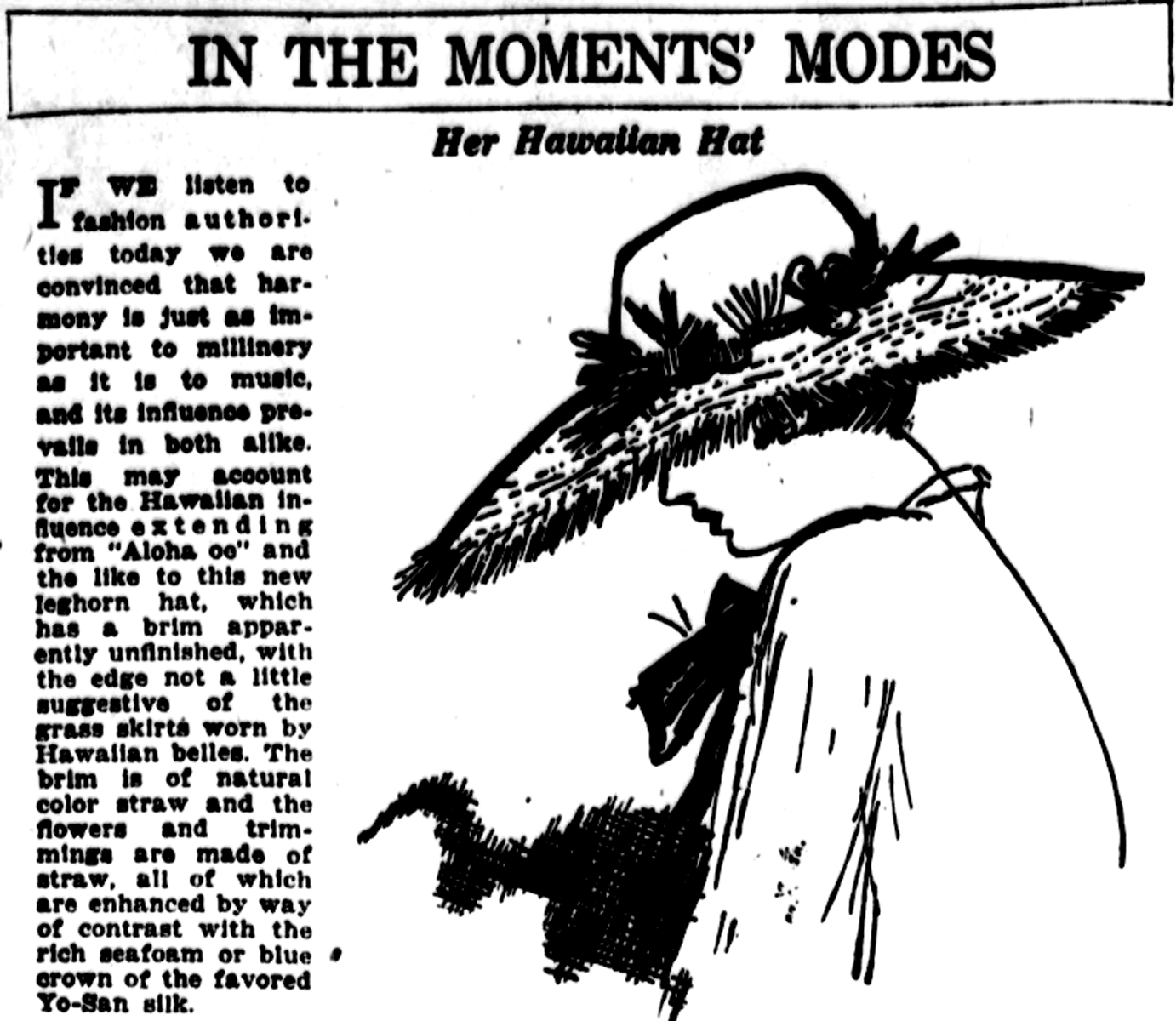
IF WE listen to fashion authorities today we are convinced that harmony is just important to millinery as it is to music, and its influence prevails in both alike. This may account for the Hawaiian influence extending from “Aloha oe” and the like to this new leghorn hat, which has a brim apparently unfinished, with the edge not a little suggestive of the grass skirts worn by Hawaiian belles. The brim is of natural color straw and the flowers and trimmings are made of straw, all of which are enhanced by way of contrast with the rich seafoam or blue crown of the favored Yo-San silk.

(Evening Ledger, 4/5/1917, p. 12)

IN THE MOMENTS' MODES

Evening Ledger, Volume III, Number 174, Page 12. April 5, 1917.

The Kawaihau Glee Club, 1904.

[Found under: “SOCIETY”]

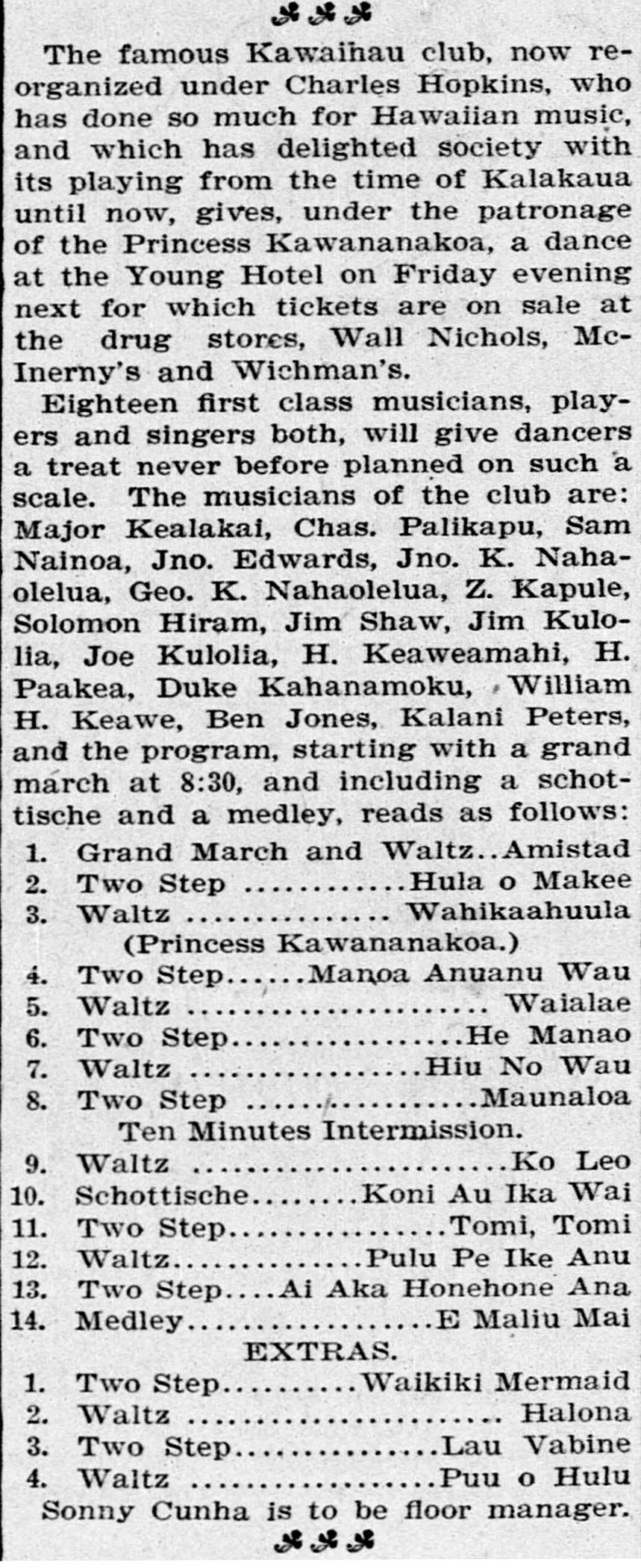
The famous Kawaihau club, now reorganized under Charles Hopkins, who has done so much for Hawaiian music, and which has delighted society with its playing from the time of Kalakaua until now, gives, under the patronage of the Princess Kawananakoa, a dance at the Young Hotel on Friday evening next for which tickets are on sale at the drug stores, Wall Nichols, McInerny’s and Wichman’s.

Eighteen first class musicians, players and singers both, will give dancers a treat never before planned on such a scale. The musicians of the club are: Major Kealakai, Charles Palikapu, Sam Nainoa, John Edwards, John K. Nahaolelua, George K. Nahaolelua, Z. Kapule, Solomon Hiram, Jim Shaw, Jim Kulolia, Joe Kulolia, H. Keaweamahi, H. Paakea, Duke Kahanamoku, William H. Keawe, Ben Jones, Kalani Peters, and the program starting with a grand march at 8:30, and including a schotische and medley, reads as follows:

1.  Grand March and Waltz ….. Amistad
2.  Two Step ….. Hula o Makee
3.  Waltz ….. Wahikaahuula (Princess Kawananakoa)
4.  Two Step ….. Manoa Anuanu Wau
5.  Waltz ….. Waialae
6.  Two Step ….. He Manao
7.  Waltz ….. Hiu No Wau
8.  Two Step ….. Maunaloa

Ten Minutes Intermission.

9.  Waltz ….. Ko Leo
10. Schottische ….. Koni Au Ika Wai
11.  Two Step ….. Tomi, Tomi
12.  Waltz ….. Pulu Pe Ike Anu
13.  Two Step ….. Ai Aka Honehone Ana
14.  Medley ….. E Maliu Mai

EXTRAS.

1.  Two Step ….. Waikiki Mermaid
2.  Waltz ….. Halona
3.  Two Step ….. Lau Vabine
4.  Waltz ….. Puu o Hulu

Sonny Cunha is to be floor manager.

(Pacific Commercial Advertiser, 6/19/1904, p. 6)

The famous Kawaihau club...

Sunday Advertiser, Volume II, Number 77, Page 6. June 19, 1904.

The Maori and Hawaiians, 1911.

Hawaiians and Maori Talk to Each Other.

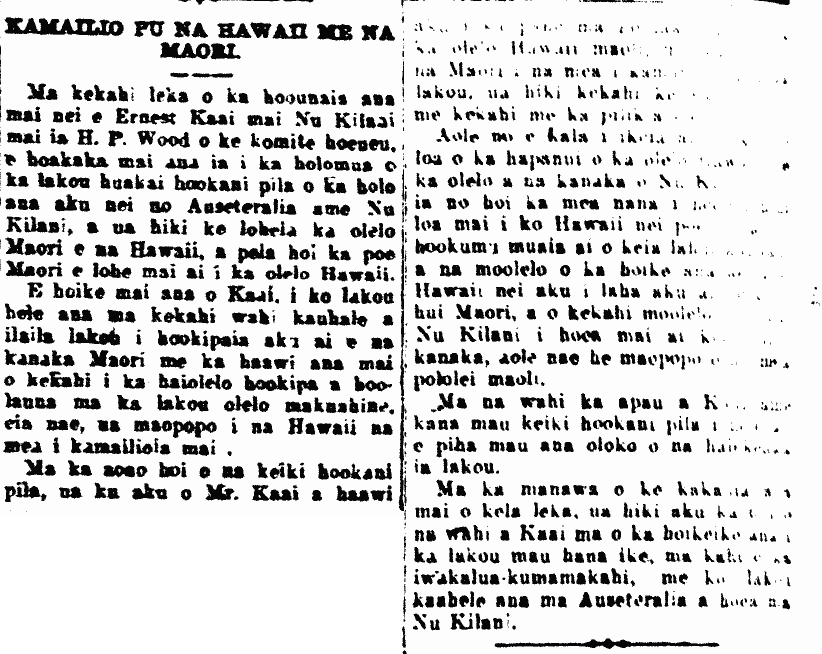
In a letter sent by Ernest Kaai from New Zealand to H. P. Wood of the Hawaiian Promotion Committee [which seems to be a precursor to the visitor’s bureau], he shows the progress of their musical touring of Australia and New Zealand. The Hawaiians could hear the Maori language and the Maori could hear the language of Hawaii.

Kaai said that when they went to some villages, they were hosted by Maori people, where one of them said words of welcome and friendship in their mother tongue. But the Hawaiians understood what was being said.

From the side of the musicians, Mr. Kaai stood and gave [rest of the paragraph unclear].

It was not long ago that [also unclear here, but they seem to be talking about the relationship between Aotearoa and Hawaii].

Everywhere that Kaai and his musical group went, the theaters would be filled with them.

When this letter was written, the number of places that Kaai them performed at was about 21, with them going around Australia and reaching New Zealand[?]

[A great deal of the Hawaiian Language Newspapers are bound into book form, and because they were purposely printed without much empty margins, often the printed portions that fall in the margin area of the books are not legible, especially when scanned. To get a clear image of the entire page, the books will have to be unbound first. That, it seems, takes a great amount of funding.]

(Kuokoa, 6/30/1911, p. 8)

KAMAILIO PU NA HAWAII ME NA MAORI.

Ka Nupepa Kuokoa, Buke XLVII, Helu 26, Aoao 8. Iune 30, 1911.

Music and dance, 1911.

A CONCERT AND DANCE.

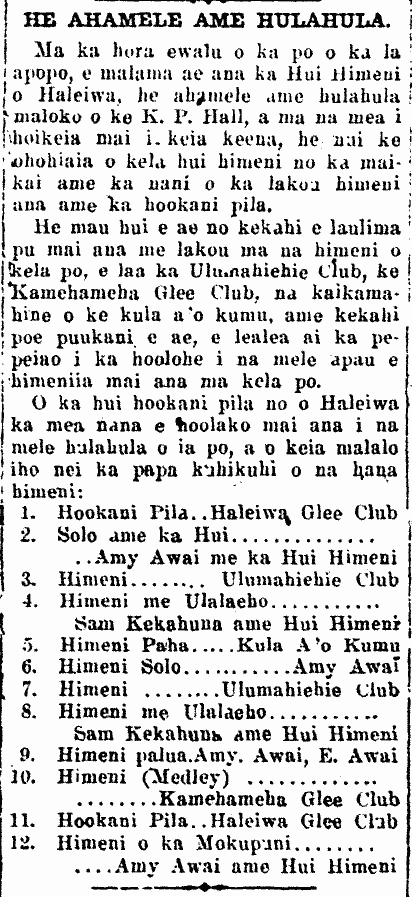
At eight o’clock tomorrow night, the Haleiwa Choir [Hui Himeni o Haleiwa] will hold a concert and dance in the K. P. Hall [Knights of Pythias Hall], and from what was told to this office, the Choir is highly acclaimed for the beauty of their singing and their music.

There will be other groups as well joining with them singing that night, like the Ulumahiehie Club, Kamehameha Glee Club, the girls of the teachers’ school, and some other singers; the ears will be entertained listening to all the mele that will be sung that night.

The band of Haleiwa will be the ones to provide the songs to dance to that night, and this below is the program of the singing:

1. Instrumental [Hookani Pila] . . . . . Haleiwa Glee Club
2. Solo and Group . . . . . Amy Awai and Glee Club
3. Singing . . . . . Ulumahiehie Club
4. Singing and Yodeling [? Ulalaeho] . . . . . Sam Kekahuna and Glee Club
5. Quartet . . . . . Teachers’ School
6. Solo . . . . . Amy Awai
7. Singing . . . . . Ulumahiehie Club
8. Singing and Yodeling . . . . . Sam Kekahuna and Glee Club
9. Duet . . . . . Amy Awai, E. Awai
10. Singing (Medley) . . . . . Kamehameha Glee Club
11. Instrumental . . . . . Haleiwa Glee Club
12. Song of the Island . . . . . Amy Awai and Glee Club

(Kuokoa 7/7/1911, p. 10)

HE AHAMELE AME HULAHULA.

Ka Nupepa Kuokoa, Buke XLVII, Helu 27, Aoao 10. Iulai 7, 1911.

A feast given at the Sacred Hearts Church, 1913.

[Found under: “Nuhou Kuloko”]

There will be a grand feast held, full of rich delicacies like pig laulau, fatty kalua pig, opihi, opae, aku, kawakawa, kulolo, haupia, koelepalau, fatty amaama, poi, sweet potato, Portuguese bread, and other delights. It is being given by the Sacred Hearts Church, at the corner of Miller and Beretania streets. The attendees will be entertained while they are eating by the two bands, the St. Louis Band and the Catholic Mission Band.

(Kuokoa, 2/21/1913, p. 8)

He papa ahaaina hanohano...

Ka Nupepa Kuokoa, Buke L, Helu 8, Aoao 8. Feberuari 21, 1913.