John Kaina, Kamehameha senior classman, 1941.

KAMEHAMEHA SCHOOLS NEWS

(Written by Louis Agard)

JOHN KAINA

The Bishop Museum [hale hoahu o na mea kahiko o Bihopa] published picture postcards [pepa kii haleleka] showing Hawaiian pictures. Amongst the cards printed is a picture of John Kaina, a senior classman at Kamehameha. John Kaina’s picture is printed in this group of postcards. The first group is made up of twelve eleven cards. Continue reading

Death of Z. P. K. Kalokuokamaile, 1942.

A Man Has Just Passed.

“A man!”

“What?”

“Has just passed!”

“WHO?”

“Z. P. Kalokuokamaile! He has gone on the road of no return; he has taken the path all must ake; he has grown weary of this worldly life; and his spirit has returned to the one who made all people; and his body has returned to the mother earth.

“Yes, one of the long-living men of Napoopoo, Hawaii has passed; and he is the last of the oldsters of that famed land at the base of the acclaimed cliff known as Kapalikapuokeoua. Z. K. Kalokuokamaile grew weary of this world at the home of his daughter, Mrs. Annie Keawe at 93 years and 4 months and a little more in age. The Heavenly Father had much aloha for this good man; he was just a few years away from reaching a century. He left this world in the afternoon of Tuesday, September 1, 1942.

His mind was strong when he grew weary; it was clear when conversing with him.

Mr. Z. P. Kalokuokamaile was born from the loins of Naili (m) and Kawaha (f) at Napoopoo, South Kona, Hawaii, on the 13th of March 1849, and he was 93 years four months and a little more in age.

He was educated at Lahainaluna School and graduated from there and made a living as a teacher at the school of Keei.

From his marriage, he had two children, they being Naili (m) who is living in Honolulu, and Mrs. Annie Keawe of Hilo, and he has just two grandchildren.

At a time in his life, he became a Sunday School principal, and a Sunday School teacher for the father’s class of the Napoopoo Church.

Z. P. Kaloku was a man who was in the class of experts at searching for the obscure information of the press of Ka Hoku o Hawaii. He was an expert at posing riddles [nane] as well as in the solving of nane from other experts such as “Pohakuopele,” Ka Naita Ilihune, Makaikiu Hene, and other highly skilled ones.

He was well known amongst the ones who answered nane by the name of Kawaikaumaiikamakaokaopua i ka Pali Kapu o Keoua.

He was a writer for the Hoku o Hawaii during the life of Rev. S. L. (Kiwini) Desha, Sr., and he was adept as a writer. Who would not be without knowledge who were taught in Hawaii’s schools in those days. How mournful is his passing.

He had good eyesight, and during his life, he didn’t read with glasses.

On the afternoon of the following Wednesday, his funeral was held in Haili Church by the Rev. Moses Moku, and his body was taken to rest in the cemetery of Homelani.

His toiling is over; his work here is over, and his spirit with the one who made all people.

O Kona of the sea of cloud banks in the calm of Ehu, you will not see again Kalokuokamaile for all times; he has gone on the path of no return. O People of Napoopoo, no more, no more will you see again your father, Z. P. Kaloku, for all times; you will no more hear his beckoning voice.

O Expert seekers of things obscure, you will no more see the name Kawaikaumaiikamakaokaopua; you will no more see his answers to newly published riddles; and no more will you see his solutions to riddles for all times. The golden chain of his life has been severed, for man’s life is a vapour that appeareth for a little time, and then vanisheth away. O Pohakuopele, here is your father; he has glided over the path of all men.

Ka Hoku o Hawaii joins in the family in mourning for him, for their loved one who left this earthly life.

MAY GOD LIGHTEN YOUR SORROW.

(Hoku o Hawaii, 9/9/1942, p. 2)

He Kanaka Ua Hala Iho Nei

Ka Hoku o Hawaii, Volume XXXVII, Number 20, Aoao 2. Sepatemaba 9, 1942.

Let Hawaiian Language be not something just remembered in February, 1920 / 2014.

THE HAWAIIAN LANGUAGE

O Mr. Editor of the Kuokoa Newspaper, Much Aloha to you:—Please allow me a column, for the title placed above.

When I read on page 8, column 2, about the Hawaiian language, I was ecstatic about what was published by the Kuokoa Newspaper on the topic of Mr. Coelho pertaining to the Hawaiian language.

This is seen on the streets, at pleasant gatherings, at meetings, and at the homes; these are just Hawaiians that I am talking about; they just speak English.

Hear me, O My flesh and blood, My beloved people: you are known as a Hawaiian and a lahui by your language; should you lose your mother tongue, you will end up like the Negroes and the Indians; they’ve no lahui and no language.

Pio ka oe ahi,
Pau ka oe hana;
I ikeia mai no oe,
I ka wa moni o ko eke;
Nele ae kahi mea poepoe,
Pau ka pilina ma ka aoao.

You light is extinguished,
Your work has come to an end;
You are acknowledged,
When there is money in your purse;
When the round objects are gone,
You have no place by her side.

Therefore, this writer is calling out to you: do not squander your gold and silver—your mother tongue. Your language is how it is known that you are an educated and superior people, like the great nations of the world. Look at Britain, France, Italy, Germany, Japan and America. Every nation learns their own language; why? For glory, for knowledge; it is known that one is British by the language he knows. The writer of the Psalms says: “That glory may dwell in our land.” How is our nation to have glory?

By abandoning our mother tongue and speaking the language of the malihini, are we knowledgeable, skilled and prepared in that language?

Are you not the foremost, O Tiny Hawaii, by way of the mother tongue of Opukahaia who travelled to America to explain the troubled existence of his lahui, and asked with tears streaming down to send missionary parents for Hawaii nei?

Did he go to America speaking English? No; he went with his own mother tongue. And when the missionaries arrived here in Hawaii, it is through the Hawaiian language that you received education, knowledge, honor, peace, justness, prosperity, righteousness, faith, and aloha.

What nation to the north or south latitudes of the equator is in peace like that of Hawaii? None, there is not a one; it is just Hawaii!

Therefore, this writer calls out: Don’t abandon your mother tongue so that glory may always dwell in Hawaii nei. We must build Hawaiian schools, and teach Hawaiian curriculum. Not just one eye, or one hand and foot. [? Aole i hookahi wale no maka, a i hookahi wale no lima a wawae.] When the legislature meets again the representatives and senators should make a law for teaching the Hawaiian language.

I give my thanks to the Honorable H. M. Kaniho, the first one to submit this bill in his first year there. It did not pass because some of the representatives just watched and did nothing. And I give my thanks to D. M. Kupihea who continually submits this bill.

Honolulu’s people should reelect the Hon. Kupihea so that this bill will once again be submitted; and should it be passed, then both eyes will be gotten: both Hawaiian language and English; and this writer will boast in advance that glory will indeed forever dwell in our land, for all times.

This writer is not saying that we should only teach these languages, but this responsibility is yours to teach knowledge and glory for your life. To be taken up at another time!

To the typesetting boys goes my love, and my unending aloha to the Editor.

[This is probably written in response to the article, “KA OLELO HAWAII.” written by Mrs. Kikilia P. Kealoha of Kaimuki, in Kuokoa on 6/18/1920, p. 8, which in turn was a response to an article of the same title written by W. J. Coelho in the Kuokoa on 5/21/1920, p. 2.

Although we have come a far way from 1920, there is still far to go. There are still those who seem to believe that losing Hawaiian is nothing to be alarmed about.

Z. P. K. Kawaikaumaiikamakaokaopua, is another name for the great historian Z. P. K. Kalokuokamaile (as well as Z. P. K. Lionanohokuahiwi).]

(Kuokoa, 6/18/1920, p. 3)

KA OLELO HAWAII.

Ka Nupepa Kuokoa, Buke LVII, Helu 24, Aoao 3. Iune 18, 1920.

Words of praise for C. R. Bishop on today, his birthday, 1896.

MEMORIALS.

….¹

There are many kinds of memorials [kia hoomanao] to remember people by. A person is remembered for his deeds, in memorials built as pillars and monuments, in reminiscences, and preserved in the hearts of the many. Famous deeds of people are remembered with aloha for the good, and with scorn for the bad.

Queen Liliuokalani’s beloved efforts stand today as the Hui Hoonaauao i na Opio [Liliuokalani Educational Society].

The epitome of great deeds of these past days was done by a haole who lived here as a malihini and married one of the Princesses amongst the royal youth. Charles R. Bishop built the Kamehameha Schools, the memorial for his wife, the Alii Pauahi Bishop; and by this act of commemoration, a memorial now stands for all of the Kamehamehas, and it is impossible to forget their name.

 In the days when this haole friend was living here in Hawaii, he was often criticized for his stinginess and defiance by Hawaiian and haole alike, but he paid no care to this criticism. He continued with his work, ate healthily, [illegible digital image], until he was a rich man; but in all the criticism for him, there is no way that it could be said that he was a scoundrel or that he cheated someone; and this says a lot for his uprighteousness.

Likewise with his charity work, he acted with maturity and kindness without end in his steadfast support for the benefit of this lahui. In giving, he was not frivolous in his giving, but gave wisely. He donated hundreds of thousands of dollars to the Punahou College and to the Kamehameha Schools, from his own estate and from that of his wife’s; and from his own, also benefited were the Boarding School for  Boys and Girls. How wondrous is God in his passing down the great entire wealth of the Kamehamehas from one to another until it all came down to Keelikolani and then to Pauahi, the grandchildren of the first born of Kamehameha Nai Aupuni; and it was the last of the two, the one most knowledgeable of them all, as measured by their final deeds, which she created with her husband as a memorial for all of the Kamehamehas. This man was of a great mind in his carrying out meticulously this work which he and his wife discussed between themselves, without misappropriating a single parcel of land included in the estate of his wife, but instead he was conscientious and included his own estate. When put together with all the other beloved deeds by everyone in Hawaii nei, this is measured as the most wise of them all, the height and breadth of its foundation will go on and bear forth much benefits for this lahui. There is but yet one thing to complete and to perfect the building of this memorial to the Kamehamehas, that being the righteousness of God’s words, the basis upon which the good and the blessings of the lahui will continue.

But Bishop’s help for our people is not done in his continued assistance to the memorial to the Kamehamehas and their foster children [keiki hookama] in the covenant of marriage of Charles R. Bishop.

¹The first paragraph was left out because it was somewhat irrelevant to this particular post, and was commentary on J. Kekipi and the Christian Science [Hoomana Karistiano Naauao] faith.

(Oiaio, 2/21/1896, p. 2)

NA KIA HOOMANAO.

Ka Oiaio Puka La, Buke I, Helu 37, Aoao 2. Feberuari 21, 1896.

Waiahole Elementary School, 130 years old! 1883 / 2013.

[Found under: “LOCAL NEWS.”]

Then English-language school at Waiahole, Oahu will be opening on Monday, the 17th of this month, under the leadership of their new teacher, Mr. G. Carson Kenyon, the previous editor of the newspaper, Daily Bulletin, of this town. He will meet with Manuela, the agent of the school, along with the parents of the students, at the schoolhouse at Waiahole, on Wednesday, the 19th, at 10 o’clock in the morning. We pray that Mr. Kenyon will be accompanied by only great blessings in this new position he is filling.

[Mahalo to Civil Beat for pointing us in the direction of this announcement for the opening of Waiahole Elementary School, which celebrates it 130th birthday this month! The school is having a birthday party this Saturday! Hauoli La Hanau!!]

(Kuokoa, 9/8/1913, p. 3)

E weheia ana ke kula...

Ka Nupepa Kuokoa, Buke XXII, Helu 36, Aoao 3. Sepatemaba 8, 1883.

The Kamehameha Museum and the Kamehameha Schools, 1894.

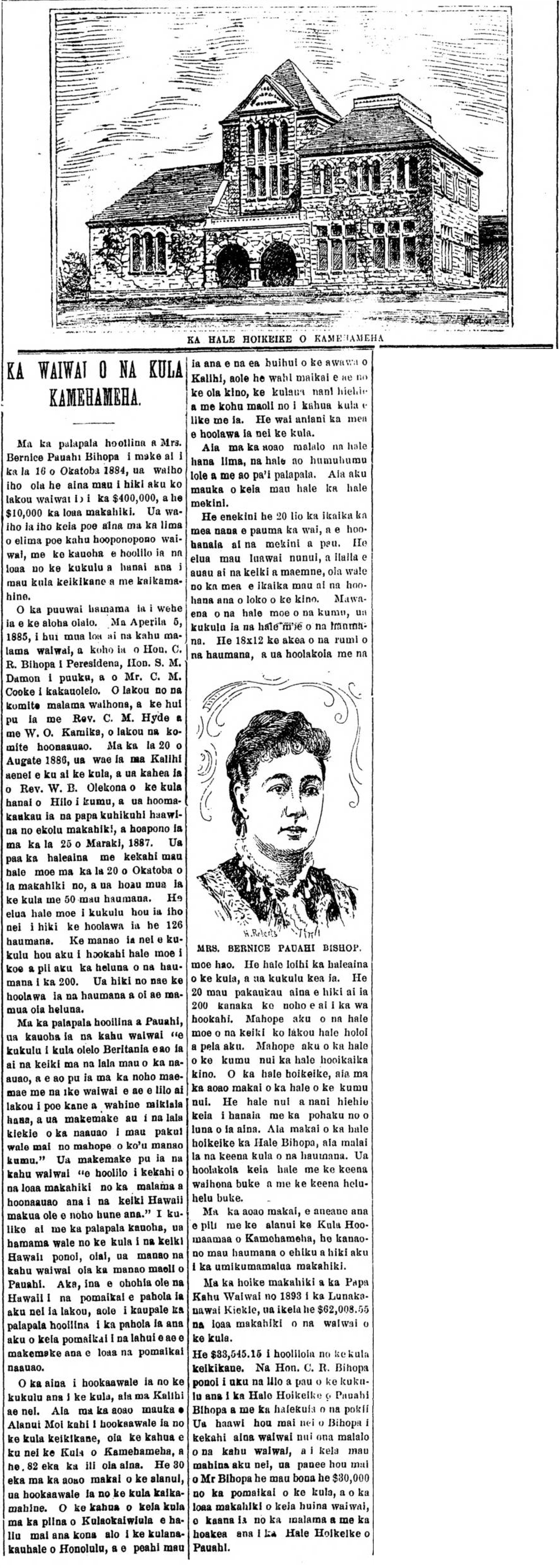
KA HALE HOIKEIKE O KAMEHAMEHA

THE ASSETS OF THE KAMEHAMEHA SCHOOLS.

In the will of Mrs. Bernice Pauahi Bishop, who died on the 16th of October 1884, she set aside lands whose true value comes to $400,000, with $10,000 profit per year. These lands are in the hands of five trustees, with the stipulation that the profits go to the building and caring for a school for boys and girls.

This generosity was based on true aloha. On the 5th of April, 1885, the trustees met for the first time and selected the Hon. C. R. Bishop as President, Hon. S. M. Damon as treasurer, and Mr. C. M. Cooke as secretary. They are the finance committee, along with Rev. C. M. Hyde and W. O. Smith, made the education committee. On the 20th of August, 1886, up in Kalihi was chosen as the place where the school would stand, and Rev. W. B. Olsen of the Hilo boarding school to be a teacher, and the curriculum for three years was prepared and approved on the 25th of March, 1887. The cafeteria and some dormitories were completed on the 20th of October of that same year, and the school began with 50 students. There were two dormitories just built, which can house 126 students. One more dormitory is planned which will increase the number of students to 200. However more than that number of students can be accommodated.

In the will of Pauahi, the trustees were instructed to “build an English-language school where the children were to be educated in the regular branches of knowledge, and they were also to be educated to live morally and with important knowledge to make them industrious men and women, and I want high branches of knowledge to supplement those basics.” It is desired that the trustees “use a portion of the profits to go to the education and care of the indigent orphaned Hawaiian children.” As per the will, the school is opened to native Hawaiians, being that the trustees believe that was the true intent of Pauahi. However, the Hawaiians are not interested in the good put before them, the will does not preclude the the provision of those blessings to the other races who want to receive the benefits of an education.

The land set aside for the building of the school is up in Kalihi. The land mauka of King Street is set aside for the boys’ school; this is where the Kamehameha School now stands; the area of that land is 82 acres. There are 30 acres makai of the street, which is set aside for the girls’ school. The area for this school is in the heights of Kulaokaiwiula with it face overlooking the cit of Honolulu, and it is constantly fanned by the cool air of the valley of Kalihi; there is no other finer place for the health, the beauty, and the suitability as a school campus like this. Clear water is supplied to the school.

Below that are the workshops, the sewing shop and the printing shop. And mauka of these buildings is the mechanic shop.

The strength of the engine pumping the water is 20 horses, and the total power is utilized. There are two huge pools where the children will bathe until clean, and that is what will keep their bodies working strong. Between the sleeping quarters of the teachers were built the dormitories of the students. The student rooms are 18 x 12 wide, and are furnished with…

MRS. BERNICE PAUAHI BISHOP.

…iron beds. The schools cafeteria is a long building, and it was built in the form of a cross. There are 20 dining tables accommodating 200 people at a time. Behind the children dormitories, are their laundry building, and so forth. Behind the principal’s house is the gymnasium. The museum is on the makai side of the principal’s house. This is a grand a beautiful structure constructed with rock from atop the land. Makai of the museum is Bishop Hall, and this is where the school rooms of the students are. This building is furnished with a library and a reading room.

On the makai side, almost adjacent to the road is the Kamehameha Preparatory School; there are sixty students from seven until twelve years of age.

In the yearly report of the Trustees for 1893 to the Chief Justice, it was seen that the school’s annual income was $62,008.55.

$33,545.15 was spent on the boys’ school. It was the Hon. C. R. Bishop who paid for the entire cost of the building of the Pauahi Bishop Museum and the preparatory school. Bishop also recently gave some of his valuable land holdings under the trustees, and several months ago, Mr. Bishop forwarded bonds of $30,000 for the benefit of the school, and the yearly income of these assets will be apportioned for the care and the expansion of the Pauahi Museum.

[It was just serendipity that caused me to notice this article the other day, and I thought with the re-opening of the new Pacific Hall at the Bernice Pauahi Bishop Museum, there was no better time to post this article about the actual beginnings of the Museum and of the Kamehameha Schools.

Check the early years of this familiar building (minus the dome) on campus as well, from an earlier post!

The public opening of Pacific Hall is tomorrow. Admission is free! Go check out all of the special events, and the newly redone Pacific Hall!!]

(Kuokoa 5/26/1894, p. 1)

KA WAIWAI O NA KULA KAMEHAMEHA.

Ka Nupepa Kuokoa, Buke XXXIII, Helu 21, Aoao 1. Mei 26, 1894.

Festivities at Hilo Union School, 1927.

A FAIR AT HILO UNION SCHOOL

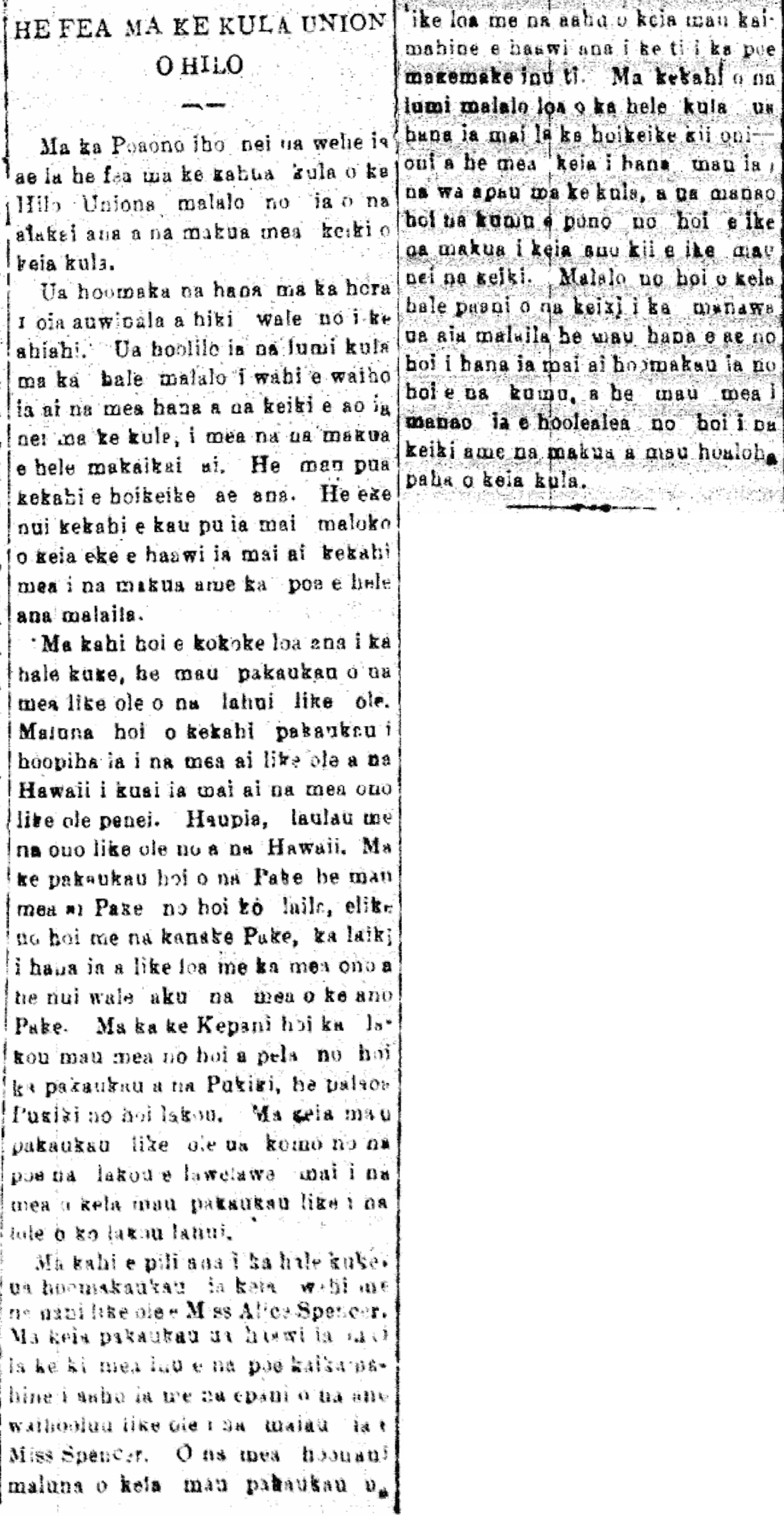
This past Saturday there was held a fair on the school grounds of Hilo Union, under the direction of the parents of the students of this school.

The activities began at 1 in the afternoon until the evening. The classrooms on the first floor was where the work of the children being taught at that school were placed, so that the parents could view them. There were also flowers on display. There was also a large bag, and from within this bag an item was given to the the parents and the people who came.

In an area near the kitchen, there were tables of all sorts of goods from all the ethnicities. One of the tables was filled with all the many delicacies of the Hawaiians. Haupia, laulau, and the other good foods of the Hawaiians. On the table of the Chinese, there was Chinese foods like Chinese candy, rice made into sweets, and many other Chinese items. On the Japanese one, was Japanese goods, and so too with the Portuguese table, they had Portuguese bread. On all of these tables, the people taking care of the items were dressed in the clothing of their people.

Near the kitchen, there was a place decorated by Miss Alice Spencer. On this table, tea to drink was served by girls dressed in aprons of all colors skillfully [made?] by Miss Spencer. The decorations on these tables were identical to the clothes of the girls serving tea to those who wanted to drink tea. In one of the rooms all the way at the bottom of the school, a movie was shown, and this is something always done, and the teachers thought it would be good for the parents to see the type of movie seen all the time by the children. Below that play house of the children in times of rain, there were other activities to do, set up by the teachers, and it was thought that these activities would entertain the children, parents, and friends of this school.

[Just passed by Hilo Union the other day and thought I’d put this article up that I had put aside some time ago.]

(Hoku o Hawaii, 5/3/1927, p. 2)

HE FEA MA KE KULA UNION O HILO

Ka Hoku o Hawaii, Buke XX, Helu 49, Aoao 2. Mei 3, 1927.

Hula and King Kalakaua’s 50th Jubilee, 1886.

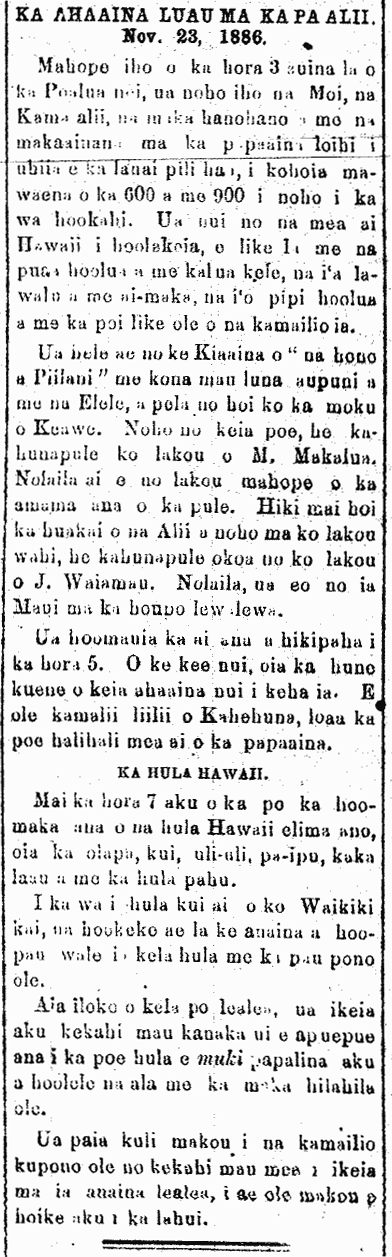
THE LUAU FEAST AT THE PALACE GROUNDS.

Nov. 23, 1886.

After 3 o’clock in the afternoon of this Tuesday, the King, the Princes and Princesses, the dignitaries, and the makaainana sat at a long table housed by a pavilion with corrugated iron roofing [lanai pili hao], which could sit an estimated 600 to 900 people at a time. There was much Hawaiian foods supplied, like laulau [puaa hoolua] and roasted pork [puaa kalua kele]; fish wrapped in ti leaves and baked [lawalu] and raw [ai-maka]; baked beef [i’o pipi hoolua] and all types of poi spoken of.

The Governor of the “bays of Piilani”¹ as well as his government officials and Delegates, along with those of the island of Keawe.² These people sat along with their pastor, M. Makalua. They began eating after the prayer was over. The entourage of the King and Queen arrived and sat in their area, and they had their own pastor, J. Waiamau. Therefore, Maui was victorious over their hunger [?? Nolaila, ua eo no ia Maui ma ka houpo lewalewa].

The eating continued perhaps until 5 o’clock. A big problem was the dearth of waiters for the grand feast that was boasted about. Thanks to the small children of Kahehuna [School], there were those to serve the food for the feast.

HAWAIIAN HULA.

From 7 o’clock in the night, Hawaiian hula of five types commenced, that being olapa, kui, uli-uli, pa-ipu, kaka laau, and hula pahu.

When those of Waikiki kai danced their hula kui, the audience complained, and that hula was put to an end without ending properly.

During that joyful night, some youths were seen attempting to get the dancers to kiss their cheeks, and to [?? hoolele na ala] without any sign of shame.

We were deafened by all the improper talk of some of the things seen in that partying crowd that we will not agree to tell the nation.

¹The governor of Maui was John Owen Dominis.

²The governor of Hawaii was Virginia Kapooloku Poomaikelani

(Ko Hawaii Pae Aina, 11/27/1886, p. 4)

KA AHAAINA LUAU MA KA PA ALII.

Ko Hawaii Pae Aina, Buke IX, Helu 48, Aoao 4. Novemaba 27, 1886.

A haole kamaaina’s advice on teaching English instead of Hawaiian, 1872.

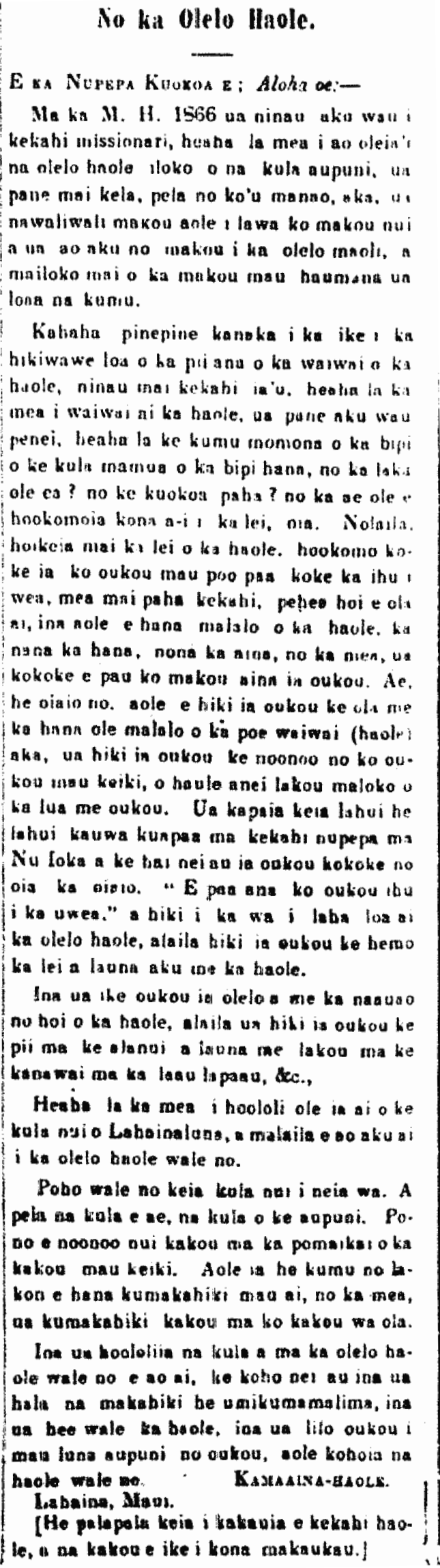
Pertaining to the English Language.

O Kuokoa Newspaper: Aloha oe:—

In the year 1866, I asked a missionary, “What is the reason English isn’t being taught in the government schools,” and he replied, “That is what I think as well, but we are weak, there are not enough of us, and we teach Hawaiian, and from amongst our students we find teachers.”

The Hawaiians are often astounded at seeing how quickly the haole gains wealth, and one asked me, “How does the haole get rich?” I answered this way, “Why is the cow in the fields fatter than the cow that works, isn’t it because it isn’t tamed? or because it is independent? or because it refuses to have it’s neck put in a yoke? That’s it. So when shown the yoke of the haole, your necks are put within it and your noses are soon wired; some may say, ‘How are we to live if we don’t work under the haole; they have the work, to them belongs the land, because soon our land will all be taken by you.’ It is true, you cannot survive without working for the rich (haole), but you can think about your children, lest they fall into the abyss with you. This race was called a race of slaves in a newspaper in New York, and I say to you that this will soon be true. ‘Your noses will be put through with a wire.’ until the day when the English language spreads amongst you, then you’ll will be able to remove your yokes and associate with the haole.

If you all understand the language and the knowledge of the haole, then you’d be able to climb the path and meet up with them in law, medicine, &c.

What is the reason that the college of Lahainaluna is not changed, having only English taught there?

This college is currently a waste. And so too the other schools, the government schools. We must all think carefully about the good of our children. That is no reason for them to forever more work under yearly contracts, for we’ve worked under yearly contracts during out lifetimes.

If the schools were changed so that just English was taught, I predict that after fifteen years, and if the haole leave, then you’d become your own leaders in the government, and not only haole would be appointed.

Kamaaina haole.

Lahaina, Maui.

{This is a letter written by a haole, and it is for us to determine his competence.}

[The argument over what language should be taught in schools is a heated topic that can be seen throughout the life of the Hawaiian-Language Newspapers. At first the argument is whether or not to teach English, and in later years when more and more schools are taught in English, the argument for teaching Hawaiian in schools will become prominent. Most everyone it seems were concerned with the future of the children (whether they were for English or Hawaiian-language education).]

(Kuokoa, 10/26/1872, p. 2)

No ka Olelo Haole.

Ka Nupepa Kuokoa, Buke XI, Helu 43, Aoao 2. Okatoba 26,1872.

Kamehameha Serenaders, 1922.

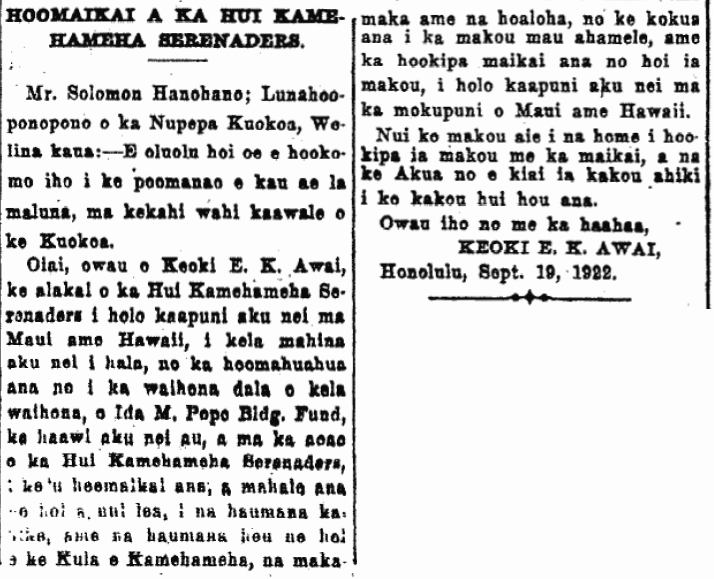
GRATITUDE FROM THE KAMEHAMEHA SERENADERS.

Mr. Solomon Hanohano; Editor of the Kuokoa Newspaper, Greetings:—Please insert this topic above in an open space in the Kuokoa.

Being that I am Keoki E. K. Awai, the leader of the Kamehameha Serenaders which travelled around Maui and Hawaii last month to increase the funds for the Ida M. Pope Bldg. Fund; I give my great appreciation and thanks to the past students and the new students as well of Kamehameha School, and intimates and friends, for their assisting our concerts and for the good care given us while we went around Maui and Hawaii.

We are greatly indebted to the homes which offered us their fine hospitality, and may God watch over us until we meet once again.

Sincerely,

GEORGE E. K. AWAI,

Honolulu, Sept. 19, 1922.

(Kuokoa, 9/21/1922, p. 8)

HOOMAIKAI A KA HUI KAMEHAMEHA SERENADERS.

Ka Nupepa Kuokoa, Buke LXI, Helu 38, Aoao 8. Sepatemaba 21, 1922.