Important words from today about yesterday, today, and tomorrow, 2013.

[Appropriate for this Lei Day, i found a lei woven with great thought and care within the pages of the current Ka Wai Ola, out today. This is a two-stranded lei—two insightful articles (both on a like topic, but one not a translation of the other) by Bryan Kamaoli Kuwada, student, translator, teacher, editor, and researcher living in Palolo i ka ua Lililehua e kilihune nei. Do read it and do pass it on.

For the entire issue, click here: Ka Wai Ola, Mei 2013.]

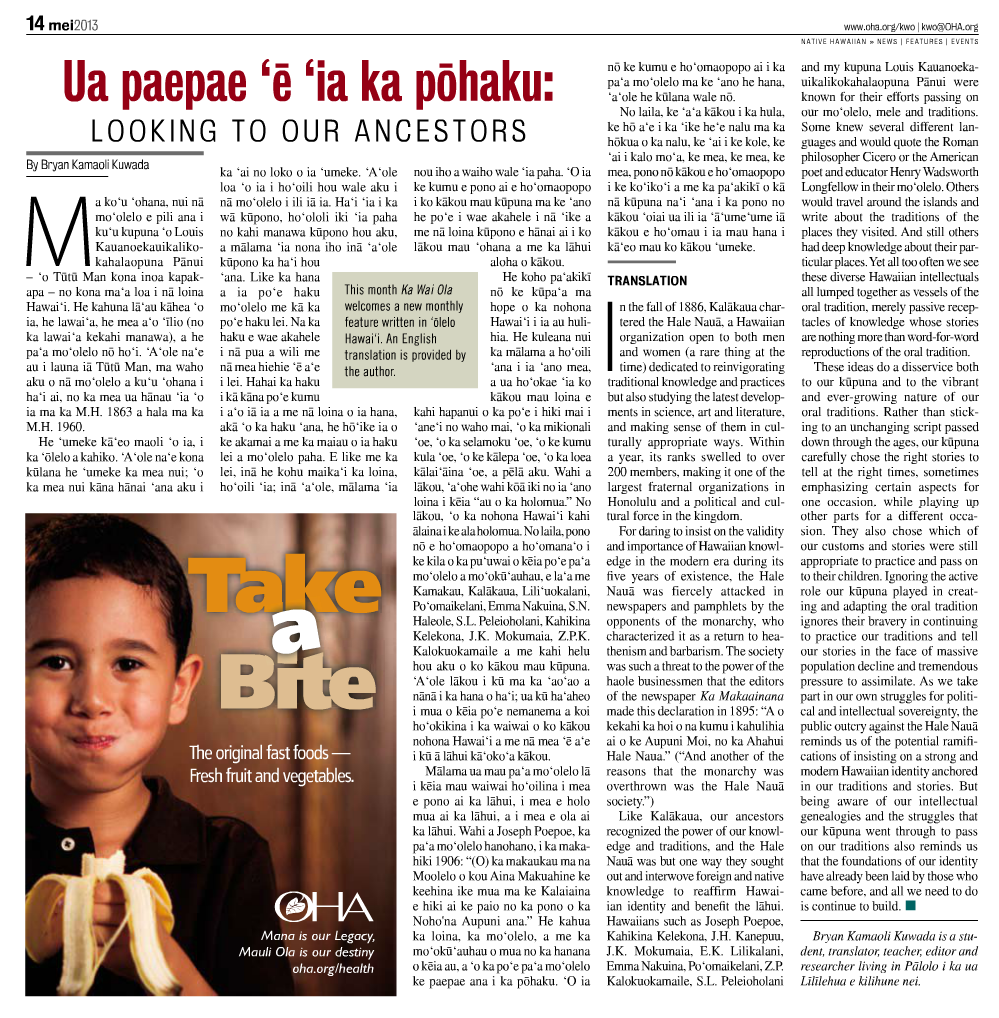
“Ua paepae ʻē ʻia ka pōhaku: Looking to Our Ancestors.”

Ua paepae e ia ka pohaku: Looking to our Ancestors

Ka Wai Ola, Volume 30, Number 5, Page 14. Mei 2013.

The children are your future! 1909 / timeless.

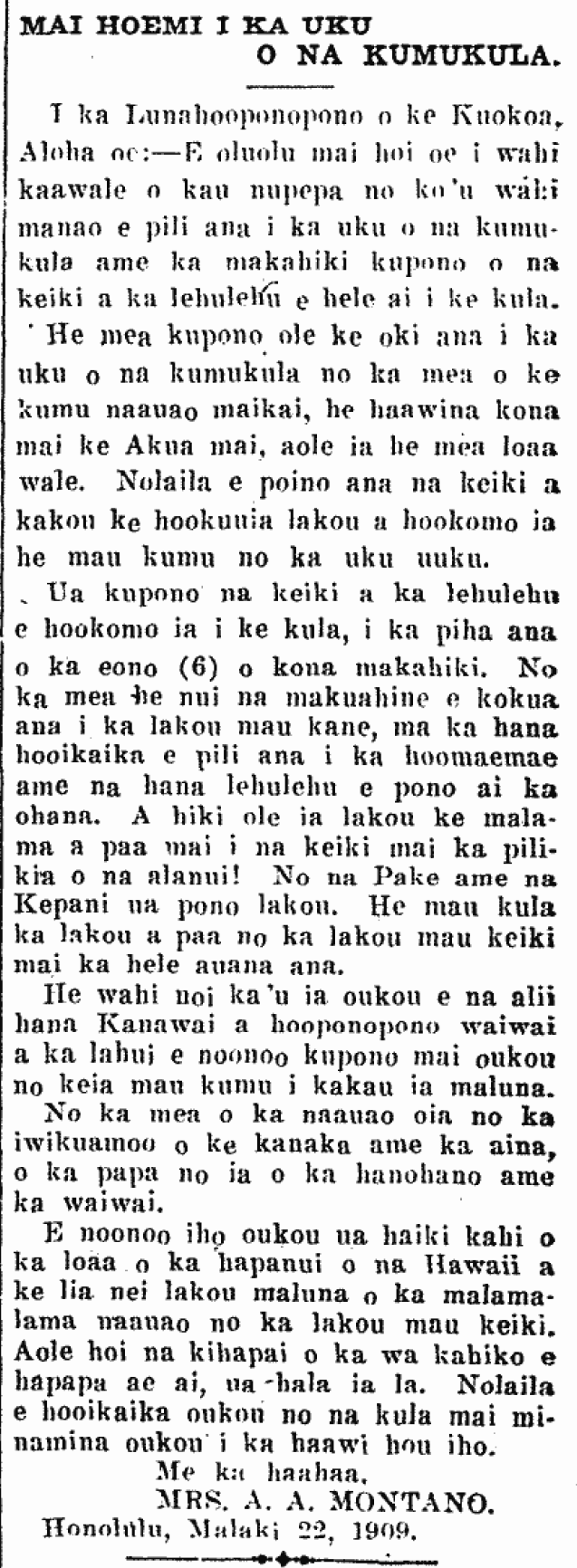
DON’T DECREASE THE PAY OF THE TEACHERS.

To the Editor of the Kuokoa, Aloha oe:—Please allow me some space in your newspaper for my humble thoughts dealing with the salary of teachers and the age at which children of the public should attend school.

It is wrong to cut the teachers’ pay because a well-educated teacher has a gift from God; it is not something readily gotten. And our children will be hurt should we let those teachers go and employ teachers for little pay.

The children of the people should be enrolled in school when they turn six (6) years of age. For there are many women who assist their husbands by endeavoring to take care of the many duties for the good of the family. And they are not able to care for and keep their children from the harm of the streets! As for the Chinese and the Japanese, they are fine. They have schools and their children are kept from wandering about.

I beseech all of you leaders who make Laws and who regulate public funds, do think carefully about these thoughts written above.

For knowledge is the backbone of man and his nation; it is the basis for fame and wealth.

Consider that the income of the majority of the Hawaiians is limited, and they are counting on the light of education for their children. The plantations of the old days are not to be reached out for, for those days are past. So all of you, please put effort into the schools, and don’t feel hesitant in investing more.

Sincerely,

MRS. A. A. MONTANO.

Honolulu, Malaki 22, 1909.

[Times have changed. Hopefully we learn from the past…

This letter is written by famed composer, Mary Jane Kekulani Montano.]

(Kuokoa, 3/26/1909, p. 4)

MAI HOEMI I KA UKU O NA KUMUKULA.

Ka Nupepa Kuokoa, Buke XLVI, Helu 13, Aoao 4. Maraki 26, 1909.

Response to hula commentary, 1891.

THE HULA AND THE “P. C. ADVERTISER.”

Another example of the “P. C. Advertiser’s” moral attitude appears int the announcement, that a hula given by the Hon. J. A. Cummins at his resident at Waimanalo was a glorious affair.—We have no doubt, that the display was exceptionally fine, since the ex-Premier has a well earned reputation as a connoiseur in that line, and is said to use the collection of females, formerly of boat house fame, second to none in the country.—Still there is something about the hula, that has so far excluded it from the programs of church festivals and school exercises.—It has never been recommended to lure the mind to thoughts of higher and better things or to produce rigid uprightness of morals.

The hula is a graceful and rhythmic representation of certain actions of the human animal. There is no doubt, that from the earliest ages the physiology of reproduction has been the most intrinsically interesting known to man. After the question of food and personal safety, it is the most important consideration in the lives of man, savage and civilized. The Hindoos and Budhists covered their temples and public buildings with indecent pictures, which in some instances took the form of a cross. This was imported to Rome together with the worship of Isis. So every spire on a Christian Church represents a resurrection of the flesh. But civilized society has decided for good reason to cover Isis with a vail and put Osiris in a straight-jacket. It is only those, who believe in the infallibility and prerogatives derived from gold—as some of our friends—who may wish to go back to the first principles and have the hula taught as an accomplishment in our public schools, so that it might prove more attractive in catching a husband and certainly in domesticating him when caught, than the art of piano playing or embroidery. There are great posibilities in the hula! But at present it is prohibited by the law, and we are sorry to see the law violated by those who ought to know better.

(Leo o ka Lahui, 5/14/1891, p. 4)

THE HULA AND THE "P. C. ADVERTISER."

Ka Leo o ka Lahui, Buke II, Helu 193, Aoao 4. Mei 14, 1891.

Jack Kaleiwahea falsely accused? 1893.

KALEIWAHEA.

Some Explanations pertaining to his arrest.

Kaleiwahea has been a kamaaina of the uplands of Kalihi for many years. He has some blemishes by his eyes and mouth. While he was living this way, he was made an adversary by some people and they went to the Board of Health as witnesses saying he had leprosy. A warrant was issued for his arrest and he was captured and taken to the quarantine station of Kalihi. He told some people that he was confined there for six weeks without being examined, along with some other patients. One day some people told him that he was going to be taken to Molokai without being examined.

Therefore, one day a thought grew within him without considering the power of the Board of Health, and thinking of his own accord that he did not have leprosy, he escaped and ran away to free himself and went to the mountains, until the valley of Waimea. Later it was heard that he fled, and the order was given to the Deputy Sheriffs in response to his escape, to capture him if found. He was constantly hunted like a wild animal. He said that he didn’t want to be taken alive. Previously, he did not carry weapons, but after he heard that he was being hunted by the officers, he ran and swam in the ocean, while being chased by officers aboard a canoe, and when the officers were close behind, he grabbed on to the outrigger float [ama] and flipped the canoe, and the officers were thrown into the ocean. The two officers returned to shore without the object of their chase. When it became dark, Kaleiwahea came to shore at Waialua.

From that time, Kaleiwahea was seen carrying a rifle and other weapons, and when the officers came to arrest him once more, he was prepared. The officers told him that they’d come at night to capture him, so he fled to live in the mountains. He said that as long as he was hunted like an animal, he’d not give up. According to some news received, he was living in a very good area in the mountains of Kahuku, where it was better than where Koolau¹ was living, and he could toy with all who appeared before him.

When he heard that he was to be captured again, he fled to the mountains, even if just a few months ago he was living by the sea and working at the dock of Waimea. He was very skilled at that kind of work. But he surmised that the order was given to the District Sheriffs of Waialua and Koolau, not to arrest him, but to let him be until the time was right, then maybe he could be assuaged and his appearance could be looked at. Because according to the people who knew, there were no signs of that disease that separates families [leprosy] upon him.

This below is the letter he wrote to one of his friends, and let it be read with great relish [? onoi nui]:

Camping Place in the Mountains

Kahuku, July 29,

To _______

I received your letter of aloha, and it gave me much hope and happiness, and for the first time, I’ve have an appetite here in my mountain home. I’ve received a lot of news that I’m being hunted after, and last week I was greatly saddened upon hearing that the haole police were coming along with the government troops to go against me, and that they’d shoot me if they can; what is the wrong I have committed that I should be treated that way like an animal? When I heard this, aloha welled up within me for my wife and our newborn baby of two weeks, as well as for my family.  I attempted to go once again and escape my mountain home and give my wife and family my last aloha; and to my wife i said, “The time has come for me to go like a wild animal and return to my mountain home, until i meet with those of which I hear, and it will be then that I fight for life or death, until the very last puffs of smoke from my rifle.” With these words above, I left my home depressed, but when I received your letter to me, it gave me good hope that there will be end to the years of persecution. I shall rest like a man, and my deed done as a man, and not like a beast running through the forest.

With much aloha, me, your humble servant,

Jack Kaleiwahea.

¹The famous one written of in “Ka Moolelo Oiaio o Kaluaikoolau” or “The True Story of Kaluaikoolau,” which is available from the Kauai Historical Society, or a bookstore near you!

[I wish the digital images of this paper were better. This article is even cut off on the left, so I had to guess at many of the words… It is definitely time to rescan the Hawaiian-Language Newspapers!]

(Lei Momi, 8/5/1893, p. 5)
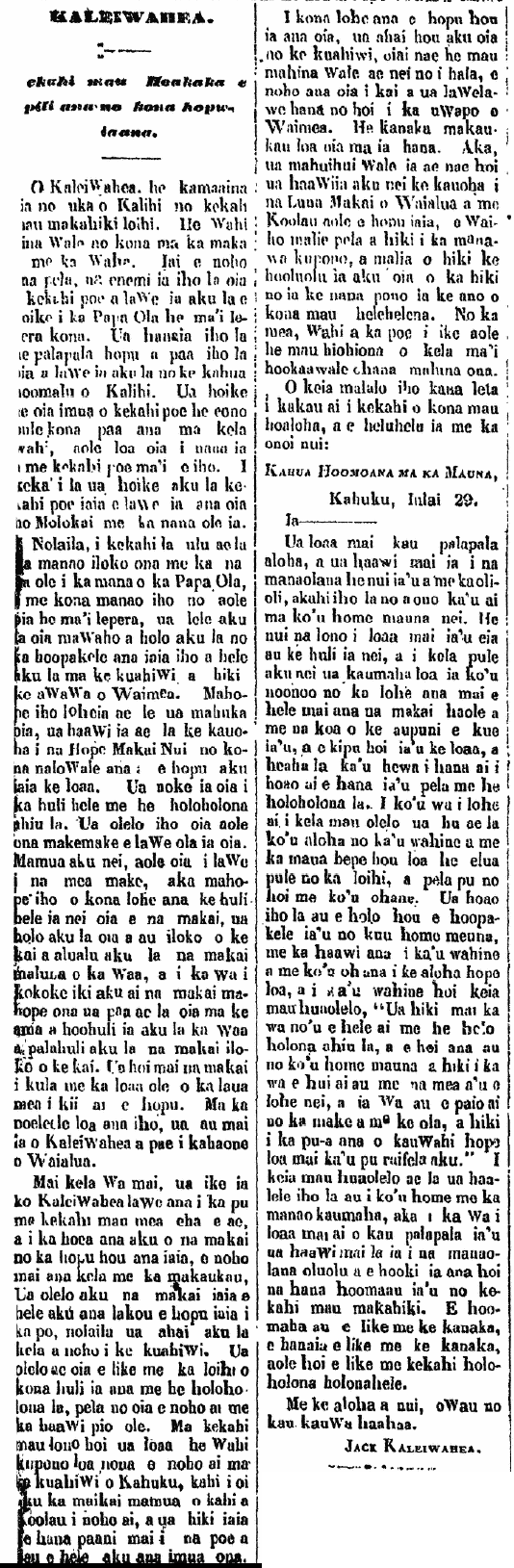
KALEIWAHEA.

Ka Lei Momi Oili Pule, Buke I, Helu 1, Aoao 5. Augate 5, 1893.

Leprosy patients on the run, 1893.

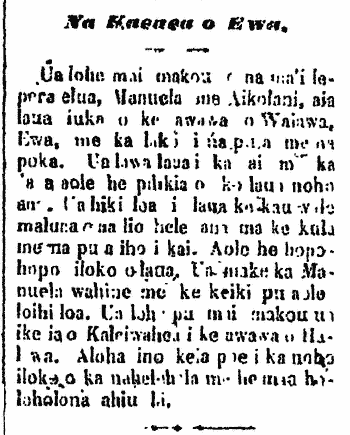
The Heroes of Ewa.

We have heard that the two leprosy patients, Manuela and Aikolani are in the uplands of Waiawa valley in Ewa, and that they are stocked with guns and bullets. The have enough fish and poi, and they have no difficulties with their living situation. They can just get on horses in the fields with their guns and go down to the sea. They have nothing to worry about. Manuel’s wife and child died long ago. We also hear that Kaleiwahea was seen in Halawa valley. How sad for these people living in the forests like wild animals.

[Here is yet another unclear digital image from a Hawaiian-Language Newspaper!]

(Lei Momi, 8/5/1893, p. 5)

Na Kaeaea o Ewa.

Ka Lei Momi (Oili Pule), Buke I, Helu 1, Aoao 5. Augate 5, 1893.
Tourists… 1906.

[Found under: “TOWN TALK”]

One of my Southern California friends here with the party of editors had a very amusing experience with a native waiter in a restaurant into which she had dropped for lunch. She saw the brown son of the islands coming and she nerved herself for the ordeal. She consulted her souvenir program and running over the list of translated words she finally found and said “Pa-Hay-Oe.”

“Maikai no” replied the man with a smile.

The young lady then attempted to find the native words for “Ham and Eggs” or something to that effect—but alas they were not there. She hesitates, looked frantically around in search of some haole, and finally she though of sign language and commenced to make all sorts of passes in the air. The native stood near her her and kept shaking his head, all the time with a questioning look in his eye.

Finally the young lady said in despair, “Oh, you block head, why don’t you talk English?”

“I was about to say madam,” came the reply, “that if you would say in English what you are endeavoring to convey by means of the sign language, I would be most delighted to fill even your humblest desire.”

Then the young lady was angry. She stamped out of the restaurant and all one needs to do to court sudden death is to make a few passes like “Ham and Eggs” in the air in her presence.

(Hawaiian Star, 9/22/1906, p. 7)

One of my Southern California friends...

The Hawaiian Star, Volume XIV, Number 4524, Page 7. September 22, 1906.

Man sent away from Queen’s Hospital, 1913.

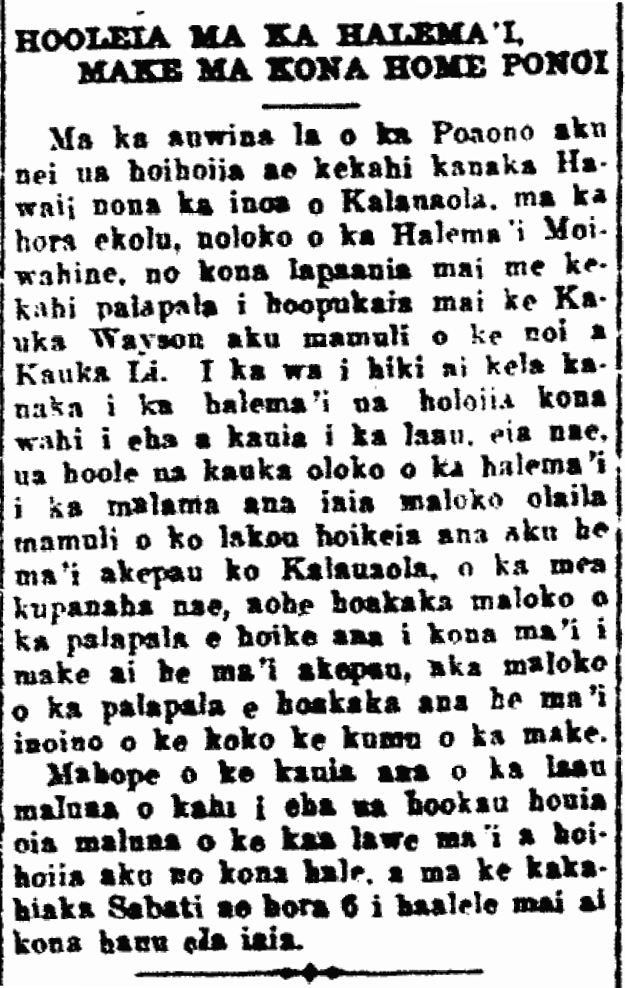
REFUSED BY THE HOSPITAL AND DIED AT HIS HOME.

In the afternoon of this past Saturday, a Hawaiian named Kalanaola was brought back at three o’clock, to the Queen’s Hospital to be treated, with a document written by Dr. Wayson at the request of Dr. Li. When that man arrived at the hospital, his wound was cleaned and treated, but the doctors in the hospital refused to admit him there because they were told Kalanaola had diabetes [ma’i akepau]; the astonishing thing was that there was no indication in his death report that he died of diabetes, but in the report it said his death was caused by a sickness of the blood.

After treating his injury, he was placed back on the ambulance and taken back to his home, and on the following Sunday at 6 o’clock, his breath of life left him.

(Kuokoa, 1/31/1913, p. 4)

HOOLEIA MA KA HALEMA'I, MAKE MA KONA HOME PONOI

Ka Nupepa Kuokoa, Buke XLIX, Helu 5, Aoao 4. Ianuari 31, 1913.

More from Puheemiki on C. Strawn in Kalawao, 1883.

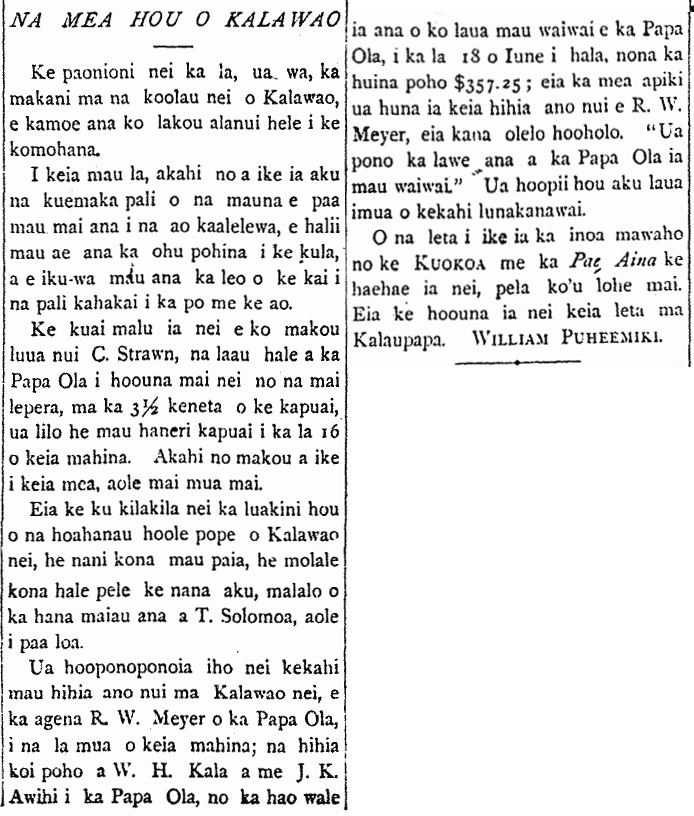
THE NEWS OF KALAWAO

The sun is shining; this wind is howling in the Koolau of Kalawao; their path lies to the west.

These days, it is the first time the brows of the cliffs of the mountains have been sighted, which are constantly blocked by floating clouds; the fields are constantly covered by gray mist; and the voice of the ocean constantly roars in the sea cliffs both night and day.

Our superintendent, C. Strawn, is secretly selling the house lumber that the Board of Health sent for the patients, at 3½ cents per yard, and hundreds of yards were sold on the 16th of this month. We just found out about this, we didn’t know from earlier.

The new church of the protestant brethren of Kalawao stands proudly, her walls are beautiful, and her bell tower is stands unobstructed; this was done skillfully under T. Solomoa [T. Solomona], but it is not completed.

Some major problems here in Kalawao were remedied by the agent of the Board of Health, R. W. Meyer, earlier this month; the claim for damages by W. H. Kala and J. K. Awihi against the Board of Health, for the seizing of their property by the Board of Health on the 18th of this past June, totaling $357.25; here is the deceitful thing: this important claim was hidden away by R. W. Meyer, and this was his decision. “The Board of Health was justified in the seizing of this property.” They two of them filed suit once again before a judge.”

Letters seen addressed outside to the Kuokoa or the Pae Aina¹ are torn apart; that is what I hear. This letter is being sent at Kalaupapa.  William Puheemiki.

[Does anyone know which Protestant church in Kalawao this would be being built in 1883?]

¹Ko Hawaii Pae Aina

(Kuokoa, 8/25/1883, p. 3)

NA MEA HOU O KALAWAO

Ka Nupepa Kuokoa, Buke XXII, Helu 34, Aoao 3. Augate 25, 1883.

Suicide in Kalawao, 1883.

HANGING IN KALAWAO.

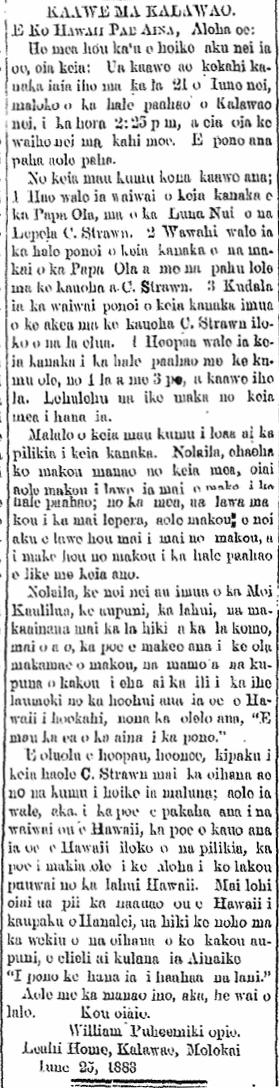
O Ko Hawaii Pae Aina, Aloha oe:

I have something to report to you, and that is this: A man hung himself on the 21st of this June, in the jail here in Kalawao, at 2:25 p. m., and he is now left to rest. Perhaps it will be set right, perhaps not.

Here is why he hung himself; 1. The estate of this man was confiscated by the Board of Health, the the superintendent of the Lepers, C. Strawn. 2. The residence of this man was torn down by the officers of the Board of health as well as his clothes trunk by the orders of C. Strawn. 3. The property of this man was auctioned off to the public by orders of C. Strawn over two days. 4. This man was imprisoned in the jail for no reason for 4 days and 3 nights, at which point he hung himself. There are many witnesses to what was done.

This is all why this man was troubled. And so we are pained by this, for we were not brought here to die in jail; because it is enough that we are inflicted with leprosy; we don’t wish for more sickness to befall us or for us to die again in jail like this.

Therefore I ask before King Kaulilua,¹ the nation, the lahui, the makaainana from where the sun rises to where it sets, from that side to this, those who care for our dear lives, the descendants of our kupuna who were wounded by the barbed spears to unify you O Hawaii as one, for whom is said, “E mau ke ea o ka aina i ka pono.”²

Please dismiss, transfer, and expell this haole C. Strawn from his job for the reasons shown above; and not just him, but those who plunder the wealth of you, O Hawaii; the people who drag you, O Hawaii into difficulties; and those who hold no aloha in their hearts for Hawaii. Don’t take your time, for your knowledge, O Hawaii, has climbed the heights of Hanalei, and you are qualified to occupy the highest positions of our government and be respected for your knowledge [e elieli ai kulana ia Ainaike.]

This is not said in spite, but for just cause [he wai o lalo]. Sincerely,

William Puheemiki, Jr.

Leahi Home, Kalawao, Molokai

June 25, 1883.

¹Kaulilua is another name for Kalakaua.

²”Ua mau ke ea o ka aina i ka pono,” is the famous proclamation of Kauikeaouli, Kamehameha III.

(Ko Hawaii Pae Aina, 7/7/1883, p. 4)

KAAWE MA KALAWAO.

Ko Hawaii Pae Aina, Buke VI, Helu 27, Aoao 4. Iulai 7, 1883.

Mistreatment of leprosy patients and why we need to reshoot the Hawaiian-Language Newspapers, 1886.

ABUSE BY THE BOARD OF HEALTH.

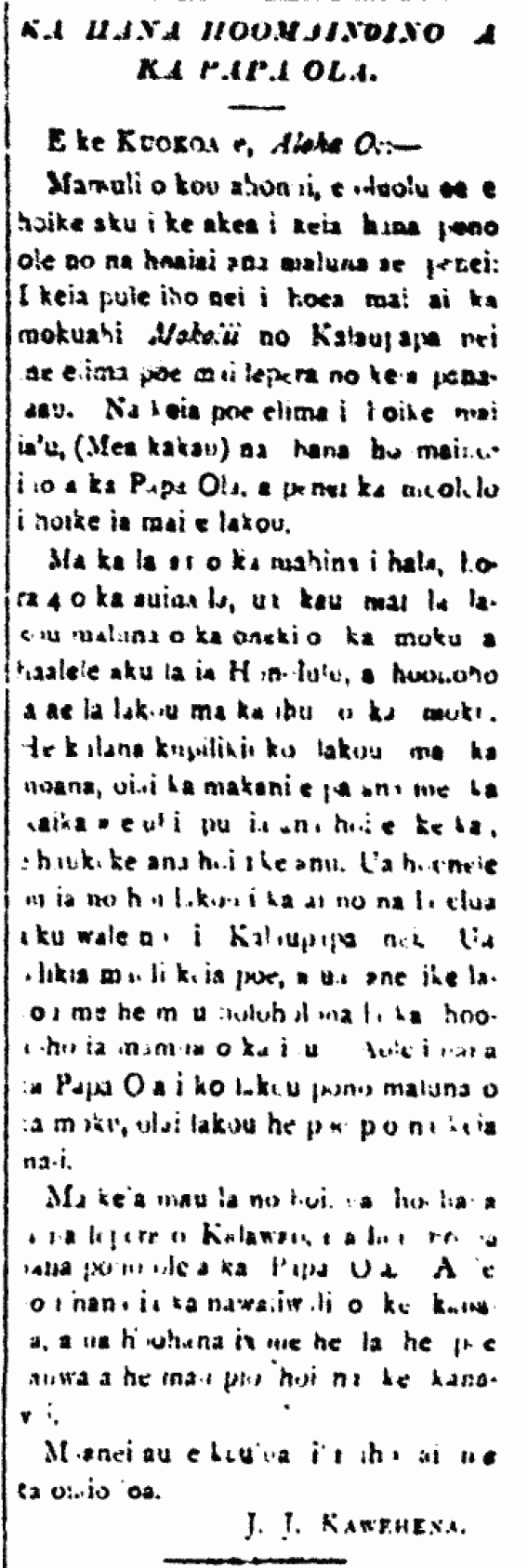
O Kuokoa, Aloha Oe:—

Please be so patient as to show this improper behavior to clarify the above, thus: This past week the steamship Makalii arrived here in Kalapapa with five leprosy patients for this colony. These five people told me (the Writer) about the cruelty done by the Board of Health, and this is the story told by them.

On the 21st of the past month, at 4 in the afternoon, stepped onto the deck of the ship and left Honolulu, and they were placed at the bow of the ship. They were in distress while at sea due to the winds that were blowing strongly and they were covered by the sea and shivered in the cold. They were not give food for two days and then landed here in Kalaupapa. They were in desperate shape, and were treated like animals being placed at the bow. The Board of Health did not look after their well-being even if they ?????

These days, the leprosy patients of Kalawao are made to work ?????? mistreated by the Board of Health. They don’t consider the weak state of the people and are worked like slaves and they are prisoners of the law.

Here, I ????? with sincerity.

J. J. Kawehena.

[I know i keep saying that the Hawaiian-Language Newspapers need to be reshot again so that we can have the clearest images possible, but i can’t help it. Here is a perfect example. I am guessing at a good deal of the content, and where i couldn’t, i left as “????” Once the papers deteriorate and crumble away, there is no way we can get these histories.]

(Kuokoa, 7/3/1886, p. 1)

KA HANA HOOMAINOINO A KA PAPA OLA.

Ka Nupepa Kuokoa, Buke XXV, Helu 27, Aoao 1. Iulai 3, 1886.