Kalawao bodies exhumed for study, 1884.

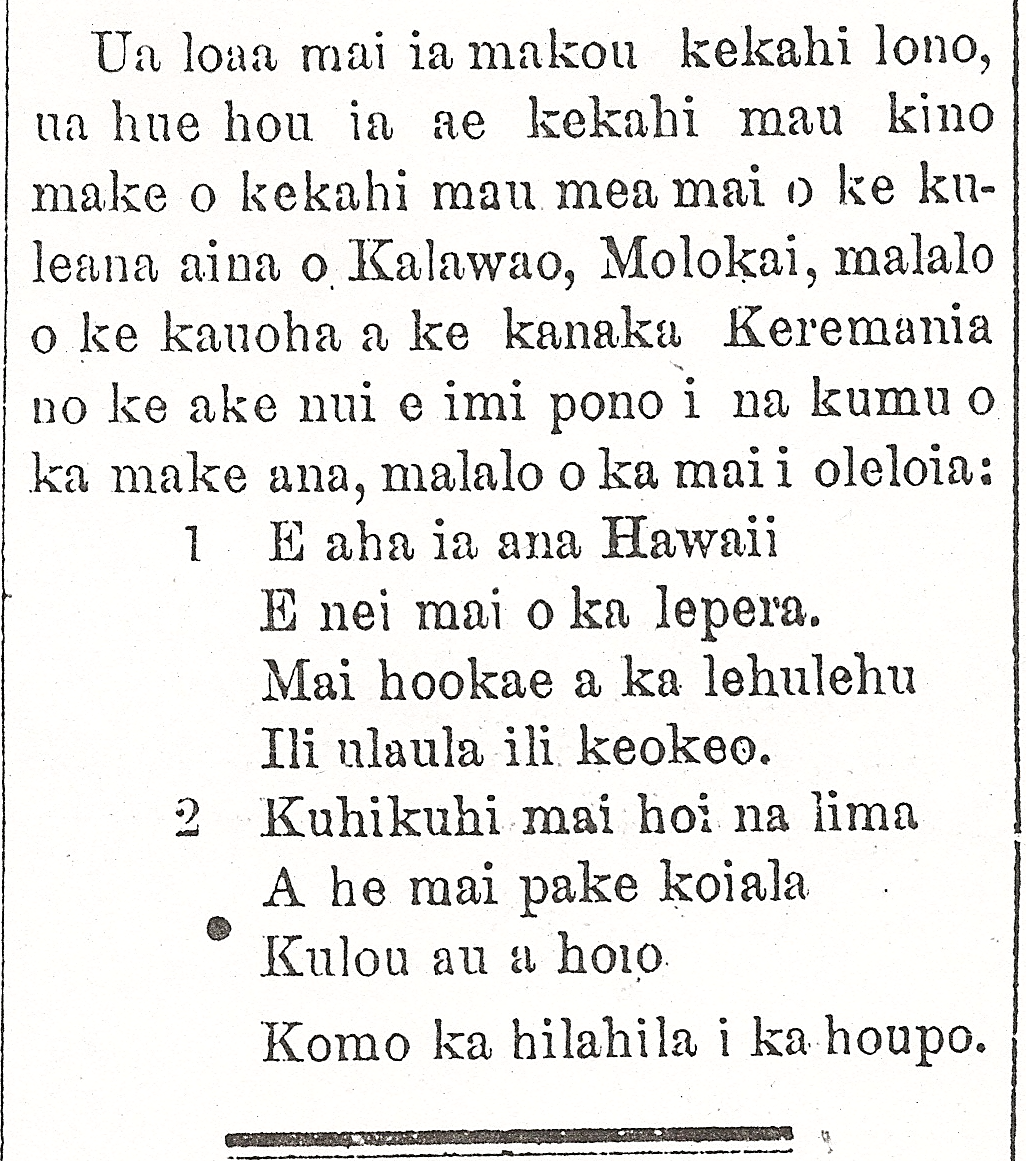
We’ve received word that more bodies were exhumed of patients in Kalawao, Molokai, under the orders of the German [Eduard Arning], because of his great desire to find the reasons for the deaths by the disease of which it is said:

1 E aha ia ana Hawaii
E nei mai o ka lepera.
Mai hookae a ka lehulehu
Ili ulaula ili keokeo.

2 Kuhikuhi mai hoi na lima
A he mai pake koiala
Kulou au a holo
Komo ka hilahila i ka houpo.

[1 What is up with Hawaii
With this disease, leprosy
Disease hated by the masses
By the dark skinned and the white skinned.

2 The hand points this way
“That one there has leprosy [mai pake]”
I look down and flee
Shame filling my heart.]

[“Ke Ola o Hawaii” is yet another newspaper that is available on microfilm that ulukau for some reason chose not to digitize. Hopefully this will be corrected soon!]

(Ola o Hawaii, 3/22/1884, p. 3)

Ua loaa mai ia makou kekahi lono...

Ke Ola o Hawaii, Buke I, Helu 11, Aoao 3. Maraki 22, 1884.

Turn in those with symptoms, 1867.

[Found under: “NU HOU KULOKO: Maui”]

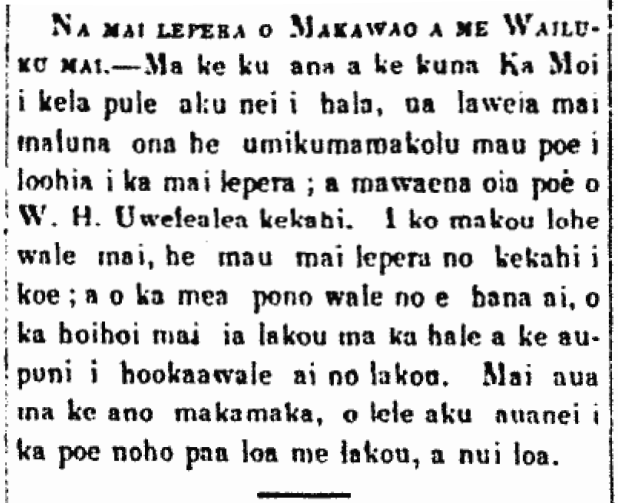
The Leprosy Patients from Makawao and Wailuku.—When Ka Moi landed this past week, taken aboard her were thirteen people suffering from leprosy; amongst them was W. H. Uwelealea. According to what we hear, there are others that remain, and the right thing to do is to send them to the building which the government has set aside for them. Don’t resist because they are your friends, lest those who live with them catch it, and it spreads.

(Kuokoa, 8/31/1867, p. 3)
Na mai lepera o Makawao a me Wailuku mai...

Ka Nupepa Kuokoa, Buke VI, Helu 35, Aoao 3. Augate 31, 1867.

One more related article on Kalaupapa, 1867.

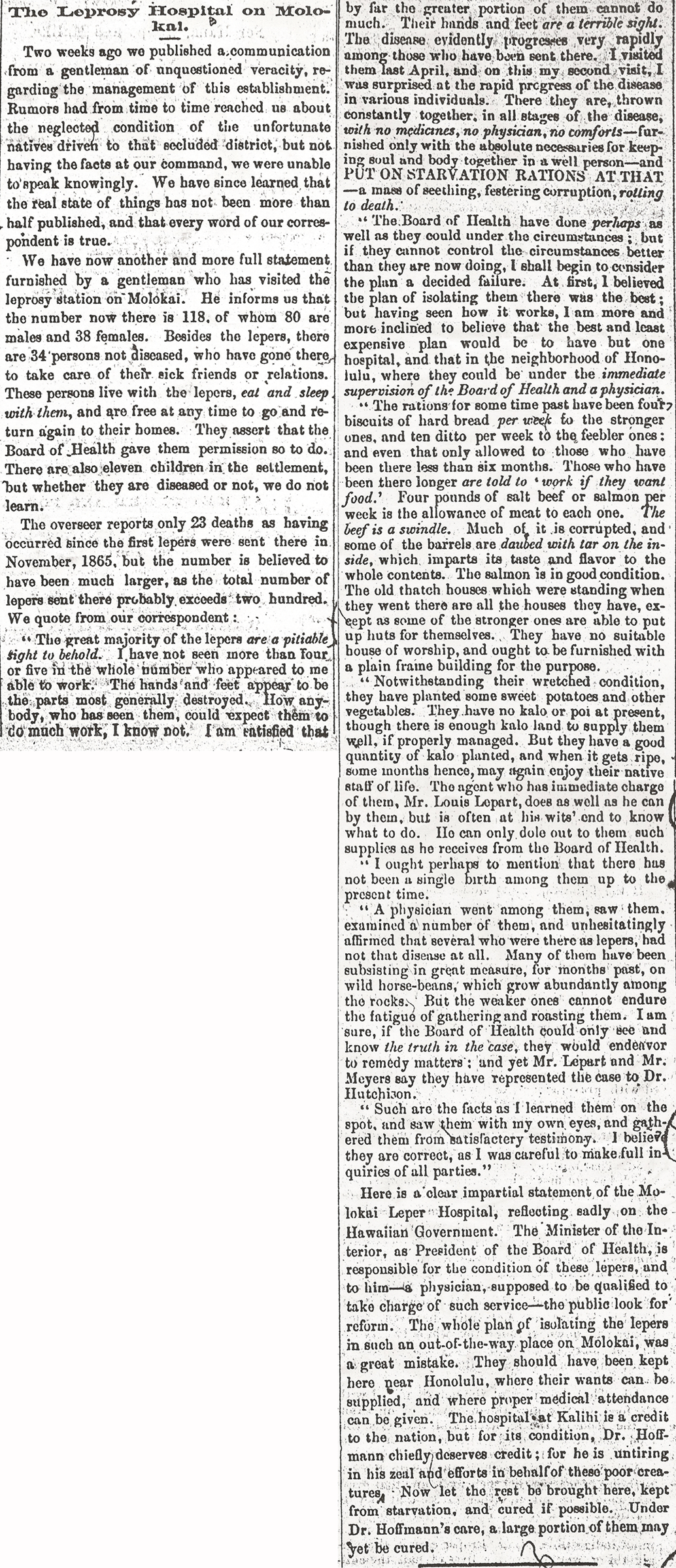
The Leprosy Hospital on Molokai.

Two weeks ago we published a communication from a gentleman of unquestioned veracity, regarding the management of this establishment. Rumors had from time to time reached us about the neglected conditions of the unfortunate natives driven to that secluded district, but not having the facts at our command, we were unable to speak knowingly. We have since learned that the real state of things has not been more than half published, and that every word of our correspondent is true.

We have no another and more full statement furnished by a gentleman who has visited the leprosy station on Molokai. He informs us that the number now there is 118, of whom 80 are males and 38 females. Besides the lepers, there are 34 persons not diseased, who have gone there to take care of their sick friends or relations. These persons live with the lepers, eat and sleep with them, and are free at any time to go and return again to their homes. They assert that the Board of Health gave them permission so to do. There are also eleven children in the settlement, but whether they are diseased or not, we do not learn.

The overseer reports only 23 deaths as having occurred since the first lepers were sent there in November, 1865, but the number is believed to have been much larger, as the total number of lepers sent there probably exceeds two hundred. We quote from our correspondent:

“The great majority of the lepers are a pitiable sight to behold. I have not seen more than four or five in the whole number who appeared to me able to work. The hands and feet appear to be the parts most generally destroyed. How anybody, who has seen them, could expect them to do much work, I know not. I am satisfied that by far the greater portion of them cannot do much. Their hands and feet are a terrible sight. The disease evidently progresses very rapidly among those who have been sent there. I visited them last April, and on this my second visit, I was surprised at the rapid progress of the disease in various individuals. There they are, thrown constantly together, in all stages of the disease, with no medicines, no physicians, no comforts—furnished only with the absolute neccessaries for keeping soul and body together in a well person—and PUT ON STARVATION RATIONS AT THAT—a mass of seething, festering corruption, rotting to death.

“The Board of Health have done perhaps as well as they could under the circumstances; but if they cannot control the circumstances better than they are now doing, I shall begin to consider the plan a decided failure. At first, I believed the plan of isolating them there was the best; but having seen how it works, I am more and more inclined to believe that the best and least expensive plan would be to have but one hospital, and that in the neighborhood of Honolulu, where they could be under the immediate supervision of the Board of Health and a physician.

“The rations for some time past have been four biscuits of hard bread per week to the stronger ones, and ten ditto per week to the feebler ones: and even that only allowed to those who have been there less than six months. Those who have been there longer are told to ‘work if they want food.’ Four pounds of salt beef or salmon per week is the allowance of meat to each one. The beef is a swindle. Much of it is corrupted, and some of the barrels are daubed with tar on the inside, which imparts its taste and flavor to the whole contents. The salmon is in good condition. The old thatch houses which were standing when they went there are all the houses they have, except as some of the stronger ones are able to put up huts for themselves. They have no suitable house of worship, and ought to be furnished with a plain frame building for the purpose.

“Notwithstanding their wretched condition, they have planted some sweet potatoes and other vegetables. They have no kalo or poi at present, though there is enough kalo land to supply them well, if properly managed. But they have a a good quantity of kalo planted, and when it gets ripe, some months hence, may again enjoy their native staff of life. The agent who has immediate charge of them, Mr. Louis Lepart, does as well as he can by them, but is often at his wits’ end to know what to do. He can only dole out to them such supplies as he receives from the Board of Health.

“I ought perhaps to mention that there has not been a single birth among them up to the present time.

“A physician went among them, saw them, examined a number of them, and unhesitatingly affirmed that several who were there as lepers, had not that disease at all. Many of them have been subsisting in great measure, for months past, on wild horse-beans, which grow abundantly among the rocks. But the weaker ones cannot endure the fatigue of gathering and roasting them. I am sure, if the Board of Health could only see and know the truth in the case, they would endeavor to remedy matters; and yet Mr. Lepart and Mr. Meyers say they have represented the case to Dr. Hutchison.

“Such are the facts as I learned them on the spot, and saw them with my own eyes, and gathered them from satisfactery testimony. I believe they are correct, as I was careful to make full inquiries of all parties.”

Here is a clear impartial statement of the Molokai Leper Hospital, reflecting sadly on the Hawaiian Government. The Minister of the Interior, as President of the Board of Health, is responsible for the condition of these lepers, and to him—a physician, supposed to be qualified to take charge of such a service—the public look for reform. The whole plan of isolating the lepers in such an out-of-the-way place on Molokai, was a great mistake. They should have been kept here near Honolulu, where their wants can be supplied, and where proper medical attendance can be given. The hospital at Kalihi is a credit to the nation, but for its condition, Dr. Hoffmann chiefly deserves credit; for he is untiring in his zeal and efforts in behalf of these poo creatures. Now let the rest be brought here, kept from starvation, and cured if possible. Under Dr. Hoffmann’s care, a large portion of them may yet be cured.

(Pacific Commercial Advertiser, 1/12/1867, p. 3)
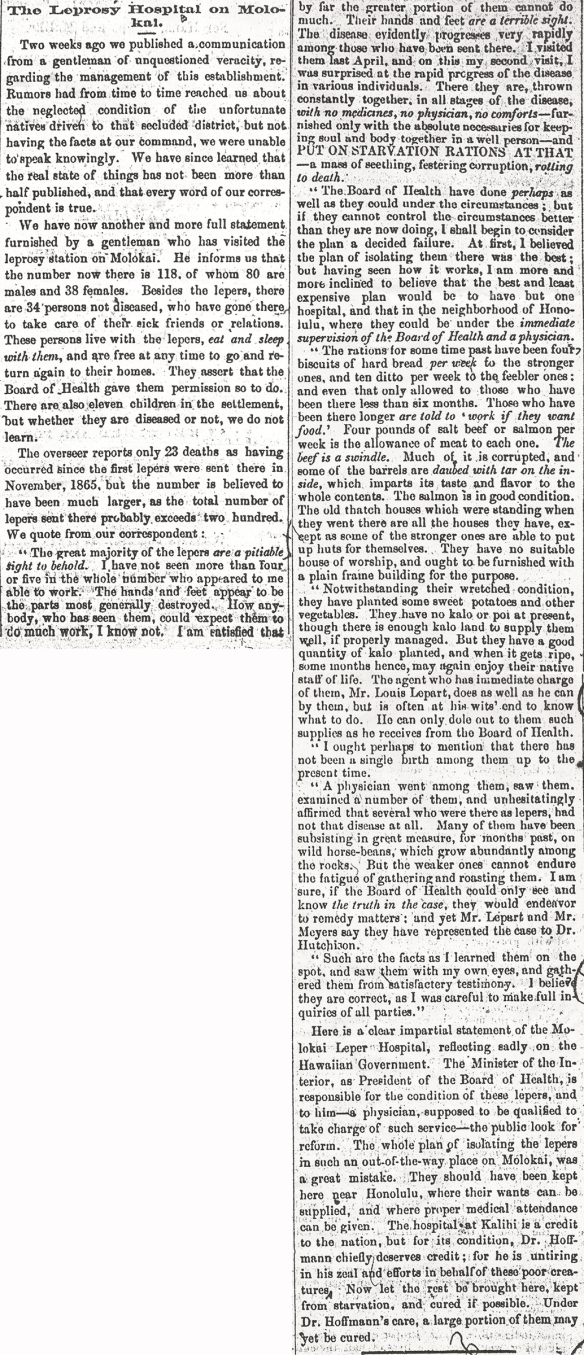
The Leprosy Hospital on Molokai.

The Pacific Commercial Advertiser, Volume XI, Number 28, Page 3. January 12, 1867.
Critique on Conditions at Kalaupapa, 1866.

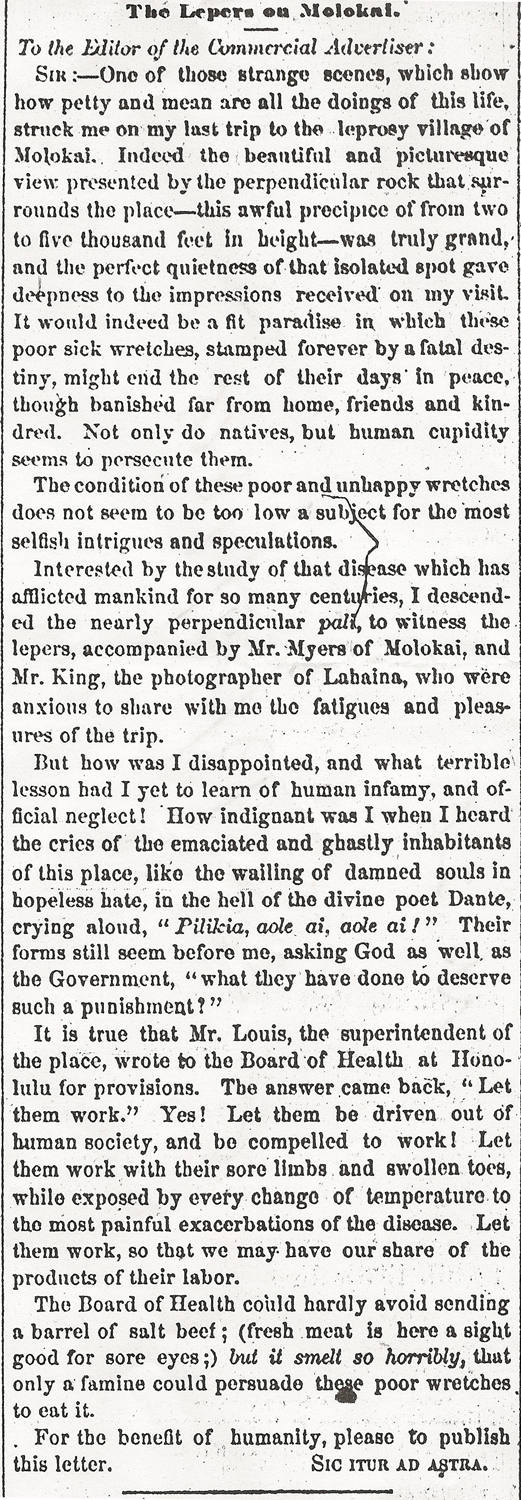
The Lepers on Molokai.

To the Editor of the Commercial Advertiser:

Sir:—One of those strange scenes, which show how petty and mean are all the doings of this life, struck me on my last trip to the leprosy village of Molokai. Indeed the beautiful and picturesque view presented by the perpendicular rock that surrounds the place—this awful precipice of from two to five thousand feet in height—was truly grand, and the perfect quietness of that isolated spot gave deepness to the impression received on my visit. It would indeed be a fit paradise in which these poor sick wretches, stamped forever by a fatal destiny, might end the rest of their days in peace, though banished far from home, friends and kindred. Not only do natives, but human cupidity seems to persecute them.

The condition of these poor and unhappy wretches does not seem to be too low a subject for the most selfish intrigues and speculations.

Interested by the study of that disease which has afflicted mankind for so many centuries, I descended the nearly perpendicular pali, to witness the lepers, accompanied by Mr. Myers of Molokai, and Mr. King, the photographer of Lahaina, who were anxious to share with me the fatigues and pleasures of the trip.

But how was I disappointed, and what terrible lesson had I yet to learn of human infamy, and official neglect! How indignant was I when I heard the cries of the emaciated and ghastly inhabitants of this place, like the wailing of damned souls in hopeless hate, “Pilikia, aole ai, aole ai!” Their forms still seem before me, asking God as well as the Government, “what they have done to deserve such a punishment?”

It is true that Mr. Louis, the superintendent of the place, wrote to the Board of Health at Honolulu for provisions. The answer came back, “Let them work.” Yes! Let them be driven out of human society, and be compelled to work! Let them work with their sore limbs and swollen toes, while exposed by every change of temperature to the most painful exacerbations of the disease. Let them work, so that we may have our share of the products of their labor.

The Board of Health could hardly avoid sending a barrel of salt beef; (fresh meat is here a sight good for sore eyes;) but it smelt so horribly, that only a famine could persuade these poor wretches to eat it.

For the benefit of humanity, please to publish this letter.  Sic itur ad astra.

(Pacific Commercial Advertiser, 12/29/1866, p. 3)

The Lepers on Molokai.

The Pacific Commercial Advertiser, Volume XI, Number 26, Page 3. December 29, 1866.

Critique of Government Policy to Isolate Leprosy Patients, 1867.

[Found under: “English Column.: Island News.”]

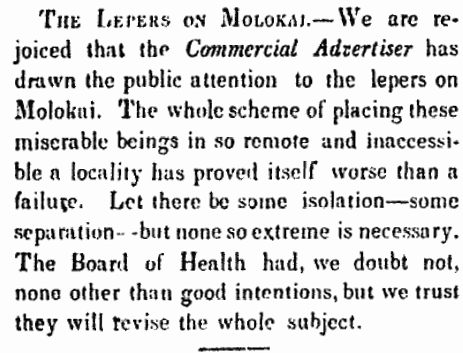
The Lepers on Molokai.—We are rejoiced that the Commercial Advertiser has drawn the public attention to the lepers on Molokai. The whole scheme of placing these miserable beings in so remote and inaccessible locality has proved itself worse than a failure. Let there be some isolation—some separation—but none so extreme is necessary. The Board of Health had, we doubt not, none other than good intentions, but we trust they will revise the whole subject.

[This article comes out soon after the policy to isolate the patients in Kalawao and Kalaupapa. It is a response to articles appearing in the Pacific Commercial Advertiser (predecessor of the Honolulu Advertiser). See following two posts.]

(Kuokoa, 1/19/1867, p. 2)

The Lepers on Molokai...

Ka Nupepa Kuokoa, Buke VI, Helu 3, Aoao 2. Ianuari 19, 1867.

Punchbowl to go to the rich, 1912.

CRYING IN REGRET

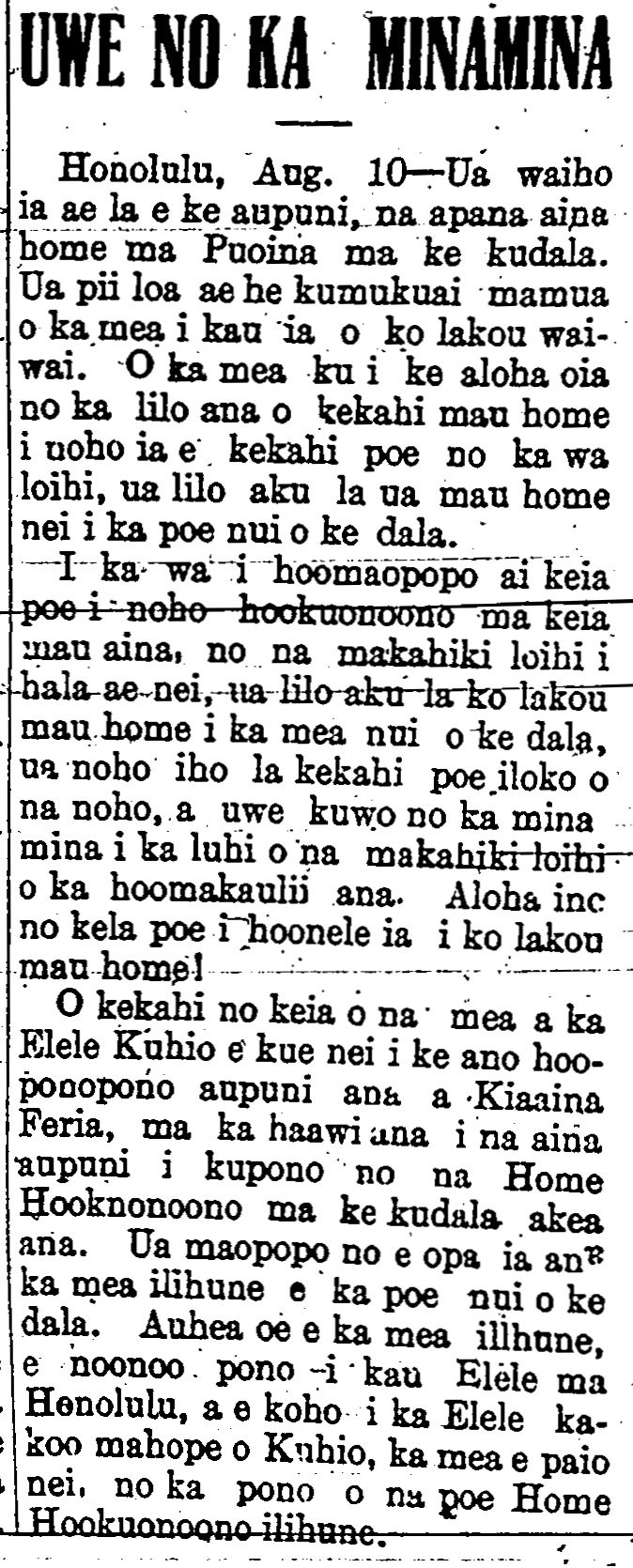
Honolulu, Aug. 10—The government has set aside the home lots at Puoina [Punchbowl] to be auctioned off. The prices have gone much higher than their value. What is so sad is that some homes which have been lived in by people for a long time will go to those who have a lot of money.

When these people who have homesteaded on these lands for many years in the past learned that their homes will go to the rich, some sat down in chairs and cried in despair over all the long years spent saving. How sad for those people who will lose their homes!

This is one of the things that Representative Kuhio opposes in the administering of the government by Governor Frear, that being the putting up for open auction lands suitable for Homesteads. It is clear that the poor will be crushed by the wealthy. Listen, oh you poor people, think carefully about your Representative of Honolulu, and choose a Representative who supports Kuhio, the one who is fighting for the rights of the poor Homesteaders [na poe Home Hookuonoono].

[The newspaper in which this article appears, “Ka Hoku o Hawaii,” is only available online from the middle of 1917. Although ulukau.org received funding many years ago to digitize all Hawaiian-Language Newspapers, many inexplicably fell through the crack. All the twelve prior years (which includes the issue from which this article was taken) can at this stage only be seen on microfilm…]

(Hoku o Hawaii, 8/22/1912, p. 1)

UWE NO KA MINAMINA

Ka Hoku o Hawaii, Buke 7, Helu 12, Aoao 1. Augate 22, 1912.

Question put out to the public, 1843.

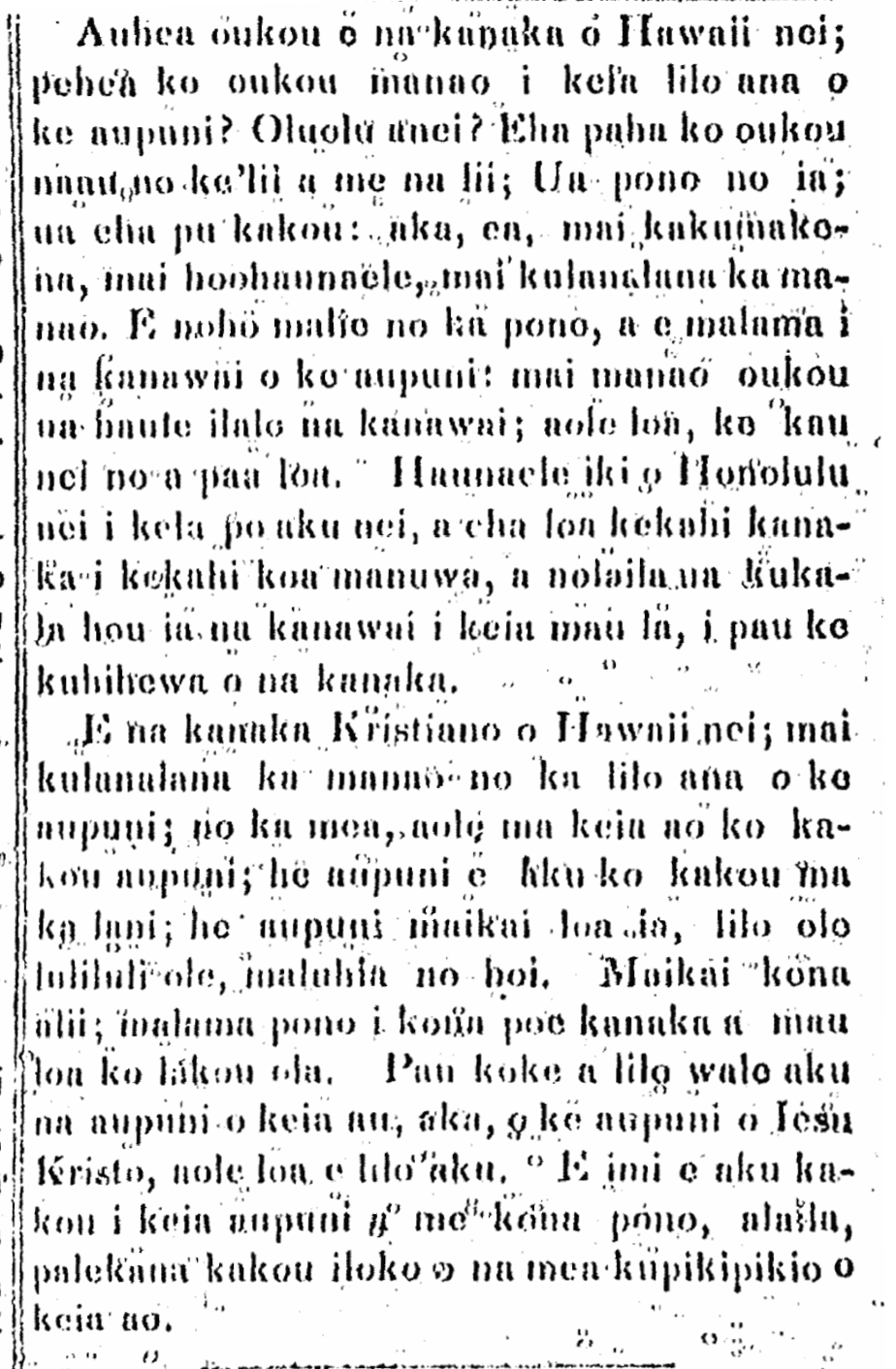
Here me O People of Hawaii nei; what do you all think of this cession of the kingdom? Is it fine? Your heart probably aches for the king and all the alii; That is how it should be; we are all hurting; however, do not grieve, do not revolt, do not let your resolve waver. We must remain calm and abide by the laws; don’t think that the laws have fallen, not at all, they are still totally in effect. There was a small disturbance in Honolulu the other night, and some men severely injured some of the sailors from the warship, and therefore the laws are being announced once again these days, so that the confusion of the people will end.

O Christian people of Hawaii nei, do not feel uncertain over the cession of the nation; our kingdom does not lie in this world, we have a different kingdom in the heavens; it is a great kingdom which is permanent, and unshakeable, and peaceful. Its king is good; he watches over his people, and they live forever. The nations of this world end quickly and are gone forever, but the kingdom of Jesus Christ will never end. Let us search after this kingdom and its righteousness, and we will be saved from the turbulence of this world.

[This editorial is probably by Richard Armstrong (Limaikaika), missionary and editor of Ka Nonanona.]

(Nonanona, 3/7/1843, p. 100)

Auhea oukou e na kanaka o Hawaii nei...

Ka Nonanona, Buke 2, Pepa 20, Aoao 100. Maraki 7, 1843.

La Hoihoi Ea, 1912.

DAY NOT TO BE FORGOTTEN BY TRUE HAWAIIANS.

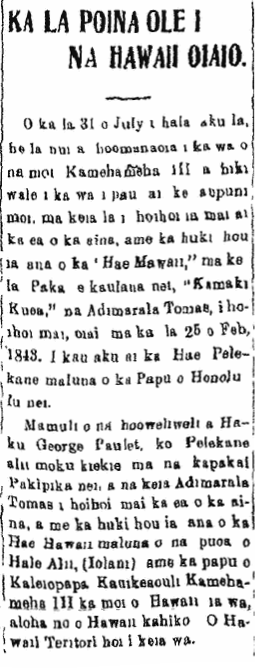
The past 31st of July was a great day celebrated in days of the monarchs, from Kamehameha III all the way until the end of the monarchy; on this day sovereignty was restored and the Hawaiian Flag was raised at that famous park, “Thomas Square,” by Admiral Thomas [Adimarala Tomas], who did the restoration, being that on the 25th of February, 1843, the British Flag was raised over the Fort of Honolulu.

As a result of the threats by Lord George Paulet; Britain’s high officer on the Pacific Ocean, it was Admiral Thomas who restored the sovereignty of the land, and re-raised the Hawaiian Flag on the flag staffs at the Palace (Iolani) and the fort of Kaleiopapa Kauikeaouli Kamehameha III, the king of Hawaii at the time; Aloha to Hawaii of old, which is the Territory of Hawaii now.

(Kuokoa Home Rula, 8/1/1912, p. 1)

KA LA POINA OLE I NA HAWAII OIAIO.

Kuokoa Home Rula, Buke X, Helu 31, Aoao 1. Augate 1, 1912.

It is best to be truthful and just admit when you are wrong before you dig yourself into a bigger hole. 1912.

LOSE YOUR HEAD, DIE; LOSE YOUR FEET, LIVE.

The statements placed above are from a couple of men in the olden days of Hawaii nei, and this is the story:

There were two men, and one day, the two of them climbed up the mountain to cut house thatching [aho hale] which was a regular thing in those days of ours. They cut thatch until evening, and their work for the day was over, and they went to somewhere suitable and started a fire to warm themselves and prepared their meal for that night, and after they were done eating, they were about to sleep.  One of them lay down with his head to the fire and his feet away, while the other slept with his feet toward the fire and his head away; and when the one who had his feet toward the fire noticed his friend with his head toward the fire, he spoke the words placed above, saying:

E, what say you my friend, LOSE YOUR HEAD, DIE; LOSE YOUR FEET, LIVE, so why don’t you move your head away from the fire and move your feet close to it; and when the one whose head was close to the fire heard this, he replied:

LOSE YOUR FEET, DIE, for if you lose your feet to the fire, then where are your feet to go back home with to see the faces of your wife and children; therefore, because of the different choices made by the two men, they stuck to their decisions and both fell asleep; in the middle of the night, the first man smelled the smell of burning hair, and thus being startled, he saw his friend whose head was on fire; at this, he got up and made ready to head back to the home of their families and as the first man neared their houses, he turned back and saw his companion running behind him with his head on fire, the first man knew that this was a spook [uhane lapu] and not a live person, and as this first one entered the house the spook passed by the house, going around with his head still on fire; the first man told their story from beginning to end, while telling those in his household that his friend died because of his stubbornness, for he warned him to move his head away from the fire and yet he did not listen [much less heed]. So pigheaded.

This story is perhaps similar to people of these times; they stick their heads [hou poo] into stubborn ideas that are caused by false pride [uilani kuhihewa] and the results of this mistaken pride is what we have seen above.

(Hoku o Hawaii, 7/25/1912, p. 3)

PAU POO MAKE, PAU WAWAE OLA

Ka Hoku o Hawaii, Buke 7, Helu 8, Aoao 3. Iulai 25, 1912.

How much do we know about how it was back then… 1909.

THE WORLD IS STILL IN THE DARK ABOUT HAWAII.

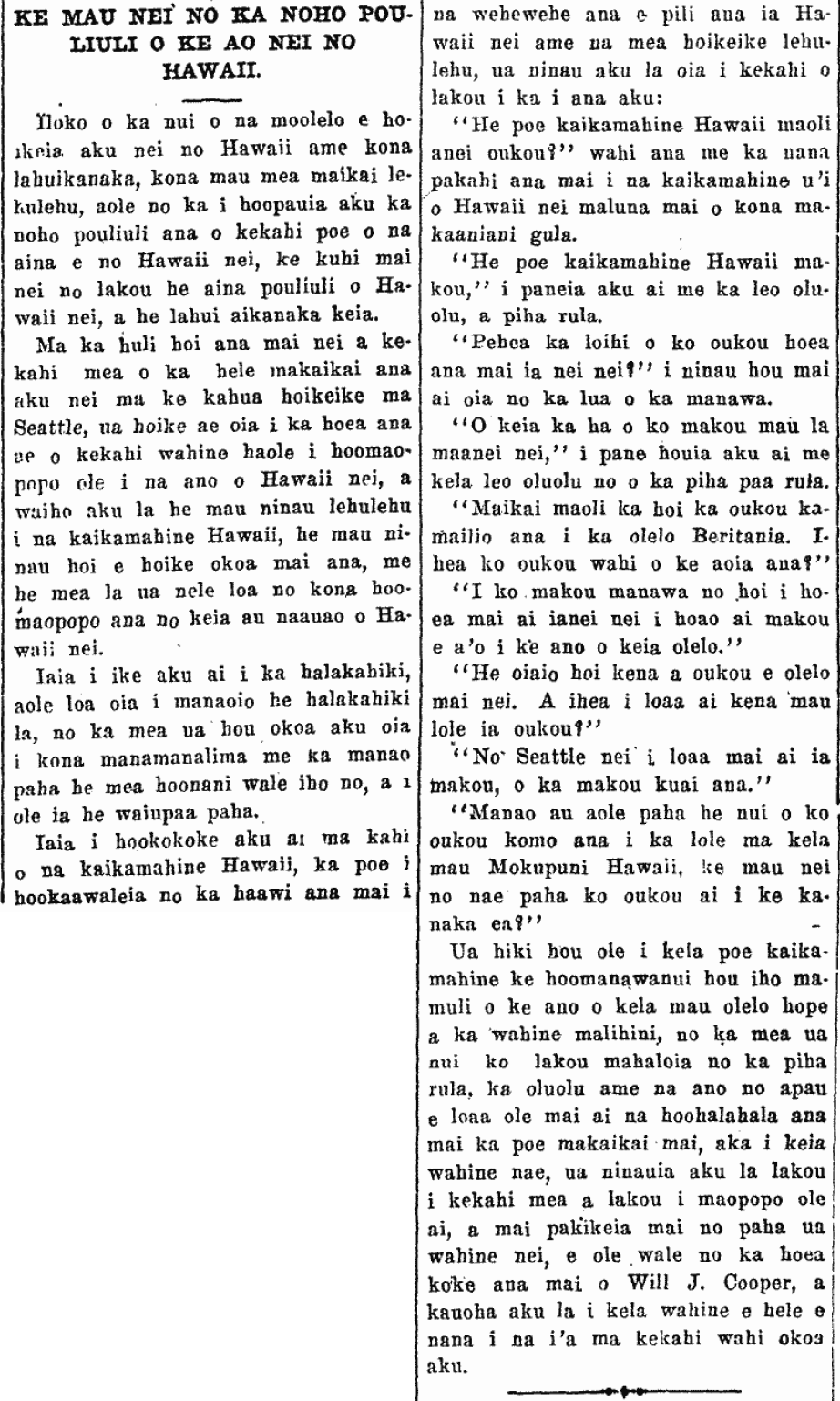
Although there has been so many stories heard talking about Hawaii and its people and its many wonderful things, in no way has the ignorance of some people in foreign lands about Hawaii been cleared; they assume Hawaii is an uneducated land and that we are cannibals.

On the return of someone who went to visit the fair in Seattle [Alaska-Yukon-Pacific Exposition], he spoke about the arrival of a haole woman who didn’t know about the conditions of Hawaii; and she put before the Hawaiian girls a great number of questions—questions which made it plain that she had no clue about this era of education here in Hawaii.

When she saw a pineapple, she didn’t believe that it was real, because she poked at it with her finger, perhaps thinking that it was just some decoration, or perhaps butter [butter sculpture seems to have been popular at the time].

When she approached the area where the Hawaiian girls were stationed to talk about Hawaii nei as well as to give various performances, she asked one of them:

“Are you all real Hawaiian girls?” she asked while peering at each one of the beautiful Hawaiian girls over her gold-rimmed glasses.

“We are all Hawaiian girls,” she was answered kindly and very politely.

“How long has it been since your arrival here?” She asked next.

“This is our fourth day here,” she was answered again, with a pleasant voice and decorum.

“Your English is quite good. Where did you all learn it?”

“Upon our arrival here, we tried learning this language.”

“Is that so. And where did you all get your clothes?”

“We got it here in Seattle; we purchased it.”

“I thought that maybe you all don’t much wear clothes in the Hawaiian Islands; but you all still are cannibals, right?”

These girls could not endure this any longer after those last words of that malihini woman; they were very well appreciated for their etiquette, pleasantness, and their entire conduct which would receive no criticism from the visitors; however, with this woman, they were asked questions that they could not fathom, and that woman perhaps was close to being railed at were it not for the arrival of Will J. Cooper who advised the woman to go and look at the fish located in a different area.

(Kuokoa, 8/27/1909, p. 6)

KE MAU NEI NO KA NOHO POULIULI O KE AO NO HAWAII.

Ka Nupepa Kuokoa, Buke XLVI, Helu 35, AoAo 6. Augate 27, 1909.