More on the taxing of leprosy patients, 1876.

The Leprosy Patients are Taxed.

O Lahui Hawaii; Aloha oe:—

That is the title put up by Siloama (no such person), an ignorant one from Kawaapae [“the beached canoe”], a speaking companion and lover of Waawaa [Stupid] folks, that was released in Helu 50 of the “Kuokoa” of the 11th of December, page 4, of 1875. It is for the readership to see this incompetence. In the title is that the leprosy patients are being taxed. And in the second paragraph, line 1½, he states, “taxing of the animals, all but the body of man.” Look at what James said. “A double minded man is unstable in all his ways.” James 1:8.

Then it goes on to say: “it has almost been 10 years that these people have been living as prisoners in the penitentiary of the law, and this is the first time we’ve been taxed.” Here is what Jesus had to say to the laborers, “Is it not lawful for me to do what I will with mine own? Is thine eye evil, because I am good?” Matthew 20:15.

And further.—”This is astonishing that those dead to the Law are being taxed.” This is not right; it is the truth; all of the animals of the patients are being taxed, and that is the true intent of the Law.

And this too.—And even the tiniest of rights that we have are being taken away.” [The following two lines of this paragraph is not legible because of what appears to be a fold in the paper.] Yours,

LIHAU ANUENUE

Kalawao, Molokai, Dek. 28, 1875.

[This is a response to the article in the previous post.

The newspapers need to be reshot one page at a time, so that folds like these can be undone, and every possible word can be read as was intended. I am sure i am not the only one interested in what the last couple of lines said about their rights being taken away…]

(Lahui Hawaii, 1/13/1876, p. 1)

Ua Auhauia na mai Lepera.

Ka Lahui Hawaii, Buke II, Helu 3, Aoao 1. Ianuari 13, 1876.
On taxation and leprosy patients, 1875.

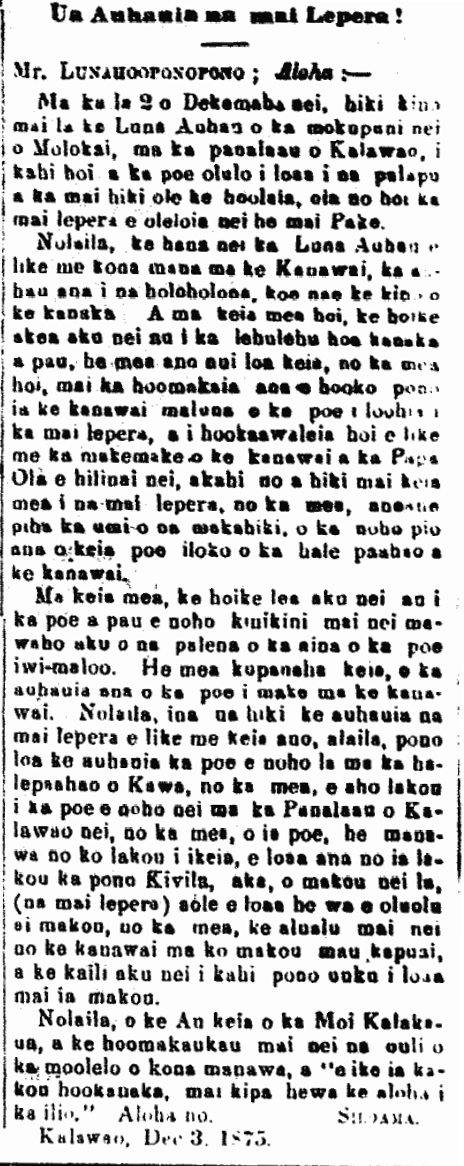
The Leprosy Patients are Taxed!

Mr. Editor; Aloha:—

On the 2nd of this December, the Tax Assessor [Luna Auhau] of this island of Molokai came in person to the colony of Kalawao, the place of the castaways who are afflicted with wounds of an incurable sickness, that being leprosy [mai lepera], which is called he Chinese sickness [mai Pake].

Therefore, the Tax Assessor is acting as per his power under the Law; the taxing of animals, all except the body of man. And as such, I am announcing before all of our fellow people, that this is a major thing, because from the beginning of the enforcement of this law upon people afflicted with leprosy and who are set apart as based on the intent of the edict of the Board of Health; this is the first time this sort of thing has come before the patience, as it has almost been ten years that these people have been living as prisoners in the penitentiary of the law.

Through this, I am announcing clearly to all the people living all over outside of the boundaries of the land of the skeletons. This is astonishing that those dead to the law are being taxed. So if leprosy patients are taxable in this way, then those imprisoned in Kawa [the government prison] should be taxed, for they are better off than those living here in the Colony of Kalawao; those people, there is a given time when they will once again receive their Civil rights, but we here (the leprosy patience), we will not have a time when we are relieved, because the law follows after our steps, and takes from us even the tiniest of rights that we have.

This is the Era of King Kalakaua, and the character of the history of his reign is being prepared; so “Recognize your fellow man, and don’t waste your aloha on dogs.” Aloha no. SILOAMA.¹

Kalawao, Dec. 3, 1875

¹Siloama is probably a pen name; it is the Protestant church in Kalawao.

(Kuokoa, 12/11/1875, p. 4)

Ua Auhauia na mai Lepera!

Ka Nupepa Kuokoa, Buke XIV, Helu 50, Aoao 4. Dekemaba 11, 1875.

Royal Order of Kamehameha: the early days, 1903.

The Secret Society of the True Natives.

On the 11th of this month, on the day of Ka Na’i Aupuni [Kamehameha Day], a number of native youths established a secret society called “Kamehameha Order”. There are many respected Hawaiians who joined this association, and Prince Kalanianaole is the head of this group.

It is stated that this association will be spread across this Archipelago, and native Hawaiians will be allowed to join, should they be fitting.

One of their major functions will be trying to search out and to care for things from times of old, and the designating of the storied places [wahi pana] all over these islands.

Currently, there is a Historical Society [Ahahui Moolelo o ke Au Kahiko]¹, and they have a lot, but the oiwi Hawaii themselves must do something so that the famed ones of times past will live on, and also to foster things that will let the name of Hawaii live on in perpetuity.

¹The roster of active members of the Hawaiian Historical Society of 1903 read:

“Ables, L. C.; Achi, W. C.; Alexander, S. T.; Alexander, W. D.; Allen, S. C.; Allen, W. F.; Baldwin, H. P.; Banning, B. R.; Beckwith, Rev. E. G.; Beckwith, Miss Martha; Bertram, Bro. G.; Bishop, Rev. S. E.; Bolte, C.; Bowen, W. A.; Boyd, J. H.; Brown, Cecil; Brown, C. A.; Bryan, Wm. A.; Carter, A. W.; Carter, G. R.; Carter, Mrs. H. A. P.; Carter, J. O.; Cartwright, Bruce; Castle, G. P.; Castle, J. B.; Castle, W. R.; Catton, R.; Cooke, A. F.; Cooke, C. M.; Cooke, Jos. P.; Cunha, E. S.; Damon, F. W.; Damon, S. M.; Day, Dr. F. R.; Dayton, D.; Desha, G. L.; Dickey, C. H.; Dickey, L. A.; Dillingham, B. F.; *Dimond, W. W.; Dole, E. P.; Dole, Hon. S. B.; Dowsett, J. M.; Emerson, J. S.; Emerson, Mrs. J. S.; Emerson, Dr. N. B.; Emerson, Rev. O. P.; Emmeluth, J.; Fisher, J. H.; Frear, Hon. W. F.; Giffard, W. M.; Goodale, W. W.; Graham, W. M.; Haalelea, Mrs. A. A.; Hackfeld, J. F.; Hall, W. W.; Hartwell, A. S.; Hatch, F. M.; Henriques, E.; Herrick, C. F.; Hobron, T. W.; Ho Fon; Humphreys, A. S.; Hustace, C.; Irwin, W. G.; Jones, P. C.; Judd, Albert F.; Lewers, Robert; Logan, D.; Lowrey, F. J.; Lucas, George; Lyle, James; Lyons, C. J.; Mclanahan, E. B.; McGonagle, Chas.; McIntyre, H. E.; Mackintosh, Rev. A.; Magoon, J. A.; May, Thos.; Mott-Smith, E. A.; Nakuina, M. K.; Nolte, H. J.; Parke, W. C.; Peacock, W. C.; Pearson, Arthur W.; Pond, Percy M.; Potter, Geo. C.; Rhodes, C. L.; Robinson, M. P.; Rodgers, Dr. C. T.; *Ropert, Rev. F. G., Bishop of Panopolis; Rowell, W. E.; Schaefer, F. A.; Schmidt, H. W.; Searle, J. C.; Sedgwick, T. F.; Smith, G. W.; Smith, Henry; Smith, Walter G.; Smith, W. O.; Stokes, John; Swanzy, F. M.; Timmons, L. D.; Towse, Ed.; Thrum, T. G.; Thurston, L. A.; von Holt, H.; Walker, T. R.; Wall, W. E.; Waterhouse, H.; Weaver, P. L.; Westervelt, Rev. W. D.; Whiting, W. A.; Whitney, Dr. J. M.; Wichman, H. F.; Wilcox, A. S.; Wilcox, C.; Wilcox, G. N.; Williams, H. H.; Wilson, W. F.; Wodehouse, E. H.; Wood, Dr. C. B.; Wood, Edgar; Wundenberg, F.
*Deceased.

(Kuokoa, 6/26/1903, p. 1)

Ka Hui Malu o na Oiwi Ponoi.

Ka Nupepa Kuokoa, Buke XLI, Helu 26, Aoao 1. Iune 26, 1903.

Workings of the Provisional Government, 1893.

INDEPENDENCE DAY OF THE PORTUGUESE.

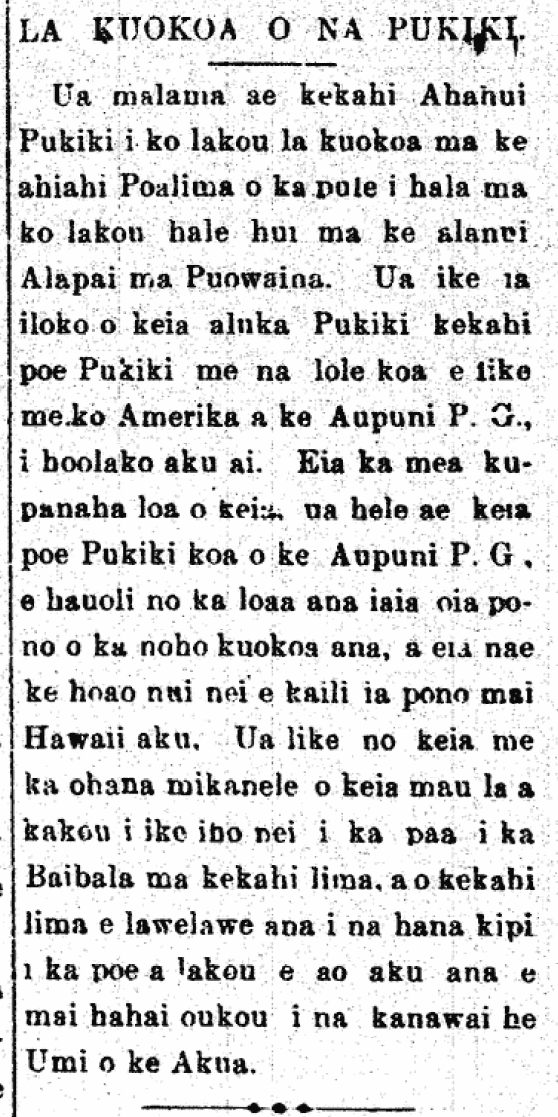
An Association of the Portuguese honored their independence day on the evening of Friday last week, in their club house on the streets of Alapai and Punchbowl [Puowaina]. Amongst this group of Portuguese were seen some with soldier uniforms like that of the Americans that were supplied by the P. G. This is the astonishing thing about this: these Portuguese soldiers of the Government of the P. G. went to celebrate their independence, and yet they are insistently trying to wrench that right from Hawaii. This is like the missionary family of these days who we’ve seen holding the Bible in one hand while with the other hand, carrying out treachery to the people to whom they taught not to break the Ten laws of God.

(Leo o ka Lahui, 12/4/1893, p. 2)

LA KUOKOA O NA PUKIKI.

Ka Leo o ka Lahui, Buke II, Helu 826, Aoao 2. Dekemaba 4, 1893.

And more on the Maori, 1920.

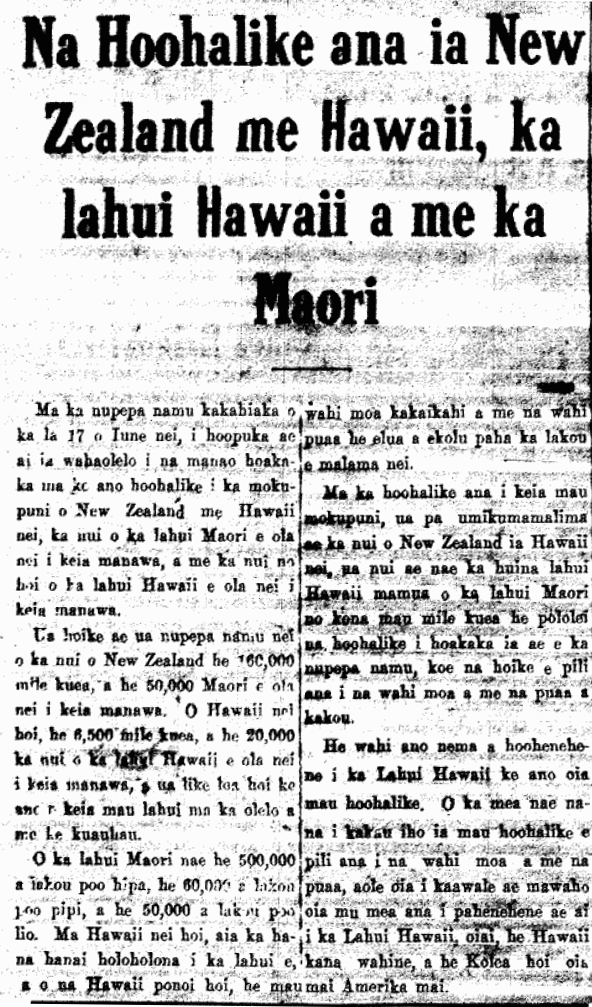
Comparison of New Zealand and Hawaii, the Hawaiian People and the Maori.

In the English morning newspaper [Pacific Commercial Advertiser] of the 17th of June, that mouthpiece published a clarification between the island of New Zealand and Hawaii, the population of the Maori lahui living today and that of the Hawaiian lahui.

That English paper said the area of New Zealand is 160,000 square miles, and that there are 50,00 Maori living today. As for Hawaii, it is 6,500 square miles, and there are 20,000 of its lahui living currently; and these two people are very much alike in language and genealogy.

However, the Maori have 500,000 heads of sheep, 60,000 heads of cattle, and 50,000 heads of horses. In Hawaii nei, the job of raising livestock is left to the other ethnicities, and the Hawaiians themselves, they raise a few chickens and a couple or three pigs.

In comparing these islands, New Zealand is fifteen times as big as Hawaii nei, but the total Hawaiians are more than the Maori per square miles; the comparisons put forth by the English paper are correct, all but what was said about our few chickens and pigs.

That comparison criticizes  and ridicules the Hawaiian people. But the one who wrote these comparisons pertaining to the chickens and pigs is not far from these things of which he mocks the Hawaiian people about, for his wife is a Hawaiian, and he is a Kolea bird¹ from America.

¹The kolea is the migrating plover, that is used to symbolize people who come to Hawaii, and like these birds, feed off of the riches only to leave after getting fat.

[I will have to check on who the writer was. Too bad the Advertiser is not online!]

(Aloha Aina, 7/4/1920, p. 4)

Na Hoohalike ana ia New Zealand me Hawaii, ka lahui Hawaii a me ka Maori

Ke Aloha Aina, Buke XXXX, Helu 43, Aoao 4. July 3, 1920.

Independence Day, 1867.

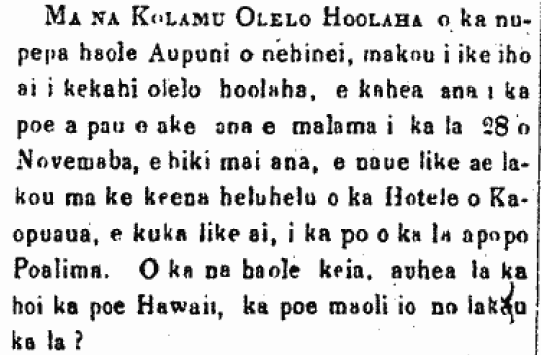
In the Announcements Column of the Government’s English newspaper [Hawaiian Gazette] of yesterday, we saw an announcement calling all those who want to celebrate the coming 28th of November, to all come down to the reading room of the Hotel of Kaopuaua to discuss it tomorrow night, Friday. This is what the haole are doing; where are the Hawaiians for whom this day is truly for?

(Au Okoa, 9/26/1867, p. 2)

Ma na Kolamu Olelo Hoolaha...

Ke Au Okoa, Buke III, Helu 23, Aoao 2. Sepatemaba 26, 1867.

The “Chinese Disease,” 1865.

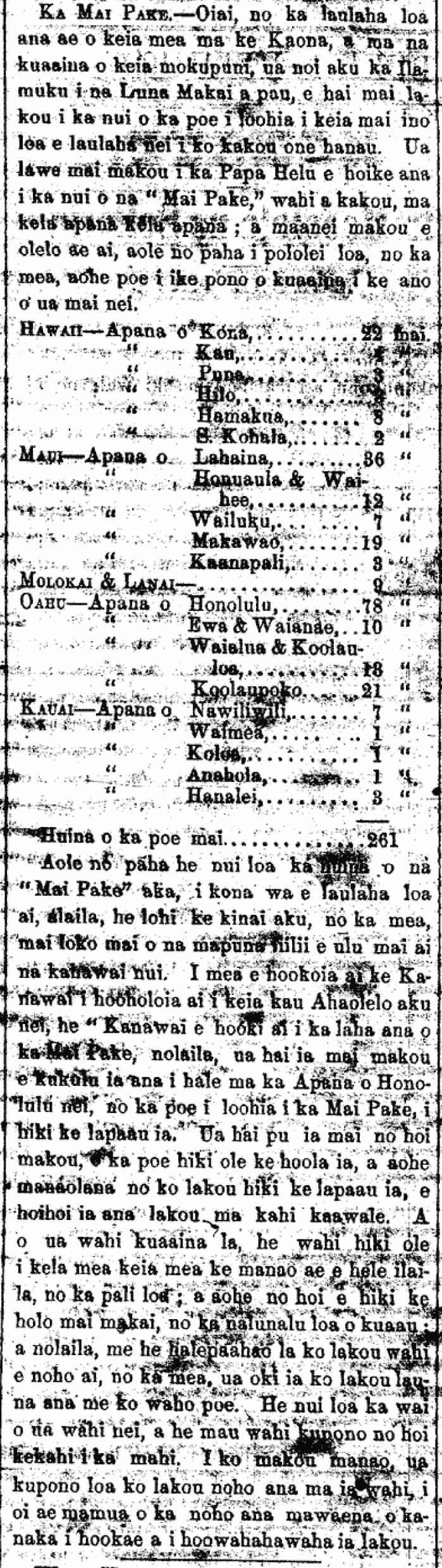
Leprosy [Mai Pake]—As this is greatly spreading about Town and in the country of this island, the Sheriff [Ilamuku ?] has requested that all of the District Sheriffs [Luna Makai ?] to report the number of people inflicted with this horrible sickness that is spreading in our homeland. We have taken the List showing the number of “Chinese Disease,” as we call it, in each district; and we say here that this is probably not accurate, because there is no one in the country who knows for certain what the symptoms are.

Hawaii—District of Kona, . . . 22 sick.
” of Kau, . . . 4 ”
” of Puna, . . . 3 ”
” of Hilo, . . . 3 ”
” of Hamakua, . . . 8 ”
” of S. Kohala, . . . 2 ”
Maui—District of Lahaina, . . . 36 ”
” of Honuaula & Waihee, . . . 12 ”
” of Wailuku, . . . 7 ”
” of Makawao, . . . 19 ”
” of Kaanapali, . . . 3 ”
Molokai & Lanai— . . . 9 ”
Oahu—District of Honolulu, . . . 78 ”
” of Ewa & Waianae, . . . 10 ”
” of Waialua & Koolauloa, . . . 18 ”
” of Koolaupoko, . . . 21 ”
Kauai—District of Nawiliwili, . . . 7 ”
” of Waimea, . . . 1 ”
” of Koloa, . . . 1 ”
” of Anahola, . . . 1 ”
” of Hanalei, . . . 3 ”
Total of sick . . . 261
Maybe the total of the number of “Mai Pake” is not so great, but when it truly spreads, then it will be too late to extinguish, for it is from tiny springs which great rivers grow forth. In order to comply with the law which was passed this last session of the legislature, “An Act to Prevent the Spread of Leprosy,” we are told that structures will be built here in Honolulu for those inflicted with leprosy so that they may be treated. We are also told that for those who are incurable, and for those for whom there is no hope in treating, they will be sent to a place set apart. And that country side will be a place that no one will think about going to, because of great cliffs; and it cannot be accessed by sea because of the rough conditions of the lagoon. So where they live will be like a prison, for their association with those on the outside will be cut off. There is much water there, and it is also a place suitable for farming. In our opinion, it is better for them to live there than for them to live amongst people who hate and scorn them.
(Au Okoa, 6/26/1865, p. 2)
Ka Mai Pake

Ke Au Okoa, Buke I, helu 10, Aoao 2. Iune 26, 1865.

Interpretation of an interesting song from across the shore, 1901.

COMPOSED FOR THE USURPERS OF LAND.

The poem below is taken by us from the newspaper, “Commoner,” of William J. Bryan, the Presidential candidate of the Democrats who lost in the last Presidential race of the United States.

Ina oe e ike ana he kapakai nani
I kaili lima nui ole ia mamua,
E waiho ana ma ke alahele o na hana kalepa
Me na kanaka e noho hemahema ana
I makaukau ole no ka hakaka
O, e komo aku oe a lawe ae no kona nani
O, e oluolu oe e ku iho a lawe ae no kona nani
E hoomaopopo ia aole no ke aloha i ke dala
E hoe aku oe ia oe iho no uka o ka aina
Me ka Baibala iloko o kou lima
E pule aku oe me ka powa pu aku iaia no kona nani
Ina oia e uwa mai, e kipu aku iaia no kona nani,
Ae, he oi loa aku ma kela wahi mamao
E olelo ae hoi kakou, ilalo o Kina
Kahi a na Karistiano e pakaha la i no poe pekana no kona nani
E puhi ahi aku oe, a e kipu aku no hoi
E hoopiha i kau eke me ka waiwai pakaha
Aka, e hoomaopopo iho oe e hana wale ana no oe no kona nani
I kou wa e pakaha ai i na Pake Buda no ko lakou mau waiwai
E lawe ana i na pohaku makamae mai ko lakou mau onohi maka laau
A i kou wa e hoonohonoho ai i na kumukuai
E haawi ae i wahi leo pule
No kou hoike ana aku e hana ana oe no ko lakou pono
A e hoomoakaka aku i ke ano o kou hahao ana iloko o kou pakeke.

[Mahalo to Chronicling America for putting up the original to this mele. See it here: “For His Good” in The Commoner, 3/1/1901, p. 8.]

(Aloha Aina, 4/27/1901, p. 2)

HAKUIA NO NA POE PAKAHA AINA.

Ke Aloha Aina, Buke VII, Helu 17, Aoao 2. Aperila 27, 1901.

One year since the Republic transferred power to the United States, 1899.

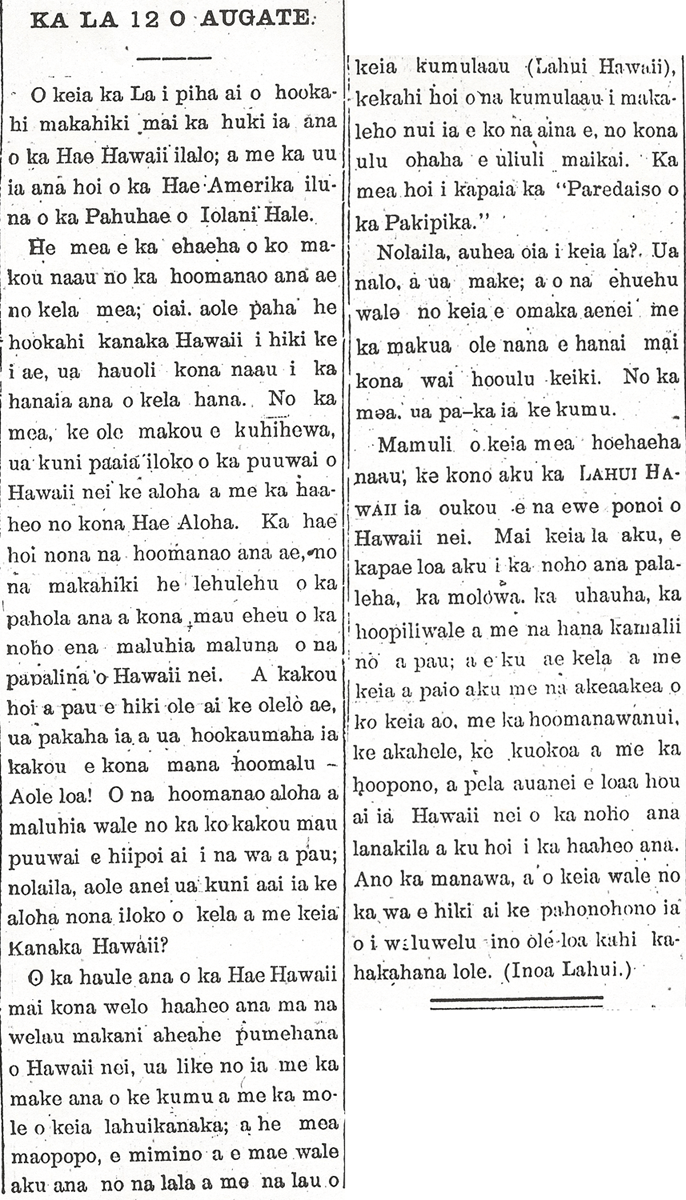
THE 12th OF AUGUST.

This is the Day that made a year since the day that the Hawaiian Flag was taken down and the American Flag was raised on the flag pole of Iolani Palace.

The hurt down in our guts [naau] is unimaginable when remembering this; for there is no Hawaiian that can say that his naau is happy with what was done. Because if we are not mistaken, branded withing the hearts of Hawaiians is the love and pride for his Beloved Flag. The flag which holds memories of many years spreading its wings in peace over the cheeks of Hawaii nei. And for which none of us can say that we were robbed and saddened under its protection. Not at all! Our hearts will only cherish for all times, the loving memories and peace; and as such, are not each and every Kanaka Hawaii burning with aloha for it?

The falling of the Hawaiian Flag from where it proudly fluttered on the tips of the warm breezes of Hawaii nei, is like the death of origin and foundation of this people [lahuikanaka]; and it is clear that the branches and leaves of this tree (The Hawaiian Nation) will wither and fade, a tree that was greatly admired by other nations for its lush and verdant growth. What was called the “Paradise of the Pacific [Paredaiso o ka Pakipika].”

Therefore, where is it today? It has gone, and died; and it is but the wisps that are budding, without a parent to feed its nourishing waters. For the trunk has been chopped.

Because of this heart-wrenching thing, the Lahui Hawaii invites all of you, native Hawaiians. From this day forward, to discard your living indifferently, lazily, wastefully, off others, and all of your childish ways; and for each and everyone of you to stand and fight against the obstructions in this world with patience, caution, independence, and righteousness; and it is through this that Hawaii nei will once again regain its success and pride. Now is the time, and it is only now that we can do the mending while this striped cloth has not become too ragged. (Inoa Lahui.)

(Lahui Hawaii, 8/12/1899, p. 4)

KA LA 12 O AUGATE.

Ka Lahui Hawaii, Buke 1, Helu 29, Aoao 4. Augate 12, 1899.

Commentary on the state of leprosy, 1879.

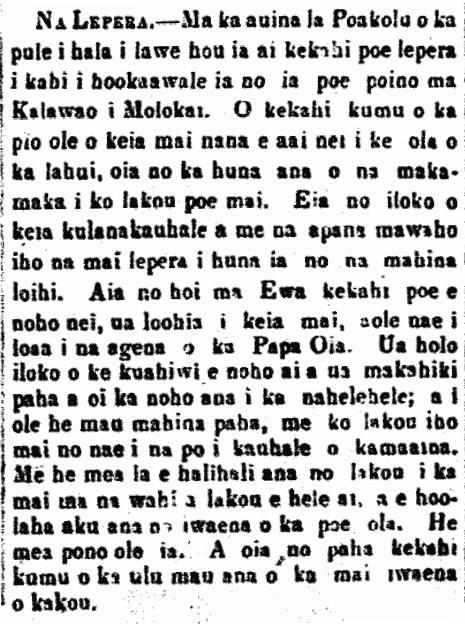
Those with Leprosy.—In the afternoon of this past Wednesday, more leprosy patients were taken to a place set apart for those unfortunate people, at Kalawao, Molokai. One reason for the lack of eradication of this disease eating away at the lives of our people, is that friends hide away their sick. Here in this town and areas right outside are those with leprosy who were hidden for many months. In Ewa there are people living, afflicted with this disease but have not been found by the agent of the Board of Health [Papa Ola]. They went into the mountains to live, and perhaps it has been over a year that they have lived in the forests; or maybe some months, descending to the houses of friends at night. It is as if they are carrying the disease where they go and are spreading it amongst the healthy people. This is not right. And that is perhaps one of the reasons that this disease keeps multiplying between us.

(Kuokoa, 7/19/1879, p. 4)

Na Lepera.

Ka Nupepa Kuokoa, Buke XVIII, Helu 29, Aoao 4. Iulai 19, 1879.