Another “Memoirs of Obookiah” translation, 1867.

Book of the Moolelo of Heneri Opukahaia.

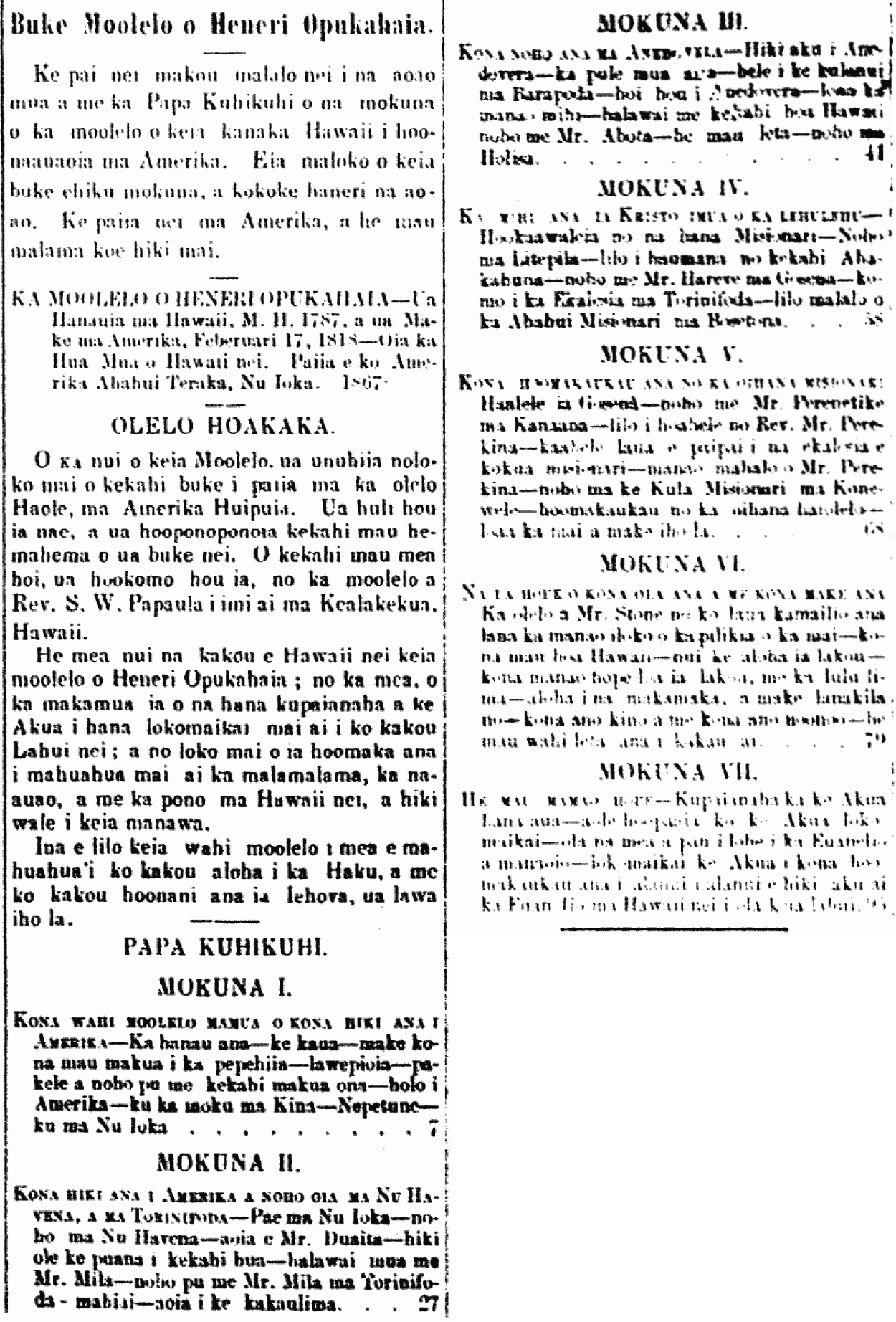
We are printing below the first pages of and the Table of Contents of the Chapters of the story of this Hawaiian that was educated in America. In this book is seven chapters, and it is almost a hundred pages. It is being printed in America and it will be here in a few more months.

THE STORY OF HENERI OPUKAHAIA—Born in Hawaii, A. D. 1787, and Died in America, February 17, 1818—The First Fruit of Hawaii nei. Printed by the American Tract Society [Amerika Ahahui Teraka], New York, 1867.

INTRODUCTION.

The majority of this Moolelo was translated from a book published in English in the United States of America. However, information was researched, and some of the errors of the book was corrected. Some things were added from the moolelo that Rev. S. W. Papalua investigated at Kealakeakua, Hawaii.

This story of Heneri Opukahaia is something important to us Hawaiians; for this is the first of the miracles that God performed benevolently upon our People; and through this start, the enlightenment, the knowledge, and the righteousness of Hawaii has increased until this day.

Should this moolelo become something which increases our love for God and our glorification of Jehovah, that will be enough…

[A couple of years later in 1867, the original translation was appended to and corrected with the information collected by that same S. W. Papaula of Napoopoo, and published in book form under the title: “KA MOOLELO O HENERI OPUKAHAIA, UA HANAUIA MA HAWAII, M. H. 1787, A UA MAKE MA AMERIKA, FEBERUARI 17, 1818. OIA KA HUA MUA O HAWAII NEI.”]

(Kuokoa, 5/18/1867, p. 3)

Buke Moolelo o Heneri Opukahaia.

Ka Nupepa Kuokoa, Buke VI, Helu 20, Aoao 3. Mei 18, 1867.

Translation of “Memoirs of Henry Obookiah: A Native of Owhyhee, and a Member of the Foreign Mission School…” 1865.

Ka Moolelo o Heneri Opukahaia.

HELU 1.
Kona wahi moolelo mamua o kona hiki ana i Amerika.

He kanaka o Heneri Opukahaia no Hawaii ka mokupuni kaulana a laukanaka hoi o ka Pae Aina Hawaii. Ua hanau ia i ka makahiki 1792. He mau makaainana kona mau makua; aka ua pili nae kona makuahine i ka ohana o na’lii. O kona inoa o Kumuola; a o ka inoa o kona makuakane aole i maopopo. I ka wa i hiki aku ai o ko Opukahaia mau makahiki i ka umi a umikumamalua paha, pepehiia kona mau makua mamua pono o kona mau maka. Elua wale no laua o kona ohana i ola, oia a me kona wahi muli loa nona na malama ekolu. Ua manao lana ia e hoola i kona wahi pokii mai ka popilikia mai i ili iho ai maluna o kona mau makua, nolaila, ua hopu akuu ia i kona wahi pokii a kau ae la ma kona kua, a holo aku la mai ka enemi aku; aka, ua loaa aku no ia i ka poe i alualu aku, a pepehi mainoino ia ua wahi pokii la ona. O ka moolelo o ia wahi ua kakau ia ma kekahi buke e aku mamuli o ka mea i hai waha ia aku e Opukahaia…

[This translation of Edwin Welles Dwight’s “Memoirs of Henry Obookiah, a Native of Owhyhee, and a Member of the Foreign Mission School; Who Died at Cornwall, Conn. Feb. 17, 1818, Aged 26 Years.” begins on 9/9/1865 and is completed on 3/24/1866.]

(Nupepa Kuokoa, 9/9/1865, p. 2)

Ka Moolelo o Heneri Opukahaia.

Ka Nupepa Kuokoa, Buke IV, Helu 36, Aoao 2. Sepatemaba 9, 1865.

Daniel Defoe’s “Life and Adventures of Robinson Crusoe” in Hawaiian, 1860.

STORY OF ROBINSON CRUSOE,

A Castaway Who Lived Twenty-Eight Years On a Deserted Island, and His Rescue.

MOKUNA I.

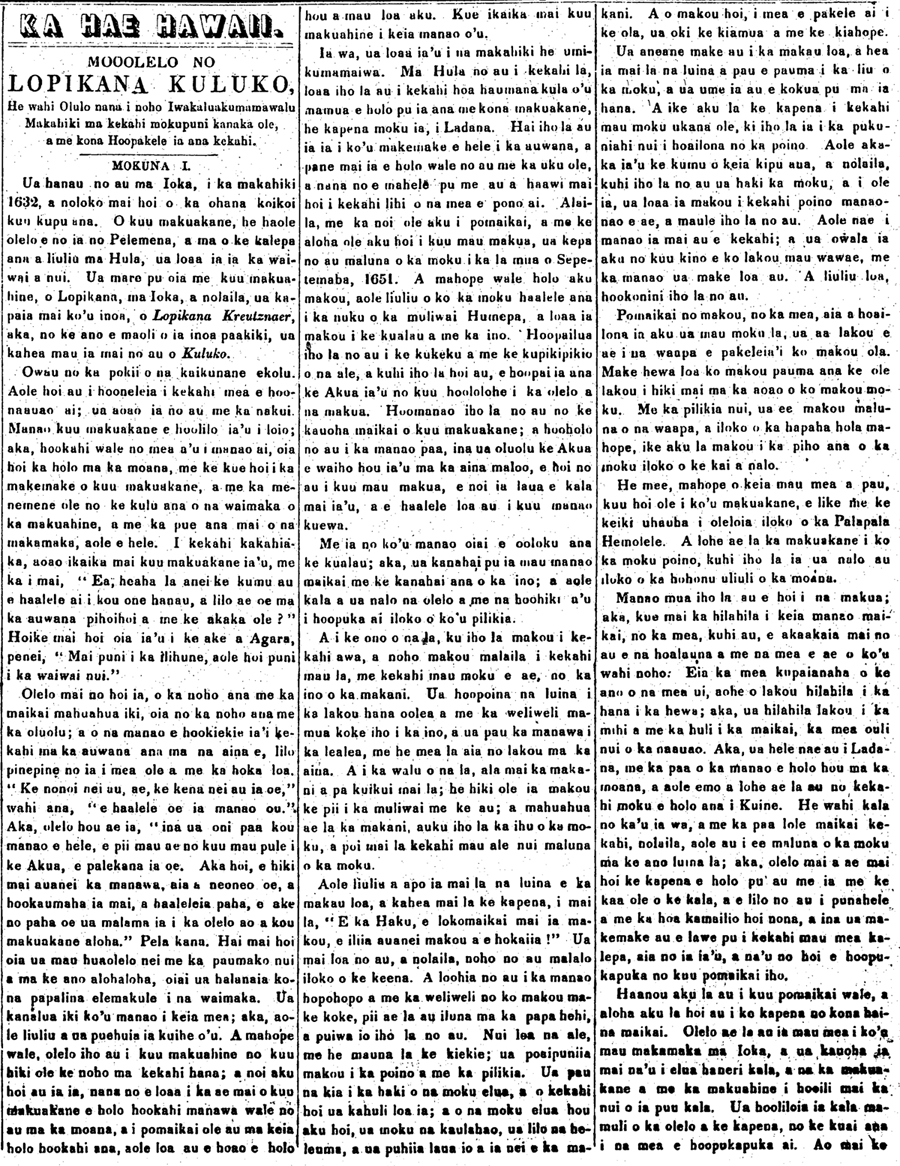
Ua hanau no au ma Ioka, i ka makahiki 1632, a noloko mai hoi o ka ohana koikoi kuu kupu ana. O kuu makuakane, he haole olelo e no ia no Pelemana, a ma o ke kalepa i ana a liuliu ma Hula, ua loaa ia ia ka waiwai a nui. Ua mare pu oia me kau makuahine, o Lopikana, ma Ioka, a nolaila, ua kapaia mai ko’u inoa, o Lopikana Kreutznaer, aka, no ke ano e maoli o ia inoa paakiki, ua kahea mau ia mai no au o Kuluko…

[This is one of the earlier foreign stories that was translated in the Hawaiian-Language Newspapers. “Mooolelo no Lopikana Kuluko” appeared in Hae Hawaii from 11/21/1860 and concluded on 5/8/1861. The translator is given at the conclusion as L. K.]

(Hae Hawaii, 11/21/1860, p. 139–140.)

MOOOLELO NO LOPIKANA KULUKO,...

Ka Hae Hawaii, Buke 5, Ano Hou.—Helu 34, Aoao 139. Novemaba 21, 1860.

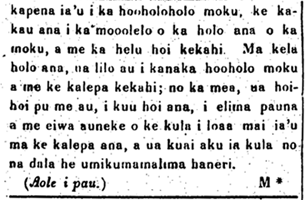
...kapena ia'u i ka hooholoholo moku...

Ka Hae Hawaii, Buke 5, Ano Hou.—Helu 34, Aoao 140. Novemaba 21, 1860.

More from Dumas: “Three Musketeers,” 1878.

HE MOOLELO
—NO NA—

KIAI EKOLU.

—A ME KE—
Koa Opio Wiwo Ole!
ATAGANANA.

{Translated by a generous pen for the Pride of the Hawaiian Nation.}

CHAPTER 1
NUMBER 1.

To the Newspaper “Ko Hawaii Pae Aina:” My pen is a stranger to your straight borders and your wide columns of news: and at the request of your captain that I write a moolelo or kaao for our Pride, therefore, I have taken my pen nib to translate the story of the “Three Musketeers,” a moolelo that I used to read all the time in days gone by, and a moolelo that I believe will mesmerize those who love kaao, and they will read it over and over so that they can memorize it and tell it by heart. One of my schoolmates.

{O Readers, do be so kind as to forgive me for the names of the people in this moolelo; they are similar with the kaao of The Count of Monte Cristo.}

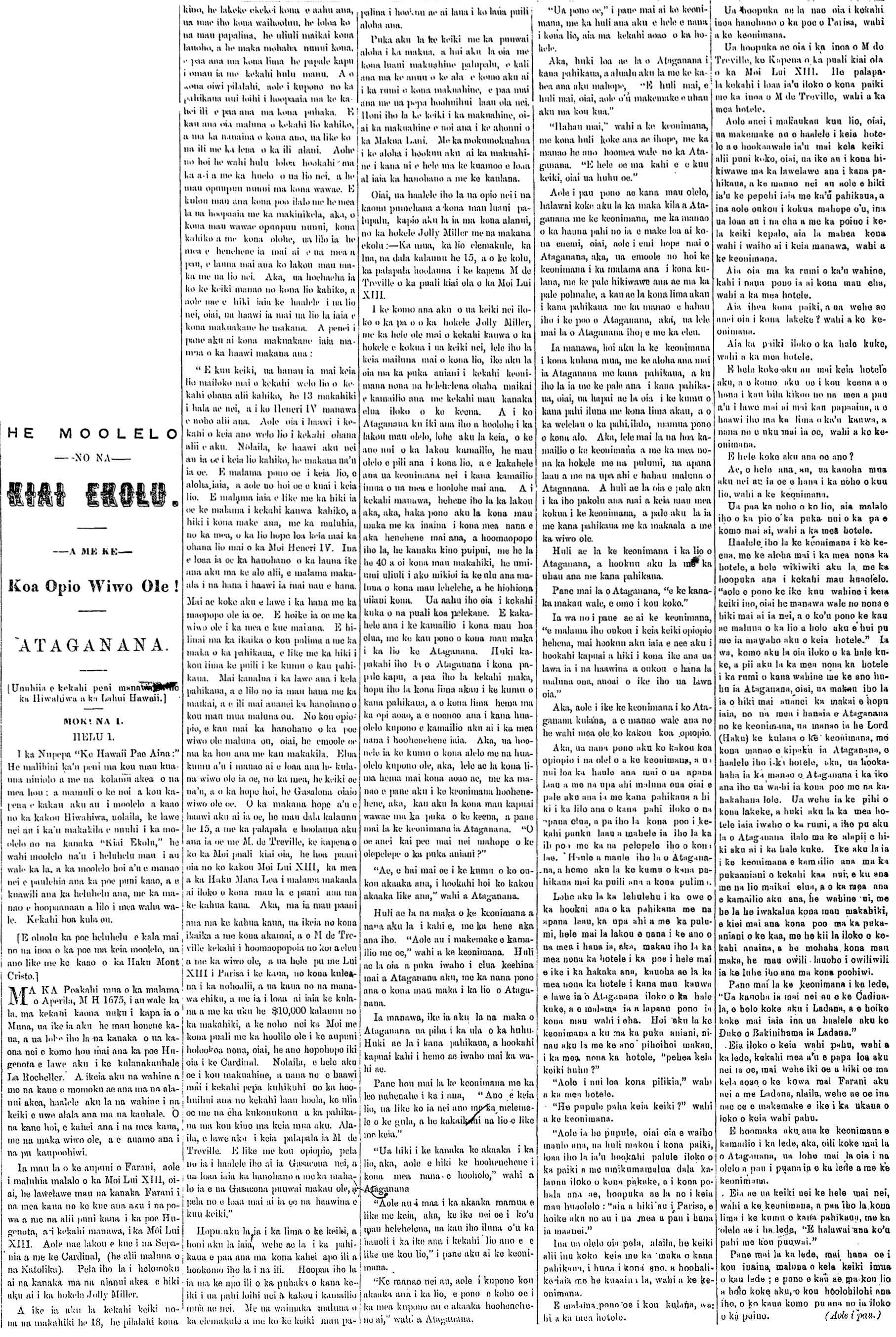
MA KA Poakahi mua o ka malama o Aperila, M. H. 1675, i au wale ka la, ma kekahi kaona nuku i kapa ia o Muna, ua ike ia aku he mau honene kaua, a ua lohe iho la na kanaka o ua kaona nei e komo hou mai ana ka poe Hugenota e lawe aku i ke kulanakauhale La Rocheller. A ikeia aku na wahine a me na kane e momoku ae ana ma na alanui akea, haalele aku la na wahine i na keiki e uwe alala ana ma na kauhale. O na kane hoi, e kahei ana i na mea kaua, me na maka wiwo ole, a e auamo ana i na pu kaupoohiwi…

[The translation of Alexander Dumas’ “The Three Musketeers” began on 3/2/1878, and the last segment found is on 12/7/1878 (mid-Chapter XVI). I could find no explanation for there only being a quarter of the entire work.]

(Ko Hawaii Pae Aina, 3/2/1878, p. 1)

HE MOOLELO NO NA KIAI EKOLU.

Ko Hawaii Pae Aina, Buke I, Helu 9, Aoao 1. Mei 2, 1878.

Dumas’ “Count of Monte Cristo,” 1868.

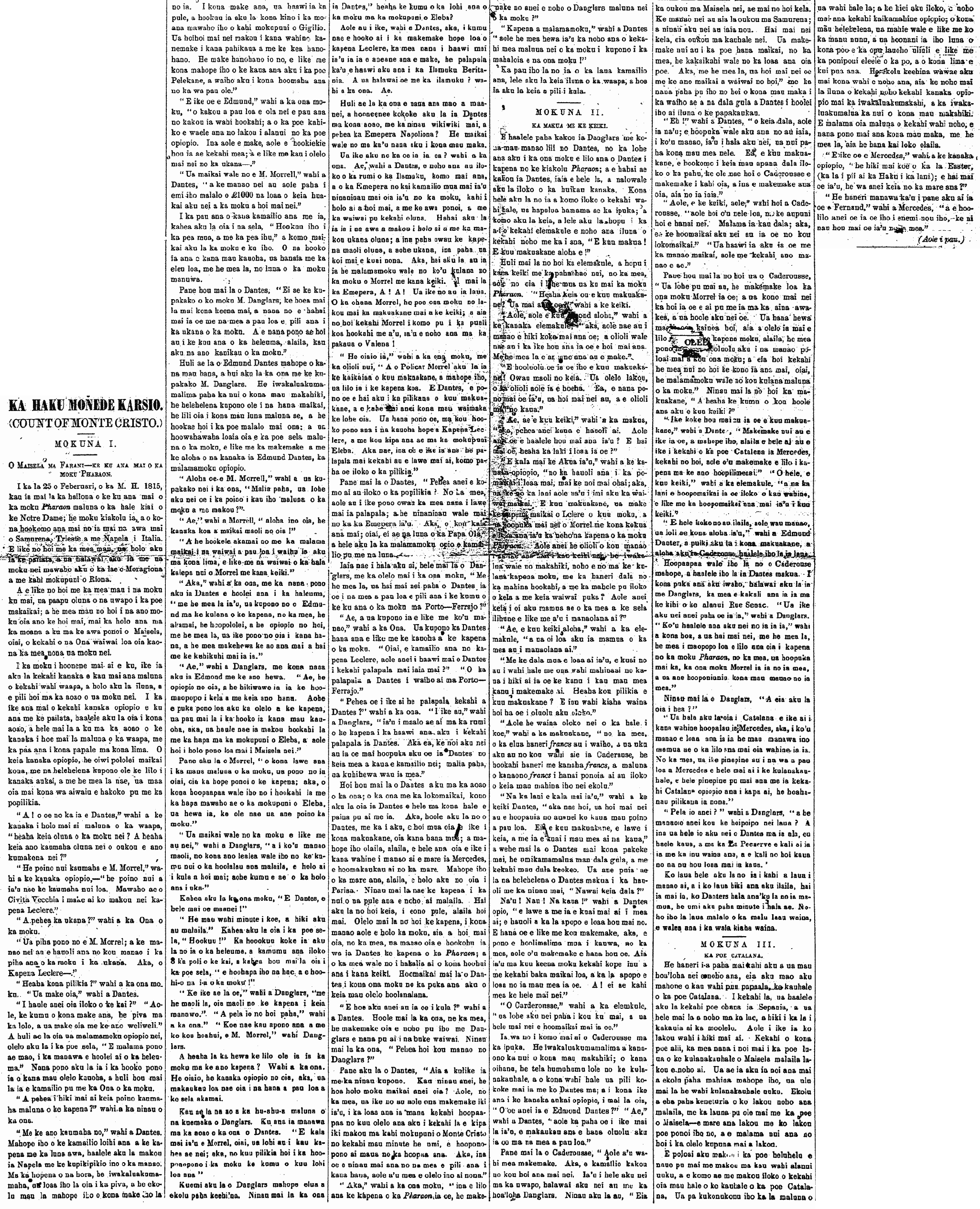
KA HAKU MONEDE KARISO.

(COUNT OF MONTE CRISTO.)

CHAPTER I.
O Maisela ma Farani—ke ku ana mai o ka moku Pharaon.

I ka la 25 o Feberuari, o ka M. H. 1815, kau ia mai la ka hailona o ke ku ana mai o ka moku Pharaon maluna o ka hale kiai o ke Notre Dame; he moku kiakolu ia, a o kona hookomo ana mai no ia mai na awa mai o Samurena, Trieste a me Napela i Italia. E like no hoi me ka mea mau, ua holo aku la ke pailata, a ua halawai aku la me na moku mawaho aku o ka lae o Moragiona a me kahi mokupuni o Riona…

[Alexandre Dumas’ “Count of Monte Cristo” is translated in the newspaper Au Okoa, and ran for two and a half years, from 8/6/1868 to 2/9/1871! This is the opening of the story.

Chapter 1.
Marseilles—The Arrival.

On the 24th of February, 1815, the look-out at Notre-Dame de la Garde signalled the three-master, the Pharaon from Smyrna, Trieste, and Naples.
As usual, a pilot put off immediately, and rounding the Chateau d’If, got on board the vessel between Cape Morgion and Rion island…
]

(Kuokoa, 8/6/1868, p. 1)

KA HAKU MONEDE KARISO.

Ka Nupepa Kuokoa, Buke IV, Helu 16, Aoao 1. Augate 6, 1868.

Poe’s “The Raven” in Hawaiian! 1871.

Ke Koraka, (The Raven)

[Translated for the “Kuokoa.”]

“Once upon a midnight dreary, while I pondered weak and weary.”

1.

Ma ke aumoe pouliuli, ia’u i nalu a luluhi
Ma na mea kahiko loa, ane nalo aku no,
Kimo au la, ane moe, hikilele i ka lohe
I ka mea me he kikoni i koni ma ka puka o’u,
He malihini wahi au, i koni ma ka puka o’u,
Oia wale iho no.

2.

Paa no ia’u la ka malama, oia hoi o Dekemaba,
Pi ke ahi, a hoea me he ano lapu no;—
Eehia! i ao koke? imi u’a au i oki
Kuu kaumaha no kuu iwa i nalo ae la, no Lenoa,
No kuu iwa i kapa ia e na anela, o Lenoa,
Ia’u he inoa huna loa.

3.

Kamumumu no na pale uliuli o ko’u hale;
Ilihia kuu uhane i na hia kamahao—
Kapalili no kuu houpo! i maha’e ke koni iloko,
Pane au he malihini nei ma ka puka o’u,
Malihini e noi ana e komo ma ka puka o’u,
Oia wale iho no.

4.

A i kuu pohala ae la, noi au la e hai mai la
“I kou ano, kou inoa, oe anei o kuu Lenoa?
Oi au e moe ana, ku mai oe e koni ana,
Koni palanehe ole, koni ma ka puka o’u,
Aue lohe ole au la,” ua wehea ka puka o’u,
Pouli! oia wale no.

5.

Kilo au i ka pouli, ku makou a ane maule!
Anoano! haohao au la, hia lua ole no.
Mau no nae ke anoano, a polio panopano!
Hanuia me he leo, o ka inoa o Lenoa,
Hanu au la, e Lenoa! kupinai la, e Lenoa!
Oia wale iho no.

6.

Hoi au i kuu keena, uluhia i ka wela,
Lohe hou la i ke koni, koni oi aku no;
Oiaio! he kakani mau kuu puka aniani;
Huli au la i akaka keia ouli kamahao,
Hamau iki a akaka keia ouli kamahao,
He makani wale no.

7.

Wehe au la i ka puka, komo me he mea mahuka
He Koraka kino nui no ka wa kahiko no.
Ole oia i kunou la, ole hoi i noho la,
Kau la me he mea haaheo iluna o ka puka o’u,
Kau la ma ke kii mabela iluna o ka puka o’u,
Kau la wale iho no.

8.

Mama iki kuu kaumaha, aka iki no kuu waha,
Ma kuu nana i ka manu i ku ma oi imua o’u;
Manu poo olohelohe, ole paha wiwo oe;
E Koraka, mea kahiko e auwana’na ma ka po,
Owai kou inoa haku ma kou home ma ka po?
Pane oia, “Nalo loa.”

9.

Haohao i kona pane, pane me he mea uhane,
Leo manu pane lea me he ano ike no!
No’u ka oli no ka ike i ka manu ano miki,
E kau mahaoi ana iluna o ka puka o’u,
Kau la ma ke kii mabela iluna o ka puka o’u,
Meia inoa “Nalo loa.”

10.

Hia au la no ka lono ia pane pili pono,
Kona ike paha keia, kona ike wale no,
I ao ia e ka haku i hau ino o kipaku,
A lohea a paa ia inoa me he inoa kanikau,
A paa loa ia inoa me he inoa kanikau,
Nalo, Nalo, “Nalo loa.”

11.

Oi i ola ae kuu eha, kau no au i noho bela
Ma ke alo o ka manu me ke kii mabela o’u;
Noho au la ma kuu bela, lilo i ka nalu ae la
I ke ano o ka manu nane no ka wa kahiko no
Manu kino wiwi ino no ka wa kahiko no
Me ia inoa, “Nalo loa.”

12.

Noho au e nalu ana, me ka pane ole ana
I ka manu me ka maka nana wela iloko o’u,
Nalu au la a kuailo me kuu poo kulou a waiho
Ma ka bela Veleveta me ka ipu lama no,
Bela uli Veleveta me ka ipu lama no,
No kuu iwa i nalo loa.

13.

Kuhi au he ahe ala no ka ipu kuai ala
O na Serapima i ku la ma ka papa hehi o’u.
Auwe au la! na ke Akua i hoouna ma lakou la
I ke klosefoma i nalo kuu kaumaha no Lenoa,
Honi i ke klosefoma, hoopoina ia Lenoa;
Pane oia, “Nalu loa.”

14.

Kaula oe! mea ino! manu paha, daimonio!
Mea hoowalewale paha, mea olulo mai ke kai!
Mehameha, wiwo ole! lele mai la i kuu home,
Home neoneo ino, e aloha a hai mai,
Ina, ea. ma Gileada, he lau bama, e hai mai,
Pane oia, “Nalo loa.”

15.

Kaula oe! mea ino! manu paha, daimonio!
Ma ka lani i kau maluna, na ke Akua ola mau
Hai mai i kuu uhane eha, aia anei ma Edena,
E apo au i kuu aloha i kapaia o Lenoa?
Apo i kuu iwa aloha i kapaia o Lenoa?
Pane oia, “Nalo loa.”

16.

Pau ko kaua launa kino, hoi iloko o ka ino,
Me kuu hulu eleele, hoi i kou home pono—
Me au mau kuu mehameha, kuu luuluu, kuu kumakena.
Hee ae mai ke kii mabela iluna o ka puka o’u;
U i kou nuku mai kuu uhane, hee ae mai ka puka o’u,
Pane oia, “Nalo loa.”

17.

Eia ua Koraka a’u la, lele ole, ke kau mau la
Ma ke kii mabela i kau iluna o ka puka o’u.
Kau la me he mea hihiu, me ka maka daimonio
A ke kau la kona aka ma ka papa hehi o’u,
O ua leo, “Nalo loa.”

Hawaii.

[This is one of many translated poems and stories found in the Hawaiian-Language Newspapers. Maybe translators of today might look at these for ideas on traditional ways stories were translated from other languages for a Hawaiian-speaking audience.

The person who translated Edgar Allan Poe’s “The Raven” also translated many hymns as well. For some reason “Ke Koraka” is reprinted two issues later on Feberuari 25, 1862, p. 4. For some reason, this page unfortunately is not available online.]

(Kuokoa, 2/11/1871, p. 1)
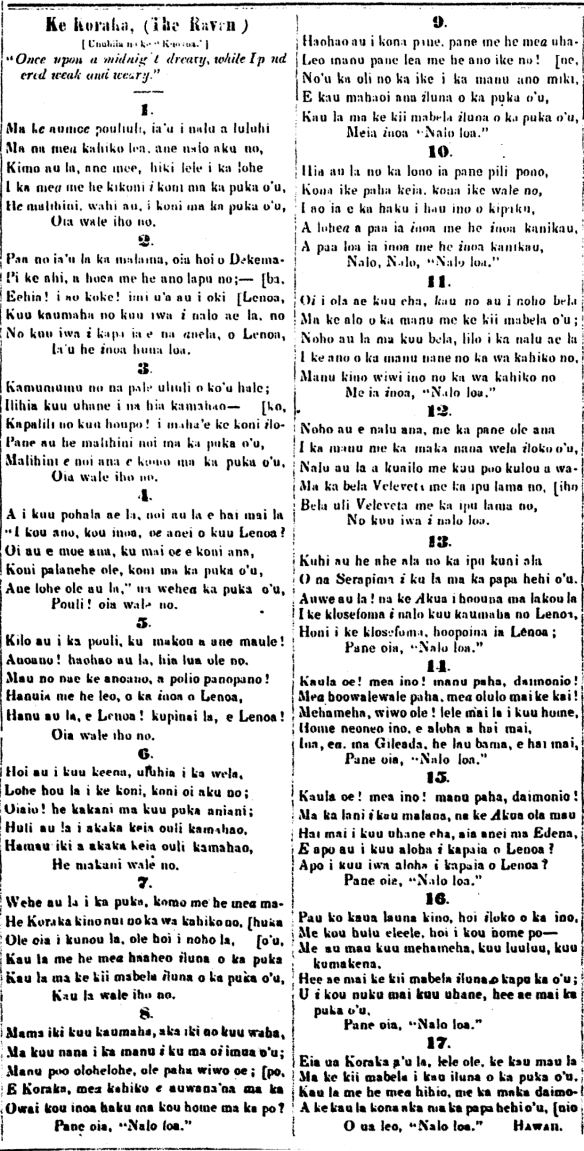
Ke Koraka, (The Raven)

Ka Nupepa Kuokoa, Buke X, Helu 6, Aoao 1. Feberuari 11, 1871.

More on the Hawaiian National Hymn, 1874.

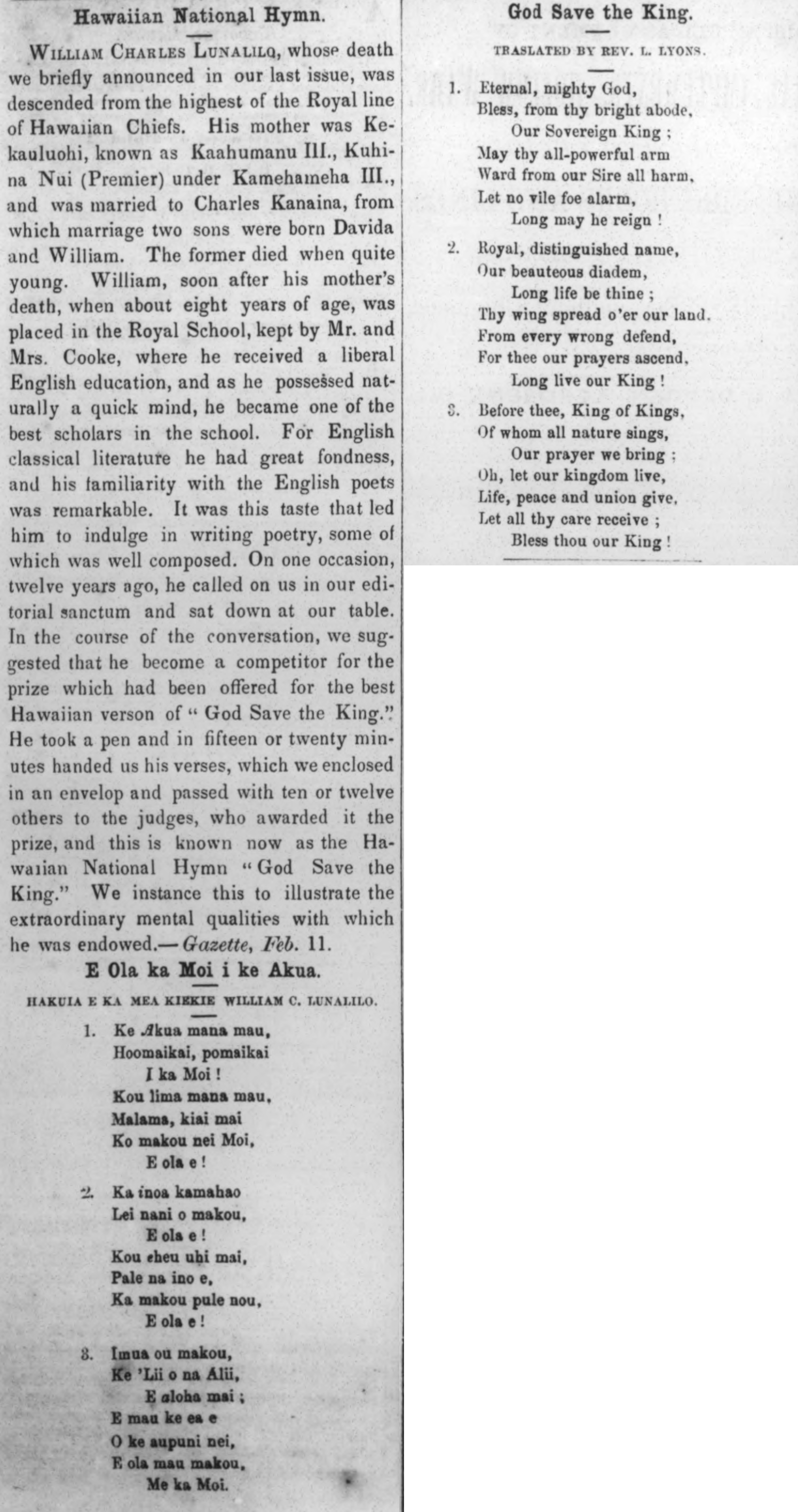
Hawaiian National Hymn.

William Charles Lunalilo, whose death we briefly announced in our last issue, was descended from the highest of the Royal line of Hawaiian Chiefs. His mother was Kekauluohi, known as Kaahumanu III., Kuhina Nui (Premier) under Kamehameha III., and was married to Charles Kanaina, from which marriage two sons were born Davida and William. The former died when quite young. William, soon after his mother’s death, when about eight years of age, was placed in the Royal School, kept by Mr. and Mrs. Cooke, where he received a liberal English education, and as he possessed naturally, a quick mind, he became one of the best scholars in the school. For English classical literature he had great fondness, and his familiarity with the English poets was remarkable. It was this taste that led him to indulge in writing poetry, some of which was well composed. On one occasion, twelve years ago, he called on us in our editorial sanctum and sat down at our table. In the course of the conversation, we suggested that he become a competitor for the best prize which had been offered for the best Hawaiian version of “God Save the King.” He took a pen and in fifteen or twenty minutes handed us his verses, which we enclosed in an envelope and passed with ten or twelve others to the judges, who awarded it the prize, and this is known now as the Hawaiian National Hymn “God Save the King.” We instance this to illustrate the extraordinary mental qualities with which he was endowed.—Gazette, Feb. 11.

E Ola ka Moi i ke Akua.

HAKUIA E KA MEA KIEKIE WILLIAM C. LUNALILO.

1. Ke Akua mana mau,
Hoomaikai, pomaikai
I ka Moi!
Kou lima mana mau,
Malama, kiai mai
Ko makou nei Moi,
E ola e!

2. Ka inoa kamahao
Lei nani o makou,
E ola e!
Kou eheu uhi mai,
Pale na ino e,
Ka makou pule nou,
E ola e!

3. Imua ou makou,
Ke ‘Lii o na Alii,
E aloha mai;
E mau ke ea e
O ke aupuni nei,
E ola mau makou,
Me ka Moi.

God Save the King.

TRANSLATED BY REV. L. LYONS.

1. Eternal, mighty God,
Bless, from thy bright abode,
Our Sovereign King;
May thy all-powerful arm
Ward from our Sire all harm,
Let no vile foe alarm,
Long may he reign!

2. Royal, distinguished name,
Our beauteous diadem,
Long life be thine;
Thy wing spread o’er our land.
From every wrong defend,
For thee our prayers ascend,
Long live our King!

3. Before thee, King of Kings,
Of whom all nature sings,
Our prayer we bring;
Oh, let our kingdom live,
Life, peace and union give,
Let all thy care receive;
Bless thou our King!

(Friend, 3/2/1874, p. 24)

Hawaiian National Hymn.

The Friend, New Series, Volume 23, Number 3, Page 24. March 2, 1874.

More on “Aia i Honolulu kuu pohaku”! 1929.

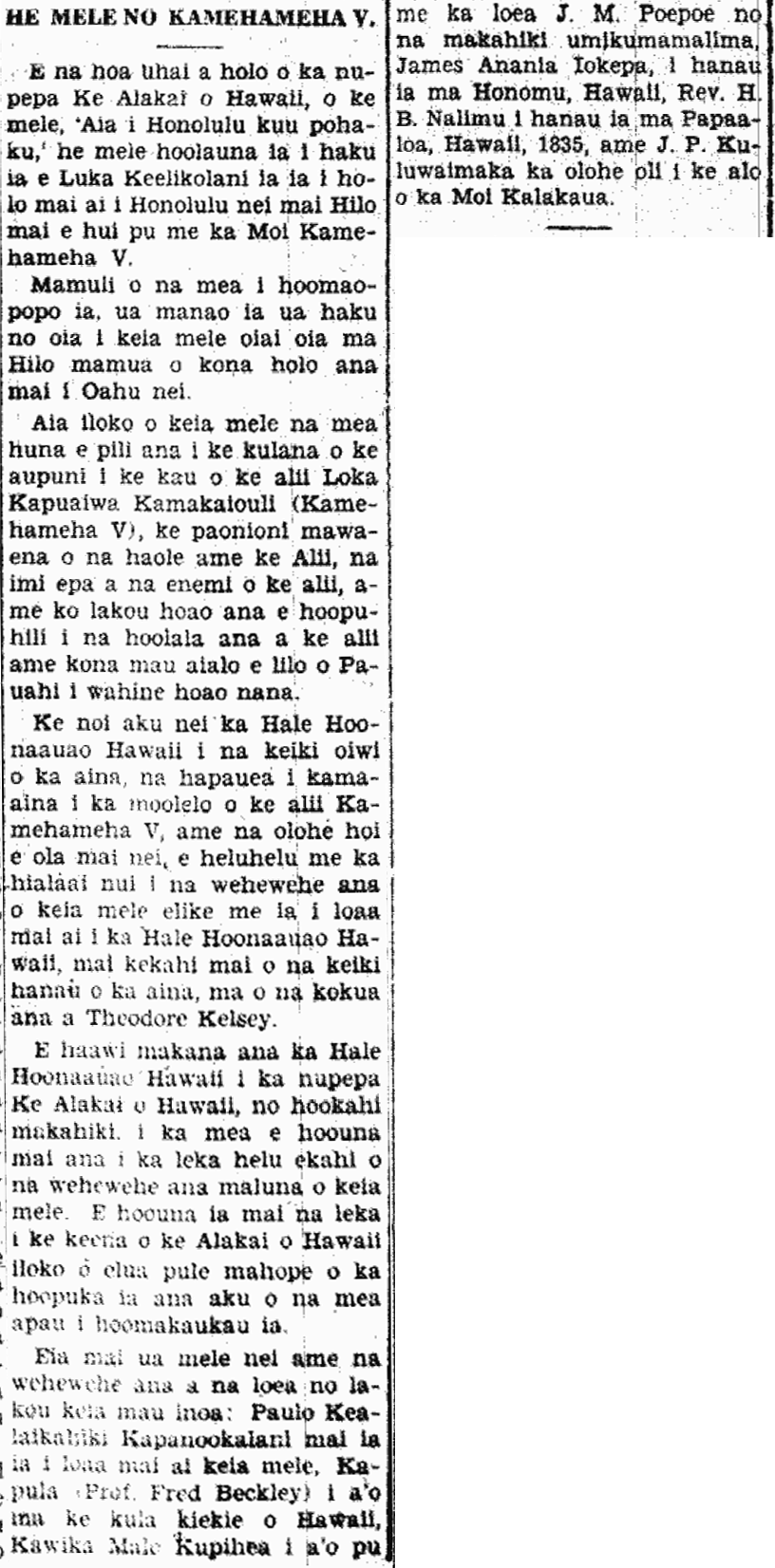
A MELE FOR KAMEHAMEHA V.

O Friends who chase after Ke Alakai o Hawaii, the mele, “Aia i Honolulu kuu pohaku,” is a mele of familiarity [mele hoolauna] composed by Luka Keelikolani when she was coming to here in Honolulu from Hilo to meet with King Kamehameha V.

From what is understood, it is believed that she composed this mele while she was in Hilo before her travelling to Oahu nei.

In this mele are hidden things dealing with the nation in the time of the alii Loka Kapuaiwa Kamakaiouli (Kamehameha V); the contention between the haole and the King, the deceit of the enemies of the King and their attempt to thwart the plans by the King and his court to make Pauahi his wife.

The Hale Hoonaauao Hawaii asks the native ones of the land, the old ones familiar with the history of King Kamehameha V, and the experts still living, to read with much pleasure the explanations of this mele as per what was obtained by the Hale Hoonaauao Hawaii from those native born of the land through the assistance of Theodore Kelsey.

The Hale Hoonaauao Hawaii will award a one-year subscription of the newspaper Ke Alakai o Hawaii to the one who sends the best letter with explanations on this mele. Send the letters to the office of Ke Alakai o Hawaii withing two weeks of the completion of the publishing of all that has been compiled.

Here is the mele and the explanations of the experts [loea] whose names are: Paulo Kealaikahiki Kapanookalani from whom we received this mele, Kahapula (Prof. Fred Beckley) who teaches at the University of Hawaii, Kawika Malo Kupihea who studied with the loea J. M. Poepoe for fifteen years. James Anania Iokepa who was born in Honomu, Hawaii, Rev. H. B. Nalimu who was born in Papaaloa, Hawaii in 1835, and J. P. Kuluwaimaka the skilled chanter [olohe oli] in the court of King Kalakaua.

[“Aia i Honolulu kuu pohaku” is perhaps the most widely studied mele i have seen, with line-by-line interpretations by experts of the day. It continues on for a number of issues of Alakai o Hawaii.

Does anyone have any details on the organization called Hale Hoonaauao Hawaii, or Hale Hoonaauao o Hawaii?]

(Alakai o Hawaii, 12/5/1929, p. 2)

HE MELE NO KAMEHAMEHA V.

Ke Alakai o Hawaii, Buke 1, Helu 32, Aoao 2. Dekemapa 5, 1929.

A Kanikau for Mrs. Fidelia Church Coan, done in Hawaiian and English! 1872.

[Translation.]

A Dirge for Mrs. Coan,

Composed by request for the Church and friends at Hilo.

Tune, A Mother’s Kiss,—Golden Robin.

1.

What hand is this stretched from above,
From where kind Spirits blend?
It is a hand let down in love
To bear away a friend.
A stranger friend she came to us
From homes beyond the seas,
And moved by love she staid with us
To teach us words of peace.

2.

Long she abode in our domain,
And domiciled with us;
A Mother teacher she became,
A kind and tender nurse;
A mother dear and much beloved,
A guide both safe and sure
O’er verdant fields with flowers perfumed,
By waters still and pure.

3.

Look upward, lo! what sight is this?
A shining cloud appears,
It floats, and thence an angel’s voice
Falls on our listening ears;
O friend beloved, there’s waiting nigh
An angel carr for thee;
Take passage, and ascend on high,
To the world though long’st to see.

4.

Hark! hark! what notes are these we hear?
they are deep sorrow’s wails;
They roll, and swell, and fill the air,
And echo o’er the hills—
The angel choir has borne away
From children weeping here
A mother whom they loved to obey,
A mother teacher dear.

5.

Our mournful tears are flowing fast,
And falling here and there,
For thee, our mother in days past,
Our leader kind and dear.
We bend in sorrow o’er one loved,
Our grief for thee is great—
Thou came’st, and we together moved;
But now we separate.

6.

Hark! hark! what bell is tolling thus?
It is a mournful bell:—
Gather together in God’s house—
It is the funeral knell.
We listen and together come,
Dear friends the summons heed;
And draped mourning, to the tomb
We march with sorrow’s tread.

7.

Mournful we move, and all are hush!
Angels are looking on,
And Jesus comes to walk with us,
And comfort those who mourn.
The hills and vales, and streams that flow,
Together with us mourn.
The loved one’s form is lower’d, and lo!
The clouds are dak’ning round!

8.

But look again, the clouds have flown,
And light breaks thro’ the gloom;
A voice exhorts with gentle tone,
O cease, ye friends, to mourn.
The dear and much beloved one
Lies not in this drear tomb,
She’s risen and to heaven has gone,
With Jesus she’s at home.

Hawaii.

[Unuhiia.]

He Kanikau no Mrs. Koana,

I hakuia ma ke noiia mai no ka ekalesia a me na makamaka o Hilo.

Leo, A Mother’s Kiss,—Golden Robin.

1.

He lima aha e o nei
Mai luna mai ke ao?
He lima kii e lawe ae
Kekahi hoahanau.
He hoa malihini nei
Mai kahi loa mai no,
Aloha nae a noho mai
I kumu no kakou.

2.

Ua noho a loihi no,
A kamaaina pu,
A lilo i makua ao,
A hanai ia kakou;
Makuwahine makamae,
A alakai maikai
Ma kahi kula uli e,
A ma na wai maemae.

3.

E nana, e, heaha nei?
He ao olino e,
Ke kau la, a noloko mai
He leo hea mai;
Ke hoa aloha, ke ku nei
He kaa anela nou;
E ee maluna, a pii ae,
Pii i ke ao ma o.

4.

Hamau! he lohe aha nei?
He olo pihe no;
O olo ae, a kupinai
Maluna o na puu—
Ua kai na anela aulii,
Mai na keiki ae,
I ka makua aloha e,
Makua ao maikai.

5.

Ke kahe nei a helelei
Na u waimaka e
Nou, ka makua aloha e,
Ko makou alakai—
Ke haalou nei, a hu ka uwe,
Pau mako e makou!
Hoea a noho pu maanei,
Kaawale nae ano.

6.

Hamau! he bele aha nei?
He bele kanikau—
E hui ma ka halawai
Hoolewa kupapau.
Ke hui nei na hoahanau,
Na hoaaloha pu;
Paa i ka lole kanikau,
A nauwe u kakou.

7.

Ke nauwe kanikau hamau—
Nana na anela,
Me Iesu hoi ke hele pu,
A, nana e hoona.
Na puu, na awawa a kahawai
Ke kanikau pu no.
Ka mea aloha ua nalo ae,
Pouli mai na ao!

8.

E nana hou, ua hee na ao,
Poha he lama e;
He leo paipai olu no,
E pau, e pau ka uwe—
Ka mea aloha makamae,
Aole ia maanei.
Ua lele i ke ao maikai
Me Iesu e maha’i.

Hawaii.

[I thought to post this piece because it is one of the few examples where the author/composer did both the Hawaiian and English version. It is interesting to look at the two compositions side by side. This is a kanikau written for Fidelia Church Coan who arrived in Hawaii along with her husband, Titus Coan, on June 6, 1835. They were stationed in Hilo, and she ran a boarding school there for girls.

The composer who calls himself “Hawaii,” is a prolific translator of English hymns into Hawaiian in the Kuokoa newspaper. Could this possibly be Lorenzo Lyons? Would anyone have any information on this?]

(Kuokoa, 11/2/1872, p. 7)

[Translation.] A Dirge for Mrs. Coan...

Ka Nupepa Kuokoa, Buke XI, Helu 44, Aoao 7. Novemaba 2, 1872.

More mele, this time all the way from Germany! 1907.

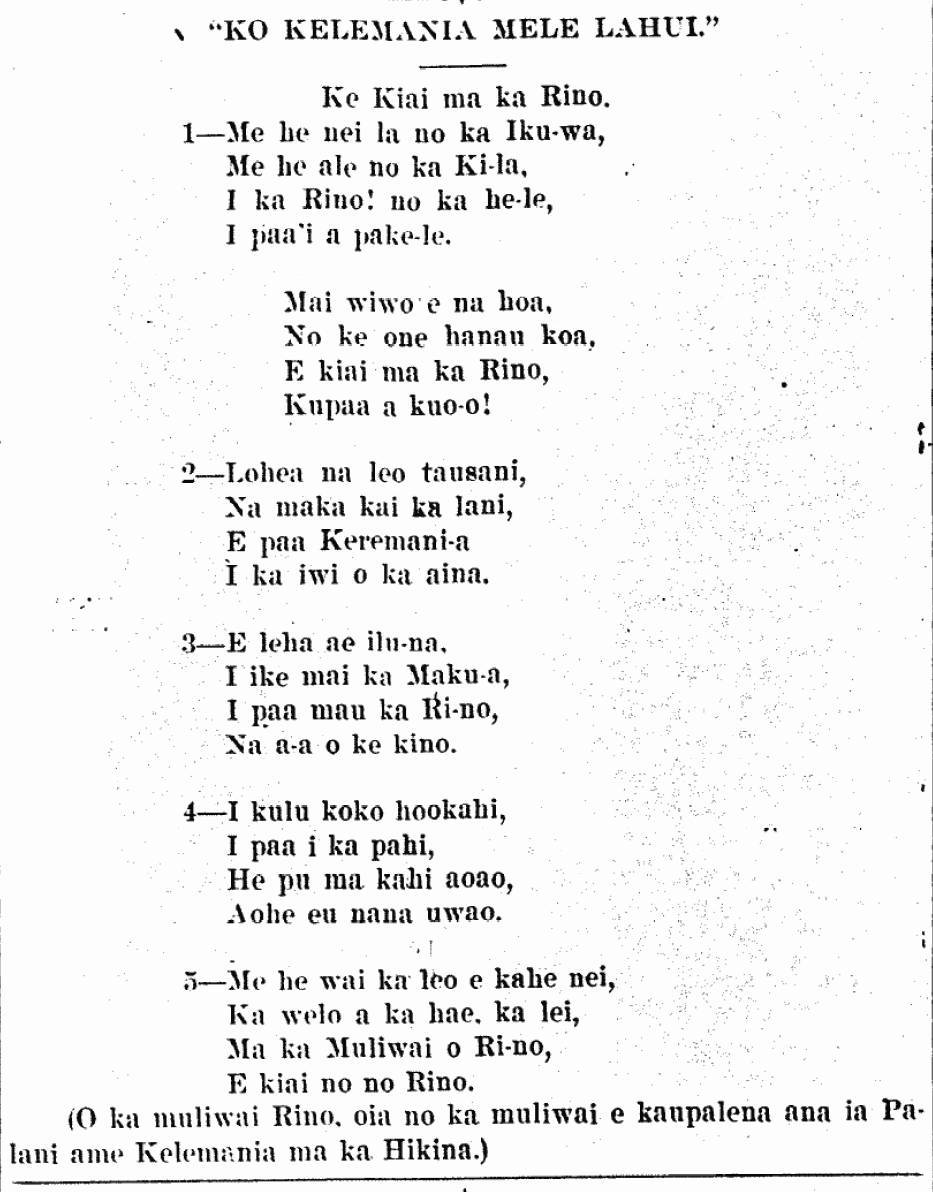
“KO KELEMANIA MELE LAHUI.”

[GERMANY’S NATIONAL ANTHEM]

Ke Kiai ma ka Rino. [Guard on the Rhine.]

1—Me he nei la no ka Iku-wa,
Me he ale no ka Ki-la,
I ka Rino! no ka he-le,
I paa’i a pake-le.

Mai wiwo e na hoa,
No ke one hanau koa,
E kiai ma ka Rino,
Kupaa a kuo-o!

2—Lohea na leo tausani,
Na maka kai ka lani,
E paa Keremani-a
I ka iwi o ka aina.

3—E leha ae ilu-na,
I ike mai ka Maku-a,
I paa mau ka Ri-no,
Na a-a o ke kino.

4—I kulu koko hookahi,
I paa i ka pahi,
He pu ma kahi aoao,
Aohe eu nana uwao.

5—Me he wai ka leo e kahe nei,
Ka welo a ka hae, ka lei,
Ma ka Muliwai o Ri-no,
E kiai no no Rino.

(The Rhine River is the river bordering Germany on the East.)

[Translation/interpretation of “Die Wacht am Rhein”.]

(Kuokoa, 3/29/1907, p. 4)

"KO KELEMANIA MELE LAHUI."

Ka Nupepa Kuokoa, Buke XLII, Helu 13, Aoao 4. Maraki 29, 1907.