Poe’s “The Raven” in Hawaiian! 1871.

I thought it would be nice to repost this today. Try reading it out loud. Lorenzo Lyons seems like he was having a fun time with this!

nupepa's avatarnupepa

Ke Koraka, (The Raven)

[Translated for the “Kuokoa.”]

“Once upon a midnight dreary, while I pondered weak and weary.”

1.

Ma ke aumoe pouliuli, ia’u i nalu a luluhi
Ma na mea kahiko loa, ane nalo aku no,
Kimo au la, ane moe, hikilele i ka lohe
I ka mea me he kikoni i koni ma ka puka o’u,
He malihini wahi au, i koni ma ka puka o’u,
Oia wale iho no.

2.

Paa no ia’u la ka malama, oia hoi o Dekemaba,
Pi ke ahi, a hoea me he ano lapu no;—
Eehia! i ao koke? imi u’a au i oki
Kuu kaumaha no kuu iwa i nalo ae la, no Lenoa,
No kuu iwa i kapa ia e na anela, o Lenoa,
Ia’u he inoa huna loa.

3.

Kamumumu no na pale uliuli o ko’u hale;
Ilihia kuu uhane i na hia kamahao—
Kapalili no kuu houpo!…

View original post 867 more words
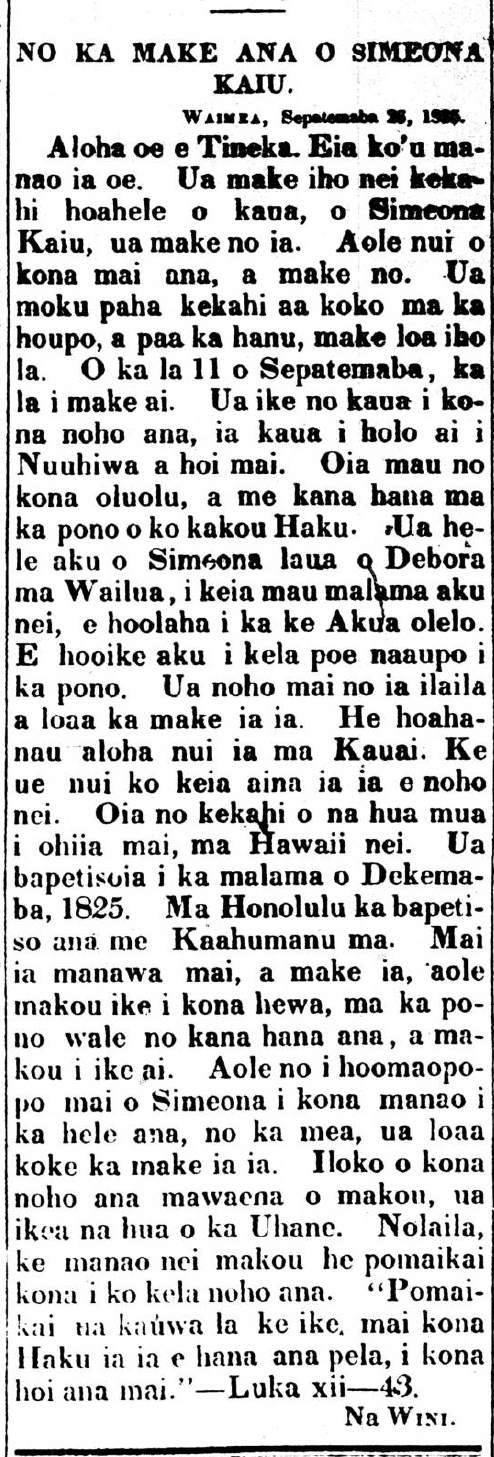
Death of Simeon Kaiu, 1835.

PERTAINING TO THE DEATH OF SIMEONA KAIU.

Waimea, September 26, 1835.

Aloha to you, O Tinker. This is my thought for you. One of our fellow travellers has recently died, Simeon Kaiu, he has died. He was not terribly sick, and he died. Perhaps one of his blood vessels severed in his chest, and he could not breathe, and he died. September 11 was the day he died. We know how he lived, when we travelled to Nuuhiwa and came back. His was as kindly as ever, as he did the work of the Lord. Simeon and Deborah [Debora] were in Wailua a few months ago spreading the word of God. They showed those ignorant ones of enlightenment. He lived there, where he died. He was a greatly beloved brethren on Kauai. He is much mourned for in this land. He is one of the first fruit picked here in Hawaii. He was baptized in the month of December, 1825. The baptism took place in Honolulu with Kaahumanu. From that time until he died, we know not of any wrong he committed, from what we saw he only did good. Simeona did not make clear what his thoughts were upon his leaving, for he died quickly. When he lived amongst us, we witnessed the fruit of the Spirit. Therefore we believe that he is doing well in that life. “Blessed is that servant, whom his lord when he cometh shall find so doing.”—Luke xii—43.

By Whitney.

[According to S. M. Kamakau, on December 4, 1825, baptized were: E. Kaahumanu, Kalanimoku, A. Keliiahonui, Lidia Namahana, Kekuaipiia, Gikeona Laanui, Simeona Kaiu, Debora Kapule Haakulou, and R. Kalaaiaulu.]

(Kumu Hawaii, 10/14/1835, p. 165)

KumuHawaii_10_14_1835_165.png

Ke Kumu Hawaii, Buke 1, Pepa 21, Aoao 165. Okatoba 14, 1835.

Bubonic plague reached our shores? 1901.

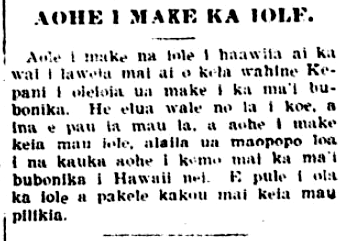
THE MICE HAVE NOT DIED.

The mice given fluids from that Japanese woman said to have died from the bubonic plague [ma’i bubonika] have not died. There are just two more days left, and after they are over, and the mice do not die, it will be clear to the doctors that the bubonic plague has not come to Hawaii nei. Pray that the mice live and we are saved of that tragedy.

(Kuokoa, 4/5/1901, p. 6)

Kuokoa_4_5_1901_6.png

Ka Nupepa Kuokoa, Buke XXXIX, Helu 14, Aoao 6. Aperila 5, 1901.

Mele inoa for Princess Kaiulani by Eleanor Kekoaohiwaikalani Prendergast, 1893.

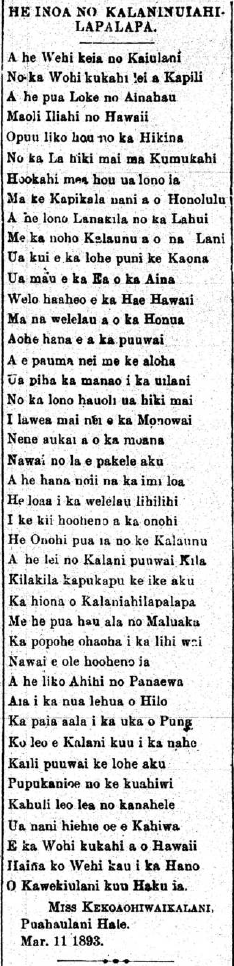
HE INOA NO KALANINUIAHILAPALAPA.

A he Wehi keia no Kaiulani
No ka Wohi kukahi lei a Kapili
A he pua Loke no Ainahau
Maoli Iliahi no Hawaii
Opuu liko hou no ka Hikina
No ka La hiki mai ma Kumukahi
Hookahi mea hou ua lono ia
Ma ke Kapikala nani a o Honolulu
A he lono Lanakila no ka Lahui
Me ka noho Kalaunu a o na Lani
Ua kui e ka lohe puni ke Kaona
Ua mau ke Ea o ka Aina
Welo haaheo e ka Hae Hawaii
Ma na welelau a o ka Honua
Aohe hana e a ka puuwai
A e pauma nei me ke aloha
Ua piha ka manao i ka uilani
No ka lono hauoli ua hiki mai
I lawea mai nei o ka Monowai
Nene aukai a o ka moana
Nawai no la e pakele aku
A he hana noii na ka imi loa
He loaa i ka welelau lihilihi
I ke kii hooheno a ka onohi
He Onohi pua ia no ke Kalaunu
A he lei no Kalani puuwai Kila
Kilakila kapukapu ke ike aku
Ka hiona o Kalaniahilapalapa
Me he pua hau ala no Maluaka
Ka popohe ohaoha i ka lihi wai
Nawai e ole hooheno ia
A he liko Ahihi no Panaewa
Aia i ka nua lehua o Hilo
Ka paia aala i ka uka o Puna
Ko leo e Kalani kuu i ka nahe
Kaili puuwai ke lohe aku
Pupukanioe no ke kuahiwi
Kahuli leo lea no kanahele
Ua nani hiehie oe e Kahiwa
E ka Wohi kukahi a o Hawaii
Haina ko Wehi kau i ka Hano
O Kawekiulani kuu Haku ia.

Miss Kekoaohiwaikalani,
Puahaulani Hale.

Mar. 11, 1893.

(Leo o ka Lahui, 3/21/1893, p. 3)

leookalahui_3_21_1893_3

Ka Leo o ka Lahui, Buke II, Helu 666, Aoao 3. Maraki 21, 1893.

Josephine Pomaikai Luia turns one year old, 1916.

[Found under: “Nuhou Kuloko.”]

There was a table set out of all sorts of delicacies to celebrate the completion of the first year of that flower bud, Miss Josephine Pomaikai Luia, this past Sunday, October 8, 1916, at Kunawai, at the Supernatural Stone of Kawaiiki [?? Pohaku Kupua o Kawaiiki]. There were many friends and associates who went to visit; also there were some candidates who were chosen recently at the election, to eat heartily together of the rich foods of the feast. Long live the new offspring was the prayer of those who joined in the eating.

[Might anyone know what the pohaku kupua at Kawaiiki in Kunawai is?]

(Kuokoa, 10/13/1916, p. 4)

Kuokoa_10_13_1916_4.png

Ka Nupepa Kuokoa, Buke LIV, Helu 41, Aoao 4. Okatoba 13, 1916.

Soldiers playing marbles? 1867.

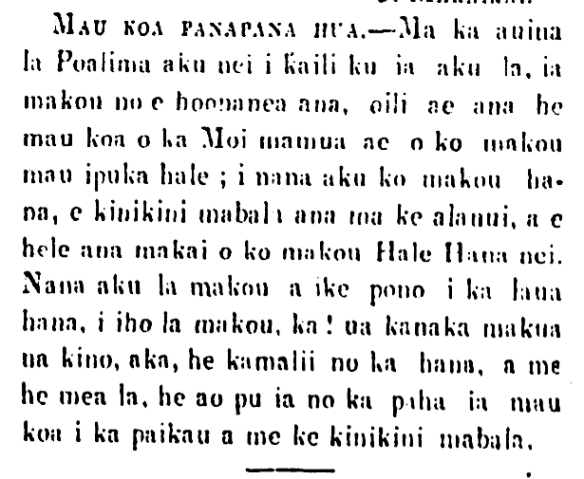
[Found under: “NU HOU KULOKO.”]

SOME SOLDIERS SHOOTING MARBLES [PANAPANA HUA].—In the afternoon this Friday past, as we were enjoying ourselves, some of the King’s soldiers appeared before the entrance of our building and we went to see; they were playing marbles on the street and going seaward of our Establishment. We looked close to see what they were doing, and we said, “Oh my, their bodies are grown up, but they do the activity of children; it would seem as if the soldiers are taught marching along with how to play marbles [kinikini mabala].

(Kuokoa, 10/26/1867, p. 2)

Kuokoa_10_26_1867_2.png

Ka Nupepa Kuokoa, Buke VI, Helu 43, Aoao 2. Okatoba 26, 1867.

Words of advice from Kamehameha I, 1891.

BE PATIENT.

O Friends, Companions, those who go hand in hand with the Leo, who walk together on the sands of Kakuhihewa moistened by the Kukalahale rains, living from Maunalua to Moanalua. Greetings to you all.

Remember the title above, “I nui ke aho.” This is one of the touching statements said by our Land Conqueror [Na’i Aina], when one of his warriors was pierced by a barbed spear; when he saw this predicament, he grabbed and pulled the spear, and that is when the warrior cried out in pain. But that conqueror of aina responded quickly while shedding tears, “My son, be patient.” Continue reading

The extent of the Hawaiian Kingdom, 1857.

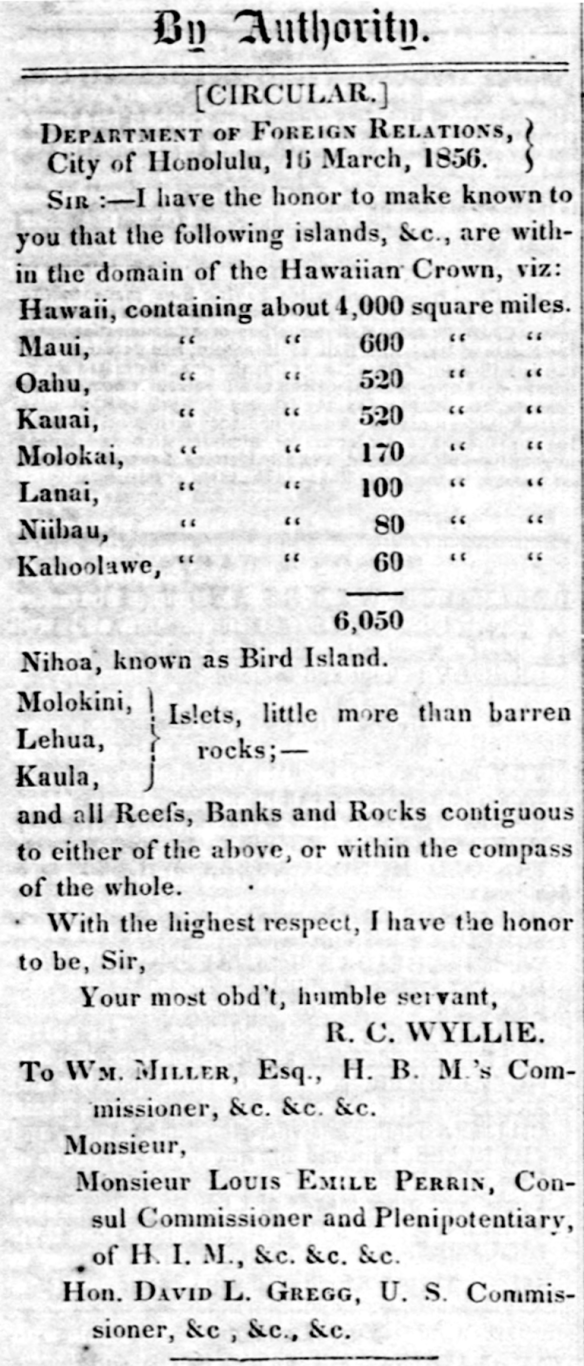
By Authority.

[CIRCULAR.]

Department of Foreign Relations,
City of Honolulu, 16 March, 1856 [1857].

Sir:—I have the honor to make known to you that the following islands, &c., are within the domain of the Hawaiian Crown, viz:

Hawaii, containing about 4,000 square miles.

Maui, ” ” 600 ” “

Oahu, ” ” 520 ” “

Kauai, ” ” 520 ” “

Molokai, ” ” 170 ” “

Lanai, ” ” 100 ” “

Niihau, ” ” 80 ” “

Kahoolawe, ” ” 60 ” “

6,050

Nihoa, known as Bird Island.

Molokini, Lehua, Kaula, Islets, little more than barren rocks;—

and all Reefs, Banks and Rocks contiguous to either of the above, or within the compass of the whole.

With the highest respect, I have the honor to be, Sir,

Your most obd’t, humble servant,

R. C. WYLLIE.

To William Miller, Esq., H. B. M.’s Commissioner, &c. &c. &c.

Monsieur,

Monsieur Louis Emile Perrin, Consul Commissioner and Plenipotentiary, of H. I. M., &c. &c. &c.

Hon. David L. Gregg, U. S. Commissioner, &c., &c., &c.

(Polynesian, 3/28/1857, p. 2)

Polynesian_3_28_1857_2.png

The Polynesian, Volume XIII, Number 47, Page 2. March 28, 1857.