Hiram Kaaha dies, 1923.

MY BELOVED FATHER, MR. HIRAM KAAHA, HAS PASSED.

MR. HIRAM KAAHA.

Iluna i ke ao,
Kuu home mau,
He malihini au,
Ma keia ao,
He waoakua nei,
He pilikia e,
Ka lani iluna ae,
Kuu home mau.

[Above in the clouds,
Is my home for all times,
I am a stranger,
In this world,
A desert,
A place of troubles,
The heavens above,
Is my home for all times.]

Mr. Solomon Hanohano: Aloha nui kaua:—Please insert this loving bundle of tears in an open space in the Kuokoa so that the fellow workers in the church, family, and friends of my dearly beloved father see that he has left this life.

My beloved papa was born at Kamoiliili, Waikiki Waena, Honolulu, Oahu, on Oct. 18, 1854 from the loins of Kawela (m) and Kahoiwai (f). Continue reading

George Vancouver arrives once more on February 14, 1793.

[Found under: “He Moolelo Hawaii”]

Vancouver Returns

In the month of February, the 14 day, 1793, Vancouver [Vanekouwa] returned to Hawaii nei, from the northwest of America, and landed at Kawaihae.

The men pleaded for guns and powder from him. Vancouver refused and would not sell those sort things to them. There was great desire of Hawaiians for those things during those days, because it was a time of war, and Kamehameha was conquering the nation then; Oahu and Kauai remained.

And from there, Vancouver landed at Kealakekua, on the 22nd of that month and met with Kamehameha.

At that time, he gifted Kamehameha with two cattle, a bull and a cow. The cattle that Vancouver brought were from Monterey, a land in America.

These animals were greatly appreciated by Hawaiians because they were unusual, and they were called puaa pipi. It is from those pipi that the cattle which roam these days at Waimea and Maunakea and the other forests of Hawaii proliferated.

Kamehameha treated Vancouver kindly; Vancouver was facing hardship without water and took his water barrels into the uplands, and Kamehameha commanded his men to carry the barrels and to fill them with water. Continue reading

Aiu, the Kauai boy comes home from war, 1920.

KAUAI BOY SONG.

He mele he inoa no Aiu,
Kuu pua o Kina hapa Hawaii,
He opua hookahi a i kuu alo,
Kuu lei miulana poina ole;
Kau he hiki aku i ka moana,
Na ale nupanupa o ka Pakipika,
Ike oe i ke anu o Kaleponi,
I ohu halii paa ka moana.
Kau aku ka manao nou e Palani,
Ke kahua hoolulu a o na koa,
O ke kikowaena a o ke kaua,
Ua huliamahi na aupuni hui,
Ike pono i ka hana a Kelemania,
Lahui puuwai ole o ke ao nei,
Ilaila hu ae ke aloha a i ka  makua.
Haalele ana i ka puuwai,
Ua paa ko kino i ka aelike,
Me na ‘liikoa Amerika.
Hookahi makahiki i ka aina malihini,
Huli ho i ka home kulaiwi,
Hoomaikaiia ka Makua Lani,
E ole kuu kokua Mana Lani,
Hoi kino mai au me ka lanakila.
Haina ia mai ana ka puana,
Kuu pua o Kina hapa Hawaii.

Owau iho no,

MRS KILA KAILI.

[Might anyone know which Aiu this song is composed for by Mrs. Kila Kaili?]

(Kuokoa, 1/2/1920, p. 2)

Kuokoa_1_2_1920_2.png

Ka Nupepa Kuokoa, Buke LVIII, Helu 1, Aoao 2. Ianuari 2, 1920.

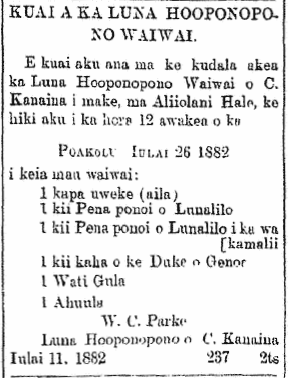
Kanaina estate auction, 1882.

AUCTION OF THE ESTATE EXECUTOR.

The Estate Executor of the deceased C. Kanaina will be put up for auction at Aliiolani Hale, when 12 noon arrives of

Wednesday, July 26, 1882

these items:

1 oil raincoat [kapa uweke]
1 painted portrait of Lunalilo
1 painted portrait of Lunalilo as a child
1 drawing of the Duke of Genoa
1 gold watch
1 ahuula

W. C. Parke
Executor of C. Kanaina

July 11, 1882.

(Ko Hawaii Pae Aina, 7/15/1882, p. 2)

KHPA_7_15_1882_2

Ko Hawaii Pae Aina, Buke V, Helu 28, Aoao 2. Iulai 15, 1882.

Estate sale of Charles Kanaina, 1882.

[Found under: “NEWS OF THE WEEK.”]

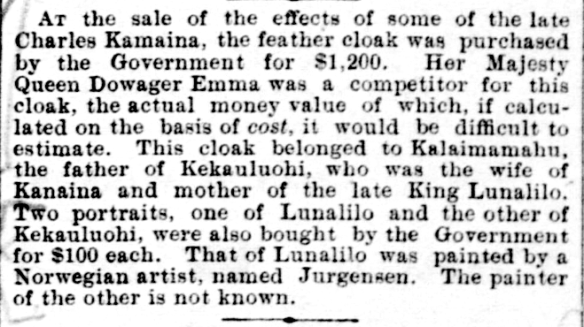
At the sale of the effects of some of the late Charles Kanaina, the feather cloak was purchased by the Government for $1,200. Her Majesty Queen Dowager Emma was a competitor for this cloak, the actual money value of which, if calculated on the basis of cost, it would be difficult to estimate. This cloak belonged to Kalaimamahu, the father of Kekauluohi, who was the wife of Kanaina and mother of the late King Lunalilo. Two portraits, one of Lunalilo and the other of Kekauluohi, were also bought by the Government for $100 each. That of Lunalilo was painted by Norwegian artist, named Jurgensen. The painter of the toher is not known.

(Pacific Commercial Advertiser, 7/29/1882, p. 3)

PCA_7_29_1882_3

The Pacific Commercial Advertiser, Volume XXVII, Number 5, Page 3. July 29, 1882.

A name song for Keelikolani, jointly composed, 1863.

NO KEELIKOLANI, MUOLAULANI KA INOA.

He anana’la i ka loa o Alakai,
Ke kuhi la he koke aku o Maunahina,
He liuliu Waialeale na ke a—nui,
He anu ka ka nahele o Aipo,
O ke kupilikii aku ia hina i Maunahina—,
Hina i ka hoona rama a ke aloha,
I ka ae hakoko a ka manao,
E pilia la i ke moe he kanaka—i—a,
He kanaka ia ua hele ia ka malama,
Hana ia iho i mio kou aloha—e—a.

Na Lilipi.

Owau e hele i ka papa o Apua,
Ke kuhi la he ale wai ko Maukele,
He pali mai hoi, Holei na ka u—a,
He ua ka ka waimaka e kulu nei,
He milimili hoi ka loko o kuu aloha—e—a,
Aloha i ka liko ohia o Puulena,
I ke-a hanu i na makani ka o lua,
Ua loa Kauonahunahu i ke a—nu,
E anu la i ka nui o ke aloha,
Ua pelepulu ua mauna i ka manao—e—a. Continue reading

Birthday of Kamehameha IV, 1862.

Orders of the General
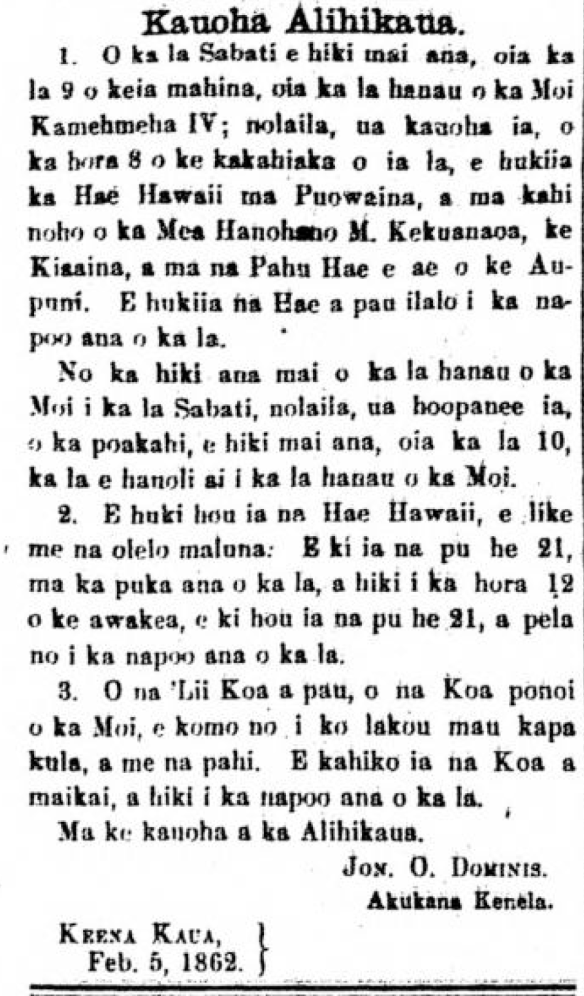
[Kauoha Alihikaua]

1. This coming Sunday, the 9th of this month, is the birthday of King Kamehameha IV; therefore, it is commanded that at 8 o’clock that morning, the Hawaiian Flag will be raised at Punchbowl [Puowaina], and at the residence of the Honorable M. Kekuanaoa, the Governor, and on the other Flag Poles of the Nation. All of the Flags will be taken down at sunset that day.

Because the birthday of the King will fall on a Sunday, therefore, the celebration of the King’s birthday will be postponed until the following Monday, that being the 10th.

2. The Hawaiian Flags will again be raised, as was stated above. 21 guns will be shot off at the rising of the sun, and at 12 noon, and also at the setting of the sun.

3. All of the Military Officers and the King’s personal Guards are to wear their gold-trimmed uniforms [kapa kula] and their swords. The Officers shall be smartly uniformed until sunset.

By the order of the General.

John O. Dominis.
Adjutant General [Akukana Kenelala].

War Department [Keena Kaua],
Feb. 5, 1862.

(Hoku o ka Pakipika, 2/6/1862, p. 3)

HokuoHawaii_2_6_1862_3

Ka Hoku o ka Pakipika, Buke I, Helu 20, Aoao 3. Feberuari 6, 1862.

Kamehameha IV’s birthday proclaimed a holiday, 1862.

[Found under: “NA KE AUPUNI”]

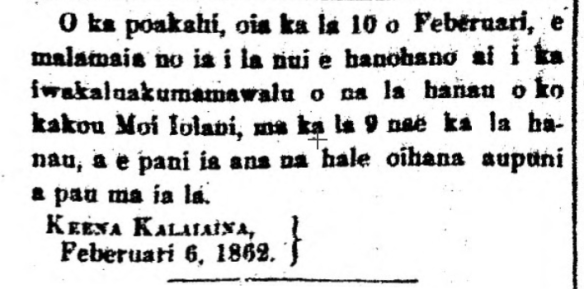
Monday, the 10th of February, will be a holiday [la nui] celebrating the twenty-eighth birthday of our King Iolani, however his birthday is on the 9th; and the doors of all of the government department buildings will be closed on that day.

Department of the Interior,
February 6, 1862.

(Hoku o ka Pakipika, 2/6/1862, p. 3)

HokuoHawaii_2_6_1862_3.png

Ka Hoku o ka Pakipika, Buke I, Helu 20, Aoao 3. Feberuari 6, 1862.

Chinese New Year beer ad, 1907.

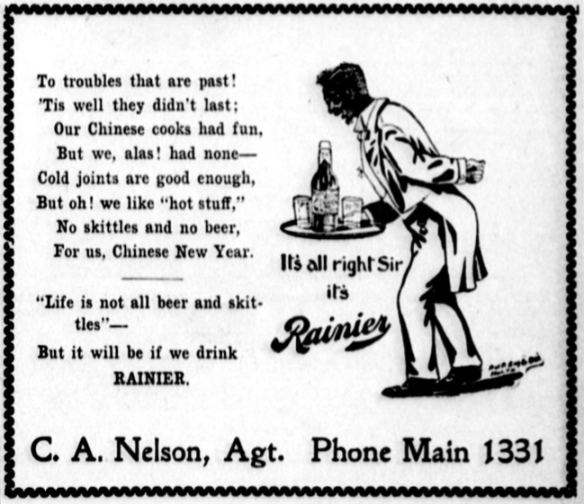
To troubles that are past!
‘Tis well they didn’t last;
Our Chinese cooks had fun,
But we, alas! had none—
Cold joints are good enough,
But oh! we like “hot stuff,”
No skittles and no beer,
For us, Chinese New Year.

“Life is not all beer and skittles”—
But it will be if we drink

RAINIER.

It’s all right Sir
it’s
Rainier

C. A. Nelson, Agt.  Phone Main 1331

(Evening Bulletin, 2/18/1907, p. 5)

EveningBulletin_2_18_1907_5.png

Evening Bulletin, Volume IX, Number 3619, Page 5. February 18, 1907.

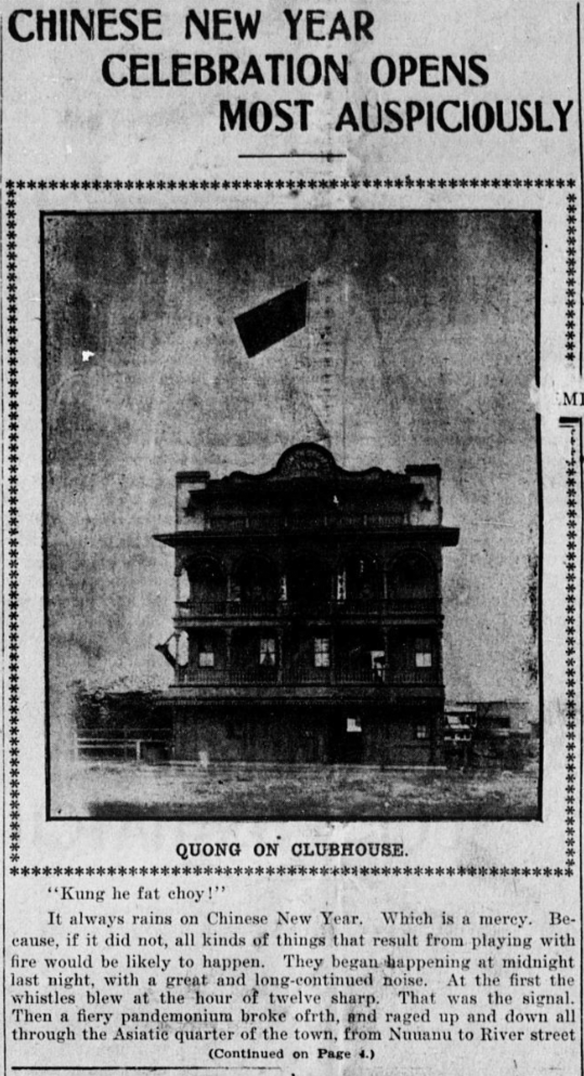
Chinese New Year, 1905.

CHINESE NEW YEAR CELEBRATION OPENS MOST AUSPICIOUSLY

QUONG ON CLUBHOUSE.

“Kung he fat choy!”

It always rains on Chinese New Year. Which is a mercy. Because, if it did not, all kinds of things that result from playing with fire would be likely to happen. They began happening at midnight last night, with a great and long-continued noise. At the first the whistles blew at the hour of twelve sharp. That was the signal. Then a fiery pandemonium broke forth, and raged up and down all through the Asiatic quarter of the town, from Nuuanu to  River street…

(Hawaiian Gazette, 2/3/1905, p. 1)

HawaiianGazette_2_3_1905_1.png

Hawaiian Gazette, Volume XL, Number 10, Page 1. February 3, 1905.

…and beyond, and on all the cross streets where the sons of the Central Flowery Kingdom, who make their homes in Honolulu, have their abiding place. Continue reading