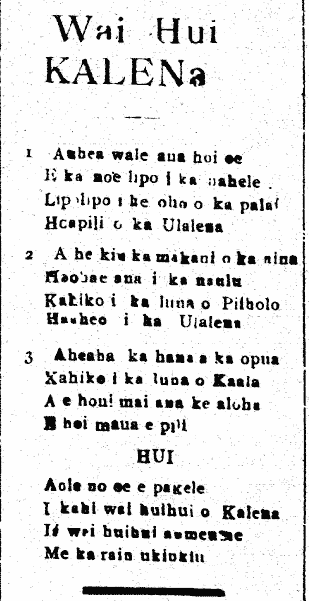
Another mele for the bracing waters of Kalena, 1929.

Wai Hui Kalena

1 Auhea wale ana hoi oe
E ka noe lipo i ka nahele
Lipolipo i ke oho o ka palai
Hoapili o ka Ulalena

2 A he kiu ka makani o ka aina
Haehae ana i ka naulu
Kahiko i ka luna o Piiholo
Haaheo i ka Ulalena

3 Aheaha ka hana a ka opua
Kahiko i ka luna o Kaala
A e honi mai ana ke aloha
E hoi maua e pili

HUI

Aole no oe e pakele
I kahi wai huihui o Kalena
Ia wai huihui aumeume
Me ka rain ukiukiu

(Hoku o Hawaii, 10/29/1929, p. 3)

Wai Hui Kalena

Ka Hoku o Hawaii, Buke XXIII, Helu 20, Aoao 3. Okatoba 29, 1929.


Patriotic mele calling out to the entire archipelago, 1894.

E OLA HAWAII I KE AKUA.

Lehua e, Lehua hoi
Pehea o Kaula au i ke kai
Hookoloia a i Niihau
Ke kupua Kilioe noho i ka pali
E Hina e, e Hina hoi
Pehea na ko’a a o ka moana
Ninau ia i ka Waikea
Me ke kauila holu Puukapele
E walea ana me Nohili
Me ka lei pahapaha a o Polihale
E ola ea, e ola hoi
A e ola Hawaii a i ke Akua.

Kaala e, Kaala hoi
Pehea ka noho’na Oahu nuui
E wale ana me Waoala
Me ka uluwehiwehi a o Halemano
Leahi e, Leahi hoi
Kaimana kaulana o ka aina
Pehea hoi a o Makapuu
Ihiihilauakea kau mai iluna
A ka luna hoi o Keaniani
Maikai na hana a Olopana
E ola ea, e ola hoi
A e ola Hawaii a i ke Akua.

Piilani e, Piilani hoi
Pehea na Hono i ka malie
Ua la’i pono Kapapawai
Ua wehi i na lehua a o Lihau
Haleakala, Haleakala e
Pehea e ka wai hu’i o Kalena
Kahiko ana a i Piiholo
Me ka ua ulalena a i Awalau
Lauahi Iao ke pani wai
I ka pela kapu hoi a o Kakae
E ola ea, e ola hoi
A e ola Hawaii a i ke Akua.

Lilinoe e, Lilinoe hoi
Pehea e ka hau o Maunakea
Kuu ia mai kuu ia mai
Ko kapa hau anu a e Poliahu
Hulihee e, Hulihee hoi
Paa ia ko kapu ihi lani kapu
Ahuena e, Ahuena hoi
Pehea e ka nalu ha’i o Kamoa
Hiilawe e, Hiilawe hoi
Makaala pono ia i ka lewa nuu
E ola ea, e ola hoi
A e ola Hawaii a i ke Akua.

Iwilei, Sept. 29th, 1894.

(Leo o ka Lahui, 10/2/1894, p. 2)

E OLA HAWAII I KE AKUA

Ka Leo o ka Lahui, Buke II, Helu 1040, Aoao 2. Okatoba 2, 1894.

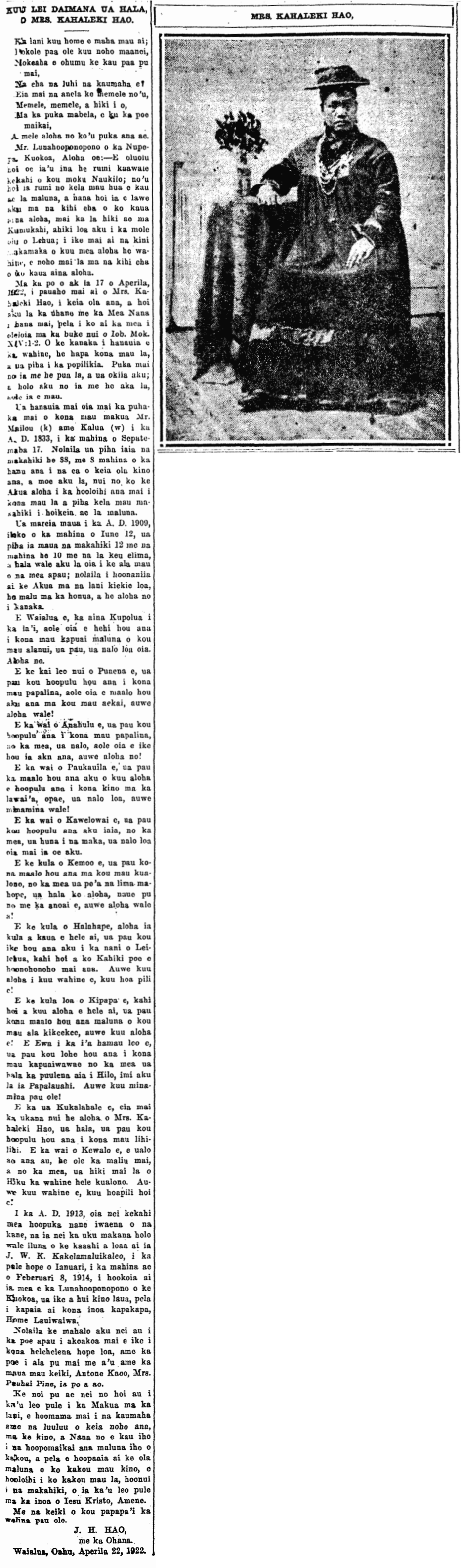
Mrs. Kahaleki Hao, Nane-ist, is no more, 1922.

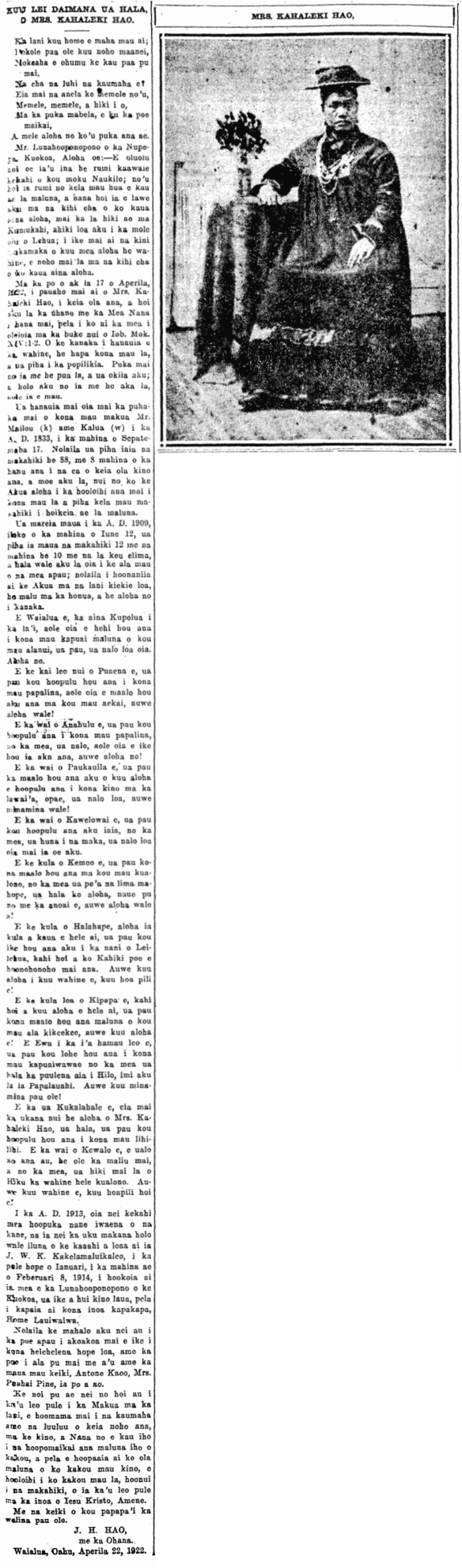
MY LEI OF DIAMONDS, MRS. KAHALEKI HAO, HAS GONE.

Ka lani kuu home e maha mau ai;
Pokole paa ole kuu noho maanei,
Nokeaha e ohumu ke kau paa pu mai,
Na eha na luhi na kaumaha e?
Eia mai na anela ke memele no’u
Memele, memele, a hiki i o,
Ma ka puka mabela, e ku ka poe maikai,
A mele aloha no ko’u puka ana ae.¹

Mr. Editor, Aloha oe:—Please should there be space on your ship the Nautilus,² allow me space for the words placed above, and may the ship take them to the four corners of our beloved land, from the rising sun at Kumukahi all the way to the pleasant base of Lehua; so that the many friends of my beloved wife, who live across the four corner of our aina aloha may know.

On the night of the 17th of April, 1922, Mrs. Kahaleki Hao grew weary of this life, and her soul returned to the One who made it, and fulfilled was the words in Job XIV:1–2. O ke kanaka i hanauia e ka wahine, he hapa kona mau la, a ua piha i ka popilikia. Puka mai no ia me he pua la, a ua okiia aku; a holo aku no ia me he aka la, aole ia e mau.

She was born from the loins of her parents Mr. Mailou (m) and Kalua (f) in 1833, in the month of September 17. Therefore, it was after 88 years and 8 months of breathing the air of this worldly life that she took her sleep; God’s love was great indeed in extending her days for that many years mentioned above.

We were wed in 1909, in the month of June 12, and we were married for 12 years and 10 months and a number of days when she left on that path all must take; and so blessed be God in the high heavens, peace on earth, goodwill toward men.

O Waialua, land fragrant in the calm, her feet will no more tread upon your pathways, no more, she is gone. Aloha no.

O Roaring sea of Puaena, no more will you moisten her cheeks, she will no longer pass along your shores, auwe aloha wale!

O Waters of Anahulu, no more will you moisten her cheeks, for she has gone, and she will not be seen again, auwe aloha ino!

O Waters of Paukauila, my beloved will never again pass by to moisten her body fishing for opae, she has gone forever, auwe, how very regrettable!

O Waters of Kawelowai, you will no more moisten her, for her face is now hidden and she is lost to you forever.

O Plains of Kemoo, she will no more pass by your ridges, for her hands are crossed behind her back, my beloved has gone, she moved along with acknowledgement, auwe, so much aloha!

O Plains of Halahape, aloha to those plains that we traveled; you will no longer see the beauty of Leilehua, where the people of foreign lands are stationed. Auwe my aloha for my dear wife, my close companion!

O Wide expanse of Kipapa, where my beloved went; she will pass no more upon your meandering roads; auwe my love! O Ewa of the fish requiring silence, you will no more hear her footsteps, for the Puulena wind has gone off to Hilo in search of Papalauahi. Auwe for my endless regret!

O Kukalahale rain, here is important news of love, Mrs. Kahaleki Hao has gone; you will no more moisten her lashes. O Waters of Kewalo, I call out without being heard, for Hiku, the woman who travels on the ridges has arrived. Auwe, my wife, my close companion!

In the year 1913, she was one of those who published nane alongside the men, and it was she who sponsored the prize which traveled on the steam engine in the last week of January, and was caught by J. W. K. Kakelamaluikaleo the next month, on February 8, 1914; this was conducted by the Editor of the Kuokoa, and they met face to face, and that is why she is called by the pen name, Home Lauiwaiwa.

And so I give my appreciation to all those who gathered to see her last countenance, and those who stayed up with me and my children Antone Kaoo, Mrs. Puahai Pine, that night and day.

I also beseech in my prayer to the Father in heaven to lighten the burdens and sadnesses of this life in body, and it is He who will give blessings upon us, and and such gives life to our bodies, extending our days, and prolonging our years; that is my prayer in the name of Jesus Christ, Amen.

My endless regards to the boys of your press.

J. H. HAO,

and Family.

Waialua, Oahu, April 22, 1922.

[You will never know what you can find in death announcements. The mention of Kahaleiki Hao being a woman nane artist associated with the identity “Home Lauiwaiwa” was an exciting find. Most of the riddles in the newspapers were signed with pen names, and only a few of their actual identities are known today.]

¹Number 585, “My home is in heaven, my rest is not here.” Found in Lyons, Lorenzo, ed. Buke Himeni Hawaii. New York: Ko Amerika Ahahui Teraka, 1872.

²From the time Jules Verne’s “Twenty Thousand Leagues Under the Sea” was translated into Hawaiian and published in the Kuokoa (12/18/1875–3/30/1878), various motifs from the story were incorporated in Hawaiian writing.

(Kuokoa, 4/28/1922, p. 3)
KUU LEI DAIMANA UA HALA, O MRS. KAHALEKI HAO.

Ka Nupepa Kuokoa, Buke LXI, Helu 17, Aoao 3. Aperila 28, 1922.

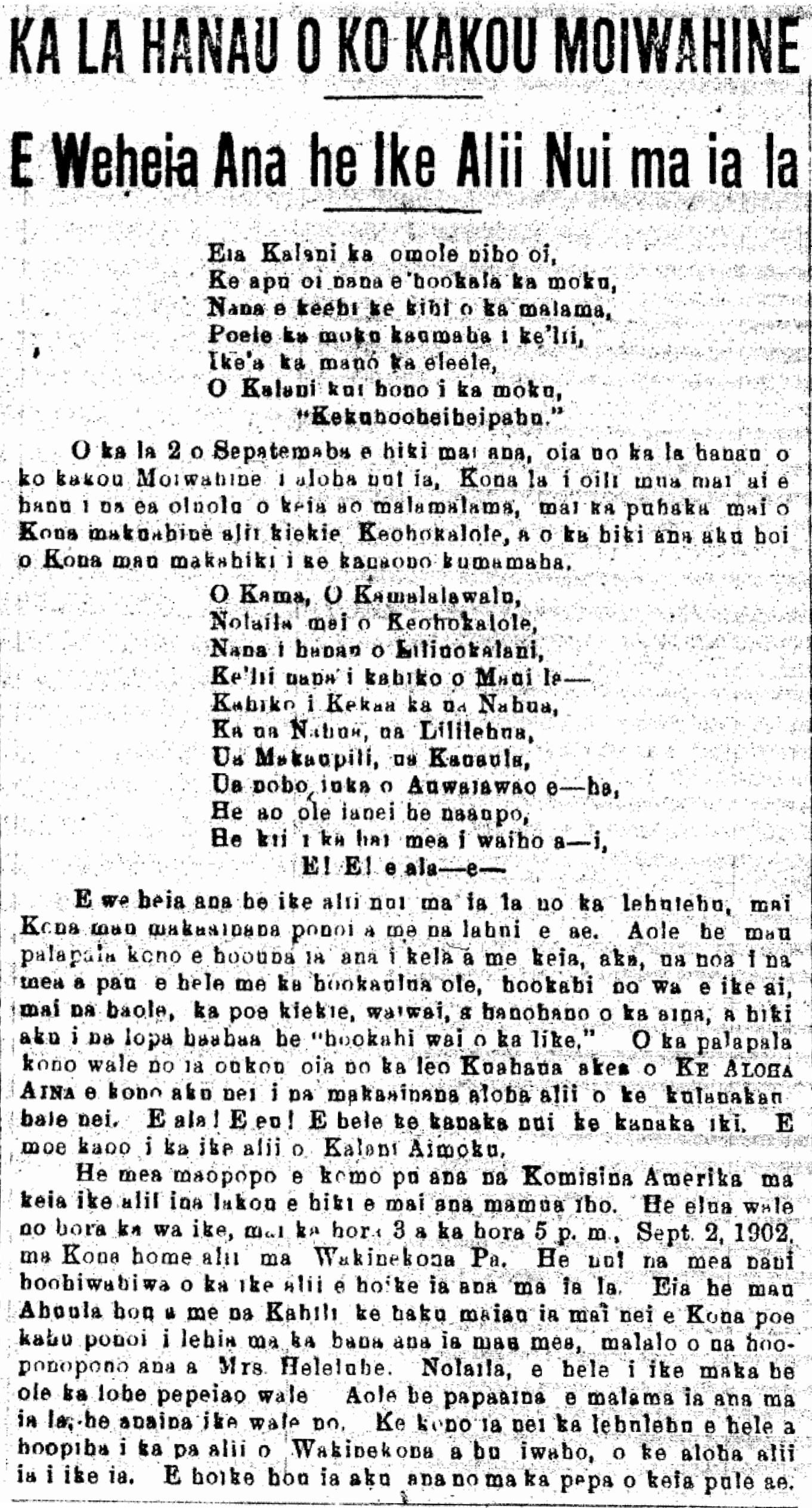
Birthday of the Queen, 1902.

THE BIRTHDAY OF OUR QUEEN

There Will be a Great Royal Audience on That Day

Eia Kalani ka omole niho oi,
Ke apu oi nana e hookala ka moku,
Nana e keehi ke kihi o ka malama,
Poele ka moku kaumaha i ke’lii,
Ike’a ka mano ka eleele,
O Kalani kui hono i ka moku,

“Kekuhooheiheipahu.”

The coming 2nd of September is the birthday of our dearly beloved Queen, the day that She first arrived and breathed in the sweet air of this world of light, from the loins of Her mother, high chiefess Keohokalole, and She has now reached the age of sixty-four.

O Kama, O Kamalalawalu,
Nolaila mai o Keohokalole,
Nana i hanau o Liliuokalani,
Ke’lii nana i kahiko o Maui la—
Kahiko i Kekaa ka ua Nahua,
Ka ua Nahua, ua Lililehua,
Ua Makaupili, ua Kauaula,
Ua noho iuka o Auwaiawao e—ha,
He ao ole ianei he naaupo,
He kii i ka hai mea i waiho a—i,
E! E! e ala—e—

There will be a great royal audience for the people that day, from Her own makaainana to the people of other ethnicities. There will not be invitations sent out to each person, but it is open to all without hesitation, and there will be but one audience, from the haole, the rich and prestigious of the land all the way to the humble peasants; they are all the same. The only invitation to you all will be this public Announcement by the Aloha Aina inviting all those of this town who have aloha for the monarch. Rise! Get going! Go forth, big man and little man. File along to the royal audience with the Queen.

It is understood that the American Commissioners [the Subcommittee on Pacific Islands and Porto Rico] will be present at this royal audience if they arrive before then. The audience will only be for two hours, from 3 to 5 p. m., Sept. 2, 1902, and Her royal residence at the grounds of Washington Place [Wakinekona Pa]. There will be many beautiful adornments displayed that day at the royal audience. There are new Feather Capes [Ahuula] and Kahili being skillfully crafted by Her own attendants who are skilled at the making of such things, under the guidance of Mrs. Heleluhe. So go and see for yourself, and not just hear about it. There will  not be a meal presented that day, only an audience. The public is invited to go a fill the yard of Washington Palace until it overflows, showing the love for the alii.  This will be shown once more in the paper of this coming week.

(Aloha Aina, 8/23/1902, p. 1)

KA LA HANAU O KO KAKOU MOIWAHINE

Ke Aloha Aina, Buke VIII, Helu 34, Aoao 1. Augate 23, 1902.

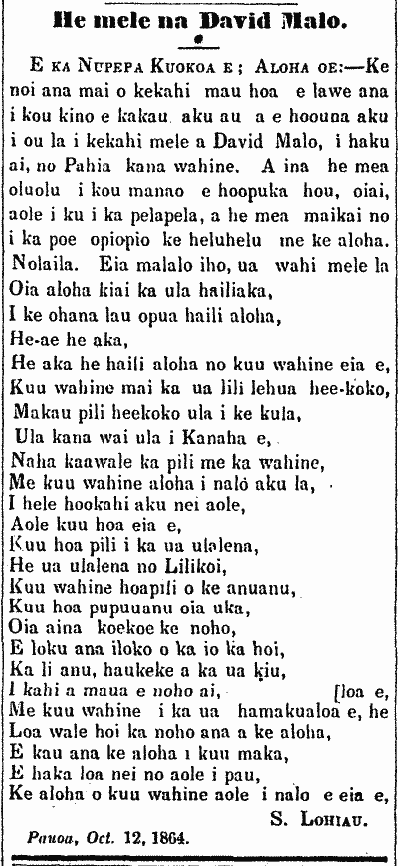
A composition by Davida Malo, 1864.

A mele by David Malo.

O Nupepa Kuokoa; Aloha oe:—Some subscribers of your newspaper have asked me to send in to you a mele by David Malo written for his wife, Pahia. And should it please you to print it once more, being that it is not offensive, and it is fine thing for the youth to read with aloha. Therefore. Here below is the mele:

Oia aloha kiai ka ula hailiaka,
I ke ohana lau opua haili aloha,
He-ae he aka,
He aka he haili aloha no kuu wahine eia e,
Kuu wahine mai ka ua lili lehua hee-koko,
Makau pili heekoko ula i ke kula,
Ula kana wai ula i Kanaha e,
Naha kaawale ka pili me ka wahine,
Me kuu wahine aloha i nalo aku la,
I hele hookahi aku nei aole,
Aole kuu hoa eia e,
Kuu hoa pili i ka ua ulalena,
He ua ulalena no Lilikoi,
Kuu wahine hoapili o ke anuanu,
Kuu hoa pupuuanu oia uka,
Oia aina koekoe ke noho,
E loku ana iloko o ka io ka hoi,
Ka li anu, haukeke a ka ua kiu,
I kahi a maua e noho ai,
Me kuu wahine i ka ua hamakualoa e, he loa e,
Loa wale hoi ka noho ana a ke aloha,
E kau ana ke aloha i kuu maka,
E haka loa nei no aole i pau,
Ke aloha o kuu wahine aole i nalo e eia e.

S. Lohiau.

Pauoa, Oct. 12, 1864.

[David Malo’s wife died on January 5, 1845, and this kanikau is first printed in the newspaper Nonanona, 3/18/1845, pp. 113–114.]

(Kuokoa, 10/15/1864, p. 3)

He mele na David Malo.

Ka Nupepa Kuokoa, Buke III, Helu 42, Aoao 3. Okatoba 15, 1864.

A father at Kalaupapa loses a son far away, 1903.

My Beloved Lei, My Child, Has Passed.

Mr. Editor of the newspaper Ke Aloha Aina.

Aloha oe:—May it please your honor to allow me some space of our precious “nupepa” for my bundle of sadness for which the title appears above, so that the friends of my child who live in the wafting Eka wind of that calm land may know.

In the evening of Friday, July 31, 1903, in Kailua, North Kona, Hawaii, the angel of death came to take the soul of my dear son, Jacob Kaleoalii, and he left silently alone on the path of no return, leaving behind his body for his mother and younger siblings to grieve over. Continue reading

Beautiful mele are easy to find in the newspapers, 1922.

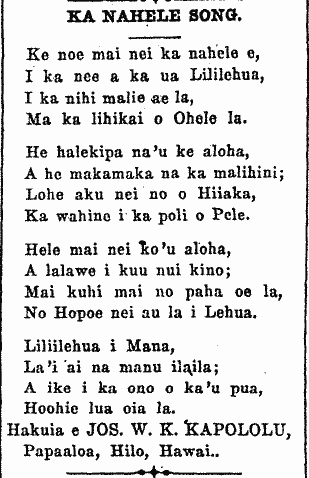
KA NAHELE SONG.

Ke noe mai nei ka nahele e,
I ka nee a ka ua Lililehua,
I ka nihi malie ae la,
Ma ka lihikai o Ohele la.

He halekipa na’u ke aloha,
A he makamaka na ka malihini;
Lohe aku nei no o Hiiaka,
Ka wahine i ka poli o Pele.

Hele mai nei ko’u aloha,
A lalawe i kuu nui kino;
Mai kuhi mai no paha oe la,
No Hopoe nei au la i Lehua.

Lililehua i Mana,
La’i ai na manu ilaila;
A ike i ka ono o ka’u pua,
Hoohie lua oia la.

Hakuia e JOS. W. K. KAPOLOLU,

Papaaloa, Hilo, Hawaii.

(Kuokoa, 7/6/1922, p. 3)

KA NAHELE SON.

Ka Nupepa Kuokoa, Buke LXI, Helu 27, Aoao 3. Iulai 6, 1923.

Another love song from a hundred years ago, 1914.

KAWAI LANA MAUA.

Ka Pua Lilia ma ka Hikina

I ka lai no wau o ka palama
Kahi a na manu e pohai ana
Ke hana akawai epipii ana
Me he ala o kuu aloha kekahi

Akahi hoi au a ike maka
I ka hana a ka lio hapa kalakoa
Ko mai ke aloha pili me a’u
Ke ala huihui i ka puuwai

Na wai eole kou makemake
Ua kila paa ia e na lani
Ua nani oe e ka nalo meli
Ka pipili ka nanahe ikau pua

E kuhi ana wau ahe pono nei
Ka hana a ka manu ailaiki
Kiina i loaa eka n ulu [? Kiina i loaa e ka naulu]
E hoi mai oe pili me a’u

Uao kaua me ka hiehie
I ka wai ma puna lana malia
Lia aku wau ao ko nni [? Lia aku wau ao ko nani]
I lei kai mana no kuu kino.

Hea aku no wau o mai oe
E hoi mai oe pili me a’u
Haina ia mai ana ka pu ana
Kealoha kakia ika puuwai.

Haku ia keiki o Kaua Kanilehua

W. D. Kawailehua.

[Newspapers until their close were a place to publish mele of all sorts, whether it be mele aloha, ko’ihonua, kanikau, &c. If you are a composer or aspiring composer, this is one of the best places to study tradition, if you are interested in tradition.

Sometimes, the typesetters weren’t very careful, especially in the later years, and more so in some papers than in others. The word breaks in this mele by Hilo boy, William D. Kawailehua, are not very consistent, but well worth working out in your head.

(Aloha Aina, 6/27/1914, p. 4)

KAWAI LANA MAUA.

Ke Aloha Aina, Buke XIX, Helu 38, Aoao 4. Iune 27, 1914.

More on ’93 KS graduate, Abraham Pihi, 1898.

MY DEAR SWEETHEART HAS JUST PASSED, AND MY EMOTIONAL SUPPORT HAS BEEN TAKEN AWAY.

Mr. Editor.

Aloha oe:

Should it be satisfactory to you and your workers, here is my bundle of olive leaves that is placed above, so that our many loved ones living all the way from Haehae where the sun rises to the pleasant base of Lehua where the sun sets may see it.

My beloved has gone, my companion who I would talk with in days gone by, that is my beloved man, Mr. Aprahama Pihi, who is a native and a familiar one of the land famous for the “Kanilehua” [Hilo] and the fragrant bowers of hala of Puna, and the land of the Haao Rains [Kaʻū], that is the roots of my dear husband who left me, his companion, his wife, grieving at the side of his grave. Auwe! How dreadful. Abraham Pihi was born in Puueo, Hilo, Hawaii on the 5th of January, 1872, of E. P. Hoaai (m) and Lilia Palapala (f), and the two of them had 7 children: 5 daughters and 2 sons; and 2 of them went off in search of the footprints of their parents, and 5 remain mourning on this side: 4 girls and one boy.

He was educated at the Hilo Boarding School under the principal, Rev. W. R. Oleson [W. R. Olesona]¹. After he was done there, he entered Kamehameha School in 1893. He was at that school for 1 year, but because it was learned that he had the disease that separates families, he asked the principal, that being the Rev. W. R. Oleson, to release him. He returned to Wailuku, Maui, where his mother was living with his new father, the Rev. S. Kapu; he lived with his parents until he was taken in by the disease that separates families; he was taken from his parents and his younger siblings. He was taken away to this land of no friends in 1895. The number of years he had in this world was 24 and eleven months and 13 days, when his last breath was released. Continue reading

Looking back at their time spent at Lahainaluna, 1904.

TEARS SHED FOR THE DAYS GONE BY.

Being that some of the old students educated at Lahainaluna College are involved in this water rights case, Mr. McDonald, the principal of Lahainaluna, gave a small party for the old students of the school.

Amongst those who attended were the Hon. J. L. Kaulukou, T. He-u, students who graduated in 1854; D. Kailua, a student who gradutated in 1858; Hon. D. Damiana, a student who graduated in 1857; Mrs. E. M. Nakuina, from the side of the Government; and some other people.

After the stomachs were filled, the graduates were called up to talk about their life at the school, and as a result of the words of these people, much tears were shed because of the great troubles faced in search of education in those days gone by.

According to one of the graduates, his clothes in those days of hardship was just two pants, two palaka, a hat, and no shoes. Another said that he had just one shirt and no other, none at all. Being that there was much food planted on the school property by the students, fish was the relish, the oopu that were caught in the rivers, and the luau.

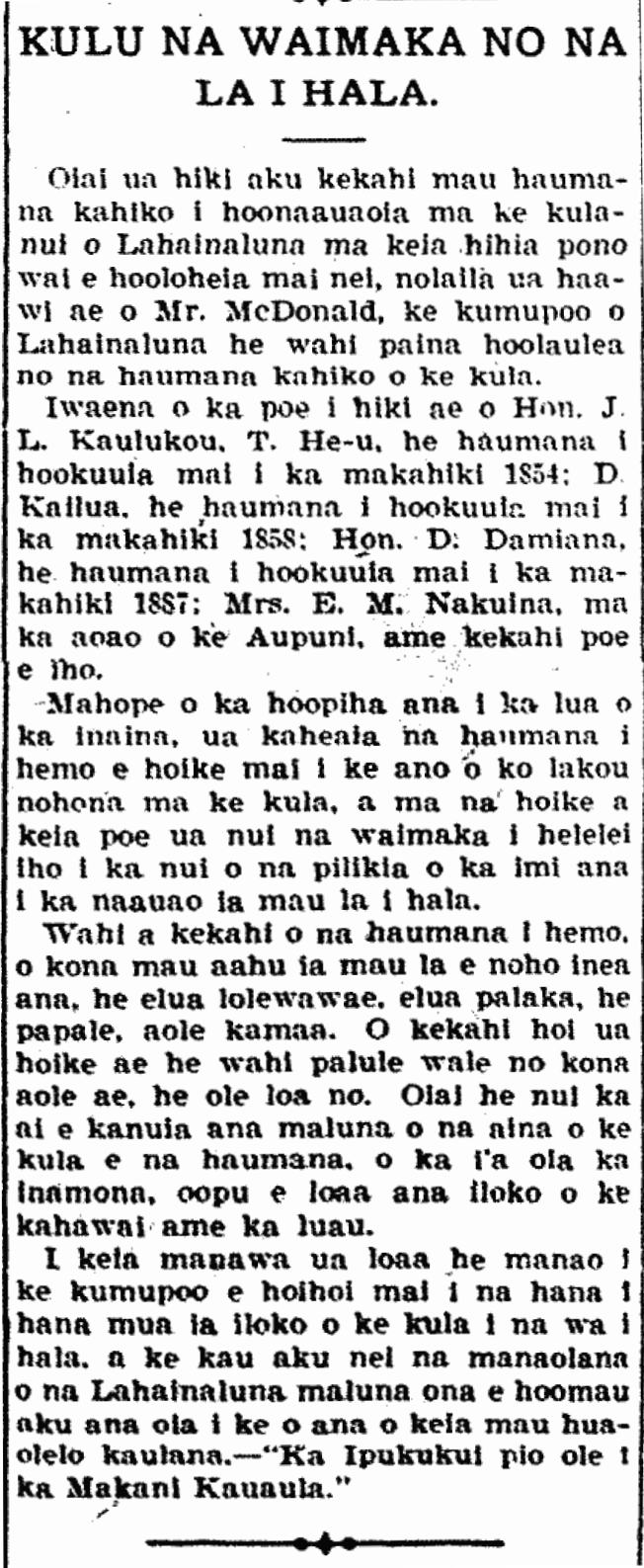
Currently, the principal is thinking about going back to the work done in the schools in days past, those of Lahainaluna have placed their hope upon him, that he will have this famous saying go on.—”Ka ipukukui pio ole i ka Makani Kauaula.”¹

¹The famous epithet for Lahainaluna School: “The light not extinguished by the Kauaula winds.”

(Kuokoa, 5/13/1904, p. 5)

KULU NA WAIMAKA NO NA LA I HALA.

Ka Nupepa Kuokoa, Buke XLII, Helu 20, Aoao 5. Mei 13, 1904.