Ane Kealoha Kawaihoa Namakelua dies, 1919.

MY BELOVED WIFE HAS GONE.

MRS. LUCY KAHAINA KEOHOHINAOKALANI KEKOA.¹

Mr. Solomon Hanohano, captain of the Kilohana; Aloha oe:—please extend me your patience, and your boys of the press, to insert into an open room my bundle of tears of clouds banks appearing in the morning which just arrived, and it will be for you to carry it to the homes of the many friends of my beloved wife.

Ane Kealoha Kawaihoa Namakelua has gone. She left me, her husband in marriage at 12 noon, on the 7th of January, 1919, at the home of our foster parent, Laika Kekuewa and Mrs. Hiku Kekuewa, on Morris Lane, Kapalama, Honolulu, and her earthly body rests at Puea Cemetery the eternal sleep, just as is written, for dust thou art, and unto dust shalt thou return [he lepo no oe a e hoi hou aku oe i ka lepo.]

My dear wife was born from the loins of Gapa (m) and Kahalewai (f) at Heeia, Koolau, Oahu, the home of her parents, on the 25th of December, 1892, therefore, she spent 27 years and 12 days in this life and left me and our hanai and all of the ohana grieving in this world.

Because of the sickness she had upon her body, a remedy was sought from doctors for six months or more, but the knowledge of the son of man could not hold it back. And so what the Great Book says came true: Man that is born of a woman is of few days and full of trouble. [O ke kanaka i hanauia e ka wahine, ua piha i na popilikia, a he pokole kona mau la.]

My dear wife was educated at the public school at Kahuku, and we were married on the 18th of May, 1908, by the Father Abraham Fernandez, of the Church of Jesus Christ of the Latter Day Saints, and we were married for 10 years and 6 months. Continue reading

Lucy Kahaina Keohohinaokalani Kekoa turns 50 years old, 1919.

JUBILEE CELEBRATION.

MRS. ANE KEALOHA K. NAMAKELUA.¹

To Solomon Hanohano, Esq., Aloha oe:—Please let me introduce before you and your workers of the press.

Last Sunday, January 5, 1919, Mrs. Lucy Kahaina Keohohinaokalani Kekoa made 50 years old; she is a native mother and kamaaina to the dark cliffs of Koolaupoko, and there she was born from the loins of Mrs. Lilia Kamaka Kailiponi and C. Apela Kailiponi on the 5th of January, 1869, and she is a mother who is well known to Honolulu’s people, and she has many family and friends on the islands. Continue reading

David Hauola Makekau and “Leahi,” 1919.

[From: “KUU KAMAAINA I KA UA KUKALAHALE.”]

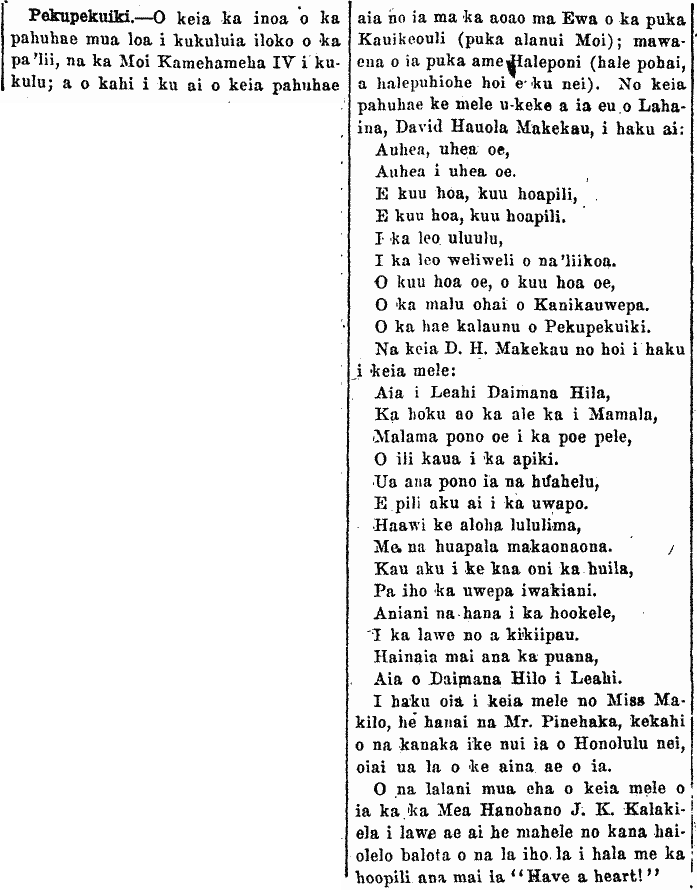
Pekupekuiki.—This is the name of the first flagpole put up in the palace grounds; it was erected by King Kamehameha IV; and this flagpole stood on the Ewa side of the Kauikeaouli gate (the King Street gate); between the gate and Haleponi, “the Coronation Building” (the gazebo and bandstand that stands now). For this flagpole is the u-keke song composed by that spry one of Lahaina, David Hauola Makekau:

Auhea, uhea oe,
Auhea i uhea oe.
E kuu hoa, kuu hoapili,
E kuu hoa, kuu hoapili.
I ka leo uluulu,
I ka leo weliweli o na ʻliikoa.
O kuu hoa oe, o kuu hoa oe,
O ka malu ohai o Kanikauwepa.
O ka hae kalaunu o Pekupekuiki.

It was this D. H. Makekau who indeed composed this mele:

Aia i Leahi Daimana Hila,
Ka hoku ao ka ale ka i Mamala,
Malama pono oe i ka poe pele,
O ili kaua i ka apiki.
Ua ana pono ia na huahelu,
E pili aku ai i ka uwapo.
Haawi ke aloha lululima,
Me na huapala makaonaona.
Kau aku i ke kaa oni ka huila,
Pa iho ka uwepa iwakiani.
Aniani na hana i ka hookele,
I ka lawe no a kikiipau.
Hainaia mai ana ka puana,
Aia o Daimana Hila i Leahi.

He composed this song for Miss Makilo, a hanai child of Mr. Pinehaka [? William Pinehasa Wood], one of the well-known men of Honolulu nei, in those days he lived there [? oiai ua la o ke aina ae o ia].

The first four lines of the mele are what the Honorable J. K. Kalakiela recently took to as part of his election speech adding, “Have a heart!”

[The awesome things you find while watching Merrie Monarch! This description is found in an awesome treatise on place names of Honolulu, “My Familiarity with the Land of the Kukalahale Rain,” which runs in the Kuokoa from 12/20/1918 to 1/24/1919 (although it indicates there is to be more to come), describing famous places of Honolulu in days gone by, written by the Anela o Mekiko, Gabriel K. Keawehaku.

Mahalo to the boys of Na Kamalei o Lililehua for their lively hula inspiring me to do a little searching.

For more on the gates of Iolani Palace, click here for Nanea Armstrong Wassel’s post!

For more on the Hale Poni, again click here for Nanea Armstrong Wassel’s post!!]

(Kuokoa, 1/24/1919, p. 3)

Pekupekuiki.

Ka Nupepa Kuokoa, Buke LVII, Helu 4, Aoao 3. Ianuari 24, 1919.

Mauna a Kea, Moana a Kea: Hawaii nei is sacred in its entirety, from the sun above to the land and ocean below. 1866 / today and the future.

No Kalani “Kauikeaouli Kamehameha III.”

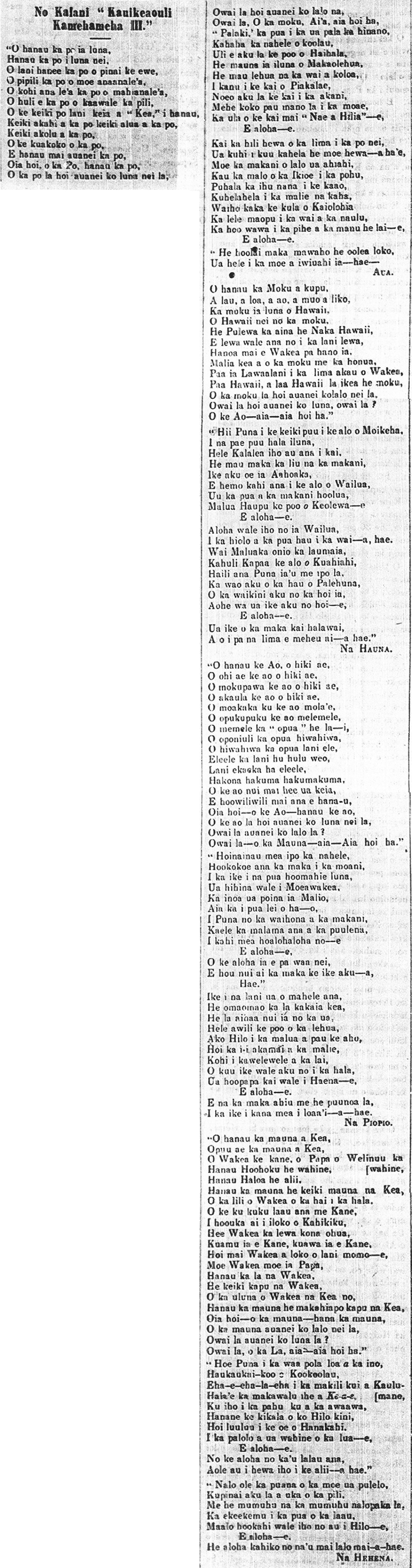
“O hanau ka po ia luna,
Hanau ka po i luna nei,
O lani hanee ka po o pinai ke ewe,
O pipili ka po o moe anaanale’a,
O kohi ana le’a ka po o mahianale’a,
O huli e ka po o kaawale ka pili,
O ke keiki po lani keia a “Kea,” i hanau,
Keiki akahi a ka po keiki alua a ka po,
Keiki akolu a ka po,
O ke kuakoko o ka po,
E hanau mai auanei ka po,
Oia hoi, o ka Po, hanau ka po,
O ka po la hoi auanei ko luna nei la,
Owai la hoi auanei ko lalo na,
Owai la, O ka moku, Ai’a, aia hoi ha,
“Palaki,” ka pua i ka ua pala ka hinano,
Kahaha ka nahele o koolau,
Uli e aku la ke poo o Haihala,
He mauna ia iluna o Makaolehua,
He mau lehua na ka wai a koloa,
I kanu i ke kai o Piakalae,
Noeo aku la ke kai i ka akani,
Mehe koko pau mano la i ka moae,
Ka ula o ke kai mai “Nae a Hilia”—e,
E aloha—e.

Kai ka hili hewa o ka lima i ka po nei,
Ua kuhi i kuu kahela he moe hewa—a ha’e,
Moe ka makani o lalo ua ahiahi,
Kau ka malo o ka Ikioe i ka pohu,
Puhala ka ihu nana i ke kaao,
Kuhelahela i ka malie na kaha,
Waiho kaka ke kula o Kaiolohia,
Ka lele maopu i ka wai a ka naulu,
Ka hoo wawa i ka piha a ka manu he lai—e,
E aloha—e.

[Na] AUA.

O hanau ka Moku a kupu,
A lau, a loa, a ao, a muo a lilo,
Ka moku ia luna o Hawaii,
O Hawaii nei no ka moku,
He Pulewa ka aina he Naka Hawaii,
E lewa wale ana no i ka lani lewa,
Hanoa mai e Wakea pa hano ia,
Malia kea a o ka moku me ka honua,
Paa ia lawaalani i ka lima akau o Wakea,
Paa Hawaii, a laa Hawaii la ikea he moku,
O ka moku la hoi auanei kolalo nei la,
Owai la hoi auanei ko luna, owai la?
O ke Ao—aia—aia hoi ha.”

“Hii Puna i ke keiki puu i ke alo o Moikeha,
I na pae puu hala iluna,
Hele Kalalea iho au ana i kai,
He mau maka ka liu na ka makani,
Ike akuu oe ia Aahoaka,
E hemo kahi ana i ke alo o Wailua,
Uu ka pua a ka makani hoolua,
Malua Haupu ke poo o Keolewa—e
E aloha—e.

Aloha wale iho no ia Wailua,
I ka hiolo a ka pua hau i ka wai—a, hae,
Wai Maluaka onio ka laumania,
Kahuli Kapaa ke alo o Kuahiahi,
Haili ana Puna ia’u me ipo la,
Ka wao aku o ka hau o Palehuna,
O ka waikini aku no ka hoi ia,
Aohe wa ua ike aku no hoi—e,
E aloha—e.
Ua ike o ka maka kai halawai,
A o i pa na lima e meheu ai—a hae.”

Na HAUNA.

“O hanau ke Ao, o hiki ae,
O ohi ae ke ao o hiki ae,
O mokupawa ke ao o hiki ae,
O akaula ke ao o hiki ae,
O moakaka ku ke ao mola’e,
O opukupuku ke ao melemele,
O memele ka “opua” he la—i,
O oponiuli ka opua hiwahiwa,
O hiwahiwa ka opua lani ele,
Eleele ka lani hu hulu weo,
Lani ekaeka ha eleele,
Hakona hakuma hakumakuma,
O ke ao nui mai hee ua keia,
E hoowiliwili mai ana e hana-u,
Oia hoi—o ke Ao—hanau ke ao,
O ke ao la hoi auanei ko luna nei la,
Owai la auanei ko lalo la?
Owai la—o ka Mauna—aia—Aia hoi ha.”

“Hoinainau mea ipo ka nahele,
Hookokoe ana ka maka i ka moani,
I ka ike i na pua hoomahie luna,
Ua hihina wale i Moeawakea,
Ka inoa ua poina ia Malio,
Aia ka i pua lei o ha—o,
I Puna no ka waihona a ka makani,
Kaele ka malama ana a ka puulena,
I kahi mea hoalohaloha no—e,
E aloha—e,
O ke aloha ia e pa waa nei,
E hou nui ai ka maka ke ike aku—a,
Hae.”

Ike i na lani ua o mahele ana,
He omaomao ka la kakaia kea,
He la aihaa nui ia no ka ua,
Hele awili ke poo o ka lehua,
Ako Hilo i ka malua a pau ke aho,
Hoi ka i-i akamai a ka malie,
Kohi i kawelewele a ka lai,
O kuu ike wale aku no i ka hala,
Ua hoopapa kai wale i Haena—e,
E aloha—e.
E na ka maka ahiu me he puunoa la,
I ka ike i kana mea i loaa’i—a—hae.

Na PIOPIO.

“O hanau ka mauna a Kea,
Opuu ae ka mauna a Kea,
O Wakea ke kane, o Papa o Welinuu ka wahine,
Hanau Hoohoku he wahine,
Hanau Haloa he alii,
Hanau ka mauna he keiki mauna na Kea,
O ka lili o Wakea o ka hai i ka hala,
O ke ku kuku laau ana me Kane,
I hoouka ai i iloko o Kahikiku,
Hee Wakea ka lewa kona ohua,
Kuamu ia e Kane, kuawa ia e Kane,
Hoi mai Wakea a loko o lani momo—e,
Moe Wakea moe ia Papa,
Hanau ka la na Wakea,
He keiki kapu na Wakea,
O ka uluna o Wakea na Kea no,
Hanau ka mauna he makahiapo kapu na Kea,
Oia hoi—o ka mauna—hana ka mauna,
O ka mauna auanei ko lalo nei la,
Owai la auanei ko luna la?
Owai la, o ka La, aia—aia hoi ha.”

“Hoe Puna i ka waa pola loa a ka ino,
Haukaukai—koo o Kookoolau,
Eha—e—eha—la—eha i ka makili kui a Kaulumano,
Hala’e ka makawalu ihe a Ko-a-e,
Ku iho i ka pahu ku a ka awaawa,
Hanane ke kikala o ko Hilo kini,
Hoi luuluu i ke oe o Hanakahi,
I ka palolo a ua wahine o ka lua—e,
E aloha—e.
No ke aloha no ka’u lalau ana,
Aole au i hewa iho i ke alii—a hae.”

“Nalo ole ka puana o ka moe ua pulelo,
Kupinai aku la a uka o ka pili,
Me he mumuhu na ka mumuhu nalopaka la,
Ka ekeekemu i ka pua o ka laau,
Maalo hookahi wale iho no au i Hilo—e,
E aloha—e.
He aloha kahiko no na’u mai lalo mai—a—hae.

Na HEHENA.

(Kuokoa, 3/24/1866, p. 4)

No Kalani "Kauikeaouli Kamehameha III."

Ka Nupepa Kuokoa, Buke V, Helu 12, Aoao 4. Maraki 24, 1866.

No Kalani “Kauikeaoule Kamehameha III.” [No Kalani “Kauikeaouli Kamehameha III.”]

O hanau ka La o na’u,
O nau ka la o Kupauole,
O Kupauole ka la kohia,
Kohia ka la ia Hina,
O ke kukuna o ka la paa,
O ka pea o hilima o hilinehu,
O ka lala o ke Kamani,
O ka hui o ke Kamani ula,
O ka ehu o Halulu,
Ke haina mai la hai,
Ke haki’a mai la e ka “La,”
E ke keiki hele lani a “Kea,”
O Wakea kai lalo o ka la kai luna,
O ke keiki la a Kea i hookauhua ai,
Oia hoi—o ka La—hanau ka La,
O ka La, hoi auanei ko luna la,
Owai la ua nei ko lalo nei?
Owai la—o ka moana—aia, aia hoi ha,
“Hemo kahili kuhao i ka pohu,
Mehe lala no ka hale loha maikai la,
Ka paia kua a ka makani,
I hoaho i hoa ia e ka lai o Hauola,
Oki ka kahi Lahaina i ka malino,
Honi na hono i ka makani paalaa,
He hanu ia no ke ka Kaalani—e,
E aloha—e.
Aloha aku la i ka lau o ka manao,
Aiwaiwa i ka moe ke pa mai—a,”
Hae.

Pa na lima o ka he Kuawa,
He makemake okoa no i Wailuku,
E like na manao me Kaiaiki,
Kahiko i hoao ai i ka moe e,
O ka momoe aku la ia i Hopukoa,
Hi hininu i ke kula me ka Haakea,
Loaa ka hoa i ke kaha o Kahuaiki—e,
E aloha—e.
O ka hue Kamehai ka inoa e nalo,
Aia no ka hewa o ka lonoia—a,
Hae.

O hanau ka moana a Kea,
O na nalu na Kea, o ke kai na Kea,
O kai kane o kai wahine na Kea,
O koa ku o koa halelo ulu na Kea, hanau ka La,
O hoowiliwili a ka ia iloko o ka moana,
Uliuli eleele nei lae—o ka moana,
O ka moana la hoi auanei ko lalo nei la,
Owai la hoi auanei ko luna, owai la?
O ku, o Lono, o Kane, o Kanalua, o Kaekae,
O Maliu, o ka haku o ka pule, o nuupule,
O Nuukahana, o elieli holo imua kapu,
O elieli holo imua noa, noa ka hanau ana o ke ‘lii,
Hanau “Ku” o ku la hoi auanei ko luna,
Owai la hoi auanei ko lalo nei owai la?
O Haloa, Puka kanaka laha na ‘liii,
Loaa iluna nei o Kalani Mehameha,
A Ekahi ka lani—la—akahi o luna nei,
O Kalani “Kauikaalaneo—la—alua oluna nei,
Pili laua—ua mau paha—oia paha?
O Kalani Nui kua Liholiho akahi,
I ke kapu la—akahi oluna nei,
O Kalani Kauikeaouli—la alua o luna nei,
Pili laua ua mau paha oia paha.”

Here O Friends is the first time we actually have the part of this mele in which is the name of the one whose birthday it is, in the mele called, “O hanau a Hua.” That being “Kapu Puna i ka wahine Ihiihi ka ma,” and after that, I, your “Expert,” will tell you of the day, and the months, and everything pertaining to the birthday of that “Leiopapa.”

[This genealogical mele for Kamehameha III was printed a number of times over the years in various Hawaiian-Language Newspapers. It was important enough back then, and it is just as important for us today, if not more so. The gods gave birth to all above and all below—it is all sacred. Let us treat all our land and ocean with that in mind.

Unfortunately much of the columns in which these appear are not digitized clearly, and are hard to read…]

(Kuokoa, 3/31/1866, p. 4)
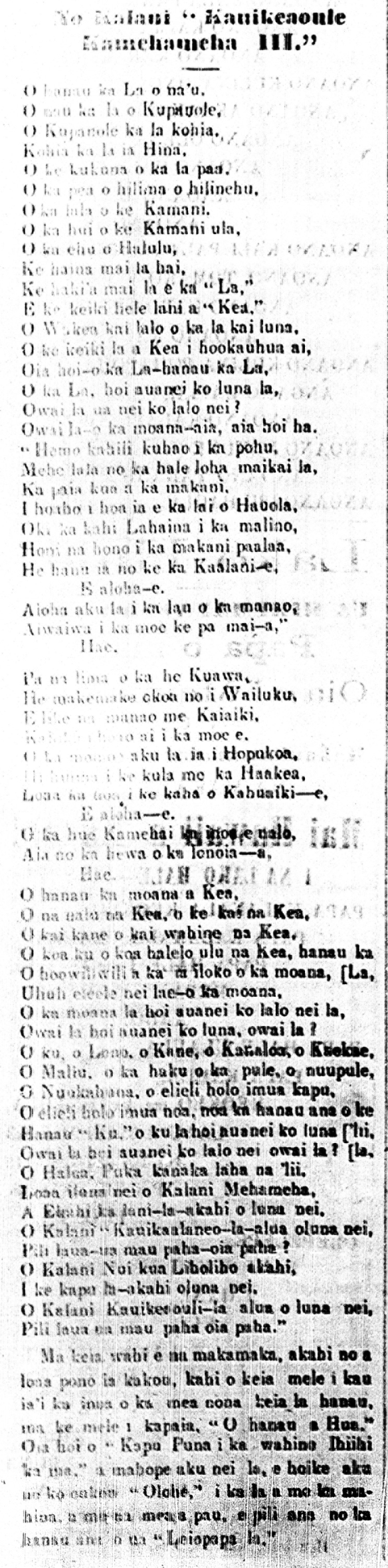
No Kalani Kauikeaoule Kamehameha III."

Ka Nupepa Kuokoa, Buke V, Helu 13, Aoao 4. Maraki 31, 1866.


Why are some religions “real” while others are “superstitions,” “myths,” and “legends”? 1905 / today.

WAKEA THE POLYNESIAN

(By Rev. W. D. Westervelt in Paradise of the Pacific.)

The fountain source of the Mississippi has been discovered and re-discovered. The origin of the Polynesian race has been a subject for discovery and re-discovery. The older theory of Malay origin as set forth in the earlier encyclopædias is now recognized as untenable. The Malays followed the Polynesians rather than preceded them. The comparative study of Polynesian legends leads almost irresistibly to the conclusion that Polynesians were Aryans, coming at least from India to Malaysia and possibly coming from Arabia, as Fornander of Hawaii so earnestly argues. It is now accepted that the Polynesians did not originate from Malay parentage, and that they did occupy for an indefinite period the region around the Sunda Straits from Java to the Molucca Islands, and also that the greater portion of the Polynesians was driven out from this region and scattered over the Pacific in the early part of the Christian Era. The legends that cluster around Wakea have greatly aided in making plain some things concerning the disposition of the Polynesians. By sifting the legends of Hawaii-loa, we learn how the great voyager becomes one of the first Vikings of the Pacific. His home at last is found to be Gilolo of the Molucca Islands. From the legends we become acquainted with Wakea (possibly meaning “noonday” or “the white time” and his wife Papa (“earth”), the most widely remembered of all the ancestors of the Polynesian race. Their names are found in the legends of the most prominent island groups, and the highest places are granted them among the chief dieties. Their deeds belong to the most ancient times—the creation or discovery of the various islands of the Pacific world. Those who worshipped Wakea and Papa are found in such widely separated localities that it must be considered impossible for even a demi-god to have had so many homes. Atea or Wakea was one of the highest gods of the Marquesas islands. Here his name means “light.” The Marquesans evidently look back of all their present history and locate Atea in the ancient home land. Va-tea, in the Society Islands, Wakea in Hawaii and New Zealand, Makea-Vakea and Akea are phonetic variations of the one name when written down by the students who made a written form for words repeated from generation to generation by word of mouth alone. Even under the name Wakea this ancient chief is known by most widely separated islands. The only reasonable explanation for this widespread reference to Wakea is that he was an ancestor belonging in common to all the scattered Polynesians. It seems as if there must have been a period when Wakea was king of chief of a united people. He must have been of great ability and probably was the great king of the United Polynesians. If this were the fact it would naturally result that his memory would be carried wherever the dispersed race might go.

In the myths and legends of the Hervey Islands, Vatea is located near the beginning of their national existence.” Then there came upon the ancient world Te Vaerua, “the breath” or “the life.” Then came the god time—Te Manawa roa, “the long ago.” Then their creation legends locate Vari, a woman whose name means “the beginning,” a name curiously similar to the Hebrew word bara, to create, as in Gen. 1:1. Her children were torn out of her breasts and given homes in the ancient mist land, with which without any preparation or introduction, Hawa-iki is confused in a part of the legend. One of the children of Vari dwelt in a “sacred tabu island” and became the god of the fish. Another sought a home “where the red parrots’ feathers were gathered”—the royal feathers for the high chief’s garments. Another became the echo-god and lived in the “hollow grey rocks.” Another as the gods of the winds went far out “on the deep ocean.” Another, a girl, found a home, “the silent land,” with her mother. Wakea, or Vatea, the eldest of this family remained in Avaiki (Hawaii) the ancestral home—”the bright land of Vatea.” Here he married Papa. This Ava-iki was to the Herveyites of later generations the fiery volcanic under-world. When the long sea voyages ceased after some centuries, the islanders realized that Ava-iki was very closely connected with their history. They had but a misty idea of far off lands, and they did know of earthquakes and lava caves and volcanic fires—so they located Ava-iki as the secret world under their islands. This underworld with legendary inconsistency was located on the ocean’s surface, when it became necessary to have their islands discovered by the descendants of Vatea. According to the Hervey legends, Vatea is the father of Lono and Kanaloa, two of the great gods of the Polynesians. They are twins. Lono has three sons, whom he sends away. They sail out through many heavens and from Ava-iki “pull up” out of the deep ocean two of the Hervey islands. The natives of the Hervey group supposed that the horizon around their group inclosed the world. Beyond this world were heaves after heavens. A daring voyager by sailing through the sky line would break out from this world into an unknown world or a heaven bounded by new horizons. Strangers thus “broke through” from heaven to heaven, sometimes making use of the path of the sun. Thus about twenty-five generations ago Raa (possibly Laa, the Hawaiian), broke down the horizon’s bars and established a line of kings in Raiatea. So also when Captain Cook came to the Hervey Islands the natives said: “Whence comes this strange thing? It has climbed up (come up forcibly) from the thin land the home of Wakea.” He had pierced the western heavens from which their ancestors had come. Continue reading

The performance of famous story of Hiiakaikapoliopele, 1880.

HAWAIIAN THEATER!

—AT THE—

TEMPERANCE HALL

—TONIGHT—

SATURDAY, JULY 31, 1880.

Shown will be the Famous Story of

HIIAKAIKAPOLIOPELE

and Lohiau on this night, like this below:

PROGRAM.

Hula Muumuu, Mokoi, Kilu, Pahu, Ka-laau, Pili, Alaapapa, Keawenuiaumi, Himeni, Uliuli and Hula Kii.

The doors will open at 7 o’clock, and begins at 8 o’clock sharp.

ENTRANCE FEE.

Front seats .. .. $1.50

Back seats .. .. $1.00

(Kuokoa, 7/31/1880, p. 2)

KEAKA HAWAII!

Ka Nupepa Kuokoa, Buke XIX, Helu 31, Aoao 2. Iulai 31, 1880.

Hula performance, 1911.

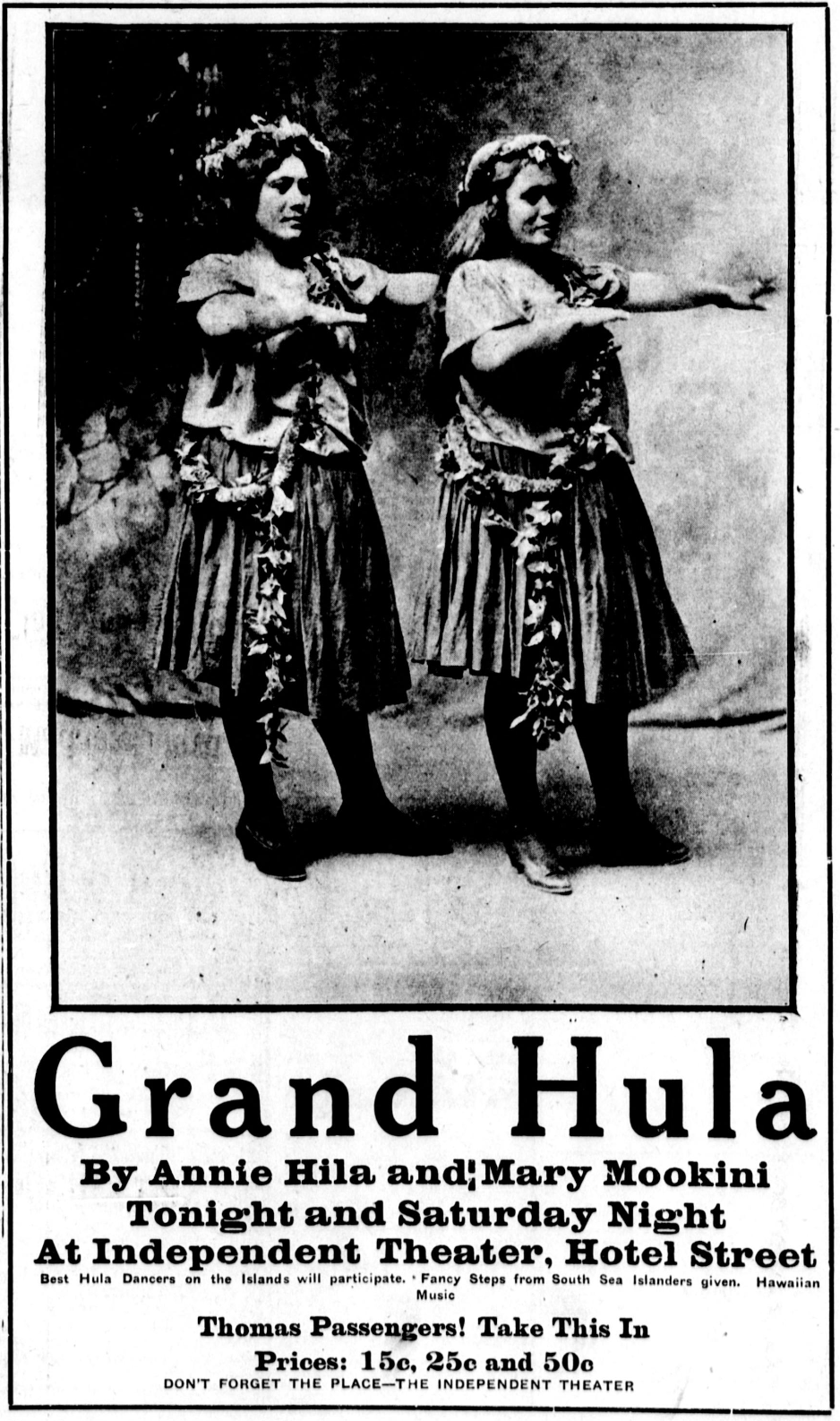
Grand Hula

By Annie Hila and Mary Mookini

Tonight and Saturday Night

At Independent Theater, Hotel Street

Best Hula Dancers on the Islands will participate. Fancy Steps from South Se Islanders given. Hawaiian Music

Thomas Passengers! Take This In

Prices: 15c, 25c and 50c

DON’T FORGET THE PLACE—THE INDEPENDENT THEATER

(Evening Bulletin, 11/14/1911, p. 6)

Grand Hula

Evening Bulletin, Established 1882, Number 5083, Page 6. November 14, 1911.

Hula and the play “Umi-a-Liloa,” 1917.

TRULY HAWAIIAN IS ‘UMI-A-LILOA’

The hula alaapapa will be one of the special entre act features of the performance of “Umi-a-Liloa” at the opera house next Thursday evening. This hula is danced standing in contradiction to the older hulas which is called for a sitting position. It will be interpreted by a band of four young girls, who are experts in the art of the real Hawaiian dance. They are assisted by a man who beats the hula drum in old-time style. It is only in recent years that the hula has been accompanied by the music of instruments.

The second act contains an elaborate representation of the court of the king of Hawaii in the year 1640 and during the scene of the royal festivity some of the very ancient dances are introduced. They are danced, if one may call it so, sitting cross-legged upon the floor and the beauty of the performance lies in the grace and graphic intensity of the gestures of the body and arms of the dancers. Continue reading

Hula from Kahuku at the Orpheum, 1905.

RURAL HULA DANCERS AT THE ORPHEUM

The country dancers of Kahuku came over to Honolulu to show the city folks what a real hula is. The show was at the Orpheum last night under the ponderous auspices of Haona whose hula school is the pride of Koolau. There was a good crowd out to see the performance and the people seemed to enjoy what they saw.

The first part of the exhibition was a hula paipu. Keaka, the star dancer, appeared in a red pa-u, with the appropriate leis and a fixed stare.

Madame Haona thumped a calabash and then twiddled a little rattler till her deprecatory helper, Niuolaa (k), smiled feebly and took the count with his instrument. Keaka danced gracefully and well and the applause rose heavily.

The Emerald Glee Club intermitted with some Hawaiian songs sung in conscientious style.

Hula olaapapa was the next on the program and once more Madame Haona banged the calabash and chanted voluminously while the same Keaka swung her lithe body over the stage to the uproarious joy of the gallery.

Hula uli-uli ku iluna, with the rattlers dancing on Haona’s knee followed and Niulaa, the helper, meek and mild, almost achieved vigor while he banged the cymbal and thumbed the drum.

Again the Emerald Glee Club played in lady-like style and elicited applause.

Then Madame Haona sprung her one sensation, hula uli-uli noho ilalo. The weary Keaka swung out to the resounding chant and took new life. The helper became agonized in his efforts to keep up with his superior on the drum and the roar of Haona’s singing thundered through the hall while Keaka danced deliriously, her red pa-u becoming a vibrant flame. Haona raised her voice a note and the swift swing of the hula girl took a more furious speed until every shout of the chant came with a bellow that raised the audience from their seats and made the atmosphere tense with expectancy.

But this was the end of the performance. Keaka sank exhausted and Haona voluminously and coughingly announced that the show was pau.

Haona had five other girls in training for the hula but did not think them equal to the strain of a metropolitan exhibition. Consequently the whole show lacked vim and life except for the one dance in which Keaka, the star dancer, forgot her sedateness.

The audience was rather a representative one and included several parties of fashionable people who professed to be duly shocked and amused.

(Pacific Commercial Advertiser, 10/15/1905, p. 1)

RURAL HULA DANCERS AT THE ORPHEUM

The Pacific Commercial Advertiser, Volume III, Number 146, Page 1. October 15, 1905.