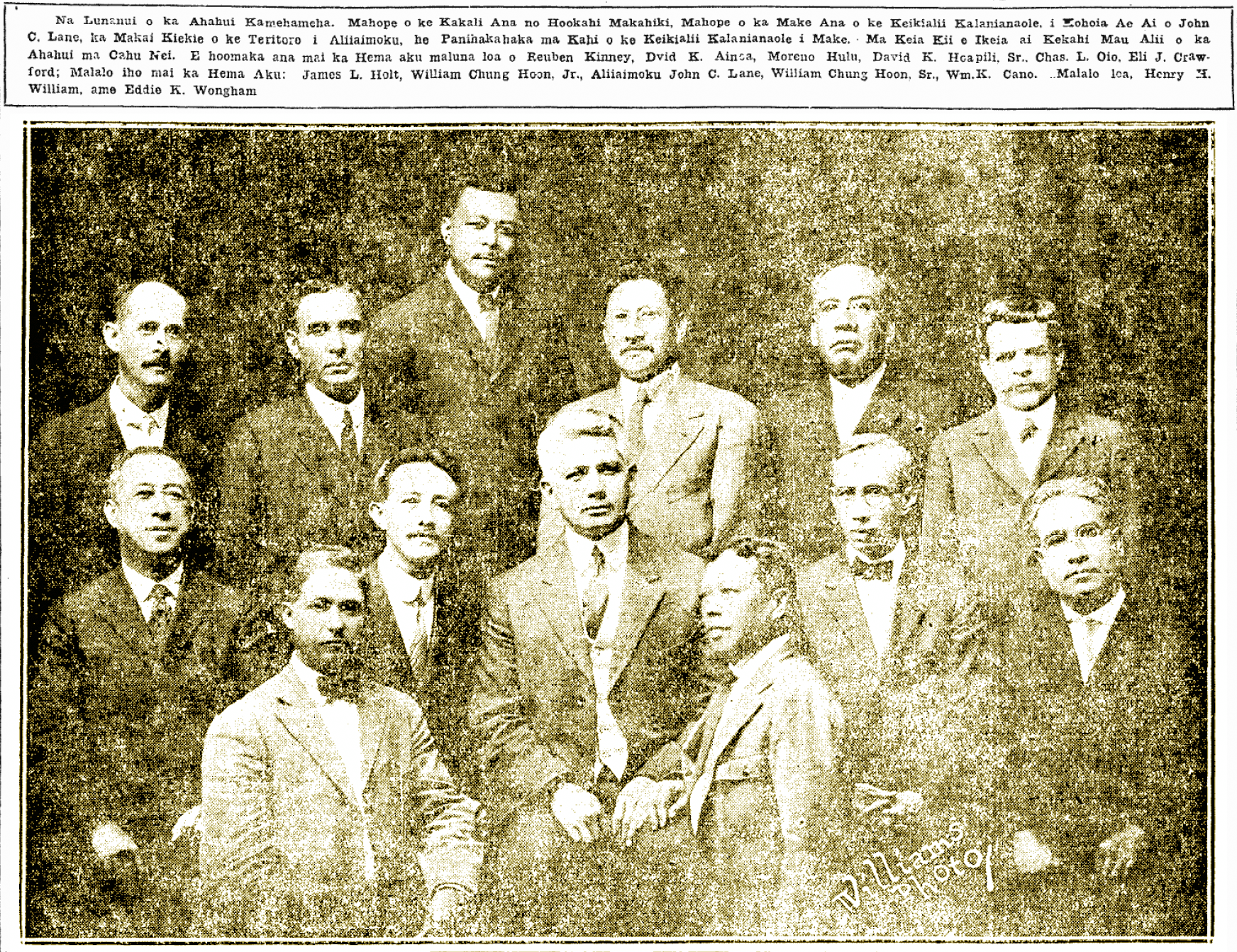
Kaahumanu Society elects new officers, 1922.

ANNUAL MEETING OF THE KAAHUMANU SOCIETY.

At three in the afternoon on Wednesday of last week, the Ahahui Kaahumanu held its seventeenth annual meeting at the usual place, to elect the new officers of the association, and to listen to the annual report of the officers.

During the year, there were twelve members who left this life; nine members were each paid for by the society for their burials, and three members who died left benefits after they left this life to the society. The expenses for those members who died reached a total of $665.

The expenses to assist ailing members of the society reached $479.30; according to the many testimonies, the society is progressing well.

There were twelve new members included into the society on that day, and their names are below:

Jennie Kapahu Wilson, Mrs. Bernice Kaehanaoleokalani Kaaiakawaha Spitz, Mrs. Stella Kalikokalani Hanohano, Miss Miriam Kahakuhaakoi Kinney, Annie Paahana Laipila, Mrs. Elizabeth Holoaumoku Gittel, Miss Erna Holoaumoku Gittel, Mrs. Elizabeth Keliinoi Kinolahilahi Bayless, Mrs. Molly Kameeaulani Kapuaokekau Cummings, Miss Mary Kahale Cummings, Miss Haumealani Sheldon, Mrs. Elizabeth Kalaulaokalani Mitchell.

The society was thrilled at the joining of the young members, because the time will come that they will the place of the old members to move the endeavors of the society forward.

The old officers were reelected at this annual meeting; some of the officers held on to each of their positions for the past seventeen years. Here are the names of the officers who were reelected:

Miss Lucy Kamalalehua Kaheiheimalie Peabody, president [peresidena]; Mrs. Helen Kaukuikamokuikekapuokanehunamoku Kamaiopili, vice president [hope peresidena]; Mrs. Elizabeth Lahilahi Napuaikaumakani Webb, secretary [kakauolelo]; Mrs. Lilia Kahuakaiulaakanani Aholo, assistant secretary [kokua kakauolelo]; Mrs. Esther Kailihao Wilson Kelle, treasurer [puuku]; Mrs. Ellen Hooipoinalanielua Dwight, auditor [lunahooia].

Miss Mary Kanailani Sylva, committe to look after the ailing members of the society.

The member of the executive committe [papa hooko]: Mrs. Irene Ii Haalou Kahalelaukoa Holloway, Mrs. Louise Iehu Hapai Ahrens, Mrs. Caroline Kapuaianahulu Robinson, Mrs. Aha Kawehiokalani Ayau, Mrs. Elizabeth Nalehua Kukalia Kahookano, Mrs. Julia Paakonia Kahanamoku, Mrs. Mary Nanea Luana Simeson, Mrs. Caroline Ke Kaua Kuamoo Wallace. Henry Smith, pastor [kahu].

After the meeting was adjourned, there was light refreshments to satisfy all who gathered at the meeting.

(Kuokoa, 6/22/1922, p. 7)

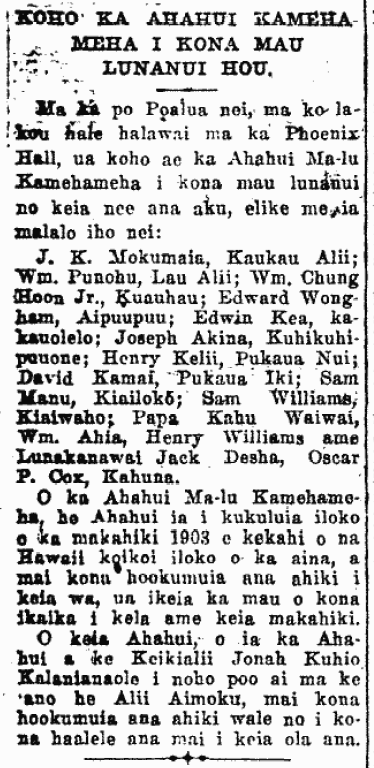
KA HALAWAI MAKAHIKI A KA AHAHUI KAAHUMANU.

Ka Nupepa Kuokoa, Buke LXI, Helu 25, Aoao 7. Iune 22, 1922.

Diamond Kekona passes away in Germany, 1922.

That Hawaiian Boy Dies in Germany

Diamond Kekona Grew Weary of This Life After One Week of Being Ill.

HIS WIFE WAS AT HIS DEATH BED

It was His Wife Who Announced the Sad News to Honolulu nei on Monday

On Monday, this town received the sad news about the death of Diamond Kekona, the son of D. K. Kekona of this town, in Berlin, Germany, on the 13th of last month, February.

It was Mrs. Diamond Kekona, the wife of Kekona, who sent the sad news of the death of her husband to Mekia Kealakai, the leader of the Royal Hawaiian Band [Bana Hawaii], because he was a friend of the young Kekona and his wife when they were all living in London.

A letter was also received by Mr. D. K. Kekona, the father of the young man, confirming the news about the passing of his son.

Diamond Kekona was born on the 6th of October, 1890, so at his death, he was thirty-three years old and some.

Diamond left Honolulu in 1905 for New York, with a group of singers and musicians. He spent many years in America in this occupation.

During the great war of the world, Diamond Kekona was in England, and he enlisted in the service under Britain, going off to war in France and Belgium. He married a British woman and had two children, however the two of them died.

At the end of the war, Mr. and Mrs. Kekona lived in Belgium, and just last year they went to Berlin, Germany, where they met up with Joe Puni, William Kanui, and Joseph Nihali [?]; but according to the letter of Mrs. Kekona, he did not get along with Joe Puni, and they did not talk.

Mr. Kekona was not sick for long before he died, it was just a week; and in the letter his wife wrote to Mr. D. K. Kekona, she told him of her intent to return the body of her husband to London to bury, in her homeland, close to her home.

With the passing of this Hawaiian youth in foreign lands, he left behind, grieving for him: his young British wife; his grandmother, Mrs. Makalohi, who is 91; his father, Mr. D. K. Kekona, working in the sheriff department and a pastor of the Christian Science Church [Hoomana Naauao]; two younger brothers named Hugo and August Kekona; and their sister, Mrs. Lonohira [Mrs. George Lonohiwa]; and a big family.

(Kuokoa, 3/22/1922, p. 1)

Make Ia Keiki Hawaii Maloko o Kelemania

Ka Nupepa Kuokoa, Buke LXI, Helu 12, Aoao 1. Maraki 22, 1922.

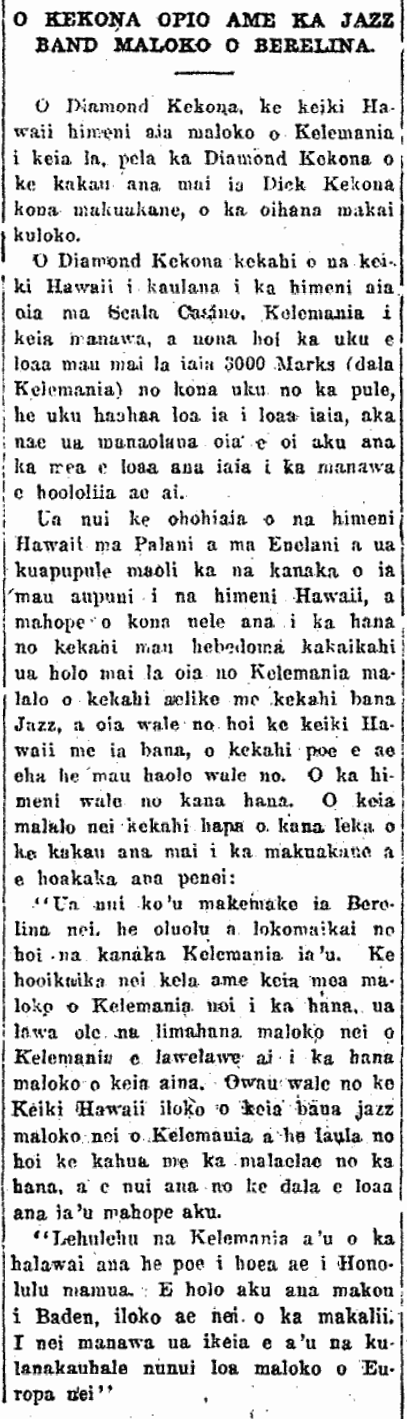
Maybe that wasn’t the final word on Diamond Kekona, 1922.

THE YOUNG KEKONA AND JAZZ BAND IN BERLIN.

Diamond Kekona, the Hawaiian singer is in Germany today, that according to what Diamond Kekona wrote to Dick Kekona, his father, who is in the local police department.

Diamond Kekona is one of the Hawaiian boys famous for his singing, in Scala Casano [?], Germany now, and is getting paid 3,000 Marks (German dollars) per week, which is a very low wage for him, but he hopes he will receive more when it is changed.

There was much enthusiasm in France and England about Hawaiian music and the people there went crazy over Hawaiian music, and after he was out of work for a few weeks, he went to Germany under a contract with a Jazz band, and he is the only Hawaiian in the band; the other four are all haole. He only sings. Here below is a portion of his letter written to his father explaining:

“I’ve met many Germans who have been to Honolulu before. We are headed for Baden in the summer. I am now seeing the huge cities of Europe.”

[I went back earlier into the year to see if i might find a death announcement for Diamond Kekona, because we have received kind word from Sabine, a dear reader in Germany, that she’d attempt looking for Diamond Kekona’s grave, and this is what I found first from early in 1922.]

(Kuokoa, 1/27/1922, p. 1)

O KEKONA OPIO AME KA JAZZ BAND MALOKO O BERELINA.

Ka Nupepa Kuokoa, Buke LXI, Helu 4, Aoao 1. Ianuari 27, 1922.

More mele, this time from Liliuokalani! 1920.

NEW MELE BY LILIU.

From within the various papers of the deceased Queen Liliuokalani, the Honorable H. L. Holstein, the executor of the deceased queen’s estate, found two mele which she composed herself, and which Honolulu’s people have not heard before; however, on the evening of this Sunday, the mele will be sung by the Royal Hawaiian Band [Bana Hawaii] outside of Kapiolani Park, under the direction of Mekia Kealakai.

The words of these compositions are profound, unlike most of the mele composed by other famous composers of Hawaii nei; this shows that there are but few people who are adept at composing mele like Queen Liliuokalani.

Being that Mekia Kealakai is one of those skilled at composing Hawaiian mele while he was a member of the Hui Kawaihau [Kawaihau Glee Club], there will be nothing lacking in his directing of the playing and singing of the Royal Hawaiian Band, when the mele are sung, drawing forth feelings of admiration from the audience.

Here below are the mele composed by Queen Liliuokalani:

KA UA KILIHUNE O KONA.

Ei ae ka ua kuakualua
Ke nihi ae la i ka moana;
E uhai ae ana e ike kona pili,
Kahi wai kaulana i Haliilua.

Hui.

Maeele au i ka ua la,
Kilikilihune ka nahele la,
Hoopulu ana i ka palai.

Pulu au i ka ua anu au maeele,
Hoopulu ana i ka palai.
Ke walea la oe i ka la’i o Maunaloa,
I ka uluwehi nani a o ka lehua.

NOHEA.

He mea nani ke aloha,
Ke hiki mai i o’u nei;
Me he opuu lei daimana,
Kahiko no kuu kino.

Hui.

Kuu lei popohe i ka la’i,
Nohea i Mu’olaulani,
Ko beauty la he mau ia,
No na kau a kau.

He pua iluna ka’u li’a,
He mea laha ole na loko;
He waiwai hiilani na’u,
O ka oi no ia o Hawaii.

[This must have been some performance! “Nohea” is also known as “Nohea i Mu’olaulani” and as just “Mu’olaulani.” I am not sure why this song is referred to as an unknown composition in 1920. But does anyone know if there are any recordings of “Ka Ua Kilihune o Kona”?]

(Kuokoa, 12/10/1920, p. 3)

HE MAU MELE HOU NA LILIU.

Ka Nupepa Kuokoa, Buke LVIII, Helu 50, Aoao 3. Dekemaba 10, 1920.

Meeting with Maori residents of Hawaii, 1920.

AUDIENCE WITH THE MAORI AT THE HOME OF MRS. A. P. TAYLOR.

In the uplands of Manoa, at the home of Mrs. A. P. (Ahuena) Taylor, at “Luana Pua,” an audience was held to honor the Maori of New Zealand [Nu Kilani], living in this town; and attending were many Hawaiians, where they spent a long time, last night, meeting with the malihini, while they compared the old Hawaiian stories with that of the Maori people.

This is the second time which the Maoris appeared at the home of Mrs. A. P. Taylor, on that night, because of the desire of these malihini to have proper time for them to meet and discuss with the descendents of the important families of Hawaii nei.

Present were the descendents of the line of Kamehameha and Kalakaua on that night, there also were some kamaaina who had a deep understanding of the history of the Hawaiian people, to satisfy the desire of the malihini.

Within Mrs. A. P. Taylor, as well as in all of the people who gathered there last night, was the wish to find the genealogy shared between the Hawaiians and the Maori people, and that it be in accordance with the stories memorized by the Maori; and it is their true belief that the Maori came from the Hawaiians by Hawaiians travelling to New Zealand.

This night was spent with talking between the malihini and kamaaina, as the crowd was entertained by singing, while light foods were passed before all who were invited.

Amongst those present at this meeting was: Princess Kawananakoa, Kaukaualii Stella Keomailani Kea, Kaukaualii Kekaaniau Pratt, Judge S. B. Dole, Mrs. Mary Jane Montano, Edwin Kea, Kaukaualii Lucy K. Peabody, Mr. and Mrs. E. Henriques, Mrs. E. M. Nakuina, Mrs. Irene Holloway, Mrs. K. Hutchinson, Misses Lani Mercy and Misses Lani Hutchinson, Mr. and Mrs. K. Beckley, L. Beckley, G. H. Beckley, Mr. and Mrs. M. Kahea, Mr. and Mrs. W. K. Taylor, Miss Mabel Taylor, Mrs. E. Straus, Mrs. K. Kali, Mr. and Mrs. J. C. Lane, Mr. and Mrs. C. Maertens, Miss Anna Maertens, Mrs. E. M. Foster, Mr. and Mrs. I. R. Burns, Mr. and Mrs. H. Afong, Mrs. J. M. Riggs, Col. and Mrs. C. P. Iaukea, Mr. and Mrs. M. Ahia, Mrs. N. Mahelona, Misses Mahelona, Mrs. M. Wilson, Mr. and Mrs. D. Hoapili, Jr., Mr. and Mrs. A. K. Hoapili, Miss Hoapili, A. Hoapili, K. Hoapili, G. Kealohapauole, Mrs. K. Mahoe, Mr. and Mrs. Hans Gittel, Mr. and Mrs. W. Simerson, Mr. and Mrs. Isaac Harbottle, Rev. and Mrs. S. Kamaiopili, Mr. and Mrs. E. Boyd, Mrs. K. Wallace, Judge and Mrs. A. G. M. Robertson, Mr. and Mrs. Chillingworth, Mr. and Mrs. S. Chillingworth, Jr., Mr. and Mrs. F. Hons, Mrs. Lahilahi Webb, Mrs. E. S. Cunha, Miss Irene Dickson, W. A. Beckley, Mr. and Mrs. J. Kamanoulu, Mrs. J. H. Wilson, Rev. Akaiko Akana, Mrs. Niau Iaukea, Mrs. S. Parker, Mr. and Mrs. Robt. Hind, Miss HInd, Miss Mary Low, Mr. and Mrs. Eben Low, Mrs. Hannah Paris, Mrs. Caroline Robinson, Miss Kathleen Ward, Miss Lucy Ward, Miss Kulamanu Ward, Mr. and Mrs. Hanohano, Mrs. K. Bishaw, Mr. and Mrs. C. Long, Mrs. Lewis, Mrs. Mana, Mrs. Myra Iona, Mr and Mrs. E. W. Burgess, Mrs. P. Phillips, Mrs. M. Fernandez, Mrs. Edwin Fernandez, Rev. and Mrs. Maikai, Mr. and Mrs. M. Robinson, Mr. and Mrs. C. F. Peterson, Mr. and Mrs. E. P. Irwin, Mr. and Mrs. D. Peterson, Mr. and Mrs. W. A. Cottrell, Mrs. Hilda Techera, Mrs. Kamaka Stillman, Mr. and Mrs. Cushingham, Mrs. Ellen Dwight, Misses Holt, Mrs. C. W. Spitz, Mrs. T. B. Walker, Mr. and Mrs. Constable, Captain and Mrs. W. E. Miles, Mrs. Victoria Buffandeau, Mr. and Mrs. W. Paikuli, H. L. Holstein, Carl Widemann.

[To have been a fly on the wall here…!]

(Kuokoa, 6/18/1920, p. 4)

KA AHA IKE A NA MAORI MA KA HOME O MRS. A. P. TAYLOR.

Ka Nupepa Kuokoa, Buke LVIII, Helu 24, Aoao 4. Iune 18, 1920.

Final word on Diamond Kekona… 1922.

A LETTER FROM FOREIGN LANDS.

Mr. Dick Kekona, much aloha between us:—Here is what I have to tell you, I met up with your letter on this past 8th, and I understand your feelings full of aloha.

Here I am, living in Berlin [Belina], and we are working at Luna Park [a well-known huge amusement park of the day] today until the end of winter [summer?] and going into September. We are working at Luna Park for four months. Great is Almighty God’s aloha for the Hawaiians  who wander about the world.

Here is another new thing I must tell you, about the grave of Diamond [Kaimana] Kekona, I will take care of it and watch over it, and I will purchase a gravestone for Kaimana Kekona, my beloved younger brother.

As for our life here, it is very good, and our health is fine as well. I pray every day for the day we will meet again.

Here is another thought I have for you, my father in the land of my birth; if you might please look for my actual family who are in Kailua, Koolaupoko, Oahu: Julia Kapahu, my mother; David Nahale, my older brother; and Mele, my sister. Give my great aloha to all of them, and tell them to write me here in Berlin.

I thank you, O Papa, for your kindness to me.

Perhaps this is enough here. Give my aloha a nui loa to the family, and to yourself as well.

Sincerely, living here,

JOSEPH K. NAHALE,

17 Liesenstrasse, Berlin, N. 39 Germany.

c/o C. Sundermann.

[I wonder what happened to Diamond. He must have been only in his early 30s? Maybe he grave is still findable in Berlin?]

(Kuokoa, 6/22/1922, p. 8)

HE LETA MAI NA AINA E MAI.

Ka Nupepa Kuokoa, Buke LXI, Helu 25, Aoao 8. Iune 22, 1922.

A Touching letter from Diamond Kekona, in far away Britain, to his father in Hawaii, 1916.

LETTER FROM BRITAIN

Dear Papa:–Here are some words for you; my wife and I are healthy, and we are believing that you and the family are doing likewise. My dear wife is completely cured of her sickness, after I put great efforts into finding a cure–partly as a result of the doctors and partly because of the Lord Jesus Christ–as I prayed all the time to the Lord to give health to my wife, as you instructed me earlier.

She was sick for 12 weeks from the time she gave birth, and because of God’s love she regained her health. I take her walking around every day for 2 hours, and she is beginning to eat and regain her weight.

Father, I have joined the armed forces, as I told you earlier. The doctor gave his permission, and I received my papers, to the regiment #30, of married men, under the command of Lord Derby. I wear the symbol of my regiment on my left arm, just as other soldiers do in the army of Britain. I will receive my orders in June or July to proceed to the battlefield without delay for the honor of the Hawaiian people and for the flag of the homeland of my beloved wife.

We will send you a picture on the next boat, and when I receive my uniform, I will send you a picture, and that will be my last picture for who knows how long, but I find my relief in God. Tell August Kekona, don’t come to this land; there are no jobs, no money, there is lack in daily needs; tell him to go to America because it is a land where you can make it, where you can make money and get other things to make you happy. I say this because I was there for many years. Tell him my advice. I am thinking this is enough writing for the time being. Papa, give my love to Kuku Makalohi and uncle, Mrs. Lonohiwa, Bro. August and Hugo Kekona, and the rest of my love, to you my Papa. You son,

DIAMOND KEKONA,
87 Blackwell St., Kidderminster, England.

Aloha Papa:–Here are some thoughts to you, those being these: I am doing well, I am over my sickness, because of the tireless efforts of my loving Daimana for me.

Papa, tell August Kekona, don’t leave Hawaii. If he listens to my advice, he will be happy; he should live in Honolulu with you. There is no work for men here; women work, and take care of their husbands. Women are more than half of the workforce here in Britain now. Also, the pay here is very low. Papa, you are probably puzzled that my Daimana has joined the 30th regiment of married men, under the command of Lord Derby. I believe that this war is one of the worst; I am very afraid. There will be many more casualties of the men joining this war–both from the Allied side and the German side, before the war is over.

Daimana and I sent our picture to you, but my picture isn’t so good because I have just recovered from my sickness. I will go again later to take a picture and send it to you. I look at my picture and it is as if I am a totally different girl. I think I will end here. I wish you and everyone there the best in this new year. Papa, don’t forget to give my aloha to Mrs. Lawe Lonohiwa (I will write her when I have some time). Give my love to August Kekona. Your daughter,

AMY KEKONA.
78 Blackwell St., Kidderminister, England.

(Kuokoa, 2/18/1916, p. 2)

LETA MAI PELEKANE MAI.

Ka Nupepa Kuokoa, Buke LIV, Helu 7, Aoao 2. Feberuari 18, 1916.

Speaking of Hawaiians serving in the military, does anyone remember Diamond Kekona? 1916.

A Son of Hawaii Goes to War for Britain

This picture was sent from Britain giving notice that Diamond Kekona, a Hawaiian, was enlisting in the Military of the homeland of his wife, Britain. He is prepared for when he will be called to service. Those in the picture are Mr. and Mrs. Barker, Mr. and Mrs. Diamond Kekona, and Mr. and Mrs. Smith. One of the women is an older sister of Mrs. Kekona’s. And one of the men is their brother.

[When i was posting to the old Hoolaupai Face Book page, there were many letters sent by Diamond Kekona from England to his father Dick [Richard Kekona] which were posted. If anyone wants to see them reposted here, where they will be easily searchable, i can do that. I will post the first letter i found in the papers right after this as an example.]

(Kuokoa, 3/31/1916, p. 1)

Komo He Keiki Hawaii E Kaua No Pelekane

Ka Nupepa Kuokoa, Buke LIV, Helu 13, Aoao 1. Maraki 31, 1916.

More Hawaiians serving in the military, 1922.

A LETTER FROM A SON TO HIS MOTHER.

A Hawaiian boy whose name is John Gilman Kealoha, who is working on the Submarine R—23, as the one who operates the Radio aboard that submarine mentioned, wrote a letter on the 26th of this past August, to his mother, Mrs. Cecilia J. Kealoha of this town, describing how he is living and also the love he has for his parents; and the thoughts in his letter written in English can be seen translated for the benefit of the readers of the Kilohana [“the Foremost,” an epithet for the Kuokoa], below:

U. S. S. R.—23,

New London, Aug. 26, 1922.

My beloved mama:—

I am writing to tell you that I’m currently working aboard the Submarine U. S. S. R.—23 as the one who operates the Radio Telephone. I have submerged 22 times from when I first boarded this vessel. Our captain is good, and so are the 30 people aboard this craft. I am in good health and I hope you two are as well, as well as everybody else living at home. Our submarine will leave here to travel on to Norfolk, Virginia with another submarine, the R—27, and while in Norfolk, the ship will be filled with fuel and food supplies and from there it will travel to Charleston, Key West, and then to New Orleans to gather for when the convention of delegates will meet, and there the submarines will show how they submerge so the people there can see, and the rest of the time will be spent by us at Coco Solo, near the Panama Canal [alawai o Panama], where the submarines will stop.

Mama, in my opinion, it is for the best if younger brother, Kalei, stays with you two at home always; he was paid two months ago; if he is at home, give him a lot of my aloha, and also to the people at home; this way, I know that I will get word by letter from some of them, mainly from Younger brother Herman and sister, and from you two as well.

It has been nearly three years that I’ve been away from home, and it is you mama who I think a lot about, and papa as well; and it is for you two that I always pray at night and day, until we meet once again. I wrote to you before this, but I did not receive a reply to that letter, maybe you sent one, but I didn’t receive it, maybe because you sent it to the wrong address; here is where to write again:

JOHN GILMAN KEALOHA,

U. S. S. R.—23,

New London, Conn.

O Mama, I just put in money into my savings again, at the Navy Savings Bank, [83 Sands Street], Brooklyn, N. Y.; I’m putting away $20 a month, and when my money accumulates, I will send it to the Bank of Hawaii in Honolulu by remittance. I have the number of that Bank book with me.

I have decided to spend my New Year (Nu I-a) at Coco Solo. I end here and wait for your reply.

Give my big aloha to papa and all the family and friends at home.

From your loving child,

JOHNNIE.

[If this is the same person as the “John Kealoha Gilman” whose grave at Punchbowl is recorded here, he was only 16 years old in 1922…]

(Kuokoa, 10/12/1922, p. 7)

HE LEKA NA KEKAHI KEIKI HAWAII I KONA MAKUAHINE.

Ka Nupepa Kuokoa, Buke LXI, Helu 41, Aoao 7. Okatoba 12, 1922.

Rising food prices: Will politicians ever learn? 1923 / timeless.

REASONS FOR THE RISING COST OF FOOD.

There is perhaps no other more important question pertaining to the life of man than that of the cost of food. How many people have sat down and thought to themselves about the reasons for the rising costs and ways to lessen their living expenses.

If we consider that there is no man on earth that can live without food, then we can find a reason; and through thought and careful consideration, we can figure out the major reasons for the rise in food prices.

First of all, for nations who rely upon other nations or other lands to supply their food, their food will be expensive, and food price stability will not be realized. But for a land that produces its own food, and exports the excess to nations who are lacking, they will see a fall in their food costs.

With these facts, we can move forward. Here we are in Hawaii, growing two major crops, however these two things are not main dishes which give sustenance to the body, but they are just treats. They being sugar and pineapple. We are putting our efforts into these two things and this nation draws its income from it; however, at the same time, we are forgetting about the foods necessary for the body, and because we are so focused on chasing after money, we assume that these funds will supply us with food for nourishment.

The problem with our focus on the pursuit of money, is that we neglect looking after the actual things that are necessary for our bodies, the main staples. We are purchasing our food from foreign nations, while we are in pursuit of making money. When the nations which we rely upon to get our food have a small harvest, this is the time we will see an increase in the costs of food. It will rise because of the small amount of food growing in those countries in which we rely upon from where we get our food.

The second detriment to us in relying on the outside for feeding us is that when the shipping costs rise to ship in the food to us, there will be another set back, and that will be another reason the costs will rise. And should the occasion arise when there is war, or the lack of ships to bring our food, then the prices will shoot up; or there will be times when there is no food, because there will be no means to get the food.

And when the shipping costs rise, it will not be the sailors who will be in trouble, but it will be those who eat the food. For with the increase in the costs to the ship owners for pay for the sailors, or the ship builders perhaps, the ship owners will add on some pennies to the shipping charges, and when this comes to the hands of the consumer, he will understand that the expense to ship food here by boat resulted in an increase in the price of food; and the one paying the exorbitant prices for those foods is you, who eat them. And when the person is eating, he will see that the price of salmon here has risen.

And another factor in the rise of food costs is the number of people who eat the food, in a country that does not produce its own food. With the increase in population, the number of mouths will increase, so there will be less, or just doing without; and as a result of this lack, and to remedy it, the outside is relied upon to make up for this, and this is a problem bigger than all others. There may be a great amount of food brought in, but in comparison to the number of those who eat the food, that food is only a little, which is the main reason for the rise in food costs.

Therefore, we have come to where we can see where the problem lies. First, we do not grow staples. Second, although we have fertile land upon which we can grow food, we just grow things that bring in money and go without growing main foods.

What are staples? Vegetables and meat. These two things are staples. Other things are just treats, and man can live without them.

Here is Hawaii, a land where all foods can be grown which people eat here, along with the condiments. During the times of our ancestors, they had ample food so that they became big and strong. But these days, we are not planting staples. The Chinese and Japanese have come with their foods, with rice being the main food. This rice can be grown here in Hawaii nei. The haole came with their thing, the Irish potato and bread. Potatoes are being grown here now. As for flour, in the year 1849 or there about, Hawaii supplied California with flour. Wheat was grown in Kula, Maui, and on Molokai. Today, wheat can be grown should we desire. And if it is not possible, this is not a problem, because we are satisfied with other foods that can take its place.

And today, should we Hawaiians consider joining together in the growing of food, we will have the best food, and we will have produce that will help lessen the cost of food, as a result of this increase in the number of farmers.

The raising of livestock is also something needed, for that is a staple. Cows, pigs, goats, sheep, chicken, and the fishes of the sea. There is a lot of land now lived on by wild goats. If they were domesticated goats, then we’d have that meat, but because it is wild, and hard to get, it will not be enough for us; all the while the wild goats are feeding off of the fields which is for the sustenance of domesticated goats; some people are going into this profession.

The main thing that will lessen the costs of our food that we eat is the increasing of the growing of those foods; the joining into the growing of these things, because the quality of soil of this land is sufficient to grow these things. And let us look to making money through that, and not solely from treats.

We Hawaiians are supplied with land where we can enter into the occupation of growing food. There is probably no piece of land in Hawaii where staples cannot be grown. The land of Molokai has been opened up. The land of Kalamaula has enough water to grow food whenever it is desired. The lands upland of Palaau and Hoolehua will be opened up. These lands have soil good enough to grow Irish potatoes and corn.

Melons and other things can be grown which can support pig farming. With these staple foods, the farmer and those that raise livestock will receive good money from the mouths of those who live here, while being relied upon by those from outside to supply their food. Maybe the food won’t be cheaper, but you will have your food, O Farmer, with ease, and your family will be supplied, without it all being consumed; and the leftover, you can sent out to be purchased by those in pursuit of making money.

When foreign nations don’t have enough to send food to Hawaii, or when there are not enough ships, or if this nation enters into war, you and your family will have enough food, and you will get a higher price, because there will not be enough food imported. For these reasons, let us Hawaiians recognize these fields of gold stretched out before us, and let us grab it and harvest its many blessings. The seeking of one’s livelihood from the soil was the first way of life of the earliest men. And we know that there is no greater occupation than this. You are independent. You will have enough staple foods. You will have enough money, and with this money, you will have things that you do not grow. Clothes and things that make your life pleasant.

[I dedicate this to all the awesome farmers out there, both big and small (and fishermen and ranchers and dairy people for that matter). Also to the farmers’ markets, and establishments who support them. And to you, the people who try to buy local first. Conversely, I would like all of you politicians and others who think that agricultural lands and farmers are not important, to think about the big picture before another 89 years pass by. At this rate, we will be leaving the next generations with a very dismal way of life.]

(Kuokoa, 2/15/1923, p. 2)

NA KUMU PII O NA MEAAI.

Ka Nupepa Kuokoa, Buke LXII, Helu 7, Aoao 2. Feberuari 15, 1923.