Stunning Niihau Shell Lei Exhibit at the Bishop Museum, 2013.

Ni‘ihau Shell Lei

October 26, 2013 – January 27, 2014
Ni'ihau Shell LeiA private collection of over 60 stunning and pristine lei will be featured in “Ni‘ihau Shell Lei: Ocean Origins, Living Traditions” examines the science behind Ni‘ihau shells, as well as its manufacturing history and the master craftsman who make them.

This exhibit will be showcased in the Bishop Museum’s Long Gallery.

Mahalo to our sponsors:

  • Rapozo Kama‘aina Fund of the Hawai‘i Community Foundation
  • Hiroaki Elaine & Lawrence Kono Foundation
  • Hawaiian Malacological Society

In the collections of the Bishop Museum, 1903.

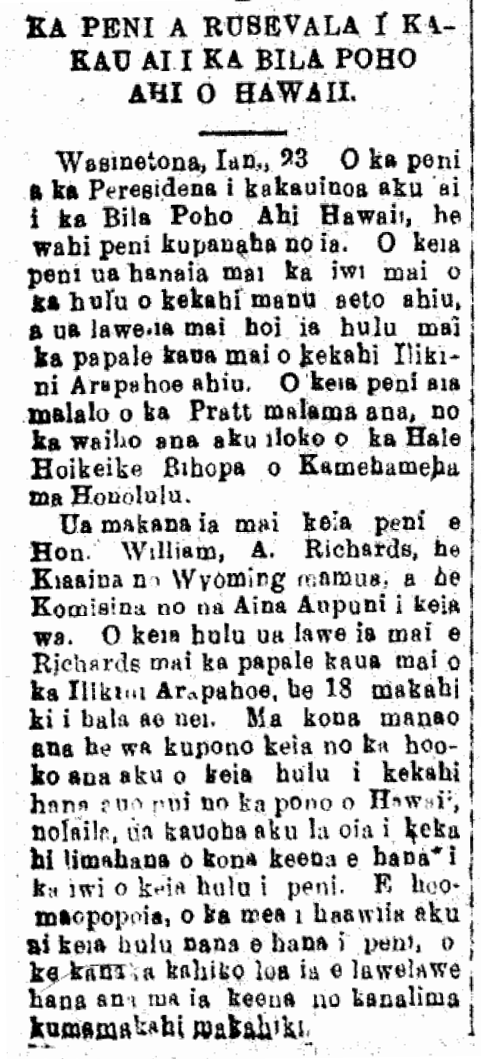
THE PEN WITH WHICH ROOSEVELT SIGNED THE FIRE CLAIMS BILL OF HAWAII.

Washington, Jan. 23. The pen with which the President signed the Hawaiian Fire Claims Bill [Bila Poho Ahi Hawaii] is a remarkable pen. This pen was made from the quill of a feather of a wild eagle, and that feather was taken from a war headdress of a wild Arapaho Indian. This pen is now in the care of Pratt to be placed in the Bishop Museum of Kamehameha in Honolulu.

This pen was gifted to the Hon. William A. Richards, a former Governor of Wyoming, and currently a Commissioner of Public Lands [Aina Aupuni]. This feather was taken by Richards from the headdress of an Arapaho Indian 18 years ago. He thought it was the right time for this feather to be put to some important use for Hawaii, therefore, he ordered one of the workers in his office to fashion the feather into a pen. Let it be remembered that this person who was given the feather to make a pen is a man of much seniority who was working in that office for fifty-one years.

(Aloha Aina, 2/7/1903, p. 1)

KA PENI A RUSEVALA I KAKAU AI I KA BILA POHO AHI O HAWAII.

Ke Aloha Aina, Buke IX, Helu 6, Aoao 1. Feberuari 7, 1903.

More on the building of the Bishop Museum, 1902.

Sent to Minnesota

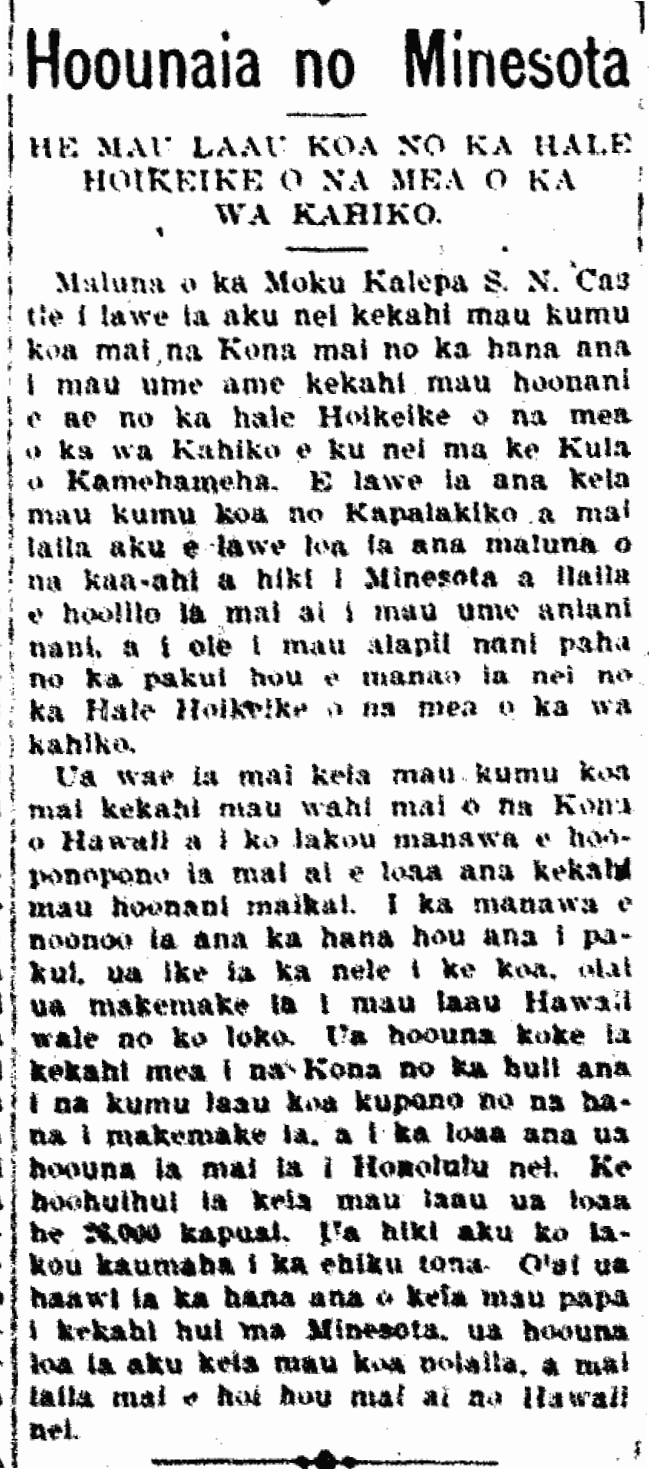
KOA TREES FOR THE MUSEUM.

Aboard the Clipper Ship, S. N. Castle, were taken koa trees from the two Kona [North and South Kona] for cases and other decorations for the Museum standing at the Kamehameha School. The koa trees will be taken to San Francisco and from there they will be taken aboard steam locomotive to Minnesota, and there they will be made into beautiful glass cases [ume aniani] or perhaps beautiful stairs for the planned annex for the Museum.

These koa trees were selected from places in Kona, Hawaii, and when they are fashioned, they will be fine decorations. When the idea for a new annex first came up, the lack of koa was noticed, being that only native woods were wanted for the interior. People were soon sent to the two Kona to search for koa fitting for the purpose, and when it was found, it was sent here to Honolulu. All together, the gathered lumber totals 26,000 feet. They weigh seven tons. Being that the job was given to a company in Minnesota, the koa was sent there, and from there it will return to Hawaii nei.

(Kuokoa, 1/31/1902, p. 6)

Hoounaia no Minesota

Ka Nupepa Kuokoa, Buke XL, Helu 5, Aoao 6. Ianuari 31, 1902.

More on the first opening of “Pacific Hall” and the Kamehameha School for Girls, 1894.

SPECIAL DAY FOR KAMEHAMEHA SCHOOL.

Remembrance of the Birthday of the Founding Lady.

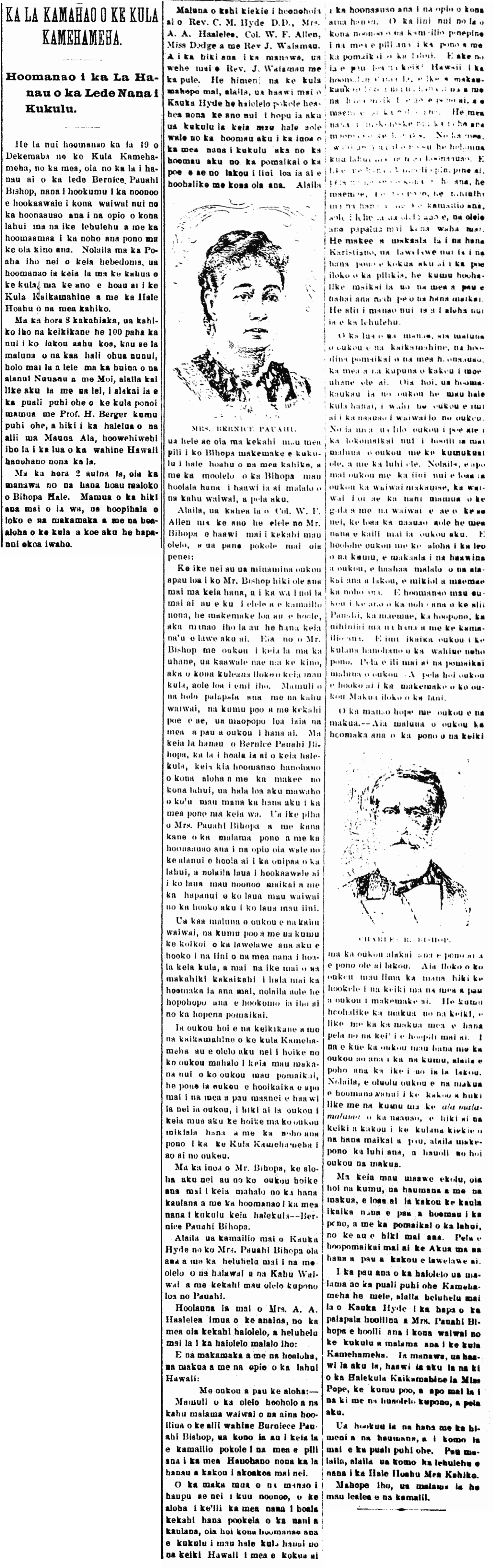
The 19th of December is a much celebrated day for Kamehameha School, for it is the day of birth of the lady, Bernice Pauahi Bishop, the one who came up with the idea to set aside her great estate for the educating of the youth of her people in the many fields of knowledge and in living healthily. Therefore on the past Thursday, the day was commemorated on the grounds of the school, by dedicating the Girls’ School and the Museum.

At 8 o’clock in the morning, perhaps 100 boys were dressed in military uniform and put aboard and rode trolleys [kaa hali ohua nunui], getting off at the corner of Nuuanu and King Streets, and from there they marched with lei, led by the school’s band in front, with Prof. H. Berger as the conductor, until the crypt of the alii at Mauna Ala, where they decorated the grave of the honorable Hawaiian woman for whom the day was for.

2 o’clock in the afternoon was the time for the dedication in Bishop Hall [Bihopa Hale]. Before the hour, the room was filled with intimates and friends of the school with a majority outside.

Rev. C. M. Hyde, D. D.; Mrs. A. A. Haalelea; Col. W. F. Allen; Miss Dodge; and Rev. J. Waiamau were sitting in a raised area. And when the time came, Rev. J. Waiamau began with a prayer. After that was a hymn by the school, and then Doctor Hyde gave a short speech of welcome of which the gist was that these structures were built not just to memorialize the name of the founder, but for the continued benefit of those who it is hoped will emulate her life. Thereafter…

MRS. BERNICE PAUAHI.

he moved on to matters dealing with Bishop’s desire to build a museum, and the story of Bishop’s planning given under the board of trustees, and so forth.

Then Col. W. F. Allen was called up as a representative for Mr. Bishop to give some words, and he spoke shortly in this manner:

I know that you all regret the absence of Mr. Bishop on this occasion, and when asked to represent and speak for him I should much rather have declined but felt it a duty to accept. That Mr. Bishop is with you today in spirit you all know, and though absent in person, he interest in these schools never wanes. By correspondence with the trustees, principals, and others, he has kept well posted in all the progress you have made. On this the natal day of Bernice Pauahi Bishop, the founders day of this Institution, such a grand monument to her love and care for her people, it is beyond my powers to do justice to the occasion or theme. Both Mrs. Bishop and her husband fully realized that the proper care and teaching of the young was the only way to insure the stability of the people, and so they have devoted their best thought, and much of their property to carry out these ideas.

To you, trustees, principals and teachers the responsibility of carrying out the wishes of the founders of this institution belongs, and from the experience of the few years since the opening, no fears are entertained of the ultimate result.

To you, boys and girls of Kamehameha School, I would say that to show your appreciation of the great gifts of your benefactors, you should ever strive to take advantage of all that is here offered you, so that in the future you can show by your industrious and virtuous lives what the Kamehameha School has done for you.

On behalf of Mr. Bishop, I thank you all for showing such an appreciation for the grand work and memory of the founder of this institution—Bernice Pauahi Bishop. [English for W. F. Allen’s speech taken from Hawaiian Star, 12/19/1894, p. 3.]

Then Dr. Hyde spoke about Mrs. Pauahi Bishop’s life, and read the minutes of meetings of the Board of Trustees as well as some appropriate words about Pauahi.

Mrs. A. A. Haalelea was introduced before the assembly because she was one of the speakers, and she read the following speech below:

O Associates and Friends, Parents and Youth of the Hawaiian People:

With all of you is my aloha:—

Because of the decision of the trustees of the estate of Bernice Pauahi Bishop, I was invited on this day to speak a bit about the Honorable one for whose birthday we are gathered.

The first thing to come to mind, is that it was the aloha of this alii which initiated this greatest work of beauty and fame, that is her idea to build boarding schools for the Hawaiian children to help educate the youth of her homeland. That was her great desire and spoke often things pertaining to the good and benefit of the lahui. [Image is unclear for a number of lines.] She was devout and vigilant in her Christian duties; she undertook many worthy causes to help those in need, and she is a fine example for all to follow after in good deeds. She was an alii who was thought much of and well loved by the people.

The second point: upon you, O Girls, is the inheritance of education, something our kupuna did not dream of. That being for you is prepared some boarding schools where you can find knowledge that will be truly valuable for you. So you will be indebted for the great kindness given upon you at no expense or trouble. Therefore, strive with great effort to acquire this precious treasure, a treasure more beautiful than gold or any of the other riches of this world; should you gain an education, there is no one that can take it away from you. Listen with aloha to the teachings of your instructors, pay attention to the lessons, be humble to their instruction, and be neat and clean in your daily life. Constantly recall the character of the alii Pauahi: her purity, righteousness, and decorum in actions and words. Always strive for the honorable standing of a woman who lives properly. In that way, you will be blessed. And in that way you will be carrying out the desire of your Father in heaven.

The last thought goes to you, O Parents.—Upon you lie the beginnings of the good character of your children…

CHARLES R. BISHOP.

…by your guidance will your children be upright or not so. Within your hands is the power to steer the children towards all that you desire. The parents are examples for the children; for instance, how a parent acts is what a child will follow. Should your actions and your instructions contradict those of the teachers’, then what is taught to them will be wasted. Therefore, O Parents, please strive to support and cooperate with the teachers on the pathway to knowledge, so that our children may reach a high level in all fine occupations, an this will make the effort worthwhile, and you, O Parents, will rejoice.

With these three plies, that being the teachers, the students, and the parents, we can get a strong cord which will hold fast and push forward the righteousness and blessings of the lahui for the coming age. In that way will God bless us in all our endeavors.

At the end of her speech, the Kamehameha band played a song, then Dr. Hyde read the portion of the will of Mrs. Pauahi Bishop giving her wealth for the building and caring for the Kamehameha School. This is when the keys of the Girls’ School handed over to Miss Pope, the principal, and she took the keys with some appropriate words, and so forth.

The activities were let out with the singing of the students, along with the band. When that was done, the crowd went in to see the Museum.

After that, some fun activities for the children were held.

[Much of the text on the top of the column on the right is hard to read. It is time that these Hawaiian-Language Newspapers were rescanned as cleanly as possible! If you can’t read the information, is it really information?]

(Kuokoa 12/22/1894, p. 2)
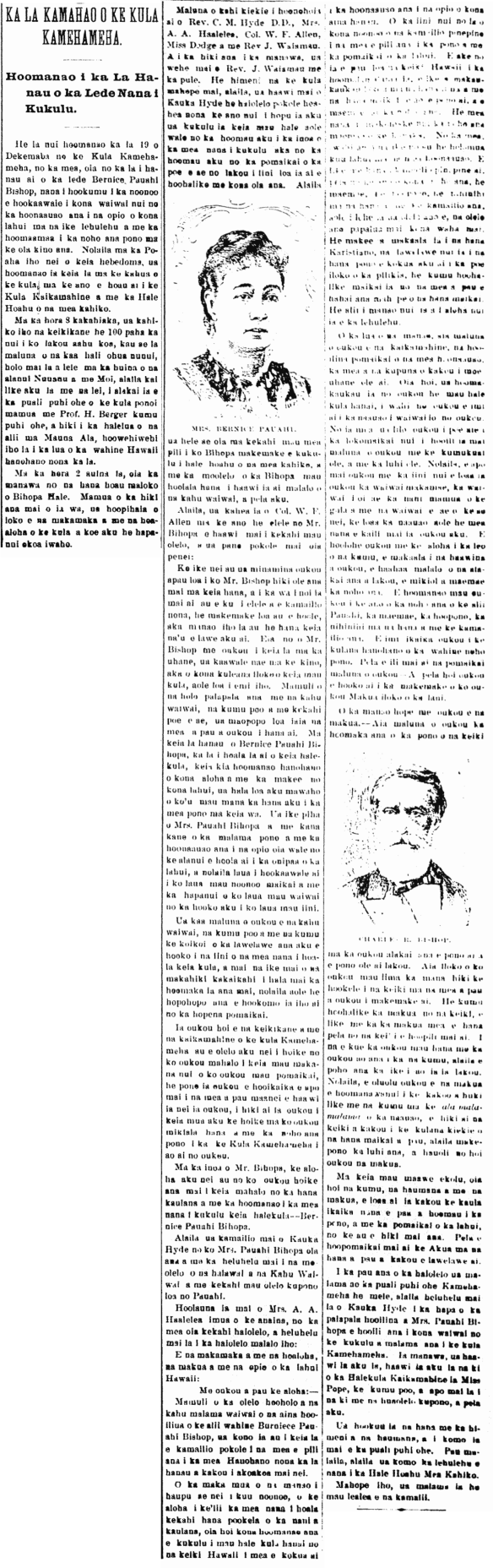
KA LA KAMAHAO O KE KULA KAMEHAMEHA.

Ka Nupepa Kuokoa, Buke 33, Helu 51, Aoao 2. Dekemaba 22, 1894.

More from Bishop Museum and Kamehameha Schools, 1894.

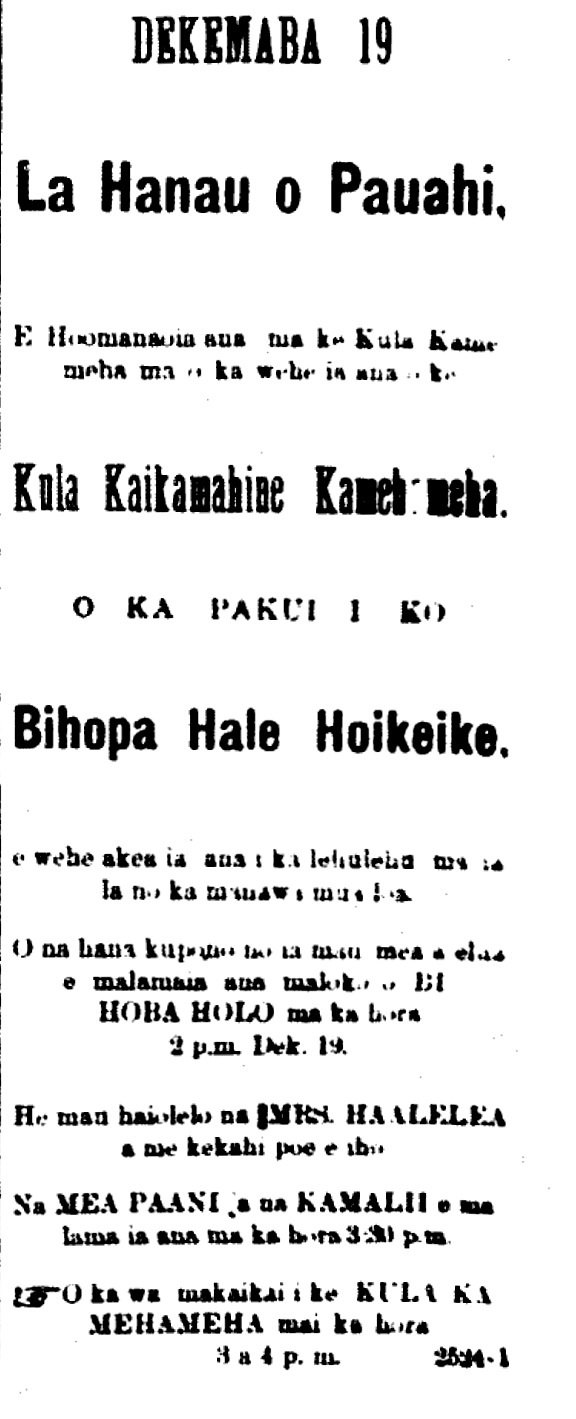
DECEMBER 19

Birthday of Pauahi.

Commemorated at the Kamehameha School with the opening of the

Kamehameha School for Girls.

THE ANNEX TO

Bishop Museum.

will be opened to the public on that day for the very first time.

Those are two fitting events held in BISHOP HALL [BiHOBA HOLO] at the hour of 2 p. m. Dec. 19.

Speeches by MRS. HAALELEA and some others.

GAMES for CHILDREN will be held at 3:30 p. m.

Period for touring the KAMEHAMEHA SCHOOL from 3 to 4 p. m.

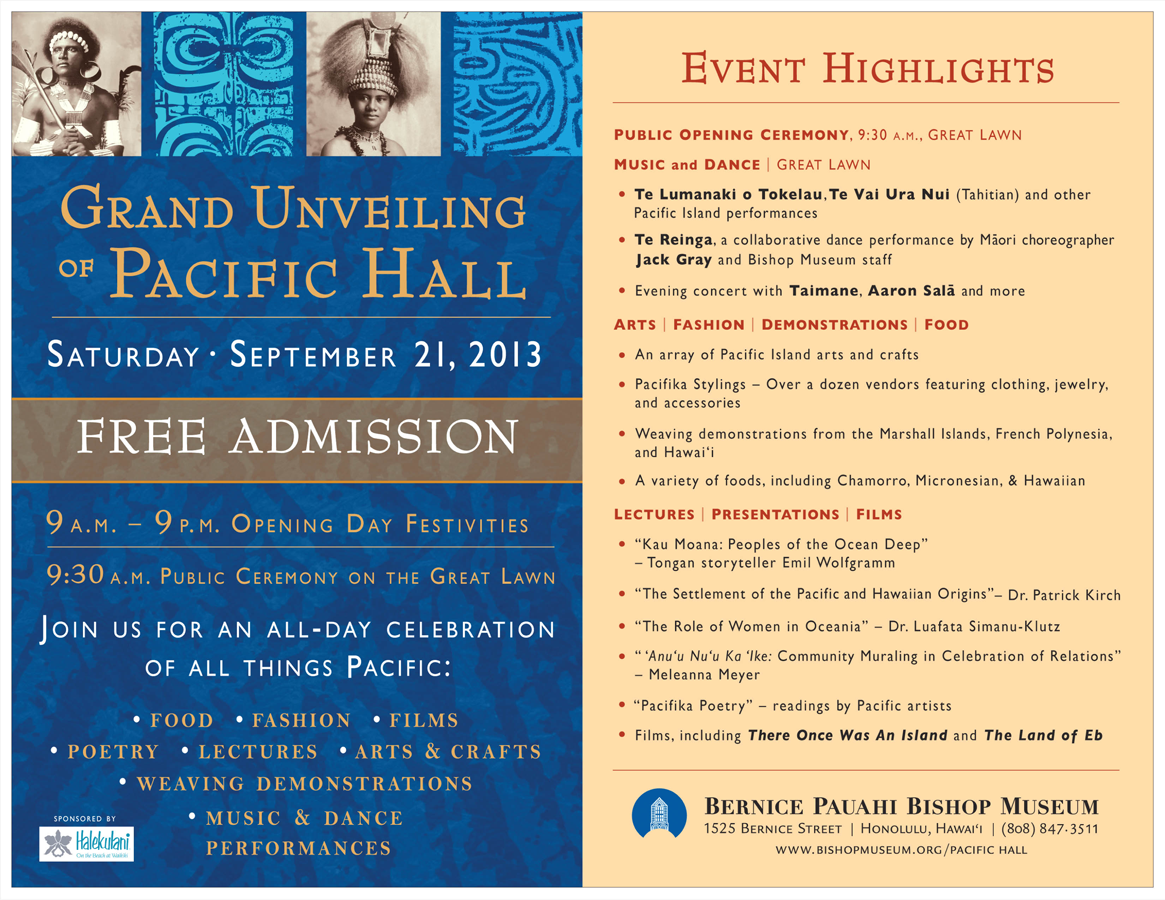
[Mahalo to DeSoto Brown for commenting on this opening. This Annex to the Bishop Museum was unveiled to the public on the 19th of December, 1894, became Polynesian Hall, and today is reopening to the public after extensive renovations as Pacific Hall! If you are here on Oahu, go check it out!! Free admission all day today (Saturday, September 21, 2013, until 9:00 p. m.)!!!]

(Kuokoa, 12/15/1894, p. 2)

DEKEMABA 19 La Hanau o Pauahi

Ka Nupepa Kuokoa, Buke XXXIII, Helu 50, Aoao 2. Dekemaba 15, 1894.

The Kamehameha Museum and the Kamehameha Schools, 1894.

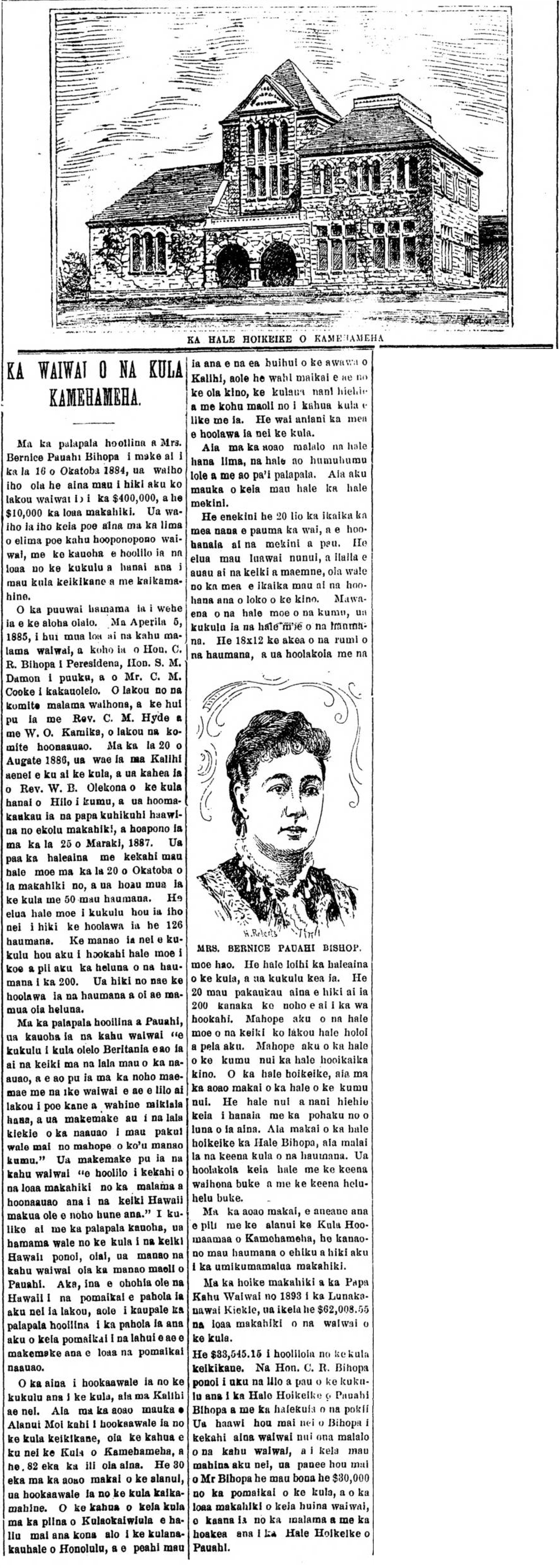
KA HALE HOIKEIKE O KAMEHAMEHA

THE ASSETS OF THE KAMEHAMEHA SCHOOLS.

In the will of Mrs. Bernice Pauahi Bishop, who died on the 16th of October 1884, she set aside lands whose true value comes to $400,000, with $10,000 profit per year. These lands are in the hands of five trustees, with the stipulation that the profits go to the building and caring for a school for boys and girls.

This generosity was based on true aloha. On the 5th of April, 1885, the trustees met for the first time and selected the Hon. C. R. Bishop as President, Hon. S. M. Damon as treasurer, and Mr. C. M. Cooke as secretary. They are the finance committee, along with Rev. C. M. Hyde and W. O. Smith, made the education committee. On the 20th of August, 1886, up in Kalihi was chosen as the place where the school would stand, and Rev. W. B. Olsen of the Hilo boarding school to be a teacher, and the curriculum for three years was prepared and approved on the 25th of March, 1887. The cafeteria and some dormitories were completed on the 20th of October of that same year, and the school began with 50 students. There were two dormitories just built, which can house 126 students. One more dormitory is planned which will increase the number of students to 200. However more than that number of students can be accommodated.

In the will of Pauahi, the trustees were instructed to “build an English-language school where the children were to be educated in the regular branches of knowledge, and they were also to be educated to live morally and with important knowledge to make them industrious men and women, and I want high branches of knowledge to supplement those basics.” It is desired that the trustees “use a portion of the profits to go to the education and care of the indigent orphaned Hawaiian children.” As per the will, the school is opened to native Hawaiians, being that the trustees believe that was the true intent of Pauahi. However, the Hawaiians are not interested in the good put before them, the will does not preclude the the provision of those blessings to the other races who want to receive the benefits of an education.

The land set aside for the building of the school is up in Kalihi. The land mauka of King Street is set aside for the boys’ school; this is where the Kamehameha School now stands; the area of that land is 82 acres. There are 30 acres makai of the street, which is set aside for the girls’ school. The area for this school is in the heights of Kulaokaiwiula with it face overlooking the cit of Honolulu, and it is constantly fanned by the cool air of the valley of Kalihi; there is no other finer place for the health, the beauty, and the suitability as a school campus like this. Clear water is supplied to the school.

Below that are the workshops, the sewing shop and the printing shop. And mauka of these buildings is the mechanic shop.

The strength of the engine pumping the water is 20 horses, and the total power is utilized. There are two huge pools where the children will bathe until clean, and that is what will keep their bodies working strong. Between the sleeping quarters of the teachers were built the dormitories of the students. The student rooms are 18 x 12 wide, and are furnished with…

MRS. BERNICE PAUAHI BISHOP.

…iron beds. The schools cafeteria is a long building, and it was built in the form of a cross. There are 20 dining tables accommodating 200 people at a time. Behind the children dormitories, are their laundry building, and so forth. Behind the principal’s house is the gymnasium. The museum is on the makai side of the principal’s house. This is a grand a beautiful structure constructed with rock from atop the land. Makai of the museum is Bishop Hall, and this is where the school rooms of the students are. This building is furnished with a library and a reading room.

On the makai side, almost adjacent to the road is the Kamehameha Preparatory School; there are sixty students from seven until twelve years of age.

In the yearly report of the Trustees for 1893 to the Chief Justice, it was seen that the school’s annual income was $62,008.55.

$33,545.15 was spent on the boys’ school. It was the Hon. C. R. Bishop who paid for the entire cost of the building of the Pauahi Bishop Museum and the preparatory school. Bishop also recently gave some of his valuable land holdings under the trustees, and several months ago, Mr. Bishop forwarded bonds of $30,000 for the benefit of the school, and the yearly income of these assets will be apportioned for the care and the expansion of the Pauahi Museum.

[It was just serendipity that caused me to notice this article the other day, and I thought with the re-opening of the new Pacific Hall at the Bernice Pauahi Bishop Museum, there was no better time to post this article about the actual beginnings of the Museum and of the Kamehameha Schools.

Check the early years of this familiar building (minus the dome) on campus as well, from an earlier post!

The public opening of Pacific Hall is tomorrow. Admission is free! Go check out all of the special events, and the newly redone Pacific Hall!!]

(Kuokoa 5/26/1894, p. 1)

KA WAIWAI O NA KULA KAMEHAMEHA.

Ka Nupepa Kuokoa, Buke XXXIII, Helu 21, Aoao 1. Mei 26, 1894.

More on Liliu’s marriage, 1862.

I was engaged to Mr. Dominis for about two years and it was our intention to be married on the second day of September, 1862. But by reason of the fact that the court was in affliction and mourning, our wedding was delayed at the request of the king, Kamehameha IV., to the sixteenth of that month; Rev. Dr. Damon, father of Mr. S. M. Damon, at present the leading banker of the Islands, being the officiating clergyman. It was celebrated at the residence of Mr. and Mrs. Bishop, in the house which had been erected by my father, Paki, and which, known as the Arlington Hotel [Haleakala], is still one of the most beautiful and central of the mansions in Honolulu. To it came all the high chiefs then living there, also the foreign residents; in fact, all the best society of the city.

[This is what Queen Liliuokalani had to say about her marriage in Hawaii’s Story by Hawaii’s Queen, first published in 1898. Mahalo to Heather Wilkinson Rojo for her response on the previous post, saying she posted an image of their marriage certificate on her blog. This is one of the many priceless treasures cared for by the Bernice Pauahi Bishop Museum!]

(Hawaii’s Story by Hawaii’s Queen, 1988. p. 22.)

Ahuula and priceless treasures gone up in smoke, 1901.

THE AHUULA WAS DESTROYED BY FIRE

This Possession Belonged to Keaumoku.

S. L. Peleiholani claims $500 in damages
for this Feather Cloak.

Before the fire inspection Commissioner, seen was the relationship of S. L. Peleiholani to Kamehameha I, the conqueror of the nation [Ka Naʻi Aupuni], and also seen was the destruction of a very valuable ahuula in the bubonic fire. Peleiholani claimed $500 damages for this ahuula, and he said that he was urged to sell the ahuula for $1,000, which he absolutely refused to do. This is an ahuula that was cared for by his grandparents on down to him, and for this reason, he refused money which kept appearing before him until the cloak was consumed by fire.

Peleioholani added a claim of $2,140.05, and the majority of the assets were inherited from his kupuna. He is the child of Peleiholani and Pukeau. His grandfather was a child of Kalanuilumoku [Kalaniulumoku], a grandchild of Kamehameha I. His grandfather married Kahana, a daughter of Keaumoku, the one to whom belonged this ahuula. This Keaumoku was a high chief, and an minister [kuhina] of Kamehameha I, and he received may greatly valuable gifts from the conqueror of the nation. Peleiholani cared for this ahuula for a long time, and showed it to the many people who came before him to buy this cloak. The sum of money desired to offer him reached a thousand, and some ministers of Kalakaua came before him wanting the ahuula for the King. He refused all of these urging, and said to them that there was no way money could buy this ahuula while he was alive. Some men came from the alii Kalakaua bringing wine and money and put it at his side, intending to get him to drink until drunk when he would agree to giving this ahuula to the alii, however they left without.

There is but one other ahuula like it, and that is the ahuula cared for in the Kamehameha Museum [Bernice Pauahi Bishop Museum]. When people ask for the actual monetary value of that ahuula, they say Peleiholani’s claim is right, but the actual truth is that the true value of this ahuula reaches $2,000. Mrs. Mary Ailau was a witness called to testify as to the truth of the claim, and according to her testimony, it was correct; and she went before this man many a time and urged him to sell to her this ahuula for $500 and her request was refused. She felt that the true value of the ahuula reached all the way to two thousand dollars. When she was asked if the ahuula was auctioned off, how much would she offer, Mrs. Ailau answered that she would bid as much as one thousand dollars, and if she had a lot of money, she would bid up to two thousand dollars for this ahuula.

In this claim by Peleiholani, it is seen the great amount of valuable antiquities he was caring for and that was destroyed in the bubonic fires. If these treasures were not burned in the fire, and they were bought off of him, he would have gained a large amount of money. This is an example to we Hawaiians, showing the great value of some antiquities which we are just selling off or discarding. Take care of them and find out their value before throwing them away.

[I am guessing not only were there priceless objects in Peleioholani’s collection, but also manuscripts, as he is well known for his writings!]

(Kuokoa, 10/18/1901, p. 6)

PAU KA AHUULA I KE AHI

Ka Nupepa Kuokoa, Buke XXXIX, Helu 16, Aoao 6. Okatoba 18, 1901.

The Bernice Pauahi Bishop Museum, and the stone awa bowl, 1919.

SEEING ONCE AGAIN THE MUSEUM AT KAMEHAMEHA SCHOOL.

Twenty years or more has past since I first saw exhibits of the antiquities of Hawaii nei and the tiny islands of Polynesia that are stored in that building, and it is of great value to those who wish to see, and it is true, there are more things stored there from when I first saw it; and there were things which shocked me while other things made me sad.

When I arrived at the museum, it was already filled with foreigners and locals going upstairs and downstairs, and soldiers were the majority, from the military ships docked those days; officers as well as enlisted men returning and going back to the battlefield, they were awestruck; and being that there was only three hours allowed for going around, and while I looked, peeped, and peered here and there, I looked at my watch and more than an hour had past, and here I was on the first floor with so much more of the building to see; therefore, I tried to quicken my pace so that I see things; but if you intended to see everything, you would not be able to do that walking around the whole day because there are so many things that catch your attention and you’d spend some minutes looking at them; and because I wanted to read the explanations and all of the stories, minutes were spent there.

There were all types of fish, birds, and fruits, war implements of all sorts of that time, and they were amazing to see; plus the animals of the land and the sea, it was as if they were living.

On the second floor were the thrones of the beloved monarchs of Hawaii nei who passed, and it was painful in my gut to see this touching sight; and their portraits hung all about, looked as if they were watching you; yes, aloha, aloha for the chiefs of the land.

The time was going quickly, and I was intent on seeing everything, and yet the time was short.

With every step on the third floor, everything was fascinating to see, and looking blow, the winding stairs were just so beautiful and everything was kept so nicely. But amongst everything I saw, there were but two most important things: the first being the thrones and all of their belongings, and the second was a huge stone which weighed more or less a ton; when I entered and met the greeter, I was given a piece of tin stamped with a number, and was asked to leave my hat and coat, and then I stood at the base of the stairs thinking where should I go first; that is when I entered the room on the mauka side of the building, greatly delighted by everything until I reached the place where the great stone stood, and I was astonished at the look and appearance of this stone;  as if it was something I saw before, but when; that is what I thought to myself; and because I was very unclear about it, I looked here and there and I saw a haole sitting at a desk reading a book; I gave my aloha and he looked at me and asked if there was something he could do for me; I said yes, if he could explain to me the story of the stone.

“Yes,” he said, “that stone is the grinding stone of the Hawaiians in the old days; it was upon that stone that adzes were sharpened, and that is the reason for that smooth indentation on the top.”

While I was listening to the explanation of that fine friend, my eyes were set directly upon that stone, and that is when I saw the description printed below it; I immediately left him and I went to read, and I was shocked and for several minutes I stood there, astounded that I met up again with this rock after a span of 55 years gone by.

That label explained that this rock was sent from Kilauea, Kauai, when George R. Ewart was boss of the Kilauea sugar plantation, in 1897, and then I went and joined my friend, and told him the truth about that stone, and its name, and its function; it wasn’t a grindstone like what he believed; and as he heard my story he began to write.

Therefore my news loving friends, so that your confusion over this stone is put to an end, and for when you go to visit this building, you won’t fail to meet up with this rock, and you will have an understanding through this story I am revealing:

The name of this stone is Kanoa, and this was a awa bowl [Kanoa awa] for the alii of that time, and this is the reason why that depression was made right on the top, and there is a place between Kilauea and Pilaa called Kanoa until this day,  named for this stone; and from this spot, the sto0ne was taken away by the boss George R. Ewart when he was the head of that sugar plantation, and this place became the graveyard for the Portuguese, and a Catholic Church [Saint Sylvester Church] stands there until today near the government road.

It was 55 years ago that I first set my eyes on this stone, during those days when the land was forested, and beneath a pandanus tree was where this stone was placed; its height from the ground was perhaps a foot or so, and this Kanoa awa was crafted with great skill and at its side was the cup [apu], which was a smaller stone fashioned like an awa cup.

From what my kupuna told me, this Kanoa belonged to some chiefs and where the Kanoa was left was where a great house one stood, which was a place where the alii of the old times would enjoy themselves. And I was also informed of the alii to whom belonged the Kanoa; Kamoku was the man, and this is a hill that stands to this day in the middle of a field, and should a malihini go and see that Catholic church mentioned earlier, that place is Kanoa, and if you turn to look inland, about two miles away a hill stands like a heap of lava, and below all around it grow all sorts of plants, and from the middle until the top is pilipiliula grass, and today on its peak is a grove of tall pine trees planted after the owner of this land, Mr. C. Bertelman, died and his body was brought and buried some years ago; as for the chiefly woman, she was Kahili, and this is a land immediately seaward of this place, with a huge estuary where fishes of all types swim today.

Should the alii want to have fun, the chiefess went up with poi and fish, and Kamoku went down with the intoxicating awa of the uplands of Kahua-a, bundles of oopu fish, mokihana lei of Kahihikolo, dark shrimps [opae kuauli] of Kaluaokalani, and it was in this house that they would enjoy themselves with their people; that is the whole story dealing with this stone, a awa bowl for the chiefs.

If Mr. George R. Ewart had known of yet another stone that is in Kilauea in Kalihiwai, which rings like a bell, and it is rounded flat, and its sound can be heard for a mile or more if it is struck with a hammer or a rock in other times, and it was something played with by school children; then it would have probably been taken by Mr. Ewart to the museum to be viewed.

I give my appreciation to him being that in that year that this stone was sent, I was working at that sugar plantation, but I had no prior knowledge of this until I saw it once again in this museum.

With the Editor and the metal type setting boys go my valediction.

Me ka mahalo,

Charles K. Nawaiula.

Honolulu, Dec. 2, 1919.

(Kuokoa, 12/12/1919, p. 3)

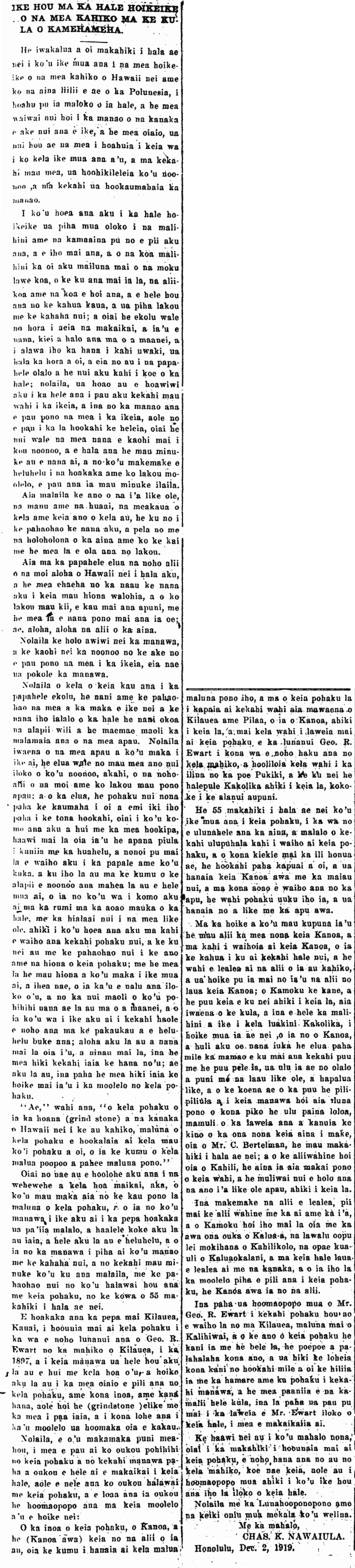
IKE HOU MA KA HALE HOIKEIKE O NA MEA KAHIKO MA KE KULA O KAMEHAMEHA.

Ka Nupepa Kuokoa, Buke LVII, Helu 50, Aoao 3. Dekemaba 12, 1919.The