Joseph Kapaeau Aea passes on, 1911.

JOSEPH AEA PASSES AWAY

Joseph Aea, agent of Her Majesty Liliuokalani, died last evening about ten o’clock at his home in Pauoa. He had been associated with the queen’s family for many years. He leaves a widow and two sons. One of them is the protege of Queen Liliuokalani and is also the stenographer and assistant clerk in the city clerk’s office.

Joseph Aea was for many years connected with the old Royal Hawaiian band. He was the solo viol player and was an excellent musician. He became attached to the household of Queen Liliuokalani, and attended Liliuokalani when she was one of the official guests at the jubilee of Queen Victoria in London. He also attended the queen when she visited Washington in 1903. His wife was also one of the queen’s closest personal attendants, and has been particularly attentive to her since the overthrow of the monarchy.

In 1907, upon the death of Hon. J. O. Carter, Liliuokalani appointed Mr. Aea as her business agent, but the Liliuokalani Trust, formed about two years ago, transferred this important office to Col. C. P. Iaukea, who is one of the trustees under the Liliuokalani Trust.

Aea was a delegate to the Democratic territorial convention in 1900, and was nominated for the legislature by the Home Rulers in 1902, and again in 1904, by the Democrats.

(Hawaiian Star, 1/26/1911, p. 7)

HawaiianStar_1_26_1911_7.png

Hawaiian Star, Volume XVIII, Number 5866, Page 7. January 26, 1911.

Francis Sinclair dies, 1916.

OWNER OF NIIHAU DIES IN ENGLAND

Francis Sinclair [? Gay], owner with his brother of the Island of Niihau, planter, rancher, author and poet, died on July 22, inst. in the Isle of Jersey, England, at the age of eighty-three. He was well-known in Hawaii to kamaainas of two and three decades ago.

 He was for many years a resident of Hawaii, coming here in 1863 with his brother, from New Zealand, in a small vessel which they had purchased and with which they cruised in the South Seas for some considerable time.

After residing in the Islands a short time Francis Sinclair and his brother purchased the Island of Niihau, northwest of Kauai. Ownership of the island is still held in the Sinclair family, which has quite a number of members in the Islands and particularly in Kauai.

During later years Mr. Sinclair resided in London, England, devoting his time to literary work. Among his works are “Ballads and Poems From the Pacific,” “Under Western Skies” and “From the Four Winds,” in addition to which he published a number of other short stories and poems, mostly dealing with the Pacific and Hawaii.

He is survived by a widow, a sister, one daughter, and many other relatives, both here and abroad. Three of his daughters married men who became prominent in the life and industries of the Islands—Mrs. Knudsen, mother of former Senator Eric A. Knudsen, mother of former Senator Eric A. Knudsen of Kauai, and the elder Mrs. Gay, and Mrs. Robinson.

(Hawaiian Gazette, 9/8/1916, p. 3)

HawaiianGazatte_9_8_1916_3.png

The Hawaiian Gazette, Volume IX, Number 74, Page 3. September 8, 1916.

Ahuimanu College exam information, 1871.

Ahuimanu College.

We had the pleasure of attending the public examination of Ahuimanu College last Wednesday, July 5. The location of the College is healthy and romantic, being situated on a plain at the foot of the mountains, and commanding a fine view of the ocean to the north and of the mountain range east and west.

The institution is under the charge of the Rev. Father Lievin, who is distinguished for his affability and kindness as much as for his many scholarly attainments. He has made improvements in the grounds and buildings during the past year: notably, in the students’ dormitory, each one having to himself a latticed apartment opening on a long corridor, all freely ventilated. The students are, even during the night, under his immediate supervision.

We were much pleased with the correct spelling and distinct reading of the primary classes. Young native boys who, a year ago, could not speak a word of English, read fluently and with a very good pronunciation. It occurred to us to ask ourselves how we could read French or German, after only one year’s study.

The examination of the classes in Grammar, Geography, Arithmetic, History, and Elementary Astronomy, was conducted by the President, and after him by the visitors. The questions asked by the latter were not the routine ones of textbooks. They were intended to draw forth the real knowledge of the students. This rather severe examination showed a proficiency in the various branches that is truly commendable. Our expectations were surpassed at the knowledge of English Grammar and Analysis evinced by that class. The study of Music and Oratory seems to be pursued con amore. The spcimens of Penmanship showed a marked improvement—those of the last and present year being side by side. It is only just to mention the Joseph Poepoe, Victor Kapule, Eddy Morgan, John K. Loio, Zachariah Kapule, and John Spencer, were the most distinguished in their several departments.

We learned that the school year commences on the 20th of August, and ends about the 4th of July. The fees for board, lodging and tuition are from $60 to $100 per year; some poor boys are received gratis. These figures are so low that the institution can not be self-sustaining. Bishop Maigret gives $300 a year towards its support. We hope that it will prosper, and continue to extend its usefulness.

(Hawaiian Gazette, 7/12/1871, p. 2)

HawaiianGazette_7_12_1871_2.png

Hawaiian Gazette, Volume VII, Number 26, Page 2. July 12, 1871.

Ahuimanu College and St. Louis College, 1882.

ST. LOUIS COLLEGE

Is our leading Roman Catholic educational institution for boys. It is an old institution called by a new name and located in a new place. The same institution long existed and prosecuted its mission at Koolau, on the other side of this island, and was there and then known as Ahuimanu College. Although delightfully situated, and having many advantages in its favor, it was felt to be too far from the centre of population, to answer fully the purpose of its existence. Consequently, it was decided, a short time ago, to remove the institution to the neighborhood of Honolulu.

For this purpose the church authorities purchased a splendid piece of property from Mr. Roth, at the north end of Beretania street, not far from Smith’s bridge, where they have erected suitable buildings, and established the old Ahuimanu College under the new name of St. Louis College.

The College grounds measure about two acres, allowing abundance of space for recreative exercise, and are planted with all kinds of tropical trees, some of which are fruit-producing, while others simply afford shade and ornamentation. It is truly a lovely spot, and being free from noisy surroundings, is peculiarly adapted to the purpose for which it is now used.

The College building is a substantial two storey brick structure, 60×20 feet in the clear. The ground floor is divided into three class rooms of equal size, by wooden partitions. Each of these rooms is nicely furnished with new school furniture of the most approved modern style. They are also well lighted and ventillated, ventillation being greatly assisted by the wooden partitions not extending the whole way to the ceiling, which latter is fourteen feet from the floor. Continue reading

The Hawaiian National Museum, 1876.

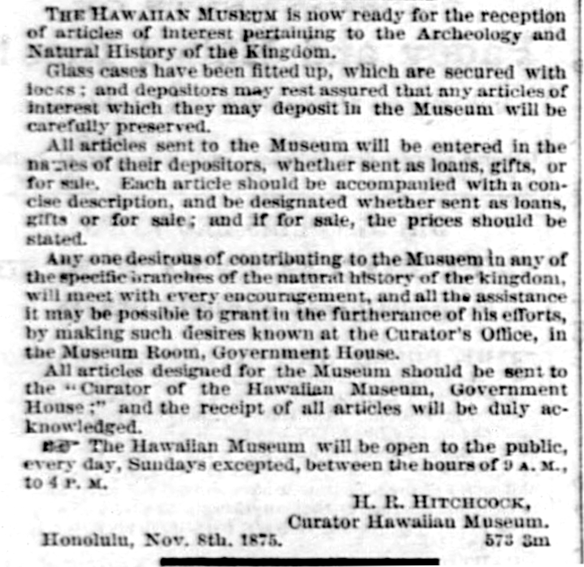
The Hawaiian Museum is now ready for the reception of articles of interest pertaining to the Archeology and Natural History of the Kingdom.

Glass cases have been fitted up, which are secured with locks: and depositors may rest assured that any articles of interest which they may deposit in the Museum will be carefully preserved.

All articles sent to the Museum will be entered in the names of their depositors, whether sent as loans, gifts, or for sale. Each article should be accompanied with a concise description, and be designated whether sent as loans, gifts or for sale; and if for sale, the prices should be stated.

Any one desirous of contributing to the Museum in any of the specific branches of the natural history of the kingdom, will meet with every encouragement, and all the assistance it may be possible to grant in the furtherance of his efforts, by making such desires known at the Curator’s Office, in the Museum Room, Government House.

All articles designed for the Museum should be sent to the “Curator of the Hawaiian Museum, Government House;” and the receipt of all articles will be duly acknowledged.

The Hawaiian Museum will be open to the public, every day, Sundays excepted, between the hours of 9 A. M., to 4 P. M.

H. R. Hitchcock,

Curator Hawaiian Museum.

Honolulu, Nov. 8th, 1875.

(Hawaiian Gazette, 3/8/1876, p. 2)

HawaiianGazette_3_8_1876_2.png

The Hawaiian Gazette, Volume XII, Number 10, Page 2. March 8, 1876.

J. E. Chamberlain, collector for the Hawaiian National Museum, 1876.

Curios for the Government Museum.

The Morning Star brought up for the Hawaiian Government the following curios, corals, &c. Two sets Gilbert Island armor complete with helmets; also shark teeth sword and spear, mats and native dresses; eel basket; common fish basket; umbrella coral, three feet six inches in diameter, perfect, from Apian by Mr. Randolph.

From Marshall Island: Spears, Male fringe petticoats and woman’s mat dress; carved figure-head; model of canoe fully rigged; paddles; red coral; black coral; platter coral, bone adzes from Strong’s Island. Continue reading

Unfortunately, some of Chamberlain’s mangrove seems to have survived, 1876.

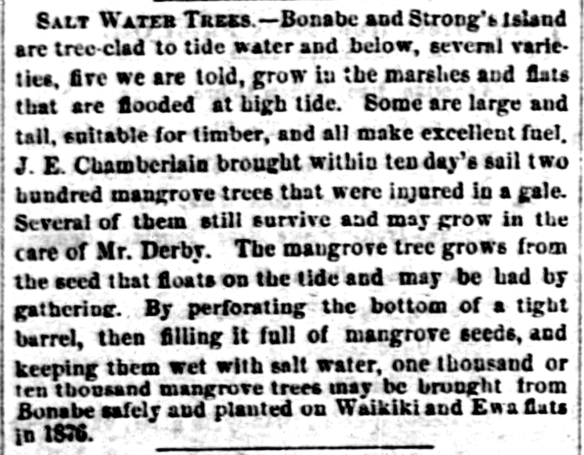
Salt Water Trees.—Bonabe and Strong’s Island are tree-clad to tide water and below, several varieties, five we are told, grow in the marshes and flats that are flooded at high tide. Some are large and tall, suitable for timber, and all make excellent fuel. J. E. Chamberlain brought within ten day’s sail two hundred mangrove trees that were injured in a gale. Several of them still survive and may grow in the care of Mr. Derby. The mangrove tree grows from the seed that floats on the tide and may be had by gathering. By perforating the bottom of a tight barrel, then filling it full of mangrove seeds, and keeping them wet with salt water, one thousand or then thousand mangrove trees may be brought from Bonabe safely and planted on Waikiki and Ewa flats in 1876.

(Hawaiian Gazette, 3/22/1876, p. 2)

HawaiianGazette_3_22_1876_2.png

The Hawaiian Gazette, Volume XII, Number 12, Page 2. March 22, 1876.

Kaili Trio performing at Kauai’s Tip Top Theatre, 1922.

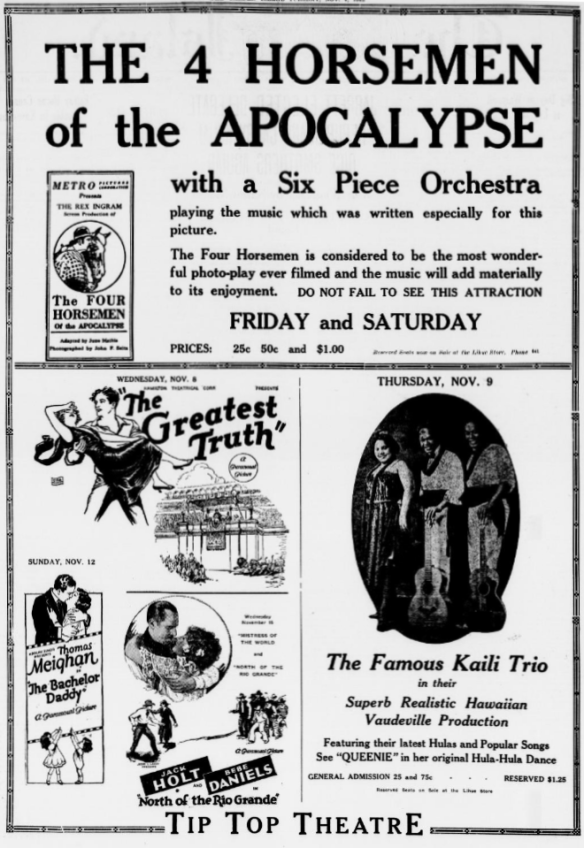
THE 4 HORSEMEN of the APOCALYPSE

with a Six Piece Orchestra

playing the music which was written especially for this picture.

The Four Horsemen is considered to be the most wonderful photo-play ever filmed and the music will add materially to its enjoyment. DO NOT FAIL TO SEE THIS ATTRACTION

FRIDAY and SATURDAY

PRICES: 25c 50c and $1.00 Reserved Seats now on Sale at the Lihue Store, Phone 641

WEDNESDAY, NOV. 8

HAMILTON THEATRICAL CORP. PRESENTS

“The Greatest Truth”

A Paramount Picture

SUNDAY, NOV. 12

ADOLPH ZUKOR PRESENTS

Thomas Meighan in “The Bachelor Daddy”

A Paramount Picture

Wednesday

November 15

“MISTRESS OF THE WORLD

and

“NORTH OF THE RIO GRANDE”

JACK HOLT AND BEBE DANIELS

in

“North of the Rio Grande”

THURSDAY, NOV. 9

The Famous Kaili Trio

in their

Superb Realistic Hawaiian
Vaudeville Production

Featuring their latest Hulas and Popular Songs
See “QUEENIE” in her original Hula-Hula Dance

GENERAL ADMISSION 25 and 75c – – – RESERVED $1.25

Reserved Seats on Sale at the Lihue Store

TIP TOP THEATRE

(Garden Island, 11/7/1922, p. 2)

GardenIsland_11_7_1922_2.png

The Garden Island, Volume 18, Number 45, Page 2. November 7, 1922.

Hawaiian Band and the parade for the Knights Templar, 1883.

THE SIR KNIGHTS IN CALIFORNIA.

A Splendid Reception.

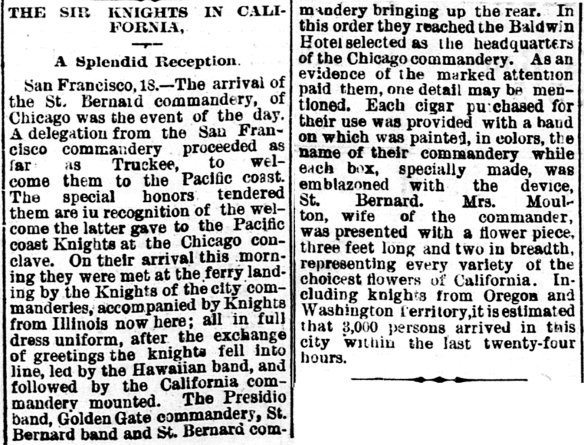
San Francisco, 18.—The arrival of the St. Bernard commandery, of Chicago was the event of the day. A delegation from the San Francisco Commandery proceeded as far as Truckee, to welcome them to the Pacific coast. The special honors tendered them are in recognition of the welcome the latter gave to the Pacific coast Knights at the Chicago conclave. On their arrival this morning they were met at the ferry landing by the Knights of the city commanderies, accompanied by Knights from Illinois now here; all in full dress uniform, after the exchange of greetings the knights fell into line, led by the Hawaiian band, and followed by the California commandery mounted. The Presidio band, Golden Gate commandery, St. Bernard band and St. Bernard commandery bringing up the rear. In this order they reached the Baldwin Hotel selected as the headquarters of the Chicago commandery. As an evidence of the marked attention paid them, one detail may be mentioned. Each cigar purchased for their use was provided with a band on which was painted, in colors, the name of their commandery while each box, specially made, was emblazoned with the device, St. Bernard. Mrs. Moulton, wife of the commander, was presented with a flower piece, three fee long and two in breadth, representing every variety of the choicest flowers of California. Including knights from Oregon and Washington Territory, it is estimated that 3,000 persons arrived in this city within the last twenty-four hours.

(Salt Lake Daily Herald, 8/19/1883, p. 1)

SaltLakeHerald_8_19_1883_1

Salt Lake Daily Herald, Volume XIV, Number 64, Page 1. August 19, 1883.

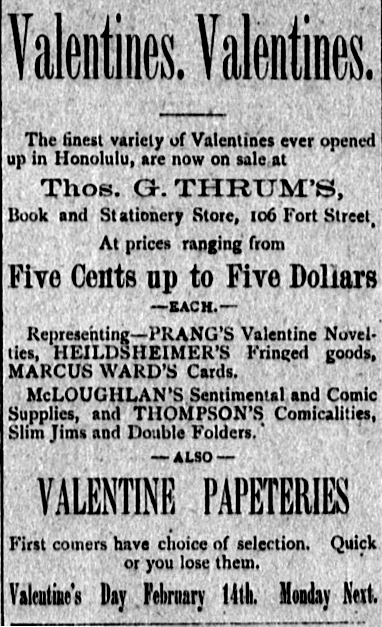
Thrum’s Valentines ad, 1887.

Valentines. Valentines.

The finest variety of Valentines ever opened up in Honolulu, are now on sale at

Thos. G. THRUM’S,
Book and Stationery Store, 106 Fort Street,
At prices ranging from

Five Cents up to Five Dollars

—EACH.—

Representing—PRANG’S Valentine Novelties, HEILDSHEIMER’S Fringed goods, MARCUS WARD’S Cards.

McLOUGHLAN’S Sentimental and Comic Supplies, and THOMPSON’S Comicalities, Slim Jims and Double Folders.

—ALSO—

VALENTINE PAPETERIES

First comers have choice of selection. Quick or you lose them.

Valentine’s Day February 14. Monday Next.

[Five dollars???]

(Daily Herald, 2/12/1887, p. 3)

DailyHerald_2_12_1887_3.png

The Daily Herald, Volume I, Number 140, Page 3. February 12, 1887.