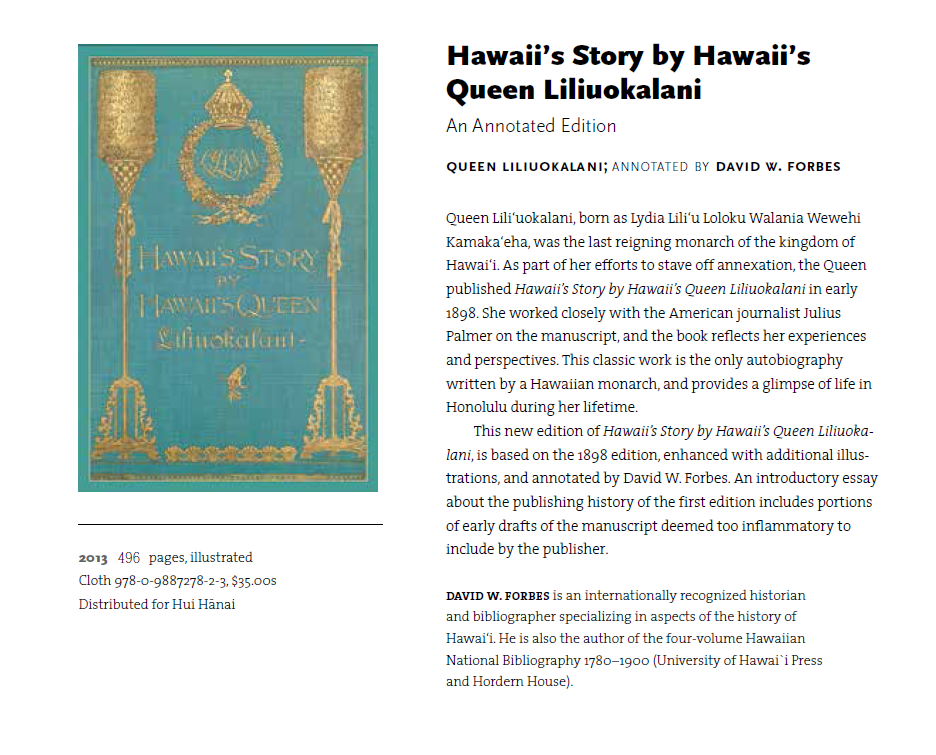
“Hawaii’s Story by Hawaii’s Queen.”
As found in the University of Hawaiʻi Press Spring 2014 Catalogue.

“Hawaii’s Story by Hawaii’s Queen.”
As found in the University of Hawaiʻi Press Spring 2014 Catalogue.
After being ill for some time, Mrs. Wakeke Ululani grew weary of this life, at six in the evening of this past Monday [11/21/1921], at her home on 13th Avenue in Kaimuki, being eighty or so years old.
Mrs. Wakeke Ululani Heleluhe was born on Maui, however, for thirty years, she was a companion to Queen Liliuokalani, from the Queen’s young days, until Liliu passed on.
In the last days of the Queen’s life, Mrs. Heleluhe was constantly before her, watching over her care, just as the days when Liliu was reigning as monarch of Hawaii nei, and everywhere that the Queen went, she went as well.
Once when the Queen went to Washington, Mrs. Heleluhe was in her retinue.
Mrs. Wakeke Heleluhe was a member of the Kaahumanu Society [Ahahui Kaahumanu]. Her husband, Joe Heleluhe, who passed long ago, was the Queen’s secretary during her reign.
Surviving her is a son and daughter of theirs; the son, Jack Heleluhe, is working in America singing, and when the steamship Hawkeye State arrived in Honolulu some weeks ago, he was one of the people on the ship, on his way to Baltimore.
As for the daughter, Mrs. Myra Iona, she is one of the women who attended Queen Liliu while she was living, and she went along twice with the Queen to Washington.
At 3:30 in the afternoon of this past Tuesday, her funeral was held, from William’s Mortuary her earthly body was laid to rest at the cemetery in Kamoiliili.
[The Queen writes of her stay in Washington D. C. in 1897:
“In the early part of May it became necessary for my companion, Mrs. Kia Nahaolelua, to return to Honolulu. Three months was the length of time I had expected to be absent when I asked her to accompany me; but five months had passed away, and her husband and large family of children needed her. So I sent her to San Francisco under the charge of Captain Palmer, where he was to meet Mrs. Joseph Heleluhe, and conduct her to Washington.”
The Mrs. Joseph Heleluhe sent for here is Wakeke Ululani Heleluhe.]
(Kuokoa, 11/25/1921, p. 4)
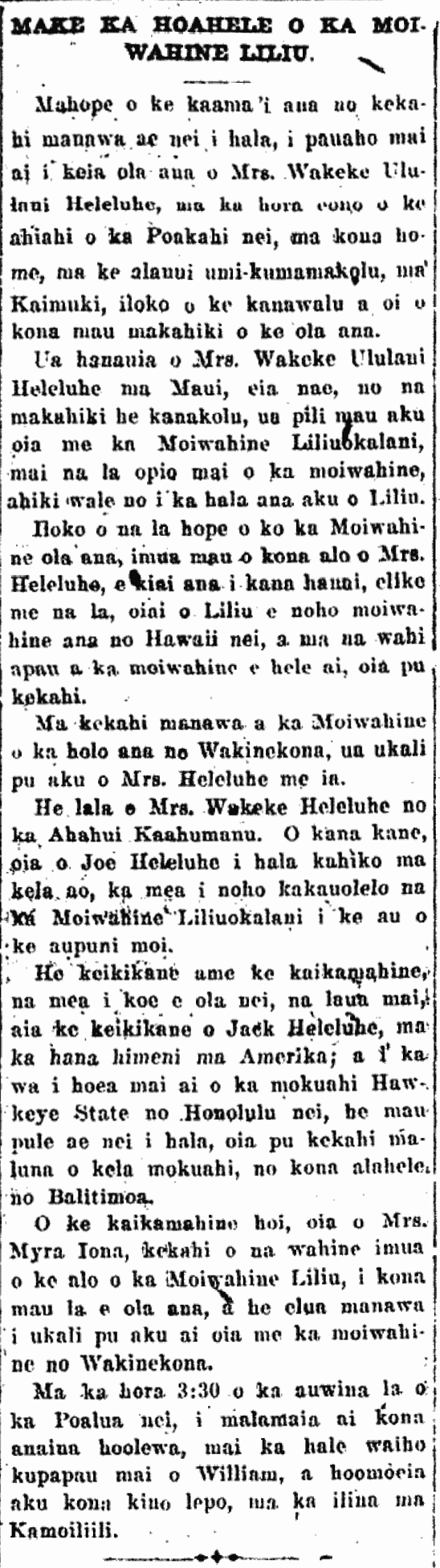
Ka Nupepa Kuokoa, Buke LIX, Helu 47, Aoao 4. Novemaba 25, 1921.
Schools and Seminaries.—In the very important point of providing instruction for all classes, as in every other duty connected with their sacred calling, the missionaries stand prominent. With them, I believe, resides the merit of having excited the chiefs to desire a school for the systematic education of their children of both sexes. With the concurrence of the king and chiefs, in 1839, the American mission selected for that purpose Mr. & Mrs. Cooke, who were assistant missionaries. Having lately at the request of Dr. Judd, visited the school daily, to watch the progress of a disease, bearing more resemblance to the “typhus mitior” of “Cullen,” than any other known types of fever, I have been an eye-witness to the anxious and parental-like care of Mr. & Mrs. Cooke, both of the sick and healthy children of the chiefs; and I am prepared to state from observation, that a more proper selection could not have been made.
The school-room is very commodiously arranged. Strict order and obedience are observed, without any exertion of authority approaching to harshness. Books, maps, stationery, gloves (terrestrial and celestial,) are at all times within the access of the scholars, and there is an excellent apparatus to illustrate the movements of the planets which compose our solar system.
(Friend, August 1, 1844, p. 35)
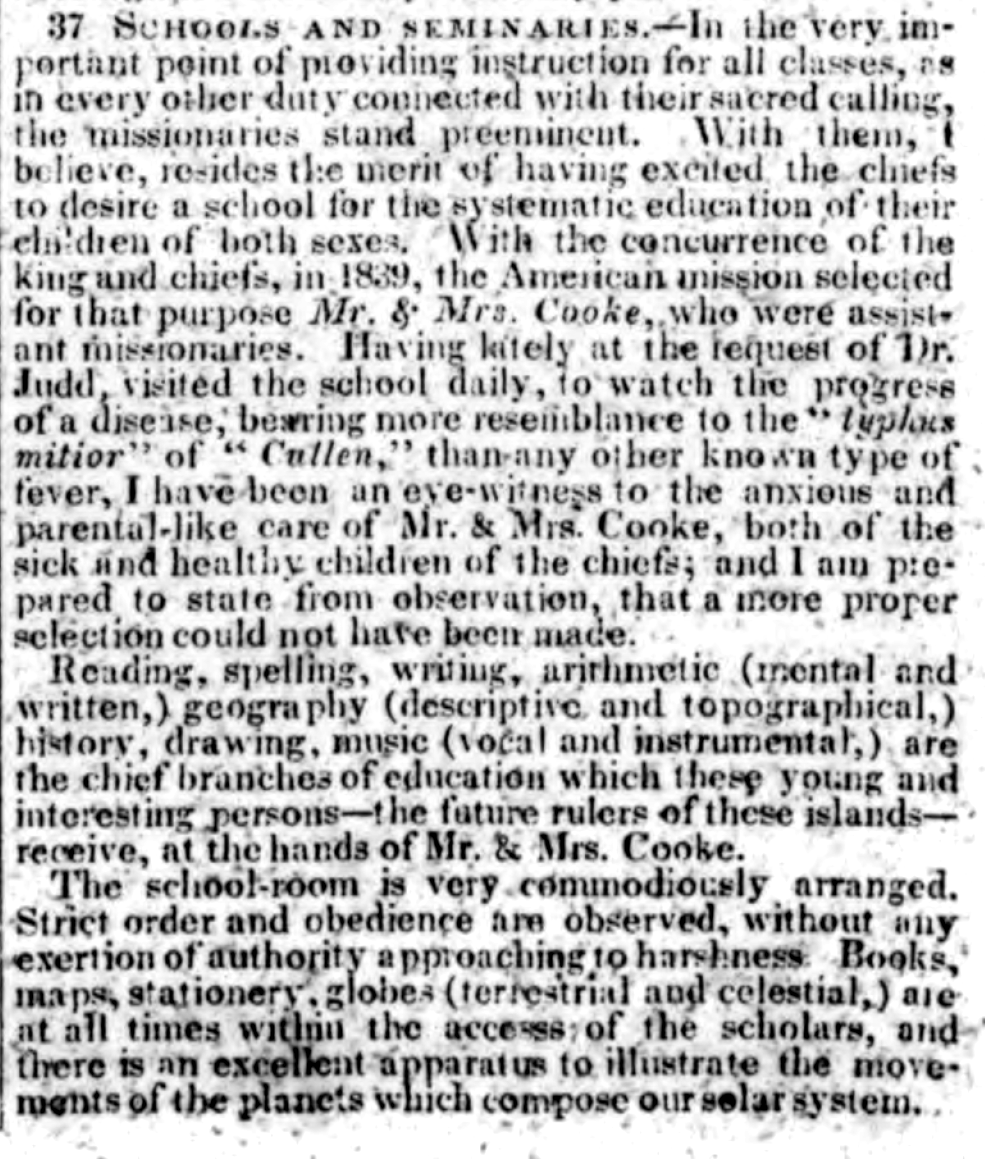
The Friend, Volume II, Number VIII, Page 35. August 1, 1844.
The following is a list of the young chiefs at present in the school of Mr. and Mrs. Cooke:
| NAMES. | WHEN BORN | FATHER | MOTHER | ADOPTED BY |
| *Alexander Liholiho, | 9 Feb. 1834. | Kekuanaoa. | Kinau. | Kamehameha III. |
| †Moses Kekuaiwa, | 20 July 1829. | ditto. | ditto. | Kaieoewa [Kaikioewa]. |
| ‡Lot Kamehameha, | 11 Dec. 1830. | ditto. | ditto. | Hoapili. |
| ‖William Charles Lunalilo, | 31 Jan. 1835. | Kanaina. | **Kekauluohi. | |
| Peter Young Kaeo, | 4 March 1836. | Kaeo. | Lahilahi. | John Young. |
| James Kaliokalani, | 29 May 1835. | Pakea [Kapaakea]. | Keohokalole. | Aikanaka. |
| David Kalakaua, | 16 Nov. 1836. | ditto. | ditto. | Haaheo Kania [Kaniu]. |
| §Victoria Kamamalu, | 4 Nov. 1838. | Kekuanaoa. | Kinau. | |
| Bernice Pauahi, | 19 Dec. 1831. | Paki. | Konia. | Kinau. |
| Abigail [Lanihau] Maheha, | 10 July 1832. | Namaile. | Liliha. | Kekauonohi. |
| ¶Jane Loeau, | 5 Dec. 1828. | Kalaiulumoku [Kalaniulumoku] | [Liliha.] | Kaukualii. |
| Elizabeth Kekaniau [Kekaaniau], | 11 Sept. 1834. | Laanui. | Oana. | |
| Emma Rooke, | 2 Jan. 1836. | Naea. | Kekela. | T. C. B. Rooke, M. D. |
| Lydia Makaeha [Kamakaeha], | 2 Sept. 1838. | Pakea [Kapaakea]. | Keohokalole. | Paki & Konia. |
| Polly Paaaina, | 1833. | Henry Lewis. | Kekala [Kekela]. | John Ii. |
*Heir apparent to the crown. (The king having no children.)
†Governor presumptive of Kauai.
‡Gov. presumpt. of maui. (Now convalescing from fever.)
‖Convalescing from fever—(25th May.)
§Heir apparent to the premiership.
¶Half-sister of Abigail.
**The premier.
Nor do Mr. & Mrs. Cooke neglect to impress upon their pupils that the fear of the Lord is the beginning of wisdom, and religion the basis of all private and public worth. A portion of scripture is read morning and evening, with singing and prayer, in the presbyterian form of family worship.
On Sundays, the pupils regularly attend two services in native, by the Rev. Mr. Armstrong, and one in English, by the Rev. Mr. Damon.
Mr. and Mrs. Cooke, both by precept and the example of their own well regulated family, enforce the utmost propriety of moral deportment, and every punctilio of cleanliness, dress, manner and address, calculated to add the polish of refinement to more solid and useful attainments.
The pupils rise with the sun, breakfast at 7 A. M., dine at 1 o’clock, take tea at 6 P. M., and retire early to rest. At table, Mr. and Mrs. Cooke always preside, and there is an abundant supply of good and substantial food.¹
The school hours are from 9 to 12 A. M., and from 2 to 5 P. M.
The medical care of the pupils has devolved upon Dr. G. P. Judd, who not withstanding his onerous and multifarious duties as secretary of state for foreign affairs, head of the financial department, &c., &c., always finds time to attend, when wanted. i myself have been an eye-witness of the extreme anxiety and tenderness with which he watched the progress of the fever of little William, whose symptoms were, for several weeks, very alarming. And it is but right I should add that his good and exemplary lady was a frequent visitor at the bed-side of the sick child.
It is impossible, in any part of the world, that sick children could have been better looked after, than were William, Lot and Jane, by Dr. Judd, and Mr. and Mrs. Cooke, whether as regards the curative or nursing department.
Amongst other things pleasing to observe, was the great concern and affection of the parents, especially in the case of William, who was the only one in real danger.
The pupils are encouraged in the gymnastical exercises which tend to develop the physical powers and fortify the constitution. Among these are playing ball, flying kites, cultivation of flowers, swinging, see-sawing, walking, and riding on horseback.
To me it is a most pleasing scene to see them all, boys and girls, well attired and well mounted, merry and good humored, curvetting, galloping and turning round their horses with great dexterity. This pleasure I have, almost every evening during my rides, as I seldom fail to meet and ride on part of my way with them.
When Admiral Thomas was here, he was always glad to see them at his house, and to encourage them to go out to tea-parties at the houses of respectable foreign residents here. I have thus met the young chiefs often in society, and I have always found that they support their part in the conversation, in English, with much decorum and propriety. In fact, there is nothing perceptible in their manner or habits that could strike a stranger as differing much from the manners and habits of young English or Americans of the same age.
Each child or pupil has from two to six native attendants, namely: tailors, washers, grooms, &c., according to the age, rank and sex of each; and these are all under the direction of John Ii and his wife, both most respectable natives, who cooperate with Mr. and Mrs. Cooke in excluding these attendants from any intercourse of intimacy with the young chiefs that could communicate to them their own vices, prejudices and superstitions.
Mr. Cooke assures me that in every department of education, they show a readiness and docility quite equal to any other children, of the same ages, and under the same circumstances.
If is evident that under his and Mrs. Cooke’s tuition, these young chiefs will go forth into the world and assume their respective stations, having a fund of general knowledge vastly superior to what is sometimes found in the riders of extensive provinces, and even some republics in Spanish America. It is equally obvious that the administration of these future rulers must be immeasurably more enlightened than any that has ever before existed in these islands; and when they come into power, a new and better order of things may be expected.
This most useful institution, fraught with so many blessings present and prospective, temporal and spiritual, is supported at an expense to the government of about $2000 yearly. This is all that is allowed to Mr. and Mrs. Cooke, for their own salaries, for finding the table, domestics and all incidental expenses. To me it is incomprehensible how they can do so much, with so little.
The clothing is found by the parents or guardians of the pupils. It is supplied in abundance and good taste.
Separate rooms are provided for every two of the pupils; and the apartments are clean, well furnished and well ventilated. There are in all 17 rooms of various dimensions, opening into a court 36 feet square, with windows on the outside, which is 76 feet square. The whole building cost originally little more than $2000, though it is solidly constructed with sun-dried bricks (adobes) with a well thatched roof. But the furniture must have cost a great deal, as no comfort, in that respect, that can be imagined, is wanting.
The Rev. Mr. Dibble says that the king, when surveying the happy group, and noticing their improvement, remarked: “I wish my lot had been like yours; I deeply regret the foolish manner in which I spent the years of my youth;” and I would venture to add, that the king has more reason to be proud of this chiefs’ school than of any thing within his dominion.
(Friend, August 1, 1844, p. 36)
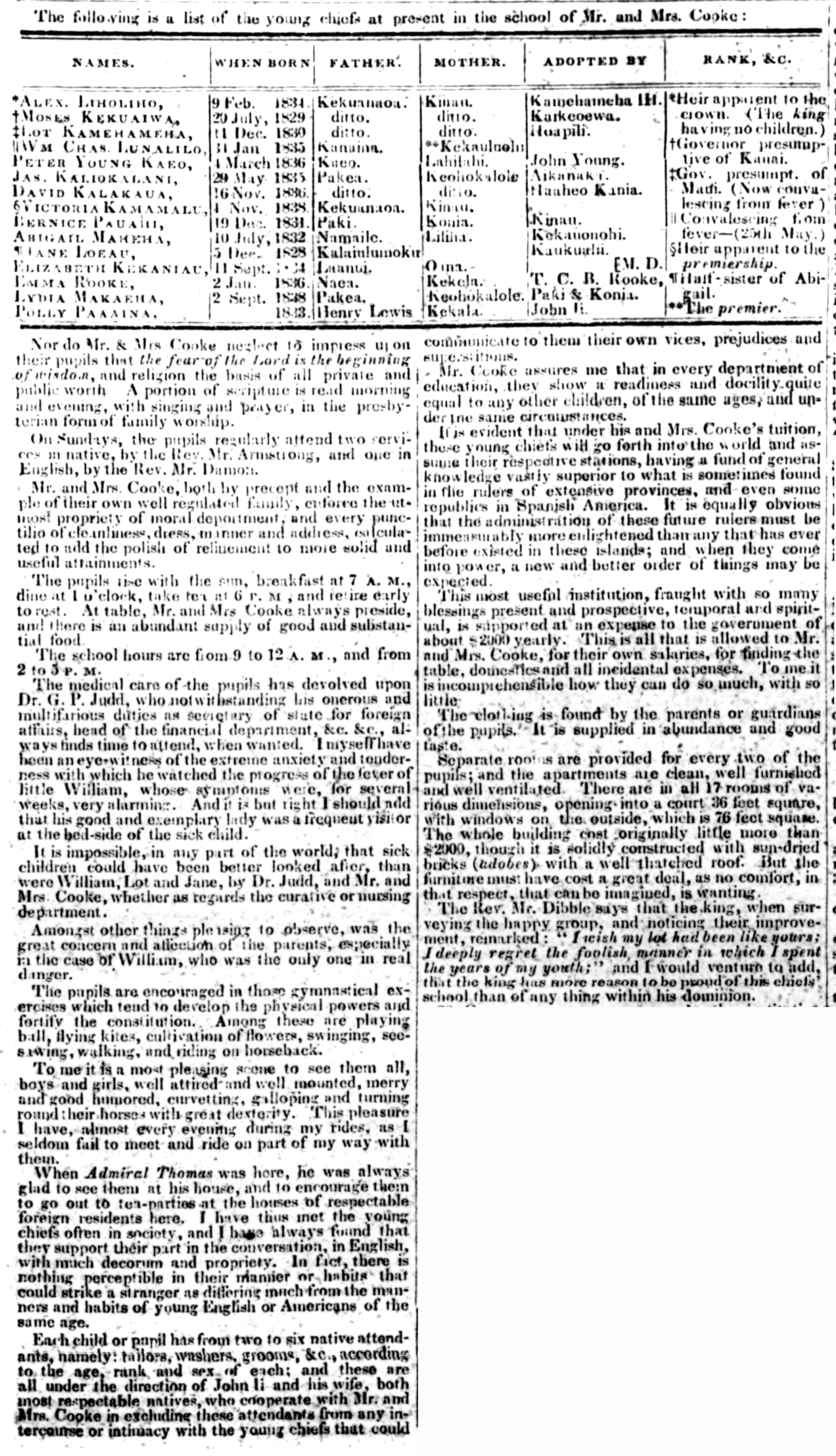
The Friend, Volume II, Number VIII, Page 36. August 1, 1844.
¹This comment about the abundance of food reminded me of something Liliuokalani said in Hawaii’s Story by Hawaii’s Queen. “…our instructors were especially particular to teach us the proper use of the English language; but when I recall the instances in which we were sent hungry to bed, it seems to me that they failed to remember that we were growing children. A thick slice of bread covered with molasses was usually the sole article of our supper, and we were sometimes ingenious, if not over honest, in our search for food: if we could beg something of the cook it was the easier way; but if not, anything eatable left within our reach was surely confiscated. As a last resort, we were not above searching the gardens for any esculent root or leaf, which (having inherited the art of igniting a fire from the friction of sticks), we could cook and consume without the knowledge of our preceptors.”
Speaking of Hawaii’s Story by Hawaii’s Queen, i was expecting the new much-awaited edition to be available already, but hopefully it will be out in bookstores soon! I am thinking of putting up related articles like this one (mostly from the Hawaiian-Language Newspapers) to perhaps give a fuller picture of topics covered in the Queen’s book.
[This is written by Robert Crichton Wyllie, and is found in a very enlightening treatise describing many aspects of life in Honolulu in the 1840s. “NOTE On the Shipping, Trade, Agriculture, Climate, Diseases, Religious Institutions, Civil and Social Conditions, Mercantile and Financial Policy of the Sandwich or Hawaiian Islands, viewed in relation to other groups of islands, and to the natural and acquired advantages of the Sandwich or Hawaiian Islands.” Friend, June 1–September 24, 1844.]
O Makalapua ulumahiehie,
O ka lei o Kamakaeha,
No Kamakaeha ka lei o na Liawahine,
No na wahine kihene pua.
Hui:—E lei ho–i e Liliulani e,
E lei ho–i e Liliulani e.
Haihai pua Kamani pauku pua Ki-ki,
I lei hoowehi no ka wahine,
I walea ai i ka waokele,
Iuka o Omaonahele.
Lei Kaala i ka ua a ka Naulu,
Hoolue ihola ilalo o Haleauau,
Ka ua lei kakooula i ke pili,
I pili ia e ka mauu nene me ke kupukupu.
Lei aku i na hala o Kekele,
Na hala moe ipo o Malailua,
Ua maewa wale i ke oho o ke Kawelu,
Ka lei Kamakahala a ka ua i Waahila.
[Another well known mele for Queen Liliuokalani found within the pages of the Hawaiian-Language Newspapers.]
(Aloha Aina, 1/16/1897, p. 7)

Ke Aloha Aina, Buke III, Helu 3, Aoao 7. Ianuari 16, 1897.
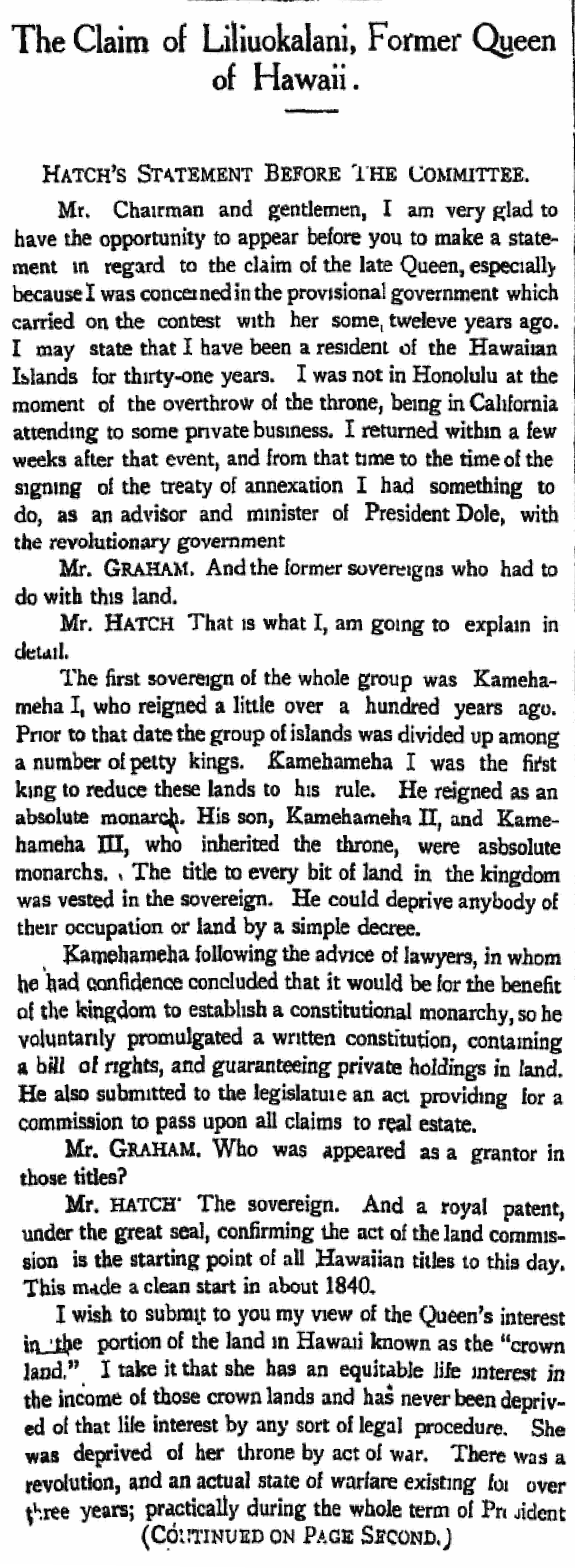
HATCH’S STATEMENT BEFORE THE COMMITTEE.
Mr. Chairman and gentlemen, I am very glad to have the opportunity to appear before you to make a statement in regard to the claim of the late Queen, especially because I was concerned in the provisional government which carried on the contest with her some twelve years ago. I may state that I have been a resident of the Hawaiian Islands for thirty-one years. I was not in Honolulu at the moment of the overthrow of the throne, being in California attending to some private business. I returned within a few weeks after that event, and from that time to the time of the signing of the treaty of annexation I had something to do, as an advisor and minister of President Dole, with the revolutionary government.
Mr. Graham. And the former sovereigns who had to do with this land.
Mr. Hatch. That is what I, am going to explain in detail.
The first sovereign of the whole group was Kamehameha I, who reigned a little over a hundred years ago. Prior to that date the group of islands was divided up among a number of petty kings. Kamehameha I was the first king to reduce these lands to his rule. He reigned as an absolute monarch. His son, Kamehameha II, and Kamehameha III, who inherited the throne, were absolute monarchs. The title to every bit of land in the kingdom was vested in the sovereign. He could deprive anybody of their occupation or land by a simple decree.
Kamehameha following the advice of lawyers, in whom he had confidence concluded that it would be for the benefit of the kingdom to establish a constitutional monarchy, so he voluntarily promulgated a written constitution, containing a bill of rights, and guaranteeing private holdings in land. He also submitted to the legislature an act providing for a commission to pass upon all claims to real estate.
Mr. Graham. Who was appeared as a grantor in those titles?
Mr. Hatch. The sovereign. And a royal patent under the great seal, confirming the act of the land commission is the starting point of all Hawaiian titles to this day. This made a clean start in about 1840.
I wish to submit to you my view of the Queen’s interest in the portion of the land in Hawaii known as the “crown land.” I take it that she has an equitable life interest in the income of those crown lands and has never been deprived of that life interest by any sort of legal procedure. She was deprived of her throne by act of war. There was a revolution, and an actual state of warfare existing for over three years; practically during the whole term of President…
(Kuokoa Home Rula, 5/21/1909, p. 1)
Kuokoa Home Rula, Buke VII, Helu 21, Aoao 1. Mei 21, 1909.
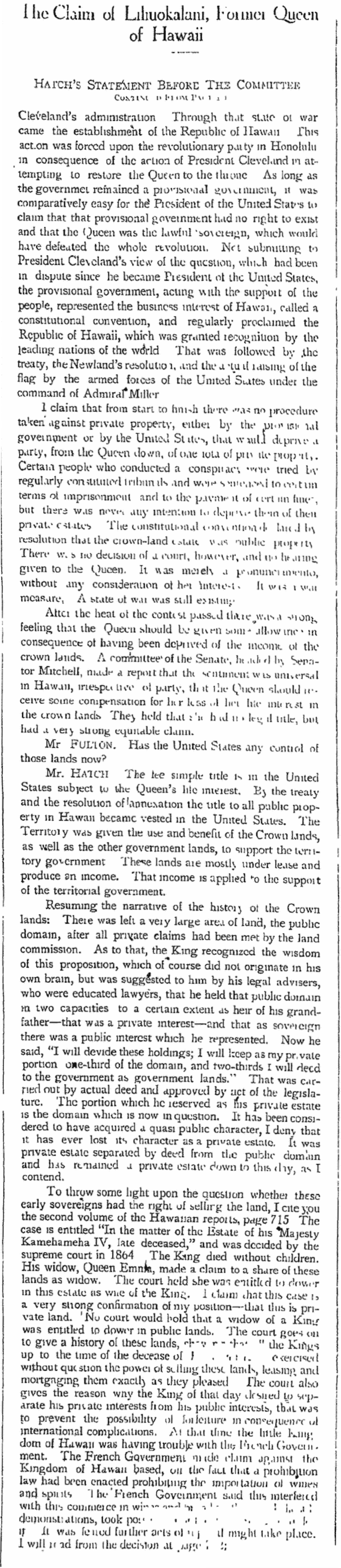
…Cleveland’s administration. Through that state of war came the establishment of the Republic of Hawaii. This action was forced upon the revolutionary party in Honolulu in consequence of the action of President Cleveland in attempting to restore the Queen to the throne. As long as the government remained a provisional government, it was comparatively easy for the President of the United States to claim that the provisional government had no right to exist and that the Queen was the lawful sovereign, which would have defeated the whole revolution. Not submitting to President Cleveland’s view of the question, which had been in dispute since he became President of the United States, the provisional government, acting with the support of the people, represented the business interest of Hawaii, called a constitutional convention, and regularly proclaimed the Republic of Hawaii, which was granted recognition by the leading nations of the world. That was followed by the treaty, the Newland’s resolution, and the actual raising of the flag by the armed forces of the United States under the command of Admiral Miller.
I claim that from start of finish there was no procedure taken against private property, either by the provisional government or by the United States, that would deprive a party, from the Queen down, of one iota of private property. Certain people who conducted a conspiracy were tried by regularly constituted tribunals and were sentenced to [unclear] but there was never any intention to deprived them of their private estates. The constitutional convention declared by resolution that the crown-land estate was public property. There was no decision of a court, however, and no hearing given to the Queen. It was merely a [unclear] without any consideration of her interests. It was a [unclear] measure. A state of war was still existing.
After the heat of the contest passed there was a strong feeling that the Queen should be given some allowance in consequence of having been deprived of the income of the crown lands. A committee of the Senate, headed by Senator Mitchell, made a report that the sentiment was universal in Hawaii, irrespective of party, that the Queen should received some compensation for her loss of her life interest in the crown lands. They held that she had no legal title, but had a very strong equitable claim.
Mr. Fulton. Has the United States any control of those lands now?
Mr. Hatch. The fee simple title is in the United States subject to the Queen’s life interest. By the treaty and the resolution of annexation the title to all public property in Hawaii became vested in the United States. The Territory was given the use and benefit of the Crown lands, as well as the other government lands, to support the territory government. These lands are mostly under lease and produce an income. That income is applied to the support of the territorial government.
Resuming the narrative of the history of the Crown lands: There was left a very large area of land, the public domain, after all private claims had been met by the land commission. As to that, the King recognized the wisdom of this proposition, which of course did not originate in his own brain, but was suggested to him by his legal advisers, who were educated lawyers, that he held that public domain in two capacities to a certain extent as heir of his grandfather—that was a private interest—and that as a sovereign there was a public interest which he represented. Now he said, “I will divide these holdings; I will keep as my private portion one0third of the domain, and two-thirds I will deed to the government as government lands.” That was carried out by actual deed and approved by net of the legislature. The portion which he reserved as his private estate is the domain which is now in question. It has been considered to have acquired a quasi public character, I deny that it has ever lost its character as a private estate. It was and has remained a private estate down to this day, as I contend.
To throw some light upon the question whether these early sovereigns had the right of selling the land, I cite you the second volume of the Hawaiian reports, page 715. The case is entitled “In the matter of the Estate of his Majesty Kamehameha IV, late deceased,” and was decided by the supreme court in 1864. The King died without children. His widow, Queen Emma, made a claim to a share of these lands as a widow. The court held she was entitled to dower in this estate as wife of the King. I claim that this case is a very strong confirmation of m position—that this is private land. No court would hold that a widow of a King was entitled to dower in public lands. The court goes on to give a history of these lands, [partially unclear from here on down].
[This is also translated and printed in Hawaiian in Kuokoa Home Rula. “KOI A LILIUOKALANI, MOIWAHINE MUA O HAWAII.”
Although this document should be easily found elsewhere, there are other stories in newspapers like Kuokoa Home Rula that are not legible online. They need to be rescanned clearly, so that they can be read as they were written, for what good is information if it cannot be read?]
(Kuokoa Home Rula, 5/21/1909, p. 2)
Kuokoa Home Rula, Buke VII, Helu 21, Aoao 2. Mei 21, 1909.
Because Washington Place [Wakinekona Hale] will be placed under the care of Governor McCarthy, as a home for him to live in with his family, twenty-six feather standards were returned from Washington Place to the old home of Queen Emma, in the uplands of Nuuanu, under the care of the Association, the Daughters of Hawaii [Na Kaikamahine o Hawaii].
During the funeral of Queen Liliuokalani, and while her body lay in state at Kawaiahao Church and in the throne room of the palace, those kahili were something the public could visit, however, as the result of an agreement between the trustees of Queen Liliuokalani’s estate and the Association of the Daughters of Hawaii, the caring for the kahili has been transferred to the association. As has been the custom from ancient times, it was during the night that kahili of those types were moved from one place to another, and so it was that the kahili were returned in the dark of night on Sunday two weeks ago.
However, because there were not enough people to carry the kahili and march on the roads to its new home where it is hoped to be cared for, the kahili were put on cars and it was on these cars which the people who held the kahili stood.
When the cars and the kahili arrived at the entrance to the yard of the home of Queen Emma in the uplands of Nuuanu, the kahili were taken by the leaders of the Association of the Daughters of Hawaii, and its care was transferred to them.
(Kuokoa, 10/18/1918, p. 2)

Ka Nupepa Kuokoa, Buke LVI, Helu 42, Aoao 2. Okatoba 18, 1918.
Look Here at This Mele
1. Kaulana na pua o Hawaii
Kupaa mahope o ka aina,
Hiki mai ka elele a ka lokoino
Palapala alunu me ka pakaha
2. Pane mai Hawaii-Nui o Keawe
Kokua na Hono-a-Piilani
Kakoo mai Kauai o Mano
Pau pu me ke one o Kakuhihewa
3. Aole e kau e ka pulima
Maluna o ka pepa a ka enemi
Aole makou a e minamina
I ka puu dala a ke Aupuni
4. Ua lawa makou i ka pohaku
I ka ai kamahao o ka aina
Hoohuiaina kuai hewa
I ka pono kivila o ke kanaka
5. Mahope makou o Liliulani
A kau hou la i ke Kalaunu
Haina ia mai ana ka puana
Na pua i aloha i ka aina
Composed by KEKOAHIWAIKALANI.
[This mele for obvious reasons is published many times throughout time.]
(Aloha Aina, 6/13/1896, p. 4)

Ke Aloha Aina, Buke II, Helu 24, Aoao 4. Iune 13, 1896.
Kumaka ka ike’na ia Kaalawai
I ka peki wawae i ke kula loa
Mea ole ka loa a oia kula
Me ke kai hone mai i ka iliili
Me he ‘la a e i mai ana
Imi ia e ka pono o ka aina
Ilaila ohohia kuu manao
I ka ike ana aku i na hoa
Hooho Wilikoki me ka leo nui
Imua kakou a lanakila
Lana mai ka manao Nou e ka Lani
E hoi hou ana i ke Kalaunu
Eia makou ke paa nei
Mamuli o ke aloha i ka aina
O ke kani makawalu a na pu
Pau ka manaolana no ka ohana
Haina ia mai ana ka puana
No ka poe i aloha i ka aina.
Hakuia e
S. Kanehe.
Kawa.
[There was a man named Herman K. Kanehe, who was one of many patriots sentenced to 5 years at hard labor and a fine of $5000. But i could not find out information on this S. Kanehe.
It is also interesting to note that this composition is reminiscent of another composition known widely today…]
(Oiaio, 3/22/1895, p. 3)

Ka Oiaio, Buke VII, Helu 3, Aoao 3. Maraki 22, 1895.
Ribbons stamped in gold: Uluhaimalama, is what these days is the great excitement; it is something of pride to place upon your hat. We give our much appreciation for the spirited action of the lady who went to print these ribbons.
[There must be a lot of these still around?]
(Leo o ka Lahui, 10/17/1894, p. 2)
Ka Leo o ka Lahui, Buke II, Helu 1051, Aoao 2. Okatoba 17, 1894.
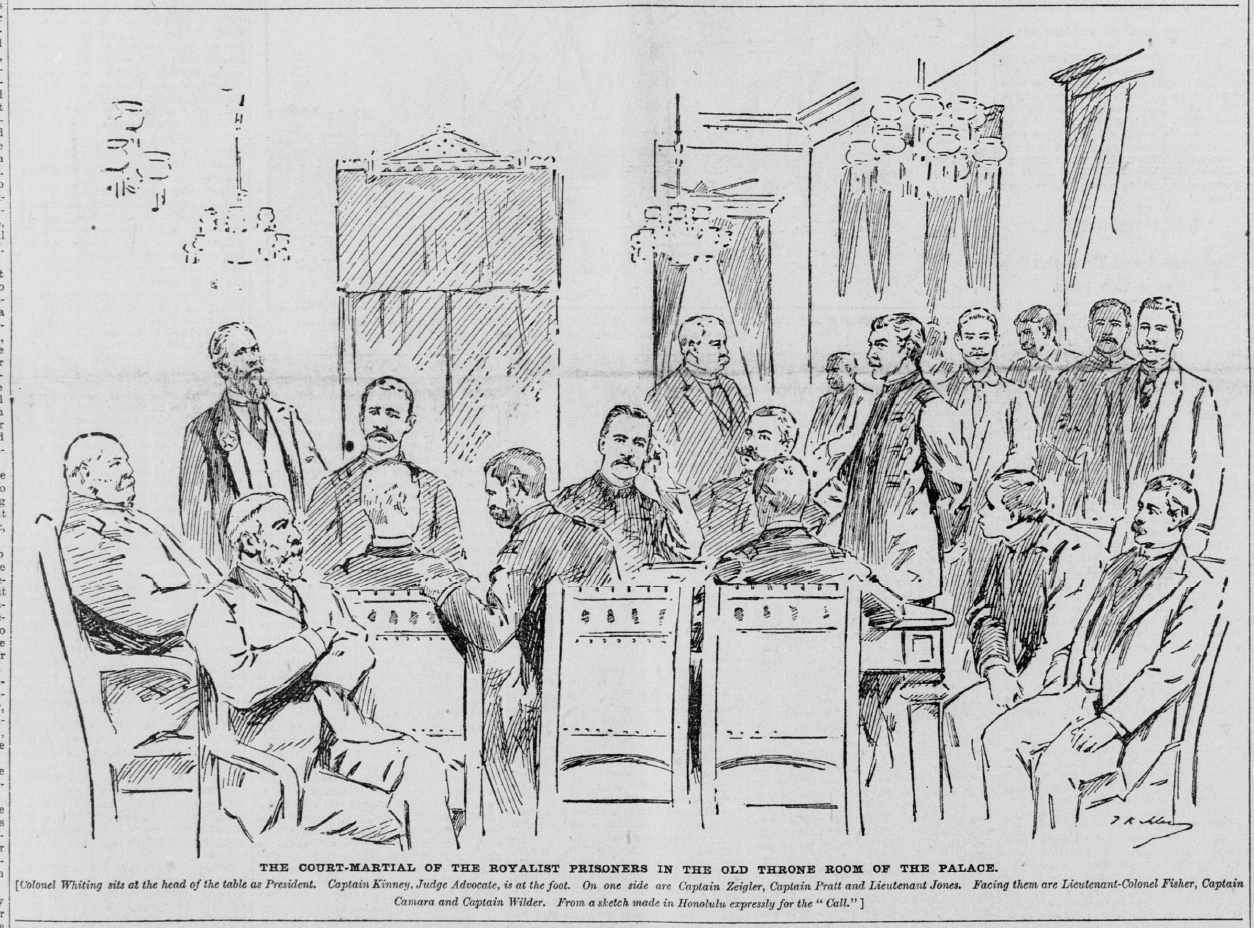
{Colonel Whiting sits at the head of the table as President. Captain Kinney, Judge Advocate, is at the foot. On one side are Captain Zeigler, Captain Pratt and Lieutenant Jones. Facing them are Lieutenant-Colonel Fisher, Captain Camara and Captain Wilder. From a sketch made in Honolulu expressly for the “Call.”}
[The San Francisco Call had strong ties with Hawaii, and it is interesting to see the articles printed within its pages and how it saw the situation in Hawaii. See for instance the famous story printed a couple of years later: “Strangling Hands upon a Nation’s Throat,” by Miriam Michelson.
…So many unthinkable things took place in the Throne Room of Iolani Palace.]
(San Francisco Call, 2/7/1895, p. 1)
San Francisco Call, Volume LXXVI, Number 52, Page 1. February 7, 1895.
 nupepa