Joseph Emerson interrupts meeting at the Kapuukolo Church, 1893.

DEVOTIONS DISTURBED.

Disruption of a Prayer Meeting With Political Dynamite.

A Visitor Miscalculates Hawaiian Feeling On Affairs.

The members of the little native church at Kapuukolo near the Fish Market held their regular prayer meeting yesterday evening. As is usual at these meetings a subject was proposed for discussion among members. The subject was, “Whether it is right to worship two Gods?” Argument was going along peacefully when Mr. Jos. Emerson entered the church and, after listening a little while, asked to be allowed to take part in the discussion. Mr. E. was given permission and spoke for some time, finally bringing in the name of the dethroned Queen and reflecting on her career. Among other remarks he is said to have referred to stories that the Queen was in the habit of consulting kahunas regarding her chances for restoration to the throne.

 Some of the congregation arose in a body and demanded that Mr. E. close his mouth or he would be summarily removed. S. Kaloa, a native preacher, then addressed the meeting, saying that a committee of church members had had communication and meetings with her Majesty during a year past, and she had told them emphatically she did not believe in kahunas. Now here came a foreigner and told them that she was harboring them. Who would they believe, this man or their committee, who has been in constant communication with the Queen?

Mr. E. asked all who were in favor of the Queen returning to the throne to stand up. All stood up with the exception of five, one a clerk in the office of the Board of Missions.

Kaloa again interfered and asked who dethroned the Queen, was it her people? Another, did Mr. E. consider that the members of the Council, where not a single Hawaiian was present, represented the people?

The argument became hot and finally Mr. Emerson retired and Kaloa held the fort.

A committee from the Church has an advertisement in a native paper calling on all the members to pray to God for the restoration of the Queen.

The foregoing report was gathered by our reporter from several native Hawaiians who was at the meeting. Some of the statements said to have been made by Mr. Emerson have been eliminated on the strength of his emphatic denial that he uttered them. A representative of the Bulletin gained an interview with Mr. Emerson to obtain his side of the story, which is given below:

STATEMENT OF MR. EMERSON.

In answer to questions Mr. Emerson gave in substance the following account of the meeting and his part in it:

 “I had been asked by some of the people to visit their meetings. When I went to the meeting last night I sat for some time listening to the discussion. Then I asked if they would like me to speak on the relations of Christianity with the monarchy, and they said they would.

“I began by telling of the difference between the Hawaiians and the natives of other groups, such as the Marquesas. In those islands tribal wars on single islands were common, while in the early times of the Hawaiian Islands each island had its own king. There were human sacrifices on these islands, but not for the purpose of eating the victims. An advance was made when all the islands were brought under the single rule of Kamehameha I.

“In the time of Kamehameha II., I told them, another great advance was made when Queen Kaahumanu, aided by her priest, threw off the shackles of the tabu and caused the idols to be renounced. Then, until Lot (Kamehameha V.) became King, there was a period free from the old system. Lot began a course of returning to the ancient superstitions.

“With the exception of the brief reign of Lunalilo, I said, down through the reign of Liliuokalani there was a disposition to return to heathen customs. They agreed with me that Kalakaua had gone back toward the ancient superstitions. I mentioned the time when Kaunamano in the presence of King Kalakaua at Kailua advocated a return to the old gods. I said I had heard stories about Queen Liliuokalani’s having sacrificed pigs to Pele at the Volcano, and they probably knew whether these stories were true, and they did not deny their truth.

“Is it true, I then asked, that J. W. Alapai was circulating a petition to have a day of fasting and prayer for the restoration of the Queen? They answered yes. Is it true that Alapai claims to have a unihipili (familiar spirit), and that his wife is the kahu (priestess) of that spirit? They said yes. Is it tre that Alapai is a confessed heathen who is at the same time a luna in Kaumakapili church? To these questions they answered in the affirmative.

“Then, I asked, what should be the attitude of Christian people toward this day of fasting and prayer? Are we to join in with a man who is a pronounced heathen and make no distinction between those who are pronounced opponents of heathenism and those who practice it? Shall we join with Alapai for the return of the Queen to the throne? Can we make common cause with a heathen?

“I did not pronounce my own opinion—I simply drew them out. There was a noisy discussion and some left the room.

“No, I was not threatened to be turned out. I said if my remarks gave offense I should sit down. I shook hands with everyone who had not left the room. My question was, ‘Shall we join with Alapai to pray for the restoration of the Queen?’

“Dr. Emerson, who was also present, tried to conciliate the people. He told them it was right for them to pray for the late Queen’s welfare. They should pray for her soul.

“Yes, I took a vote. There were five who voted against joining with Alapai and three in favor of doing so, but most of those present at the time refrained from voting. The question was not whether they thought the Queen should be restored, but whether it was right to join in a movement to that end with Alapai.”

Mr. Emerson, in answer to a question, admitted that results showed it was injudicious to have introduced the question of restoration at all. Had he known that it would have awakened so much feeling, he said, he would have abstained from questioning the people in the manner described.

[This article was translated in Leo o ka Lahui, 2/9/1893, p. 2. It is interesting that there is a note appended to the end of the translated article that they did not have time to translate Emerson’s response.]

(Daily Bulletin, 2/7/1893, p. 3)
DEVOTIONS DISTURBED.

The Daily Bulletin, Volume V, Number 644, Page 3. February 7, 1893.
More on the “King of the Cannibal Islands,” 1873.

Hoky Poky Wanky Fong.

Minister De Long in Japan has gone back on us. He washes his hands of the isles, and says no more Sandwich for him, as it is too strongly peppered with coolieism to suit his moral stomach. He is the blarneying ambassadorial Barnum, who tried to make a puff and pelf by showing around Mori and the princly Japs; but those chaps, and Mori said no more, do we belong to De Long, and told him to get along. And now this rough in Eastern diplomacy, this bull in a China shop, has to return to his old pastures and stamping grounds; and so, like a retiring politician in our latitudes, he wants to go home with a good record, by throwing overboard heathen Hawaiian. This made our Bohemian sing in this wise:

Oh, have you heard the news of late?
About a canting diplomate,
Who says no Coolies shall be ate
By the King of the Cannibal islands.

Hoky, poky, wanky, fong,
What a canting guy this old De Long
Who swears that he can never get along
With the King of the cannibal islands.

He’s got in the East a tawney slut
And one in the West of a double smut
But with a wahine he never will put
Up in the Cannibal islands.

Hoky, poky, wanky, fong,
Chink is the thing will shove him along
And make this canting guy go strong
For the King of the Cannibal islands.

(Nuhou, 4/15/1873, p. 3)

Hoky Poky Wanky Fong.

Nuhou, Volume I, Number 15, Aoao 3. Aperila 15, 1873.

The famous Niihau protest mat on display at the Bishop Museum, 1874 / 2015.

[Found under: “NOTES OF THE WEEK.”]

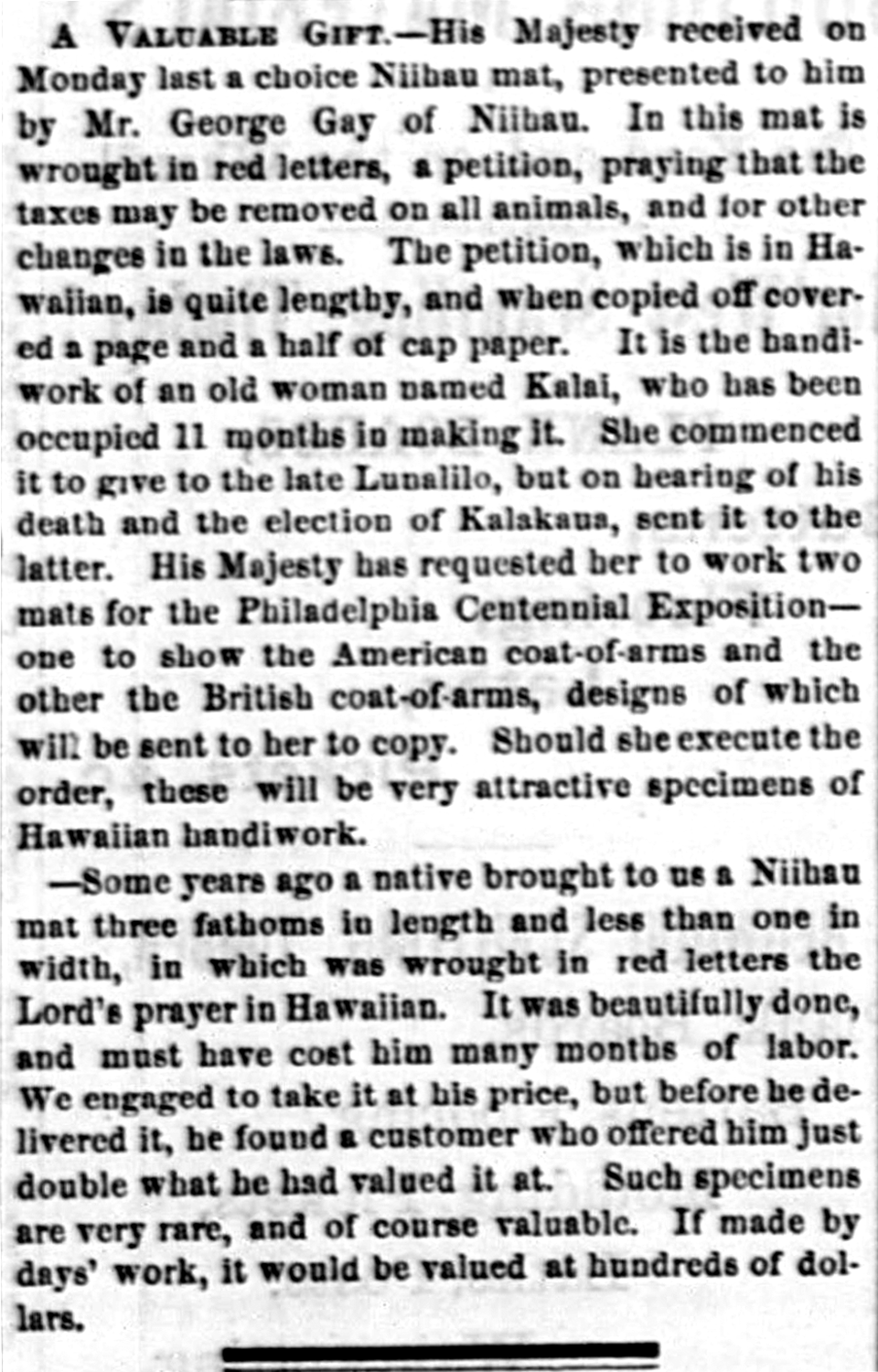
A Valuable Gift.—His Majesty received on Monday last a choice Niihau mat, presented to him by Mr. George Gay of Niihau. In this mat is wrought in red letters, a petition, praying that the taxes may be removed on all animals, and for other changes in the laws. The petition, which is in Hawaiian, is quite lengthy, and when copied off covered a page and a half of cap paper. It is the handiwork of an old woman named Kalai, who has been occupied 11 months in making it. She commenced it to give to the late Lunalilo, but on hearing of his death and the election of Kalakaua, sent it to the latter. His Majesty has requested her to work tow mats for the Philadelphia Centennial Exposition—one to show the American coat-of-arms and the other the British coat-of-arms, designs of which will be sent to her to copy. Should she execute the order, these will be very attractive specimens of Hawaiian handiwork.

—Some years ago a native brought to us a Niihau mat three fathoms in length and less than one in width, in which was wrought in red letters the Lord’s prayer in Hawaiian. It was beautifully done, and must have cost him many months of labor. We engaged to take it at his price, but before he delivered it, he found a customer who offered him just double what he had valued it at. Such specimens are very rare, and of course valuable. If made by days’ work, it would be valued at hundreds of dollars.

[This mat was put on display at the Bishop Museum just yesterday. Go check it out if you are on Oahu nei.]

(Hawaiian Gazette, 4/29/1874, p. 3)

A Valuable Gift.

Hawaiian Gazette, Volume X, Number 17, Page 3. Aprila 29, 1874.

History of Kawaiahao Church, 1885.

KAWAIAHAO CHURCH

The readers of the Kuokoa will probably not be unable to recognize the features of the building pictured above; it is the church of Kawaiahao. It is an old building and one that is greatly beloved by a portion of our people, this mother church of ours. Its predecessor on these grounds was a church of pili grass; and the stone building was completed in 1842, constructed by the loving hands of the alii and makaainana of times gone by. It was Kekuanaoa and Bingham [Binamu] Sr. who selected the area where it was to be built and supervised its construction, however Bingham returned to America before the completion of this building.

There were many renowned events which were done in Kawaiahao such that it is as if the building was the place to carry out grand and fine deeds of the past, of the nation and the people. It was in this building that a number of the Legislative Sessions of the nation were opened, if this writer is not mistaken. It was in this building that Kamehameha V opened the Constitutional Convention [Ahaolelo Hooponopono Kumukanawai] on the 7th of July, 1864. Continue reading

King Kalakaua’s expected treatment in the United States, 1874.

To King Kalakaua will go the honor of being the first ruling monarch to travel to the Nation of the United States of America since it was established as a nation. He will meet with a very grand reception greater than anyone else who has gone there.

When the battleship Benecia enters the entrance of the Golden Gate with the Hawaiian Flag waving in the wind on it central mast, it will be given a salute from the nation of the United States of America by the guns of the forts of Pine and Alcatraz when it passes before each of them. And should there be no obstructions or accidents, perhaps General Schofield [Sekofila], the Commander of the U. S. Forces in the division of the Pacific will meet and welcome Him in the name of the President, at a Hotel which he deems as fitting for the honor of the Monarch to spend the night. General Schofield appeared amongst us in the early months of Lunalilo reign. The length of their stay in San Francisco is not clear, but from what is known, it will not be for many days. Continue reading

Twenty-one peals of thunder for the People’s King, 1875.

[Found under: “Nu Hou Kuloko.”]

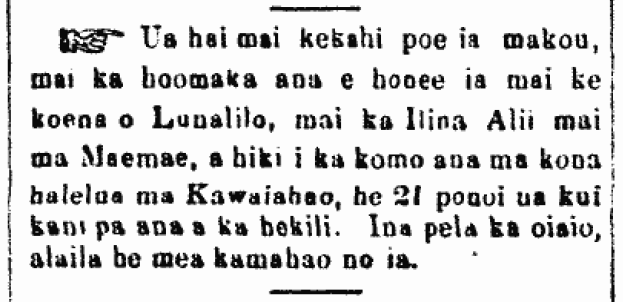
Some people have reported to us that from the beginning of the transportation of the remains of Lunalilo from the Royal Mausoleum at Maemae until entering his crypt at Kawaiahao, there were exactly 21 peals of thunder. Should that be the truth, it is something remarkable.

[The first funeral procession on February 28, 1874 took Lunalilo to the Royal Mausoleum, because his crypt was not yet complete, and then on November 23, 1875, as this article states, his remains were moved to his final resting place at Kawaiahao.

For even more accounts on this amazing occurrence, see https://www.facebook.com/photo.php?fbid=10201289583821168&set=a.10200741355595805.1073741841.1219578864&type=1&theater]

(Kuokoa, 11/27/1875, p. 2)

Ua hai mai kekahi poe...

Ka Nupepa Kuokoa, Buke XIV, Helu 48, Aoao 2. Novemaba 27, 1875.

More on Lunalilo’s birthday, 1874.

Birthday of the King.

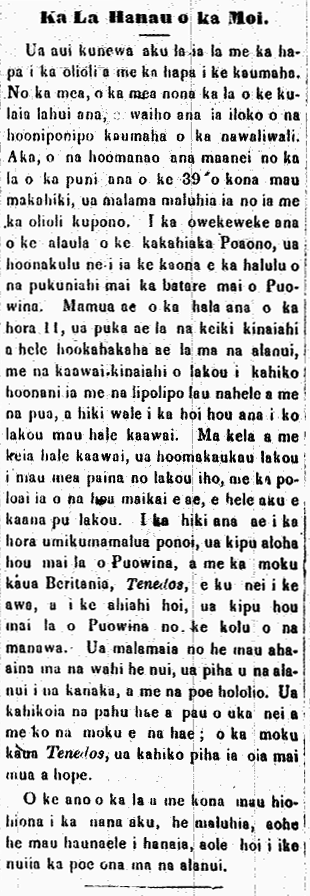
The day passed partially in happiness and partially in sadness. Being that the one whose day this holiday of the lahui is for is there languishing in weakness. The celebration here for his 39th birthday was held peacefully with proper cheer. With the break of dawn of the morning of Saturday, the town was rattled by the boom of the cannons from the battery of Puowina.¹ Before the passing of 11 o’clock, out came the firemen as they paraded on the streets with their fire trucks decorated with the verdure of the forest and flowers, until they returned once again to their station. At each fire station, they had prepared a banquet for themselves while their fine friends were invited to share in this with them. When 11 o’clock arrived exactly, cannons were shot off again from Puowina, along with the warship, Tenedos, which was docked in the harbor; and in the evening as well, cannons were shot off a third time from Puowina. Parties were held at many places, and the streets were teeming with people and those on horseback. All of the flagpoles on land and those on the ships were decorated with flags; the warship Tenedos was adorned from bow to stern.

The nature of the day and its sights were peaceful; there were no commotions aroused, nor were there many drunken people seen on the streets.

¹Puowina is one of the many variants for what we see mostly as Puowaina today [Punchbowl].

(Ko Hawaii Ponoi, 2/4/1874, p. 2)

Ka La Hanau o ka Moi.

Ko Hawaii Ponoi, Buke I, Helu 34, Aoao 2. Feberuari 4, 1874.

King Lunalilo’s second birthday and last as King of the Hawaiian Archipelago, 1874.

The King’s Birthday.

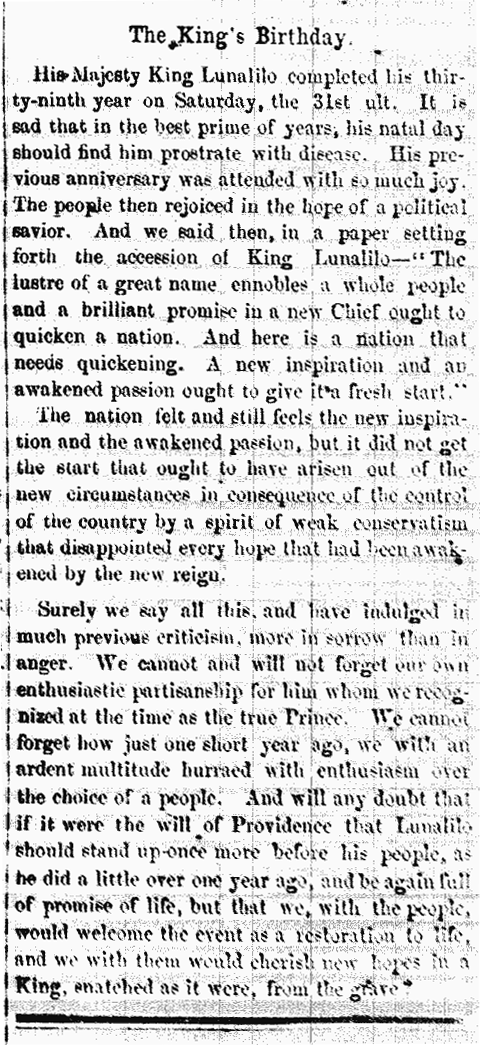
His Majesty King Lunalilo completed his thirty-ninth year on Saturday, the 31st ult. It is sad that in the best prime of years, his natal day should find him prostrate with disease. His previous anniversary was attended with so much joy. The people then rejoiced in the hope of a political savior. And we said then, in a paper setting forth the accession of King Lunalilo—”The lustre of a great name ennobles a whole people and a brilliant promise in a new Chief ought to quicken a nation. And here is a nation that need quickening. A new inspiration an awakened passion ought to give it a fresh start.”

The nation felt and still feels the new inspiration and the awakened passion, but it did not get the start that ought to have arisen out of the new circumstances in consequence of the control of the country by a spirit of weak conservatism that disappointed every hope that had been awakened by the new reign.

Surely we say all this, and have indulged in much previous criticism, more in a sorrow than in anger. We cannot and will not forget our own enthusiastic partisanship for him whom we recognized at the time as the true Prince. We cannot forget how just one short year ago, we with an ardent multitude hurraed with enthusiasm over a choice of a people. And will any doubt that if it were the will of Providence that Lunalilo should stand up once more before his people, as he did a little over one year ago, and be again full of life, but that we, with the people, would welcome the even as a restoration to life, and we with them would cherish new hopes in a King, snatched as it were, from the grave.

(Nuhou, 2/3/1874, p. 6)

The King's Birthday.

Ka Nuhou Hawaii, Buke I, Helu 14, Aoao 6. Feberuari 3, 1874.

More on Jane Loeau’s passing, 1873.

Death of a Chiefess.—Jane Loeau, a descendant in the female line of the ancient chiefs of Kauai, and a reputed granddaughter of Kamehameha I., died suddenly in this city on Wednesday last. She was 45 years of age, and was in childhood an inmate of the Chief’s school under the charge of Mr. and Mrs. Cooke, at the same time with Kamehameha IVth and Vth and His present Majesty.

(Pacific Commercial Advertiser, 8/2/1873, p. 3)

Death of a Chiefess.

The Pacific Commercial Advertiser, Volume XVIII, Number 5, Page 3. August 2, 1873.

Those afflicted with leprosy forsaken by the church? 1873.

Statement on Leprosy, and Resolutions

Adopted by the Hawaiian Evangelical Association, Honolulu, June 10, 1873.

The disease of leprosy in these islands has assumed such an aspect, that it becomes our immediate duty to determine our course of action as pastors and teachers respecting it.

This loathsome, incurable and deadly disease has fastened upon the vitals of the nation. Although we hope and believe that it is not yet too late by the use of sufficiently stern and vigorous measures to dislodge its fatal hold, that hold has become fearfully strong. The numbers already known to be victims to leprosy, the still larger numbers who are undoubtedly infected, the steady, remorseless activity with which it is extending, all tell us with ghastly assurance, that unless remedial measures are used more effective than have been hitherto applied, our Hawaiian people will become in a very few years, a nation of lepers.

Do we consider what this means? It means the disorganization and total destruction of civilization, property values, and industry, of our churches, our contributions, our Hawaiian Board and its work of Missions. It means shame, and defeat, and disgraceful overthrow to all that is promising and fair in the nation.

We are on the brink of a horrible pit, full of loathsomeness, into which our feet are rapidly sliding.

The chief cause of our peril, is not, that God who has stricken our nation with this awful judgment, has placed no remedy within our reach. He has given a remedy, which the experience of wise men and wise nations has made certain. Nay, He has laid the rule down in the law given to Israel by His servant Moses. It is this; strict, thorough separation from us of all infected persons, not only of established lepers, but also of all who are reasonably suspected.

If we obey God’s leadings and follow this rule, our nation will be saved. If we do not, we are doomed to an early and shameful death.

Our great peril is from general ignorance on this subject among the common people, and their consequent apathy and perversity. They refuse to separate their lepers from them. They eat, drink and sleep with them. They oppose their removal and hide them. They listen to the voices of evil-minded men who raise an outcry against the King and his helpers, when they strive to root out the evil thing.

We therefore as pastors and teachers, as an association have a pressing duty. It is this, to teach and persuade all the people to obey the law of God, and separate the lepers from among us, and while striving to comfort and strengthen with the love of Jesus the afflicted hearts of the lepers and their friends, also to teach every leper who cleaves to his people and refuses to go away, that he is sinning against the lives of men and against the law of God. Therefore,

Resolved, That every Pastor and Preacher of this Association be instructed to preach frequently, and particularly to his people, upon the duty of isolating their lepers, especially as illustrated by the Mosaic law in the thirteenth chapter of Leviticus; also, that he use diligently his personal efforts to induce the people to perform this duty.

Resolved, To set apart the 18th day of July next as a day of Fasting, of Repentance before God for our sins, and especially for those sins which promote the spread of this disease, and also as a day of Prayer to God, to strengthen the King and officers of the Government in cleansing the land of this disease, and to turn the hearts of the people to help in this work of saving the nation.

Resolved, That the names of all the members of the Association be signed to this paper, and that it be placed in the hands of His Excellency the Minister of the Interior, who is ex-officio President of the Board of Health.

J. Hanaloa,  J. Kaiwiaea, H. H. Parker,
J. Kauhane,  G. W. Pilipo,  J. Kalana,
S. W. Papaula,  J. D. Paris,  O. Nawahine,
J. F. Pogue,  J. Waiamau,  J. N. Paikuli,
J. K. Kahuila,  S. Paaluhi,  P. W. Kaawa,
G. P. Kaonohimaka,  E. Kekoa,  J. Manuel,
T. N. Simeona,  S. Aiwohi,  S. Waiwaiole,
S. Kamelamela,  J. K. Paahana,  A. Kaoliko,
S. Kamakahiki,  E. Helekunihi,  Kekiokalani,
S. Kuaumoana,  J. M. Kealoha,  S. E. Bishop,
W. P. Alexander,  Ioela,  D. Dole,
G. W. Lilikalani,  M. Kuaea,  A. Pali,
J. W. Kahele,  G. Puuloa,  B. W. Parker,
Noa Pali,  S. P. Heulu,  L. Smith,
S. Kanakaole,  D. Baldwin,  J. A. Kaukau,
J. Porter Green,  E. Kahoena,  A. O. Forbes.

[How have things changed today? How have things remained the same? Find the Hawaiian-Language version printed in the Kuokoa, 6/18/1873, p. 3, here.]

(Pacific Commercial Advertiser, 6/14/1873, p. 3)

Statement on Leprosy, and Resolutions

The Pacific Commercial Advertiser, Volume XVII, Number 50, Page 3. June 14, 1873.