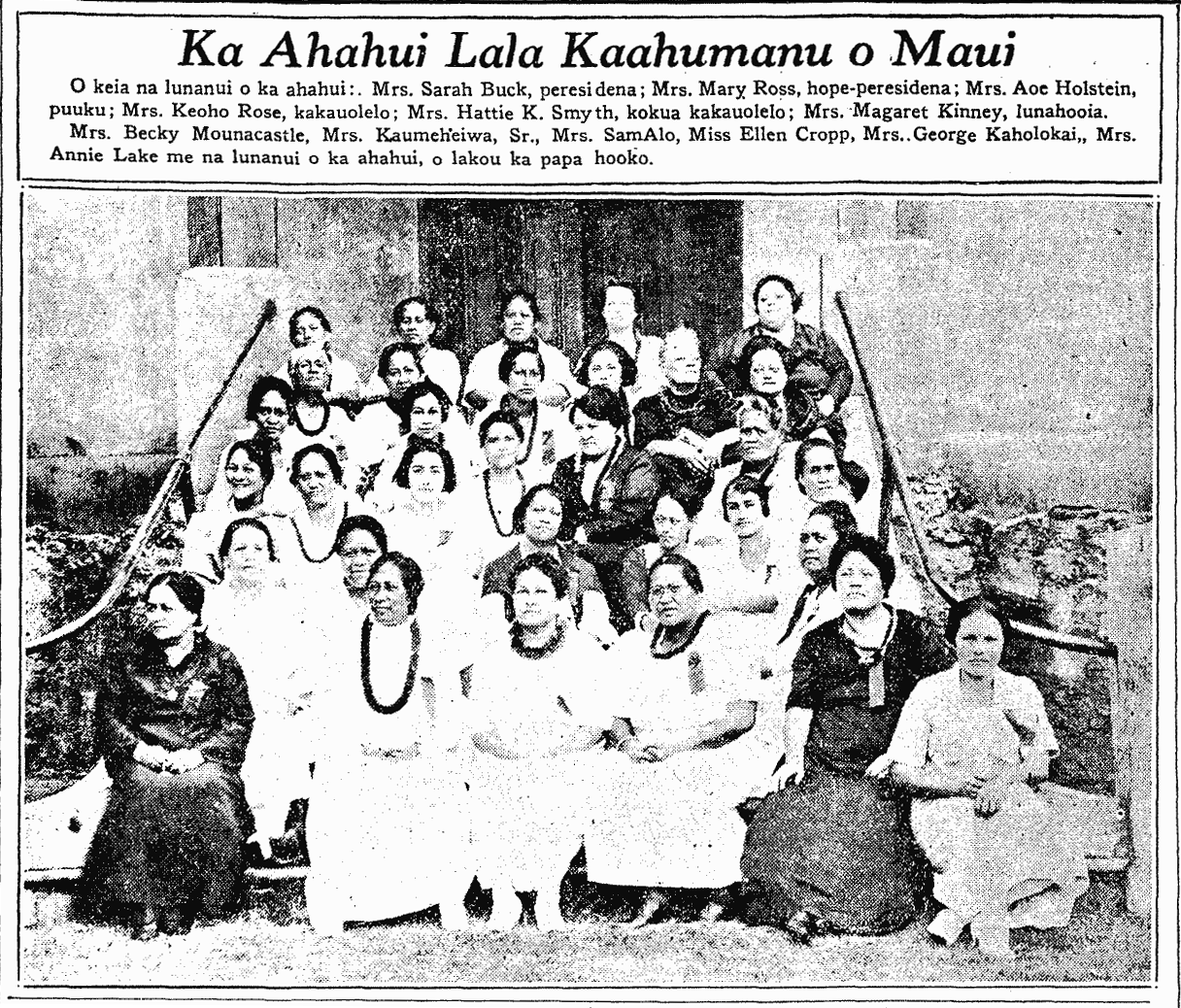
Nice picture of Maui’s Kaahumanu Society officers, 1923.

The Members of the Kaahumanu Society of Maui

These are the officers of the society: Mrs. Sarah Buck, president; Mrs. Mary Ross, vice president; Mrs. Aoe Holstein, treasurer; Mrs. Keoho Rose, secretary; Mrs. Hattie K. Smyth, assistant secretary; Mrs. Magaret [Margaret] Kinney, auditor; Mrs. Becky Mounacastle [Mountcastle], Mrs. Kaumeheiwa, Sr., Mrs. Sam Alo, Miss Ellen Cropp, Mrs. George Kaholokai, Mrs. Annie Lake along the officers of the society, are the executive committee.

(Kuokoa, 7/5/1923, p. 3)

Ka Ahahui Lala Kaahumanu o Maui

Ka Nupepa Kuokoa, Buke LXII, Helu 27, Aoao 3. Iulai 5, 1923.

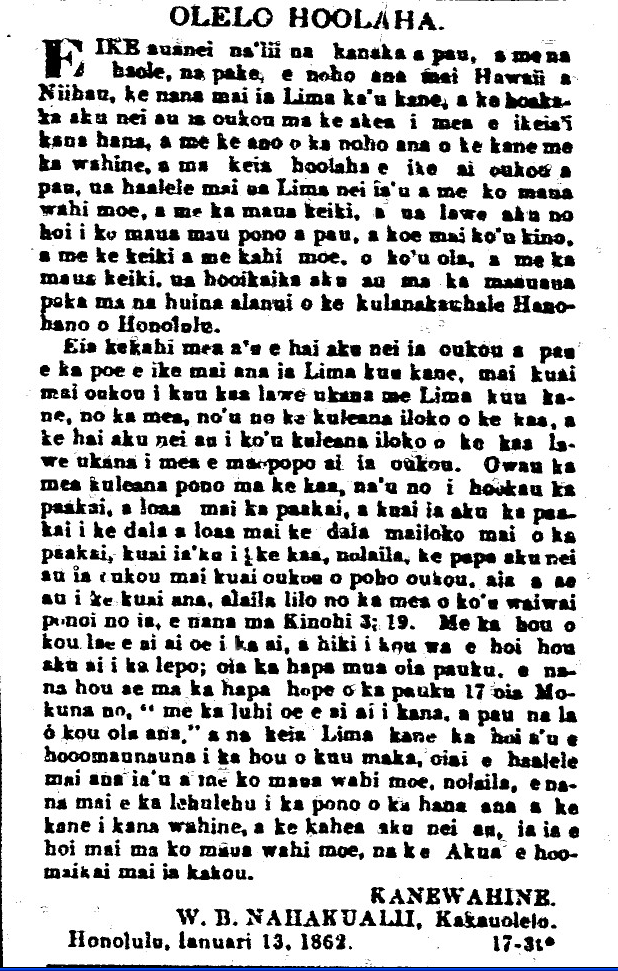
Original post by Kanewahine about husband, Lima. 1862.

ANNOUNCEMENT.

[Here is the original article that was commented upon by the Pacific Commercial Advertiser (1/23/1862).]

(Hoku o ka Pakipika, 1/23/1862, p. 3)

OLELO HOOLAHA.

Ka Hoku o ka Pakipika, Buke I, Helu 18, Aoao 3. Ianuari 23, 1862.

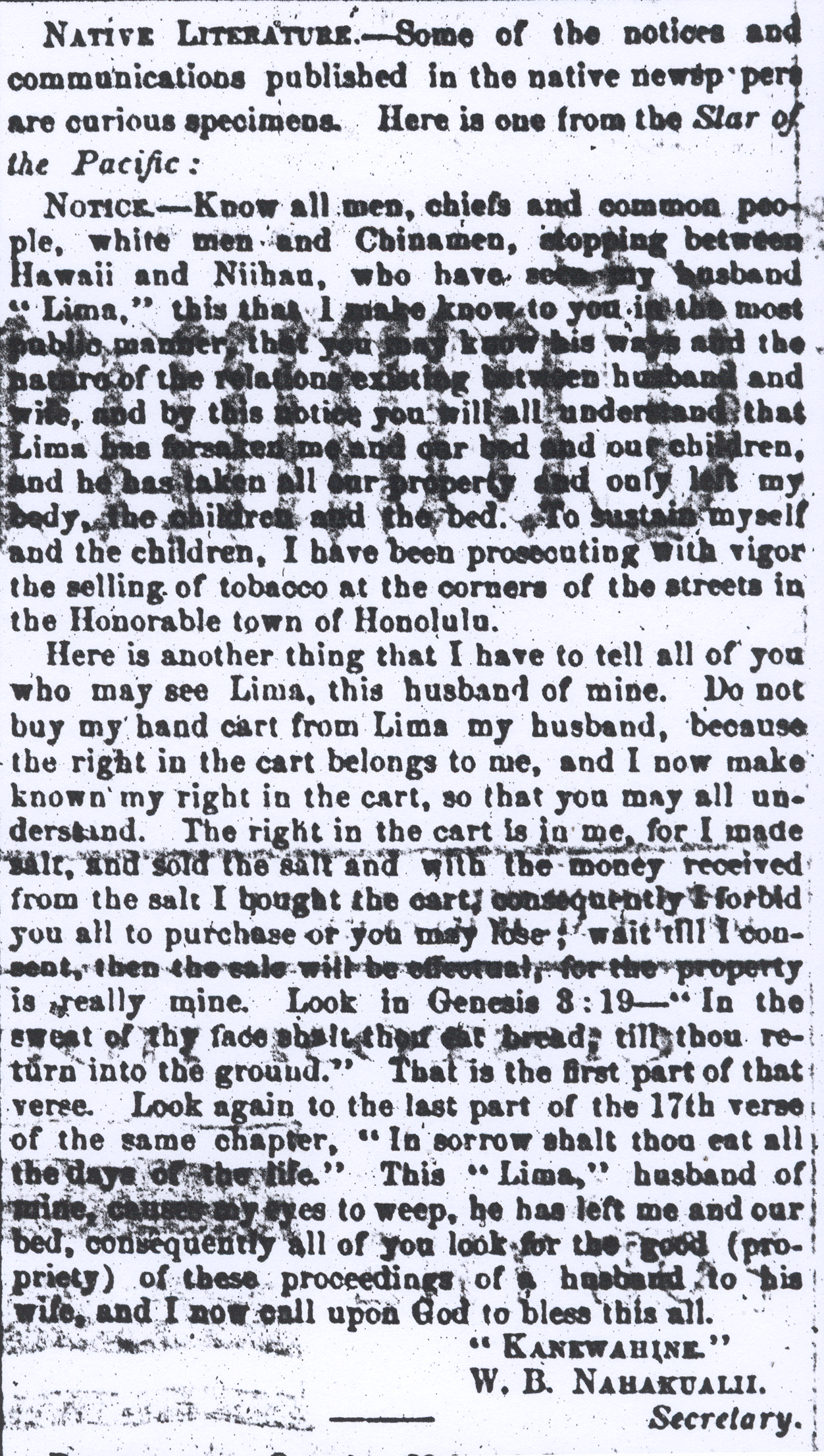
Mockery? by the Pacific Commercial Advertiser over personal ads in the Hawaiian-Language Newspapers, 1862.

NATIVE LITERATURE—Some of the notices and communications published in the native newspapers are curious specimens. Here is one from the Star of the Pacific [Ka Hoku o ka Pakipika]:

NOTICE.—Know all men, chiefs, and common people, white men and Chinamen, stopping between Hawaii and Niihau [residing from Hawaii to Niihau], who have seen my husband “Lima,” this that I make know to you in the most public manner that you may know his ways and the nature of the relations existing between husband and wife, and by this notice you will all understand that Lima has forsaken me and our bed and our children, and he has taken all our property and only left my body, the children and the bed. To sustain myself and the children, I have been prosecuting with vigor the selling of tobacco at the corners of the streets in the Honorable town of Honolulu.

Here is another thing that I have to tell all of you who may see Lima, this husband of mine. Do not buy my hand cart from Lima my husband, because the right in the cart belongs to me, and I now make know my right in the cart, so that you may all understand. The right in the cart is in me, for I made salt, and sold the salt and with the money received from the salt I bought the cart, consequently I forbid you all to purchase or you may lose [or it will be your loss]; wait till i consent, then the sale will be effectual [only should I consent will the sale be effectual], for the property is really mine. Look in Genesis 3:19—”In the sweat of thy face shalt thou eat bread; till thou return into the ground.” That is the first part of that verse. Look again to the last part of the 17th verse of the same chapter, “In sorrow shalt thou eat all the days of the [thy] life.” This “Lima,” husband of mine, causes my eyes to weep [It is because of this Lima that I waste the sweat of my face], he has left me and our bed, consequently all of you look for the good (propriety) of these proceedings of a husband to his wife [so all of you, look at the treatment by this man of his wife], and i now call upon God to bless this all [and I call out to him to return to our bed, and may God bless us all].

“Kanewahine.”

W. B. Nahakualii,

Secretary.

[The bracketed inserts are what I felt might be closer interpretations of the original…]

(Pacific Commercial Advertiser, 2/23/1862, p. ?)

Native Literature.

The Pacific Commercial Advertiser, ????. January 23, 1862.

Vital Statistics, 1862.

MARRIAGES.

Feb. 10, at Holualoa, Hawaii, Kaulua and Kaleimakalii were wed by H. L. Sheldon.
March 13, at Kaa, Lanai, Lau and Kawailiu were wed by Koiku.
March 10, at Kahalapalaoa, Lanai, Kaiwi and Nuipoohiwi were wed by Koiku.
March 30, at Kahalapalaoa, Lanai, Kauhane and Hanakulani were wed by Koiku.
May 11, at Kahana, Maui, Maaloe and Holi were wed by Koiku.
August 8, at Kaohai, Lanai, Kaawa and Halakaipo were wed by Koiku.
May 9, at Kahalapalaoa, Lanai, Kahele and Punana were wed by Koiku.
September 1, at Palawai, Lanai, Paiwi and Rahaba were wed by Koiku.
October 20, at Kahalapalaoa, Lanai, Kanakaole and Kaikaika were wed by Koiku.
March 25, at Kihamaniania, Lanai, Ohule and Naimu were wed by Koiku.
April 3, at Kahalapalaoa, Lanai, Malumalu and Kauhaleliilii were wed by Koiku.
June 2, at Kahalapalaoa, Lanai, Kalani and Kemiki Kimo were wed by Koiku.
June 10, at Kahana, Maui, Kuoiwi and Makakoa were wed by Koiku.
Nov. 27, at Kahalapalaoa, Lanai, Kalehuamakanoe and Kahele were wed by Koiku.
January 10, at Kahalapalaoa, Lanai, Naliieha and Niau were wed by Koiku.
Feb. 8, at Nawiliwili, Kauai, Robora Manukilika and S. Kamahalo were wed.

BIRTHS.

Feb. 3, at Waipio, Hamakua, Hawaii, Xaiewe [Kaiewe ?] (f) was born.
Feb. 1, at the same location, Kekuhaulua (m) was born to Kahinalua (m) and Kapawai (f).
Feb. 4, at Niuula, Kawailoa, Waialua, Oahu, Lusia (f) was born to Kaikoo (m) and Kapule.
Feb. 4, at Lokoea, Kawailoa, Waialua, Oahu, Luka (f) was born, an illegitimate child [keiki kamehai].

DEATHS.

Feb. 3, at Waipio, Hamakua, Hawaii, Kapoka (f) dies suddenly; she was 50 years old.
Nov. 26, at Puuwai, Niihau, R. Kokiki (f) died.
December 9, at Lilea, Niihau, Hiloiki (m) died.
December 17, at Kaolaelae, Niihau, Kaweheokalani (f) died.
December 24, at Kalanihale, Niihau, Kaninaualii (m) died.
December 26, at Kaluapupa [?], Niihau, Keoni (m) died.
December 30, at Koenaha, Niihau, Wahinekane (f) died.
Feb. 7, at Waialua, Molokai, H. Kauwewa (m) died of a headache and fever.
Feb. 17, at Auwaiolimu, Honolulu, Oahu, Kauhi died.
Feb. 4, at Kaumakapili, Honolulu, Oahu, Paaluhi (m) died.

(Hoku o ka Pakipika, 2/20/1862, p. 3)

MARE / HANAU / MAKE

Ka Hoku o ka Pakipika, Buke I, Helu 22, Aoao 3. Feberuari 20, 1862.

Tsunami? 1862.

Turbulent Sea.

On Tuesday, the 28th of January, at Waialua, Molokai, exceptionally rough seas were seen, and there was much damage. The fish ponds from Moanui until Puako were smashed by the sea. The road at Honouliwai was dashed, and horses cannot  travel there. On the night of the 29th, there was a great earthquake, and the earth shook for eleven seconds. This is what was written in by M. Timoteo.

(Hoku o ka Pakipika, 2/20/1862, p. 2)

Kaikoo nui.

Ka Hoku o ka Pakipika, Buke I, Helu 22, Aoao 2. Feberuari 20, 1862.

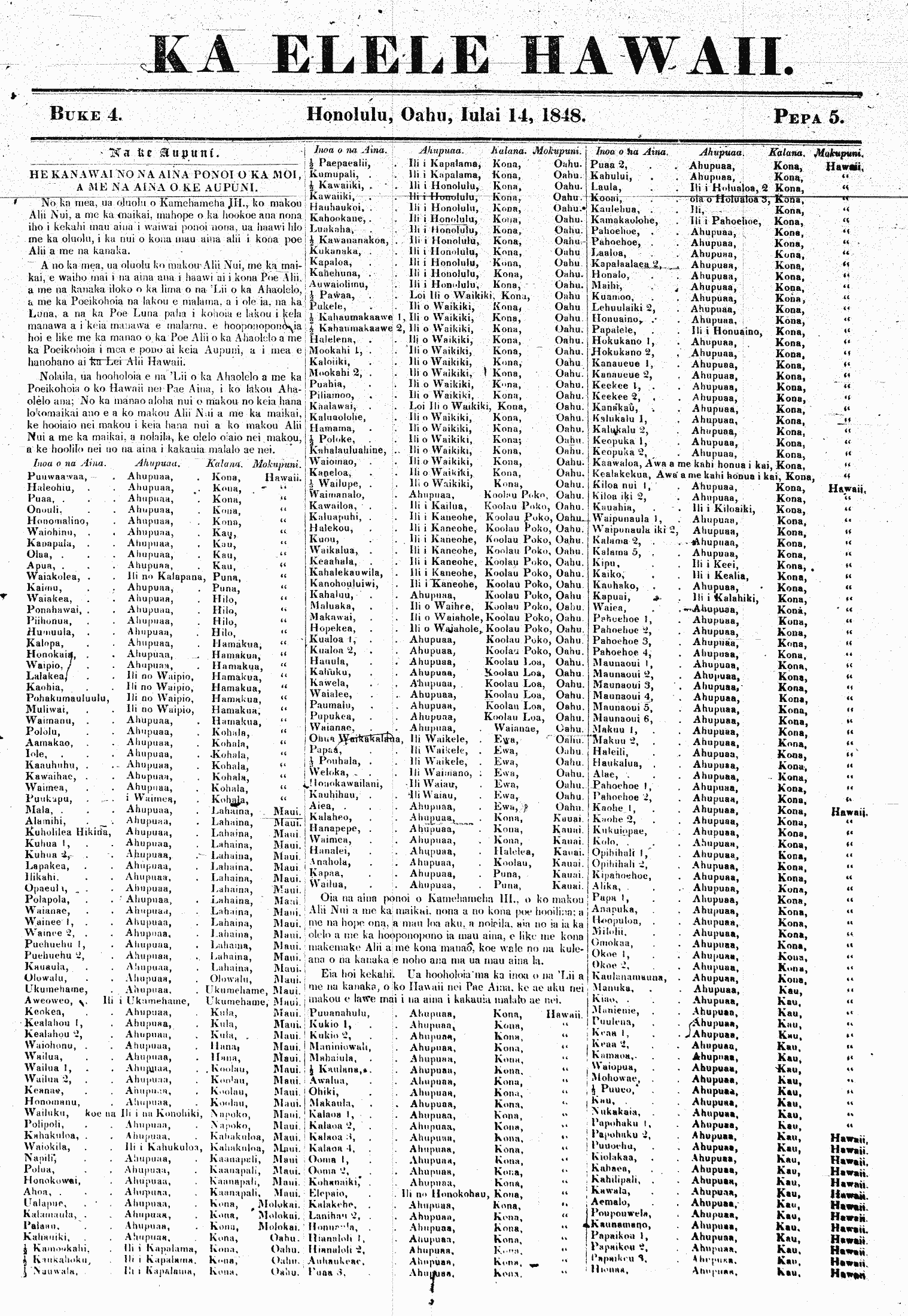
Personal Lands of Kamehameha III, and Government Lands, 1848.

By the Government.

A LAW FOR THE PERSONAL LANDS OF THE KING,
AND THE LANDS OF THE NATION.

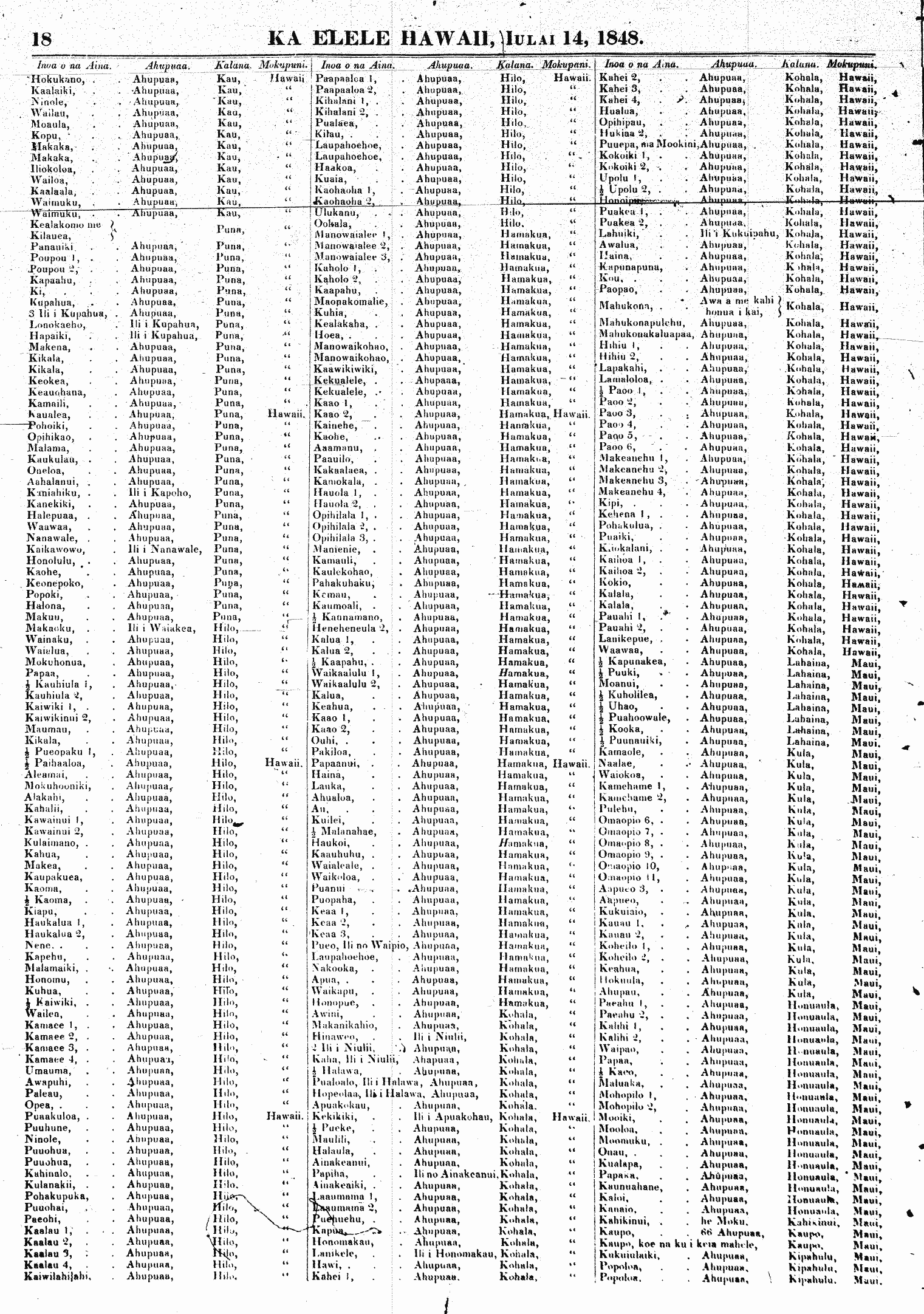
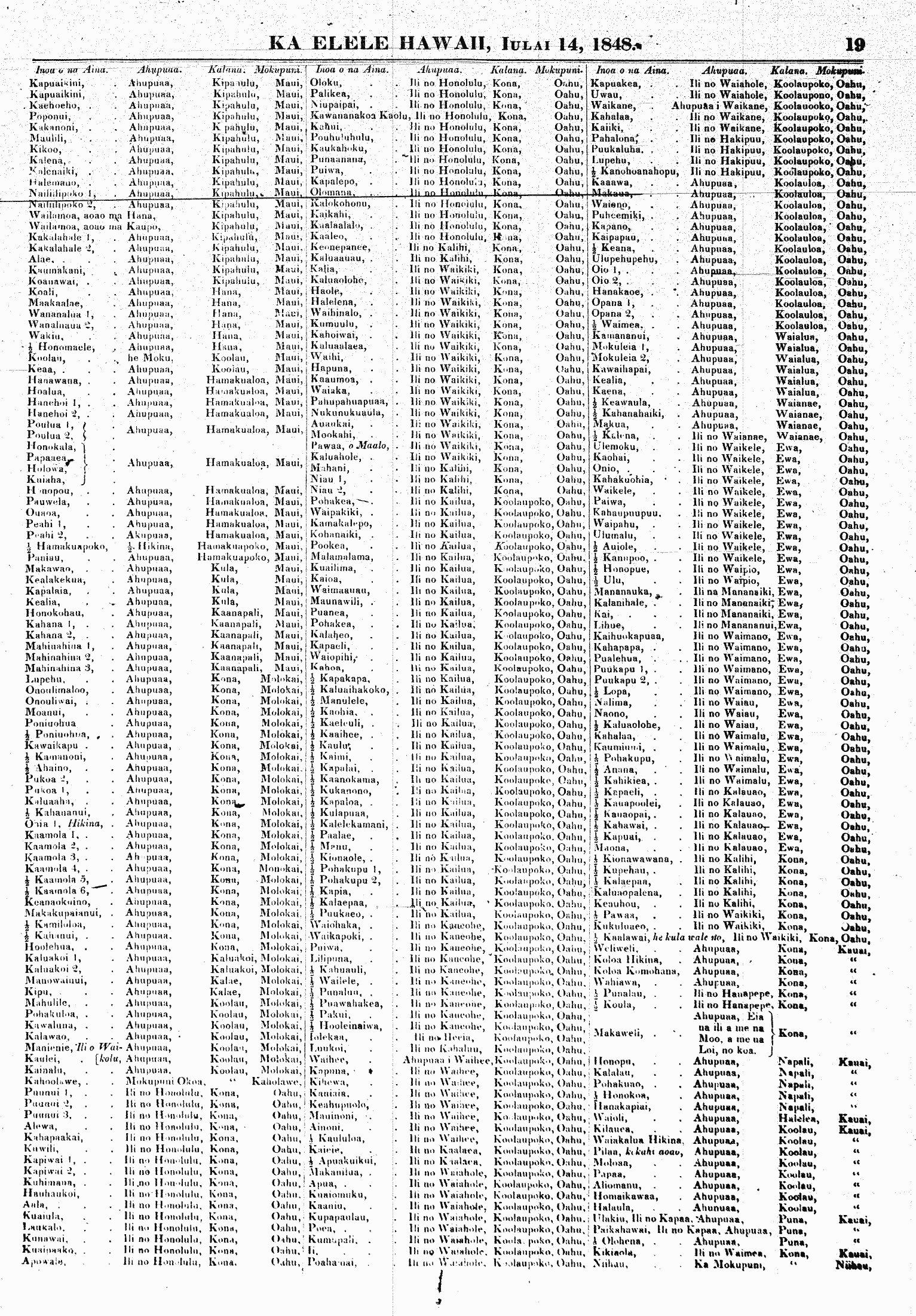
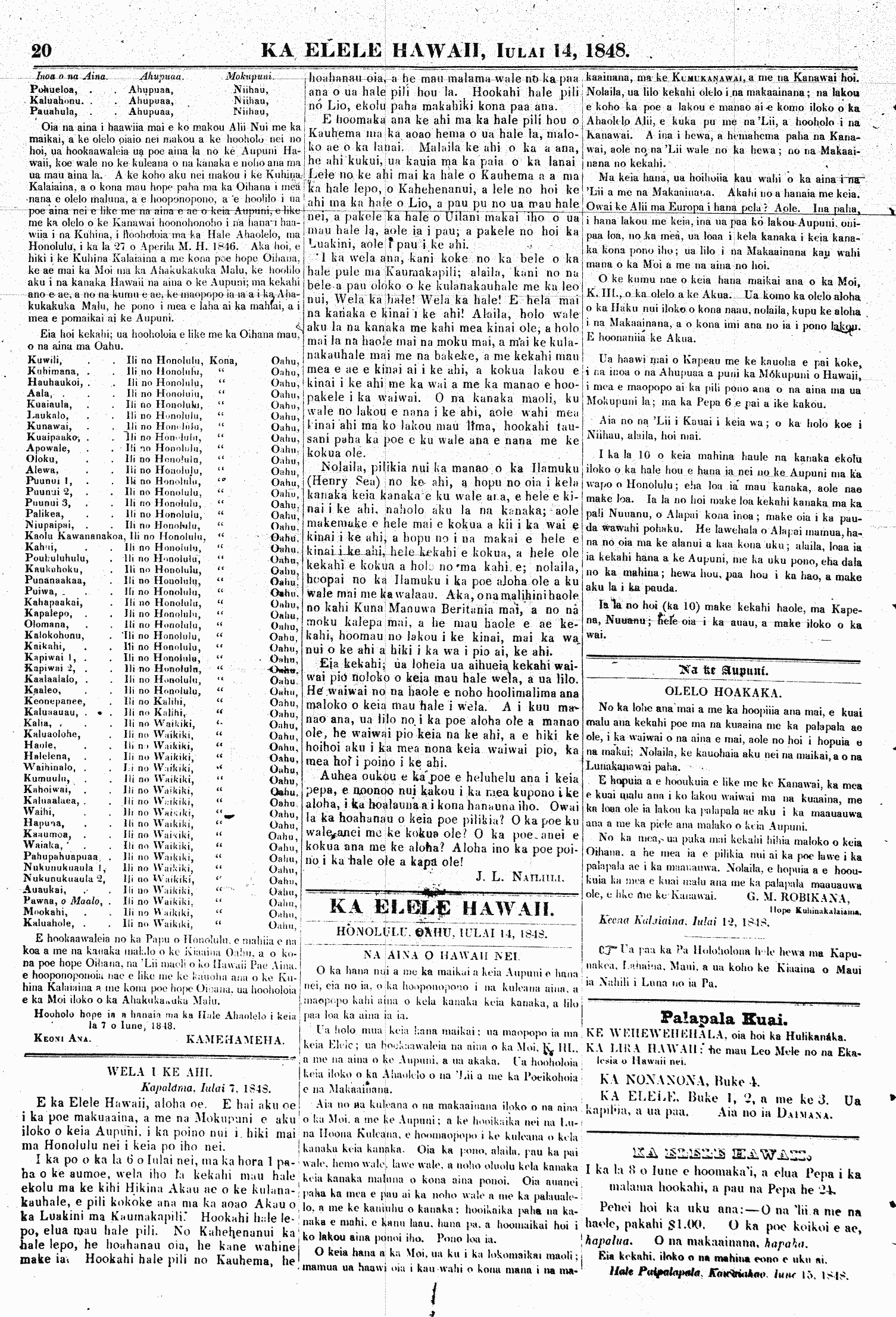
[Here is a newly passed law of the land appearing in the newspaper Elele Hawaii. One of the functions of the newspapers was to inform the nation’s citizens of new laws and proclamations from the government. This particular law establishes the Crown Lands (and Government Lands) which still holds much importance to this day.

For a translation see “A Supplement to the Statute Laws of His Majesty, Kamehameha III., King of the Hawaiian Islands, … 1848.” pp. 22–43.

What is also valuable about this listing is that it describes in 1848 what ahupuaa a certain land belonged to, and so forth.]

(Elele Hawaii, 7/14/1848, pp. 17–20.)

HE KANAWAI NO NA AINA PONOI O KA MOI, A ME NA AINA O KE AUPUNI.

Ka Elele Hawaii, Buke 4, Pepa 5, Aoao 17. Iulai 14, 1848.


HE KANAWAI NO NA AINA PONOI O KA MOI, A ME NA AINA O KE AUPUNI.

Ka Elele Hawaii, Buke 4, Pepa 5, Aoao 18. Iulai 14, 1848.

HE KANAWAI NO NA AINA PONOI O KA MOI, A ME NA AINA O KE AUPUNI.

Ka Elele Hawaii, Buke 4, Pepa 5, Aoao 19. Iulai 14, 1848.

HE KANAWAI NO NA AINA PONOI O KA MOI, A ME NA AINA O KE AUPUNI.

Ka Elele Hawaii, Buke 4, Pepa 5, Aoao 20. Iulai 14, 1848.

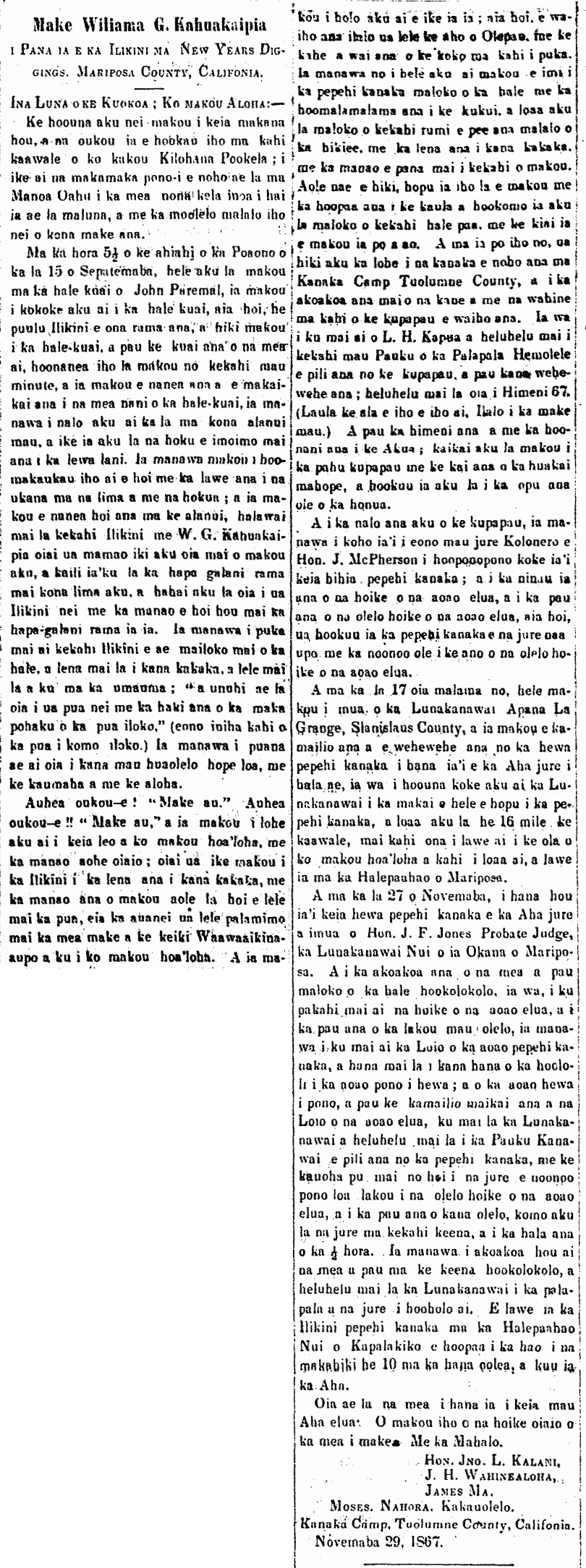
William G. Kahuakaipia is killed in California, 1868.

Wiliama G. Kahuakaipia is Dead

Shot by an Indian with a Bow and Arrow at New Year’s Diggings, Mariposa County, California.

To the Heads of the Kuokoa; Our Aloha:—

We are sending you this new gift, and it is for you to place it in some open space of our Greatest Prize (the newspaper Kuokoa) so that the personal friends living in Manoa, Oahu, of the person mentioned above, may see, along with the story below of his death.

At 5:30 in the evening of Saturday, the 15th of September, we went to the shop of John Paremal, and as we got closer to the store, there was a group of Indians getting drunk; and we got to the store, and finished our food shopping, then we hung around for a few minutes; and as we looked around at the nice items in the shop, the sun left on its usual path and the stars were seen twinkling in the heavens. That was when we got ready to leave, carrying our good by hand and on our shoulders; and while we were enjoying our way back, an Indian met up with W. G. Kahuakaipia while he was a bit away from us, and a half gallon jug of alcohol was taken from his hand, and he went after that Indian, thinking to retrieve the half gallon jug. Right then, another Indian came out from the shop and drew back his bow and the [arrow] flew and struck the chest; “and Kahuakaipia pulled out the arrow breaking the stone head off within,” (the arrow entered six inches). That was when he spoke his last words, with sadness and aloha.

O You guys! I am dead. Hey you guys!! and when we heard this call by our friend, we didn’t believe it was true, for when we saw the Indian pull back his bow, we thought that he wouldn’t let the arrow fly, but no, the weapon of the Ignorant [Waawaaikinaaupo] youth flew swiftly and struck our friend. And when we approached to see him, he already lay there, his last breath gone with blood flowing profusely from the wound. Right then we went to look for the murderer in the store aided by the light of a lamp and we found him in a room hiding under a couch; he was pulling back his bow, thinking to shoot one of us. But he was not able to because he was grabbed by us and tied up with rope and thrown into a secured building which we guarded all night until day. And on the next night, the news reached those living at Kanaka Camp, Tuolumne County, and when the men and women had gathered by where the body lay, then L. H. Kapua stood and read some passages from the Holy Book about the dead one, and after his talk, he read Hymn 67 (Wide is the path to go down, Down to eternal death). And after the hymn was over and the glorification of God, we carried the coffin with the procession following behind, and let it down into the depths of the bowels of the earth.

After the body was gone, a coroner’s jury of six was chosen by Hon. J. McPherson so that this murder case would be resolved quickly. With the questioning of the witnesses of both sides, and after the presentations by both sides were finished, come to find out, the murderer was set free by the stupid jury without them considering the testimony of both sides.

And on the 17th of that same month, we went before the district judge of La Grange, Stanislaus County, and when we were speaking of and explaining what was done by the past jury in the crime of murder, the judge immediately sent an officer to arrest the murderer, and he was found 16 miles away from where he took the life of our friend, and was taken to the jail of Mariposa.

Then on the 27th of November, this murderer was retried by a jury before Hon. J. F. Jones Probate judge, the head judge of Mariposa County. When everyone was gathered in the courthouse, each witness for both sides stood one by one, and after they were done with their statements, then the lawyer for the murderer stood and did his job of twisting right into wrong and wrong into right; and when the eloquent speeches by the lawyers of both sides were completed, the judge stood up and read the law dealing with murder and instructed the jury to carefully consider the testimony by both sides, and when he was done the jury went into a room. After half an hour, everyone gathered again in the courthouse and the judge read the decision of the jury. The murdering Indian will be taken to the great prison of San Francisco where he will be incarcerated for 10 years with hard labor; and the court was adjourned.

The is what was done in the two trials. We are true witnesses of the deceased. With appreciation.

Hon. John L. Kalani,

J. H. Wahinealoha,

James Ma,

Moses Nahora, Secretary.

Kanaka Camp, Tuolumne County, California.

November 29, 1867.

[I am not sure if this Moses Nahora and the Moses Naehola of the earlier post are the same person or not…

And how awesome is this, Mariposa County History page has a sponsor!]

(Kuokoa, 2/1/1868, p. 4)

Make Wiliama G. Kahuakaipia

Ka Nupepa Kuokoa, Buke VII, Helu 6, Aoao 4. Feberuari 1, 1868.

Less than a week before the new system at Bishop Museum Library and Archives kicks in!

“In alignment with Bishop Museum’s new strategic plan, the Library and Archives collections have been identified as an area of priority in the effort to develop increased access to Museum resources for our community. Effective March 1, 2012, the Library and Archives will temporarily suspend public reference hours and provide limited, by-appointment access to its collections. This temporary closure will allow staff the necessary time to support a museum and community effort to plan and implement a new model of operation for this area. “

Here is the link to the new form you must fill out and submit to make an appointment to request use of the Library and Archives.

Hawaiianized missionary name list, 1848.

NAMES OF THE MISSIONARIES.

Hawaiians are bad at pronouncing haole words, so they call the haole by names that they can pronounce. However, these names are not familiar to the newcomers; therefore, letters often fall to the side and do not arrive because the person to whom it is addressed is not known. In this manner, sometime earlier, a letter was addressed to Rev. R. Tinker, and this is what was written on the outside. Ia Tineka Amerikahuipuia [To Tineka, United States of America]. What Postmaster in America understands these words? So too of many who deliver letters here in Hawaii; those malihini form foreign lands who don’t know the missionaries’ Hawaiian names. Therefore, this document makes clear the real names of the missionaries living in this Archipelago.

Laimana, Rev. D. B. Lyman.

Koana, Rev. Titus Coan.

Parika, Rev. J. D. Paris.

Kine, Rev. H. Kinney.

Aiwa, Rev. Mar. Ives.

Pokue, Rev. J. F. Pogue.

Tatina, Rev. Asa Thurston.

Kauka Aneru, S. L. Andrews, M. D.

Laiana, Rev. Lorenzo Lyons.

Bona, Rev. E. Bond.

Kaahele, Rev. E. Whittlesey.

Gerina, Rev. J. S. Green.

Bele, Mr. E. Bailey.

Konede, Rev. D. T. Conde.

Okana, Miss M. Ogden.

Alekanedero, Rev. W. P. Alexander.

Aneru, Rev. C. B. Andrews.

Baluwina, Rev. D. Baldwin, M. D.

Hikikoke, Rev. H. R. Hitchcock.

Duaita, Rev. S. G. Dwight.

Berauna, Miss L. Brown.

Kalaka, Rev. E. W. Clark.

Kemita, Rev. Lowell Smith.

Limaikaika, Rev. R. Armstrong.

Kamalani, Mr. Levi Chamberlain.

Kasela, Mr. S. N. Castle.

Holo, Mr. E. O. Hall.

Laukeke, Mr. E. H. Rogers.

Kaimana, Mr. H. Dimond.

Kuke, Mr. A. S. Cooke.

Rikeke Wahine, Mrs. C. L. Richards.

Dole, Rev. D. Dole.

Rike, Mr. W. H. Rice.

Kemika, Miss M. M. Smith.

Aneru, Lunakanawai Rev. L. Andrews.

Hana, Rev. T. D. Hunt.

Demana, Rev. S. Damon.

Bihopa, Rev. A. Bishop.

Emekona, Rev. J. S. Emerson.

Kulika, Rev. P. J. Gulick.

Pareka, Rev. B. W. Parker.

Kauka Kemika, J. W. Smith, M. D.

Ioane, Rev. E. Johnson.

Wilikoke, Mr. A. Wilcox.

Rowela, Rev. G. B. Rowell.

Wini Wahine, Mrs. M. P. Whitney.

[This is definitely not a complete listing. One famous person not included for example is Gerrit P. Judd, who was called Dauta Iada and Kauka Iada, but mostly just Kauka. Also once again, there are often a variety of given names for a single person. Baldwin was not only called Baluwina, but Balawina, Ogden is not only Okana, but Ogana, etc.

This hopefully will help you when searching for missionaries, especially because they are often referred to only by their Hawaiian names in the newspapers (like Laiana in the earlier post about snow on Hualalai in 1862)!

There needs to be a more comprehensive listing (not only of missionary names but of all name variants) done and put somewhere online so that it is easily accessed!!

Also found: Ioane, Edward Johnson]

(Elele Hawaii, 10/9/1848, p. 36)
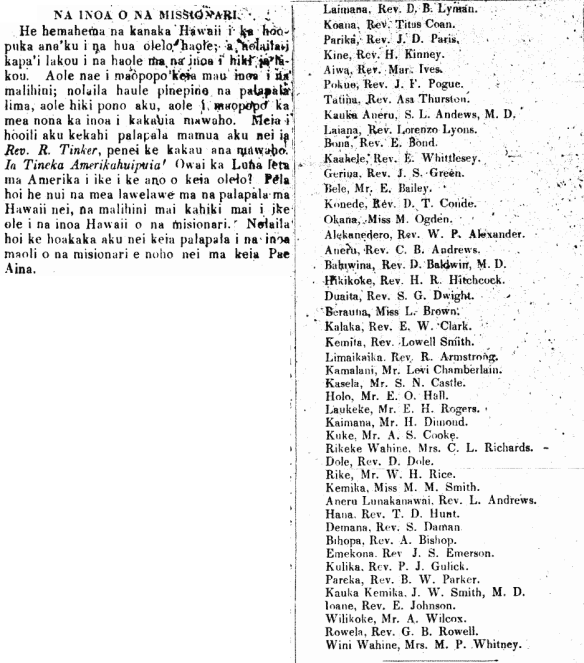
NA INOA O NA MISIONARI.

Ka Elele Hawaii, Buke 4, Pepa 9, Aoao 36. Okatoba 9, 1848.

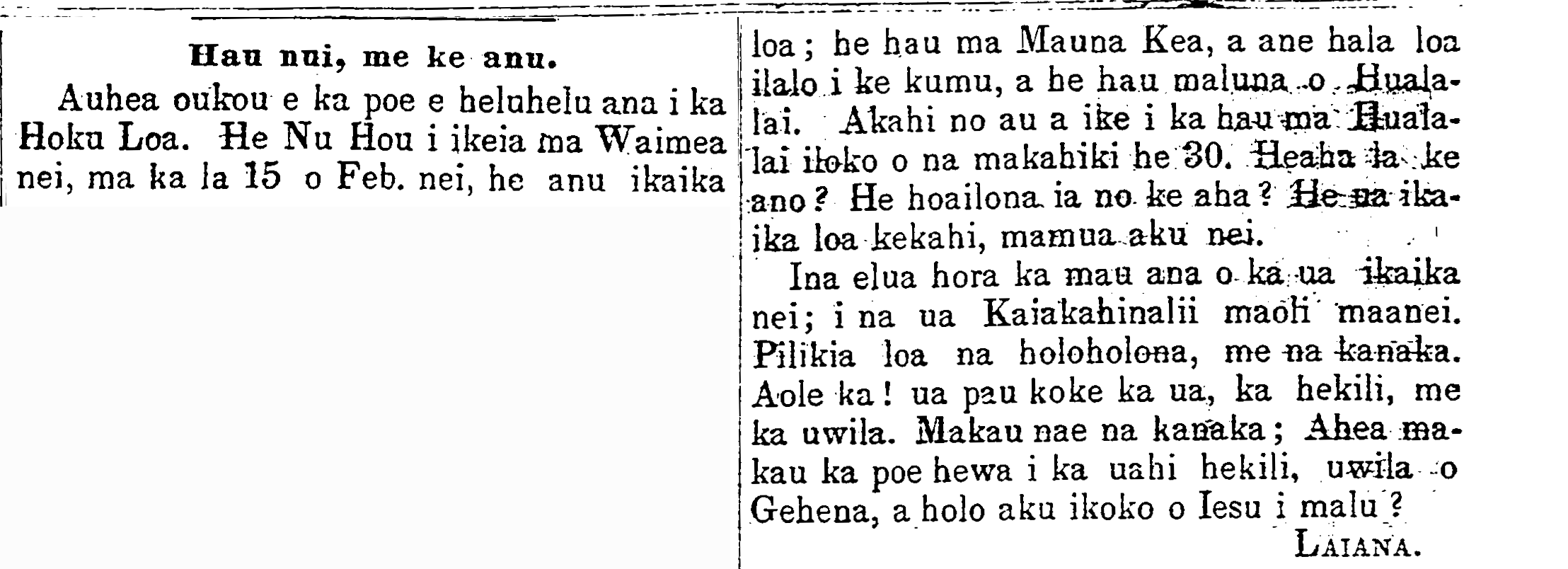
Snow on Hualalai 150 years ago. 1862.

Much Snow, and cold.

O People reading the Hoku Loa. There is News seen here in Waimea; on the 15th of February, there was extreme cold; there was snow on Mauna Kea, and it almost reached its base, and there was snow atop Hualalai. It was the first time I saw snow on Hualalai in 30 years. What is this? What is it a sign of? There was also heavy rains earlier.

If the heavy rains lasted for a couple of hours, it would have had a massive flood [Kaiakahinalii] here. The livestock and people would have been in trouble. But no! the rain, thunder, and lightning soon stopped. The people were still afraid; When will the people be afraid of the smoke, thunder, and lightning of Gehenna, and go to the protection of Jesus?

LYONS.

(Hoku Loa, 3/1862, p. 34.)

Hau nui, me ke anu.

Ka Hoku Loa, Buke III, Helu 9, Aoao 34. Maraki, 1862.