Chinese New Year, 1911.

HAPPY NEW YEAR OF THE CHINESE

This coming Friday, February 7th, is the Happy New Year Day and Konohi of the Chinese. The Bow Wong Wui, the Chinese Reform Society is preparing to give on that day a great feast, and on that same day, some leaders of the group will give speeches on the reason for separating themselves from the leadership of China’s traditional government. However, it would seem that there will not be as grand a commemoration as the previous year because of the difficulty in obtaining funds now.

(Aloha Aina, 1/11/1907, p. 7)

LA HAPE NUIA O NA PAKE

Ke Aloha Aina, Buke VIII, Helu 2, Aoao 7. Ianuari 11, 1902.

Kaahumanu Church repairs, 1911 / 2015.

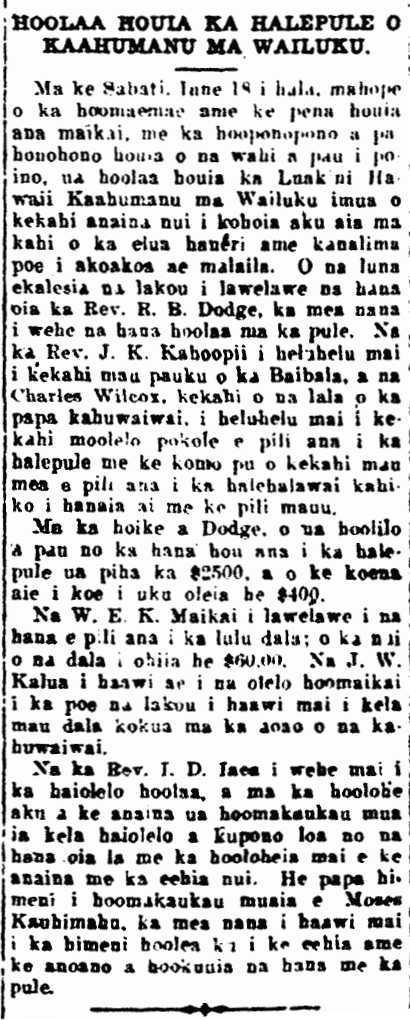
KAAHUMANU CHURCH IN WAILUKU IS REDEDICATED.

On Sunday, this past June 18th, after the cleaning and repainting nicely, and the repairing and patching up of all damaged places, the Kaahumanu Hawaiian Church in Wailuku was reconsecrated before a great crowd estimated to be about two hundred and fifty people who gathered there. The heads of the church who performed the services were the Rev. R. B. Dodge, the one who opened the dedication with a prayer. Rev. J. K. Kahoopii read a passage from the Bible, and Charles Wilcox, one of the members of the board of trustees [papa kahuwaiwai] read a short history about the church along with some information about the old meeting hall which was made of pili grass.

According to Dodge’s speech, the costs to rebuild the church reached $2,500, and the remainder that has not been paid off is $400.

W. E. K. Maikai was in charge of donations; and the total collected was $60.00. J. W. Kalua gave a speech of thanks to those who gave the monetary contributions, on behalf of the trustees.

Rev. I. D. Iaea gave the speech of dedication, and and as the congregation listened, the speech was well prepared and was very appropriate for the service that day for the congregation to hear with great awe. There was a choir arranged earlier by Moses Kauhimahu that sang the hymn of praise full of reverence and awe, and the service was let out with a prayer.

[It seems that the Kaahumanu Church once again needs assistance to do repairs! Check out the Save Kaahumanu Church Facebook page for more information.]

(Kuokoa, 6/30/1911, p. 8)

HOOLAA HOUIA KA HALEPULE O KAAHUMANU MA WAILUKU.

Ka Nupepa Kuokoa, Buke XLVII, Helu 26, Aoao 8. Iune 30, 1911.

Voting Precincts in Hawaiian in an English newspaper, 1922.

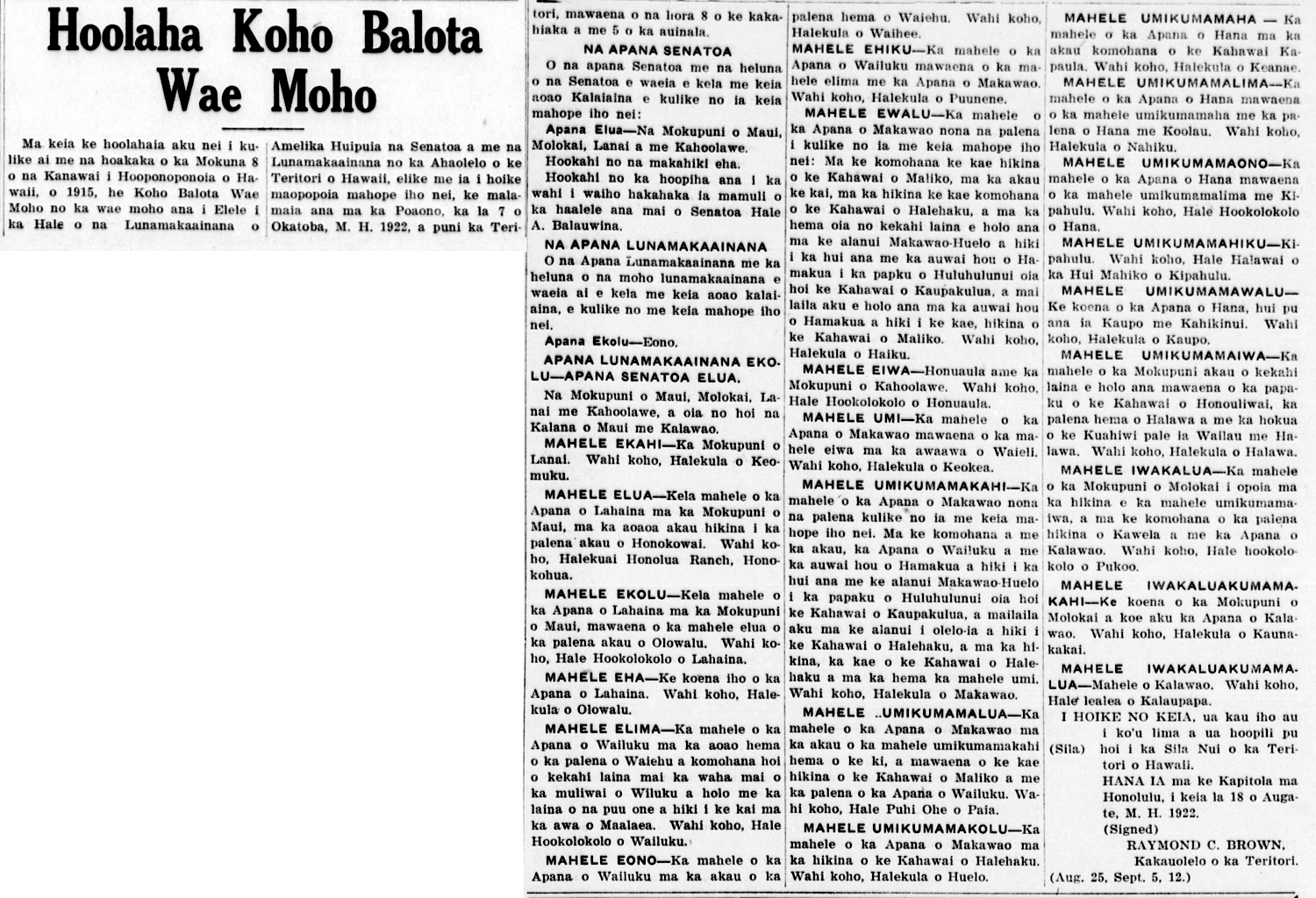
Hoolaha Koho Balota Wae Moho

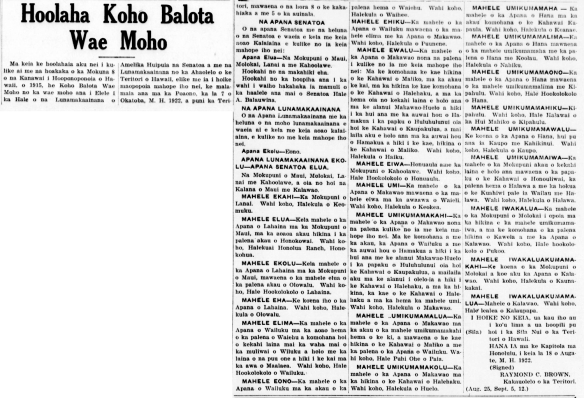
Ma keia ke hoolahaia aku nei i kulike ai me na hoakaka o ka Mokuna 8 o na Kanawai i Hooponoponoia o Hawaii, o 1915, he Koho Balota Wae Moho no ka wae moho ana i Elele i ka Hale o na Lunamakaainana o Amelika Huipuia na Senatoa a me na Lunamakaainana no ka Ahaolelo o ke Teritori o Hawaii, elike me ia i hoike maopopoia mahope iho nei, ke malamaia ana ma ka Poaono, ka la 7 o Okatoba, M. H. 1922, a puni ka Teritori, mawaena o na hora 8 o ke kakahiaka a me 5 o ka auinala.

NA APANA SENATOA

O na apana Senatoa me na heluna o na Senatoa e waeia e kela me keia aoao Kalaiaina e kulike no ia keia mahope iho nei:

Apana Elua—Na Mokupuni o Maui, Molokai, Lanai a me Kahoolawe.

Hookahi no na makahiki eha.

Hookahi no ka hoopiha ana i ka wahi i waiho hakahaka ia mamuli o ka haalele ana mai o Senatoa Hale A. Balauwina.

NA APANA LUNAMAKAAINANA

O na Apana Lunamakaainana me ka heluna o na moho lunamakaainana e waeia e kela me keia aoao kalaiaina, e kulike no me keia mahope iho nei.

Apana Ekolu—Eono.

APANA LUNAMAKAAINANA EKOLUAPANA SENATOA ELUA.

Na Mokupuni o Maui, Molokai, Lanai me Kahoolawe, a oia no hoi na Kalana o Maui me Kalawao.

MAHELE EKAHI—Ka Mokupuni o Lanai. Wahi koho, Halekula o Keomuku.

MAHELE ELUA—Kela mahele o ka Apana o Lahaina ma ka Mokupuni o Maui, ma ka aoao akau hikina i ka palena akau o Honokowai. Wahi koho, Halekuai Honolua Ranch, Honokohau.

MAHELE EKOLU—Kela mahele o ka Apana o Lahaina ma ka Mokupuni o Maui, mawaena o ka mahele elua o ka palena akau o Olowalu. Wahi koho, Hale Hookolokolo o Lahaina.

MAHELE EHA—Ke koena iho o ka Apana o Lahaina. Wahi koho, Halekula o Olowalu.

MAHELE ELIMA—Ka mahele o ka Apana o Wailuku a komohana hoi o ka palena o Waiehu a komohana hoi o kekahi laina mai ka waha mai o ka muliwai o Wailuku a holo me ka laina o na puu one a hiki i ke kai ma ka awa o Maalaea. Wahi koho, Hale Hookolokolo o Wailuku.

MAHELE EONO—Ka mahele o ka Apana o Wailuku ma ka akau o ka palena hema o Waiehu. Wahi koho, Halekula o Waihee.

MAHELE EHIKU—Ka mahele o ka Apana o Wailuku mawaena o ka mahele elima me ka Apana o Makawao. Wahi koho, Halekula o Puunene.

MAHELE EWALU—Ka mahele o ka Apana o Makawao nona na palena i kuliike no ia me keia mahope iho nei: Ma ke komohana ke kae hikina o ke Kahawai o Maliko, ma ka akau ke kai, ma ka hiki ke kae komohana o ke Kahawai o Halehaku, a ma ka hema oia no kekahi laina e holo ana ma ke alanui Makawao-Huelo a hiki i ka hui ana me ka auwai hou o Hamakua i ka papaku o Huluhulunui oia hoi ke Kahawai o Kaupakulua, a mai laila aku e holo ana ma ka auwai hou o Hamakua a hiki i ke kae hikina o ke kahawai o Maliko. Wahi koho, Halekula o Haiku.

MAHELE EIWA—Honuaula ame ka Mokupuni o Kahoolawe. Wahi koho, Hale Hookolokolo o Honuaula.

MAHELE UMI—Ka mahele o ka Apana o Makawao mawaena o ka mahele eiwa ma ka awaawa o Waieli. Wahi koho, Halekula o Keokea.

MAHELE UMIKUMAMAKAHI—Ka mahele o ka Apana o Makawao nona na palena kulike no ia me keia mahope iho nei. Ma ke komohana a me ka akau, ka Apana o Wailuku a me ka auwai hou o Hamakua a hiki i ka hui ana me ke alanui Makawao-Huelo i ka papaku o Huluhulunui oia hoi ke Kahawai o Kaupakulua, a mailaila aku ma ke alanui i olelo ia a hiki i ke Kahawai o Halehaku, a ma ka hikina, ka kae o ke Kahawai o Halehaku a ma ka hema ka mahele umi. Wahi koho, Halekula o Makawao.

MAHELE UMIKUMAMALUA—Ka mahele o ka Apana o Makawao ma ka akau o ka mahele umikumamakahi hema o ke ki, a mawaena o ke kae hikina o ke Kahawai o Maliko a me ka palena o ka Apana o Wailuku. Wahi koho, Hale Puhi Ohe o Paia.

MAHELE UMIKUMAMAKOLU—Ka mahele o ka Apana a Makawao ma ka hikina o ke Kahawai o Halehaku. Wahi koho, Halekula o Huelo.

MAHELE UMIKUMAMAHA—Ka mahele o ka Apana o Hana ma ka akau komohana o ke Kahawai Kapaula. Wahi koho, Halekula o Keanae.

MAHELE UMIKUMAMALIMA—Ka mahele o ka Apana o Hana mawaena o ka mahele umikumamaha me ka palena o Hana me Koolau. Wahi koho, Halekula o Nahiku.

MAHELE UMIKUMAMAONO—Ka mahele o ka Apana o Hana mawaena o ka mahele umikumamalima me Kipahulu. Wahi koho, Hale Hookolokolo o Hana.

MAHELE UMIKUMAMAHIKU—Kipahulu. Wahi koho, Hale Halawai o ka Hui Mahiko o Kipahulu.

MAHELE UMIKUMAMAWALU—Ke koena o ka Apana o Hana, hui pu ana ia Kaupo me Kahikinui. Wahi koho, Halekula o Kaupo.

MAHELE UMIKUMAMAIWA—Ka mahele o ka Mokupuni akau o kekahi laina e holo ana mawaena o ka papaku o ke Kahawai o Honouliwai, ka palena hema o Halawa a me ka hokua o ke kKuahiwi pale ia Wailau me Halawa. Wahi koho, Halekula o Halawa.

MAHELE IWAKALUA—Ka mahele o ka Mokupuni o Molokai i opoia ma ka hikina e ka mahele umikumamaiwa, a ma ke komohana o ka palena hikina o Kawela a me ka Apana o Kalawao. Wahi koho, Hale hookolokolo o Pukoo.

MAHELE IWAKALUAKUMAMAKAHI—Ke koena o ka Mokupuni o Molokai a koe aku ka Apana o Kalawao. Wahi koho, Halekula o Kaunakakai.

MAHELE IWAKALUAKUMAMALUA—Mahele o Kalawao. Wahi koho, Hale lealea o Kalaupapa.

I HOIKE NO KEIA, ua kau iho au i ko’u lima a ua hoopili pu hoi i ka Sila Nui o ka Teritori o Hawaii. HANA IA ma ke Kapitola ma Honolulu, i keia la 18 o Augate, M. H. 1922.

(Sila) (Signed)

RAYMOND C. BROWN,
Kakauolelo o ka Teritori.

[Yesterdayʻs post was of a personal ad, but here is a government announcement in Hawaiian from 1922. This is printed along with the English on the same page.]

(Maui News, 9/5/1922, p. 7)
Hoolaha Koho Balota Wae Moho

Semi-Weekly Maui News, Year 22, Number 1198, Page 7. September 5, 1922.

Voting Precincts in an English newspaper, 1922.

BY AUTHORITY

Public Notice of Primary Election

Notice is hereby given that in accordance with the terms of Chapter 8 of the Revised Laws of Hawaii, 1915, a Primary Election for the purpose of making nominations for a Delegate to the House of Representatives of the United States and for Senators and Representatives of the Legislature of the Territory of Hawaii, as more particularly hereinafter set forth, will be held on Saturday, the 7th day of October, A. D. 1922, throughout the Territory, between the hours of eight o’clock, a. m., and five o’clock p. m.

SENATORIAL DISTRICTS

The several Senatorial Districts and the number of candidates by each political party are as follows:

SECOND DISTRICT—Islands of Maui, Molokai, Lanai and Kahoolawe—

One for full term of four years.

One to fill vacancy caused by resignation of Senator H. A. Baldwin.

REPRESENTATIVE DISTRICTS

The several Representative Districts and the number of candidates for Representative to be nominated by each political party are as follows:

IN THE THIRD DISTRICT—Six.

THIRD REPRESENTATIVE DISTRICTSECOND SENATORIAL DISTRICT.

The Islands of Maui, Molokai, Lanai and Kahoolawe, constituting the Counties of Maui and Kalawao.

FIRST PRECINCT—The Island of Lanai. Polling place, Keomuku Schoolhouse.

SECOND PRECINCT—The portion of Lahaina District on the Island of Maui, northeasterly of the north boundary of Honokowai. Polling place, Honolua Ranch Store, Honokohau.

THIRD PRECINCT—The portion of Lahaina District on the Island of Maui, between the Second Precinct and the north boundary of Olowalu. Polling place, Lahaina Courthouse.

FOURTH PRECINCT—The remainder of Lahaina District. Polling place, Olowalu schoolhouse.

FIFTH PRECINCT—The portion of Wailuku District south of Waiehu and west of a line from the mouth of the Wailuku stream along the sand hills to the sea at Maalaea Bay. Polling place, Wailuku courthouse.

SIXTH PRECINCT—The portion of Wailuku District north of the south boundary of Waiehu. Polling place, Waihee schoolhouse.

SEVENTH PRECINCT—The portion of Wailuku District between the Fifth Precinct and the Makawao District. Polling place, Puunene schoolhouse.

EIGHTH PRECINCT—The portion of Makawao District bounded on the west by the east edge of the Maliko gulch; on the north by the sea; on the east by the west edge of the Halehaku gulch; and on the south by a line along the Makawao-Huelo road to its junction with the new Hamakua Ditch in the bottom of the Huluhulunui o Kaupakulua gulch, thence along the new Hamakua Ditch to the east edge of the Maliko Gulch. Polling place, Haiku schoolhouse.

NINTH PRECINCT—Honuaula and the Island of Kahoolawe. Polling palce, Honuaula courthouse.

TENTH PRECINCT—The portion of Makawao District between the Ninth Precinct and the bed of Waieli gulch. Polling place, Keokea schoolhouse.

ELEVENTH PRECINCT—The portion of Makawao District bounded on the west and north by the Wailuku District and the new Hamakua Ditch to its junction with the Makawao-Huelo road in the bottom of the Heluhulunui or Kaupakulua gulch, thence along said road to the Halehaku gulch; on the east by the west edge of the Halehaku gulch; and on the south by the Tenth Precinct. Polling place, Makawao schoolhouse.

TWELFTH PRECINCT—The portion of Makawao District north of the Eleventh Precinct south of the sea and between the east edge of the Maliko gulch and the boundary of Wailuku District. Polling place, Paia band hall.

THIRTEENTH PRECINCT—The portion of Makawao District east of the bed of Halehaku gulch. Polling place, Huelo schoolhouse.

FOURTEENTH PRECINCT—The portion of Hana District northwest of the Kapaula Stream. Polling place, Keanae schoolhouse.

FIFTEENTH PRECINCT—The portion of Hana District between the Fourteenth Precinct and the Hana-Koolau boundary. Polling place, Nahiku schoolhouse.

SIXTEENTH PRECINCT—The portion of Hana District between the Fifteenth Precinct and Kipahulu. Polling place, Hana courthouse.

SEVENTEENTH PRECINCT—The District of Kipahulu. Polling place, Kipahulu Plantation hall.

EIGHTEENTH PRECINCT—The remainder of Hana District, including Kaupo and Kahikinui. Polling place, Kaupo schoolhouse.

NINETEENTH PRECINCT—The portion of the Island of Molokai north of a line running along the bed of the Honouliwai gulch, the southern boundary of Halawa and the top of the ridge between Wailau and Halawa. Polling place, Halawa schoolhouse.

TWENTIETH PRECINCT—The portion of the Island of Molokai bounded on the east by the Nineteenth Precinct and on the west by the east boundary of Kawela and the Kalawao District. Polling place, Pukoo courthouse.

TWENTY-FIRST PRECINCT—The remainder of the Island of Molokai, excepting the Kalawao District. Polling place, Kaunakakai schoolhouse.

TWENTY-SECOND PRECINCT—The Kalawao District. Polling place, amusement hall at Kalaupapa.

IN TESTIMONY WHEREOF, I have hereunto set my hand and caused the Great Seal of the Territory of Hawaii to be affixed.

DONE at the Capitol, in Honolulu, this 18th day of August, A. D. 1922.

(Seal) (Signed)

RAYMOND C. BROWN,
Secretary of Hawaii.

[See the Hawaiian-Language article published on the same page.]

(Maui News, 9/5/1922, p. 7)

Public Notice of Primary Election

Semi-Weekly Maui News, Year 22, Number 1198, Page 7. September 5, 1922.

Hawaiian Language even in the Star-Bulletin, 1917.

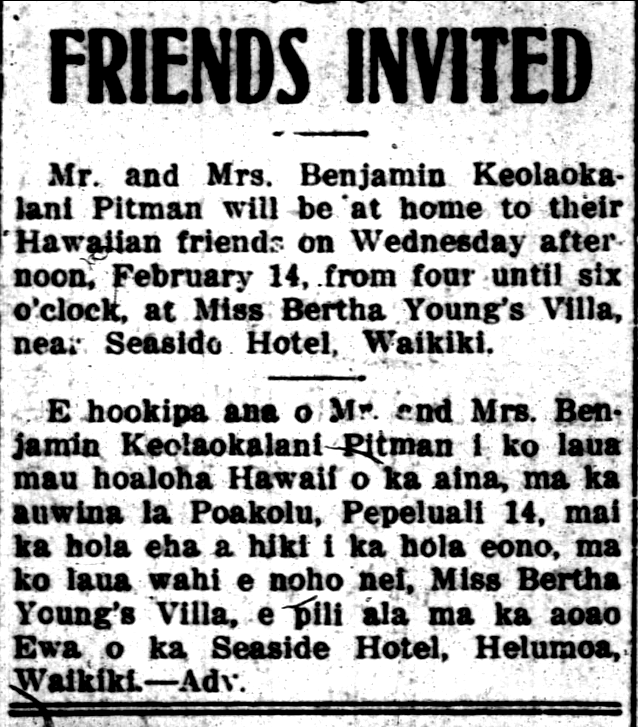
FRIENDS INVITED

Mr. and Mrs. Benjamin Keolaokalani Pitman will be at home to their Hawaiin friends on Wednesday afternoon, February 14, from four until six o’clock, at Miss Bertha Young’s Villa, near Seaside Hotel, Waikiki.

———

E hookipa ana o Mr. and Mrs. Benjamin Keolaokalani Pitman i ko laua mau hoaloha Hawaii o ka aina, ma ka auwina la Poakolu, Pepeluali 14, mai ka hola eha a hiki i ka hola eono, ma ko laua wahi e noho nei, Miss Bertha Young’s Villa, e pili ala ma ka aoao Ewa o ka Seaside Hotel, Helumoa, Waikiki.—Adv.

(Honolulu Star-Bulletin, 2/12/1917, p. 5)

FRIENDS INVITED

Honolulu Star-Bulletin, Volume XXIV, Number 7748, Page 5. February 12, 1917.

Emma Nakuina educates teachers on Hawaiian history, 1920.

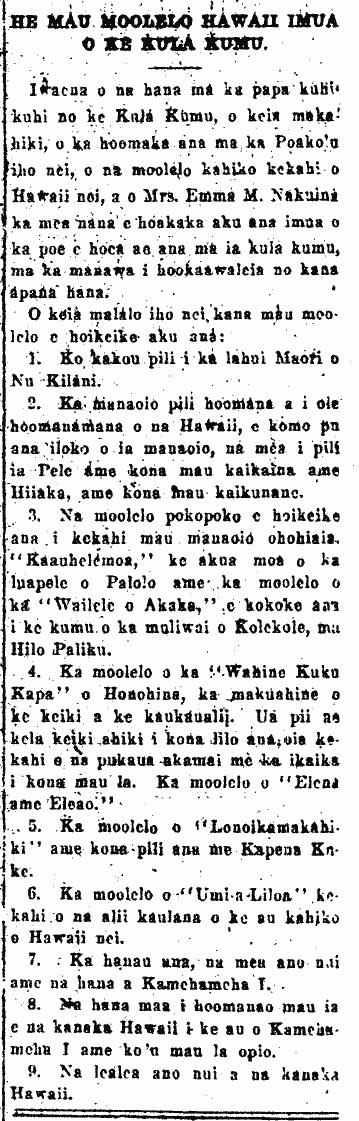
HAWAIIAN STORIES PRESENTED BEFORE THE TEACHERS’ SCHOOL.

In the syllabus of the School of Education this year, beginning on this past Wednesday, were old moolelo of Hawaii nei. And it is Mrs. Emma M. Nakuina who is teaching them before those who come to the teachers’ school during the time set aside for her course.

These below are the moolelo that she will be teaching:

1. Our ties with the Maori of New Zealand.

2. The religion or superstition of the Hawaiians, and along with those beliefs are things relating to Pele and her younger sisters and Hiiaka, along with her brothers.

3. Short stories which show amazing beliefs, like the story of “Kaauhelemoa,” the chicken god of the crater of Palolo and the story of “Akaka Waterfall,” which is close to the head of the Kolekole River in Hilo Paliku.

4. The story of “The Kapa-Beating Woman” of Honohina, the mother of the chiefly child. That child grew up to become one of the strong and skilled warriors of his time. The story of “Elena [Eleau?] and Eleao.”

5. The moolelo of “Lonoikamakahiki” and his association with Capt. Cook.

6. The moolelo of “Umi-a-Liloa,” one of the famous alii of old Hawaii nei.

7. The birth, the important things, and accomplishments of Kamehameha I.

8. The usual activities recalled by Hawaiians in the time of Kamehameha I as well as during my childhood.

9. The major entertainments of Hawaiians.

(Kuokoa, 7/9/1920, p. 4)

HE MAU MOOLELO HAWAII IMUA O KE KULA KUMU.

Ka Nupepa Kuokoa, Buke LVIII, Helu 28, Aoao 4. Iulai 9, 1920.

A sweet song indeed, 1920.

SWEET SONG.

Auhea wale oe e ke Sweet,
E ke onaona puahala;
Hoi mai no kaua e pili,
I hoapili oe no’u nei.

Aole no au e moe ana,
Eia ke ala i kuu poli;
E kiss ana no au,
Me kuu hoa alo anu.

Aole no au e hopo ana,
I ka nui leo a o na manu,
E kani hala ole nei i ka pua,
I ka piko o ke kuahiwi.

Composed by J. W. K. KAWAI.
Papaaloa, Hilo, June 20, 1920.

(Kuokoa, 7/9/1920, p. 8)

SWEET SONG.

Ka Nupepa Kuokoa, Buke LVIII, Helu 28, Aoao 8. Iulai 9, 1920.

Curious mele, 1892.

KA’U MELE.

Lohe mai au ulalaeho
Me Kahikina oe ulalaeho
Kahi niniau ai alalaeho
A niniau iho ulalaeho
O kou mau ia ulalaeho
A e ike ia nei ulalaeho
O ka holo mamua ulalaeho
Haule hope ai ulalaeho
Hawaii hope ai ulalaeho
Heaha keia ulalaehe
Kahikina Kelekona ulalaeho
Ua eha ke poo ulalaeho
Ke kulou nei ulalaeho
I ke koa wiwo ole ulalaeho
Ka Leo o ka Lahui ulalaeho
Heaha kou mai ulalaeho
E wilinau nei ulalaeho
E inu paakai ulalaeho
I pau ko lena ulalaeho

[I am not sure what this complaint against John G. M. Sheldon is about.]

(Leo o ka Lahui, 11/21/1892, p. 4)

KA'U MELE.

Ka Leo o ka Lahui, Buke II, Helu 586, Aoao 4. Novemaba 21, 1892.


Music and dance, 1911.

A CONCERT AND DANCE.

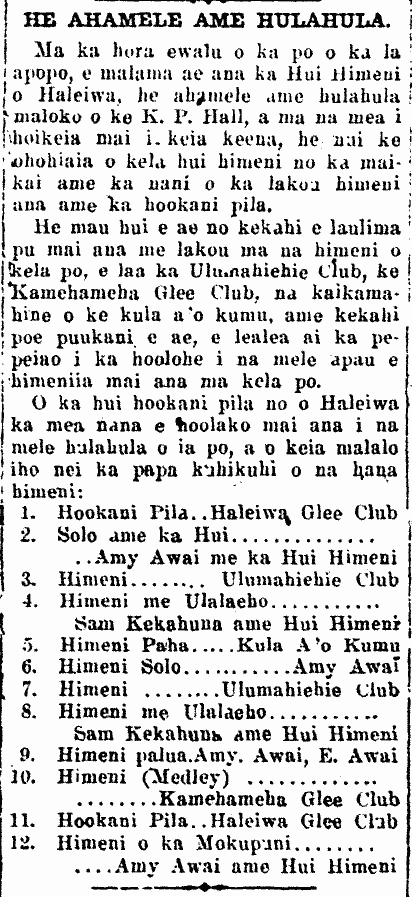
At eight o’clock tomorrow night, the Haleiwa Choir [Hui Himeni o Haleiwa] will hold a concert and dance in the K. P. Hall [Knights of Pythias Hall], and from what was told to this office, the Choir is highly acclaimed for the beauty of their singing and their music.

There will be other groups as well joining with them singing that night, like the Ulumahiehie Club, Kamehameha Glee Club, the girls of the teachers’ school, and some other singers; the ears will be entertained listening to all the mele that will be sung that night.

The band of Haleiwa will be the ones to provide the songs to dance to that night, and this below is the program of the singing:

1. Instrumental [Hookani Pila] . . . . . Haleiwa Glee Club
2. Solo and Group . . . . . Amy Awai and Glee Club
3. Singing . . . . . Ulumahiehie Club
4. Singing and Yodeling [? Ulalaeho] . . . . . Sam Kekahuna and Glee Club
5. Quartet . . . . . Teachers’ School
6. Solo . . . . . Amy Awai
7. Singing . . . . . Ulumahiehie Club
8. Singing and Yodeling . . . . . Sam Kekahuna and Glee Club
9. Duet . . . . . Amy Awai, E. Awai
10. Singing (Medley) . . . . . Kamehameha Glee Club
11. Instrumental . . . . . Haleiwa Glee Club
12. Song of the Island . . . . . Amy Awai and Glee Club

(Kuokoa 7/7/1911, p. 10)

HE AHAMELE AME HULAHULA.

Ka Nupepa Kuokoa, Buke XLVII, Helu 27, Aoao 10. Iulai 7, 1911.

Lydia Panioikawai French, 1880.

Mrs. Panioikawai French.

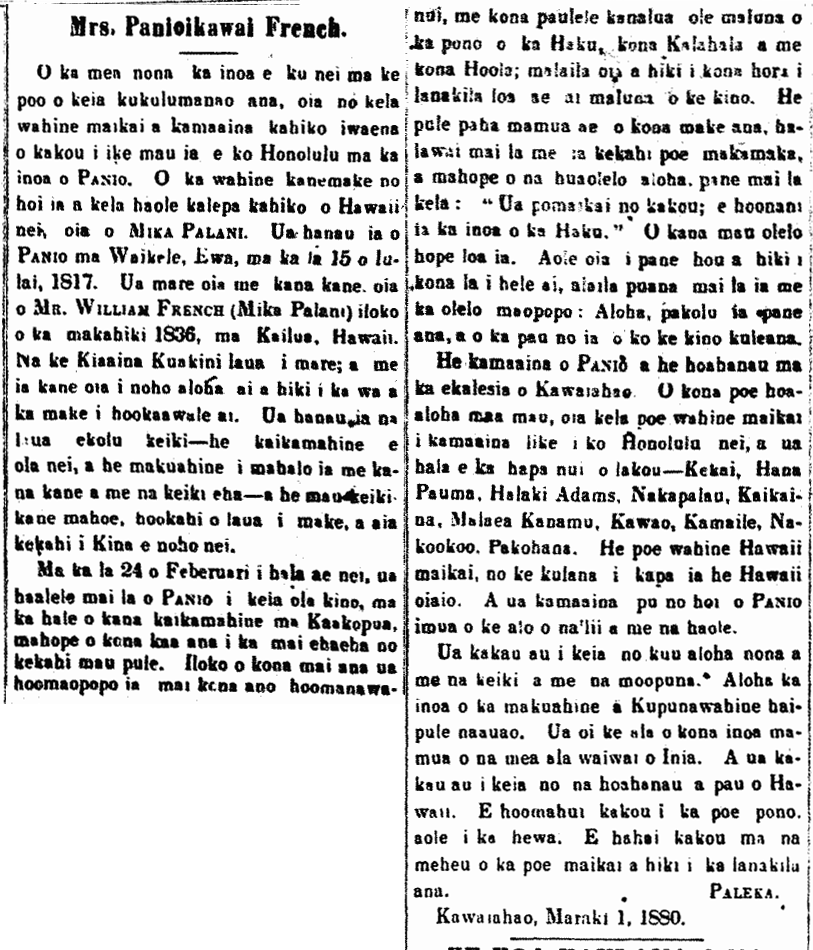
The person whose name appears at the top of this article is that fine woman and old-time kamaaina amongst we the people who always see her in Honolulu going by the name Panio. She is the widow of the old haole trader of Hawaii nei, Mika Palani. Panio was born in Waikele, Ewa, on the 15th of July, 1817. She married her husband, Mr. William French (Mika Palani) in 1836 at Kailua, Hawaii. Governor Kuakini was the one who married them; and it was with this husband who she lived in aloha with until death separated them. The two of them had three children—a daughter that is still living, and a mother that is admired along with her husband and four children—and twin sons, one who has died, and one who is living in China.

On the 24th of February past, Panio left this life, at the home of her daughter in Kaakopua, after being in pain for several weeks. In her sickness, her great patience was made clear, along with her unwavering faith in the goodness of the Lord, her Redeemer, and her Savior; and she was there until the victorious hour upon her body. She perhaps had a prayer before she died; she met with some friends, and after words of aloha, she said: “We are fortunate; blessed be the name of the Lord.” These were her last words. She did not say anything until the day she left, then she said clearly: Aloha, three times, and her body’s work was done.

Panio was a kamaaina and a brethren of Kawaiahao Church. Her regular friends were the fine women who are also well known here in Honolulu, and most of them have already passed on—Kekai, Hana Pauma, Halaki Adams, Nakapalau, Kaikaina, Malaea Kanamu, Kawao, Kamaile, Nakookoo, Pakohana. They were good Hawaiian women, who are amongst those called true Hawaiians. And Panio was a kamaaina amongst the royal court and amongst the haole.

I write this because of my aloha for her and her children and grandchildren. Beloved is the name of this enlightened devout mother and Grandmother. The fragrance of her name is stronger than the treasured perfumes of India. And I write this for all of the brethren of Hawaii. Let us copy the righteous, and not the wicked. Let us follow in the footsteps of the good until we are victorious.

PALEKA.

Kawaiahao, March 1, 1880.

(Kuokoa, 3/6/1880, p. 4)

Mrs. Panioikawai French.

Ka Nupepa Kuokoa, Buke XIX, Helu 10, Aoao 4. Maraki 6, 1880.