The translator of mele who calls himself “Hawaii” is Lorenzo Lyons! 1866.

[Found under: “HUNAHUNA MEA HOU O HAWAII NEI.”]

Appreciation for Hawaii.—The song published on Page 4 of our paper today, is something truly that our hearts desire. This is the first time that we have seen a song that is exceptionally beautiful translated by Hawaii from English to our language. And being that we feel admiration in our hearts, we give a portion of thanks [??? ke haawi hapalua aku nei makou i ka mahalo] to Hawaii, that is to Lyons [Laiana]. And we believe that there will be many who will see it and like the mele, just as we do.

[I have been searching for the identity of this person Hawaii for many years. Finding the identity of pen names used in Hawaiian newspapers is always an exciting thing.]

(Kuokoa, 1/27/1866, p. 2)
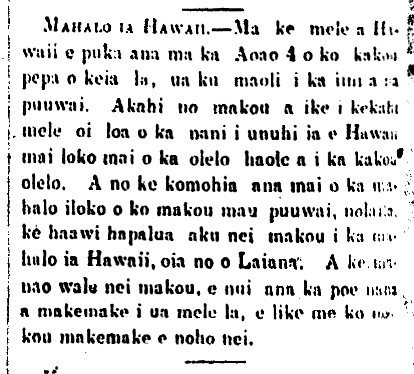
Kuokoa_1_27_1866_2

Ka Nupepa Kuokoa, Buke V, Helu 4, Aoao 2. Ianuari 27, 1866.
Emma Nakuina tells the story of Hiiaka, 1883.

HIIAKA.

A Hawaiian Legend by a Hawaiian Native. A Legend of the Goddess Pele, Her Lover Lohiau and her Sister Hiiakaikapoliopele.

The crater of Kilauea on Hawaii, is the residence of the Goddess Pele. She had eight sisters, all called Hiiaka, with some distinguishing ending, as Hiiaka-noholae, (Hiiaka living on the headland), Hiiaka-wawahilani, (Hiiaka the heaven breaker,) Hiiakaikapoliopele, (Hiiaka in Pele’s heart) etc. The latter commonly called the Hiiaka is the heroine of this legend. Pele had also several brothers Kamohoalii, Lonomakua, Lonoonolii, etc.

All her brothers and sisters were subordinate to her, but Kamohoalii was her favorite brother and Hiiakaikapoliopele the favorite sister. Tradition is not very explicit as to the source of Kamohoalii’s power, but he has always been regarded as the very sacred royal brother of Pele. The brothers and sisters seem to have had great respect foreach other and never trespassed on one another’s privileges, or interfered with each other ‘s actions. Uwekahuna the high bluff of the crater walls beyond the sulphur banks is supposed to contain a large cave, his dwelling, and the bluff is known as “Ka-pali-kapu-o-Kamohoalii” (the tabu cliffs of Kamohoalii.) Smoke from volcanic fires has never been known to be blown against them. True believers stoutly insist that smoke could never by any possibility bend or be blown against it, as that would be a gross violation of the royal privileges of the sacred brother. Continue reading

Cars collide a hundred and fifty years ago? 1866.

[Found under: “HUNAHUNA MEA O HAWAII NEI.”]

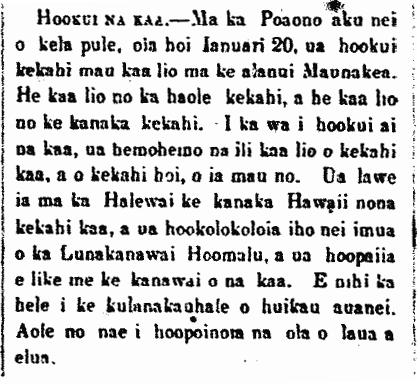
Cars Collide.—On Wednesday Saturday last week, that being the 20th of January, some horse carts collided on Maunakea Street. One was a horse cart belonging to a haole, the other horse cart belonged to a Hawaiian. When the cars collided, the harness [ili kaa lio] of one of the cars came off, and the other remained as always. The Hawaiian to whom belonged one of the cars was taken to Jail [Halewai] and he was tried in front of the Police Justice [Lunakanawai Hoomalu], and he was penalized as per the laws dealing with vehicles. Proceed with caution in this town lest there be confusion. The lives of the two of them however were not harmed.

(Kuokoa, 1/27/1866, p. 2)

Kuokoa_1_27_1866_2

Ka Nupepa Kuokoa, Buke V, Helu 4, Aoao 2. Ianuari 27, 1866.

Kinau, Kaahumanu II, dies, 1839.

DIED.

KAAHUMANU II.

In Honolulu, on the 4th of April.

She became sick from the 30th of March, early in the morning; it was a paralysis. She was numb in her left hand and leg, and on the 31st, she fell into a sleep: This was a sleep where the paralysis on  her left side subsided, but her slumbering grew, until the 2nd of April when her fellow brethren could not wake her.

On the fourth, Kamehameha III, the King, arrived although he was sick, enduring this for his love for his “mother” [makuahine]. The King landed early in the morning, and at miday, at half past 12, that is when she died, without seeing the King.

Everyone is in mourning, and cry with aloha, because their alii has died, the one that was greatly loved. But on the fifth, the crying was ceased because of the illness of the King; talking loudly is not good.

(Kumu Hawaii, 4/10/1839, p. 92)

MAKE.

Ke Kumu Hawaii, Buke 4, Pepa 23, Aoao 92. Aperila 10, 1839.

C. R. Bishop turns 87, 1909.

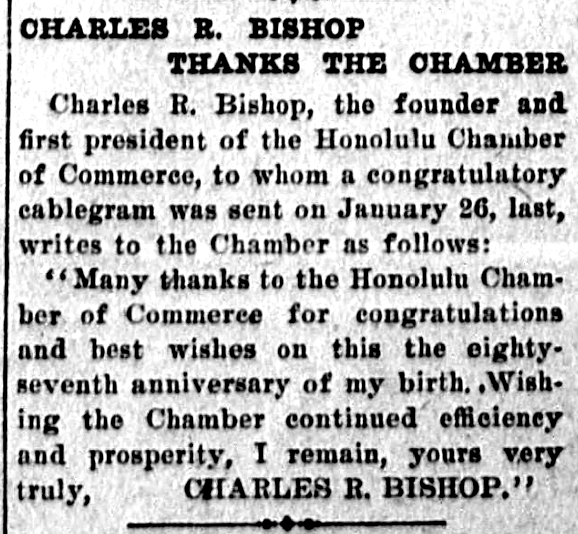
CHARLES R. BISHOP THANKS THE CHAMBER

Charles R. Bishop, the founder and first president of the Honolulu Chamber of Commerce, to whom a congratulatory cablegram was sent on January 26, last, writes to the Chamber as follows:

“Many thanks to the Honolulu Chamber of Commerce for congratulations and best wishes on this the eighty-seventh anniversary of my birth. Wishing the Chamber continued efficiency and prosperity, I remain, yours very truly,  CHARLES R. BISHOP.

[C. R. Bishop is widely known for his involvement in many great endeavors, but he might not be so well know for his founding of the Chamber of Commerce which is still active today.]

(Hawaiian Gazette, 2/12/1909, p. 3)

HawaiianGazette_2_12_1909_3

Hawaiian Gazette, Volume LI, Number 117, Page 3. February 12, 1909.

Old school desserts and such, 1865.

Rules for making Desserts.

Here below are the rules for making Desserts [mea ono]. If you want your desserts to have a fine white color, you should use white sugar; similarly will be the white from good brown sugar. Fresh butter is used often, because if it is old butter, there is no body added to the dessert.

If you are adding eggs, scatter with flour, then add to butter and egg. If you are making a dessert without eggs, don’t add flour, not until you are ready to put the dessert where it will be made.

To know if the dessert is done, stick a skewer [niau] into the dessert, and if nothing sticks to it, it is done, and there is one thing left to do, that is to swallow it down. The making is what is important; if it is not done correctly, and nothing goes wrong, it will turn out well. Keep a constant heat under the dessert.

Number 1. Cup Cake.

Break five eggs, then add two teaspoons full of sugar, and so too with fresh butter, mixing well. After mixing, add into it two teaspoons full of flour, with grated nutmeg. Put into an Oven at a good temperature. Before putting  it in, add a teaspoon saleratus [kareta] and half a cup of sour milk [waiu awaawa]…

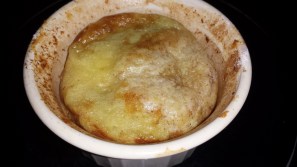
20160124_161515

I substituted baking soda for saleratus.

Continue reading

Visit to Haleakala, 1876.

ABOUT HALEAKALA.

O Lahui Hawaii; Aloha oe:—

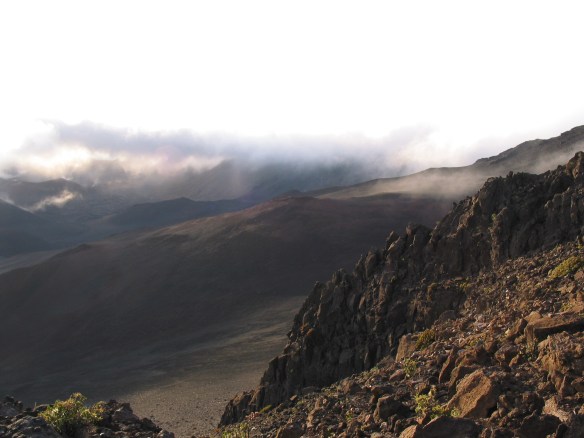
Perhaps there are not that many people who have travelled to the top of that famous mountain Haleakala in East Maui. It was the perfect time, because when I awoke this morning at maybe three o’clock and my eyes were set upon that mountain, I was filled with great admiration. I woke up my kamaaina and we got the horses ready, and at my urging, we left Makawao; and soon I’m writing this letter from the high rocks of this mountain at 9 o’clock in the morning. We are looking at the schooner greatly beloved by the friends of this land, that being the Moi, whose prow was rooting through the lapping sea of Kahului, and the famous pond in the cold, that being Kanaha. The mist is moving down to Iao and blanketing Kapela and her beautiful flowers, and the pili of Kakae disappeared, just leaving the hills in view, and it was as if waters were rushing the dam of Iao. The shady valleys at the edge of Nawaieha are imposing, seeming to duel with the rows of waves of Kahului.

105-0568_IMG

Haleakala 2003. Mau no ka nani hemolele!

Continue reading

Fount of knowledge, H. B. Nalimu, turns 96! 1931.

GOOD NEWS

On the eleventh of November, 1835, Henry Benjamin Nalimu was born, at Papaaloa, North Hilo, Hawaii, the land of birth of his parents.

On November, he became ninety-six years old at “Kamaluokaohai,” at 1536 Alewa Drive, the home of his grandchildren.

Nalimu is a descendant of his ancestor I, who was a famed strategist of Kamehameha ka Na’i Aupuni.

The I, the Mahi, and the Palena, were famous troops of Kamehameha, and leaders of Kamehameha, and I commanded the troops of I.

In 1840, Nalimu left Papaaloa and lived in Pi’opi’o, Hilo, until 1847.

At that time, Kamehameha began to give land to the makaainana.

In 1852, Nalimu entered into the Hilo Boarding School.

D. B. Lyman was the principal at the time, and it was he who built that college on land given by the alii for that school.

In 1857, Nalimu became the assistant kahu of the church of Hilo, under the old Missionary Coan [Koana, Titus Coan].

He accompanied Coan to the cliffs of Hilo, climbing up and going down into the rivers. There were no bridges and no good roads at the time. The walked the trails until Kalapana. The shoes they wore were ti-leaf sandals [kamaa la’i], and pandanus root sandals [kamaa aahala], so that their feet would not be harmed by the rocks. Continue reading

No Hilo koʻu lei e lei ai, 1893.

Ka Ua Kanilehua.

He aloha e ka ua Kanilehua
I loku hala ole i ka waokele
Hookele akamai no hoi oe
Helu ekahi o ka mikioi
Na’u i pailaka pololei
Ike ia ka nalu hai o Kawili
Neenee mai oe e ke aloha
I mehana pono iho ko’u po anu
Ua anu ka lehua i ka nahele
I ka pehi mau ia e ka ua noe
Noeau ka hana a ka uwila
Ka anapa ma na rumi liilii
He liilii ka hana a ke akamai
I ka oni malie lawe nihinihi
A he nihi ka hele’na o ka nahele
Ua ako hewa oe i ka lehua
I lawa no a hoolale iho
Holu ana e ka malua kiiwai
Haina ka puana i lohe ia
No Hilo ko’u lei e lei ai

(Lei Momi, 7/24/1893, p. 4)

LeiMomi_7_24_1893_4

Ka Lei Momi, Buke I, Helu 27, Aoao 4. Iulai 24, 1893.

Death of Stephen William Kekuewa, 1920.

THE REV. S. W. KEKUEWA PASSES ON

After being worn away by a debilitating illness for some time, the Rev. Stephen William Kekuewa grew weary of this life, at the home of his daughter, Mrs. John P. Kapua, on School Street, at four o’clock in the afternoon, on Wednesday of this past week; and in the afternoon of this past Sunday, his remains were carried to the Maemae Cemetery.

The Rev. S. W. Kekuewa was born at Luakaha, Nuuanu, on the 25th of February, 1842, therefore when he died he was over seventy-eight years old.

During his youth, he was educated at Lahainaluna School, under his teachers, S. E. Bishop and C. B. Andrews; and for some years he lived on the island of Micronesia on a mission he was sent on by the Hawaiian Evangelical Board [Papa Hawaii].

Because the health of his wife was not good, they returned to Hawaii nei, and he served as the kahu of the chruch at  Iole, Kohala, Hawaii for many years.

Because of the letter of the members of the church of Waianae which called for him to be the kahu of that church, he left the church of Kohala and went to live at Waianae; at that church he lived and worked until he was called by his Lord, and he went to his permanent home beyond. Continue reading