Unknown's avatar

About nupepa

Just another place that posts random articles from the Hawaiian Newspapers! It would be awesome if this should become a space where open discussions happen on all topics written about in those papers!! And please note that these are definitely not polished translations, but are just drafts!!! [This blog is not affiliated with any organization and receives no funding. Statements made here should in now way be seen as a reflection on other organizations or people. All errors in interpretation are my own.]

What Maialoha is said to have written in English which he supposedly did not speak, 1904.

LEPERS CALL THE PINKHAM ENDORSEMENT A HUMBUG

That fishy wireless from Kalaupapa which arrived here the day Pinkham expected to be reappointed, announcing his endorsement by the lepers of the Settlement, has brought the following repudiation. it now looks as if the “endorsement” had been a put-up job between Pinkham and one of his subordinates with the intent to deceive the Governor:

To Mrs. Atcherley:

Having received work by mail of last week to this effect: That we, the leper inmates of Kalaupapa did meet and appoint a committee to extend by wireless our hearty endorsement to the Governor for the reappointment of L. E. Pinkham, Esq. as president of the Board of Health, on the 18th day of April, 1908,

Therefore, We, the undersigned lepers residing in the County of Kalawao, hereby wish the truth to be publicly announced, that there was, and has never been a meeting held here at Kalaupapa for such purpose on the date mentioned or any other date thereof.

Be it further announced, That Mr. Pinkham’s removal from that office receives our hearty approval.

(Signed) K. Naholoholo, J. Uha, K. Kapaa, William Noa Keama, David Ilihia, Kaele, Kaaukai, Hale Kauhola, H. Brown, George McLane, David Pauahi, Paahao, A. M. Koloa, Kalei, Eddie Naukana, John Naluai, S. K. Maialoha, John Taylor Unea. Continue reading

For those who believe anything on Facebook. 1908.

That letter from Kalawao.

The English article that was printed in one of the English newspapers of Honolulu nei, from S. K. Maialoha of Kalawao, Molokai, is clear to the editor of this paper, that it is not a letter written in English by S. K. Maialoha, because the editor of this paper is familiar with S. K. Maialoha, and he is not someone skilled in English. Continue reading

Charles Reed Bishop honored at Kamehameha Schools, 1946.

Arrived 100 Years Ago

Kamehameha To Honor Memory Of C. R. Bishop

Charles Reed Bishop, a builder of Hawaii in the field of education as well as business during the 19th century, and who arrived in the Hawaiian Islands 100 years ago this week, on October 12, 1846, will be remembered at centennial services at the Kamehameha Schools Friday and Saturday. Continue reading

Hawaiian language was even the official language of the Territory? 1903.

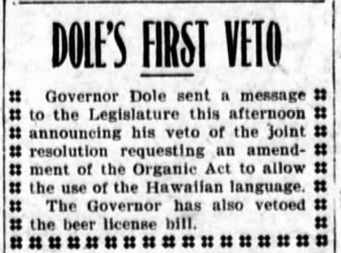
Hawaiian the Official Language

HONOLULU, April 9.—(By Pacific cable.) The legislature has passed, over Governor Dole’s veto, a joint resolution making the Hawaiian language the official language of the territory, as well as English.

(Los Angeles Herald, 4/10/1903, p. 2)

LAHerald_4_10_1903_2.png

Los Angeles Herald, Volume XXX, Number 185, Page 2. April 10, 1903.

Newspapers can’t survive on just aloha, 1918.

Mrs. Becky Wilkinson of Kahului paid for the life of her Hoku, all the way until May 1919. This is tremendous confidence for which we give our greatest aloha. Who else will follow this good Mother of the rising and falling seas of Kahului.

[The last Hawaiian language newspaper, Ka Hoku o Hawaii, will decrease to a two page format from 5/6/1942 and prints its final issue in 1948.]

(Hoku o Hawaii, 1/24/1918, p. 2)

HokuoHawaii_1_24_1918_2.png

Ka Hoku o Hawaii, Buke 12, Helu 35, Aoao 2. Ianari 24, 1918.

Makee Aupuni responds to that Mrs. W. Hall, 1893.

That Minneapolis Letter.

Editor Bulletin:—

It is not easy to realize the fact that any woman having an atom of regard for that high sense of honor of which truth is the basis could pen such a letter as you published on Saturday, even though it were not intended, as may be supposed, for publication. Is this Mrs. W. Hall, who now traduces the Queen, in innuendo too utterly vile and baseless for repetition, the same Mrs. W. Hall who for years has been the seeming friend of the Queen, and members of the same religious organization? The public will remember that about a year and a half ago the W. C. T. U. [Women’s Christian Temperance Union], of which Mrs. W. Hall is a leading light, conceived the brilliant idea of opening a coffee-shop in the Queen Emma Hall. The enterprise was ushered in with a great flourish of religious trumpets and the usual benedictions were pronounced on the undertaking, and the creme de la creme of local “Christian business men promised to boom up the good work. But, lo, there are expenses confronting the ladies of the “Union” in starting the movement and to whom do they go? Not to the millionaire merchants their husbands and others, but to the Queen. Yes, to Queen Liliuokalani, gentle reader in Minneapolis, did Mrs. W. Hall and her sisters of the Honolulu W. C. T. U. go for the fifty-two dollars for the license, and the gift of a bag of Kona coffee and other incidentals necessary to the starting of that enterprise which was to do so much for temperance and didn’t; for after having flickered through a feeble existence of four or five months the Queen’s bag of coffee gave out, and the “movement” ceased to  move, and the word “closed” was written on the front door of the “enterprise,” and the Queen’s money might have been as well thrown into the sea, and the only residue of this coffee episode is a reminder that between pious temperance and professional missionary the kaleidoscopic picture of “Christian” character as presented by the latest local doctrinaires must appear to the Hawaiian “very pronounced” indeed, as a compound variety of intolerance, hypocrisy and unmitigated greed. Continue reading

Mrs. William Hall, 1893.

HAWAII.

Mrs. William Hall Tells of the Arrival of Commissioner Blount.

Disappointment Created by the Taking Down of Old Glory.

How Annexation is Viewed by the People of the Sandwich Islands.

The Daily Rumors Which Alternately Buoy the Annexationists and Royalists.

The following letter from Honolulu was written to Minneapolis friends by Mrs. William Hall, daughter of Mrs. C. O. Van Cleve, the wife of a missionary to the Sandwich islands, and has resided on the islands for the past 30 years. Mrs. Hall’s husband is also a son of a missionary. The story of the courtship and marriage is romantic, for Mr. Hall was visiting Minneapolis when he met Miss Van Cleve, and he fell in love with her at sight. He had only a short time to remain, and as Gen. Van Cleve was then out with a command,the impatient young lover made the journey to the general’s station to tell him he had laid siege to the the daughter’s heart, and that she would surrender if the father gave his consent. Miss Van Cleve afterwards went out to the Sandwich islands, where she was married and began missionary labors with her husband. The letter was written early in April, just after the lowering of the American flag on the islands.

Honolulu, April 5, 1893.

Just as we were in the midst of writing for the mail by the Australia last Wednesday, the telephone announced a United States steamer off Koko Head, supposed to be the revenue cutter Richard Rush, bringing commissioners from Washington to the Hawaiian government. This proved to be correct, and hurrying our letters, we repaired to the water front to see what was to be seen.

The streets were full of people and full of flags. Chicago will hardly fly more bunting to the square yard at the opening of the Columbian Exposition. Everyone hung out a flag of some kind, mostly American, though I noticed “The harp that once through Tara’s halls the soul of music shed,” is hanging “mute” on a green field between two brick buildings on the corner of Fort and Hotel streets, and I think likely, if the trade wind continues as vigorous as at present a few days longer, the cord (chord) will “indignant break.” But to return to our muttons, otherwise streets.

One feature of the display was a procession of native women dressed in white and bearing Hawaiian and American flags, marching down to the wharf to receive and welcome the commissioners.

The Rush entered the harbor and took her place in the naval row. The American minister, the consul, and a committee of three gentlemen boarded her from a steam launch just before she entered the harbor.

It soon became noised abroad that only one commissioner had arrived, and he would not  land for an hour or two. There was some disappointment among the natives when they heard that Admiral Brown had not been sent; others did not quite know whether to be glad or sorry that only one man had been entrusted with this mission.

Soon after the cutter anchored, Maj. Robertson, the ex-queen’s chamberlain, went on board and, presenting the queen’s compliments, offered the commission her carriage in which to ride to the hotel. The offer was declined with thanks, the commissioner had already declined several offers of the kind, preferring to ride in his private carriage. Continue reading