Unknown's avatar

About nupepa

Just another place that posts random articles from the Hawaiian Newspapers! It would be awesome if this should become a space where open discussions happen on all topics written about in those papers!! And please note that these are definitely not polished translations, but are just drafts!!! [This blog is not affiliated with any organization and receives no funding. Statements made here should in now way be seen as a reflection on other organizations or people. All errors in interpretation are my own.]

Miriam Kekupuohi dies, 1836.

[Found under: “MAKE.”]

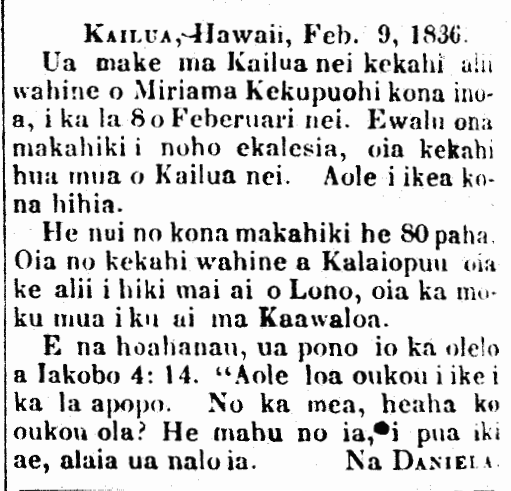
Kailua, Hawaii, Feb. 9, 1836.

Died here in Kailua was the chiefess named Miriama Kekupuohi, on the 8th of February. She belonged to the church for eight years, and she was one of the first converts of Kailua nei. She was not known to have any entanglements.

She was very old, perhaps 80 years old. She was a wife of Kalaiopuu,* the chief when Lono [Captain Cook] came, in the first ship to arrive in Kaawaloa.

O Brethren, very true are the words of James 4:14. “Whereas ye know not what shall be on the morrow. For what is your life? It is even a vapour, that appeareth for a little time, and then vanisheth away.”  By DANIELA.

*Kalaiopuu was also known as Kaleiopuu and today is more commonly known as Kalaniopuu.

(Kumu Hawaii, 3/16/1836, p. 24)

Kailua, Hawaii...

Ke Kumu Hawaii, Buke 2, Pepa 6, Aoao 24. Maraki 16, 1836.

Red Cross knitting drive, 1917.

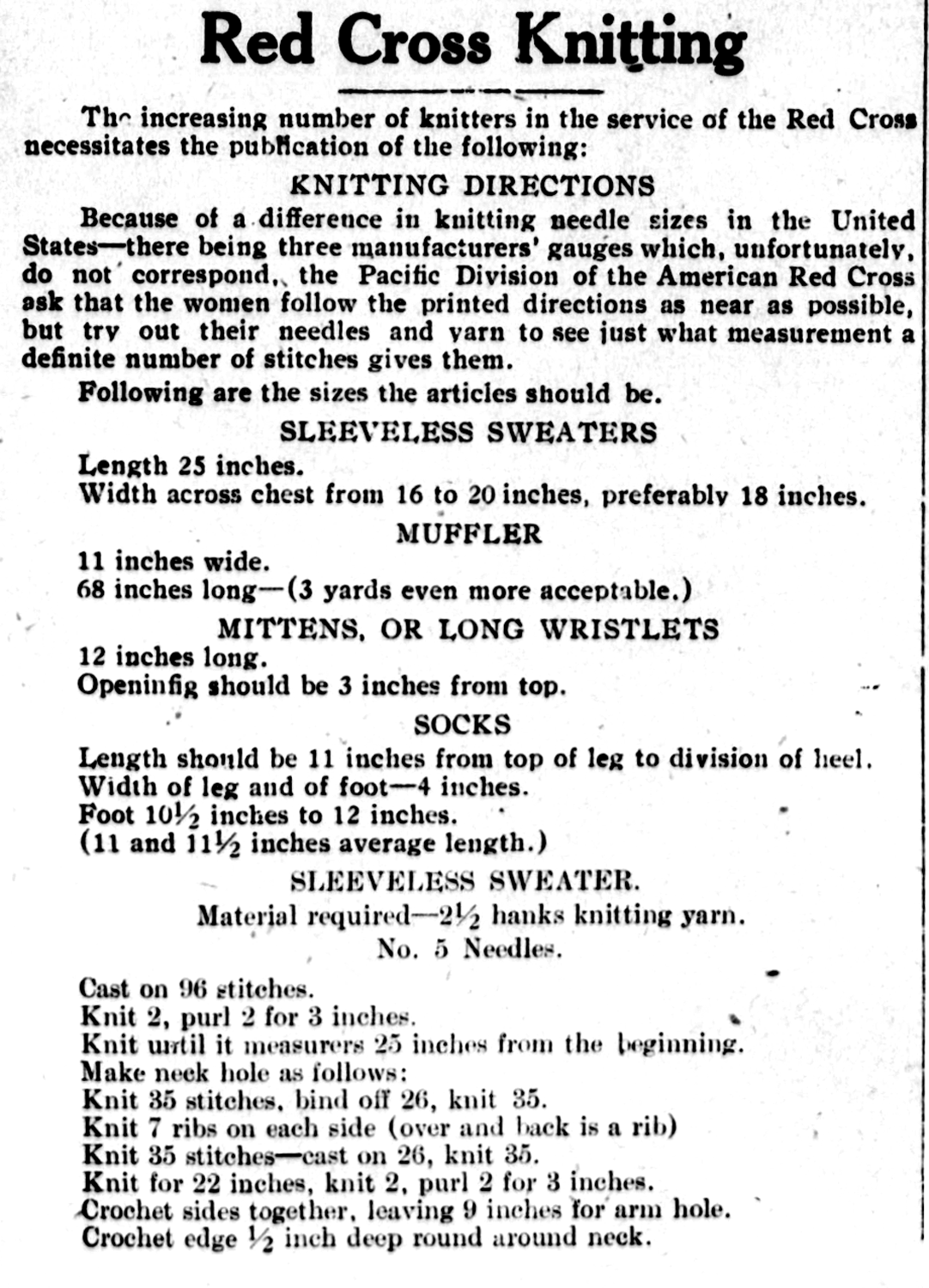
Red Cross Knitting

The increasing number of knitters in the service of the Red Cross necessitates the publication of the following:

KNITTING DIRECTIONS

Because of a difference in knitting needle sizes in the United States—there being three manufacturers’ gauges which, unfortunately, do not correspond, the Pacific Division of the American Red Cross ask that the women follow the printed directions as near as possible, but try out their needles and yarn to see just what measurement a definite number of stitches gives them.

Following are the sizes the articles should be.

SLEEVELESS SWEATERS

Length 25 inches.
Width across chest from 16 to 20 inches, preferably 18 inches.

MUFFLER

11 inches wide.
68 inches long—(3 yards even more acceptable.)

MITTENS, OR LONG WRISTLETS

12 inches long.
Openifig should be 3 inches from top.

SOCKS

Length should be 11 inches from top of leg to division of heel.
Width of leg and of foot—4 inches.
Foot 10½ inches to 12 inches.
(11 and 11½ inches average length.)

SLEEVELESS SWEATER.
Materials required—2½hanks knitting yarn.
No. 5 Needles.

Cast on 96 stitches.
Knit 2, purl 2 for 3 inches.
Knit until it measures 25 inches from the beginning.
Make neck hole as follows:
Knit 35 stitches, bind off 26, knit 35.
Knit 7 ribs on each side (over and back is a rib)
Knit 35 stitches—cast on 26, knit 35.
Knit for 22 inches, knit 2, purl 2 for 3 inches.
Crochet sides together, leaving 9 inches for arm hole.
Crochet edge ½ inch deep round around neck.

(Garden Island, 12/4/1917, p. 4)

Red Cross Knitting

The Garden Island, Volume 13, Number 49, Page 4. December 4, 1917.

Duke donating time to make warm clothing, 1918.

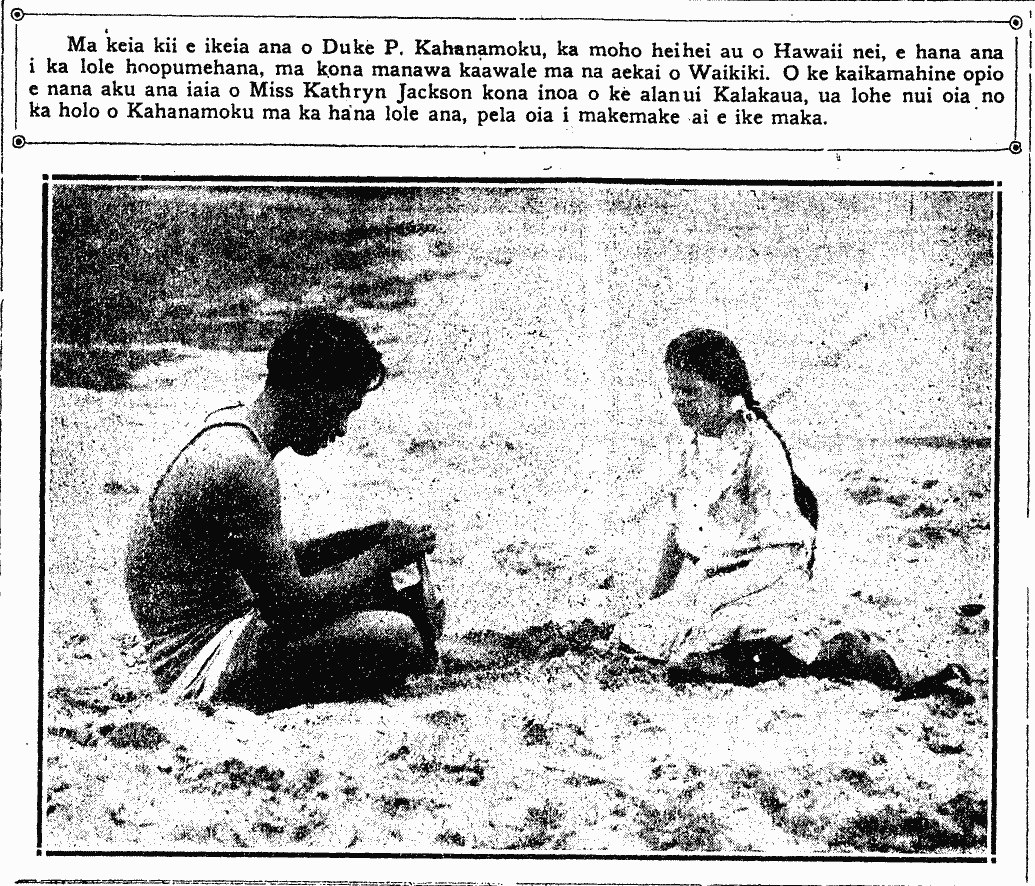
In this picture is seen Duke P. Kahanamoku, the swimming champion of Hawaii nei making warm clothing in his spare time on the shore of Waikiki. The young girl watching him is named Miss Kathryn Jackson of Kalakaua Avenue who heard much of Kahanamoku going to make clothes, and she thus wanted to see it for herself.

(Kuokoa, 4/5/1918, p.1)

Ma keia kii e ikeia ana o Duke P. Kahanamoku...

Ka Nupepa Kuokoa, Buke LVI, Helu 14, Aoao 1. Aperila 5, 1918.

Duke saves lives, 1925.

SENT WAS A MEDAL GIFTED TO KAHANAMOKU.

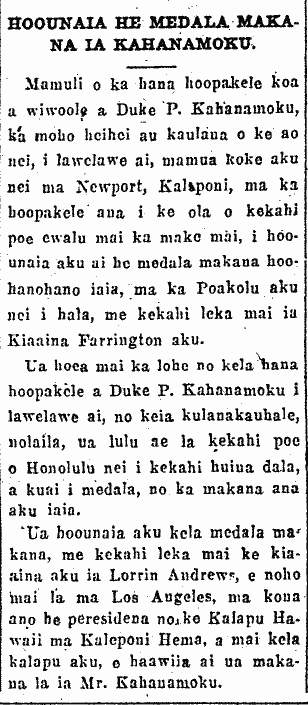
Because of the brave and fearless rescue carried out by Duke P. Kahanamoku, the famous swimming champion of the world, just recently at Newport, California, in saving the lives of eight people from death, he was sent a gift of a medal to honor him, last Wednesday with a letter from Governor Farrington.

The news of this rescue carried out by Duke P. Kahanamoku arrived in this town, therefore,  some people of Honolulu donated a sum of money to purchase a medal to present to him.

This presentation medal was sent along with a letter from the governor to Lorrin Andrews, living in Los Angeles, as the president of the Hawaiian Club of South California [Kalapu Hawaii ma Kalepooni Hema], and from that club the gift will be given to Mr. Kahanamoku.

[I noticed today’s post by Bishop Museum announcing their upcoming exhibit on this hero, Duke Paoa Kahanamoku!]

(Kuokoa, 8/27/1925, p. 4)

HOOUNAIA HE MEDALA MAKANA IA KAHANAMOKU.

Ka Nupepa Kuokoa, Buke LXIV, Helu 35, Aoao 4. Augate 27, 1925.

Apapane flourishing, 1939.

Hawaiian Birds

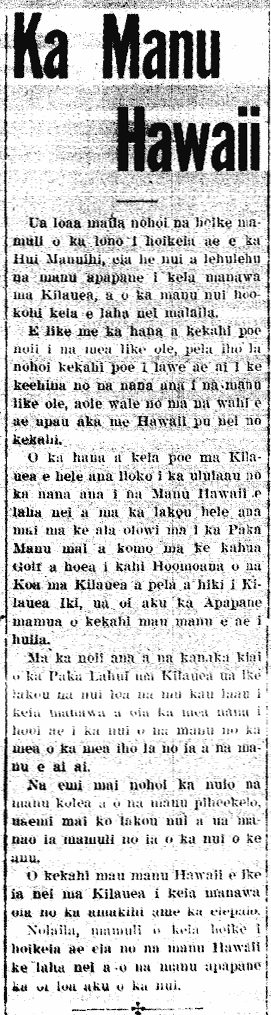
We received word from the news released by the Hui Manuihi [?? Audubon Society ??] that there are now at Kilauea many apapane birds, and it is the one bird that is most widespread there.

Just like the work of those who research all sorts of things, there are some who made a move to study the different birds, and not only in other places, but here in Hawaii as well.

The activity of these people on Kilauea was to go into the forests to look at the Hawaiian Birds that are spread out there, and by them travelling the narrow paths in the Bird Park and entering into the Golf course and reaching the Soldier Camp at Kilauea and then arriving at Kilauea Iki; there were more Apapane than all the other birds put together.

With the research of the rangers of Kilauea National Park, they saw there was a large amount of bugs on the trees these days and that is was has caused an increase in the birds, for that is what the birds eat.

The number of kolea decreased and the mynah [piheekelo] birds are less, and it is believed because of the great cold.

Other Hawaiian birds seen at Kilauea these days are the amakihi and the elepaio.

Therefore according to this report shown, Hawaiian birds are indeed numerous, and the apapane is the most abundant.

[What about today? Are things better? Are things worse?]

(Hoku o Hawaii, 1/11/1939, p. 2)

Na Manu Hawaii

Ka Hoku o Hawaii, Volume XXXIII, Number 37, Aoao 2. Ianuari 11, 1939.

Opeapea from Hilea, 1887.

AN INTERESTING SPECIMEN.

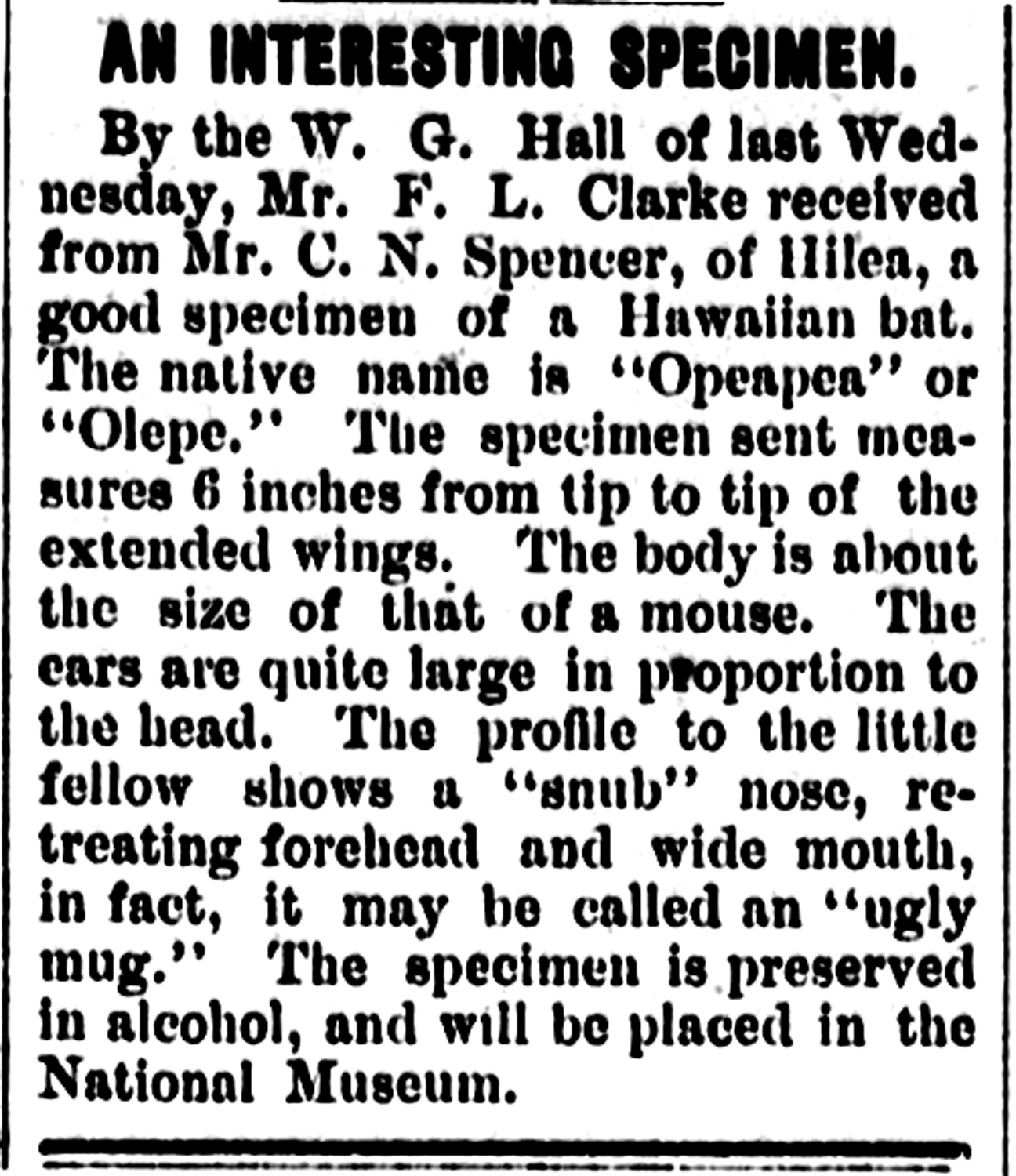
By the W. G. Hall of last Wednesday, Mr. F. L. Clarke received from Mr. C. N. Spencer, of Hilea, a good specimen of a Hawaiian bat. The native name is “Opeapea” or “Olepe.” The specimen sent measures 6 inches from tip to tip of the extended wings. The body is about the size of that of a mouse. The ears are quite large in proportion to the head. The profile to the little fellow shows a “snub” nose, retreating forehead and wide mouth, in fact, it may be called an “ugly mug.” The specimen is preserved in alcohol, and will be placed in the National Museum.

(Daily Bulletin, 2/17/1887, p. 2)

AN INTERESTING SPECIMEN.

The Daily Bulletin, Volume XI, Number 1562, Page 2. February 17, 1887.

Pueo found in Kalihi, 1902.

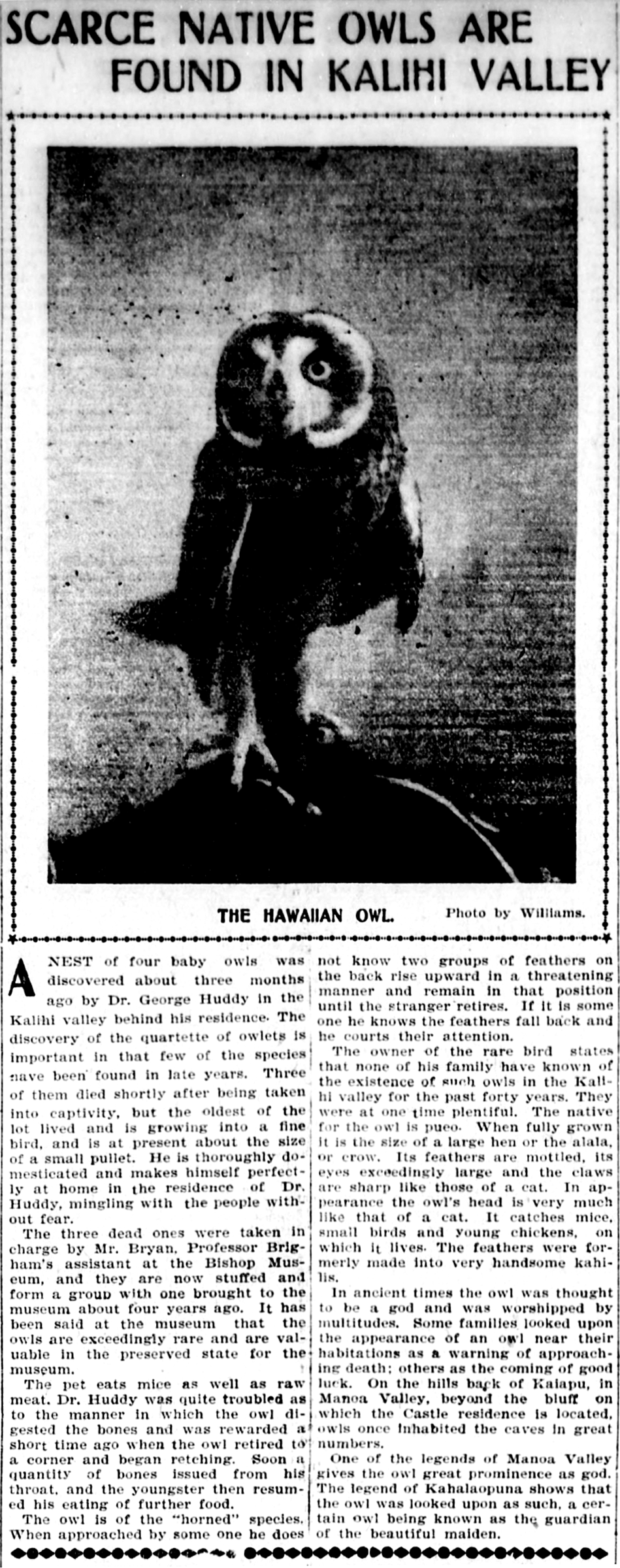
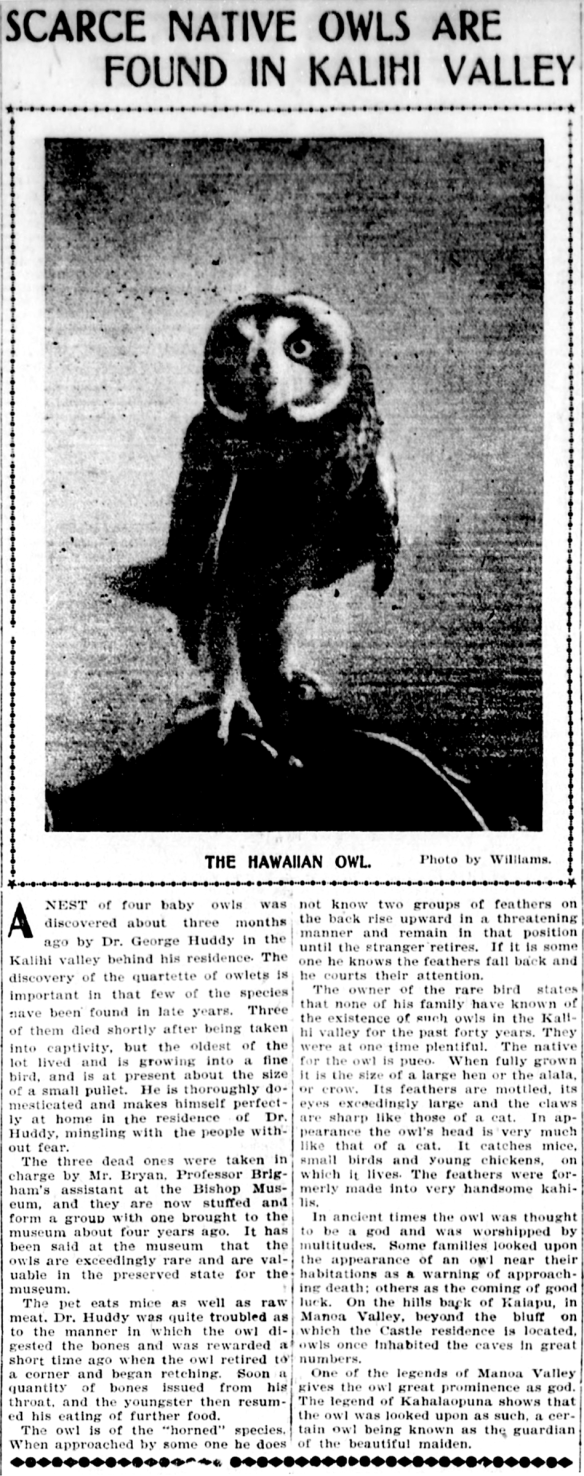
SCARCE NATIVE OWLS ARE FOUND IN KALIHI VALLEY

THE HAWAIIAN OWL.  Photo by Williams.

A NEST of four baby owls was discovered about three months ago by Dr. George Huddy in the Kalihi valley behind his residence. The discovery of the quartette of owlets is important in that few of the species have been found in late years. Three of them died shortly after being taken into captivity, but the oldest of the lot lived and is growing into a fine bird, and is at present about the size of a small pullet. He is thoroughly domesticated and makes himself perfectly at home in the residence of Dr. Huddy, mingling with the people without fear.

The three dead ones were taken in charge by Mr. Bryan, Professor Brigham’s assistant at the Bishop Museum, and they are now stuffed and form a group with one brought to the museum about four years ago. It has been said at the museum that the owls are exceedingly rare and are valuable in the preserved state for the museum.

The pet eats mice as well as raw meat. Dr. Huddy was quite troubled as to the manner in which the owl digested the bones and was rewarded a short time ago when the owl retired to a corner and began retching. Soon a quantity of bones issued from his throat, and the youngster then resumed his eating of further food.

The owl is of the “horned” species. When approached by some one he does not know two groups of feathers on the back rise upward in a threatening manner and remain in that position until the stranger retires. If it is some one he knows the feathers fall back and he courts their attention.

The owner of the rare bird states that none of his family have known of the existence of such owls in the Kalihi valley for the past forty years. They were at one time plentiful. The native for the owl is pueo. When fully grown it is the size of a large hen or the alala, or crow. Its feathers are mottled, its eyes exceedingly large and the claws are sharp like those of a cat. In appearance the owl’s head is very much like that of a cat. It catches mice, small birds and young chickens, on which it lives. The feathers were formerly made into very handsome kahilis.

In ancient times the owl was thought to be a god and was worshipped by multitudes. Some families looked upon the appearance of an owl near their habitation as a warning of approaching death; others as the coming of good luck. On the hills back of Kalapu, in Manoa Valley, beyond the bluff on which the Castle residence is located, owls once inhabited the caves in great numbers.

One of the legends of Manoa Valley gives the owl great prominence as god. The legend of Kahalaopuna shows that the owl was looked upon as such, a certain owl being known as the guardian of the beautiful maiden.

[Does anyone know of kahili made with pueo feathers?]

(Hawaiian Gazette, 2/11/1902, p. 5)
SCARCE NATIVE OWLS ARE FOUND IN KALIHI VALLEY

Hawaiian Gazette, Volume XXXVII, Number 12, Page 5. February 11, 1902.


Luau at Kaumakapili Church put on by Princess Liliuokalani, 1887.

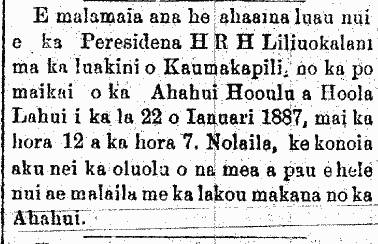
There will be a grand luau put on by the President, H. R. H. Liliuokalani, at Kaumakapili Church, for the benefit of the Hooulu and Hoola Lahui Society [Ahahui Hooulu a Hoola Lahui] on the 22nd of January 1887, from 12 to 7 o’clock. Therefore, the kindness of all is requested to come there with their donations for the Ahahui.

(Ko Hawaii Pae Aina, 1/15/1887, p. 4)

E malamaia ana he ahaaina luau...

Ko Hawaii Pae Aina, Buke X, Helu 3, Aoao 4. Ianuari 15, 1887.