Unknown's avatar

About nupepa

Just another place that posts random articles from the Hawaiian Newspapers! It would be awesome if this should become a space where open discussions happen on all topics written about in those papers!! And please note that these are definitely not polished translations, but are just drafts!!! [This blog is not affiliated with any organization and receives no funding. Statements made here should in now way be seen as a reflection on other organizations or people. All errors in interpretation are my own.]

D. S. K. Pahu writes from the Philippines, 1912.

OUR LETTER FROM THE PHILIPPINES.

THAT BOY TELLS HIS FATHER OF THE GREAT AMOUNT OF GOVERNMENT LAND.

Baguio, Benguet, Philippines.

O My Beloved Father:

Here we are, the two of us, now living in the mountains. We got back on the 17th. Live here is good; the air is brisk, and the only trees that grow in abundance on this mountain are pine. I am thinking that we will be here until the last week of June.

It is not certain whether I will stay here for a full three years. This is a fertile land if you have a lot of money. I met up with a haole man who is the secretary of a Filipino organization here, and he wants me to write about sugar in Hawaii and to publish it in the local papers. He tells me that there are vast and much government lands that are left unfarmed because of lack of funding. If I want land, he can definitely help me to ask for government land. Looking at the worth of sugar in Hawaii, I believe that money can be made through this endeavor. there are a lot of sugar lands here, however, the sugar mills are decrepit and sugar has been pushed to the side; the people here do not understand the sugar industry as they do in Hawaii. That is what makes me want to write about sugar. Here’s something else: Hawaii’s people have their eyes set on here, and a couple of weeks ago, a haole man came from Hawaii to look at the land here with the intent of building a modern sugar mill like in Hawaii. If everything goes well, I am determined to leave this job and to start a large sugar plantation here, and I’ll return to Hawaii to work out the selling of shares [kea] and the purchase of a mill and so forth; I have written to some people in Honolulu about this venture, and if things go well, I will come home to Hawaii in two years, but if they do not go well, I suppose I will wait it out.

I saw the Exposition here [Philippine Exposition held in Manila, February 3–11, 1912], and there are many goods from here. Sugar, coconuts, manila rope, rice, gold, silver, charcoal, and so forth were the things on display. The wood of this land is beautiful, used to make chairs and tables. One of the tables was 10 feet long across the middle, and 40 feet long across the edges, made out of one tree without the addition of other boards. The performances by school children was full of beauty; the lace, household furnishings, hats, clothing, and so forth were lovely and fine. Better than Hawaii.

With aloha from the daughter and from me as well.

Me.

D. S. K. PAHU.

(Aloha Aina, 7/27/1912, p. 1)

KA MAKOU LETA MAI MANILA MAI.

Ke Aloha Aina, Buke XVII, Helu 30, Aoao 1. Iulai 27, 1912.
Congratulations to all ‘Ike Kū‘oko‘a Project volunteers, 2012.

I was looking in this morning’s newspaper, and there was an article by ‘Alohi Bikle, on page 2 of section B, “Volunteers end transcriptions of Hawaiian-language papers,” about the volunteer project that just ended their first phase yesterday, Hawaiian Restoration Day. The volunteers typed an amazing 15,500 pages of newspapers!

I am perhaps most excited to hear that the project is pledging to translate all of the completed 15,500 pages of newspaper and to put them up online! And it seems that these will not just be summaries like what i do here just for fun, but “quality translations.” Hopefully some day in the near future, i can put this blog aside, and do some gardening, because they also pledge to be thorough, making sure that “no ‘a,’ ‘e,’ ‘i,’ ‘o’ and ‘u’ will be overlooked.”!!

This is something the words and thoughts of the people of old deserve. After all, in the word is life, and in the word is death.

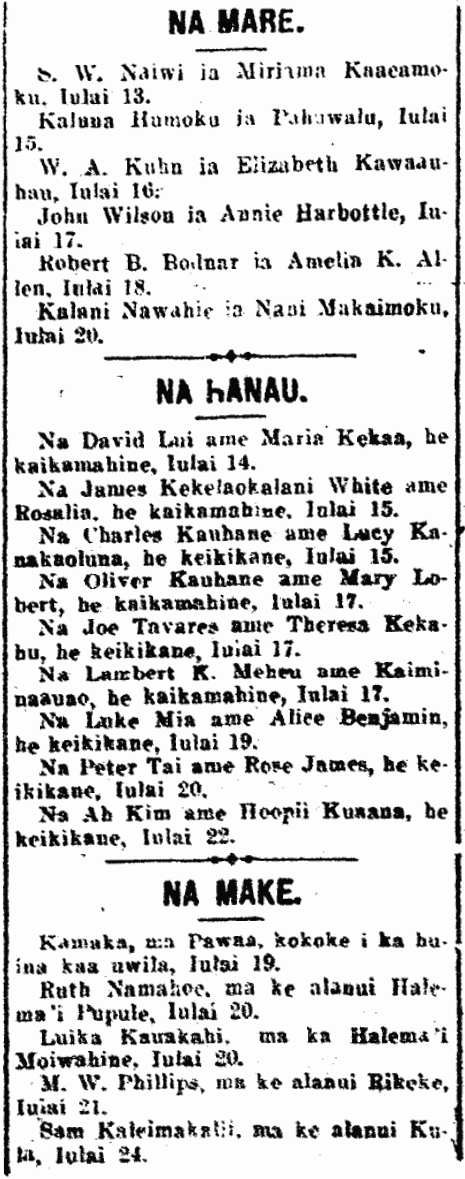
Vital Statistics. 1912.

MARRIAGES.

S. W. Naiwi to Miriama Kaaeamoku, July 13.

Kaluna Humoku to Pahuwalu, July 15.

W. A. Kuhn to Elizabeth Kawaauhau, July 16.

John Wilson to Annie Harbottle, July 17.

Robert B. Bodnar to Amelia K. Allen, July 18.

Kalani Nawahie to Nani Makaimoku, July 20.

BIRTHS.

To David Lui and Maria Kekaa, a daughter, July 14.

To James Kekelaokalani White and Rosalia, a daughter, July 15.

To Charles Kauhane and Lucy Kanakaoluna, a son, July 15.

To Oliver Kauhane and Mary Lobert, a daughter, July 17.

To Joe Tavares and Theresa Kekahu, a son, July 17.

To Lambert K. Meheu and Kaiminaauao, a daughter, July 17.

To Luke Mia and Alice Benjamin, a son, July 19.

To Peter Tai and Rose James, a son, July 20.

To Ah Kim and Hoopii Kuaana, a son, July 22.

DEATHS.

Kamaka, at Pawaa, near the streetcar junction [huina kaa uwila], July 19.

Ruth Namahoe, on the road to the Insane Asylum, July 20.

Luika Kauakahi, at the Queen’s Hospital, July 20.

M. W. Phillips, on Richards Street, July 21.

Sam Kaleimakalii, on School Street, July 24.

(Kuokoa, 7/26/1912, p. 8)

NA MARE. / NA HANAU. / NA MAKE.

Ka Nupepa Kuokoa, Buke XLVIII, Helu 30, Aoao 8. Iulai 26, 1912.

“Ka Nonanona,” 1841–1845.

THE ANT.

“Go to the ant, thou sluggard; consider her ways, and be wise.”

[Just as an aside, here is the masthead of “Ka Nonanona,” and you can see here why this was chosen as the title of the paper. The passage is found in Proverbs (Solomona) 6:6. It is also seen in Hawaiian as: “E ka mea hiamoe, e hele oe i ka anonanona¹, E nana i kona aoao a e hoonaauao iho.”]

¹”Anonanona” is a variant of “nonanona,” meaning ant.

KA NONANONA

“Ka Nonanona” masthead


Question put out to the public, 1843.

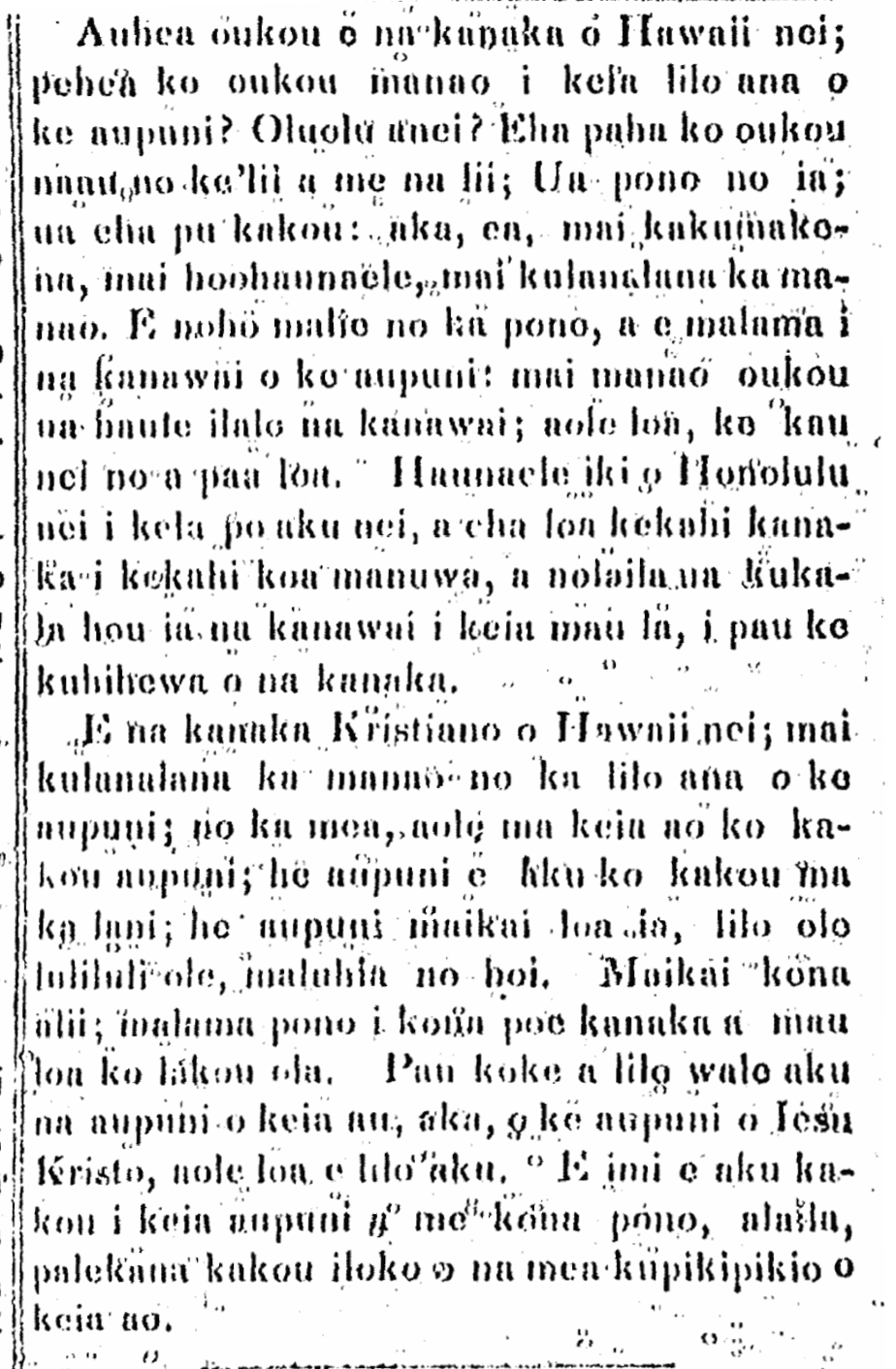
Here me O People of Hawaii nei; what do you all think of this cession of the kingdom? Is it fine? Your heart probably aches for the king and all the alii; That is how it should be; we are all hurting; however, do not grieve, do not revolt, do not let your resolve waver. We must remain calm and abide by the laws; don’t think that the laws have fallen, not at all, they are still totally in effect. There was a small disturbance in Honolulu the other night, and some men severely injured some of the sailors from the warship, and therefore the laws are being announced once again these days, so that the confusion of the people will end.

O Christian people of Hawaii nei, do not feel uncertain over the cession of the nation; our kingdom does not lie in this world, we have a different kingdom in the heavens; it is a great kingdom which is permanent, and unshakeable, and peaceful. Its king is good; he watches over his people, and they live forever. The nations of this world end quickly and are gone forever, but the kingdom of Jesus Christ will never end. Let us search after this kingdom and its righteousness, and we will be saved from the turbulence of this world.

[This editorial is probably by Richard Armstrong (Limaikaika), missionary and editor of Ka Nonanona.]

(Nonanona, 3/7/1843, p. 100)

Auhea oukou e na kanaka o Hawaii nei...

Ka Nonanona, Buke 2, Pepa 20, Aoao 100. Maraki 7, 1843.

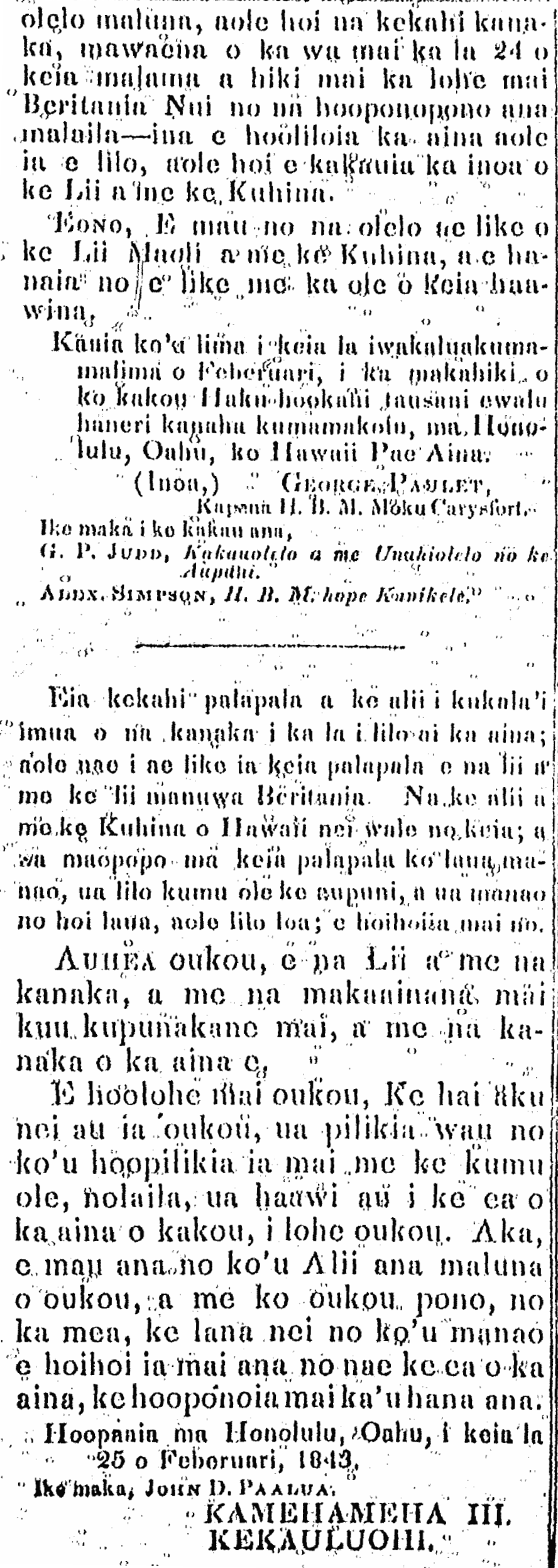
Correspondences between Paulet and the Hawaiian Government. 1843.

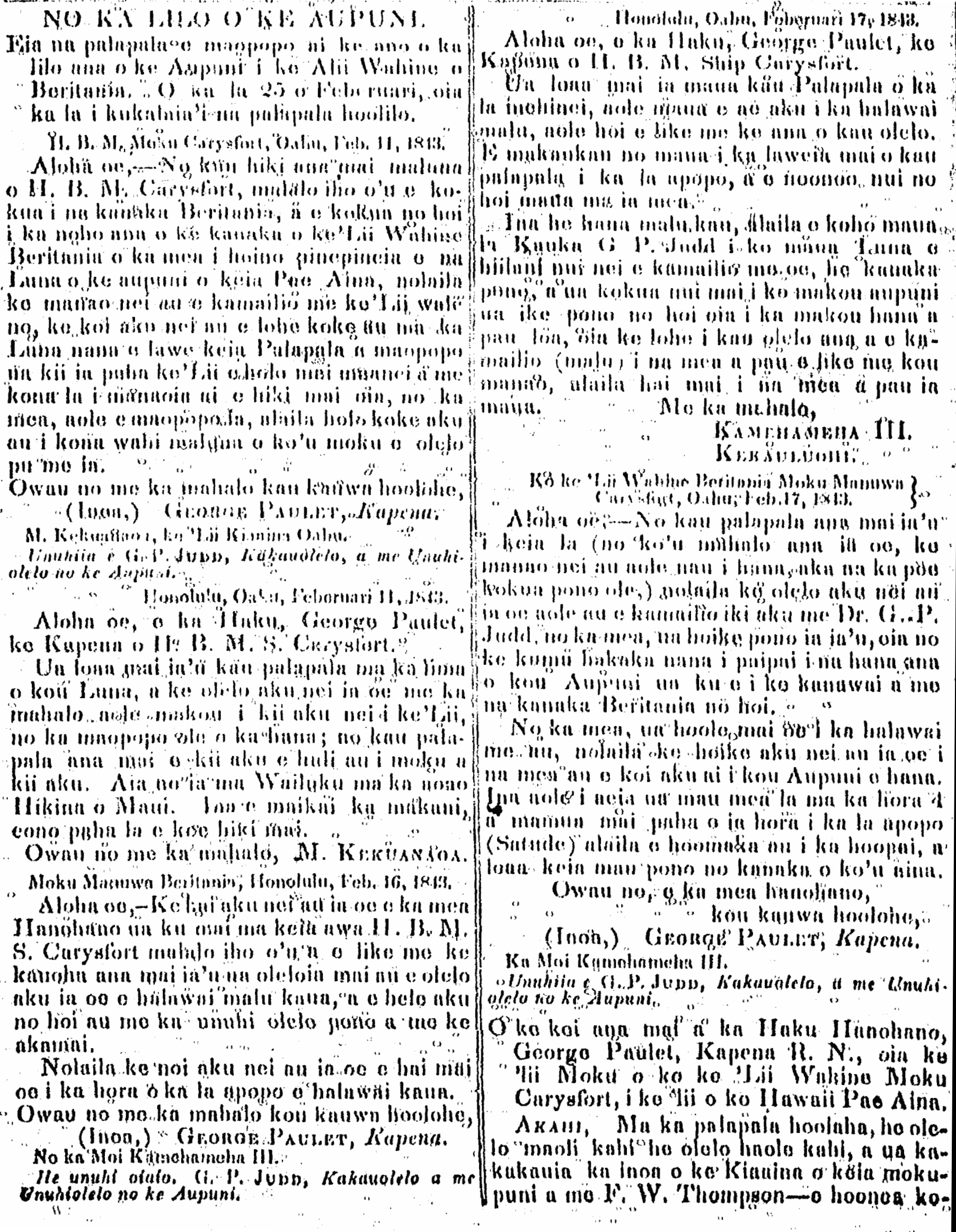
ON THE LOSS OF THE KINGDOM.

Here are the documents illuminating how the Kingdom was lost to the Queen of Britain. The 25th of February was the day the cession was proclaimed.

[See on Google Books: British and Foreign State Papers, starting on page 1023. These correspondences were translated from English into Hawaiian, and from Hawaiian into English by Gerrit Parmele Judd (Kauka), the Secretary and Translator of the Kingdom.]

(Nonanona, 3/7/1843, pp. 97–100.)

NO KA LILO O KE AUPUNI.

Ka Nonanona, Buke 2, Pepa 20, Aoao 97. Maraki 7, 1843.

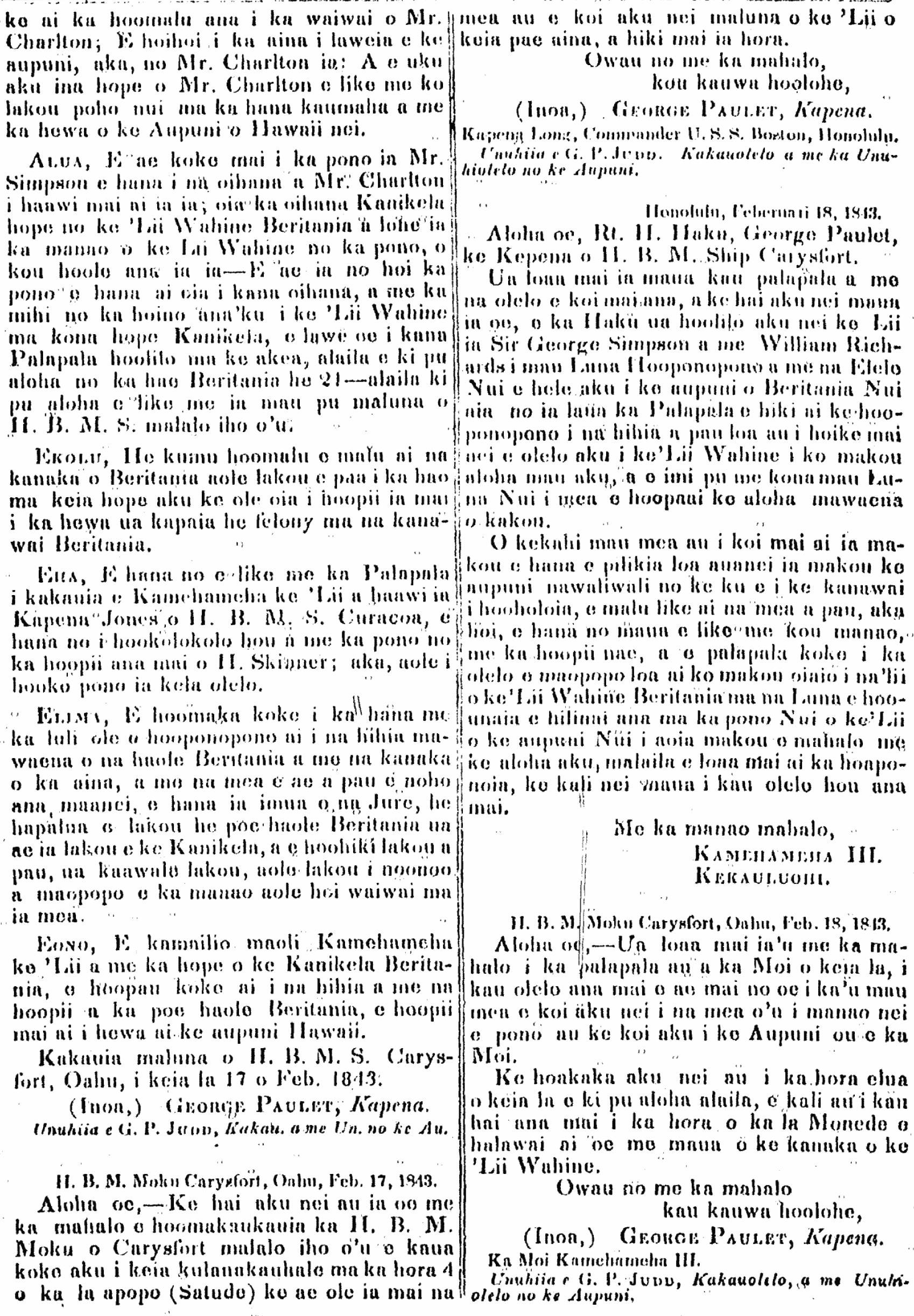
ke ai ka hoomalu ana...

Ka Nonanona, Buke 2, Pepa 20, Aoao 98. Maraki 7, 1843.

Honolulu, Oahu, Feb. 18, 1843.

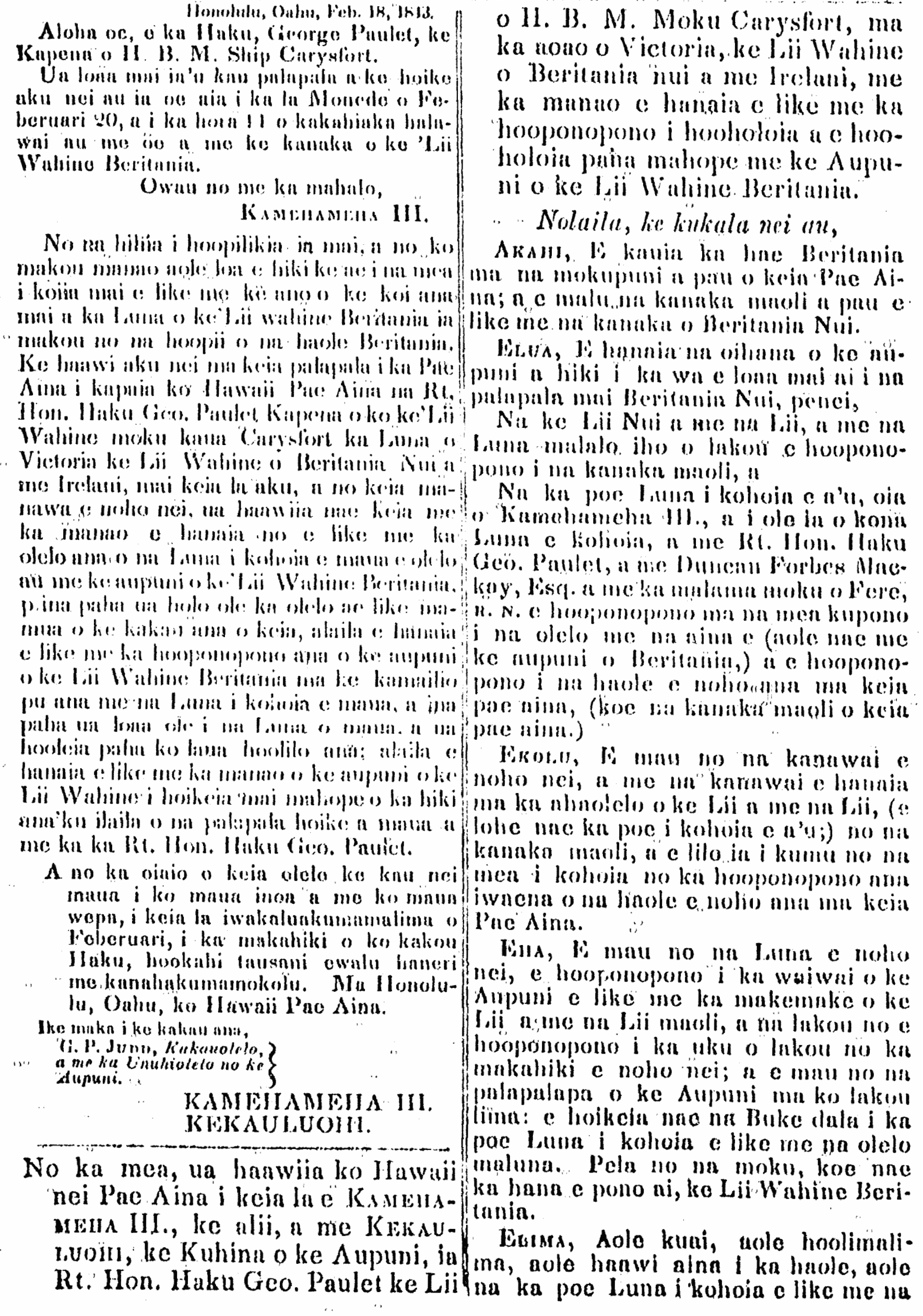
Ka Nonanona, Buke 2, Pepa 20, Aoao 99. Maraki 7, 1843.

olelo maluna, aole hoi na kekahi kanaka...

Ka Nonanona, Buke 2, Pepa 20, Aoao 100. Maraki 7, 1843.

Paulet arrives. 1843.

WARSHIPS.

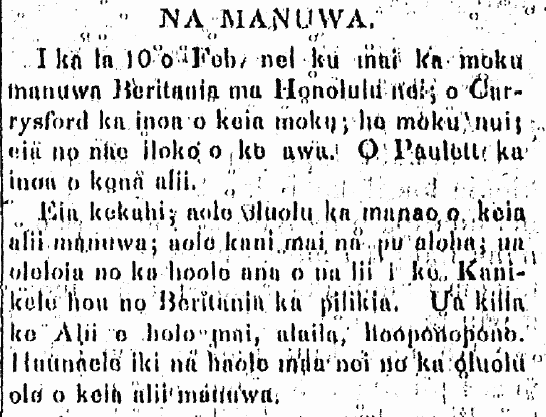
On the 10th of this Feb., the British man-of-war arrived here in Honolulu; the name of the ship is Carysfort; it is a large ship and yet is here in the harbor. Paulet is the name of its captain.

Here is another thing; the captain of this warship is not here with good intent; he did not fire his guns in salute; it is said that the problem is because of the denial of the new British Consul by the king. The King was sent for to come, and then they’d work it out. The haole here are having minor demonstrations in response to the ill will of the warship captain.

(Nonanona, 2/14/1843, p. 96)

NA MANUWA.

Ka Nonanona, Buke 2, Pepa 19, Aoao 96. Feberuari 14, 1843.

La Hoihoi Ea, 1912.

DAY NOT TO BE FORGOTTEN BY TRUE HAWAIIANS.

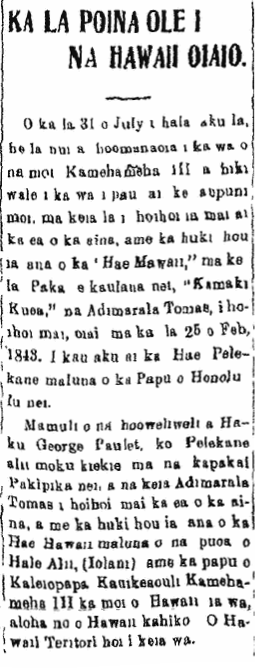
The past 31st of July was a great day celebrated in days of the monarchs, from Kamehameha III all the way until the end of the monarchy; on this day sovereignty was restored and the Hawaiian Flag was raised at that famous park, “Thomas Square,” by Admiral Thomas [Adimarala Tomas], who did the restoration, being that on the 25th of February, 1843, the British Flag was raised over the Fort of Honolulu.

As a result of the threats by Lord George Paulet; Britain’s high officer on the Pacific Ocean, it was Admiral Thomas who restored the sovereignty of the land, and re-raised the Hawaiian Flag on the flag staffs at the Palace (Iolani) and the fort of Kaleiopapa Kauikeaouli Kamehameha III, the king of Hawaii at the time; Aloha to Hawaii of old, which is the Territory of Hawaii now.

(Kuokoa Home Rula, 8/1/1912, p. 1)

KA LA POINA OLE I NA HAWAII OIAIO.

Kuokoa Home Rula, Buke X, Helu 31, Aoao 1. Augate 1, 1912.

Even more from Ka Nonanona, August 8, 1843.

TRAITORS.

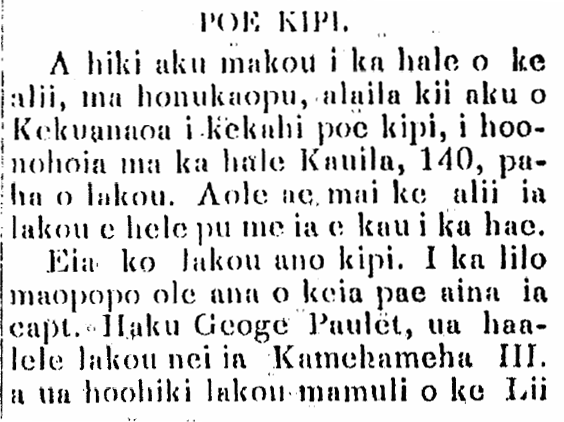
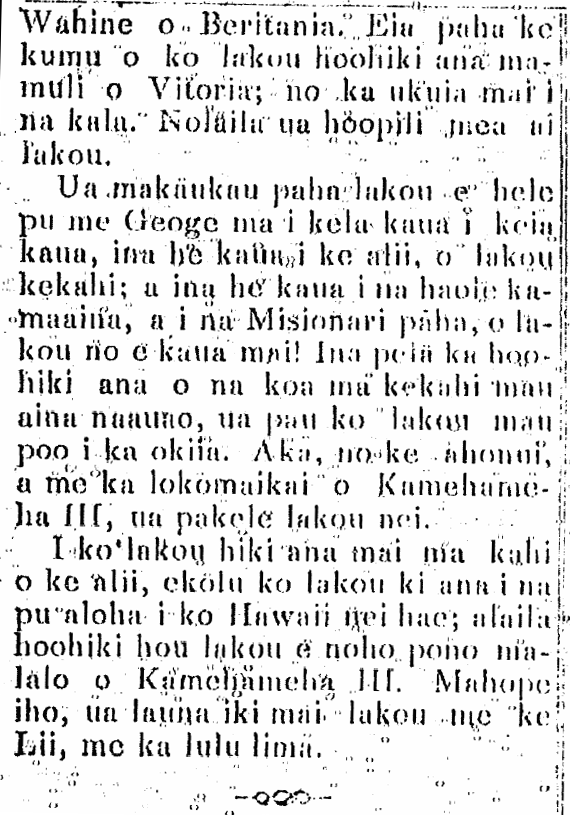
When we reached the residence of the king, at Honukaopu [Honokaupu ?], Kekuanaoa fetched some traitors who were kept at Hale Kauila; perhaps there were 140 of them. The king did not allow them to accompany him to raise the flag.

This is the nature of their treason. When this archipelago was not clearly under Capt. Lord George Paulet, they left Kamehameha III, and they swore allegiance to the Queen of Britain. This is probably the reason they swore allegiance to Victoria; because they were paid money. They therefore curried his favor [hoopilimeaai].

They were probably prepared to go with George to this war and that; if he warred against the king, so too would they; and if he went to war against the local haole or the Missionaries, they would fight as well! If soldiers of enlightened lands took an oath in this fashion, their heads would fall. But because of the patience and goodness of Kamehameha III, they were saved.

When they came in the presence of the king, they gave a three gun salute to Hawaii’s flag; and they swore once again to live obediently beneath Kamehameha III. After that, they spent time with the King, and shook hands.

(Nonanona, 8/8/1843, pp. 25 & 26.)

POE KIPI.

Ka Nonanona, Buke 3, Pepa 6, Aoao 25. Augate 8, 1843.

Wahine o Beritania...

Ka Nonanona, Buke 3, Pepa 6, Aoao 26. Augate 8, 1843.

More from Ka Nonanona, August 8, 1843.

THE RESTORATION OF THE KINGDOM.

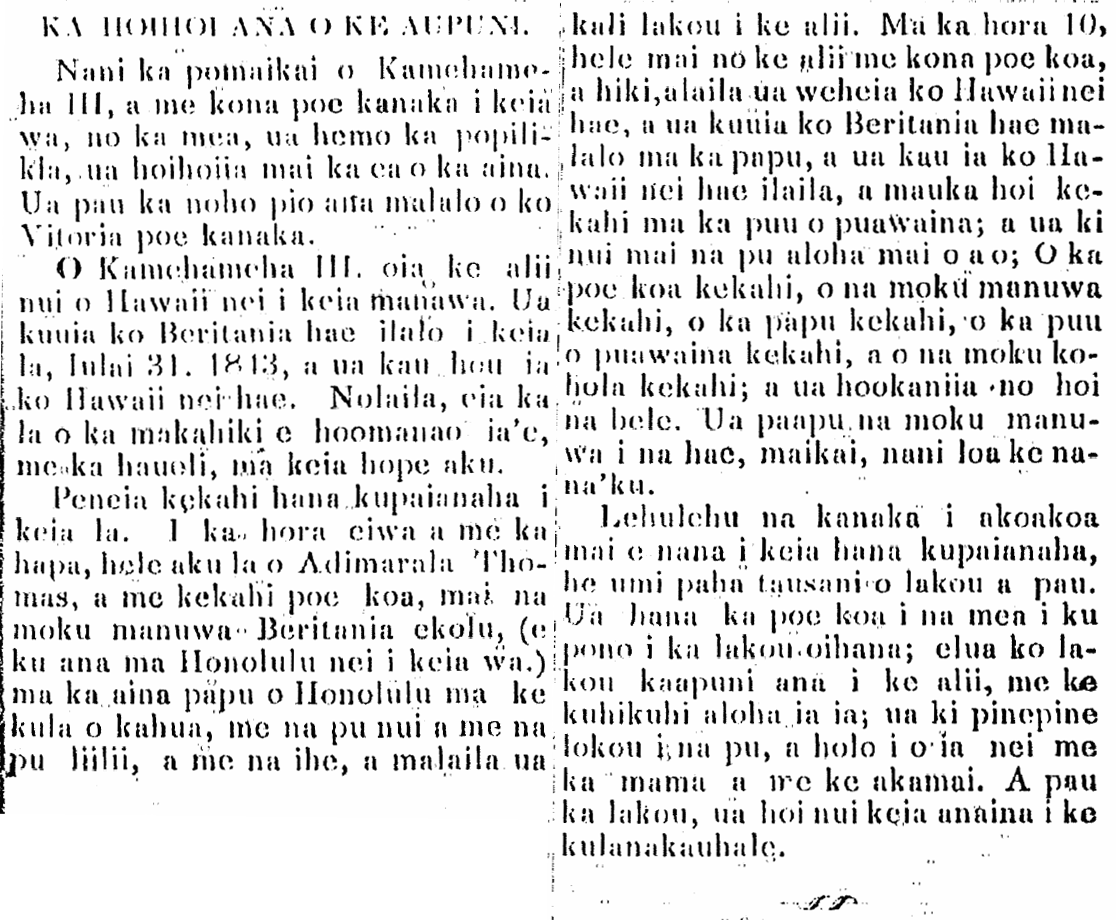
How great are the blessings of Kamehameha III and his subjects now, for the difficulties have subsided and the sovereignty of the land has been restored. No more is the living as subjects under the men of Victoria.

Kamehameha III is now the monarch of Hawaii nei. The British flag has been taken down on this day, July 31, 1843, and Hawaii’s flag has been raised once more. Therefore, this will be the day of the year that will be commemorated with joy from here forth.

Here is an awesome event that happened today. At half past eight, Admiral Thomas went along with some sailors, from the three British ships (anchored at Honolulu now) to the fort of Honolulu at Kulaokahua, with large and small firearms, and spears, and there he awaited the king. At 10 o’clock, the king went with his soldiers, and arrived; the Hawaiian flag was unfurled, the British flag was taken down from the fort, and there the Hawaiian flag was raised, and so too in uplands, on the hill of Puawaina [Punchbowl]; many guns were shot off in salute all over: The soldiers did it, the warships as well, the forts as well, and the hill of Puawaina as well, and the whaling ships as well; and the bells were rung. The warships were festooned with flags; it was a fine and beautiful sight to see.

There were many people gathered to witness this amazing event, perhaps there were ten thousand in total. The soldiers carried out their duties well; they circled the king twice, while saluting him; they shot off their guns many times and marched here and there quickly and smartly. And when they were done, the crowd all returned to town.

(Nonanona, 8/8/1843, p. 25)

KA HOIHOI ANA O KE AUPUNI.

Ka Nonanona, Buke 3, Pepa 6, Aoao 25. Augate 8, 1843.