History of the Hawaiian Flag. 1879.

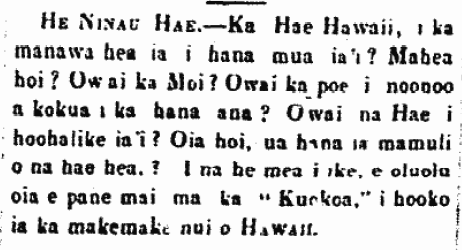
Question on the Flag.—The Hawaiian Flag; when was it first made? Where? Who was the King? Who were the ones who thought about and helped in its making? Which flags was it made like? In other words, it was made following which flags? If there is someone who knows, please answer the “Kuokoa,” so that Hawaii’s great desire is fulfilled.

[This is an interesting question, considering that 17 years earlier, the Kuokoa (1/1/1862) ran an article on the history of the Hawaiian flag along with a color image of the flag!

The history was rerun again nine years later on 1/7/1871 (also with a color image of the flag).]

(Kuokoa, 3/22/1879, p. 2)

He Ninau Hae.

Ka Nupepa Kuokoa, Buke XVIII, Helu 12, Aoao 2. Maraki 22, 1879.

John Ioane Ukeke, in his earlier days! 1880

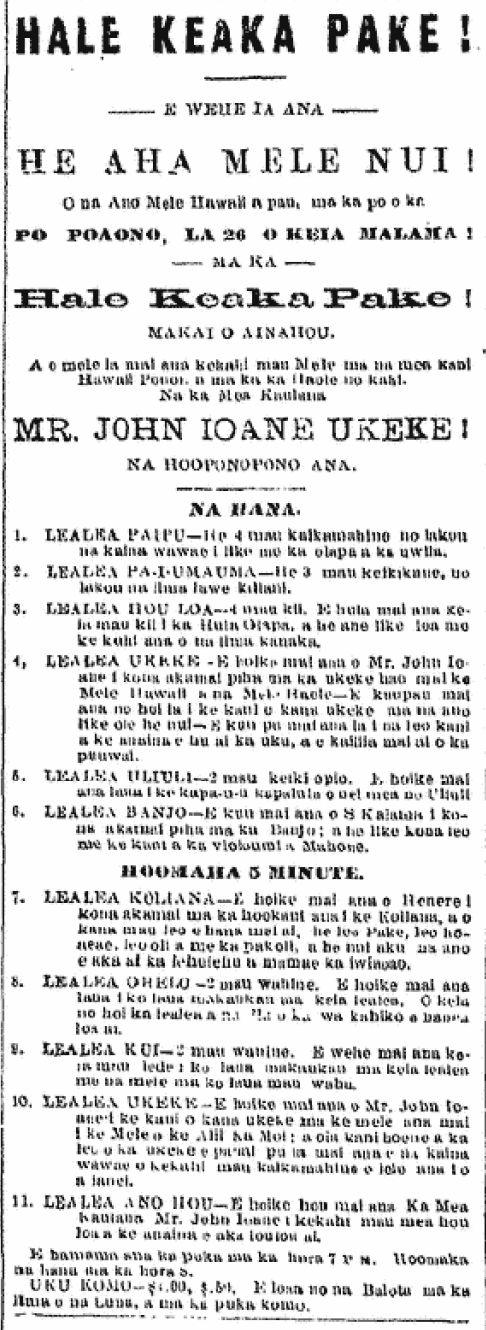
CHINESE THEATER!

OPENING

A GRAND CONCERT!

Of all types of Hawaiian Music, on the night of the

SATURDAY NIGHT, THE 26TH OF THIS MONTH!

AT THE

Chinese Theater!

SEASIDE OF AINAHOU.

There will be some Mele performed with Native Hawaiian instruments, and some with Haole instrments.

By the Famed One

MR. JOHN IOANE UKEKE!

IS THE ORCHESTRATING.

THE PERFORMANCE.

1. IPU PERFORMANCE [LEALEA PAIPU]—4 girls whose steps are like flashes of lightning.

2. CHEST SLAPPING PERFORMANCE [LEALEA PA-I-UMAUMA]—3 boys with swift hand motions.

3. MODERN PERFORMANCE [LEALEA HOU LOA]—4 dolls. The dolls will do a Hula Olapa, and their hand motions will be like those of a human.

4. UKEKE PERFORMANCE [LEALEA UKEKE]—Mr. John Ioane will show his total skill with the metal ukeke (Jew’s harp) with Hawaiian songs and Haole songs—He will exert himself with his ukeke playing in all fashions—[It doesn’t help that the image is not clear, but cannot make out the next line and a half. Anyone?] and your hearts will be captured.

5. ULIULI PERFORMANCE [LEALEA ULIULI]—2young children. They will show the fluttering and rattling of this thing, the Uliuli.

6. BANJO PERFORMANCE [LEALEA BANJO]—S. Kalama will exhibit his full skill at the Banjo; and its sound is like the ten-stringed lyre of Mahone [this is probably a reference to a story running in the Kuokoa: “KA MOOLELO O BERIANA KA WIWO OLE A ME MAHONE KE KOA” (4/26/1879–11/20/1880)]

FIVE MINUTE BREAK.

7. ACCORDIAN PERFORMANCE [LEALEA KOLIANA]—Henere [Henry] will show his skill at playing the Accordian, and the sounds he makes: Chinese, hoaeae, oli and the musical scale [pakoli]; it will make the crowd laugh and your sides will hurt.

8. OHELO PERFORMANCE [LEALEA OHELO]—2 women. They will show their abilities at this amusement. This is the amusement of the alii of the olden days that they greatly enjoyed.

9. KUI PERFORMANCE [LEALEA KUI]—2 women. These two ladies will display their readiness at this amusement while from their mouths come mele.

10. UKEKE PERFORMANCE [LEALEA UKEKE]—Mr. John Ioane will show his playing of the ukeke with Mele of the King; and this sweet voice of the ukeke will be accompanied by the steps of some girls doing lele this way and that.

11. MODERN PERFORMANCE [LEALEA ANO HOU]—The Famous Mr. Ioane will show once again some new things that will have the audience in stitches.

The doors will open at 7 P. M. Performances begin at 8.

ENTRANCE FEE: $1.00, $ .50. Tickets [Balota ?] available from hand of those in charge as well as at the entrance.

(Ko Hawaii Pae Aina, 6/26/1880, p. 2)

HALE KEAKA PAKE!

Ko Hawaii Pae Aina, Buke III, Helu 26, Aoao 2. Iune 26, 1880.

One more on the passing of Ioane Ukeke, 1903.

IOANE UKEKE HAS DIED.

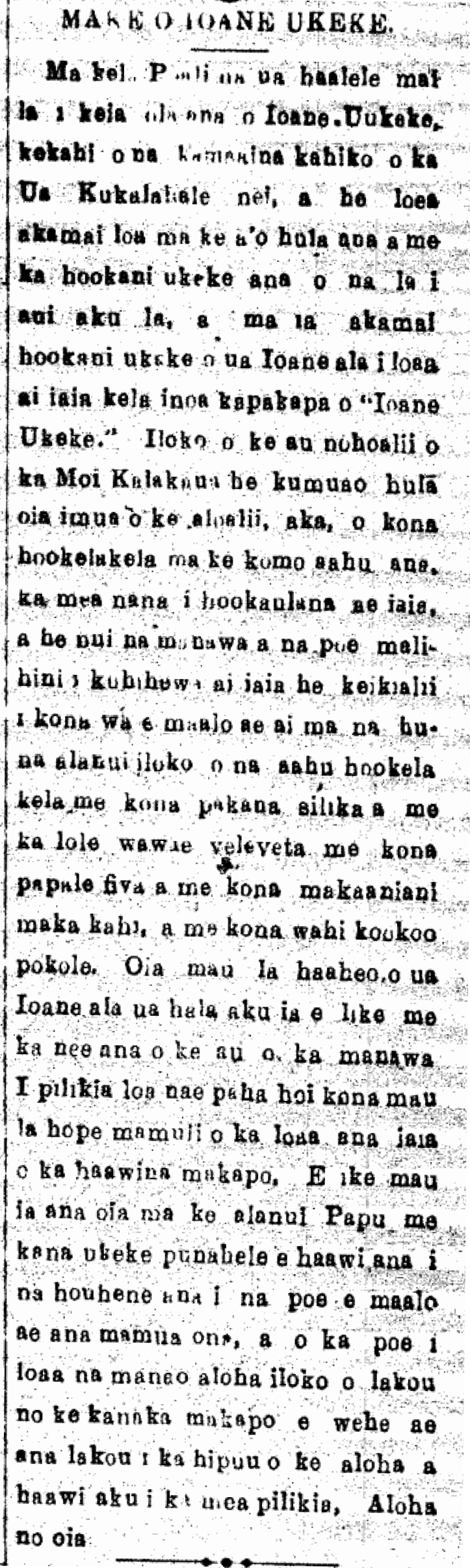
Last Friday, Ioane Ukeke left this life, he was one of the old-time kamaaina of the Kukalahale Rain [famous rain of Honolulu], and he was a skilled expert at teaching hula and playing the ukeke in the days gone by, and it is because of Ioane’s skill at playing the ukeke that he received the nickname “Ioane Ukeke.” During the reign of King Kalakaua, he was a hula teacher [kumuao hula] in the royal court, but what made him famous was his showing off in costume, and there was many a time when foreigners mistook him for a prince when he passed by the street corner [huna alanui? huina alanui?] in his stylish attire and his silk waist [pakana ?] and velvet slacks with his beaver hat and monocle, with his short cane. Those proud days of Ioane have gone with the flow of time. He faced difficulties in his latter days, because of blindness. He was always seen on Fort Street with his favorite ukeke serenading those passing by before him, and those who felt aloha for this blind man would undo the tie of aloha and gave a helping hand to the impaired one. Aloha for him.

(Aloha Aina, 5/9/1903, p. 6)

MAKE O IOANE UKEKE.

Ke Aloha Aina, Buke IX, Helu 19, Aoao 6. Mei 9, 1903.

Famed Dandy, Ioane Ukeke, is no more. 1903.

His Joyous Voice is Gone.

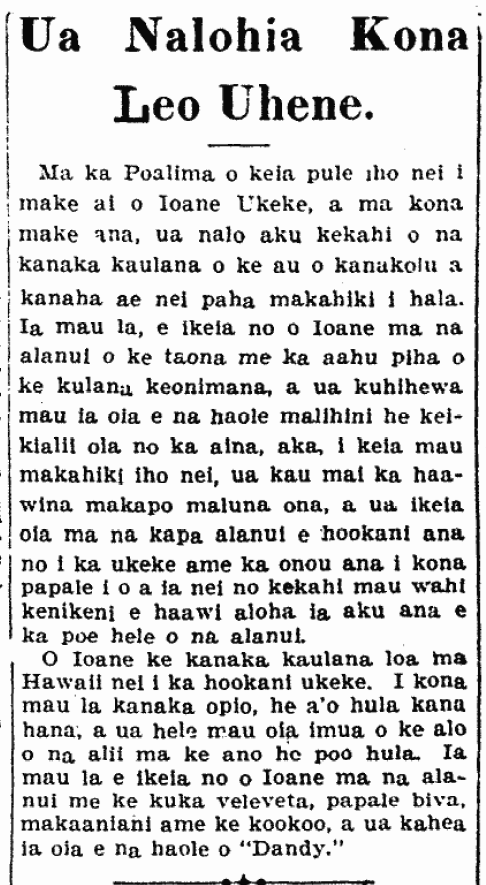
On Friday of this past week [5/1/1903], Ioane Ukeke died, and with his death, so too has one of the famous people of thirty or forty years ago left. Those days, Ioane was seen on the streets of town in full attire of a gentleman, and he was often mistaken by the foreign haole, as a prince of the land; but these past years, he went blind, and he was seen on the street sides playing the ukeke and sticking out his hat this way and that for some coins given charitably by the passersby.

Ioane is very famous in Hawaii for his playing of the ukeke. In his youth, he was a hula teacher [a’o hula], and he often went before the court of the alii as a hula leader [poo hula ?]. In those days, Ioane was seen on the streets in a velvet suit, beaver hat, glasses and a cane; he was called “Dandy” by the haole.

(Kuokoa, 5/8/1903, p. 6)

Ua Nalohia Kona Leo Uhene.

Ka Nupepa Kuokoa, Buke XLI, Helu 19, Aoao 6. Mei 8, 1903.

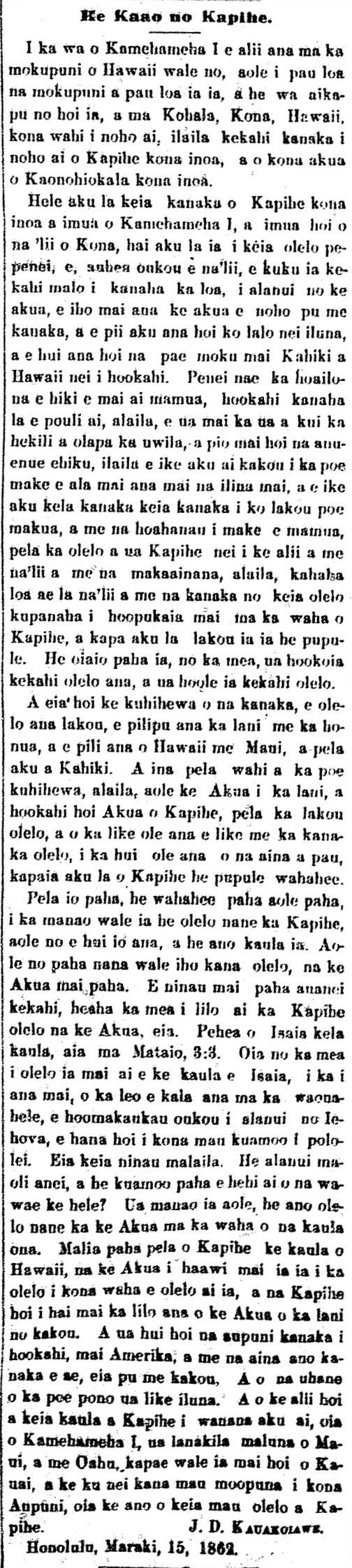
Kapihe and his prophecy. 1862.

The Story of Kapihe.

When Kamehameha I was ruler over only Hawaii Island, and not all of the islands were his, and while the eating kapu was still enforced, and while he was living in Kohala, Kona, Hawaii, it was there that a certain man lived named Kapihe, and his god was called Kaonohiokala.

This man named Kapihe went before Kamehameha I and before the alii of Kona, and he said these words, “Listen, O Chiefs, a malo will stand, forty in length, as a path for the god; the god will come down and live with man, and what is down here will rise up above, and the archipelago from Kahiki* all the way to Hawaii will be joined as one. This is the sign that will come before this: there will be forty days of darkness and then rain will fall and thunder will crash and lightning will flash and seven rainbows will arch; there we will see the dead rise from the graves and all people will see their parents and hoa hanau [siblings, cousins] who died earlier.” And that is what Kapihe said to the King, alii, and makaainana. The chiefs and commoners were astounded at these shocking words spoken by Kapihe, and they called him crazy. This perhaps is the truth, for some of his predictions came true and others were denied.

This is how people are mistaken, they say, the heavens and earth will come together, and Hawaii and Maui will join together, and so too with Kahiki. And if that is the case, according to the mistaken ones, then God is not in heaven, and there is but one God, and that is Kapihe; that is what they said, and because all of the lands did not merge together as the they were saying, Kapihe was called a lying, crazed person.

Perhaps that is so, perhaps he was a liar, and perhaps not; it might be thought that Kapihe’s was a riddle and the land would not literally join together, and that he was a prophet. Perhaps his words were not his alone, but from God. Someone might ask, how did Kapihe’s words come from God, and here is the answer. What of Isaiah, that prophet, in Matthew 3:3? For this is what was spoken by the prophet Isaiah, ‘The voice of the one crying in the wilderness: ‘Prepare ye the way of Jehovah, make his paths straight.'” Here is the question there. Is it a real road, and is it a path that will be tread on by feet? It is believed not, but that it was a riddle from God through the mouth of his prophet. Maybe so too it was of Kapihe, the prophet of Hawaii; God gave the words for his mouth to speak, and Kapihe spoke what God of the heavens gave to us. And the nations of man joined as one, from America, and the other inhabited lands, they are here together with us. And the souls of the righteous are the same up above. The alii of whom Kapihe predicted was Kamehameha I, who was victorious over Maui and Oahu, and Kauai was left, and his grandchildren now rule over his Kingdom. This is the nature of Kapihe’s words. J. D. Kauakoiawe

Honolulu, March 15, 1862.

*Kahiki usually refers to foreign lands.

(Hoku o ka Pakipika, 3/20/1862, p. 1)

Ke Kaao no Kapihe.

Ka Hoku o ka Pakipika, Buke I, Helu 26, Aoao 1. Maraki 20, 1862.

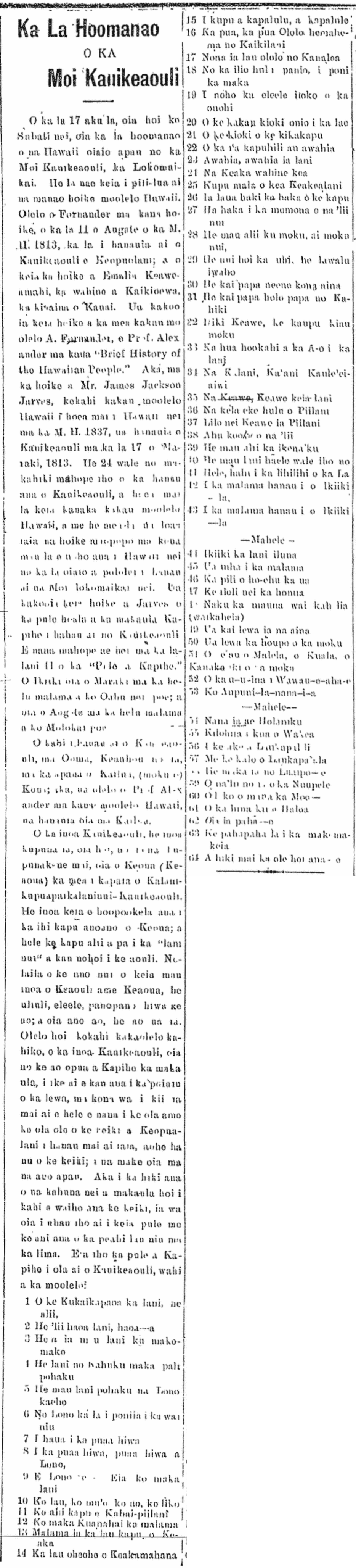
Kamehameha III, Kauikeaouli’s birthday, a little late. 1907.

Day of Remembrance

of the

King Kauikeaouli

This past 17th, Sunday, was the day of remembrance for all true Hawaiians, of the King Kauikeaouli, the Benevolent one. There are two different historical accounts of this day. Fornander states in his account that Kauikeaouli was born of Keopuolani on 11 August 1813, and that this information was from Emalia Keaweamahi, the wahine of Kaikioewa, the governor of Kauai. This date of A. Fornander is supported by Prof. Alexander in his “Brief History of the Hawaiian People.” However, in the account of Mr. James Jackson Jarves, a scholar of Hawaiian history who arrived here in Hawaii nei in 1837, Kauikeaouli was born on 17 March 1813. This historian arrived here but 24 years after the birth of Kauikeaouli, and it would seem that he obtained clear information about the true birth date of the Benevolent King, while he was living here. This statement by Jarves is supported by the reviving prayer that Kapihe offered for Kauikeaouli. Look below at line 11 [42?] in the “Pule a Kapihe.” Ikiiki is the month of March according to the reckoning of Oahu people, and according to Molokai people it is August.

Kauikeaouli was born at Ooma, Keauhou, in Kailua, in the moku of Kona. However, Prof. Alexander, in his history of Hawaii, says Kauikeaouli was born in Kailua.

The name Kauikeaouli is a name from his ancestors, that being the name of his grandfather, Keoua (Keaoua), the one called Kalanikupuapaikalaninui Kauikeaouli. This name puts on high the sacred kapu of Keoua–his chiefly kapu extends above and touches the great heavens, and rests upon the dark clouds. So therefore, the importance of the names Keaouli and Keaoua, is the dark, black, thick, esteemed cloud. This cloud is a rain cloud. A Orator of the old times said that the name Kauikeaouli is the bank of clouds that Kapihe, the prophet, saw spread high in the heavens when he was called to go to see if the child that Keopualani gave birth to was alive or not alive. He was not breathing and was totally lifeless. However, when this kahuna and prophet arrived to where the child was placed, he offered this prayer while waving a coconut frond in his hand. This is the prayer by which Kapihe made Kauikeaouli live, according to the story:

1 O ke Kukaikapaoa ka lani, ae alii,

2 He ‘lii haoa lani, haoa—a

3 He a ia m u lani ku makomako

4 He lani no Kahuku maka pali pohaku

5 He mau lani pohaku na Lono kaeho

6 No Lono ka la i poniia i ka wai niu

7 I haua i ka puaa hiwa

8 I ka puaa hiwa, puaa hiwa a Lono,

9 E Lono—e. Eia ko maka lani

10 Ko lau, ko mu’o, ko ao, ko liko

11 Ko alii kapu e Kahai-piilani

12 Ko maka Kuanahai ka malama

13 Malama ia ka lau kapu o Keaka

14 Ka lau oheohe o Keakamahana

15 I kupu a kapalulu, a kapalule

16 Ka pua, ka pua Ololo hemahema no Kaikilani

17 Nona ia lau ololo no Kanaloa

18 No ka ilio hulu panio, i poni ka maka

19 I noho ka eleele iloko o ka onohi

20 O ke kakau kioki onio i ka lae

21 O ke kioki o ke kikakapu

22 O ka i’a kapuhili au awahia

23 Awahia, awahia ia lani

24 Na Keaka wahine kea

25 Kupu mala o kea Keakealani

26 Ia laua haki ka haka o ke kapu

27 He haka i ka momona o na ‘lii nui

28 He mau alii ku moku, ai moku nui,

29 He nui hoi ka uhi, ka lawalu iwaho

30 He kai papa neenekona aina

31 He kai papa holo papa no Kahiki

32 I iki Keawe, ke kaupu kiau moku

33 Ka hua hookahi a ka A-o i ka lani

34 Na Kalani Ka’ani Kauleleiaiwi

35 Na Keawe, Keawe keia lani

36 Na kela eke hulu o Piilani

37 Lilo nei Keawe ia Piilani

38 Ahu kooka o na ‘lii

39 He mau alii ka ikena ‘ku

40 He mau lani haele wale iho no

41 Hele, hahi i ka lihilihi o ka La

42 I ka malama hanau i o Ikiiki—la

43 I ka malama hanau i o Ikiiki—la

—Mahele—

44 Ikiiki ka lani iluna

45 Ua uiha i ka malama

46 Ka pili o ho-ehu ka ua

47 Ke iloli nei ka honua

48 Naku ka mauna wai kali lia (waikaheia)

49 Ua kai lewa ia na aina

50 Ua lewa ka houpo o ka moku

51 O e au o Malela, o Kuala, o Kanaka ki o a moku

52 O ka u-u-ina i Wawau-e-aha-o

53 Ko Aupuni-la-nana-i-a

—Mahele—

54 Nana ia ae Holaniku

55 Kilohiia i kua o Wakea

56 I ke ake a Laukapalili

57 Me ke kalo o Laukapalala

58 He maka ia no Luaipo—e

59 O na ‘lii no ia o ka Nuupele

60 O I ko o maua ka Moo—

61 O ka hina kai o Haloa

62 Oia ia paha—e

63 Ke pahapaha la i ka makemakeia

64 A hiki mai ka ole hoi ana—e

[Amazingly, this is the only issue of this entire year that seems to have survived! If this newspaper could be reshot nicely, we could get a clear/clearer reading of this important mele!

And I put up the mele as is (although the image is not clear in some areas, so there are some questionable lines), so that words and phrases will be searchable on this blog or on google right now, instead of having to wait for some time in the future…]

(Kuokoa Home Rula, 3/22/1907, p. 4)
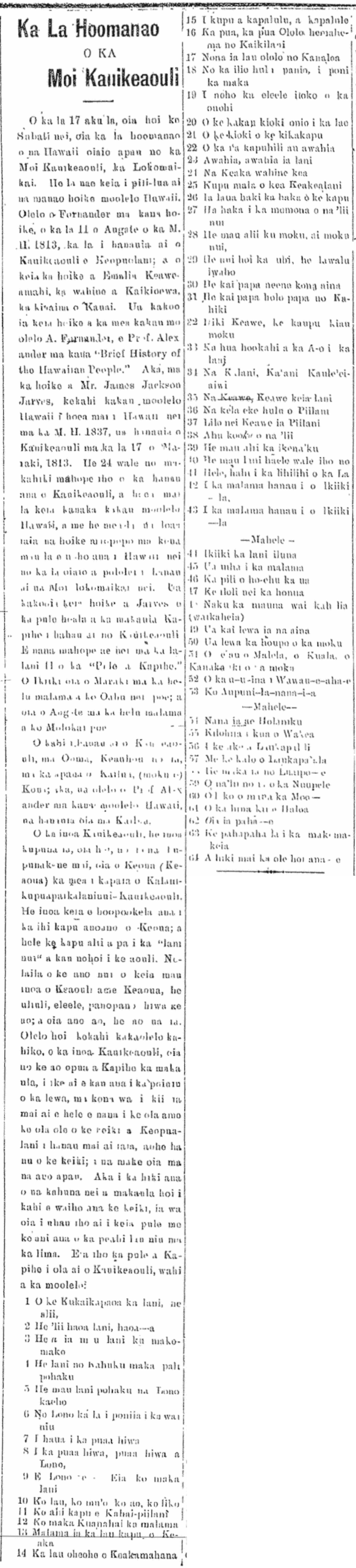
Ka La Hoomanao O KA Moi Kauikeaouli

Kuokoa Home Rula, Buke V, Helu 12, Aoao 4. Maraki 22, 1907.

Laying of the cornerstone of Liliuokalani School, 1912.

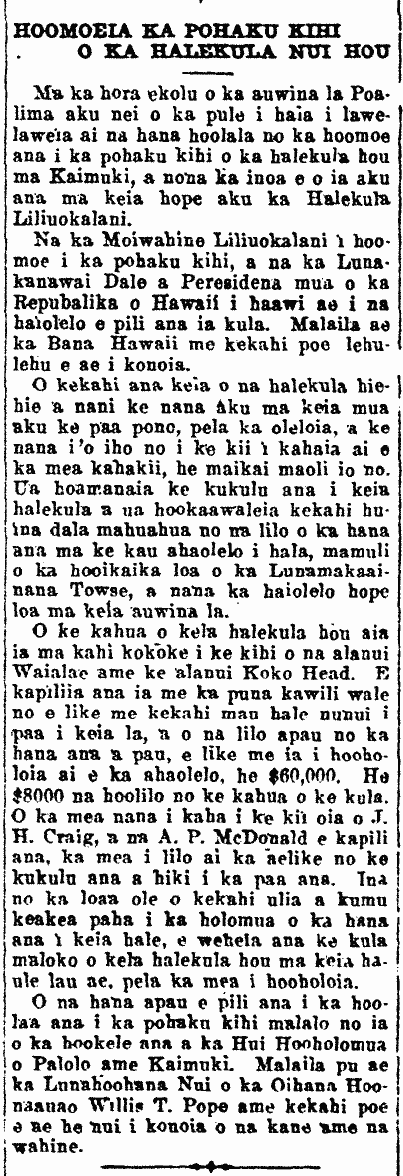
The Cornerstone of the New Great School is Laid.

At three o’clock on the afternoon of last Friday (4/12/1912), a ceremony was conducted to lay the cornerstone of the new school house in Kaimuki, that will be called hereafter, Liliuokalani School.

Queen Liliuokalani laid the cornerstone, and Legislator Dole, and former President of the Republic of Hawaii gave a speech about the school. The Hawaiian Band was there along with many invited guests.

When it is completed, this will be one of the most distinguished and beautiful schools, according to what is being said. And when you look at the artist’s rendering, it is indeed splendid. Authorization for building and funds were set aside in the previous session of the Legislature, through the efforts of Legislator Towse, and it was he that gave the final speech that afternoon.

The grounds of this school is near the corner of Waialae and Koko Head. It is being constructed of cement, like many of the great buildings being built these days. And the entire costs will be, as decided by the legislature, $60,000. $8000 was spent to purchase the land. The artist who drew the rendering was J. H. Craig. A. P. McDonald is the one doing the constructing; he received the contract to build the school to completion. Should there be no accidents or hinderances to the progress, the school will be unveiled this coming fall, as per what was decided.

Everything concerning the dedication of the cornerstone fell under the Improvement Club of Palolo and Kaimuki. Present also the head of the DOE, Willis T. Pope, as well as many men and women invited to attend.

[Although sadly this school has been closed, I hear there will be a 100th year celebration of the laying of the cornerstone to be held on the Queen Liliuokalani School grounds, on the 12th of April, with gates opening at 3:00 p. m.

See also from Chronicling America these related articles in English:

Evening Bulletin, 4/13/1912, p. 11,

Hawaiian Gazette, 4/16/1912, p. 7.

And about the actual opening of the school:

Hawaiian Gazette, 10/15/1912, p. 7.]

(Kuokoa, 4/19/1912, p. 6)

HOOMOEIA KA POHAKU KIHI O KA HALEKULA NUI HOU.

Ka Nupepa Kuokoa, Buke XLVIII, Helu 16, Aoao 6. Aperila 19, 1912.

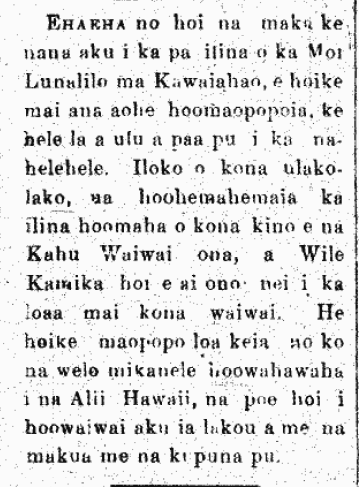
Lunalilo’s Crypt overgrown by weeds? 1894.

It is painful to see the cemetery of King Lunalilo at Kawaiahao, showing that it is not remembered, for it is overgrown by weeds. In its wealth, the crypt where his body is laid to rest was left to waste by his Trustees, along with Wile Kamika [William Owen Smith] who feasts off of his pay from the trust. This is proof of the missionary descendents’ [welo mikanele] contempt for the Alii of Hawaii, the people who made them wealthy and also their parents and grandparents.

(Makaainana, 3/19/1894, p. 4)

Ehaeha no hoi na maka...

Ka Makaainana, Buke I----Ano Hou, Helu 12, Aoao 4. Maraki 19, 1894.

One of many congratulatory messages to the newly elected king, Kalakaua, 1874.

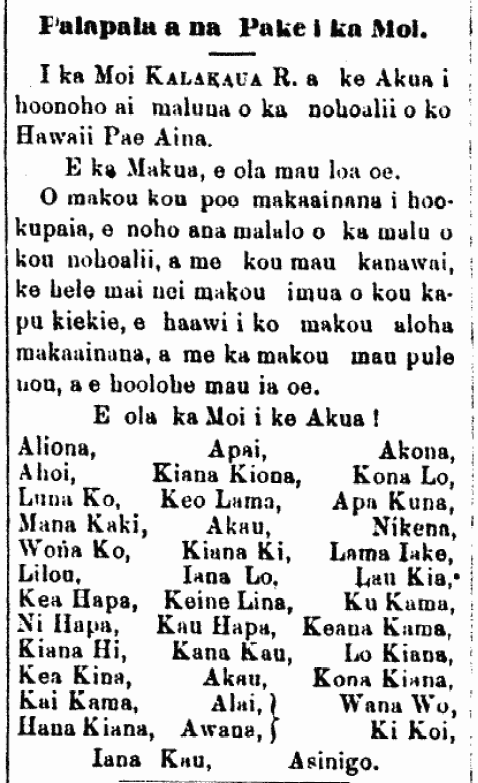
Letter from the Chinese to the King.

To King Kalakaua Rex, whom God has placed on the throne of the Hawaiian Archipelago.

Oh Father, long may you live.

We are your citizens who have been naturalized, living in under the protection of your rule and your laws; we come before your high kapu, to offer you our aloha from your citizens, as well as our prayers for you, and we shall always heed you.

Let the King live Through God!

Aliona, Apai, Akona, Ahoi, Kiana Kiona, Kona Lo, Luna Ko, Keo Lama, Apa Kuna, Mana kaki, Akau, Nikena, Wona Ko, Kiana Ki, Lama iake, Lilou, Iana Lo, Lau Kia, Kea Hapa, Keine Lina, Ku Kama, Ni Hapa, Kau Hapa, Keana Kama, Kiana Hi, Kana Kau, Lo Kiana, Ke Kina, Akau, Kona Kiana, Kai Kama, Alai, Wana Wo, Hana Kiana, Awana, Ki Koi, Iana Kau, Asinigo.

(Kuokoa, 3/21/1874, p. 1)

Palapala a na Pake i ka Moi.

Ka Nupepa Kuokoa, Buke XIII, Helu 12, Aoao 1.

Excerpts of “Strangling Hands…” appearing in the Hawaiian-Language Newspaper. 1897.

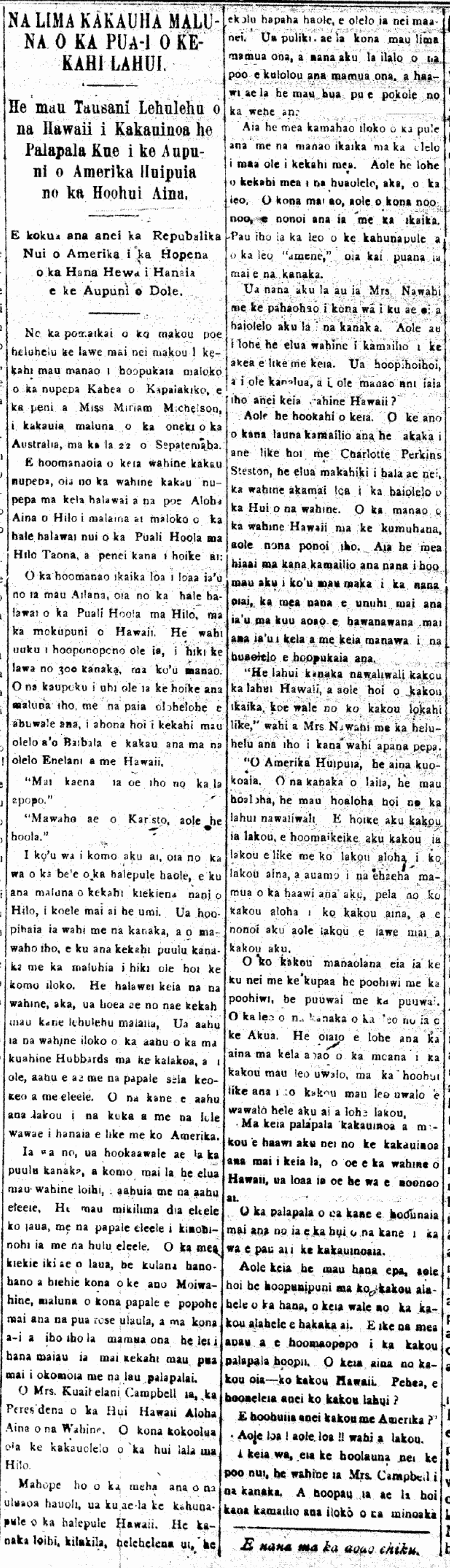
NA LIMA KAKAUHA MALUNA O KA PUA-I O KEKAHI LAHUI.

[This article is taken from the famed “Strangling Hands upon a Nation’s Throat” article by Miriam Michelson, which appears in the San Francisco Call, 9/30/1897, pp. 1–3. The introductory paragraphs go:]

For the benefit of our readers, we are taking some ideas printed in the newspaper San Francisco Call, written by the pen of Miss Miriam Michelson, on the deck of the ship, Australia, on the 22nd of September.

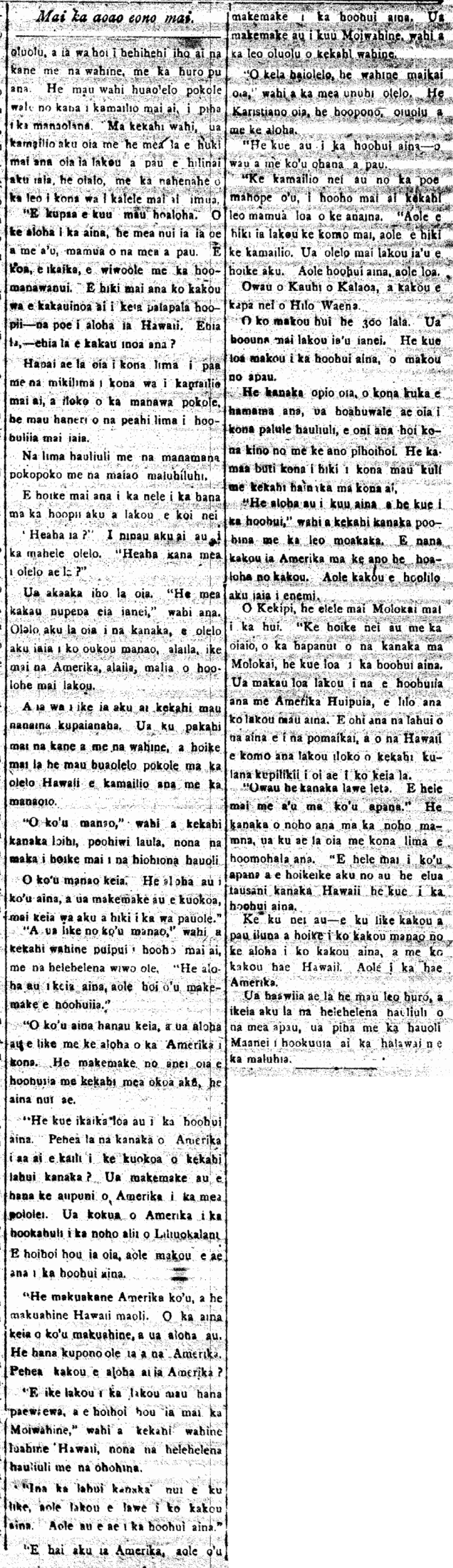
Remember that this woman newspaper reporter was the woman reporter present at the meeting of the Patriotic League of Hilo held at the meeting house of the Salvation Army in Hilo Town, and this is what she reported: . . .

(Aloha Aina, 10/16/1897, pp. 6 & 7.)

NA LIMA KAKAUHA MALUNA O KA PUA-I O KEKAHI LAHUI.

Ke Aloha Aina, Buke III, Helu 42, Aoao 6. Okatoba 16, 1897.

Mai ka aoao eono mai.

Ke Aloha Aina, Buke III, Helu 42, Aoao 7. Okatoba 16, 1897.