Personal Lands of Kamehameha III, and Government Lands, 1848.

By the Government.

A LAW FOR THE PERSONAL LANDS OF THE KING,
AND THE LANDS OF THE NATION.

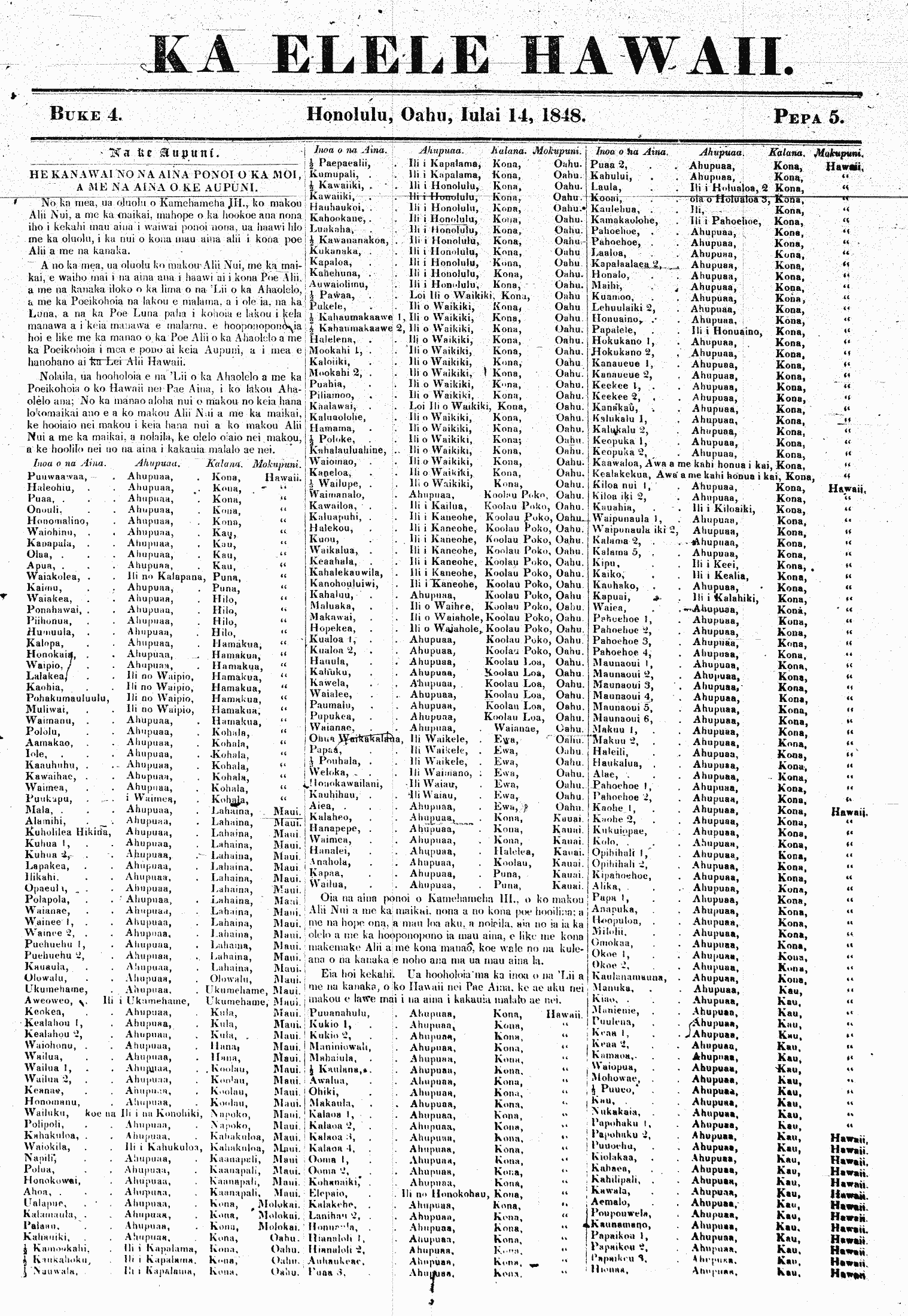
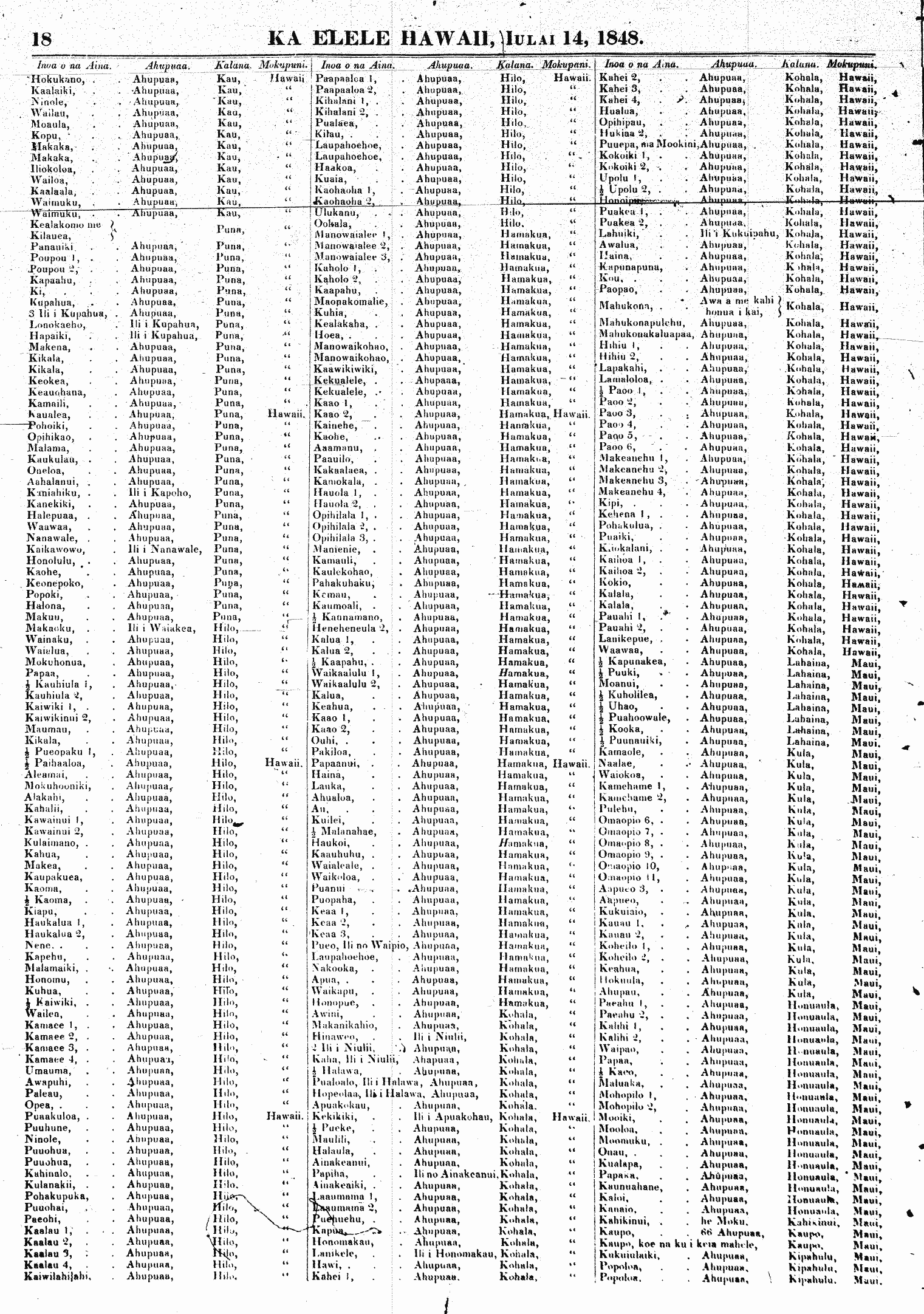
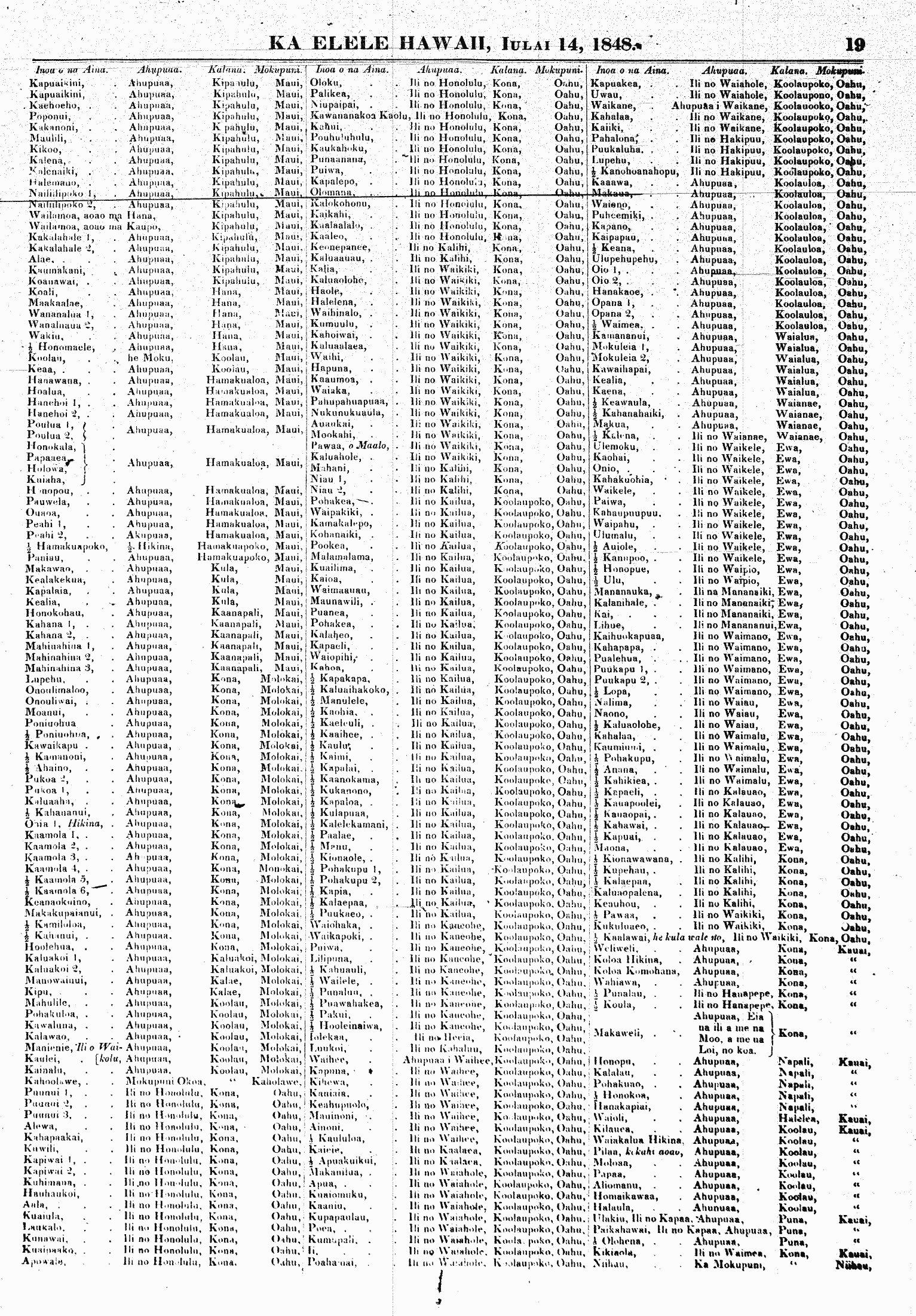
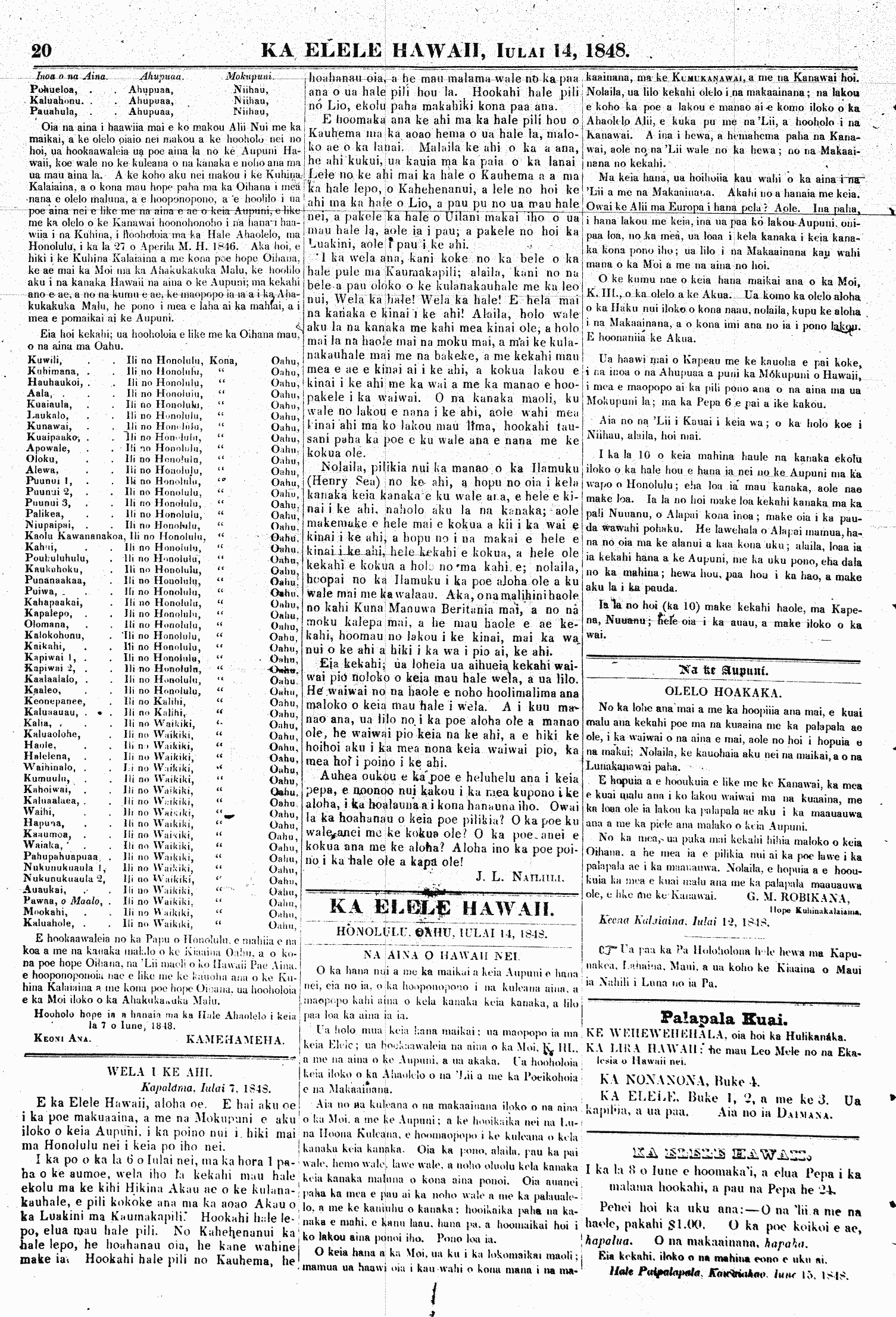
[Here is a newly passed law of the land appearing in the newspaper Elele Hawaii. One of the functions of the newspapers was to inform the nation’s citizens of new laws and proclamations from the government. This particular law establishes the Crown Lands (and Government Lands) which still holds much importance to this day.

For a translation see “A Supplement to the Statute Laws of His Majesty, Kamehameha III., King of the Hawaiian Islands, … 1848.” pp. 22–43.

What is also valuable about this listing is that it describes in 1848 what ahupuaa a certain land belonged to, and so forth.]

(Elele Hawaii, 7/14/1848, pp. 17–20.)

HE KANAWAI NO NA AINA PONOI O KA MOI, A ME NA AINA O KE AUPUNI.

Ka Elele Hawaii, Buke 4, Pepa 5, Aoao 17. Iulai 14, 1848.


HE KANAWAI NO NA AINA PONOI O KA MOI, A ME NA AINA O KE AUPUNI.

Ka Elele Hawaii, Buke 4, Pepa 5, Aoao 18. Iulai 14, 1848.

HE KANAWAI NO NA AINA PONOI O KA MOI, A ME NA AINA O KE AUPUNI.

Ka Elele Hawaii, Buke 4, Pepa 5, Aoao 19. Iulai 14, 1848.

HE KANAWAI NO NA AINA PONOI O KA MOI, A ME NA AINA O KE AUPUNI.

Ka Elele Hawaii, Buke 4, Pepa 5, Aoao 20. Iulai 14, 1848.

Another image of the return of Kamehameha III’s ahuula, 1927.

The guards of the Palace, when the Ahuula was returned to the Palace on this past Monday. Starting from the left, on the bottom row: E. K. Kaihe, John Hicky [John Hickey], J. K. Mokumaia, D. Hoke, and M. K. Reuter. The row in the back, from the left: S. K. Levi, Joseph Kawai, and John Paakaula.

(Kuokoa, 12/1/1927, p. 4)

Na kiai keia o ka Halealii...

Ka Nupepa Kuokoa, Buke LXVI, Helu 53, Aoao 4. Dekemaba 1, 1927.

Images of the return of Kamehameha III’s ahuula, 1927.

This is a picture showing scenes of the Feather cape of Kamehameha. The picture on the top is the return of the ahuula from the archives to within the Palace. The picture below is the ahuula draped upon the throne.

(Kuokoa, 12/1/1927, p. 1)

He kii keia e hoikeike ana...

Ka Nupepa Kuokoa, Buke LXVI, Helu 53, Aoao 1. Dekemaba 1, 1927.

Kamehameha III’s Feather Cape returned to Hawaii, 1927.

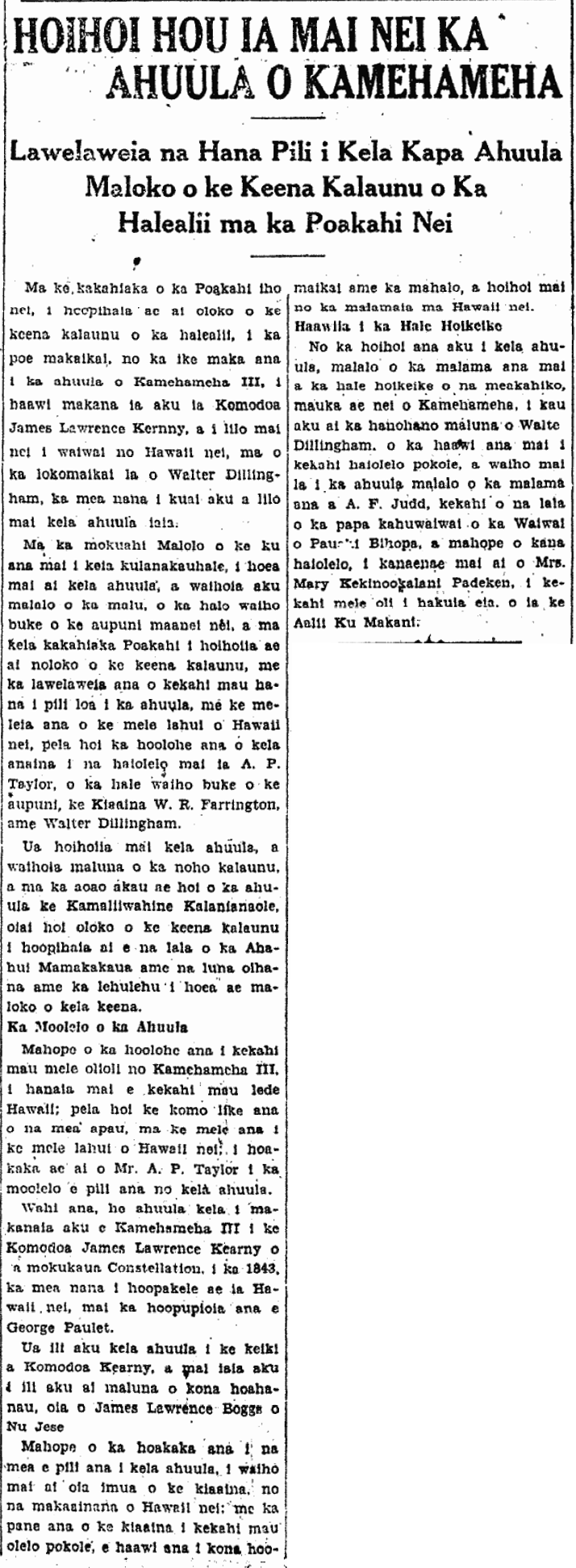
THE FEATHER-CAPE OF KAMEHAMEHA IS RETURNED

Ceremony in Respect to the Ahuula is Carried Out in the Crown Room of the Palace Last Monday

In the morning of last Monday, the throne room of the palace was filled with visitors to see the ahuula of Kamehameha III gifted to Commodore James Lawrence Kernny, and now becoming a treasure for Hawaii nei, through the generosity of Walter Dillingham, the one who purchased the ahuula.

The ahuula arrived aboard the steamer Malolo which arrived in town, and was entrusted to the safekeeping of the national archives, and on that Monday was returned to the throne room with ceremony befitting the ahuula, along with the singing of patriotic songs of Hawaii nei, as well as the hearing by the crowd of speeches given by A. P. Taylor of the national arvhives, Governor W. R. Farrington, and Walter Dillingham.

The ahuula was returned and draped upon the throne, and to the right was the Princess Kalanianaole, while the throne room was filled with members of the Mamakakaua Association and heads of businesses and the multitudes there in that room.

The Story of the Ahuula

After hearing some songs for Kamehameha III, composed by some Hawaiian ladies, the crowd entered while singing the anthem of Hawaii. And Mr. A. P. Taylor explained the history of the ahuula.

According to him, this was an ahuula gifted to Commodore James Lawrence Kearny of the warship Constellation, by Kamehameha III, in the year 1843. He was the one who saved Hawaii from the subjugation by George Paulet.

The ahuula was inherited by the child of Commodore Kearny, and from there to his cousin, James Lawrence Boggs of New Jersey.

After the explanation of its story, the ahuula was presented before the governor for the makaainana of Hawaii nei, whereupon the governor spoke a bit, while giving his thanks and appreciation for it being returned here to be cared for in Hawaii nei.

Given to the Museum

The honor was given to Walter Dillingham for his return of the ahuula for stewardship by the museum up above Kamehameha, and he gave a short speech and placed the ahuula under the care of A. F. Judd, one of the members of the board of the Trust of Pauahi Bishop. After his speech, Mrs. Mary Kekinookalani Padeken presented a chant composed by her, “Aalii Ku Makani.”

[If this sounds familiar, I am reposting it from the old Facebook site. Posts on FB are not easily searched, and so periodically I am thinking of doing reposts of those articles…]

(Kuokoa, 12/1/1927, p. 1)

HOIHOI HOU IA MAI NEI KA AHUULA O KAMEHAMEHA

Ka Nupepa Kuokoa, Buke LXVI, Helu 53, Aoao 1. Dekemaba 1, 1927.

Moanalua, then and now, 1922.

MOANALUA PAST AND MOANALUA PRESENT.

(Written by J. K. Mokumaia)

(Continued)

[This is from a serial column on stories about Moanalua. At the close of the previous installment, Mokumaia is speaking about Waiapuka and evidence of a large population…]

So too a well-built rock platform, it is like a heiau; and so too a huge cave large enough for a hundred people to live; and so too perhaps a small cave enough for a single person to live as a lookout, looking out at Moanalua, where the oncoming enemies would be plain in sight.

In my estimation, its height above sea level is 500 and a half feet, and this valley was an important one to the people, and was called Kamanaiki, and there is the famous hill Puukapu.

It is said that this was a place where the alii and people got together to discuss an important problem, and it will be be clear through your writer, those things integrally related to this hill and why it is famous; being that this hill is very close to where passing travellers were waylaid at night.

Therefore, dear readers of my fond Kilohana (a frequently used appellation for the newspaper Kuokoa, coming from its subtitle “Ke Kilohana Pookela no ka Lahui Hawaii” [The Greatest Prize of the Hawaiian Nation]), I am taking this little entertainment back to the time when Kaleiluhiole was ruling as konohiki, where this story gets its basis.

Kaleiluhiole’s total area of management went all the way to Makua, Waianae and back, when he made his tour, he would start at Moanalua and take a respite at Makua, staying there for some anahulu (a period of 10 days), and then turn back; going along on these tours were his workers as well as those who entertained on the trips so that everyone amongst his travelling companions was filled with the constant promise of merriment.

When the konohiki stayed there, items from the seaside were prepared by the natives, and so too the fruits of the land; being that his word had power, it was necessary to prepare all these things; and the important man during those times as heard by your writer was the one called Kihikihi; this gentleman was lame, but his  mind however was filled with all sorts of ideas that benefited him.

He owned a number of schooners, and from amongst his servants, there is one still alive in Waianae, that being Mr. Hui; they went around with the father of your writer, being that my father was a captain of the vessels belonging to Kihikihi, who was also the grandfather of your writer.

The basis for this discussion was that when the Konohiki stayed in Makua it was a regular thing that entertainment was provided for him; and from amongst these entertainments, was a hula troupe headed by Mahoe; this hula leader was from Kauai,  and when he was joined by the beauty of Makua, that hula performance of his—the hips of that hula leader were pressed by that beauty of Makua; quiet your breathing at the whispering seas of that land, as your eyes will  grow dizzy watching [?].

My father was also one who belonged to this hula troupe, and when the konohiki made his return, until reaching his usual lands, that being Moanalua, it was customary for him, were it extremely long, for everyone to be filled with happiness, and this happiness was what was witnessed when that hula troupe was joined by Moanalua’s, which was headed by Keoni Paakaula, and hula students got together, and thus appeared your writer; from what is known, this travelling was the foundation from which a brought forth its garden and came the year spoken previously of by the writer, when thought first came to him.

Looking at how the konohiki and people lived, it was quite fun; this was a land of people and food aplenty.

(To be continued.)

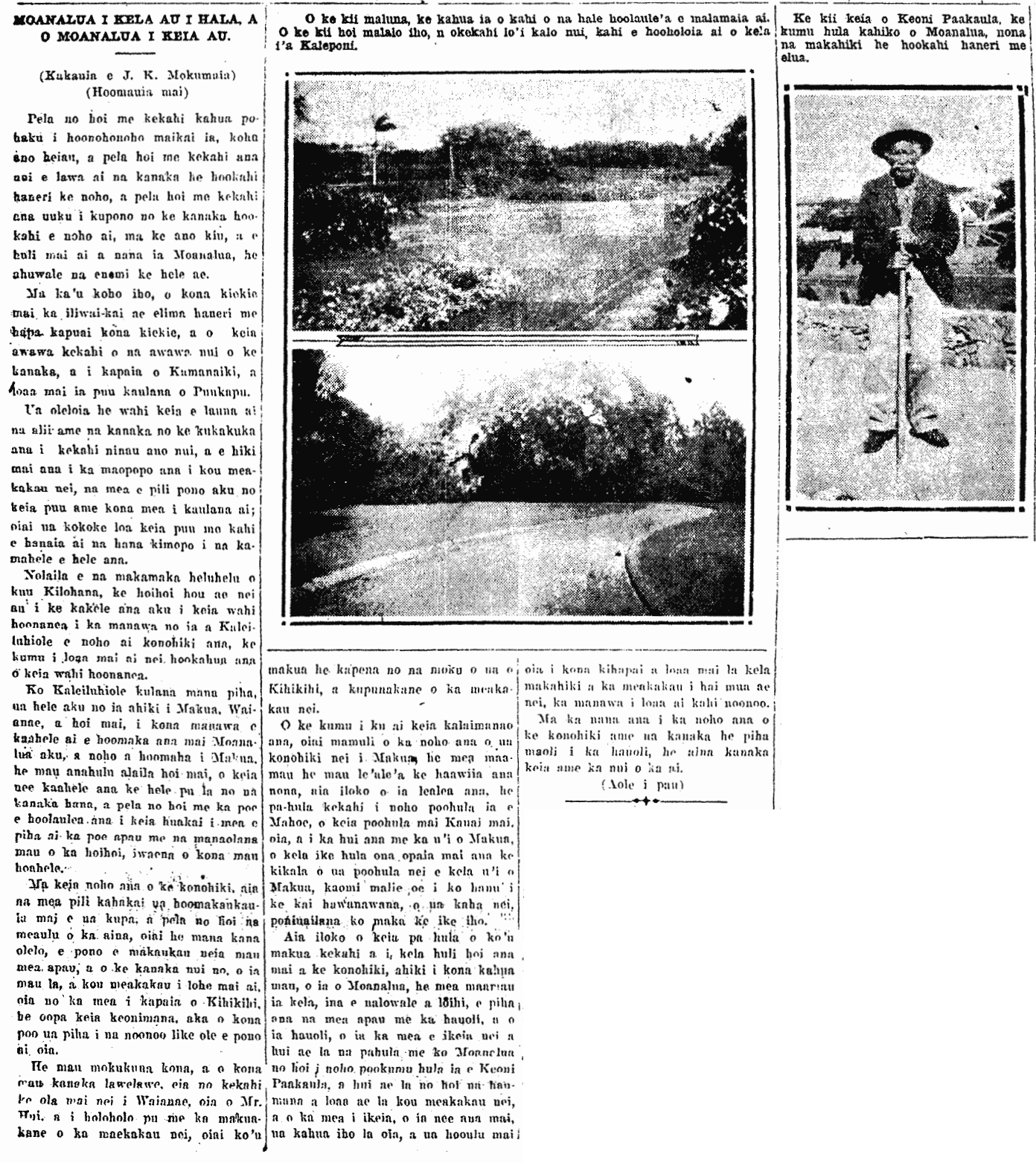
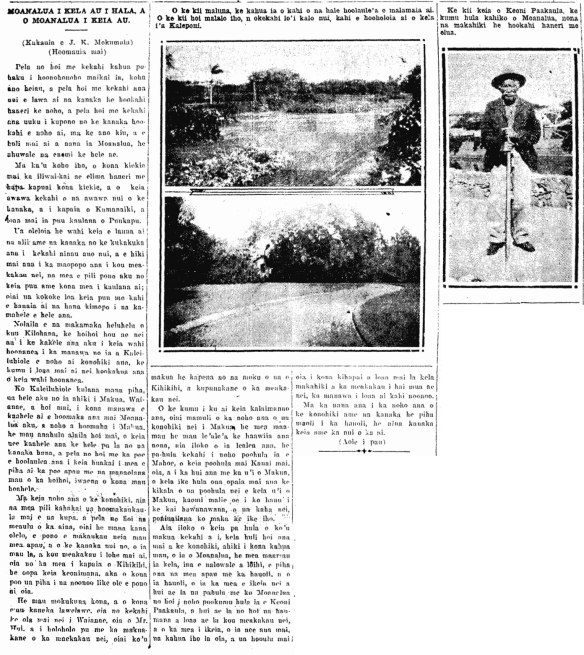
The picture above is the grounds on which was the structure where festivities were held. The picture below is of a great taro patch where the fish from California [i’a Kaleponi?] was set loose.

This is a picture of Keoni Paakaula, the old kumu hula of Moanalua, who is 102 years old.

[This serial by J. K. Mokumaia begins on 2/17/1922 and might end on 8/31/1922 (although there is indication that it is not completed).]

(Kuokoa, 3/10/1922, p. 6)
MOANALUA I KELA AU I HALA, A O MOANALUA I KEIA AU.

Ka Nupepa Kuokoa, Buke LXI, Helu 10, Aoao 6. Maraki 10, 1922.

Hawaiian-Language Newspapers and the past and the future, 1906.

The History of Your Native Land.

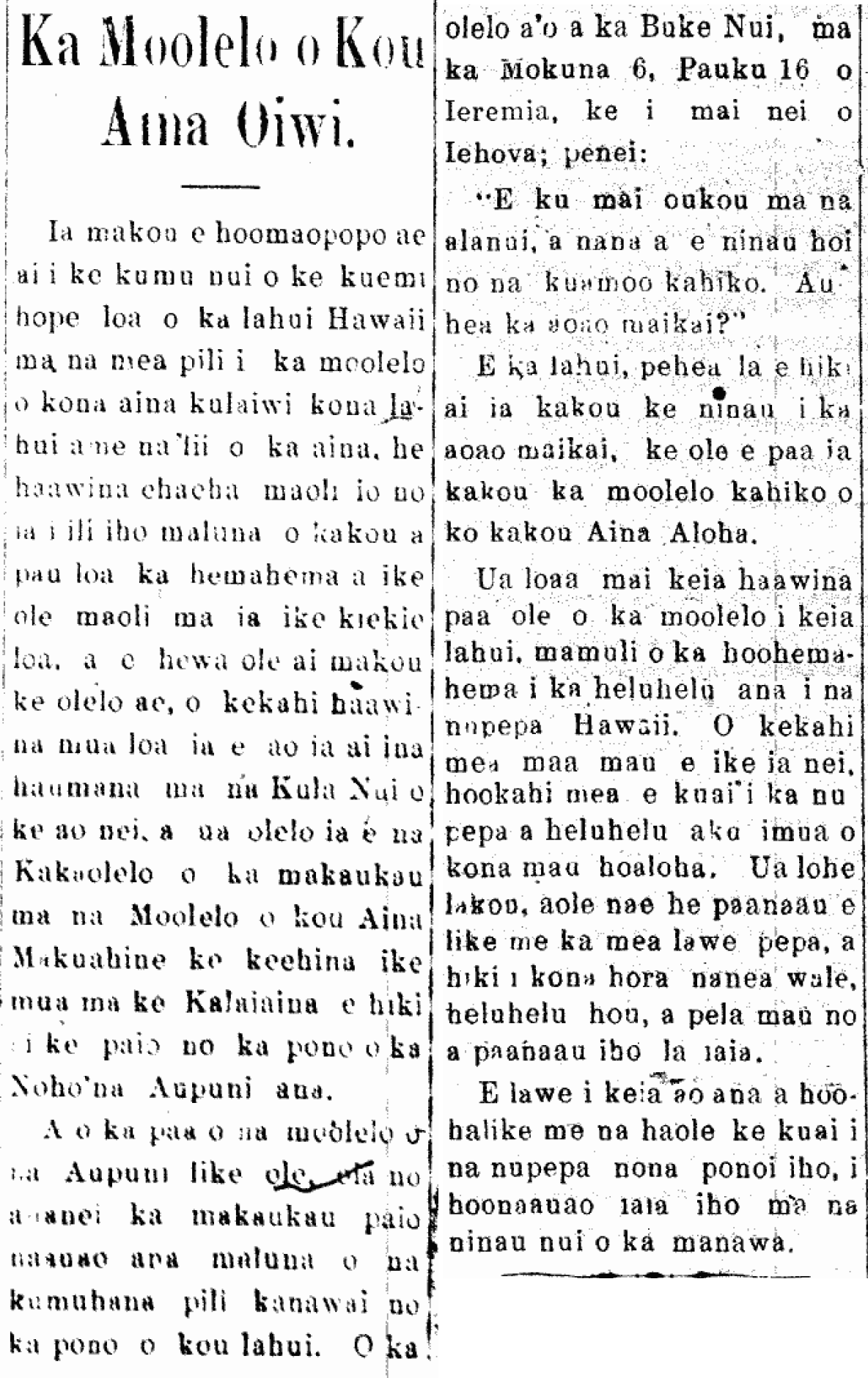
As we contemplate the main reason for the falling far behind of the Hawaiian people in matters dealing with the history of their homeland, their lahui, and the alii of the land, we are all racked with intense pain at the haphazard and total lack of knowledge in this terribly important study; and it would not be wrong for us to say that it should be one of the first subjects that should be taught to the students at schools of higher education across the world; and it is said by the Orators that being knowledgeable in the History of your Motherland is the first step in Politics where you’d be able to fight for the good of the Rule of the Nation.

And understanding the histories of all Nations is what will prepare you to fight intelligently on legal grounds for the benefit of your lahui. In the teachings of the Great Book, in Jeremiah 6:16, Jehovah says to us:

“Stand ye in the ways and see and ask for the old paths. Where is the good way?”

O Lahui, how will we be able to ask of the right way if we do not know the old history of our Beloved Aina?

This lack of knowledge of the history of this people comes from not consistently reading the Hawaiian newspapers. Something frequently seen is one person buying a paper and reading it before his friends. They hear it but they don’t retain it like one who subscribes to the paper, who can re-read it at his leisure and thus commit to memory the information.

Learn from this instruction, and do as the haole, who buys his very own newspapers to educate himself in current events.

[The Hawaiian-Language Newspapers is a massive history book—a history on the most part told by Hawaiians living while the “history” was happening. As it was argued more than a hundred years ago, in order to fight for things like Sovereignty, Land, and Water, shouldn’t we know the history as told by Hawaiians? Perhaps we shouldn’t focus solely on what is written down in law books, but also on what Hawaiians actually said and did about these laws, about water rights, about land ownership, about fishing bans, etc., etc. etc.?

For sure this is no easy task. The original newspapers aren’t going to last forever. The current images for many of them are not totally clear (if there are images at all). They need to be word-searchable so that if you search for something, you will find it. There needs to be more people doing translations of them. But then again, Kamehameha Paiea didn’t exclaim, “Forward my younger brothers and drink of the sweet waters”…]

(Na’i Aupuni, 1/17/1906, p. 2)

Ka Moolelo o Kou Aina Oiwi.

Ka Na'i Aupuni, Buke I, Helu 44, Aoao 2. Ianuari 17, 1906.

Rebuilding of Aliiolani Hale, 1912.

[Found under, “Local News”]

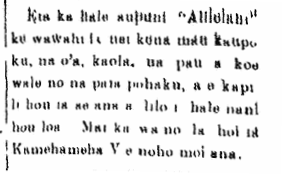
The government building, “Aliiolani” is being demolished; its roof, rafters, and beams are all gone, and only its stone walls remain, and it will be rebuilt and will be a new, splendid structure. It was from the time that Kamehameha V. was ruling as king.

(Kuokoa Home Rula, 2/16/1912, p. 2)

Eia ka hale aupuni "Aliiolani"...

Kuokoa Home Rula, Buke X, Helu 7, aoao 2. Feberuari 16, 1912.

Hawaiian-Language column in the Garden Island! 1912.

[Found under the column entitled: “LEI MOKIHANA”]

A Monument to Kamehameha III Might be Built.

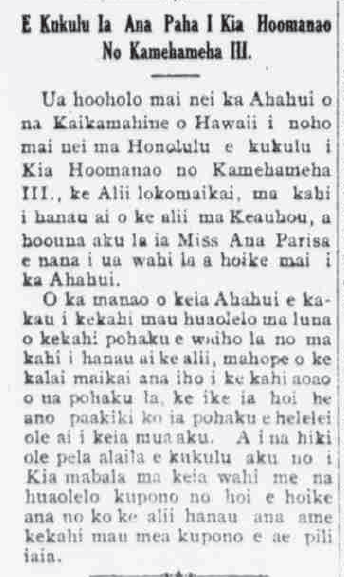
The Association, The Daughters of Hawaii which just met in Honolulu decided to build a Monument to Kamehameha III, the kindhearted Alii, where he was born in Keauhou, and Miss Ana Paris will be sent there to to survey the site and to report to the Association.

The idea of this Association is to inscribe some words upon a rock that is located where the chief was born, after one side of the rock was shaved nicely away, and knowing that the rock was solid and would not wear away in the future. And if this is not possible, then they will put up a marble monument at this place with proper words telling of the birth of the alii and some other fitting things about him.

[Here is one of the articles under the Hawaiian-Language column of the Garden Island newspaper, called: “Lei Mokihana”. It was edited by J. M. Kaneakua  and A. G. Kaulukou. (And in following issues, also by H. W. Waiau.)]

(Garden Island, 1/30/1912, p. 2)

E Kukulu Ia Ana Paha I Kia Hoomanao No Kamehameha III.

The Garden Island, Volume 9, Number 5, Page 2. January 30, 1912.

First birth announcement in a Hawaiian-Language Newspaper? 1834.

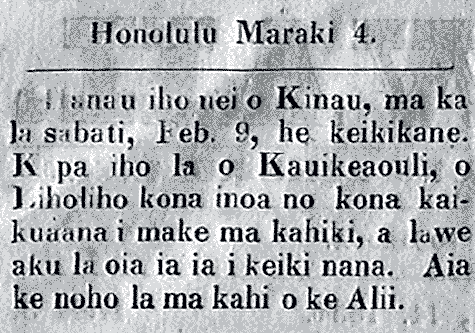
Honolulu March 4.

Kinau just gave birth, on Sunday, Feb. 9th, to a son. Kauikeaouli named him Liholiho for his older brother who died in lands afar, and took this child as his own. The child is living with the King.

[This Liholiho, child of Kinau, is Kamehameha IV.]

Honolulu Maraki 4.

Ka Lama Hawaii, Makahiki 1, Helu 5, Aoao 2. Maraki 14, 1834.


Patriotic mele, 1893.

[Here is a patriotic mele famous to this day, it is also known as Mele Ai Pohaku, but familiar to most as Kaulana na Pua. This composition is published many times and in more than one Hawaiian-Language Newspaper. It is a song which both lauds and encourages.]

AN ADORNMENT FOR THE PATRIOTS.

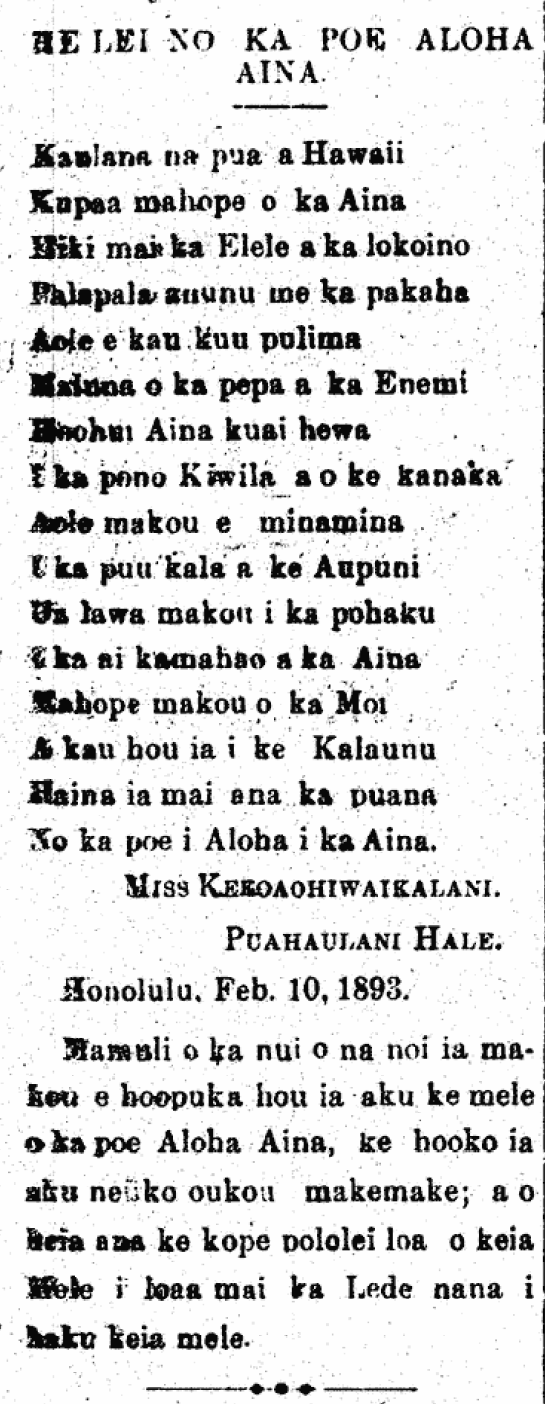
Famous are the blossoms of Hawaii

Who stand steadfast behind the Land

When the evil Messenger arrives

With his documents of greed and plunder

I won’t affix my signature

To the papers of the Enemy

That Annex and sell wrongfully

The Civil rights of the people

We will not feel longing

For the sums of money of the Government

We are satisfied with the stones

The amazing food of the land

We stand behind the Sovereign

She will be placed back upon the Throne

Let the refrain be told

Of the people who Love the Land.

Miss Kekoaohiwaikalani.
Puahaulani Hale.
Honolulu, Feb. 10, 1893.

Because of the many requests for us to reprint the song of the Patriots, we are fulfilling your desire; and this is a correct copy of this song which we received from the Lady who composed this song.

(Leo o ka Lahui, 5/11/1893, p. 3)

HE LEI NO KA POE ALOHA AINA.

Ka Leo o ka Lahui, Buke II, Helu 703, Aoao 3. Mei 11, 1893.