Na olelo ponoi o Kalani Kalakaua ma kona la hanau, 1874.

“Aloha oukou:

Ua lawe mai au i keia la, oia hoi kuu la hanau, i la hoomaikai i ka Mea Mana, no na pomaikai o ko kakou ola kino a kokoke i ka puni o keia makahiki. A ano ka mea hoi, ke kokoke mai nei ka manawa o Ko’u holo ana aku i na aina e, e imi i ka pomaikai o na hana nui a ko kakou aupuni; ua puili ae au i keia wa, e hai aku i Ko’u aloha ia oukou e na makaainana.

Ke hele nei au e hooko aku i ka mea a ke kau Ahaolelo i hooholo iho nei.

He mea mau iloko o na moolelo kahiko o na aupuni a me ko keia wa no hoi, ke kaahele ana o na Aimoku iloko o kekahi mau aupuni e aku, e imi ana no i pomaikai lahui iho. Continue reading

King Kalakaua’s 50th birthday celebration, with detailed tour of Iolani Palace, 1886.

THE KING’S BIRTHDAY.

The Palace Decorated for the Festivities.

Changes in the Pictures and Decorations Which Bring Out the Ancient History of the People.

In view of the festivities which commence this morning in honor of the fiftieth anniversary of the natal day of His Majesty the King, Iolani Palace has undergone extensive preparations, the arrangements for the reception and entertainment of the guests being very complete. The balconies are bedecked in bunting embodying in bold and striking designs the colors of the Royal Standard. The principal entrance hall has been richly caparisoned at the hands of the upholsterer. Its walls have been newly hung with the valuable oil paintings, representing in life size the line of Hawaiian Sovereigns, with their consorts, from the time of Kamehameha I, downwards. The first position on the right is occupied by the portrait of the Conqueror, whose reign marked so momentous and epoch in the history of the Kingdom, and whose genius has so largely influenced its destiny. Side by side with this is the portrait of Kekauluohi, mother of King Lunalilo. Next are those of Kmehameha II and Queen Kaumaulii [Kamamalu ?]; Kamehameha III and Queen Kalama. On the left are arranged the portraits of Kamehameha IV and Queen Emma; Kamehameha V and King Lunalilo. The niches in the intervening spaces are each filled with some choice fern or other horticultural specimen. The general effect is extremely pleasing to the eye.

The throne room, in which the receptions will take place, has been newly furnished with a rich crimson carpet. On either side of the dais are suspended the Royal Orders of Kamehameha, Kalakaua, Kapiolani and the Crown of Hawaii, whilst the walls on every side are adorned with the numerous foreign decorations with which His Majesty has from time to time been invested. Each one is enclosed in a gilt oval frame, surmounted with the Royal Arms of the particular nation or empire to which the Order belongs. Leaving the throne room and crossing the central hall, one passes into the Blue room . The first object that meets the eye is a striking portrait of His Majesty in the uniform of the King’s Guard, with decorations. Facing this, to the right of the doorway, is one of Her Majesty the Queen, whilst on the left is a full length life size representation of Louis XIV of France, a work of rare value. The two former are from the brush of Charles Hasselmann. Among the many ornaments and curios is a set of vases in Benares brass ware, from India. To the rear of this apartment is the spacious dining hall, in which are displayed the massive silver table ware, each article bearing the Royal Arms in colored enamel. The furniture is early English in style, whilst some choice works of art adorns the walls. The latter include a portrait of Kamehameha IV, taken during the monarch’s boyhood, a companion pair of Napoleon I and IV, taken during that monarch’s boyhood, a companion pair of Napoleon I and Blucher; Admiral Thomas, who restored the country; the Czar Alexander II of Russia, and a graphic delineation of the crater of Kilauea by night, painted by Furneaux.

Ascending the grand staircase the upper hall is next entered, wherein the King’s Privy Council of State is usually held. The central figure is a bust in bronze of His Majesty the King; oil paintings and tasteful cabinets, containing articles of vertu,are disposed on either side, while the hall, which runs the entire width of the building, commands a magnificent vista of Pauoa Valley, the mountains, tier behind tier, with the different hues forming an effective background. The front window overlooks the Aliiolani Hale, and affords a distant view of the sea.

The private apartments of His Majesty lead off from the upper hall, and are located on the left, or Ewa, side of the Palace. In the front is the music room, in which the heavy style of furniture is discarded for a lighter and more appropriate one, the appointments being in excellent taste. In the room are a set of half a dozed water color drawings of special historic interest. They are illustrative of island scenes at a period prior to the advent of civilization, among which are representations of the large double canoes carrying the ancient idols; the heiaus or temples, both open and closed; grass houses, etc. These pictures are enlargements by R. C. Barnfield, after the originals taken on the spot by Captain Kotzbue, the Russian author of “Voyages in the Pacific.”

At the further end, facing the entrance, is a speaking likeness of Her Majesty the Queen, life size, in oil, by Furneaux. The room also contains a very fine painting of the crater of Kilauea, by Tavernier; a Belgian Princess, a daughter of the present King, together with cabinet photographs of Sir John and Lady Franklin. Less obtrusive, but of considerable interest, is a study in music, framed in a peculiarly chaste and unique manner.

Continue reading

The royals in Kona, 1879.

News from Kona.

O Kuokoa Newspaper; Aloha oe:—

At 11 o’clock at night on the 19th of March, landed at the shore of Kailua nei were the King; Queen Kapiolani; Her Highness, R. Keelikolani; Minister of Finance S. K. Kaai; and some others. There were many of us gathered during those days. On the 22nd, the Queen went to the uplands of Kuahewa to see the troubles of Nawai, a blind man, to give him some help for his home that burned down. Continue reading

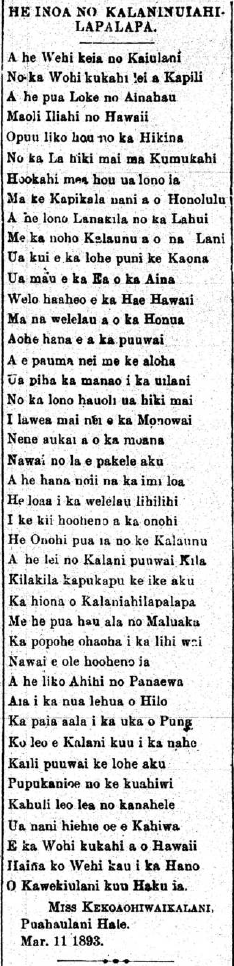
Mele inoa for Princess Kaiulani by Eleanor Kekoaohiwaikalani Prendergast, 1893.

HE INOA NO KALANINUIAHILAPALAPA.

A he Wehi keia no Kaiulani
No ka Wohi kukahi lei a Kapili
A he pua Loke no Ainahau
Maoli Iliahi no Hawaii
Opuu liko hou no ka Hikina
No ka La hiki mai ma Kumukahi
Hookahi mea hou ua lono ia
Ma ke Kapikala nani a o Honolulu
A he lono Lanakila no ka Lahui
Me ka noho Kalaunu a o na Lani
Ua kui e ka lohe puni ke Kaona
Ua mau ke Ea o ka Aina
Welo haaheo e ka Hae Hawaii
Ma na welelau a o ka Honua
Aohe hana e a ka puuwai
A e pauma nei me ke aloha
Ua piha ka manao i ka uilani
No ka lono hauoli ua hiki mai
I lawea mai nei o ka Monowai
Nene aukai a o ka moana
Nawai no la e pakele aku
A he hana noii na ka imi loa
He loaa i ka welelau lihilihi
I ke kii hooheno a ka onohi
He Onohi pua ia no ke Kalaunu
A he lei no Kalani puuwai Kila
Kilakila kapukapu ke ike aku
Ka hiona o Kalaniahilapalapa
Me he pua hau ala no Maluaka
Ka popohe ohaoha i ka lihi wai
Nawai e ole hooheno ia
A he liko Ahihi no Panaewa
Aia i ka nua lehua o Hilo
Ka paia aala i ka uka o Puna
Ko leo e Kalani kuu i ka nahe
Kaili puuwai ke lohe aku
Pupukanioe no ke kuahiwi
Kahuli leo lea no kanahele
Ua nani hiehie oe e Kahiwa
E ka Wohi kukahi a o Hawaii
Haina ko Wehi kau i ka Hano
O Kawekiulani kuu Haku ia.

Miss Kekoaohiwaikalani,
Puahaulani Hale.

Mar. 11, 1893.

(Leo o ka Lahui, 3/21/1893, p. 3)

leookalahui_3_21_1893_3

Ka Leo o ka Lahui, Buke II, Helu 666, Aoao 3. Maraki 21, 1893.

Words of advice from Kamehameha I, 1891.

BE PATIENT.

O Friends, Companions, those who go hand in hand with the Leo, who walk together on the sands of Kakuhihewa moistened by the Kukalahale rains, living from Maunalua to Moanalua. Greetings to you all.

Remember the title above, “I nui ke aho.” This is one of the touching statements said by our Land Conqueror [Na’i Aina], when one of his warriors was pierced by a barbed spear; when he saw this predicament, he grabbed and pulled the spear, and that is when the warrior cried out in pain. But that conqueror of aina responded quickly while shedding tears, “My son, be patient.” Continue reading

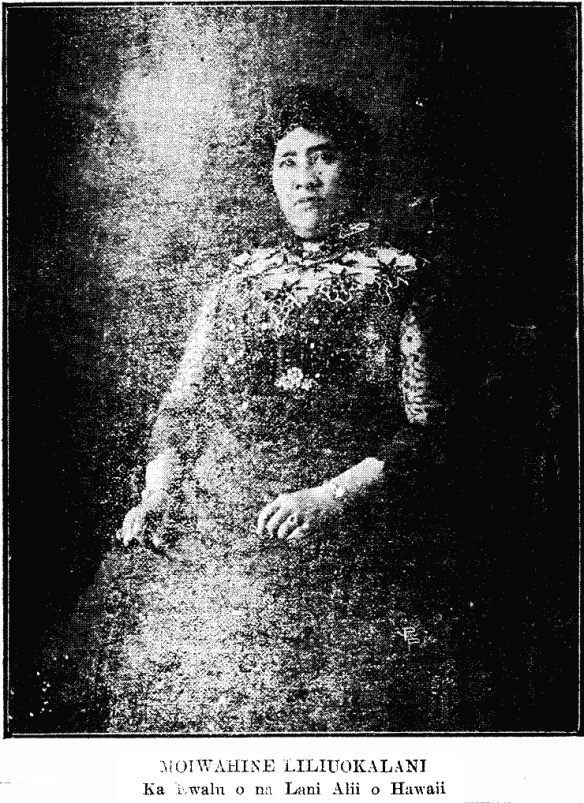
E o, e Ka Walu o Na Lani! 1875.

Birthday of the Princess Liliu.

This past Thursday, September 2, made the thirty-seventh year of Her Highness, the Princess for whom is this kahoahoa:

O Liliu o Loloku
O Walania i ke kii onohi
O ka onohi o Kalani Nui
Ke ka Hiwauli o Ku
O Kamakaeha o Kina.

She was born at Mana, Manamana, Honolulu, on September 2, 1838, a royal daughter of Caisara Kapaakea and A. Keohokalole and she was a younger sibling of the Alii, King Kalakaua. Continue reading

Who is this wahine? (conclusion), 1909.

…Kamehameha asked: “Which Kawaihae are you going to?”

“To Kawaihae Kai, near the capital where the alii lives,” answered the woman.

“So what is that bundle you hold in your hand?” Kamehameha questioned.

The woman responded, “A bundle of Lipalu seaweed.”

With that Kamehameha said: “Say woman, I am one of the alii’s men, and my occupation is one of the messengers for the alii. And being that I have clearly heard your fine words, I am hopeful that should the alii hear me about the words of appreciation of yours for him, then you will be given some land for yourself. Continue reading

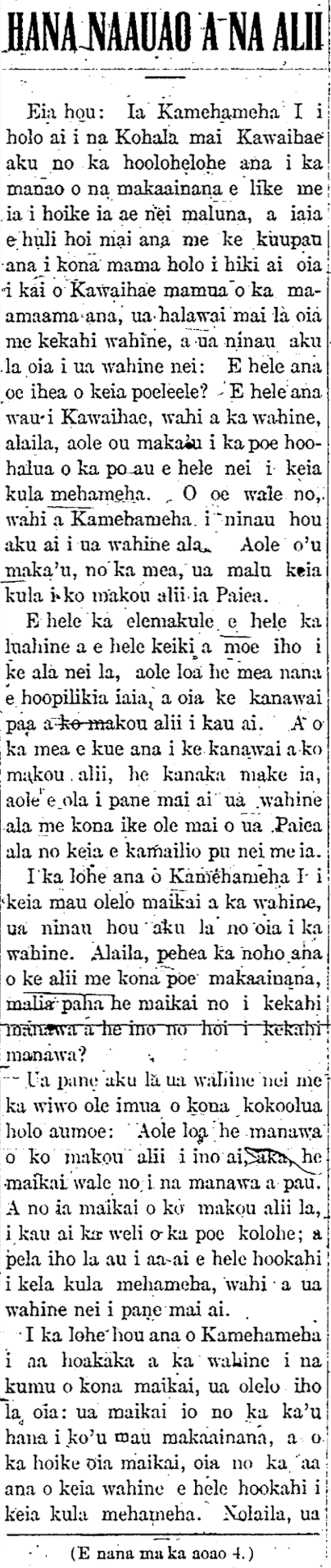
Who is this wahine? 1909.

ENLIGHTENED DEEDS OF THE CHIEFS.

And here is something else: When Kamehameha I went to the Kohala districts from Kawaihae to hear the thoughts of the makaainana like those shown earlier, as he turned back with haste so that he would reach the seaside of Kawaihae before it was light, he came upon an old woman and asked her: “Where are you going in the darkness?” “I am going to Kawaihae,” replied the woman. “Aren’t you afraid of being ambushed at night while you walk this desolate field. Just by yourself?” Kamehameha then asked of the woman. “I have no fear, for this plain is protected because of our alii, Paiea.”

“The old men go, the old women go, and the children go and sleep on these pathways, and there is no one at all who will bother them, for that is a strict law that our alii has placed. And the person who disobeys the law of our alii is a dead man; he will not live,”  answered the woman, not knowing that it was Paiea who was talking with her.

When Kamehameha heard these fine words of the woman, he further asked the woman. “So how is the way of life of the alii with his makaainana? Is it good sometimes and bad sometimes?”

The woman answered with no fear before her late night travelling companion, “There has been no time in which our alii has been bad to us, but he has always been good. And it is because of this goodness of our alii that wrongdoers are fearful, and it is thus that I can dare to walk alone across the desolate field,” the woman replied.

When Kamehameha heard once again the woman expounding on why he was good, he said [to himself], “I am indeed beneficent to my people, and the proof of this good is that this woman dares to travel this lonely field alone.” Therefore,…

[To be continued.]

(Hoku o Hawaii, 7/1/1909, p 1)

HokuoHawaii_7_1_1909_1.png

Ka Hoku o Hawaii, Buke IV, Helu 9, Aoao 1. Iulai 1, 1909.

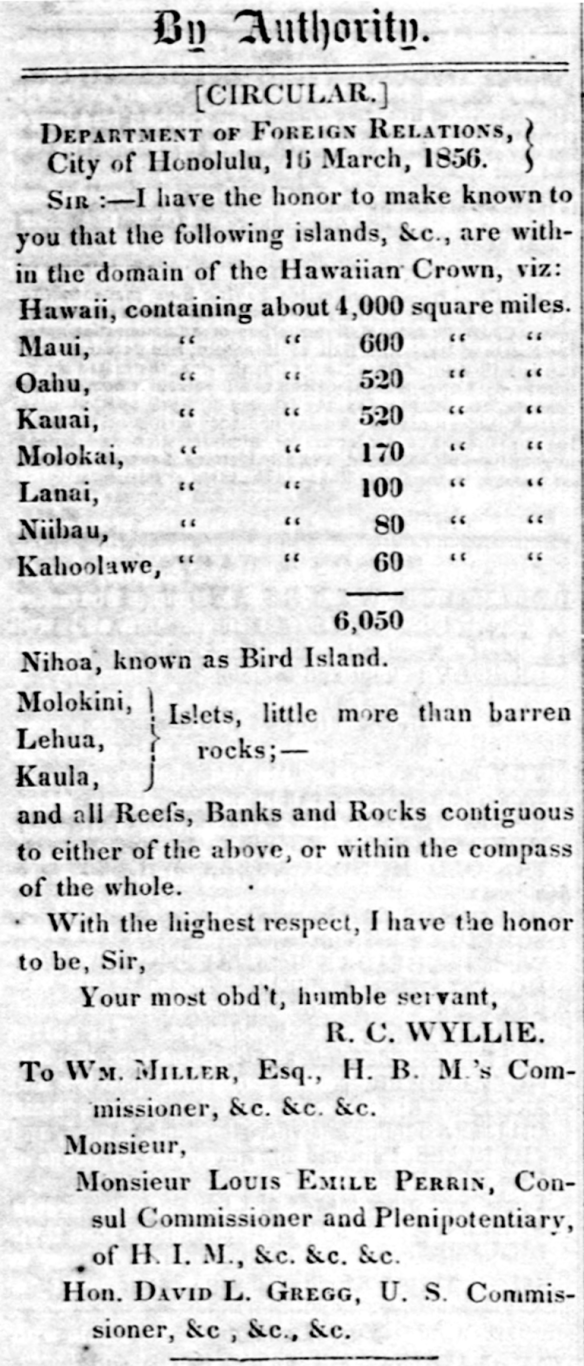
The extent of the Hawaiian Kingdom, 1857.

By Authority.

[CIRCULAR.]

Department of Foreign Relations,
City of Honolulu, 16 March, 1856 [1857].

Sir:—I have the honor to make known to you that the following islands, &c., are within the domain of the Hawaiian Crown, viz:

Hawaii, containing about 4,000 square miles.

Maui, ” ” 600 ” “

Oahu, ” ” 520 ” “

Kauai, ” ” 520 ” “

Molokai, ” ” 170 ” “

Lanai, ” ” 100 ” “

Niihau, ” ” 80 ” “

Kahoolawe, ” ” 60 ” “

6,050

Nihoa, known as Bird Island.

Molokini, Lehua, Kaula, Islets, little more than barren rocks;—

and all Reefs, Banks and Rocks contiguous to either of the above, or within the compass of the whole.

With the highest respect, I have the honor to be, Sir,

Your most obd’t, humble servant,

R. C. WYLLIE.

To William Miller, Esq., H. B. M.’s Commissioner, &c. &c. &c.

Monsieur,

Monsieur Louis Emile Perrin, Consul Commissioner and Plenipotentiary, of H. I. M., &c. &c. &c.

Hon. David L. Gregg, U. S. Commissioner, &c., &c., &c.

(Polynesian, 3/28/1857, p. 2)

Polynesian_3_28_1857_2.png

The Polynesian, Volume XIII, Number 47, Page 2. March 28, 1857.