The death of Kaoleioku Pauli, 1874.

O PAULI, ALOHA

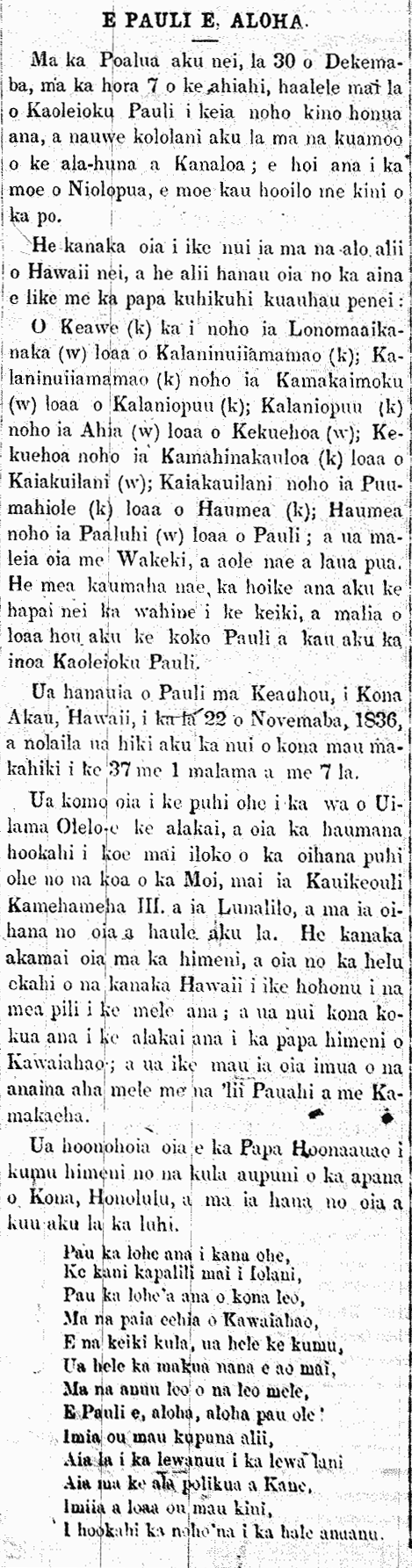
This past Tuesday, the 30th of December, at 7 o’clock in the evening, Kaoleioku Pauli left this earthly body and silently went on to the hidden pathway of Kanaloa; to return to the slumber of Niolopua, the eternal rest.

He was a man who was often seen in the royal courts of Hawaii nei, and he was a chief born of the land as shown in the genealogy chart below:

Keawe (m) dwelt with Lonomaaikanaka (f), begot was Kalaninuiiamamao (m); Kalaninuiiamamao (m) dwelt with Kamakaimoku, begot was Kalaniopuu (m); Kalaniopuu (m) dwelt with Ahia (f), begot was Kekuehoa (f); Kekuehoa dwelt with Kamahinakauloa (m), begot was Kaiakuilani (f); Kaiakauilani dwelt with Puumahiole (m), begot was Haumea (m); Haumea dwelt with Paaluhi (f), begot was Pauli; and he married Wakeki, but they have no offsrping. But it is sad that it was revealed that his wife is now pregnant with child, and perhaps the blood of Pauli will be begotten anew, and the name Kaoleioku Pauli will be given.

Pauli was born at Keauhou, in North Kona, Hawaii, on the 22nd of November 1836, and therefore he reached 37 years old and 1 month and 7 days.

He began playing the band during the time it was lead by William Merseburgh [?? Uilama Olelo-e], and he was the only student left from the band of the Kings, from Kauikeaouli Kamehameha III to Lunalilo, and while in that occupation, he fell. He was a man that was skilled at singing, and he was the greatest of Hawaiians in his deep knowledge of singing; and he greatly assisted in leading the choir of Kawaiahao; and he was always seen in front of song concerts with the alii Pauahi and Kamakaeha.

He was assigned by the Board of Education as a singing teacher for the government school for the district of Kona, Honolulu, and while in that position he let go of his burdens.

Pau ka lohe ana i kana ohe,
Ke kani kapalili mai i Iolani,
Pau ka lohe’a ana o kona leo,
Ma na paia eehia o Kawaiahao,
E na keiki kula, ua hele ke kumu,
Ua hele ka makua nana e ao mai,
Ma na anuu leo o na leo mele,
E Pauli e, aloha, aloha pau ole!
Imia ou mau kupuna alii,
Aia ia i ka lewanuu i ka lewa lani,
Aia ma ke ala polikua a Kane,
Imiia a loaa ou mau kini,
I hookahi ka noho’na i ka hale anuanu.

[No more will we hear wind instrument,
Its trilling song from Iolani,
No more will his voice be heard,
In the solemn walls of Kawaiahao,
O Schoolchildren, your teacher has gone,
Went is the father who taught,
The intervals in singing,
O Pauli, aloha, our never-ending aloha!
Seek out your chiefly ancestors,
They are in the sky up above, the sky in the heaven,
On the dark path of Kane,
Search out and find your relatives,
You will live as one in the cold house.

This is not the Pauli Kaoleioku who was the son of Kamehameha I and Kanekapolei.]

(Nuhou, 1/6/1874, p. 6)
Nuhou_1_6_1874_6

Ka Nuhou Hawaii, Buke I, Helu 10, Aoao 6. Ianuari 6, 1874.

The story of Umi, by Simeon Keliikaapuni and J. H. Z. Kalunaaina, 1862.

HE MOOLELO NO UMI.

KEKAHI ALII KAULANA O KO HAWAII NEI PAE AINA

HELU 1.

I laweia mai e a’u noloko mai o kekahi Buke Moolelo Hawaii, i paiia ma Lahainaluna, M. H. 1838, a ke manao nei au e paiia kona Moolelo ma ka Nupepa Kuokoa, a me ke ano o kana hana i ka wa kahiko.

O Umi ke keiki a Liloa, aole nae oia ka Liloa keiki mua, aka, o Hakau ka mua a Liloa laua me Piena, ka Liloa wahine hoao maole ia; nolaila, ua kapaia o Hakau he alii nui, no ka mea, ua like pu ko Piena alii me ko Liloa; aka, o Umi, he keiki oia na Liloa me kekahi wahine ana i launa wale aku ai, o Akahiakuleana ka inoa o ua wahine la. Ua manao nuiia oia he wahine alii ole; aka, ma kona kuauhau, he alii no, hookahi o laua kupuna me Liloa. He mau mamo laua na Kanipahu.

[This is the beginning of the story of Umi as told by Simeon Keliikaapuni which he says he based off of the story in “Ka Mooolelo Hawaii.” This ran in the Kuokoa from 1/25/1862 to 2/8/1862. The telling of Umi’s story was then continued by J. H. Z. Kalunaaina from 2/22/1862 and concluded on 4/26/1862. Check out a translation of this serial column by Noʻeau Peralta, on the cool page of the Hamakua community group Hui Mālama i ke Ala ʻŪlili (huiMAU). Take a look also at all the other activities being done by huiMAU shown on their page. Wouldn’t it be awesome if other communities could look to this group as an example!]

 (Kuokoa, 1/25/1862, p. 1)

Kuokoa_1_25_1862_1.png

Ka Nupepa Kuokoa, Buke I, Helu 9, Aoao 1. Ianuari 25, 1862.

Umi, the son of Liloa and Akahiakuleana, 1859.

[Found under: “MOOOLELO HAWAII.—Helu 49.”]

Pertaining to Umi.—Umi was an alii of the people of Hawaii. Here is the history of this alii:

Umi was the son of Liloa, he was not the first son of Liloa, but Hakau was the first son of Liloa with Pinea, who was Liloa’s true “wife” [wahine hoao maoli]; therefore, Hakau was called a high chief, for the rank of Pinea was equal to that of Liloa. Umi however was the child of Liloa with a woman who he just took, her name being Akahiakuleana. It was widely thought that she was not an alii, but according to her genealogy she is indeed an alii; she and Liloa had a common ancestor. They were both descendants of Kanipahu.

Here is the genealogy of that Akahiakuleana from Kanipahu and Liloa’s genealogy from Kanipahu.

Kanipahu dwelt with Alaikauakoke, born was Kalapana, that being Liloa’s ancestor; Kanipahu dwelt with Hualani, born was Kalahumoku, that being Akahiakuleana’s ancestor. Continue reading

Ninia Haihailauahiku Kanae dies, 1926.

THAT OLD MOTHER OF WAIKIKI, MRS. N. H. KANAE, PASSES ON.

At 4 o’clock in the morning of Saturday of last week, Mrs. Ninia Haihailauahiku Kanae grew weary of this worldly life at the home of her granddaughter, Mrs. Eva Laupoli Perkins, on Liholiho Street in Makiki, at ninety or more years of elderly age, and with her passing to the other side, it would seem that no more are the old-time locals who accompanied the sea spray of Waikiki. Continue reading

More on the parentage of Kalaniopuu from S. M. Kamakau, 1867.

[Found under: “KA MOOLELO O NA KAMEHAMEHA”]

A GENEALOGY

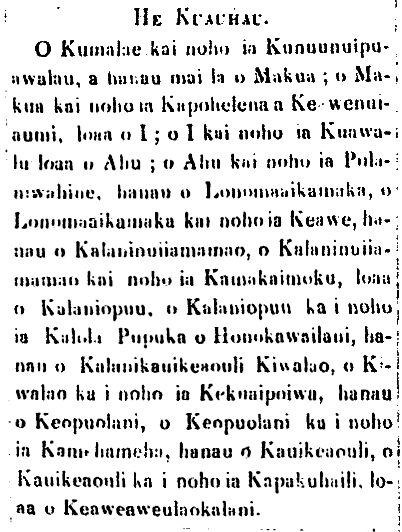
Kumalae dwelt with Kunuunuipuawalu, and born was Makua; Makua dwelt with Kapohelena, child of Keawenuiaumi, and born was I; I dwelt with Kuawalu, born was Ahu; Ahu dwelt with Piilaniwahine, and born was Lonomaaikanaka; Lonomaaikanaka dwelt with Keawe, born was Kalaninuiamamao, Kalaninuiiamamao dwelt with Kamakaimoku, born was Kalaniopuu; Kalaniopuu dwelt with Kalola Pupuka o Honokawailani, born was Kalanikauikeaouli Kiwalao; Kiwalao dwelt with Kekuiapoiwa, born was Keopuolani; Keopuolani dwelt with Kamehameha, born was Kauikeaouli; Kauikeaouli dwelt with Kapakuhaili, born was Keaweaweulaokalani.

(Kuokoa, 11/16/1867, p. 1)

Kuokoa_11_16_1867_1

Ka Nupepa Kuokoa, Buke VI, Helu 46, Aoao 1. Novemaba 16, 1867.

The parentage of Kalaniopuu, 1867.

[Found under: “KA MOOLELO O KAMEHAMEHA I.”]

It is said that Kalaniopuu was the child of Peleioholani, the King of Oahu, and that he was called Kalaniopuu, that being Kaleiopuu, the lei of Kualii, that is the tooth of the whale and whale ivory made smooth in the shape of a chicken spur [opuu], and that is what was the royal adornment of the alii of Oahu—this was not the case with Hawaii Island [who wore tongue-shaped lei niho palaoa]. Continue reading

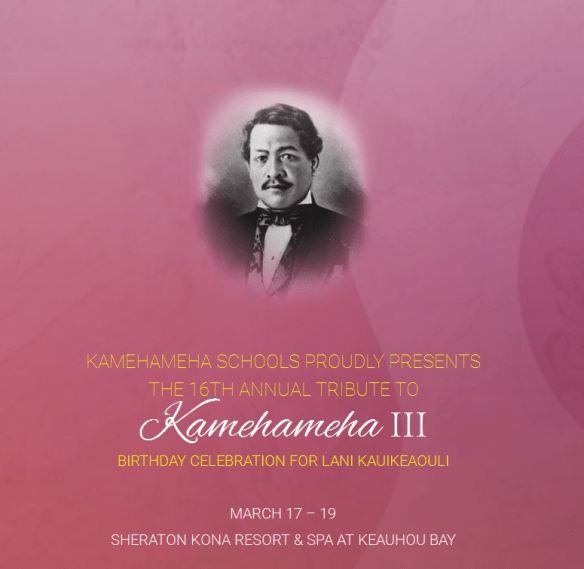
Birthday of King Kamehameha III, 1846.

By the Government.

AGREEMENT BY THE PRIVY COUNCIL.

At the meeting of the Privy Council [Poe Kukakuka Malu], on the 27th of February 1846, this was agreed to.

The birthday of the King will be commemorated on the coming 17th of March; the flag of the land will be flown at all of the forts from the morning until nightfall; and at noon the fort at Honolulu and all the forts in Hawaii nei will fire their guns. The Hawaiian flag will be flown from all of the ships of this Archipelago, and we believe that it will be good for the Governors and others to throw parties as they see fit, but with propriety and honor, loyal to the King of this independent Nation.

(Elele, 3/3/1846, p. 183)

Elele_3_3_1846_183.png

Ka Elele, Buke I, Pepa 24, Aoao 183. Maraki 3, 1846.

Joseph Kapaeau Aea passes on, 1911.

JOSEPH AEA PASSES AWAY

Joseph Aea, agent of Her Majesty Liliuokalani, died last evening about ten o’clock at his home in Pauoa. He had been associated with the queen’s family for many years. He leaves a widow and two sons. One of them is the protege of Queen Liliuokalani and is also the stenographer and assistant clerk in the city clerk’s office.

Joseph Aea was for many years connected with the old Royal Hawaiian band. He was the solo viol player and was an excellent musician. He became attached to the household of Queen Liliuokalani, and attended Liliuokalani when she was one of the official guests at the jubilee of Queen Victoria in London. He also attended the queen when she visited Washington in 1903. His wife was also one of the queen’s closest personal attendants, and has been particularly attentive to her since the overthrow of the monarchy.

In 1907, upon the death of Hon. J. O. Carter, Liliuokalani appointed Mr. Aea as her business agent, but the Liliuokalani Trust, formed about two years ago, transferred this important office to Col. C. P. Iaukea, who is one of the trustees under the Liliuokalani Trust.

Aea was a delegate to the Democratic territorial convention in 1900, and was nominated for the legislature by the Home Rulers in 1902, and again in 1904, by the Democrats.

(Hawaiian Star, 1/26/1911, p. 7)

HawaiianStar_1_26_1911_7.png

Hawaiian Star, Volume XVIII, Number 5866, Page 7. January 26, 1911.

John Wise on Hawaiian Homes and more, 1921.

The Question about the Work Ethic of Hawaiians.

Your writer [John Wise], continues to defend the Hawaiian lahui from being attacked by that question above.

The Hawaiians have perhaps become much talked about amongst those who do not know them and who are not familiar with their accomplishments of today and of the past. And maybe mostly these days for the land being given to us. Your writer frequently clashes with all kinds of other people who protest the giving of land to Hawaiians, because of the ridiculous idea that they don’t know how to work or that they are lazy.

In these attacks, we can see, O Lahui, that they are carried with criticisms and that it is would be a waste to confirm their misbeliefs. But so that the Hawaiians may answer these questions, your writer wants to be made known for all times the sound justification for our side. The readers of past issues of the Kuokoa have seen the responses given by the Commissioner in Washington, and they have seen also the other justifications given, in the newspaper.

The ultimate representation of the skill of a people is their supplying themselves with food and the things necessary for their livelihood. There perhaps is no better response than that. This lahui was living by  themselves for centuries, supplying themselves with everything, and received no assistance from the outside.

But there are things made by this lahui, things that attest to their fine craftsmanship, that will serve as a measure of their skills. Those that see Hawaiian canoes and their manufacture and how they can get Hawaiians through great gales, remaining solid in the dangers of the pounding of waves; how they could make beautiful canoes by using stone adzes; the distance they were taken from mountain to the sea; the patience of the canoe makers. All of these things will show, without being contradicted, that just by seeing the quality of the canoes can one see that this is a lahui that knows how to work. We see the canoes of today being made by people from other lands, and the canoes made by Hawaiians are far more well made and beautiful.

The beauty of things crafted by a people are undeniable proof of the work ethic of that people. Where will you find things more beautiful, O Hawaiians, if you travel all over the world, than the ahuula that are preserved at the Museum of Kamehameha School. Where is the lahui that lives on today, or perhaps has disappeared, that can make these outstanding works, with a beauty second to none, with fine craftsmanship, and patience; with a true sense of work ethic. Snaring birds is a great task all in itself, the inserting [kuku ana] of the feathers is a big job. One mamo feather cloak was said to have been started during the time of Umi and completed during the time of Kamehameha. For this ahu, the entire ahu were done with mamo feathers. And by our counting back, we see that ten generations of ancient kings passed on before the completion of this ahu; showing that it took from about 250 to 300 years of work. Where is there a great work that was completed by a people taking hundreds of years to construct? We perhaps can think of huge things, but as for something of this nature which required the knowledge and patience of men, there is no equal. Continue reading