“Ka Ipo Lei Manu,” 1891.

KALANI KAULILUA.

He manao he aloha
Na ka ipo lei manu
Ua manu kuu hoa
Noho mai ka nahele
Iiwi o uka
Polena i ka ua
Elua maua
I ka po ua nui
Ua o Hanalei
Anu au maeele
Ua anu hoi au
I ka ua noe anu
Na hau o Maihi
Au ana i ke kai
Na ulu o Weli
Ponuhu mai ana
Mapu mai ana
Ke ala o ka Hala
Hala o Mopuena [Mapuana]
Onaona i ka ihu
Ke ala pua Loke
Hone na ka manao
Naue kuu kino
Ko hiki ana mai
Haina ia ka puana
O ka Lani Kaulilua.

[A song attributed to Queen Kapiolani for her King that travelled afar; it is still widely sung today and more commonly known by the title “Ka Ipo Lei Manu”. This is perhaps the first time it appears in the Hawaiian-Language Newspapers. It was published in the issue immediately following the issue announcing the death of King Kalakaua.]

(Leo o ka Lahui, 2/2/1891, p. 2)

KALANI KAULILUA.

Ka Leo o ka Lahui, Buke II, Helu 120, Aoao 2. Feberuari 2, 1891.

Kahili from Washington Place to go to Hanaiakamalama, 1918.

KAHILI TO BE RETURNED TO THE HOME OF EMMA.

Because Washington Place [Wakinekona Hale] will be placed under the care of Governor McCarthy, as a home for him to live in with his family, twenty-six feather standards were returned from Washington Place to the old home of Queen Emma, in the uplands of Nuuanu, under the care of the Association, the Daughters of Hawaii [Na Kaikamahine o Hawaii].

During the funeral of Queen Liliuokalani, and while her body lay in state at Kawaiahao Church and in the throne room of the palace, those kahili were something the public could visit, however, as the result of an agreement between the trustees of Queen Liliuokalani’s estate and the Association of the Daughters of Hawaii, the caring for the kahili has been transferred to the association. As has been the custom from ancient times, it was during the night that kahili of those types were moved from one place to another, and so it was that the kahili were returned in the dark of night on Sunday two weeks ago.

However, because there were not enough people to carry the kahili and march on the roads to its new home where it is hoped to be cared for, the kahili were put on cars and it was on these cars which the people who held the kahili stood.

When the cars and the kahili arrived at the entrance to the yard of the home of Queen Emma in the uplands of Nuuanu, the kahili were taken by the leaders of the Association of the Daughters of Hawaii, and its care was transferred to them.

(Kuokoa, 10/18/1918, p. 2)

HOIHOIIA NA KAHILI MA KA HOME O EMA.

Ka Nupepa Kuokoa, Buke LVI, Helu 42, Aoao 2. Okatoba 18, 1918.

On the name Kamehameha, 1838.

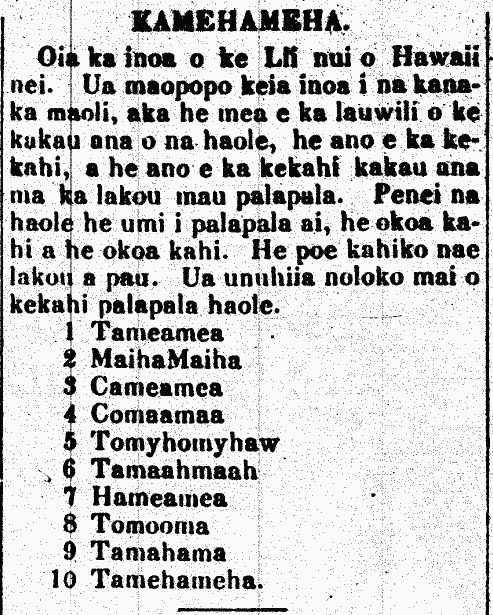
KAMEHAMEHA.

That is the name of the Alii nui of Hawaii nei. This name is known to the native people, but the spelling by the haole is confused; in their letters, this and that one’s spelling is strange. Here are what ten haole have written, each are different. All of them are old-timers. They are taken from haole documents.

1. Tameamea

2. MaihaMaiha

3. Cameamea

4. Comaamaa

5. Tomyhomyhaw

6. Tamaahmaah

7. Hameamea

8. Tomooma

9. Tamahama

10. Tamehameha

(Kumu Hawaii, 9/12/1838, p. 31.)

KAMEHAMEHA.

Ke Kumu Hawaii, Buke 4, Pepa 8, Aoao 31. Sepatemaba 12, 1838.

E o, e ka Wahine Hele La o Kaiona, 1913.

Aloha Pauahi the Alii

This coming Friday, the 19th of December is the day to remember, for all those Hawaiian hearts with love for their Chiefs, the birthday of the Princess Mrs. Pauahi Bishop, the Mother who left behind the glory of her name with her lahui from one generation to the next, all the way until the very last Hawaiian child. Being that she is the Royal Mother who remembered the youth of the people of her own flesh, skin, and blood, by dedicating her wealth to the establishing of the Kamehameha Schools where our youths are to be educated.

We commemorate the sacredness and the grandeur of her name, “The Mother of Her People,” and upon our breasts is a bouquet of unforgettable flowers pinned with deep sadness of love. She now sleeps the eternal sleep, but her name is remembered with awe amongst the children whom she supported, along with their parents. We now voice from our lips with appreciation—”Aloha Pauahi, the Alii.”

E o e ka wahine hele la o Kaiona
Alualu wai li’ula o ke kaha puaohai
O ka ua lani polua, po anu o ke Koolau,
Kuu hoa o ka malu kiu, malu kukui o Kahoiwai.

[And more on the celebration one hundred years ago, at the Kamehameha Schools.]

(Holomua, 12/13/1913, p. 4)

Aloha Pauahi ke Alii

Ka Holomua, Buke I, Helu 11, Aoao 4. Dekemaba 13, 1913.

Queen Kapiolani, Mele, Maunakea, and a new site to check out, 1878/2013.

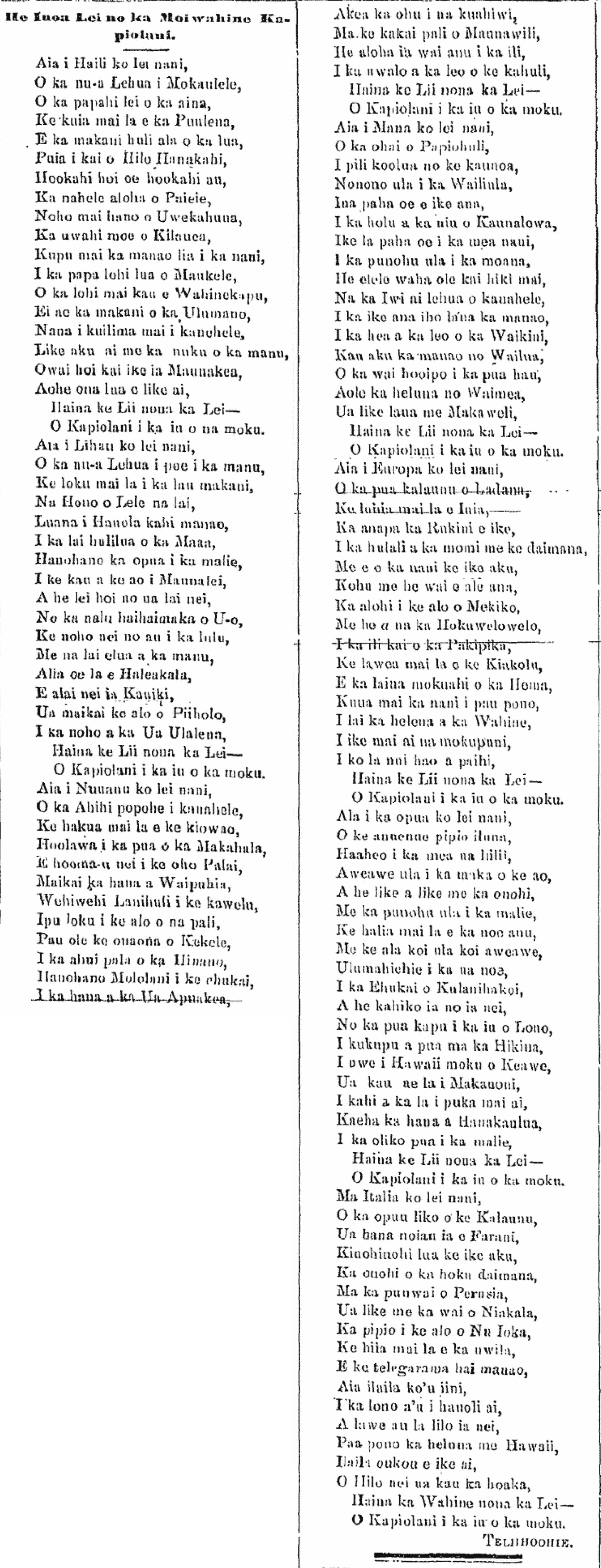
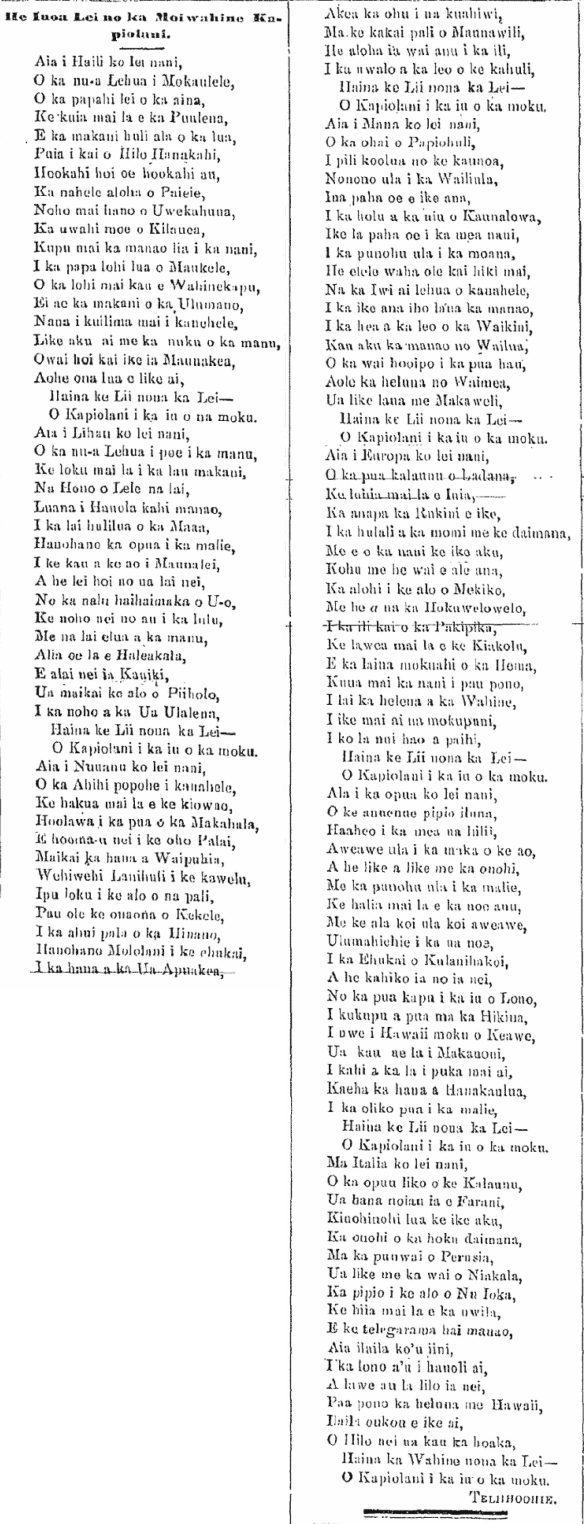
He Inoa Lei no ka Moiwahine Kapiolani.

Aia i Haili ko lei nani,
O ka nu-a Lehua i Mokaulele,
O ka papahi lei o ka aina,
Ke kuia mai la e ka Puulena,
E ka makani huli ala o ka lua,
Puia i kai o Hilo Hanakahi,
Hookahi hoi oe hookahi au,
Ka nahele aloha o Paieie,
Noho mai hano o Uwekahuna,
Ka uwahi moe o Kilauea,
Kupu mai ka manao lia i ka nani,
I ka papa lohi lua o Maukele,
O ka lohi mai kau e Wahinekapu,
Ei ae ka makani o ka Ulumano,
Nana i kuilima mai i kanehele,
Like aku ai me ka nuku o ka manu,
Owai hoi kai ike ia Maunakea,
Aohe ona lua e like ai,
Haina ke Lii nona ka Lei—
O Kapiolani i ka iu o na moku.

Aia i Lihau ko lei nani,
O ka nu-a Lehua i poe i ka manu,
Ke loku mai la i ka lau makani,
Na hono o Lele na lai,
Luana i Hauola kahi manao,
I ka lai hulilua o ka Maaa,
Hanohano ka opua i ka malie,
I ke kau a ke ao i Maunalei,
A he lei hoi no ua lai nei,
No ka nalu haihaimaka o U-o
Ke noho nei no au i ka lulu,
Me na lai elua a ka manu,
Alia oe la e Haleakala,
E alai nei ia Kauiki,
Ua maikai ke alo o Piiholo,
I ka noho a ka Ua Ulalena,
Haina ke Lii nona ka Lei—
O Kapiolani i ka iu o ka moku.

Aia i Nuuanu ko lei nani,
O ka Ahihi popohe i kanahele,
Ke hakua mai la e ke kiowao,
Hoolawa i ka pua o ka Makahala,
E hooma-u nei i ke oho Palai,
Maikai ka hana a Waipuhia,
Wehiwehi Lanihuli i ke kawelu,
Ipu loku i ke alo o na pali,
Pau ole ke onaona o Kekele,
I ka ahui pola o ka Hinano,
Hanohano Mololani i ke ehukai,
I ka hana a ka Ua Apuakea,
Akea ka ohu i na kuahiwi,
Ma ke kakai pali o Maunawili,
He aloha ia wai anu i ka ili,
I ka uwalo a ka leo o ke kahuli,
Haina ke Lii nona ka Lei—
O Kapiolani i ka iu o ka moku.

Aia i Mana ko lei nani,
O ka ohai o Papiohuli,
I pili koolua no ke kaunoa,
Nonono ula i ka Wailiula,
Ina paha oe e ike ana,
I ka holu a ka ulu o Kaunalewa,
Ike la paha oe i ka mea nani,
I ka punohu ula i ka moana,
He elele waha ole kai hiki mai,
Na ka Iwi ai lehua o kanahele,
I ka ike ana iho lana ka manao,
I ka hea a ka leo o ka Waikini,
Kau aku ka manao no Wailua,
O ka wai hooipo i ka pua hau,
Aole ka heluna no Waimea,
Ua like laua me Makaweli,
Haina ke Lii nona ka Lei—
O Kapiolani i ka iu o ka moku.

Aia i Europa ko lei nani,
O ka pua kalaunu o Ladana,
Ke luhia mai la e Inia,
Ka anapa ka Rukini e ike,
I ka hulali a ka momi me ke daimana,
Me e o ka nani ke ike aku,
Kohu me he wai e ale ana,
Ka alohi i ke alo o Mekiko,
Me he a na ka Hokuwelowelo,
I ka ili kai o ka Pakipika,
Ke lawea mai la e ke Kiakolu,
E ka laina mokuahi o ka Hema,
Kuua mai ka nai i pau pono,
I lai ka helena a ka Wahine,
I ike mai ai na mokupuni,
I ko la nui hao a paihi,
Haina ke Lii nona ka Lei—
O Kapiolani i ka iu o ka moku.

Ala i ka opua ko lei nani,
O ke anuenue pipio iluna,
Haaheo i ka mea na liilii,
Aweawe ula i ka maka o ke ao,
A he like a like me ka onohi,
Me ka punohu ula i ka malie,
Ke halia mai la e ka noe anu,
Me ke ala koi ula koi aweawe,
Ulumahiehie i ka ua noe,
I ka Ehukai o Kulanihakoi,
A he kahiko ia no ia nei,
No ka pua kapu i ka iu o Lono,
I kukupu a pua ma ka Hikina,
I uwe i Hawaii moku o Keawe,
Ua kau ae la i Makanoni,
I kahi a ka la i puka mai ai,
Kaeha ka hana a Hanakaulua,
I ka oliko pua i ka malie,
Haina ke Lii nona ka Lei—
O Kapiolani i ka iu o ka moku.

Ma Italia ko lei nani,
O ka opuu liko o ke Kalaunu,
Ua hana noiau ia e Farani,
Kinohinohi lua ke ike aku,
Ka onohi o ka hoku daimana,
Ma ka puuwai o Perusia,
Ua like me ka wai o Niakala,
Ka pipio i ke alo o Nu Ioka,
Ke hiia mai la e ka uwila,
E ke telegarama hai manao,
Aia ilaila ko’u iini,
I ka lono a’u i hauoli ai,
A lawe au la lilo ia nei,
Paa pono ka helua me Hawaii,
Ilaila oukou e ike ai,
O Hilo nei ua kau ka hoaka,
Haina ka Wahine nona ka Lei—
O Kapiolani i ka iu o ka moku.

Teliihoohie.

[I was reminded of this set of lei chants for Queen Kapiolani by a post on a relatively new site with information about Hawaii past and present. Check out the recent post on Maunakea and much more by Nanea Armstrong Wassel, right here:

http://instagram.com/naneaarmstrongwassel

This mele is also printed in the very next issue of Ko Hawaii Pae Aina, 10/12/1878, p. 4, with some variation.]

(Ko Hawaii Pae Aina, 10/5/1878, p. 4)
He Inoa Lei no ka Moiwahine Kapiolani.

Ko Hawaii Pae Aina, Buke I, Helu 40, Aoao 4. Okatoba 5, 1878.

The Ninth Independence Day, 1852.

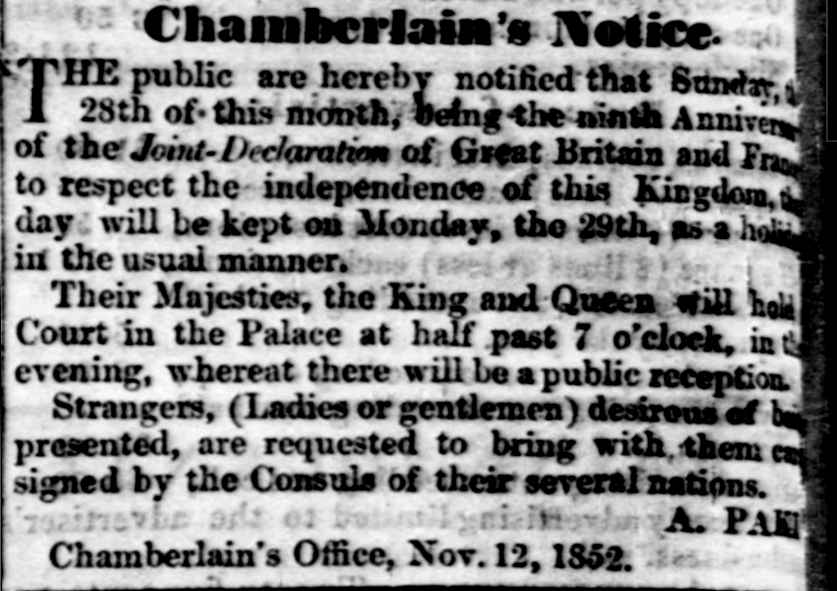
Chamberlain’s Notice.

The public are hereby notified that Sunday, the 28th of this month, being the ninth Anniversary of the Joint-Declaration of Great Britain and France to respect the independence of this Kingdom, the day will be kept on Monday, the 29th, as a holiday in the usual manner.

Their Majesties, the King and Queen will hold Court in the Palace at half past 7 o’clock, in the evening, whereat there will be a public reception.

Strangers, (Ladies or gentlemen) desirous of being presented, are requested to bring with them cards signed by the Consuls of their several nations.

A. PAKI

Chamberlain’s Office, Nov. 12, 1852.

[The 9th anniversary of La Kuokoa was celebrated under the reign of King Kamehameha III, Kauikeaouli and Queen Kapakuhaili.]

(Polynesian, 11/20/1852, p. 110)

Chamberlain's Notice.

The Polynesian, Volume 9, Number 28, Page 110. November 20, 1852.

45th La Kuokoa celebration, 1888.

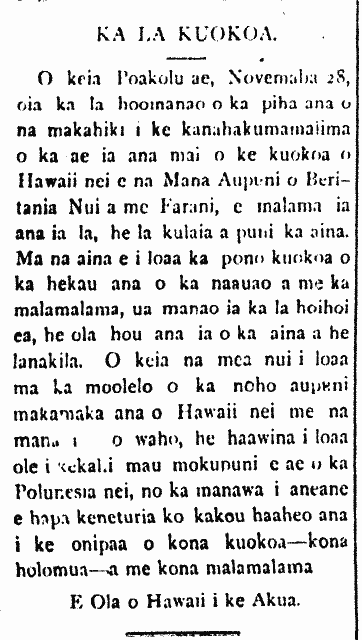
INDEPENDENCE DAY.

This coming Tuesday, November 28th, is the forty-fifth year celebration marking the recognition by the Heads of the Nations of Great Britain and France of Hawaiian independence; this day is set aside as a holiday all across the land. In other lands which enjoy independence through learning and enlightenment, independence day is seen as a day of rebirth for the nation and victory. These are great events found in the history of Hawaii’s friendly international relations; this is a distinction not received by any other island here in Polynesia; it has been nearly half a century that we remain proud of her unwavering  independence—progress—and enlightenment.

Long Live Hawaii Under God.

[On this the 170th anniversary of La Kuokoa, what are you doing to remember the great efforts taken by those like Timoteo Haalilio and William Richards to gain independence for the Nation?]

(Kuokoa, 11/24/1888, p. 2)

KA LA KUOKOA.

Ka Nupepa Kuokoa, Buke XXVII, Helu 47, Aoao 2. Novemaba 24, 1888.

Ellen Kekoahiwaikalani Prendergast’s “Kaulana na Pua”, 1896.

Look Here at This Mele

MELE ALOHA AINA AI-POHAKU
[PATRIOTIC ROCK-EATING SONG]

1. Kaulana na pua o Hawaii
Kupaa mahope o ka aina,
Hiki mai ka elele a ka lokoino
Palapala alunu me ka pakaha

2. Pane mai Hawaii-Nui o Keawe
Kokua na Hono-a-Piilani
Kakoo mai Kauai o Mano
Pau pu me ke one o Kakuhihewa

3. Aole e kau e ka pulima
Maluna o ka pepa a ka enemi
Aole makou a e minamina
I ka puu dala a ke Aupuni

4. Ua lawa makou i ka pohaku
I ka ai kamahao o ka aina
Hoohuiaina kuai hewa
I ka pono kivila o ke kanaka

5. Mahope makou o Liliulani
A kau hou la i ke Kalaunu
Haina ia mai ana ka puana
Na pua i aloha i ka aina

Composed by KEKOAHIWAIKALANI.

[This mele for obvious reasons is published many times throughout time.]

(Aloha Aina, 6/13/1896, p. 4)

MELE ALOHA AINA AI-POHAKU.

Ke Aloha Aina, Buke II, Helu 24, Aoao 4. Iune 13, 1896.

Let the old men go forth and lie upon the roads… 1895.

“LAW OF THE PADDLE BLOW.”
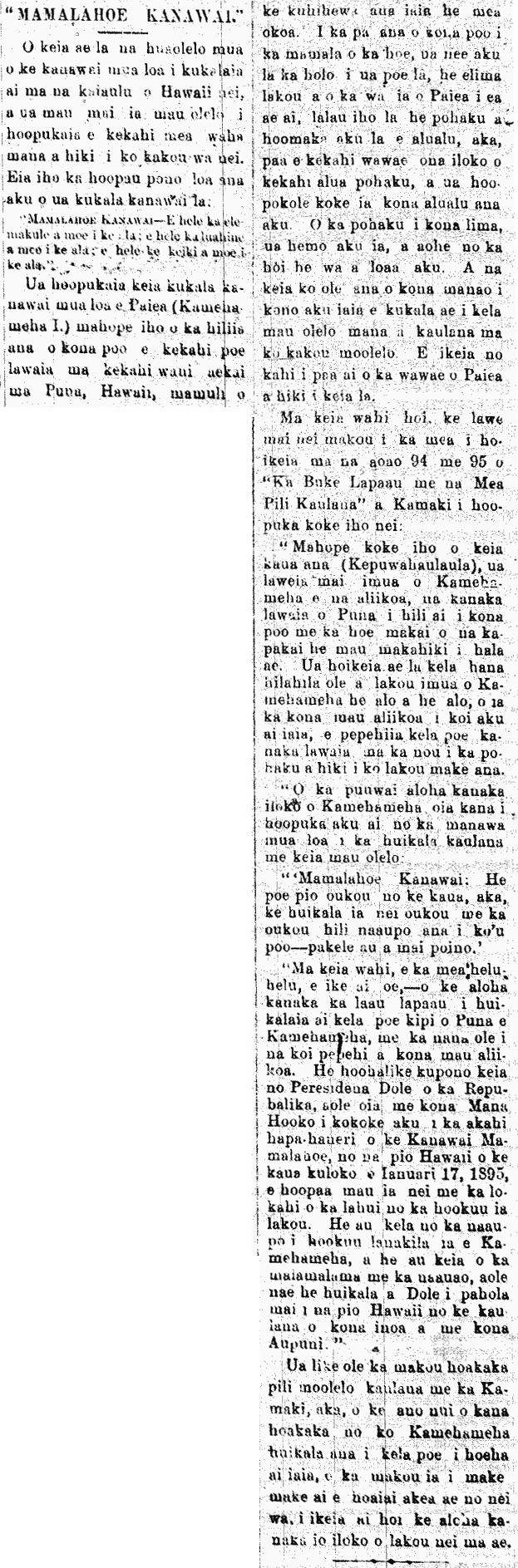
[“MAMALAHOE KANAWAI.”]

This above are the initial words of the very first law promulgated in the communities of Hawaii, and those words spoken by one in authority still remain. Here below is the the law in its entirety:

“MAMALAHOE KANAWAI—Let the old men go forth and lie upon the roads; let the old women go forth and lie upon the roads; let the children go forth and lie upon the roads.”

This first law was proclaimed by Paiea (Kamehameha I) after his head was struck by some fishermen at the seashore in Puna, Hawaii, because they mistakenly thought he was someone else. When his head was struck with the blow from a canoe paddle, the men fled, there being five of them; that was when Paiea rose, picked up a rock, and made to chase after them, however, his foot was caught in a rock crevice, and his chase was cut short. The rock in his hand fell, and there was no getting it back. And it was this disappointment which caused him to proclaim these famous and powerful words in our history. The place where Paiea’s foot was caught can be seen to this day.

Here, we take what is shown on pages 94 and 95 of “Ka Buke Lapaau me na Mea Pili Kaulana” which was published by Kamaki [Thomas P. Spencer]:¹

“Soon after this battle (Kepuwahaulaula), the fishermen who years earlier struck the head of Kamehameha with a paddle near the sea were brought before him by his officers. This shameful act of theirs was made known to Kamehameha face to face, for which his officers demanded that they be killed by stoning them to death.

“The aloha Kamehameha had for his fellow man was expressed for the first time in his famous pardon by announcing:

“‘Mamalahoe Kanawai: you are prisoners of war, but you are forgiven for unwittingly striking my head–I escaped, but nearly was in trouble.’

“Here, O Reader, do recognize–love for his fellow man was the cure² for which allowed for the release of these rebels of Puna by Kamehameha, and him not giving regard to the calls by his officers to put them to death. This is a fine comparison to President Dole of the Republic; he with his Executive Powers does not come close to a hundredth of the Kanawai Mamalahoe, in his treatment of the Hawaiian prisoners of the revolution of January 17, 1895 who continue to be imprisoned albeit the lahui are united in wanting them released. That was an uncivilized time when [the men] were triumphantly released by Kamehameha, and this is a knowledge and civilization, and yet Dole has not given clemency to the Hawaiian prisoners for the fame of his name and that of his Nation.”

Our elucidation of this famous story is not like that of Spencer’s, but the basis of his explanation of Kamehameha’s forgiving those who injured him, that is what we want to make clear at this time, so that true love of one’s fellow man is seen by them.

¹This book was republished in 2003 by Bishop Museum Press as: Buke ‘Oihana Lapa’au me na ‘Apu la’au Hawai’i (Book of Medical Practices and Hawaiian Prescriptions). See here for further description.

²”Laau lapaau” [medicinal cure] is the word chosen here because this story appears in a book of traditional medicinal practices.

(Makaainana, 11/25/1895, p. 4)

"MAMALAHOE KANAWAI."

Ka Makaainana, Buke IV—-Ano Hou. Helu 22, Aoao 4. Novemaba 25, 1895.

Ia oe e ka la e alohi nei… 1874.

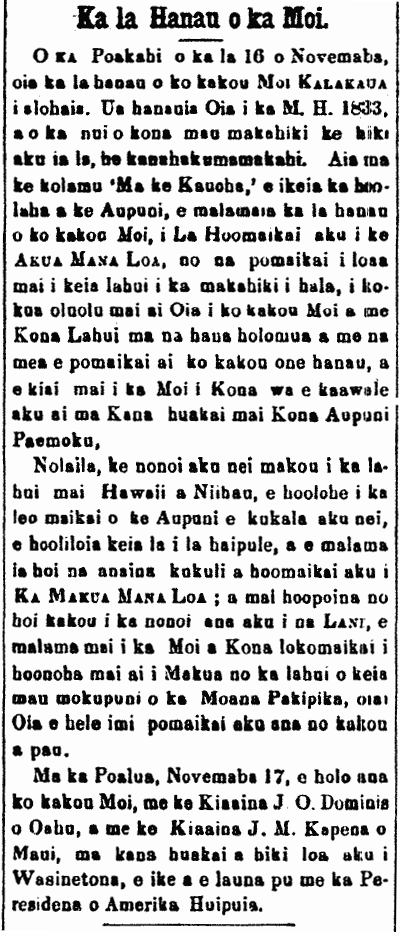
The Birthday of the King.

Monday, the 16th of November, is the birthday of our beloved King Kalakaua. He was born in the year 1833, and he will be making forty-three years old. In the column ‘Ma ke Kauoha’ [By Authority], seen is the Government notice that the birthday of our King will be held as a Day of Thanks to the Almighty God, for the blessings received by our lahui this past year; He has kindly assisted our King and His People in progressive endeavors and in things that will benefit our homeland, and may He watch over the King during His time away from his Kingdom of Islands on His travels.

Therefore, we ask the lahui from Hawaii to Niihau to heed the good announcement of the Government, that this day shall be a day of prayer, and that meetings will be held to kneel and give appreciation to the Almighty Father; and let us not forget to ask of the Heavens to watch over the King who He in his benevolence has placed as a Father to the lahui of these islands in the Pacific Ocean, while He will be travelling to seek blessings for us all.

On Tuesday, November 17th, our King and the Governor of Oahu, J. O. Dominis, along with the Governor of Maui, J. M. Kapena, will go on a trip to Washington to meet with the President of the United States of America.

(Kuokoa, 11/7/1874, p. 2)

Ka la Hanau o ka Moi.

Ka Nupepa Kuokoa, Buke XIII, Helu 5, Aoao 2. Novemaba 7, 1874.