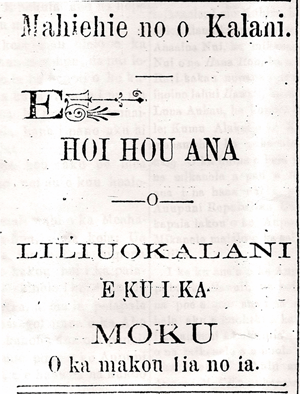
Grand is the Royal One
RETURNING
IS
LILIUOKALANI
TO RULE
THE LAND
This is our hope.
[This is a running announcement in the Loea Kalaiaina.]
(Loea Kalaiaina, 12/16/1899, p. 2)
Ka Loea Kalaiaina, Buke III, Helu 49, Aoao 2. Dekemaba 16, 1899.

[This is a running announcement in the Loea Kalaiaina.]
(Loea Kalaiaina, 12/16/1899, p. 2)
Ka Loea Kalaiaina, Buke III, Helu 49, Aoao 2. Dekemaba 16, 1899.
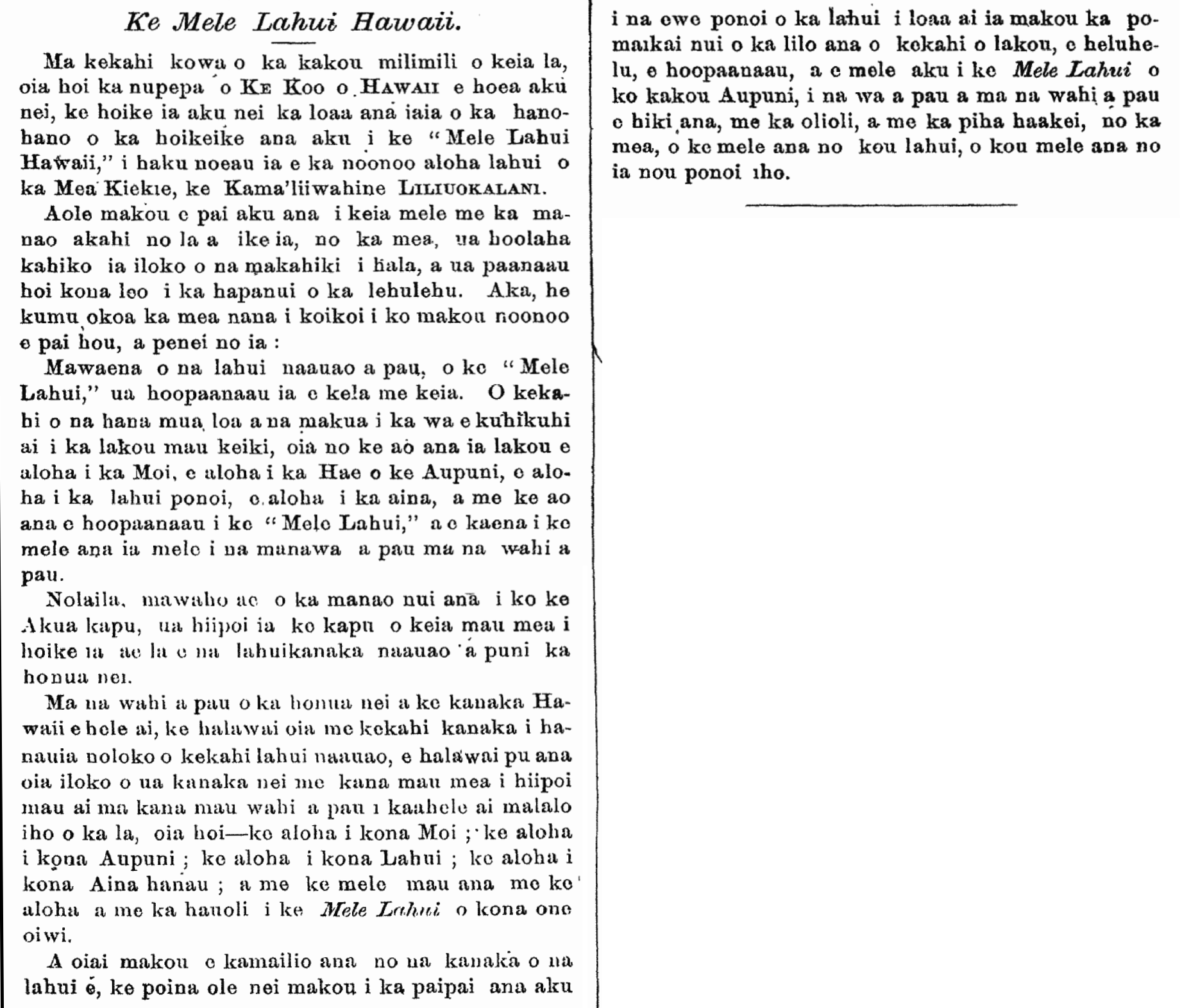
In an open space in our beloved one of this day, that being the newspaper “Ke Koo o Hawaii,” that is coming to you, it is being shown that we have the honor of putting before you the Hawaiian National Anthem [“Mele Lahui Hawaii”] which was skillfully composed with feelings of aloha for her people by Her Highness, Princess Liliuokalani.
We are not printing this mele thinking that this is the first time it will be seen, for it was printed a long ago in years past, and its melody is memorized by most. However, there is a different reason we thought it was important to reprint it, and that being:
Amongst all enlightened people, the “National Anthem” is memorized by everyone. One of the first duties of a parent when instructing their children is to teach them to love their Monarch, to love the Flag of their Nation, to love their own people [lahui], to love their land, and to memorize their National Anthem and to be proud to sing this mele at all times and at all places.
Therefore, besides respecting God’s laws, the sacredness of those things mentioned above are cherished by enlightened nations all over the world.
In all places on this earth travelled by Hawaiians, whenever he meets up with someone born in an enlightened nation, he meets also within that person [e halawai pu ana oia iloko o ua kanaka nei ?] with what he constantly cherishes in all places travelled by him under the sun, that being—love for his King; love for his Nation; love for his People, love for his Land of birth; and the singing always with love and joy of the National Anthem of his homeland.
And while we speak of those of other nations, we do not forget to encourage our own natives of this lahui who we have the great fortune to have some of them read, memorize, and sing the National Anthem of our Nation, at all times and at all places they go, with joy and filled of pride, because singing for your lahui is singing for your very own self.
(Koo o Hawaii, 8/15/1883, p. 5)
Ke Koo o Hawaii, Buke 1, Helu 1, Aoao 5. Augate 15, 1883.
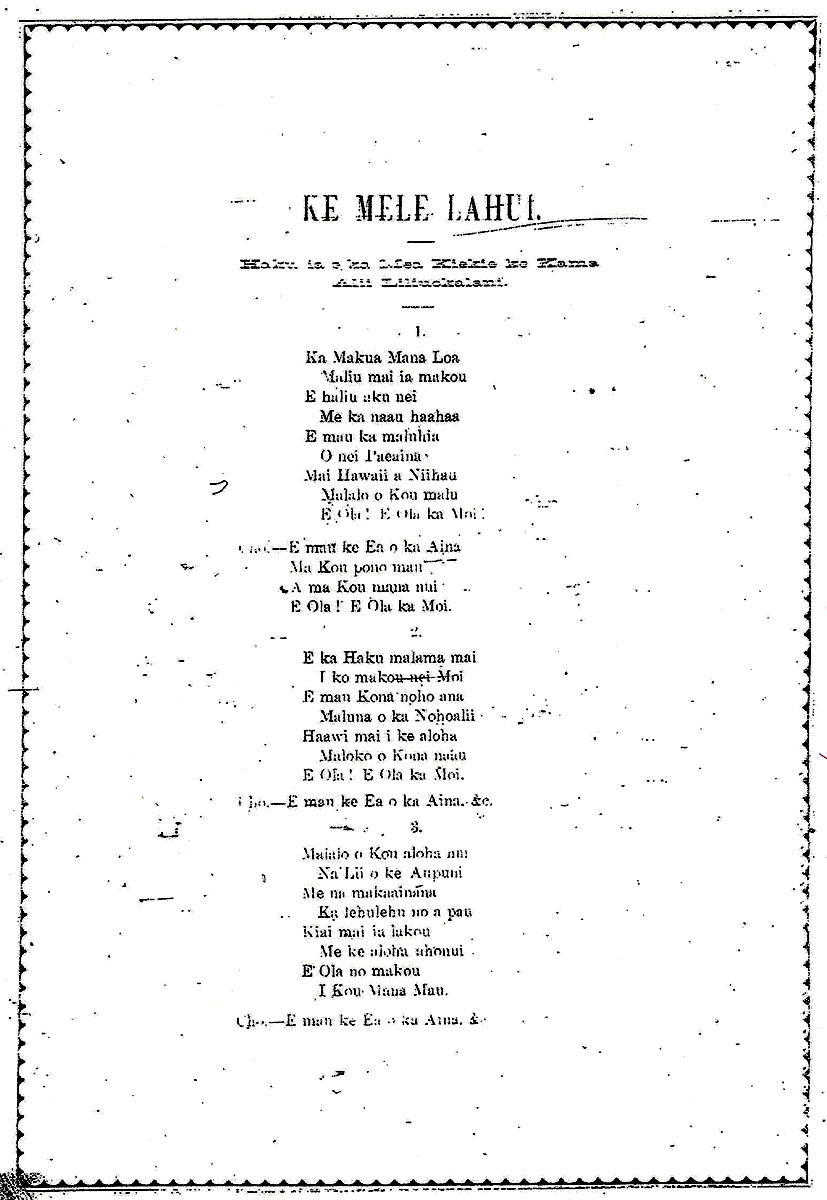
Composed by Her Highness
Princess Liliuokalani.
1.
Ka Makua Mana Loa
Maliu mai ia makou
E Haliu aku nei
Me ka naau haahaa
E mau ka maluhia
O nei Paeaina
Mai Hawaii a Niihau
Malalo o Kou malu
E Ola! E Ola ka Moi!
Cho.—E mau ke Ea o ka Aina
Ma Kou pono mau
A ma Kou mana nui
E Ola! E Ola ka Moi.
2.
E ka Haku malama mai
I ko makou nei Moi
E mau Kona noho ana
Maluna o ka Nohoalii
Haawi mai i ke aloha
Maloko o Kona naau
[A ma Kou ahonui]
E Ola! E Ola ka Moi.
Cho.—E mau ke Ea o ka Aina, &c.
3.
Malalo o Kou aloha nui
Na’Lii o ke Aupuni
Me na makaainana
Ka lehulehu no a pau
Kiai mai ia lakou
Me ke aloha ahonui
E Ola no makou
I Kou Mana Mau.
Cho.—E mau ke Ea o ka Aina, &c.
(Koo o Hawaii, 8/15/1883, p. 11)
Ke Koo o Hawaii, Buke 1, Helu 1, Aoao 11. Augate 15, 1883.
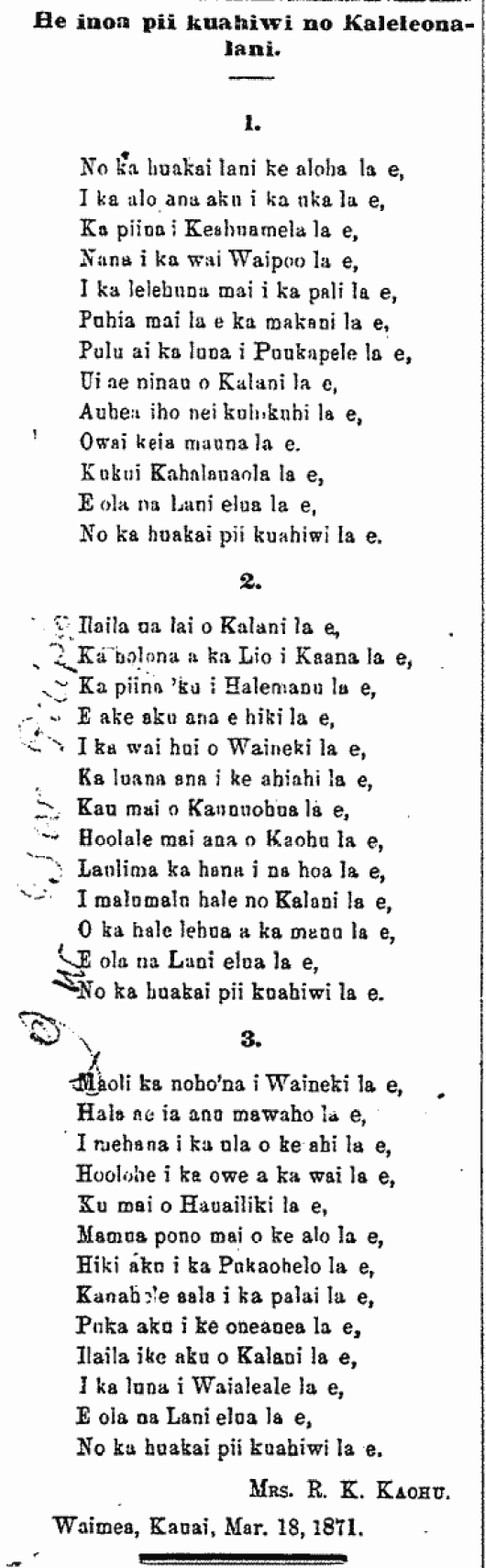
1.
No ka huakai lani ke aloha la e,
I ka alo ana aku i ka uka la e,
Ka piina i Keahuamela la e,
Nana i ka wai Waipoo la e,
I ka lelehuna mai i ka pali la e,
Puhia mai la e ka makani la e,
Pulu ai ka luna i Puukapele la e,
Ui ae ninau o Kalani la e,
Auhea iho nei kuhikuhi la e,
Owai keia mauna la e,
Kukui Kahalauaola la e,
E ola na Lani elua la e,
No ka huakai pii kuahiwi la e.
2.
Ilaila ua lai o Kalani la e,
Ka holona a ka Lio i Kaana la e,
Ka piina ‘ku i Halemanu la e,
E ake aku ana e hiki la e,
I ka wai hui o Waineki la e,
Ka luana ana i ke ahiahi la e,
Kau mai o Kaunuohua la e,
Hoolale mai ana o Kaohu la e,
Laulima ka hana i na hoa la e,
I malumalu hale no Kalani la e,
O ka hale lehua a ka manu la e,
E ola na Lani elua la e,
No ka huakai pii kuahiwi la e.
3.
Maoli ka noho’na i Waineki la e,
Hala ae ia anu mawaho la e,
I mehana i ka ula o ke ahi la e,
Hoolohe i ka owe a ka wai la e,
Ku mai o Hauailiki la e,
Mamua pono mai o ke alo la e,
Hiki aku i Pukaohelo la e,
Kanahele aala i ka palai la e,
Puka aku i ke oneanea la e,
Ilaila ike aku o Kalani la e,
I ka luna o Waialeale la e,
E ola na Lani elua la e,
No ka huakai pii kuahiwi la e.
Mrs. R. K. Kaohu.
Waimea, Kauai, Mar. 18, 1871.
[For more mele in honor of Queen Emma, see “He Lei no Emalani”.]
(Au Okoa, 4/13/1871, p. 1)
Ke Au Okoa, Buke VI, Helu 52, Aoao 1. Aperila 13, 1871.
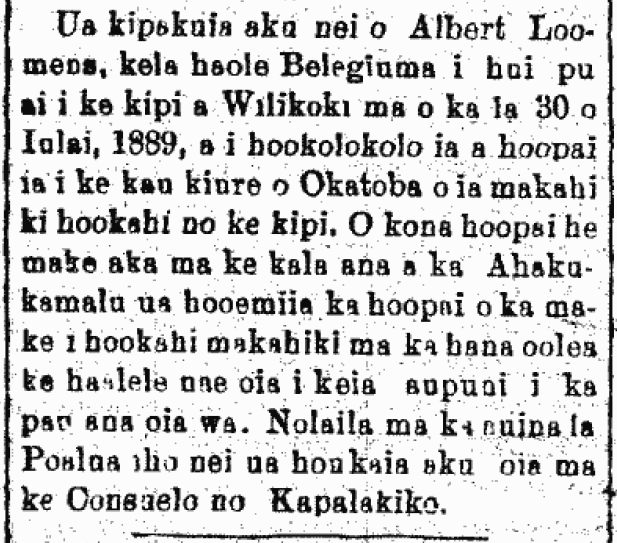
Albert Loomens is being banished, that Belgian who joined the rebellion with Wilcox and party on the 30th of July 1889; and he was tried and sentenced by jury on October of the same year for treason. His sentence was death but this was forgiven by the Privy Council [Ahakukamalu], and the death sentence was reduced to one year of hard labor on the condition that he leave this country at the end of this term. Therefore, on the afternoon of this Tuesday, he was sent aboard the Consuelo for San Francisco.
(Ko Hawaii Pae Aina, 10/18/1890, p. 2)
Ko Hawaii Pae Aina, Buke XIII, Helu 42, Aoao 2. Okatoba 18, 1890.
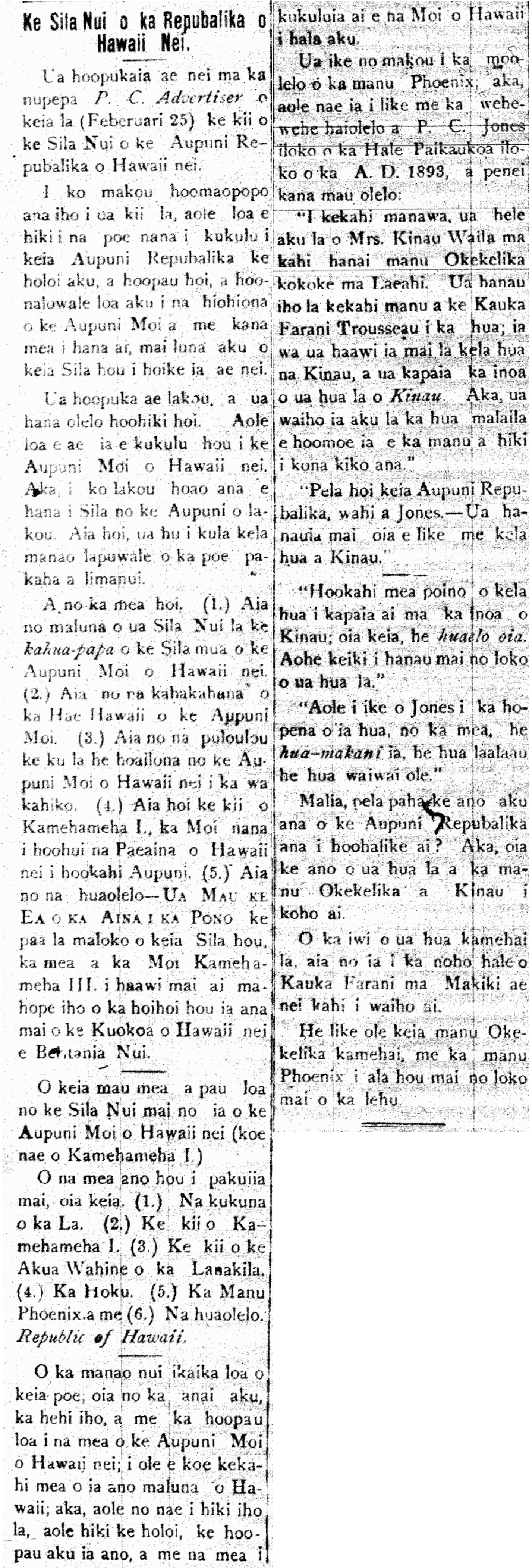
In today’s P. C. Advertiser (February 25), a picture of the Great Seal of the Republic of Hawaii was printed.
By our understanding of that image, there is no way that those who established this Republic can erase or end or eradicate visages of the Monarchy and its accomplishments, from the seal mentioned above.
They stated and vowed that there will be no way that the reestablishment of the Kingdom of Hawaii nei will be allowed. However, when they set out to create a Seal for their Government. And now, that foolish idea of the plunderers and thugs has gone awry.
Being that, (1.) On that Great Seal, is the foundation of the first Seal of the Monarchy of Hawaii nei. (2.) There is the stripes of the Hawaiian Flag of the Monarchy. (3.) There stand puloulou, a symbol of the Hawaiian Monarchy of old. (4.) There is an image of Kamehameha I., the King who unified the Hawaiian Archipelago into one Nation. (5.) There are the words—”Ua Mau ke Ea o ka Aina i ka Pono” affixed onto this new Seal, the words given by King Kamehameha III after the restoration of the Independence of Hawaii nei by Great Britain.
All these things were from the Great Seal of the Monarchy of Hawaii nei (except Kamehameha I.)
The new things added are these. (1.) Rays of the Sun. (2.) The image of Kamehameha I. (3.) The image of the Goddess of Victory. (4.) The Star. (5.) The Phoenix Bird, and (6.) The words, Republic of Hawaii.
Their intense desire is to rub out, to stomp out, and to end for all time, things of the Monarchy of Hawaii nei, lest vestiges of that sort remain in Hawaii; but that is not possible: there is no erasing, nor putting end to deeds done by the past Monarchs of Hawaii.
We know the story of the Phoenix, but it is not the same as the explanatory speech by P. C. Jones at the Armory [Hale Paikaukoa] in the year 1893, and these are his words:
“Once, Mrs. Kinau Wilder [Waila] went to where Ostrich were raised near Diamond Head [Laeahi]. One of the birds of the French Doctor Trousseau laid an egg, and it was on that occasion given to Kinau, and the egg was called Kinau. However, it was left there to be sat on by a bird until it hatched.
“This is similar to this Republic,” according to Jones. “It was born like that egg, Kinau.”
There is one unfortunate thing about that egg called by the name of Kinau, that being, it was a rotten egg [huaelo]. There was no chick born from that egg.
Jones didn’t know of the outcome of that egg, for it was but a yolk-less egg [hua makani], a hua laalaau?, a worthless egg.
Perhaps this will be the outcome of the Republic to which he compares it to? But at any rate, that is the kind of Ostrich egg that Kinau chose.
The shell of that astonishing egg is kept at the residence of Trousseau [Kauka Farani] in Makiki.
This astonishing Ostrich is not the same as a Phoenix which rises from the ashes.
(Aloha Aina, 2/29/1896, p. 4)
Ke Aloha Hawaii, Buke II, Helu 9, Aoao 4. Feberuari 29, 1896.
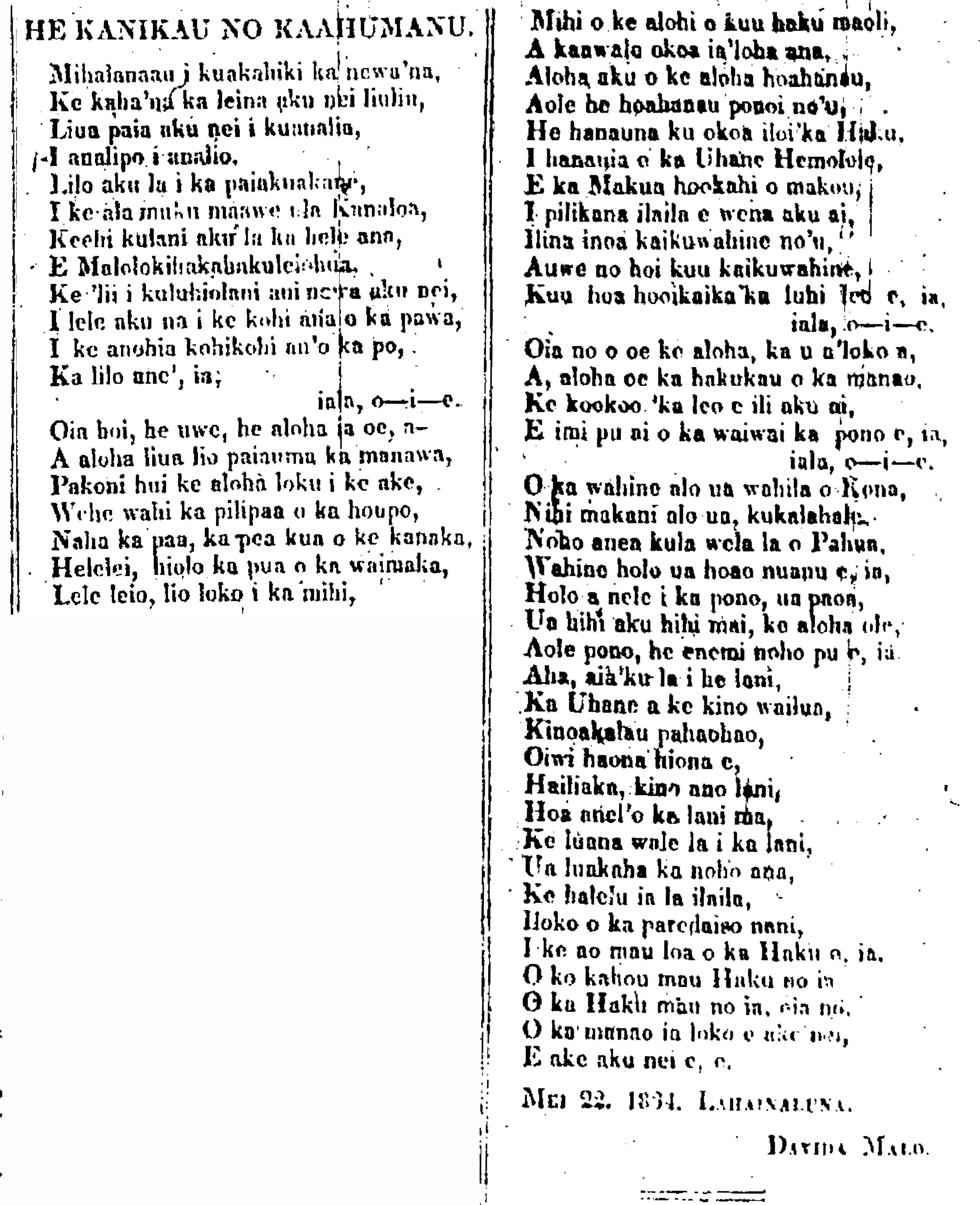
Mihalanaau i kuakahiki ka newa’na,
Ke kaha’na ka leina aku nei liuliu,
Liua paia aku nei i kuanalia,
I analipo i analio.
Lilo aku la i ka paiakuakane,
I ke ala muku maawe ula Kanaloa,
Keehi kulani aku la ka hele ana,
E Malolokihakahakuleiohua.
Ke ‘lii i kuluhiolani aui newa aku nei,
I lele aku na i ke kohi ana o ka pawa,
I ke anohia kohikohi an’o ka po,
Ka lilo ane’, ia,
Oia hoi, he uwe, he aloha ia oe, aiala, o—i—e.
A aloha liua lio paiauma ka manawa,
Pakoni hui ke aloha loku i ke ake,
Wehe wahi ka pilipaa o ka houpo,
Naha ka paa, ka pea kua o ke kanaka,
Helelei, hiolo ka pua o ka waimaka,
Lele leio, lio loko i ka mihi,
Mihi o ke alohi o kuu haku maoli,
A kaawale okoa ia’loha ana,
Aloha aku o ke aloha hoahanau,
Aole he hoahanau ponoi no’u,
He hanauna ku okoa iloi ka Haku,
I hanauia o ka Uhane Hemolele,
E ka Makua hookahi o makou,
I pilikana ilaila e wena aku ai,
Ilina inoa kaikuwahine no’u,
Auwe no hoi kuu kaikuwahine,
Kuu hoa hooikaika ka luhi leo e, ia, iala, o—i—e.
Oia no o oe ke aloha, ka u a’loko a,
A, aloha oe ka hakukau o ka manao,
Ke kookoo ‘ka leo e ili aku ai,
E imi pu ai o ka waiwai ka pono e, ia, iala, o—i—e.
O ka wahine alo ua wahila o Kona,
Nihi makani alo ua, kukalahale.
Noho anea kula wela la o Pahua,
Wahine holo ua hoao nuanu e, ia,
Holo a nele i ka pono, ua paoa,
Ua hihi aku hihi mai, ke aloha ole,
Aole pono, he enemi noho pu e, ia.
Aha, aia’ku la i he lani,
Ka Uhane a ke kino wailua,
Kinoakalau pahaohao,
Oiwi haona hiona e,
Hailiaka, kino ano lani,
Hoa anel’o ka lani ma,
Ke luana wale la i ka lani,
Ua luakaha ka noho ana,
Ke halelu ia la ilaila,
Iloko o ka paredaiso nani,
I ke ao mau loa o ka Haku e, ia.
O ko kahou mau Haku no ia
O ka Haku mau no ia, oia no.
O ka manao ia loko e ake nei,
E ake aku nei e, e.
MEI 22, 1834. LAHAINALUNA.
DAVIDA MALO.
[As mentioned by Kuamoolelo, here is the earliest published appearance of Malo’s famous kanikau for Kaahumanu. Unfortunately the image is not so legible, i had to go back to the original to check it. Hopefully one day soon, some entity will understand how important clear images of the newspapers are, and they will fund this priceless undertaking!!]
(Lama Hawaii, 8/8/1834, p. 3)
Ka Lama Hawaii, Makahiki 1, Helu 17, Aoao 3. Augate 8, 1834.
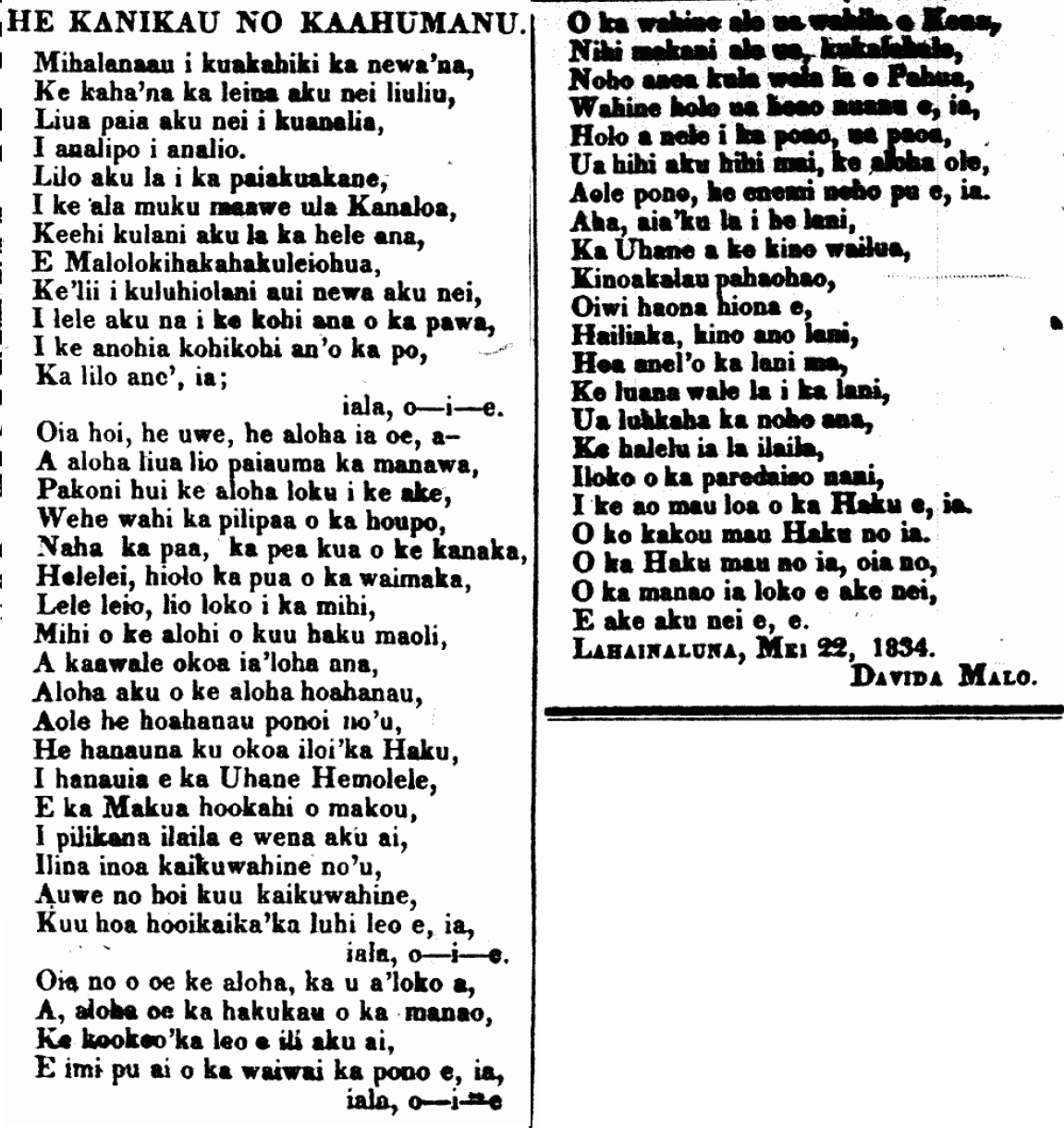
Mihalanaau i kuakahiki ka newa’na,
Ke kaha’na ka leina aku nei liuliu,
Liua paia aku nei i kunolia,
I analipo i analio.
Lilo aku la i ka paiakuakane,
I ke ala muku maawe ula Kanaloa,
Keehi kulani aku la ka hele ana,
Ke’lii i kuluhiolani aui newa aku nei,
I lele aku na i ko kohi ana o ka pawa,
I ke anohia kohikohi an’o ka po,
Ka lilo ane’, ia;
iala, o—i—e.
Oia hoi, he uwe, he aloha ia oe, a—
A aloha liua lio paiauma ka manawa,
Pakoni hui ke aloha loku i ke ake,
Wehe wahi ka pilipaa o ka houpo,
Naha ka paa, ka pea kua o ke kanaka,
Helelei, hiolo ka pua o ka waimaka,
Lele leio, he loko i ka mihi,
Mihi a ke alohi o kuu haku maoli,
A kaawale okoa ia’loha ana,
Aloha aku o ke aloha hoahanau,
Aole he hoahanau ponoi no’u,
He hanauna ku okoa ilo’ika Haku,
I haupuia e ka Uhane Hemolele,
E ka Makua hookahi o makou,
I pilikana ilaila e wena aku ai,
Ilina inoa kaiakwahine no’u,
Auwe no hoi kuu kaikuwahine,
Kuu hoa hooikaika’ka luhi leo e, ia,
iala, o—i—e.
Oia no o oe ke aloha, ka u’aloko a,
A, aloha oe ka hakukau o ka manao,
Ke kookoo’ka leo e ili aku ai,
E imi pu ai o ka waiwai ka pono, e ia,
iala, o—i—e.
O ka wahine alo ua wahila o Kona,
Nihi makani alo ua, kukalahale,
Noho anea kula wela la o Pahua,
Wahine holo ua hoao auanu e, ia,
Holo a nele i ka pono, ua paoa,
Ua hihi aku hihi mai, ke aloha ole,
Aole pono, he enemi noho pu e, ia.
Aha, aia’ku la i he lani,
Ka Uhane a ke kino wailua,
Oiwi haona hiona e,
Hailiaka, kino ano lani,
Hea anei’o ka lani ma,
Ke luana wale la i ka lani,
Ua luakaha ka noho ana,
Ke halelu ia la ilaila,
Iloko o ka paredaiso nani,
I ke ao mau loa o ka Haku e, ia.
O ko lakou mau Haku no ia.
O ka Haku mau no ia, oia no,
O ka manao ia loko e ake nei,
E ake aku nei e, e.
LAHAINALUNA, MEI 22, 1834.
DAVIDA MALO.
[This is the second known publication of the kanikau. The image is a clearer, but not totally clear.]
(Kumu Hawaii, 10/28/1835, p. 176)
Ke Kumu Hawaii, Buke 1, Pepa 22, Aoao 176, Okatoba 28, 1835.
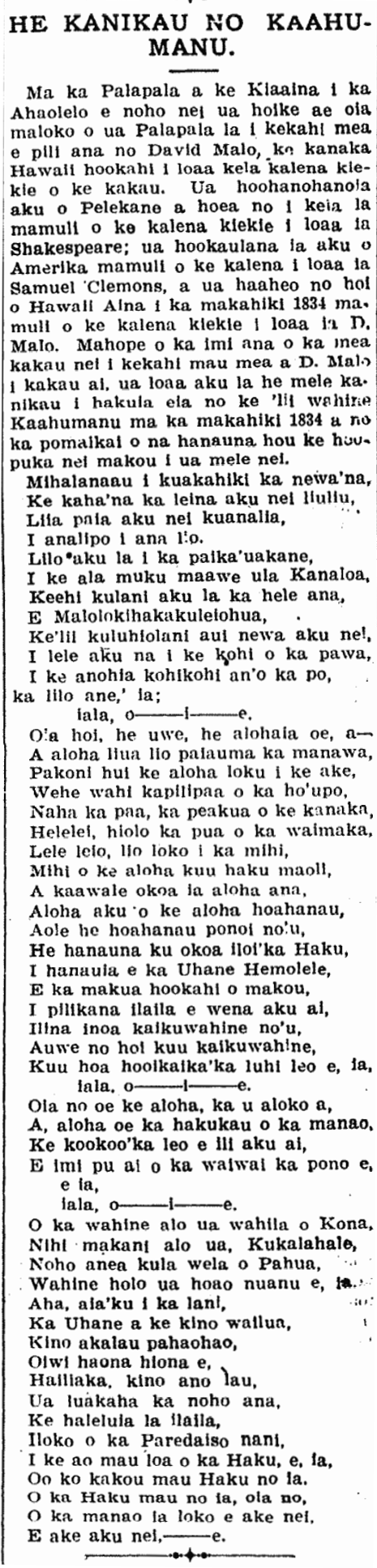
In the Document by the Governor [George Robert Carter] to the current Legislature, he spoke of in the Document about David Malo, the single Hawaiian who had a excellent talent for writing. Britain is famed to this day for the high talent of Shakespeare; America is made famous because of the talent of Samuel Clemens [Mark Twain], and Hawaii was proud indeed in the year 1834, because of the great talent of D. Malo. After your writer searched for things written by D. Malo, this kanikau was found, composed by him for the queen, Kaahumanu, in 1834; and for the benefit of the new generations, we are reprinting that mele.
Mihalanaau i kuakahiki ka newa’na,
Ke kaha’na ka leina aku nei liuliu,
Liia paia aku nei kuanalia,
I analipo i ana lio,
Lilo aku la i ka paika’uakane,
I ke ala muku maawe ula Kanaloa,
Keehi kulani aku la ka hele ana,
E Malolokihakakuleiohua,
Ke’lii kuluhiolani aui newa aku nei,
I lele aku na i ke kohi o ka pawa,
I ke anohia kohikohi an’o ka po, ka lilo ane,’ ia;
iala, o———i———e,
Oia hoi, he uwe, he alohaia oe, a—
A aloha liua lio paiauma ka manawa,
Pakoni hui ke aloha loku i ke ake,
Wehe wahi kapilipaa o ka ho’upo,
Naha ka paa, ka peakua o ke kanaka,
Helelei, hiolo ka pua o ka waimaka,
Lele leio, lio loko i ka mihi,
Mihi o ke aloha kuu haku maoli,
A kaawale okoa ia aloha ana,
Aloha aku o ke aloha hoahanau,
Aole he hoahanau ponoi no’u,
He hanauna ku okoa iloi’ka Haku,
I hanauia e ka Uhane Hemolele,
E ka makua hookahi o makou,
I pilikana ilaila e wena aku ai,
Ilina inoa kaikuwahine no’u,
Auwe no hoi kuu kaikuwahine,
Kuu hoa hooikaika’ka luhi leo e, ia,
iala, o———i———e.
Oia no oe ke aloha, ka u aloko a,
A, aloha oe ka hakukau o ka manao,
Ke kookoo’ka leo e ili aku ai,
E imi pu ai o ka waiwai ka pono e,
e ia,
iala, o———i———e.
O ka wahine alo ua wahila o Kona,
Nihi makani alo ua, Kukalahale,
Noho anea kula wela o Pahua,
Wahine holo ua hoao nuanu e, ia.
Aha, aia’ku i ka lani,
Ka Uhane a ke kino wailua,
Kina akalau pahaohao,
Oiwi haona hiona e,
Hailiaka, kino ano lau,
Ua luakaha ka noho ana,
Ke haleluia la ilaila,
Iloko o ka Paredaiso nani,
I ke ao mau loa o ka Haku, e, ia,
Oo ko kakou mau Haku no ia,
O ka Haku mau no ia, oia no,
O ka manao ia loko e ake nei,
E ake aku nei,———e.
(Kuokoa, 4/26/1907, p. 5)
Ka Nupepa Kuokoa, Buke XLII, Helu 17, Aoao 5. Aperila 26, 1907.
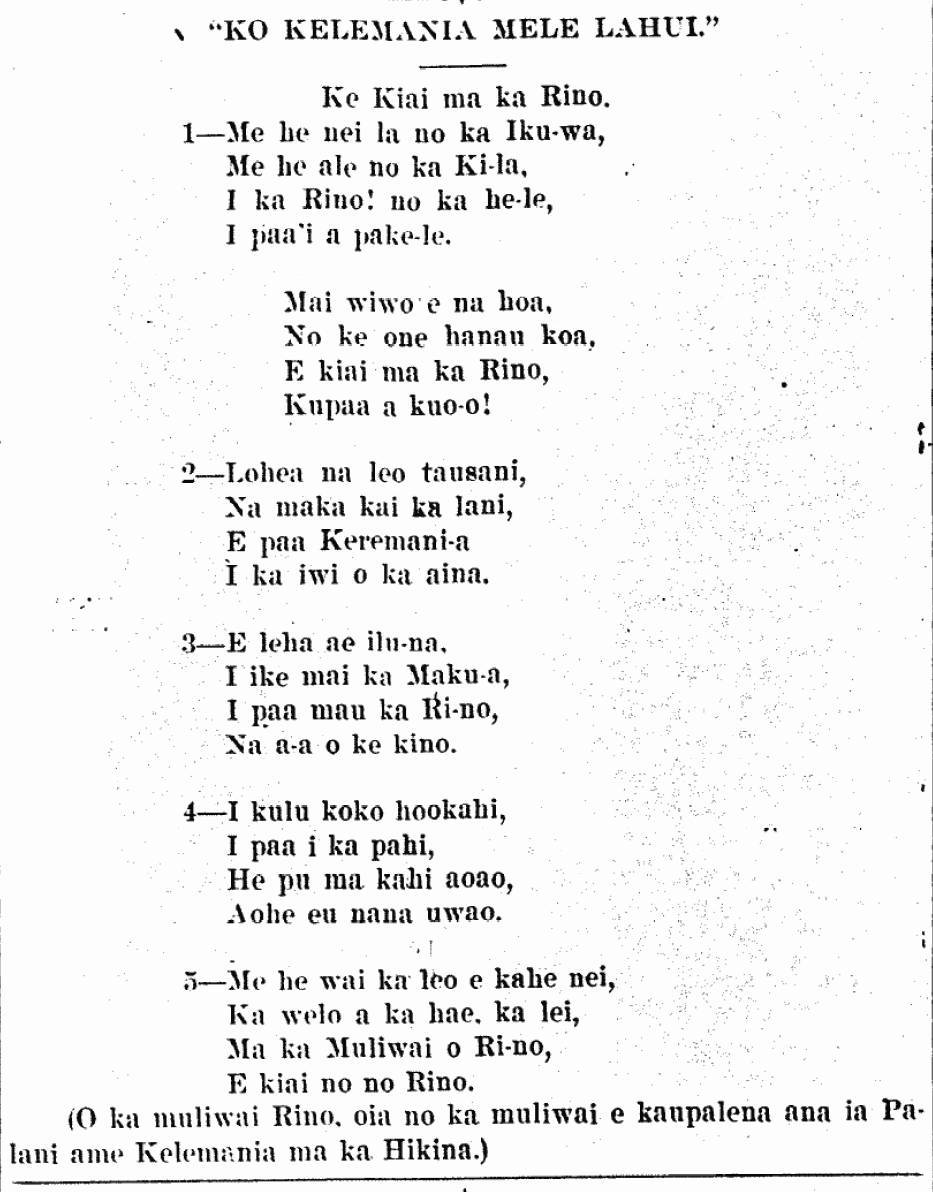
Ke Kiai ma ka Rino. [Guard on the Rhine.]
1—Me he nei la no ka Iku-wa,
Me he ale no ka Ki-la,
I ka Rino! no ka he-le,
I paa’i a pake-le.
Mai wiwo e na hoa,
No ke one hanau koa,
E kiai ma ka Rino,
Kupaa a kuo-o!
2—Lohea na leo tausani,
Na maka kai ka lani,
E paa Keremani-a
I ka iwi o ka aina.
3—E leha ae ilu-na,
I ike mai ka Maku-a,
I paa mau ka Ri-no,
Na a-a o ke kino.
4—I kulu koko hookahi,
I paa i ka pahi,
He pu ma kahi aoao,
Aohe eu nana uwao.
5—Me he wai ka leo e kahe nei,
Ka welo a ka hae, ka lei,
Ma ka Muliwai o Ri-no,
E kiai no no Rino.
(The Rhine River is the river bordering Germany on the East.)
[Translation/interpretation of “Die Wacht am Rhein”.]
(Kuokoa, 3/29/1907, p. 4)
Ka Nupepa Kuokoa, Buke XLII, Helu 13, Aoao 4. Maraki 29, 1907.
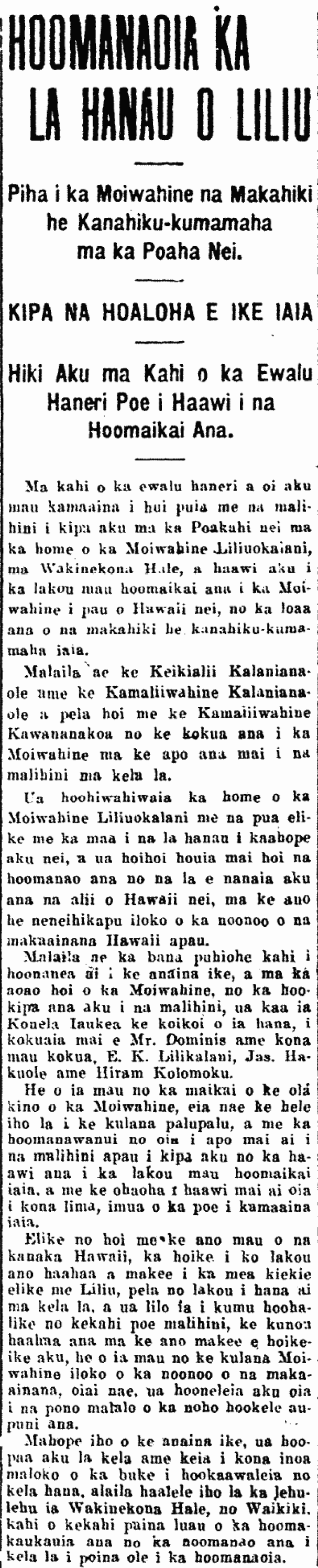
About eight-hundred or more kamaaina and malihini went on Monday to the home of Queen Liliuokalani, Washington Place [Wakinekona Hale], and gave their congratulations to the former Queen of Hawaii nei, for her reaching seventy-four years in age.
Present was Prince Kalanianaole and Princess Kalanianaole and also Princess Kawananakoa, who were there to assist the Queen in welcoming the visitors on that day.
The Queen’s home was decorated in flowers as was customary on her birthdays in the past and memories were stirred up of days when the alii of Hawaii nei were viewed with majesty in the minds of all Hawaii’s people.
The band was there entertaining the visitors; and from the Queen’s side, to welcome the guests, the responsibility went to Colonel Iaukea, assisted by Mr. Dominis and his aids, E. K. Lilikalani, James Hakuole, and Hiram Kolomoku.
The Queen is still in good health, however she is becoming frail, yet with patience she welcomed all the guests who visited her to extend their congratulations, and delightedly she extended her hand before those with whom she was familiar.
Just as it is with Hawaiians, who show their deference and affection for their royalty, like Liliu; so they did on this day, and this was followed as an example by some of the malihini, who bowed deeply and with affection, showing that the Queen’s position remained the same in the minds of the people even if she is left without her rights in ruling the nation.
Following the audience, each person signed their name in the book set aside for this occasion, and then the crowd left Washington Place for Waikiki where a luau was prepared to celebrate that unforgettable day.
(Kuokoa, 9/6/1912, p. 1)
Ka Nupepa Kuokoa, Buke XLVIII, Helu 36, Aoao 1. Sepatemaba 6, 1912.
 nupepa