Winona Kapuailohia Desha Beamer, 1943.

[Found under: “News From Boys, Girls Kamehameha Schools”]

By Pilialoha Hopkins

Miss Winona Kapuailohia Desha Beamer, a graduate of the Kamehameha Schools for Girls, class of ’41, returned from Barnard college, New York.

While she was there Winona was studying in the fields of ethnology and anthropology.

Because of health condition Miss Beamer will remain in the islands for some time. She hopes to continue her study after the war.

While a student at Kamehameha, Winona was engaged in various activities some being, class president, a member of Hui Kumolipo [Kumulipo], a piano and organ pupil, a member of the choir, silver and gold pin student, and was awarded upon graduation a scholarship to Colorado Women’s college. While in school she also won the Clarke-English award and was interested a great deal in relationship and study of the early Hawaiians and Polynesians.

Winona is the daughter of Mr. and Mrs. Francis Pono Beamer of Waikiki, Oahu. She is the granddaughter of Mr. and Mrs. Peter Carl Beamer of Hilo, Hawaii.

At present, Winona has two brothers Francis and Cleighton and a sister Flora attending Kamehameha. Also at Kam she has four cousins, Milton, Edwin, and Helen Beamer, and Helen Walker.

[This was a regular column on the happenings at Kamehameha Schools in the Hoku o Hawaii, and the articles were composed by the students, sometimes in English, and sometimes in Hawaiian.]

(Hoku o Hawaii, 4/14/1943, p. 2)

By Pilialoha Hopkins

Ka Hoku o Hawaii, Volume XXXVII, Number 51, Aoao 2. Apelila 14, 1943.

Kamehameha Schools Song Contest, yesterday and today, 1944 / 2014.

[Found under: “News From Boys, Girls Kamehameha School”]

By HARRIETTE HURLEY

People who enjoy Hawaiian music have expressed the desire to know the meanings of the Hawaiian songs. Translations of the two prize songs to be used in the Kamehameha School for Girls’ song contest to be held on February 13, appear below.

Mrs Mary Kawena Pukui, translator at the Bishop Museum and director of Hawaiian activities at the Kamehameha Preparatory School, has translated the songs.

The junior division prize song is Pa’au’au Waltz. Selected for the senior division prize song is Lei Awapuhi.

Translation of Lei Awapuhi

I hear the voice of a loved one say
Let me pluck and wear the flower
To string a lei for my leaf bud to wear
My love was strongly attracted
To the choicest flower that ever bloomed
Let me, darling, string it into a lei,
O let your ginger lei be mine. Continue reading

King Lunalilo’s second birthday and last as King of the Hawaiian Archipelago, 1874.

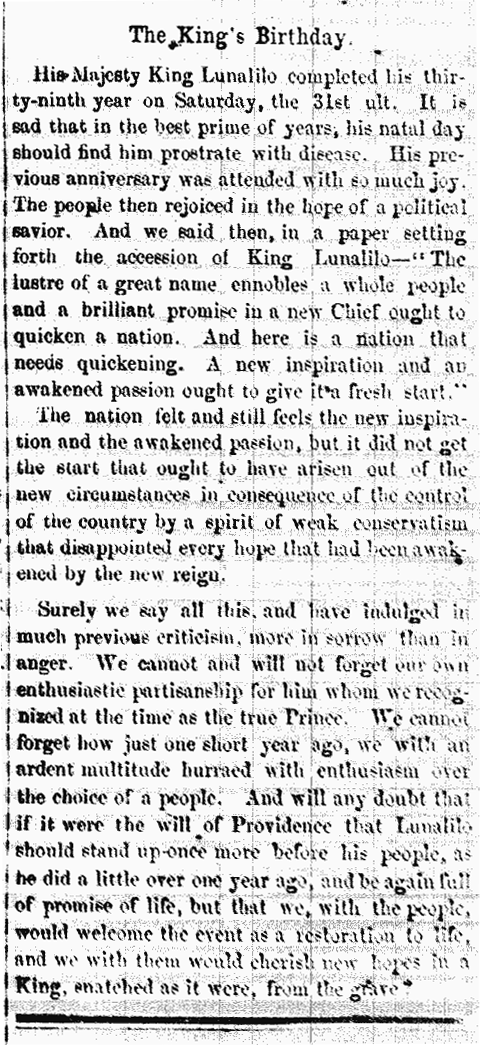
The King’s Birthday.

His Majesty King Lunalilo completed his thirty-ninth year on Saturday, the 31st ult. It is sad that in the best prime of years, his natal day should find him prostrate with disease. His previous anniversary was attended with so much joy. The people then rejoiced in the hope of a political savior. And we said then, in a paper setting forth the accession of King Lunalilo—”The lustre of a great name ennobles a whole people and a brilliant promise in a new Chief ought to quicken a nation. And here is a nation that need quickening. A new inspiration an awakened passion ought to give it a fresh start.”

The nation felt and still feels the new inspiration and the awakened passion, but it did not get the start that ought to have arisen out of the new circumstances in consequence of the control of the country by a spirit of weak conservatism that disappointed every hope that had been awakened by the new reign.

Surely we say all this, and have indulged in much previous criticism, more in a sorrow than in anger. We cannot and will not forget our own enthusiastic partisanship for him whom we recognized at the time as the true Prince. We cannot forget how just one short year ago, we with an ardent multitude hurraed with enthusiasm over a choice of a people. And will any doubt that if it were the will of Providence that Lunalilo should stand up once more before his people, as he did a little over one year ago, and be again full of life, but that we, with the people, would welcome the even as a restoration to life, and we with them would cherish new hopes in a King, snatched as it were, from the grave.

(Nuhou, 2/3/1874, p. 6)

The King's Birthday.

Ka Nuhou Hawaii, Buke I, Helu 14, Aoao 6. Feberuari 3, 1874.

Why Crown Lands are not public lands, 1909.

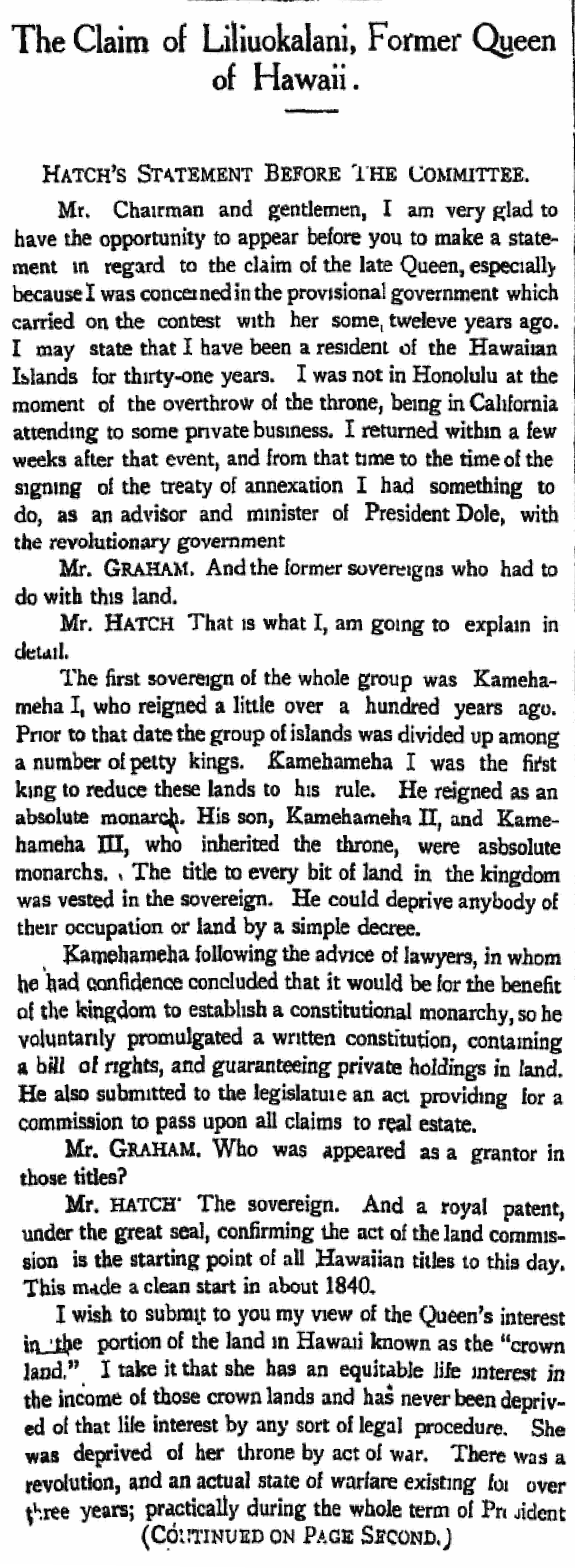
The Claim of Liliuokalani, Former Queen of Hawaii.

HATCH’S STATEMENT BEFORE THE COMMITTEE.

Mr. Chairman and gentlemen, I am very glad to have the opportunity to appear before you to make a statement in regard to the claim of the late Queen, especially because I was concerned in the provisional government which carried on the contest with her some twelve years ago. I may state that I have been a resident of the Hawaiian Islands for thirty-one years. I was not in Honolulu at the moment of the overthrow of the throne, being in California attending to some private business. I returned within a few weeks after that event, and from that time to the time of the signing of the treaty of annexation I had something to do, as an advisor and minister of President Dole, with the revolutionary government.

Mr. Graham. And the former sovereigns who had to do with this land.

Mr. Hatch. That is what I, am going to explain in detail.

The first sovereign of the whole group was Kamehameha I, who reigned a little over a hundred years ago. Prior to that date the group of islands was divided up among a number of petty kings. Kamehameha I was the first king to reduce these lands to his rule. He reigned as an absolute monarch. His son, Kamehameha II, and Kamehameha III, who inherited the throne, were absolute monarchs. The title to every bit of land in the kingdom was vested in the sovereign. He could deprive anybody of their occupation or land by a simple decree.

Kamehameha following the advice of lawyers, in whom he had confidence concluded that it would be for the benefit of the kingdom to establish a constitutional monarchy, so he voluntarily promulgated a written constitution, containing a bill of rights, and guaranteeing private holdings in land. He also submitted to the legislature an act providing for a commission to pass upon all claims to real estate.

Mr. Graham. Who was appeared as a grantor in those titles?

Mr. Hatch. The sovereign. And a royal patent under the great seal, confirming the act of the land commission is the starting point of all Hawaiian titles to this day. This made a clean start in about 1840.

I wish to submit to you my view of the Queen’s interest in the portion of the land in Hawaii known as the “crown land.” I take it that she has an equitable life interest in the income of those crown lands and has never been deprived of that life interest by any sort of legal procedure. She was deprived of her throne by act of war. There was a revolution, and an actual state of warfare existing for over three years; practically during the whole term of President…

(Kuokoa Home Rula, 5/21/1909, p. 1)
The Claim of Liliuokalani, Former Queen of Hawaii.

Kuokoa Home Rula, Buke VII, Helu 21, Aoao 1. Mei 21, 1909.

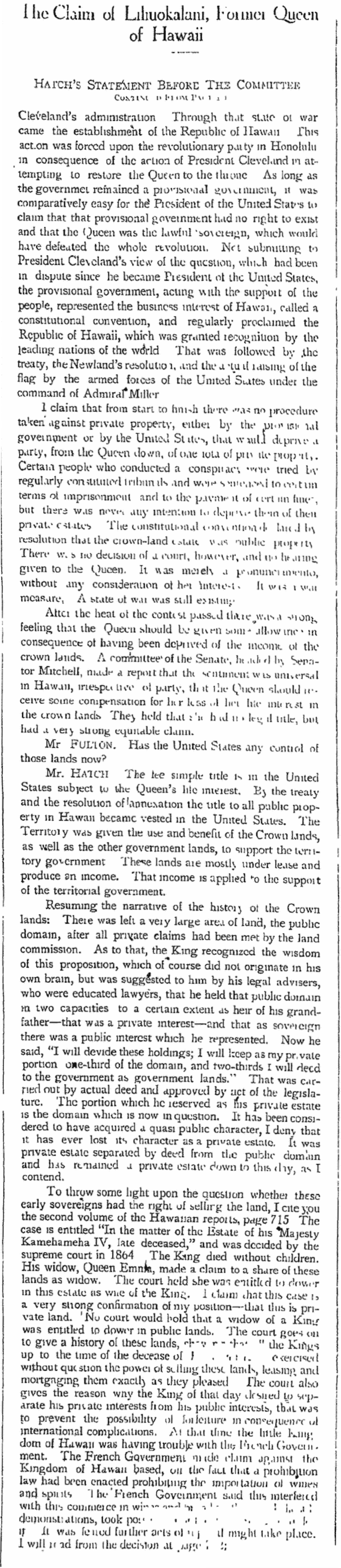
…Cleveland’s administration. Through that state of war came the establishment of the Republic of Hawaii. This action was forced upon the revolutionary party in Honolulu in consequence of the action of President Cleveland in attempting to restore the Queen to the throne. As long as the government remained a provisional government, it was comparatively easy for the President of the United States to claim that the provisional government had no right to exist and that the Queen was the lawful sovereign, which would have defeated the whole revolution. Not submitting to President Cleveland’s view of the question, which had been in dispute since he became President of the United States, the provisional government, acting with the support of the people, represented the business interest of Hawaii, called a constitutional convention, and regularly proclaimed the Republic of Hawaii, which was granted recognition by the leading nations of the world. That was followed by the treaty, the Newland’s resolution, and the actual raising of the flag by the armed forces of the United States under the command of Admiral Miller.

I claim that from start of finish there was no procedure taken against private property, either by the provisional government or by the United States, that would deprive a party, from the Queen down, of one iota of private property. Certain people who conducted a conspiracy were tried by regularly constituted tribunals and were sentenced to [unclear] but there was never any intention to deprived them of their private estates. The constitutional convention declared by resolution that the crown-land estate was public property. There was no decision of a court, however, and no hearing given to the Queen. It was merely a [unclear] without any consideration of her interests. It was a [unclear] measure. A state of war was still existing.

After the heat of the contest passed there was a strong feeling that the Queen should be given some allowance in consequence of having been deprived of the income of the crown lands. A committee of the Senate, headed by Senator Mitchell, made a report that the sentiment was universal in Hawaii, irrespective of party, that the Queen should received some compensation for her loss of her life interest in the crown lands. They held that she had no legal title, but had a very strong equitable claim.

Mr. Fulton. Has the United States any control of those lands now?

Mr. Hatch. The fee simple title is in the United States subject to the Queen’s life interest. By the treaty and the resolution of annexation the title to all public property in Hawaii became vested in the United States. The Territory was given the use and benefit of the Crown lands, as well as the other government lands, to support the territory government. These lands are mostly under lease and produce an income. That income is applied to the support of the territorial government.

Resuming the narrative of the history of the Crown lands: There was left a very large area of land, the public domain, after all private claims had been met by the land commission. As to that, the King recognized the wisdom of this proposition, which of course did not originate in his own brain, but was suggested to him by his legal advisers, who were educated lawyers, that he held that public domain in two capacities to a certain extent as heir of his grandfather—that was a private interest—and that as a sovereign there was a public interest which he represented. Now he said, “I will divide these holdings; I will keep as my private portion one0third of the domain, and two-thirds I will deed to the government as government lands.” That was carried out by actual deed and approved by net of the legislature. The portion which he reserved as his private estate is the domain which is now in question. It has been considered to have acquired a quasi public character, I deny that it has ever lost its character as a private estate. It was and has remained a private estate down to this day, as I contend.

To throw some light upon the question whether these early sovereigns had the right of selling the land, I cite you the second volume of the Hawaiian reports, page 715. The case is entitled “In the matter of the Estate of his Majesty Kamehameha IV, late deceased,” and was decided by the supreme court in 1864. The King died without children. His widow, Queen Emma, made a claim to a share of these lands as a widow. The court held she was entitled to dower in this estate as wife of the King. I claim that this case is a very strong confirmation of m position—that this is private land. No court would hold that a widow of a King was entitled to dower in public lands. The court goes on to give a history of these lands, [partially unclear from here on down].

[This is also translated and printed in Hawaiian in Kuokoa Home Rula. “KOI A LILIUOKALANI, MOIWAHINE MUA O HAWAII.”

Although this document should be easily found elsewhere, there are other stories in newspapers like Kuokoa Home Rula that are not legible online. They need to be rescanned clearly, so that they can be read as they were written, for what good is information if it cannot be read?]

(Kuokoa Home Rula, 5/21/1909, p. 2)
The Claim of Liliuokalani, Former Queen of Hawaii

Kuokoa Home Rula, Buke VII, Helu 21, Aoao 2. Mei 21, 1909.

More familiar mele, with English translation, 1909.

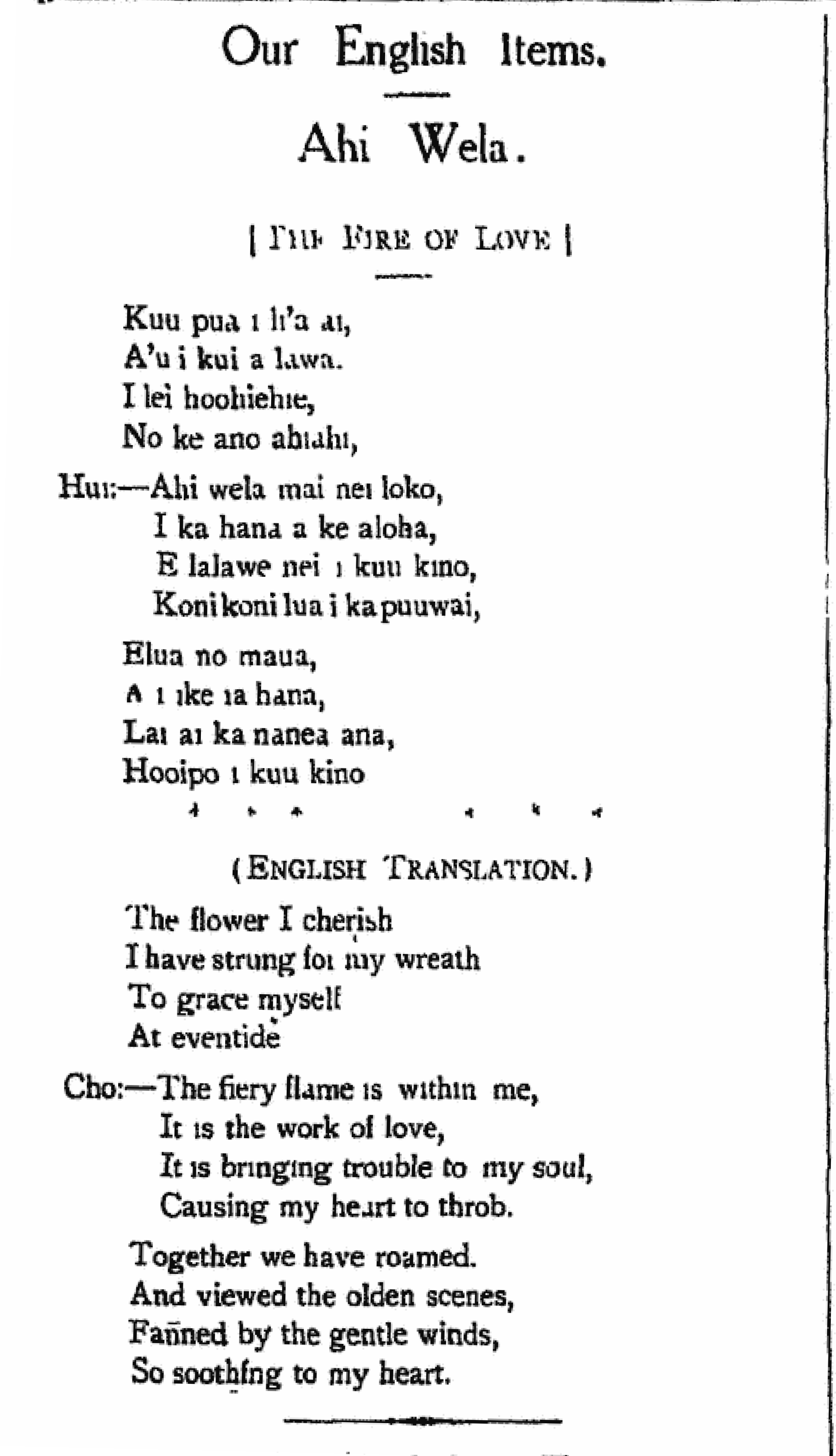
Our English Items.

Ahi Wela.

[THE FIRE OF LOVE]

Kuu pua i li’a ai,
A’u i kui a lawa,
I lei hoohiehie,
No ke ano ahiahi,

Hui:—Ahi wela mai nei loko,
I ka hana a ke aloha,
E lalawe nei i kuu kino,
Konikoni lua i ka puuwai,

Elua no maua,
A i ike ia hana,
Lai ai ka nanea ana,
Hooipo i kuu kino.

(English Translation.)

The flower I cherish
I have strung for my wreat
To grace myself
At eventide

Cho:—The fiery flame is within me,
It is the work of love,
It is bringing trouble to my soul,
Causing my heart to throb.

Together we have roamed,
And viewed the olden scenes,
Fanned by the gentle winds,
So soothing to my heart.

(Kuokoa Home Rula, 5/21/1909, p. 1)

Our English Items.

Kuokoa Home Rula, Bukke VII, helu 21, Aoao 1. Mei 21, 1909.

Kamehameha Schools column in Hoku o Hawaii, 1940.

NEWS FROM KAMEHAMEHA SCHOOL FOR BOYS

By John Desha

KAMEHAMEHA SCHOOL. May 22 (Special)—Four seniors from the Big Island were graduated on May 30. They were Frances Nohoikaiu, Odetta Needham, George Mills, and Nephi Needham.

All of these students have attained a standard of which they can be proud.

George Mills and Nephi Needham have taken up at Kamehameha the agriculture course.

Frances Nohoikaiu and Odetta Needham have taken the general course at Kamehameha school for Girls.

Calvin Christ, also of Hawaii, is graduating this year. Calvin is in his high-eleventh year but is graduating with six other high-eleventh students. He has taken up the electrical course at Kamehameha and is planning to return to Hawaii where he intends to work.

KAMEHAMEHA SCHOOLS, May 26 (Special) — Memorial services were held for Bernice Pauahi Bishop by the Kamehameha Schools at Mauna Ala cemetery at Nuuanu on Friday, May 24.

While the school band played “Hawaii”, the students marched in and formed in a semicircles before the grave of Mrs. Bishop. The program ran in the following order:

“He Inoa No Pauahi” — Led by Daniel Hano.

“Pauahi O Kalani” — Led by Bernice Campbell.

“Boys’s School Pledge” — Led by Richard Hart.

“Pauahi Ke Alii” — Led by Amy Miller.

“Girls’ School Pledge” — Led by Florence Spencer.

“Decorating the Grave” — By the various class presidents.

“Only Remembered” — Led by Bernhardt Alama.

“Girls’ School Call” — Led by Josephine Keanoano.

A number of townspeople were present, including graduates and parents.

By D. Akaka.

KAMEHAMEHA SCHOOLS. May 22 (Special). Keanohou Ludloff of Hilo was recently elected to the post of treasurer for the coming year of the Hi Y Warriors club.

The other officers who were also elected are Robert Gomard, president, John Saber [?], vice-president, and Arthur Doo, secretary.

The present officers of the Hi Y club are James G???, president, Reuben Anderson, vice-president, John Desha, secretary, and Robert Fountain, treasurer.

“Ka oki ana o ka piko o Hale Lama” was the first sentence of a Hawaiian chant that was chanted by Kahuna pule Kahului Anderson and was interpreted by Moki Burrows, wearing malos, as “The cutting of the piko o Hale Lama” which is the ceremonial dedication of Hale Lama. A brief history of Hale Lama was presented by Louis Agard. the paina was followed by a program of dances and songs. “Aloha oe,” which was sung by the boys conducted the ritual ceremony. This ceremony marked the completion of a grass hut, constructed by students at Kamehameha schools.

Invited guests were as follows: Mrs. Lahilahi Webb, Mrs. Mary Pukui, Mrs. Keith Jones, Mrs. Margaret Bardwell, Miss Maude K. Scheiffer, Mrs. Antoinette Faahong, Dr. and Mrs. Homer F. Barnes, Mr. and Mrs. Pat Rankin, Mr. and Mrs. L??? G. Hudson, Miss Juliana Jones, Miss Pat Namaka Wiggin, Mr. William Jones and Mr. Jack Q. Haydgen. Sponsoring the paina were the 24? members of the Hui Kumulipo and 41? members of the Hui Oiwi which were successfully advised by Miss Mabel Catlin and Mr. Donald Mitchell a total of about 100 persons attended the ceremony.

[If only papers like Hoku o Hawaii were rescanned as clearly as possible, maybe more information would be available from articles like these. Information can only be appreciated if it is legible! It is however awesome that you can actually make out that attending the opening ceremony for Hale Lama were people like Lahilahi Webb, Mary Kawena Pukui, and Pat Namaka (Wiggin) Bacon!

Oooh, and D. Akaka? Senator Daniel Akaka, class of ’42?

Once again, i am sorry if some of the names i typed are incorrect!]

(Hoku o Hawaii, 6/5/1940, p. 4)

NEWS FROM KAMEHAMEHA SCHOOL FOR BOYS

Ka Hoku o Hawaii, Volume XXXV, Number 6, Aoao 4. Iune 5, 1940.

Patriotic mele in English, 1893.

As Israel in ancient times sat weeping by the waters of Babylon listening to the plaintive songs which arose from their singers, so sits Hawaii in grief and mourning to-day and to Her our bard sings:

I had a dream, I saw a vision pass before me,
Long ages past arose in swift array,
Adown the stream of time my fleeting fancy bore me
From age to age unto the present day,
Far o’er the southern sea I saw brave ships a-sailing
From isle to isle, till at Hawaii’s shore
They touched, and soon with joy the natives came, them hailing
With pious awe, incarnate Gods of yore,
From all the land they flocked with speed to see the stranger,
Adoring gave their gifts both rich and rare,
But time brought fuller knowledge, knowledge brought its dangers
And Captain Cook’s life paid the forfeit there.
And down the stream still visions came a-floating;
Vancouver came unto this race so brave;
Restored the friendship Cook had lost; while noting
That Britain ne’er would hold them as her slave.
Still swept the vision on with flight so speedy;
One ship alone this time comes into view—
America’s gift unto these islands needy,
Peace, love, goodwill—and Christianity too.
Right lovingly was welcomed each new teacher,
The people flocked to hear good news so true,
That more and more it seemed to every preacher,
The harvest plenteous, but the laborers few.
And time flew by on wings. The isles grew fair, and fairer;
One Briton thought to seize them for his land,
But Britain’s Admiral, our independence bearer,
Restored the flag midst praise from every hand,
The years passed by. Through all the land there rose the steeple—
The preacher controlled all with kindly hand;
Give land and constitution to your people!
(O King! Give heed!) and God will bless your land.
Year followed year. Changed Kings and constitution.
The stranger increased: took mortgages on land:
Kept Hawaii’s daughters, sisters, wives in prostitution:
Spread poverty and vice around on ev’ry hand.
Still years rolled on. With sugar now grown wealthy,
The foreign Christians lifts his eye around,
And says: “For me no doubt the climate is most healthy,
“Tho’ poor and dying Hawaii’s native sons are found.
“Some seventy years ago we gave this land the Bible
“And tried to teach them then its use,
“(To say we’ve showed them poor examples is no libel)
“And fair exchange ‘t will be to cook their goose.
“Their cries for right and justice soon we’ll stifle:
“Take for ourselves this Paradise on earth.
“If they object, we’ll each one tap our rifle,
“And call for help upon our land of birth.
“Unfit to rule with all these years of training—
“(We’ll spread the lie around on every hand,)
“You’ll see they’ll let us do it, uncomplaining,
“For they have got our Bible, and so we’ll take their land.”
At this a noise awoke me, and in wonder
I saw the very instance of my dream.
Hawaii’s Queen and Natives were put under
To bolster up their money-getting scheme
And now forth from them goes across the waters
One last appeal for Justice and for Right.
Preserving peace, Hawaii’s gen’rous sons and daughters,
Before God’s throne on high, in prayer unite:
“Great God! the Judge of All! The records thou art keeping!
“Look down in mercy on our sad estate!
“Be kind unto us! Hear our voice of weeping!
“Till thou restore, grant us in peace to wait.
“And thou, great nation! home of truth and bravery!
“Freedom’s defender! we pray thee us O, hear!
“Restore our Queen and us; now, as in slavery,
“Held by usurper’s armed fear.
“Restore our rights and help us to maintain them!
“O let our prayer be crowned with success!
“Our conduct and your friendship will retain them,
“The God of nations will for ever bless.”

[This mele was probably composed by Kahikina Kelekona, J. G. M. Sheldon.

The image taken from the microfilm is hard to make out at the bottom. Hopefully there will be funding found to have the Hawaiian-Language Newspapers be unbound and rescanned clearly. How can you get to all the pearls stored in the newspapers if you can’t make out the words?]

(Hawaii Holomua, puka pule, 1/28/1893, p. 4)

As Israel in ancient times...

Hawaii Holomua (Puka Pule), Buke III, Helu 5, Aoao 4. Ianuari 28, 1893.

The Hawaiian Moses? 1893.

“THE MISTAKES OF MOSES.”

We refer, of course, to the Hawaiian political Moses, who has recently broken camp, and set the faithful in motion through sea, desert and wilderness to the Land of Promise, beyond the shadow of the Throne. Yes! We refer to the Hawaiian political Moses, but whether his other name is Dole or Thurston, has not, at this writing, fully transpired. Still, the doubt as to his other name is a merely nominal doubt, not affecting the merits of the case. And as the original state—man of that name was not gifted with immunity from error, so neither has the Hawaiian Moses, even during his very brief pilgrimage, avoided all mistakes. It should ever be the part of a friend to note his friends’ infirmities, and, by bringing them mildly to their authors’ notice, suggest their reform, or convey a warning against their repetition.

———

We are all aware of the high pressure of seeming necessity under which the present government was formed. We can therefore appreciate, to some extent, the causes of the neglect to observe, towards the numerous Native element, those marks of regard and confidence without which no government can hope to endure in Hawaii. We repeat, that the pressure of the occasion must be the excuse of the gentlemen at the head of the movement for their seemingly unfriendly, and even hostile attitude toward the entire Native race, in the ordering of early events under the new dispensation.

———

The exclusion of Hawaiians from a participation in the beneficent project not only seemed, but was, and is complete. There may have been, and no doubt were reasons, seemingly sound to those who adopted them, for such a course,—reasons of which the public cannot judge, because the public know them not. Yet it would seem that one of two propositions must be true; viz.: either the Hawaiians were needlessly, and, therefore, harshly excluded from such participation in the reforming of their own government, or else the entire race were deemed by the leaders to be unfit to participate in such an enterprise.

———

If the former of the above propositions be true, one would naturally expect the mistake to be rectified at the earliest opportunity. That it has not been rectified would seem to stamp it as having been no mistake, but a course deliberately adopted, for, note the opportunity to retrieve the error, (if error it had been thought to be) in the filling of the four vacancies in the Advisory Council, on the 21st inst. It was then, as seems to us, the manifest duty of the government to seek out and appoint to those vacancies, men of Hawaiian blood, whose brains, interests and loyalty to the new idea bespoke than as deserving of such honor and confidence.

———

The failure of the government to attempt to bring even one Hawaiian to a seat at the Council Board is susceptible of only one of two meanings:—1st, that no Hawaiian could be found possessing those qualifications, or, 2nd, that the government were determined to ignore and exclude them, in any event.

———

If such exclusion was premeditated and malicious, the less said of it the better, as it is self-condemnatory. If on the other hand, there be no native Hawaiian fit to occupy a seat in the government councils, with what degree of candor or confidence can the Provisional Government request of expect the United States to incorporate our country into itself? What a commentary upon that request is the action of the government itself, in thus excluding from their confidence the entire aboriginal race, more completely than the Mongolian is now excluded from the Union. Forty odd thousand Hawaiians on these shores, and not one, (in the opinion of the government,) entitled or qualified to have a voice in the government of his native land. What a text for the American enemies of annexation, and how they will use it!

(Liberal, 1/25/1893, p. 2)

"THE MISTAKES OF MOSES."

The Liberal, Volume I, Number 39, Page 2. January 25, 1893.

C. C. Moreno on missionaries, 1893.

A Misunderstood People.

MORENO ON THE MISSIONARIES.

Editor Post: For several years your public-spirited paper has published correspondence and statements submitted by me about Hawaii in which was foreshadowed the present state of affairs. The revolution which has just taken place is the inevitable result of missionary rule; the long-standing and deep-rooted cause of the unrest.

The missionaries in Hawaii, as in China, Japan, and elsewhere, consider that country as their open hunting grounds, regardless of the rights, customs, wishes, and priviliges of the natives and of stipulations.

I positively know that the self-appointed four chiefs of the Provisional Government in the Hawaiian Islands and the five commissioners coming to Washington to negotiate a treaty of annexation are, without a single exception, missionariesʻ confederates. Not a single native Hawaiian is with them, therefore, they cannot be considered as the representatives of the Hawaiian nation, of which they are aliens and enemies, but only as the emissaries of one side (or of a higher), which is not the right side.

The truth about Hawaiian affairs has never reached the State Department and that is the reason why, in the department, the knife has always been taken by the blade instead of by the handle in dealing with the Hawaiian question.

The United States always sent third rate politicians as ministers and consult to Honolulu, hence the erroneous information about Hawaii. I have on the spot studied Hawaii and the Hawaiians, their troubles with the missionaries of all creeds, and when distant from the islands I have kept an uninterrupted correspondence with the leaders of the Hawaiian nation, such as the Hons. Wilcox, Bush, Testa, Kaai, Kapena, Kaunamano, Kimo Pelekane [James I. Dowsett], and others.

My views on the Hawaiian question I explained at length to President Hayes and Secretary of State Evarts, to President Cleveland and to Assistant Secretary of State Porter: later, to Senator Morgan and to Congressman McCreary, and these are the statesmen that ought to dispose of the Hawaiian question and render justice to the weak, ill-treated, honest, and generous Hawaiian people that have been continually misrepresented, misjudged, and grossly wronged.

In accordance with the good order of things the coming self-appointed and self-styled Hawaiian commissioners, with more appearance than substance, should not be received by the United States authorities, because their self-attributed mission to Washington is based only upon selfish and malignant motives.

This will be a good opportunity for the great people of the United States to show their sentiment for fair play and generosity toward the unfortunate, harmless, friendly, and oppressed Hawaiian people, worthy of sympathy and of help in this their hour of national distress.

Celco Cæsar Moreno.

(Liberal, 2/25/1893, p. 2)

A Misunderstood People.

The Liberal, Volume I, Number 48, Page 2. February 25, 1893.

Astronomy, 1909.

The Hawaiian Astronomy.

It is a great pity that David Malo, the Hawaiian Historian and Antiquarian, did not preserve in his “Moolelo Hawaii” or Hawaiian Antiquities, some account on Ancient Hawaiian Astronomy. S. M. Kamakau, a contemporary of David Malo, and also a writer on the Ancient History of Hawaii nei, is little better off, about this matter than his colleague. He wrote an article on “Instructions in Ancient Hawaiian Astronomy” and was published in the Nupepa Kuokoa of Aug. 5th, 1865. It was translated into English by Prof. W. D. Alexander for Maile Wreath (Lei Maile), and was republished by Mr. Thos. G. Thrum, in his “Hawaiian Annual” for 1890.

In the year 1885, we found in the monthly newspaper, “Ka Hoku o ke Kai,” that subject was treated again, only to last a very short time. And about twelve or thirteen years ago we again found certain very valuable statements pertaining to the Ancient History of Hawaii by Kanalu, said to be the priestly ancestor of the priesthood or order of Kanalu.

We saw in “The Journal of the Polynesian Society,” Vol. XVI, No. 2, an article on “Tahitian Astronomy” by Miss Teuira Henry. It treats the “Birth of the Heavenly Bodies.” It is very interesting.

In order to preserve these accounts relating to Hawaiian Astronomy, we give our English translation here, starting first from the account in Ka Hoku o ke Kai (1885).

In ancient times, the class of people studying the positions of the moon, the rising and setting of certain fixed stars and constellations, and also of the sun, are called the kilo-hoku or astrologers. Their observations of these heavenly bodies might well be called the study of astronomy. The use of astrology anciently, was to predict certain events of fortunes and misfortunes, victory or defeat of a battle, death of king or queen, or any high chief; it also foretells of pestilence, famine, fine or stormy weather and so forth.

The old Hawaiians knew some names of certain planets and several constellations. The names of planets are somewhat slightly different in corresponding English names, rendered by Andrews, Alexander and the late Dr. Bishop.

HAW. NAMES OF PLANETS ANDREWS. ALEXANDER. BISHOP.
1 Ukali Mercury Mercury Mercury
2 Hokuao
Hokuloa Venus Venus Venus
Mananalo
3 Holoholopinaau Mars Saturn Mars
4 Kaawela Venus (an evening star) Jupiter Jupiter
5 Naholoholo Saturn (See No. 3) Saturn

The Hawaiian name for Mars according to Prof. Alexander is Hokuula (red star). In the newspaper “Ka Hoku o ka Pakipika,” published about the year 1860, the name for the planet Saturn was Makalii, Kauopae for Jupiter and Polowehilani for Mars.

(To be Continued)

(Kuokoa Home Rula, 4/2/1909, p. 2)

The Hawaiian Astronomy.

Kuokoa Home Rula, Buke VII, Helu 14, Aoao 2. Aperila 2, 1909.