Important words from today about yesterday, today, and tomorrow, 2013.

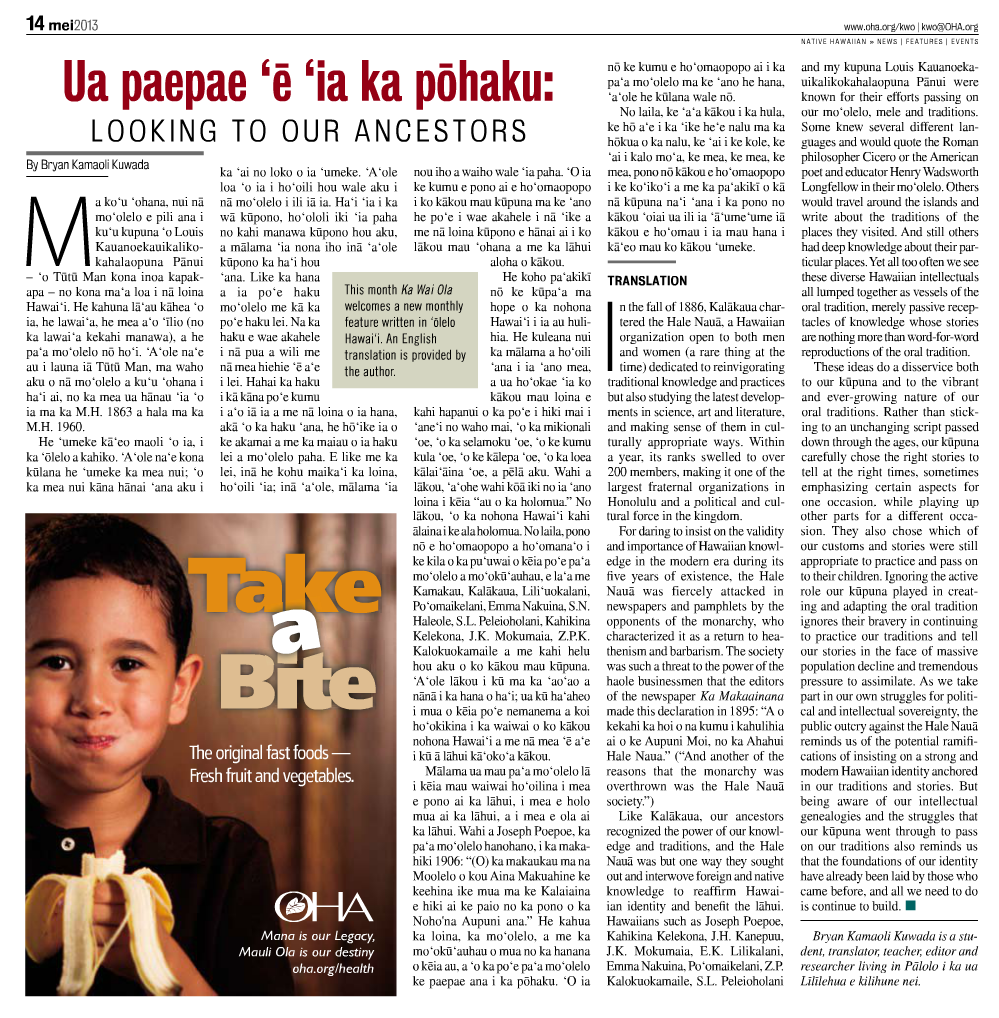
[Appropriate for this Lei Day, i found a lei woven with great thought and care within the pages of the current Ka Wai Ola, out today. This is a two-stranded lei—two insightful articles (both on a like topic, but one not a translation of the other) by Bryan Kamaoli Kuwada, student, translator, teacher, editor, and researcher living in Palolo i ka ua Lililehua e kilihune nei. Do read it and do pass it on.

For the entire issue, click here: Ka Wai Ola, Mei 2013.]

“Ua paepae ʻē ʻia ka pōhaku: Looking to Our Ancestors.”

Ua paepae e ia ka pohaku: Looking to our Ancestors

Ka Wai Ola, Volume 30, Number 5, Page 14. Mei 2013.

Response to hula commentary, 1891.

THE HULA AND THE “P. C. ADVERTISER.”

Another example of the “P. C. Advertiser’s” moral attitude appears int the announcement, that a hula given by the Hon. J. A. Cummins at his resident at Waimanalo was a glorious affair.—We have no doubt, that the display was exceptionally fine, since the ex-Premier has a well earned reputation as a connoiseur in that line, and is said to use the collection of females, formerly of boat house fame, second to none in the country.—Still there is something about the hula, that has so far excluded it from the programs of church festivals and school exercises.—It has never been recommended to lure the mind to thoughts of higher and better things or to produce rigid uprightness of morals.

The hula is a graceful and rhythmic representation of certain actions of the human animal. There is no doubt, that from the earliest ages the physiology of reproduction has been the most intrinsically interesting known to man. After the question of food and personal safety, it is the most important consideration in the lives of man, savage and civilized. The Hindoos and Budhists covered their temples and public buildings with indecent pictures, which in some instances took the form of a cross. This was imported to Rome together with the worship of Isis. So every spire on a Christian Church represents a resurrection of the flesh. But civilized society has decided for good reason to cover Isis with a vail and put Osiris in a straight-jacket. It is only those, who believe in the infallibility and prerogatives derived from gold—as some of our friends—who may wish to go back to the first principles and have the hula taught as an accomplishment in our public schools, so that it might prove more attractive in catching a husband and certainly in domesticating him when caught, than the art of piano playing or embroidery. There are great posibilities in the hula! But at present it is prohibited by the law, and we are sorry to see the law violated by those who ought to know better.

(Leo o ka Lahui, 5/14/1891, p. 4)

THE HULA AND THE "P. C. ADVERTISER."

Ka Leo o ka Lahui, Buke II, Helu 193, Aoao 4. Mei 14, 1891.

More stories about alalaua, 1873.

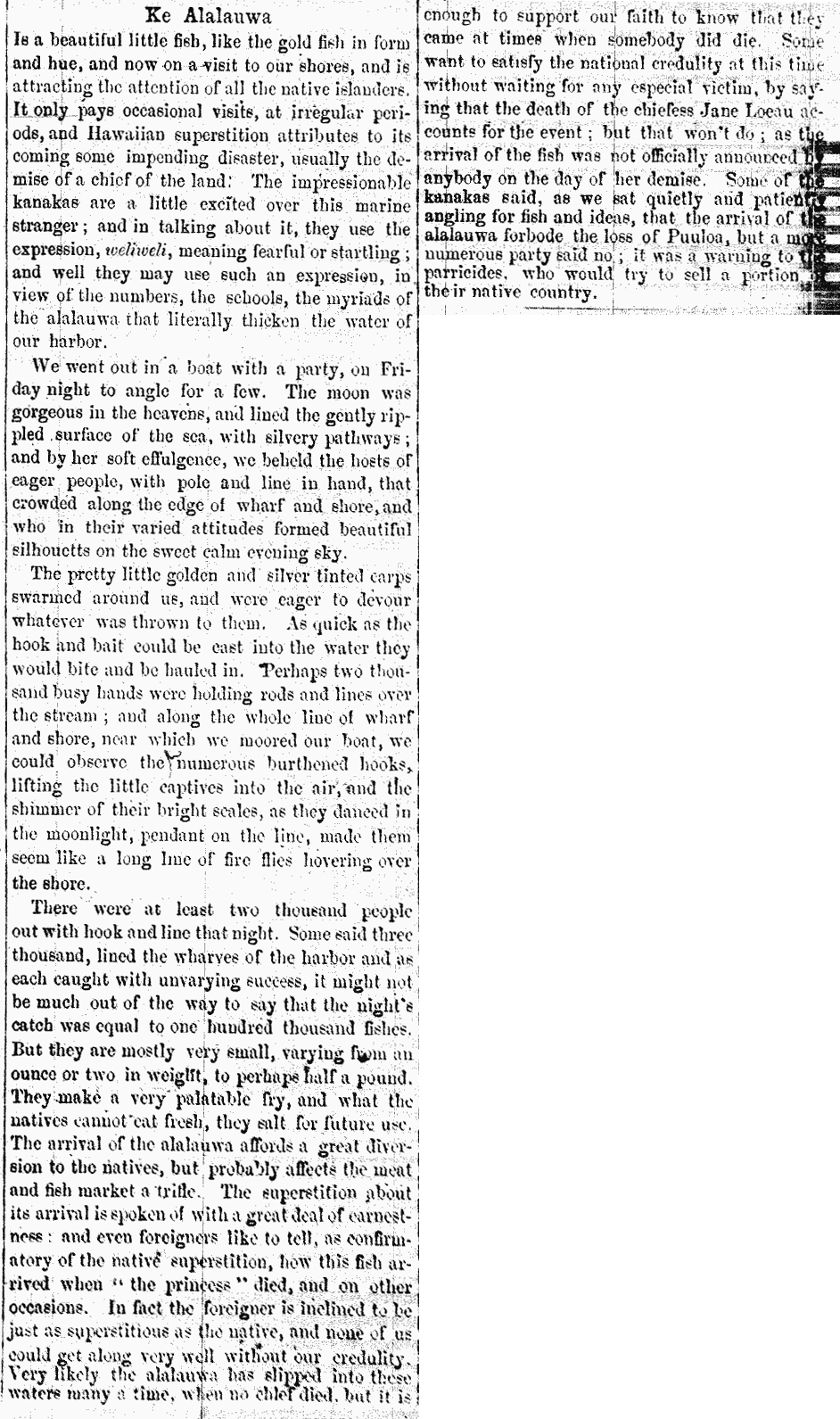
Alalauwa

Is a beautiful little fish, like the gold fish in form and hue, and now on a visit to our shores, and is attracting the attention of all the native islanders. It only pays occasional visits, at irregular periods, and Hawaiian superstition disaster, usually the demise of a chief of the land. The impressionable kanakas are a little excited over this marine stranger; and in talking about it, they use the expression, weliweli, meaning fearful or startling; and well they may use such expression, in view of the numbers, the schools, the myriads of the alalauwa that literally thicken the water of our harbor.

We went out in a boat with a party, on Friday night to angle for a few. The moon was gorgeous in the heavens, and lined the gently rippled surface of the sea, with silvery pathways; and by her soft effulgence, we beheld the hosts of eager people, with pole and line in hand, that crowded along the edge of wharf and shore, and who in their varied attitudes formed beautiful silhouetts on the sweet calm evening sky.

The pretty little golden and silver tinted carps swarmed around us, and were eager to devour whatever was thrown to them. As quick as the hook and bait could be cast into the water they would bite and be hauled in. Perhaps two thousand busy hands were holding rods and lines over the stream; and along the whole line of wharf and shore, near which we moored our boat, we could observe the numerous burthened hooks, lifting the little captives into the air, and the shimmer of their bright scales, as they danced in the moonlight, pendant on the line, made them seem like a long line of fire flies hovering over the shore.

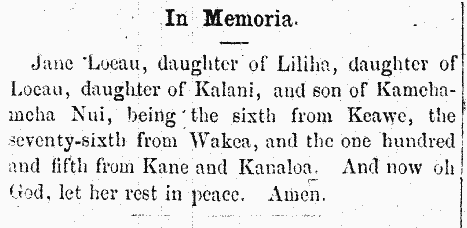
There were at least two thousand people out with hook and line that night. Some said three thousand, lined the wharves of the harbor and as each caught with unvarying success, it might not be much out of the way to say that the night’s catch was equal to one hundred thousand fishes. But they are mostly very small, varying from an ounce or two in weight, to perhaps half a pound. They make very palatable fry, and what the natives cannot eat fresh, they salt for future use. The arrival of the alalauwa affords great diversion to the natives, but probably affects the meat and fish market a trifle. The superstition about its arrival is spoken of with a great deal of earnestness: and even foreigners like to tell, as confirmatory of the native superstition, how this fish arrived when “the princess” died, and on other occasions. In fact the foreigner is inclined to be just as superstitious as the native, and none of us could get along very well without our credulity. Very likely the alalauwa has slipped into these waters many a time, when no chief died, but it is enough to support our faith to know that they came at times when somebody did die. Some want to satisfy the national credulity at this time without waiting for any especial victim, by saying that the death of the chiefess Jane Loeau accounts for the event; but that won’t do; as the arrival of the fish was not officially announced by anybody on the day of her demise. Some of the kanakas said, as we sat quietly and patiently angling for fish and ideas, that the arrival of the alalauwa forbode the loss of Puuloa,¹ but a more numerous party said no; it was a warning to the parricides, who would try to sell a portion of their native country.

¹Pearl Harbor

(Nuhou, 8/12/1873, p. 1)

Ke Alalauwa

Nuhou, Volume II, Number 9, Page 1. August 12, 1873.

Denial of intent to annex Hawaii, 1891.

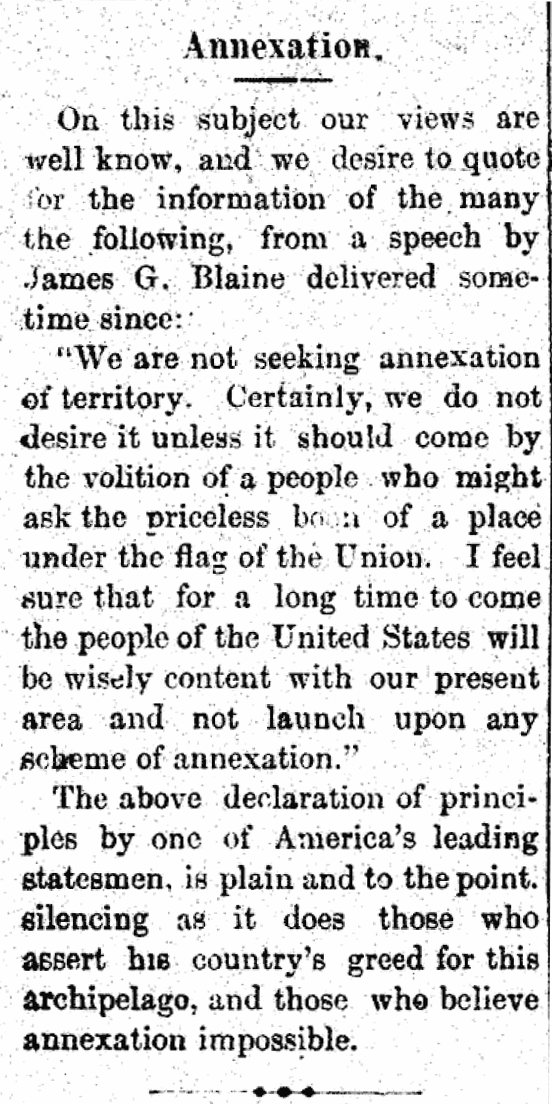
Annexation.

On this subject our views are well known, and we desire to quote for the information of the many the following, from a speech by James G. Blaine delivered sometime since:

“We are not seeking annexation of territory. Certainly, we do not desire it unless it should come by the volition of a people who might ask the priceless boon of a place under the flag of the Union. I feel sure that for a long time to come the people of the United States will be wisely content with our present area and not launch upon any scheme of annexation.”

The above declaration of principles by one of America’s leading statesman is plain and to the point, silencing as it does those who assert his country’s greed for this archipelago, and those who believe annexation impossible.

(Leo o ka Lahui, 9/11/1891, p. 4)

Annexation.

Ka Leo o ka Lahui, Buke II, Helu 278, Aoao 4. Sepatemaba 11, 1891.

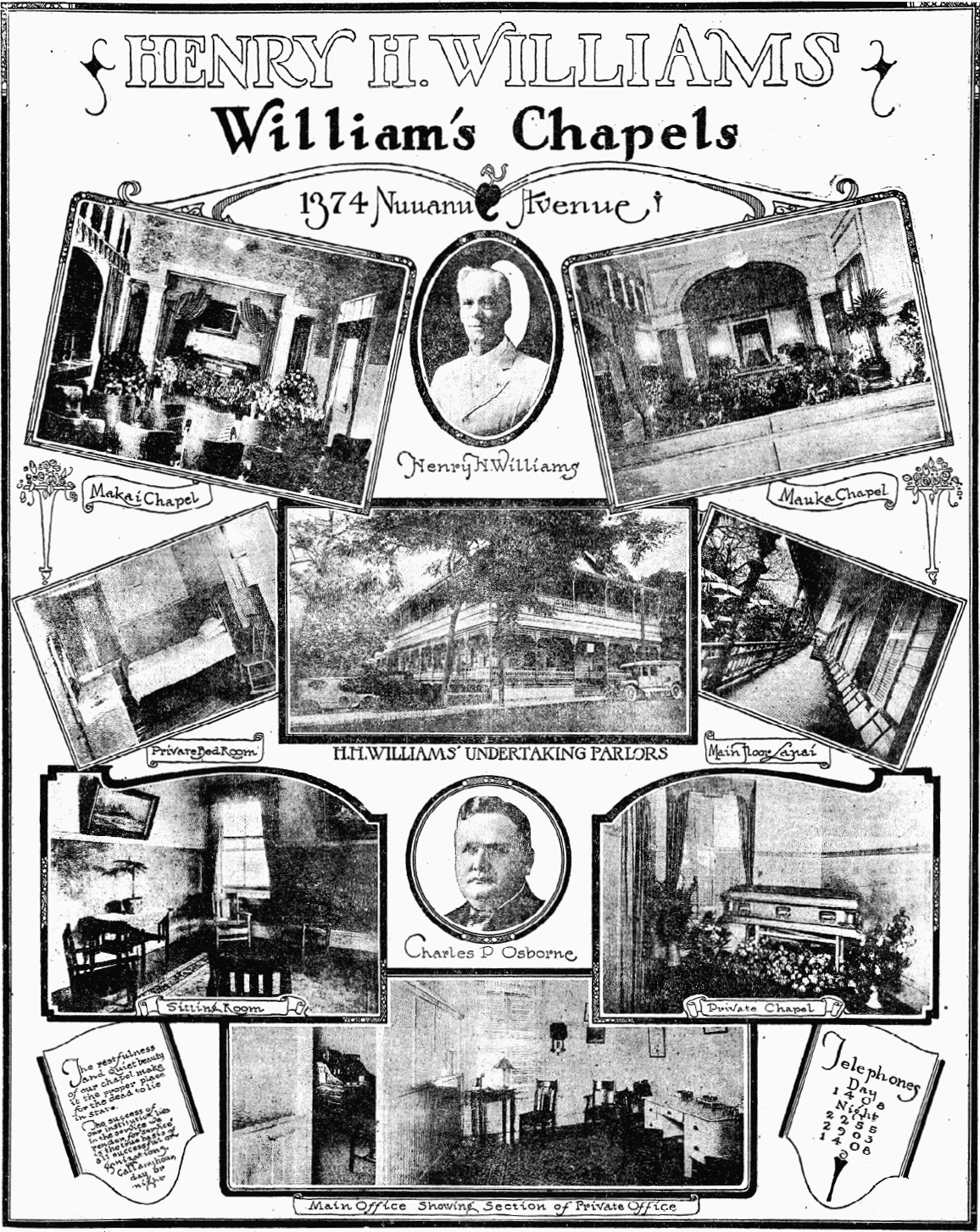
Full-page advertisement, Henry H. Willams, 1922.

HENRY H. WILLIAMS

William’s Chapels

1374 Nuuanu Avenue

Makai Chapel;  Henry H. Williams;  Mauka Chapel

Private Bed Rooms;  H. H. WILLIAMS’ UNDERTAKING PARLORS;  Main Floor Lanai

Sitting Room;  Charles P. Osborne;  Private Chapel

The restfulness and quiet beauty of our chapel make it the proper place for the dead to lie in state.

The success of our institutions lies in the service we render for service is the true basis of all successful organizations.

Call any hour, day or night.

Main Office Showing Section of Private Office.

Telephones
Day 1408
Night
2255
2903
1408

[A full-page ad by a business was not common in the Hawaiian-Language Newspapers, whether in Hawaiian or English.]

(Kuokoa, 11/9/1922, p. 3)

HENRY H. WILLIAMS

Ka Nupepa Kuokoa, Buke LXI, Helu 45, Aoao 3. Novemaba 9, 1922.

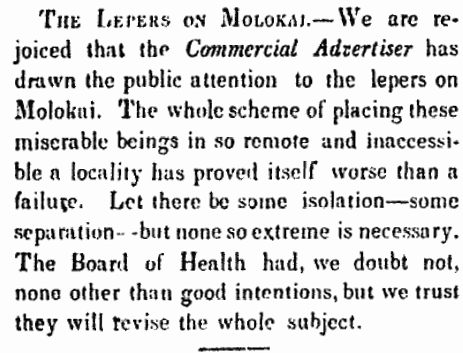
Critique of Government Policy to Isolate Leprosy Patients, 1867.

[Found under: “English Column.: Island News.”]

The Lepers on Molokai.—We are rejoiced that the Commercial Advertiser has drawn the public attention to the lepers on Molokai. The whole scheme of placing these miserable beings in so remote and inaccessible locality has proved itself worse than a failure. Let there be some isolation—some separation—but none so extreme is necessary. The Board of Health had, we doubt not, none other than good intentions, but we trust they will revise the whole subject.

[This article comes out soon after the policy to isolate the patients in Kalawao and Kalaupapa. It is a response to articles appearing in the Pacific Commercial Advertiser (predecessor of the Honolulu Advertiser). See following two posts.]

(Kuokoa, 1/19/1867, p. 2)

The Lepers on Molokai...

Ka Nupepa Kuokoa, Buke VI, Helu 3, Aoao 2. Ianuari 19, 1867.

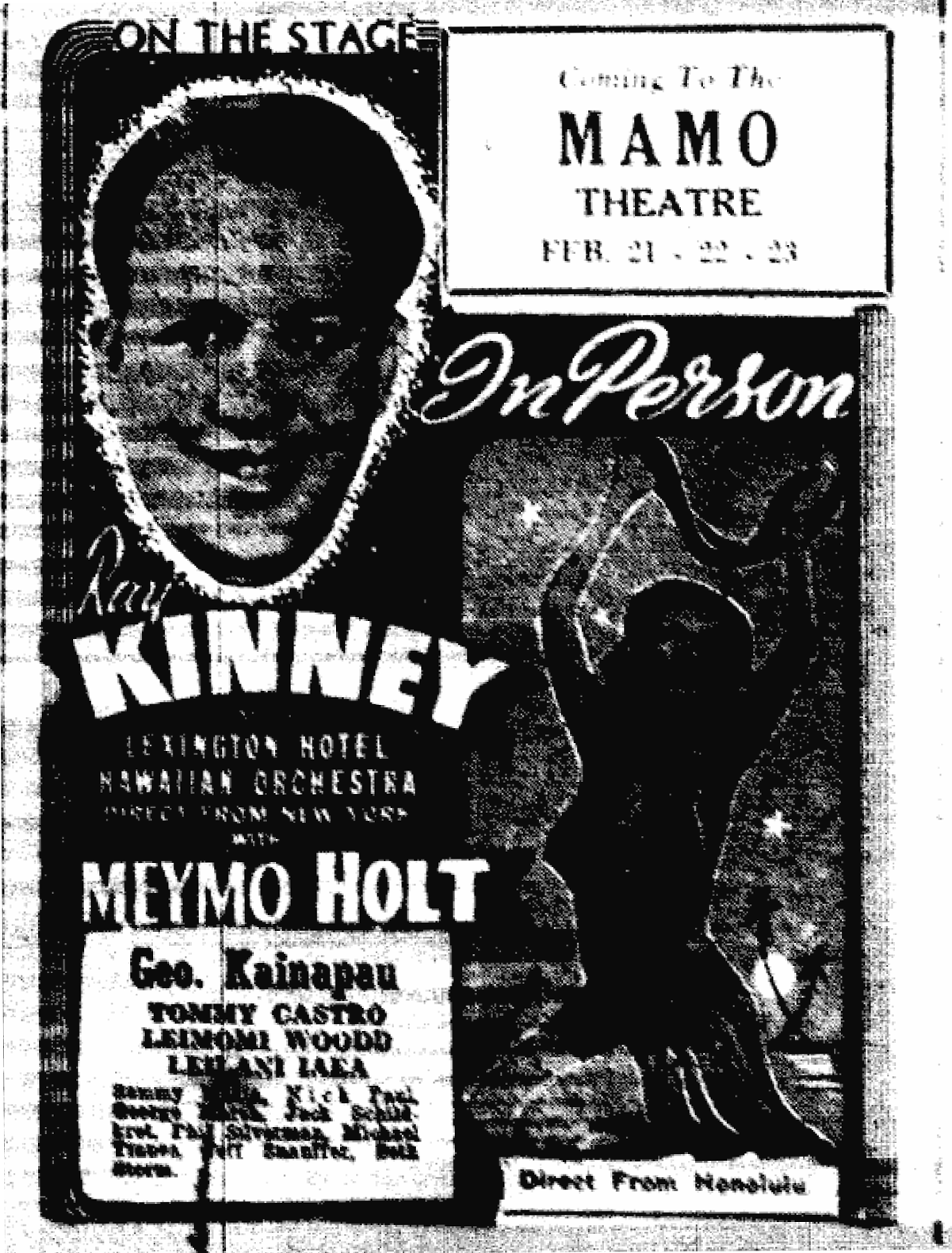
Ray Kinney and group from the Lexington Hotel performing in his hometown, Hilo, 1940.

ON THE STAGE

Coming To The

MAMO

THEATRE

FEB 21 – 22 – 23

In Person

Ray

KINNEY

LEXINGTON HOTEL

HAWAIIAN ORCHESTRA

DIRECT FROM NEW YORK

WITH

MEYMO [Ululani] HOLT

George Kainapau

TOMMY CASTRO

[Lillian] LEIMOMI WOODD

LEILANI IAEA

[illegible group of names]

Direct From Honolulu

[It seems the Senate Honored the entertainers and workers of the Lexington Hotel’s Hawaiian Room on its 75th anniversary just the other month!

There is also going to be a presentation related to this at the Distinctive Women in Hawaiian History Program on Saturday, September 15, 2012)

Unfortunately, the available digital image is as seen below, the actual  newspaper image should probably be much more clear and legible.]

(Hoku o Hawaii, 2/21/1940, p. 4)

ON THE STAGE

Ka Hoku o Hawaii, Volume XXXIV, Number 43, Page 4. Pepeluali 21, 1940.

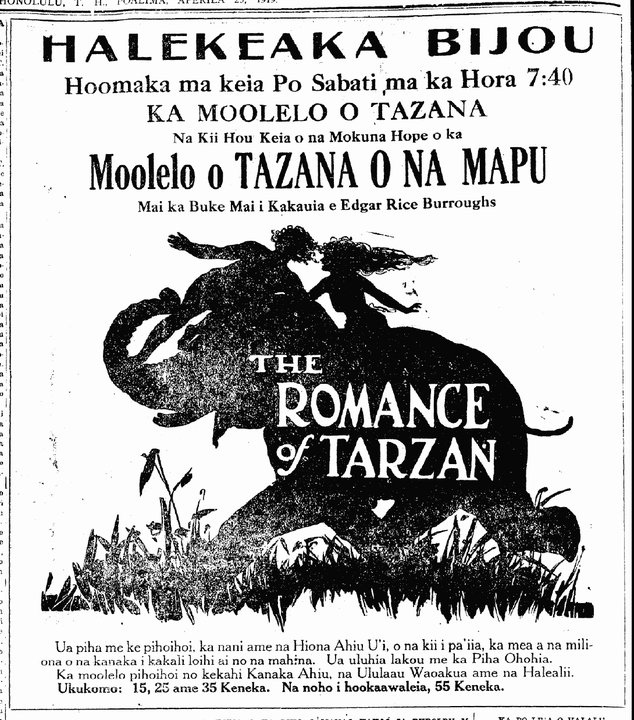
Tarzan ad, 1919.

BIJOU THEATRE

Starting this Sunday Night at 7:40

THE STORY OF TARZAN

These are Pictures From the Last Chapters of the

Story of TARZAN OF THE APES

From the Book by Edgar Rice Burroughs

THE ROMANCE OF TARZAN

Filled with excitement, magnificence, and Wild Beauty; the images taken are what millions of people have been awaiting for months. They are overcome with total fascination.

The thrilling story of a Primitive Man, Jungle Wilds, and Palaces.

Entrance fee: 15, 25, and 35 Cents. Reserved seating: 55 Cents.

[Chronicling America does not have any Honolulu papers up yet for this year, so here is a similar ad printed in The Garden Island, 5/27/1919, p. 3.]

(Kuokoa 4/25/1919, p. 2)

HALEKEAKA BIJOU

Ka Nupepa Kuokoa, Buke LVII, Helu 17, Aoao 2. Aperila 25, 1919.

Law banning the killing of imported birds, 1870.

HE KANAWAI

E HOOLOLI ANA I KA PAUKU 3 A ME KA PAUKU 7, A E HOOPAU ANA I KA PAUKU 5, O KA MOKUNA LXXXV O KE KANAWAI HOOPAI KARAIMA.

E hooholoia e ka Moi a me ka Hale Ahaolelo o ko Hawaii Pae Aina i akoakoa iloko o ka Ahaolelo Kaukanawai o ke Aupuni:

PAUKU 1. E hoololiia a ma keia ke hoololiia nei ka Pauku 3, o ka Mokuna LXXXV o ke Kanawai Hoopai Karaima, a penei e heluheluia ai:

“PAUKU 3. Ina e pepehi a hoomake paha kekahi kanaka ma ke ki ana i ka pu, ma ke kipukaahele a ma kekahi ano e ae paha, i kekahi manu i laweia mai mai na aina e mai i mea e laha ai kona ano manu ma keia Pae Aina, a i kekahi puka ana o ia ano manu mai na aina e mai i hookuu wale ia maloko o keia Aupuni, a ina hoi e lawe wale i na hua, a i na punana paha o ia mau ano manu, alaila, e hoopaiia oia, ke ku ka hewa ma ka hookolokoloia ana imua o kekahi Lunakanawai Hoomalu a Apana paha, aole emi malalo iho o na dala he umi, aole hoi e oi mamua o na dala he iwakalua no kela hewa keia hewa, a ina aole i hookaaia, alaila e noho oia ma ka Hale Paahao a kaa ia dala hoopai.”

PAUKU 2. E hoololiia ka Pauku 7, o ia Mokuna a ma keia, ua hoololiia, a penei ka heluhelu ana:

“PAUKU 7. Aole no e kipu, aole e pepehi ma kekahi ano e ae, kekahi mea i na holoholona holo wale i laweia mai, mai na aina e mai, a o kekahi puka ana mai o ia holoholona, iloko o na makahiki he umi mahope o ia lawe ana mai, malalo o ka hoopai aole e oi aku mamua o ke kanalima dala no ka hana ana pela.”

PAUKU 3. Ma keia e hoopauia ka Pauku 5 o ia Mokuna i oleloia.

PAUKU 4. E lilo keia i Kanawai i kona la e hooholoia ai.

Aponoia i keia la 8 o Iulai, M. H. 1870.

KAMEHAMEHA R.

(Au Okoa, 8/4/1870, p. 4)
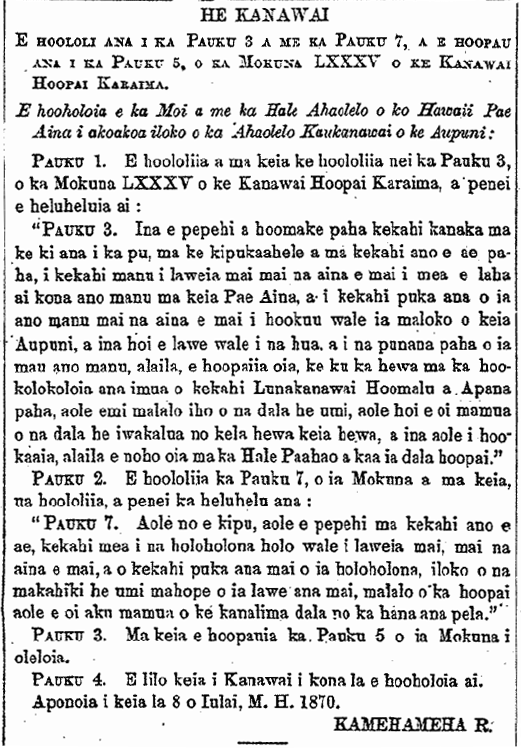
HE KANAWAI, E HOOLOLI ANA I KA PAUKU 3 A ME KA PAUKU 7...

Ke Au Okoa, Buke VI, Helu 16, Aoao 4. Augate 4, 1870.

AN ACT

TO AMEND SECTION 3 and 7 AND REPEAL SECTION 5 OF CHAPTER LXXXV OF THE PENAL CODE.

Be it Enacted by the King and the Legislative Assembly of the Hawaiian Islands, in the Legislature of the Kingdom assembled:

SECTION 1. That Section 3 of Chapter LXXXV of the Penal Code, be and hereby is amended to read as follows:

Section 3. Any person who shall shoot, snare or otherwise destroy any bird, brought from a foreign country for the purpose of propagating its species within this Kingdom, or any of the progeny of such imported bird; or who shall disturb the eggs and nests of such birds, shall, on conviction, before any Police or District Justice, be fined not less than ten dollars, nor more than twenty dollars, for each offense, and in default of payment, be imprisoned until such fine is paid.

SECTION 2. That Section 7 of the said Chapter be, and hereby is amended to read as follows:

“SECTION 7. No person shall shoot or otherwise destroy any animals ‘Feræ Naturæ,’ which shall have been introduced into this Kingdom, within ten years, nor the progeny of such animals, under a penalty of not more than fifty dollars for each offense.”

SECTION 3. That Section 5 of said Chapter, is hereby repealed.

SECTION 4. This Act shall take effect and become a law from and after the date of its passage.

Approved this 8th day of July, A. D. 1870.

KAMEHAMEHA R.

(Hawaiian Gazette, 7/27/1870, p. 4)
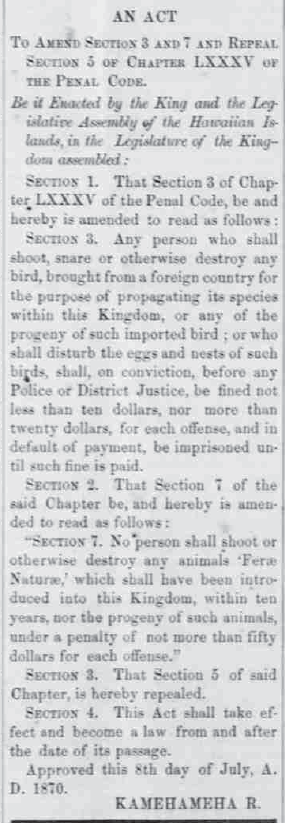
AN ACT, TO AMEND SECTION 3 and 7 AND REPEAL SECTION 5...

Hawaiian Gazette, Volume VI, Number 28, Page 4. July 27, 1870.