The call to protest in English, 1894.

A SOLEMN PROTEST.

The People of Hawaii protest against the New Constitution and Mr. Dole’s Republic.

This afternoon at five o’clock the loyal citizens of Hawaii will meet on Palace Square, and enter a solemn and earnest protest against the infamous outrage, which it is proposed to perpetuate on Wednesday—the proclaiming of a republic of filibusters, the proclamation of a constitution framed by aliens and for the sole benefit of certain classes.

The temporary power invested in the provisional government was obtained through a most contemptible conspiracy, and through underhanded tricks. The revolt of January 1893 was not the outcome of a spontaneous outburst of the popular will. It was the most contemptible act on record in history. The hired brigand John L. Stevens used his brief authority to further this scheme. The country which he represented disavowed his actions and thought that the honor of the United States was saved by dismissing him, and in six lines in a message to congress rebuking him.

The world thinks differently, and there are no reasons to believe hat President Cleveland will allow himself, and his administration to be covered with infamy by leaving an admitted wrong unrepaired.

In this, the fin de siecle, the bloody ravage of war and revolution is out of fashion and arbitration has taken the place of force. But, it is necessary to show to the world that the Hawaiian People are not participating in the revolutionary movement of the oath-breaking ex-Judge, who now maskerades as a president of a republic. The People of Hawaii believe in self-government and, by the Heavens they will have it. The people shall rule. The will of the people shall be the force which makes the government.

When, this afternoon, Hawaiians and foreigners be the Anglo-Saxons, Portuguese or Chinese, stand sholder to shoulder and listen to J. O. Carter, Hawaii’s best citizen, reading the protest of Hawaii against the usurpers the loyal men they can rest assured that their protest will be heard and echoed all over the civilized world, and that the unrelenting and solid opposition to the junta, now calling themselves a republic, will be supported and admired by every power that knows the existence of these fair isles. Let therefore every man, woman and child of every race, nationality and birth be present on Palace Square, and by their presence testify to the true desire of the people of Hawaii, and quietly, orderly and peacefully prove to the world that the new government is unpopular, detested, and created against the will of the Hawaiian nation.

(Hawaii Holomua, 7/2/1894, p. 2)

A SOLEMN PROTEST.

Hawaii Holomua, Volume III, Number 153, Page 2. July 2, 1894.

D. L. Conkling, from bicyclist to treasurer, 1909.

BICYCLE RACER IS NOW TERRITORIAL TREASURER

David L. Conkling Is Given Fat Job in Hawaii

[Special Correspondence of the Call]

HONOLULU, July 2.—David Lloyd Conkling, formerly chief clerk of the territory, has been appointed territorial treasurer to succeed A. M. Campbell, whom the senate refused to confirm.

Conkling is a young man who came to Hawaii from San Francisco as a fancy bicycle rider and racer, having been well known on the coast tracks 10 years ago.

After the bicycle craze died out he became purser on one of the inter-island steamers and later was a reporter for the Honolulu papers. He was appointed chief clerk by Governor Carter and received his promotion from Governor Frear.

Conkling’s appointment has been received with general favor.

(San Francisco Call, 7/11/1909, p. 28)

BICYCLE RACER IS NOW TERRITORIAL TREASURER

San Francisco Call, Volume CVI, Number 41, Page 28. July 11, 1909.

Lohiauipo’s house disappears, 1892.

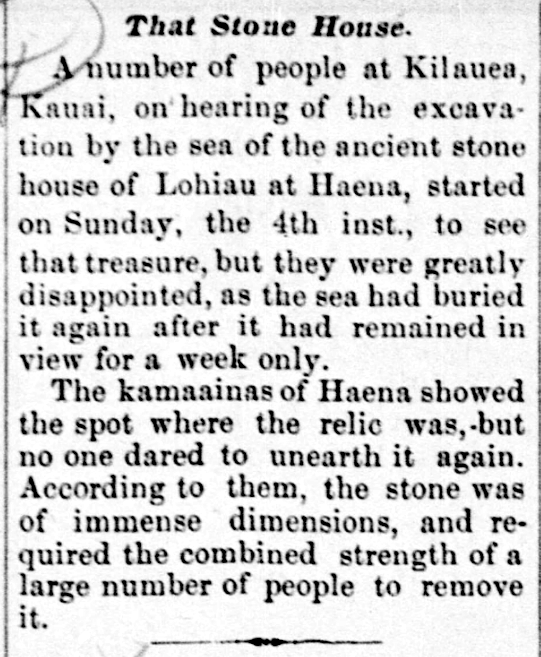
That Stone House.

A number of people at Kilauea, Kauai, on hearing of the excavation by the sea of the ancient stone house of Lohiau at Haena, started on Sunday, the 4th inst., to see that treasure, but they were greatly disappointed, as the sea had buried it again after it had remained in view for a week only.

The kamaainas of Haena showed the spot where the relic was, but no one dared to unearth it again. According to them, the stone was of immense dimensions, and required the combined strength of a large number of people to remove it.

(Pacific Commercial Advertiser, 12/13/1892, p. 3)

That Stone House.

The Pacific Commercial Advertiser, Volume XVI, Number 3251, Page 3. December 13, 1892.

More on the stone house of Lohiau, 1892.

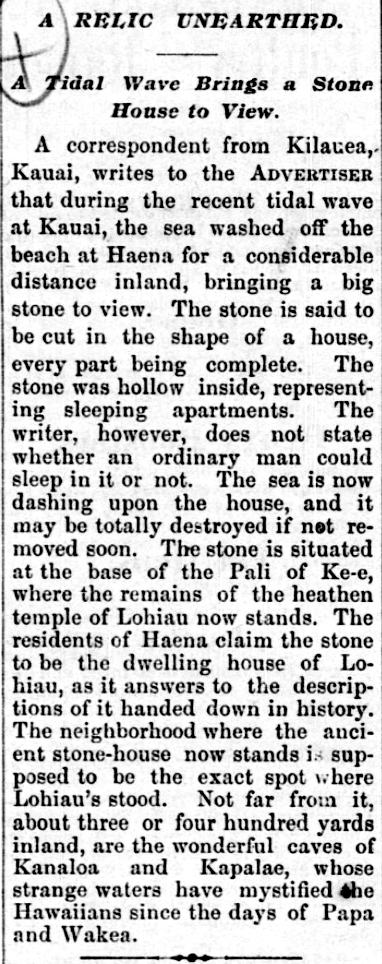
A RELIC UNEARTHED.

A Tidal Wave Brings a Stone House to View.

A correspondent from Kilauea, Kauai, writes to the Advertiser that during the recent tidal wave at Kauai, the sea washed off the beach at Haena for a considerable distance inland, bringing a big stone to view. The stone is said to be cut in the shape of a house, every part being complete. The stone was hollow inside, representing sleeping apartments. The writer, however, does not state whether an ordinary man could sleep in it or not. The sea is now dashing upon the house, and it may be totally destroyed if not removed soon. The stone is situated at the base of the Pali of Ke-e, where the remains of the heathen temple of Lohiau now stands. The residents of Haena claim the stone to be the dwelling house of Lohiau, as it answers to the descriptions of it handed down in history. The neighborhood where the ancient stone-house now stands is supposed to be the exact spot where Lohiau’s stood. Not far from it, about three or four hundred yards inland, are the wonderful caves of Kanaloa and Kapalae, whose strange waters have mystified the Hawaiians since the days of Papa and Wakea.

(Pacific Commercial Advertiser, 12/5/1892, p. 3)

A RELIC UNEARTHED.

The Pacific Commercial Advertiser, Volume XVI, Number 3244, Page 3. December 5, 1892.

Rabbits for the Prince, 1861.

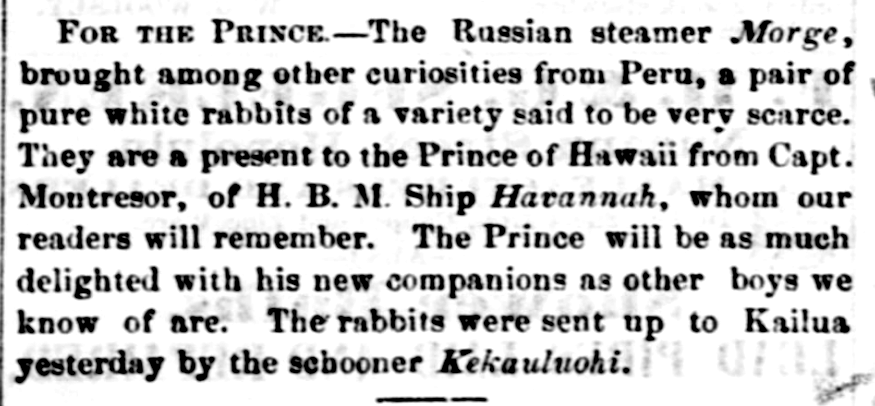
For the Prince—The Russian steamer Morge, brought among other curiosities from Peru, a pair of pure white rabbits of a variety said to be very scarce. They are a present to the Prince of Hawaii from Capt. Montresor, of H. B. M. Ship Havannah, whom our readers will remember. The Prince will be as much delighted with his new companions as other boys we know of are. The rabbits were sent up to Kailua yesterday by the schooner Kekauluohi.

[It is very interesting to compare this article with a Hawaiian-Language one found in the Kuokoa on 12/16/1861!]

(Pacific Commercial Advertiser, 12/5/1861, p. 2)

For the Prince.

The Pacific Commercial Advertiser, Volume VI, Number 23, Page 2. December 5, 1861.

More on George Glendon and Samoa, 1890.

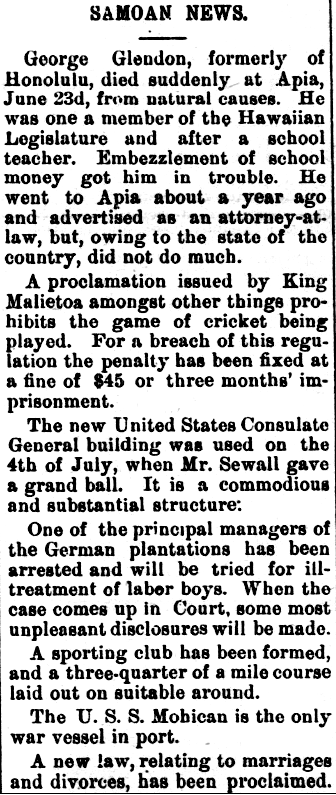
SAMOAN NEWS.

George Glendon, formerly of Honolulu, died suddenly at Apia, June 23d, from natural causes. He was one a member of the Hawaiian Legislature and after a school teacher. Embezzlement of school money got him in trouble. He went to Apia about a year ago and advertised as an attorney-at-law, but, owing to the state of the country, did not do much.

A proclamation issued by King Malietoa amongst other things prohibits the game of cricket being played. For a breach of this regulation the penalty has been fixed at a fine of $45 of three months’ imprisonment.

The new United States Consulate General building was used on the 4th of July, when Mr. Sewall gave a grand ball. It is a commodious and substantial structure.

One of the principal managers of the German plantation has been arrested and will be tried for ill-treatment of labor boys. When the case comes up in Court, some most unpleasant disclosures will be made.

A sporting club has been formed, and a three-quarter of a mile course laid out on suitable around.

The U. S. S. Mohican is the only war vessel in port.

A new law, relating to marriages and divorces, has been proclaimed.

(Pacific Commercial Advertiser, 7/28/1890, p. 2)

SAMOAN NEWS.

Pacific Commercial Advertiser, Volume XII, Number 23, Page 2. July 28, 1890.


Kamehameha boys graduate, 1917.

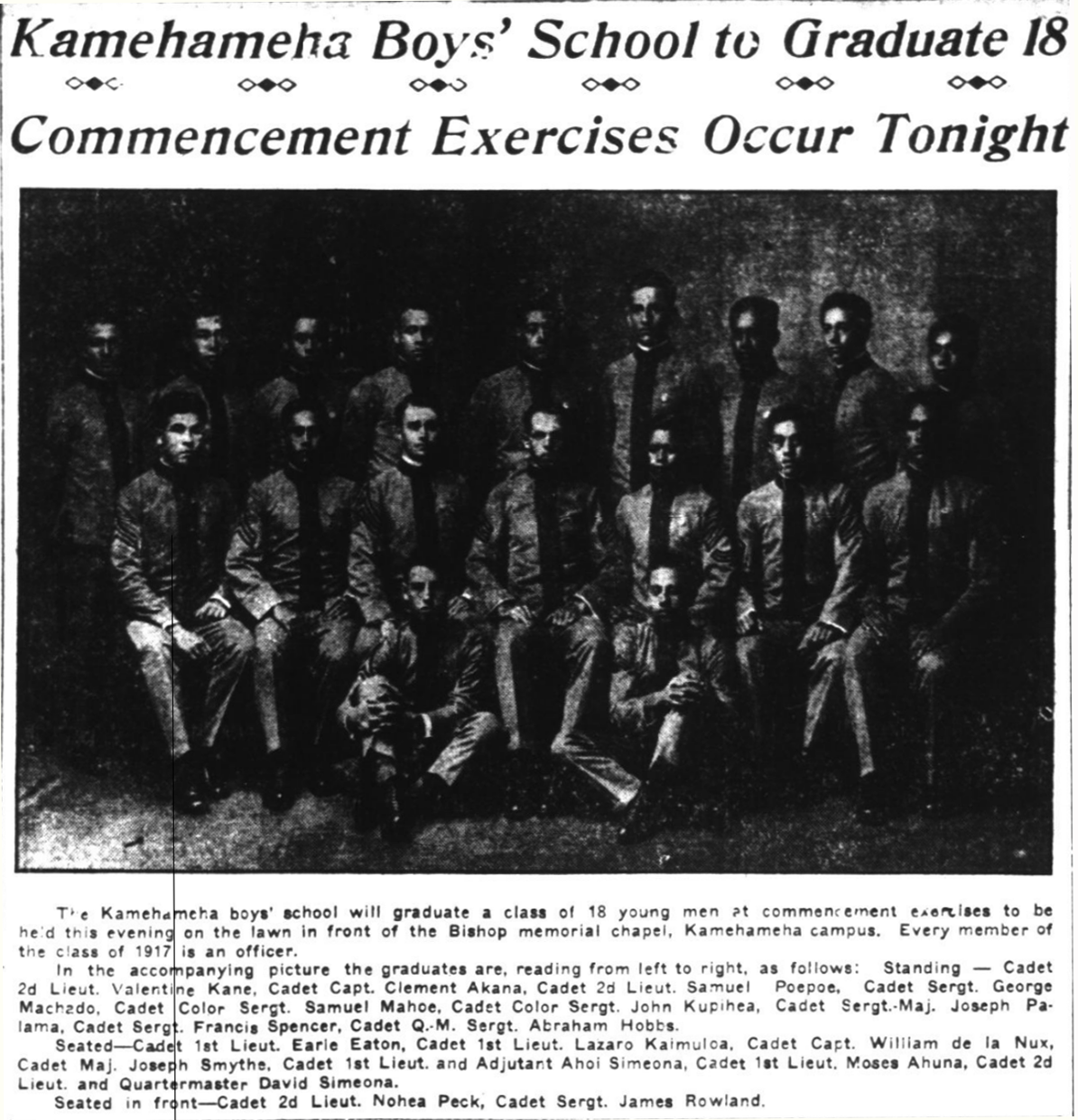
Kamehameha Boys’ School to Graduate 18 Commencement Exercises Occur Tonight

The Kamehameha boys’ school will graduate a class of 18 young men at commencement exercises to be held this evening on the lawn in front of the Bishop memorial chapel, Kamehameha campus. Every member of the class of 1917 is an officer.

In the accompanying picture the graduates are, reading from left to right, as follows: Standing—Cadet 2d Lieut. Valentine Kane, Cadet Capt. Clement Akana, Cadet 2d Lieut. Samuel Poepoe, Cadet Sergt. George Machado, Cadet Color Sergt. Samuel Mahoe, Cadet Color Sergt. John Kupihea, Cadet Sergt.-Maj. Joseph Palama, Cadet Sergt. Francis Spencer, Cadet Q. M. Sergt. Abraham Hobbs.

Seated—Cadet 1st Lieut. Earle Eaton, Cadet 1st Lieut. Lazaro Kaimuloa, Cadet Capt. William de la Nux, Cadet Maj. Joseph Smythe, Cadet 1st Lieut. and Adjutant Ahoi Simeona, Cadet 1st Lieut. Moses Ahuna, Cadet 2d Lieut. and Quartermaster David Simeona.

Seated in front—Cadet 2d Lieut. Nohea Peck, Cadet Sergt. James Rowland.

(Honolulu Star-Bulletin, 6/7/1917, p. 5)

Kamehameha Boys' School to Graduate 18...

Honolulu Star-Bulletin, Volume XXIV, Number 7847, Page 5. June 7, 1917.

Death of Mary Ann Kaaumokulani Kinoole Pitman Ailau, 1905.

DIED.

AILAU—In Hilo, Hawaii. February 11, 1905. Mrs. Mary Ann Kaaumokulani Kinoole Pitman Ailau, daughter of the High Chiefess Kinoole and the late Benjamin Pitman, and widow of John Keakaokalani Ailau, aged 67 years.

Mrs. Ailau was known from one end of the group to the other, and in Boston and many of the Atlantic watering places.

She was born at Hilo 67 years ago, and with the exception of a number of years spent in Boston and New England completing her education, she always resided in the islands. She was a daughter of Benjamin Pitman a capitalist, who resided both in Hilo and Honolulu. The Pitman home was at the corner of Alakea and Beretania streets, on the site now occupied by the C. Q. Yee Hop building.

The Pitmans came here from Boston, where they were well connected. Mrs. Ailau’s father-in-law also resided here for a number of years. Her father married the High Chiefess Kinoole, daughter of the High Chief Hoolulu. Continue reading

Hawaiian boys headed to China to play music, 1916.

[Found under: “LOCAL AND GENERAL”]

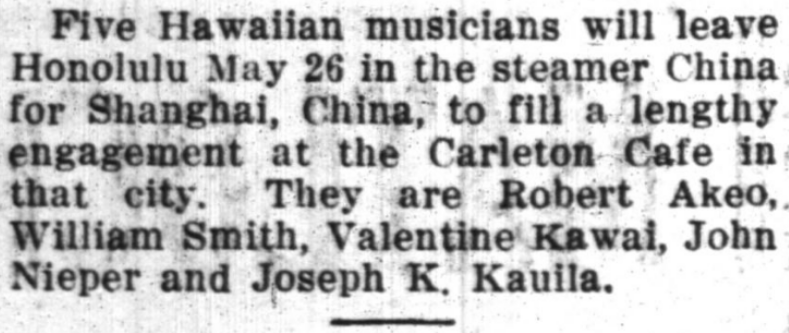
Five Hawaiian musicians will leave Honolulu May 26 in the steamer China for Shanghai, China, to fill a lengthy engagement at the Carleton Cafe in that city. They are Robert Akeo, William Smith, Valentine Kawai, John Nieper and Joseph K. Kauila.

(Honolulu Star-Bulletin, 5/9/1916, p. 3)

Five Hawaiian musicians...

Honolulu Star-Bulletin, Volume XXIII, Number 7511, Page 3. May 9, 1916.

Kamehameha School graduation, 1893.

KAMEHAMEHA SCHOOL.

Graduating Exercises at Kawaiahao Church—List of Graduates.

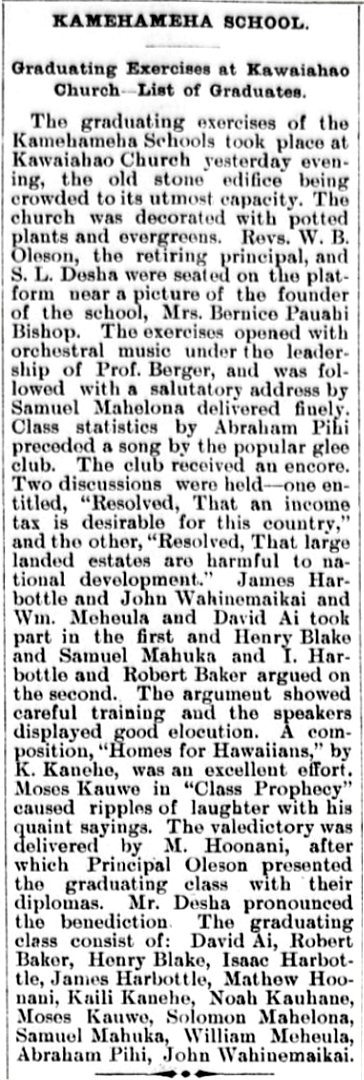
The graduating exercises of the Kamehameha Schools took place at Kawaiahao Church yesterday evening, the old stone edifice being crowded to its utmost capacity. The church was decorated with potted plants and evergreens. Revs. W. B. Oleson, the retiring principal, and S. L. Desha were seated on the platform near a picture of the founder of the school, Mrs. Bernice Pauahi Bishop. The exercises opened with orchestral music under the leadership of Prof. Berger, and was followed with a salutatory address by Samuel Mahelona delivered finely. Class statistics by Abraham Pihi preceded a song by the popular glee club. The club received an encore. Two discussions were held—one entitled, “Resolved, That an income tax is desirable for this country.” and the other, “Resolved, That large landed estates are harmful to national development.” James Harbottle and John Wahinemaikai and William Meheula and David Ai took part in the first and Henry Blake and Samuel Mahuka and I. Harbottle and Robert Baker argued on the second. The argument showed careful training and the speakers displayed good elocution. A composition, “Homes for Hawaiians,” by K. Kanehe, was an excellent effort. Moses Kauwe in “Class Prophecy” caused ripples of laughter with his quaint sayings. The valedictory was delivered by M. Hoonani, after which Principal Oleson presented the graduating class with their diplomas. Mr. Desha pronounced the benediction. The graduating class consist of: David Ai, Robert Baker, Henry Blake, Isaac Harbottle, James Harbottle, Matthew Hoonani, Kaili Kanehe, Noah Kauhane, Mose Kauwe, Solomon Mahelona, Samuel Mahuka, William Meheula, Abraham Pihi, John Wahinemaikai.

[Here is a picture of the class of 1893 found on the Kamehameha Schools Archives page. Some names given on the Archives page are not the same as found here.

Here is perhaps a more detailed article on the graduation appearing in the Hawaiian Gazette.

Yet another article in the Pacific Commercial Advertiser.

And this as well.

Also, see this touching follow up post on one of the graduates, Abraham Pihi!]

(Daily Bulletin, 6/16/1893, p. 3)

KAMEHAMEHA SCHOOL.

The Daily Bulletin, Volume V, Number 754, Page 3. June 16, 1893.