Might these be the feathers the Hawaiians were wearing in Salt Lake City? 1898.

CORSETS, HATS AND JEWELRY.

Some Late Fashion Hints—Philadelphia Physician Shows Women How to Lace.

A NEW PARIS COAT.

IBIS FEATHERS.

The promises of May are already being made, and tender hearts who will not have the plumage or bodies of dead songsters in their hats can this spring trim the hats with lovely ibis feathers that cost no avian lives, and are fair to look upon. Of course the purple ibis feathers from Egypt are to be classed among the costly beauties of millinery, but we have our own American scarlet ibis to borrow tail feathers from and fix in our new wide-brimmed hats.

This delicate plumage is, however, dyed many handsome colors, and, beside this and ostrich feathers, to be safely adopted by any Audubonite, we are going to have lovely hats later on trimmed so gracefully and economically with nothing but masses of shot taffeta silk cut on the bias and every edge closely pinked. This piece silk will assume, in fact, has already largely taken the place of ribbon bows for the trimming of simpler hats. Nothing can be more alluringly daring than a sapphire blue felt, with just a yard of cerise taffeta twisted about the crown, perky bows and ends starting up in every direction. Here and there the taffeta was caught down with cheap pins set with mock sapphires and rhinestones.

Nobody yet dares to assume which ways hats are going to tilt for spring wearing, but just in this midseason a tendency is making toward piling everything in front. Thake a look, for instance, at the crowning glory on the head of the model in the braided coat. It is typical of the daring frontage now used. Here the hat brim is of modes proportions; it is the mounting black and white ostrich tips that lend the stately effect. Another hat worth mentioning boasted a brim four and one-half inches wide, and this was turned directly off the face, bent into three perpendicular flutes, and over the edge of the brim, finished by puffings of black chiffon, nodded the heavy heads of half a dozen prize tall feathers.

(Salt Lake Hearld, 1/16/1898, p. 15)

SaltLakeHerald_1_16_1898_15.png

(The Salt Lake Herald, Number 49, Page 15. January 16, 1898.
John Wise on Hawaiian Homes and more, 1921.

The Question about the Work Ethic of Hawaiians.

Your writer [John Wise], continues to defend the Hawaiian lahui from being attacked by that question above.

The Hawaiians have perhaps become much talked about amongst those who do not know them and who are not familiar with their accomplishments of today and of the past. And maybe mostly these days for the land being given to us. Your writer frequently clashes with all kinds of other people who protest the giving of land to Hawaiians, because of the ridiculous idea that they don’t know how to work or that they are lazy.

In these attacks, we can see, O Lahui, that they are carried with criticisms and that it is would be a waste to confirm their misbeliefs. But so that the Hawaiians may answer these questions, your writer wants to be made known for all times the sound justification for our side. The readers of past issues of the Kuokoa have seen the responses given by the Commissioner in Washington, and they have seen also the other justifications given, in the newspaper.

The ultimate representation of the skill of a people is their supplying themselves with food and the things necessary for their livelihood. There perhaps is no better response than that. This lahui was living by  themselves for centuries, supplying themselves with everything, and received no assistance from the outside.

But there are things made by this lahui, things that attest to their fine craftsmanship, that will serve as a measure of their skills. Those that see Hawaiian canoes and their manufacture and how they can get Hawaiians through great gales, remaining solid in the dangers of the pounding of waves; how they could make beautiful canoes by using stone adzes; the distance they were taken from mountain to the sea; the patience of the canoe makers. All of these things will show, without being contradicted, that just by seeing the quality of the canoes can one see that this is a lahui that knows how to work. We see the canoes of today being made by people from other lands, and the canoes made by Hawaiians are far more well made and beautiful.

The beauty of things crafted by a people are undeniable proof of the work ethic of that people. Where will you find things more beautiful, O Hawaiians, if you travel all over the world, than the ahuula that are preserved at the Museum of Kamehameha School. Where is the lahui that lives on today, or perhaps has disappeared, that can make these outstanding works, with a beauty second to none, with fine craftsmanship, and patience; with a true sense of work ethic. Snaring birds is a great task all in itself, the inserting [kuku ana] of the feathers is a big job. One mamo feather cloak was said to have been started during the time of Umi and completed during the time of Kamehameha. For this ahu, the entire ahu were done with mamo feathers. And by our counting back, we see that ten generations of ancient kings passed on before the completion of this ahu; showing that it took from about 250 to 300 years of work. Where is there a great work that was completed by a people taking hundreds of years to construct? We perhaps can think of huge things, but as for something of this nature which required the knowledge and patience of men, there is no equal. Continue reading

More on Kalaniopuu’s ahuula and mahiole, 1887.

Captain Cook Relics.

Speaking of the Captain Cook relics which have been secured for the New South Wales Government, our London correspondent says, writing on September 9:—”Sir Saul Samuel has secured for the New South Wales Government the whole of the interesting collection of Captain Cook’s relics which were on view at the late Colonial and Indian Exhibition. Some of them he has had to purchase, others have been presented as gift. Your…

(Sydney Mail, 10/22/1887, p. 868)

SydneyMail_10_22_1887_868

The Sydney Mail, Volume XLIV, Number 1424, Page 868. October 22, 1887.

Continue reading

Kalaniopuu’s ahuula and mahiole that he placed on Cook, 1779 / 2016.

I just put up the short excerpt the other day describing Kalaniopuu giving James Cook his ahuula and kahili. And now there is this exciting announcement from the Bernice Pauahi Bishop Museum!

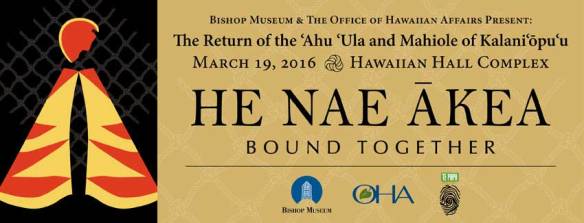
he-nae-akea

[It should be perhaps made clear however that the ahuula at least has made its way back to Hawaii nei two times since 1779, courtesy of the Dominion Museum, the predecessor of Te Papa Tongarewa]. The first time was in 1960:

DOMINION MUSEUM FEATHER CLOAK

Each year the Museum attempts to bring back for the Aloha Week exhibit a fine example of Hawaiian featherwork from abroad. This year the Dominion Museum of Wellington, New Zealand, has generously loaned a large Hawaiian feather cloak, which to the best of our knowledge, was presented to Captain Cook’s expedition in 1779. Aloha Week marks the first return of this cloak to Hawaii.

(Conch Shell: News of the Bishop Museum, October 1960)

The second time was for the “Artificial Curiosities” exhibit at the Bishop Museum which ran from January 18 to August 31, 1978.

Also, check out this previous post on an amazing story about other featherwork given to Cook by Kalaniopuu!

George Vancouver arrives once more on February 14, 1793.

[Found under: “He Moolelo Hawaii”]

Vancouver Returns

In the month of February, the 14 day, 1793, Vancouver [Vanekouwa] returned to Hawaii nei, from the northwest of America, and landed at Kawaihae.

The men pleaded for guns and powder from him. Vancouver refused and would not sell those sort things to them. There was great desire of Hawaiians for those things during those days, because it was a time of war, and Kamehameha was conquering the nation then; Oahu and Kauai remained.

And from there, Vancouver landed at Kealakekua, on the 22nd of that month and met with Kamehameha.

At that time, he gifted Kamehameha with two cattle, a bull and a cow. The cattle that Vancouver brought were from Monterey, a land in America.

These animals were greatly appreciated by Hawaiians because they were unusual, and they were called puaa pipi. It is from those pipi that the cattle which roam these days at Waimea and Maunakea and the other forests of Hawaii proliferated.

Kamehameha treated Vancouver kindly; Vancouver was facing hardship without water and took his water barrels into the uplands, and Kamehameha commanded his men to carry the barrels and to fill them with water. Continue reading

Recalling the death of James Cook, 1896.

[Found under: “He Moolelo no ka HOOKUMUIA ANA O HAWAII”]

PERTAINING TO THE DEATH OF LONO.

On the 24th of January 1779, Kalaniopuu returned from Maui; Lono was at Kealakekua in Kona, and Kalaniopuu met with Lono, and Kalaniopuu the chief treated Lono kindly and donned a ahu ula upon Lono, with kahili, and Kalaniopuu did a great many good things for Lono.

And on the 4th of February 1779, Lono leaves Kealakekua and his ship sails directly outside of Kawaihae and Kohala; it is noticed that one of the masts of his ship is rotten, so he returns to Kealakekua to build a new mast for his ship. Continue reading

Daughters of Hawaii to Put on Historical Play, 1913.

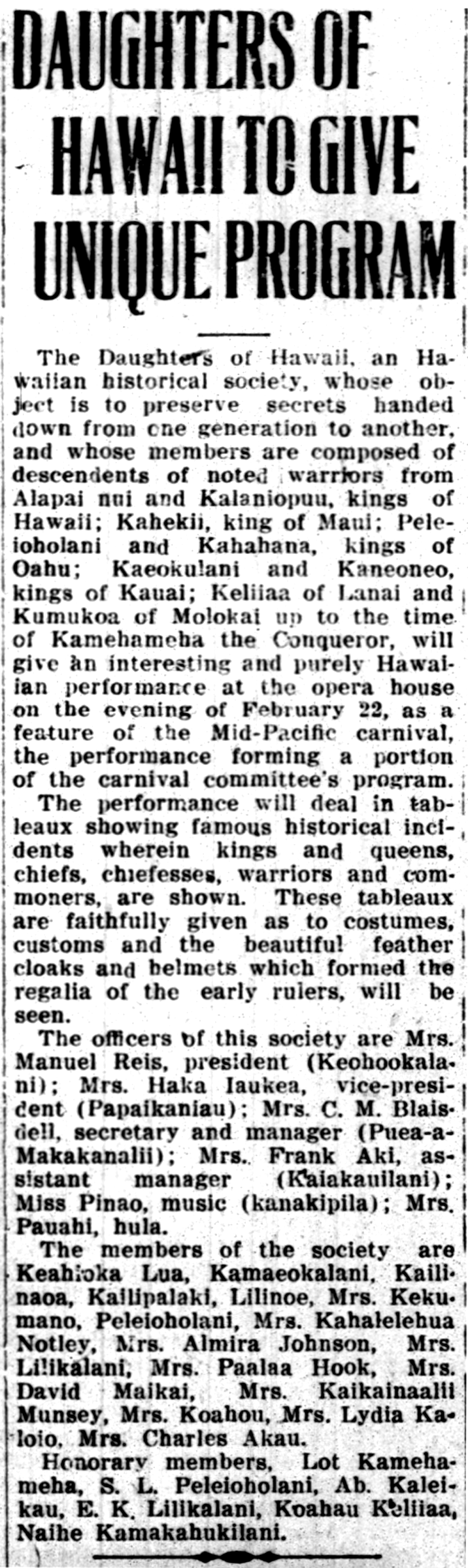
DAUGHTERS OF HAWAII TO GIVE UNIQUE PROGRAM

The Daughters of Hawaii, an Hawaiian historical society, whose object is to preserve secrets handed down from one generation to another, and whose members are composed of descendents of noted warriors from Alapai nui and Kalaniopuu, kings of Hawaii; Kahekili, king of Maui; Peleioholani and Kahahana, kings of Oahu; Kaeokulani and Kaneoneo, kings of Kauai; Keliiaa of Lanai and Kumukoa of Molokai up to the time of Kamehameha the Conqueror, will give an interesting and purely Hawaiian performance at the opera house on the evening of February 22, as a feature of the Mid-Pacific carnival, the performance forming a portion of the carnival committee’s program.

The performance will deal in tableaux showing famous historical incidents wherein kings and queens, chiefs, chiefesses, warriors and commoners, are shown. These tableaux are faithfully given as to costumes, customs and the beautiful feather cloaks and helmets which formed the regalia of the early rulers, will be seen.

The officers of this society are Mrs. Manuel Reis, president (Keohookalani); Mrs. Haka Iaukea, vice-president (Papakaniau); Mrs. C. M. Blaisdell, secretary and manager (Puea-a-Makakanalii); Mrs. Frank Aki, assistant manager (Kaiakauilani); Miss Pinao, music (kanikapila); Mrs. Pauahi [? Mrs. Puahi], hula.

The members of the society are Keahioka Lua, Kamaeokalani, Kailinaoa, Kailipalaki, Lilinoe, Mrs. Kekumano, Peleioholani, Mrs. Kahalelehua Notley, Mrs. Almira Johnson, Mrs. Lilikalani, Mrs. Paalaa Hook, Mrs. David Maikai, Mrs. Kaikainaalii Munsey, Mrs. Koahou, Mrs. Lydia Kaloio, Mrs. Charles Akau.

Honorary members, Lot Kamehameha, S. L. Peleioholani, Ab. Kaleikau [Abraham Kaleikau], E. K. Lilikalani, Koahau Keliiaa, Naihe Kamakahukilani.

(Honolulu Star-Bulletin, 2/18/1913, p. 5)

DAUGHTERS OF HAWAII TO GIVE UNIQUE PROGRAM

Honolulu Star-Bulletin, Volume XX, Number 6514, Page 5. February 18, 1913.

Ahahui Mamakakaua forms, 1917.

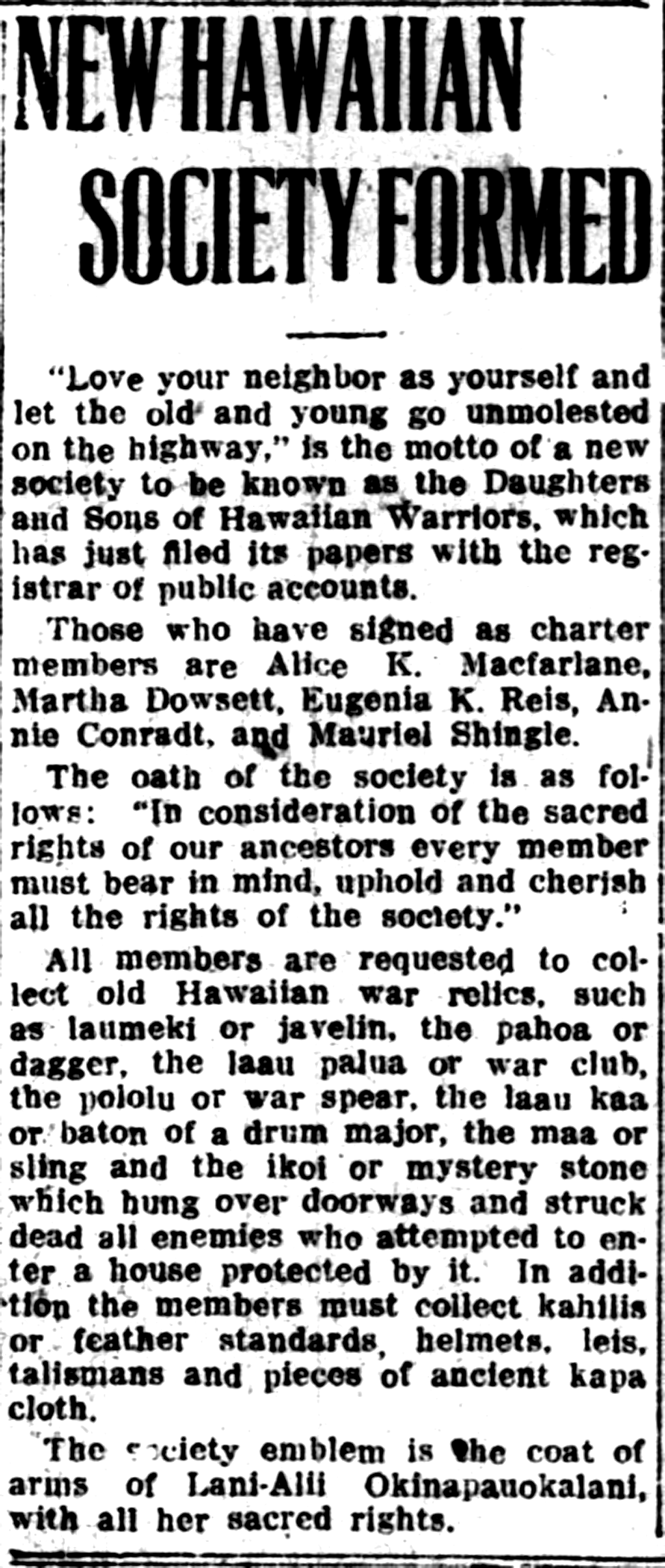
NEW HAWAIIAN SOCIETY FORMED

“Love your neighbor as yourself and let the old and young go unmolested on the highway,” is the motto of a new society to be known as the Daughters and Sons of Hawaiian Warriors, which has just filed its papers with the registrar of public accounts.

Those who have signed as charter members are Alice K. Macfarlane, Martha Dowsett, Eugenia K. Reis, Annie Conradt, and Mauriel Shingle [Muriel Campbell Shingle].

The oath of the society is as follows: “In consideration of the sacred rights of our ancestors every member must bear in mind, uphold and cherish all the rights of the society.”

All members are requested to collect old Hawaiian war relics, such as laumeki or javelin, the pahoa or dagger, the laau palua [laau palau] or war club, the pololu or war spear, the laau kaa or baton of a drum major, the maa or sling and the ikoi or mystery stone which hung over doorways and struck dead all enemies who attempted to enter a house protected by it. In addition the members must collect kahilis or feather standards, helmets, leis, talismans and pieces of ancient kapa cloth.

The society emblem is the coat of arms of Lani-Alii Okinapauokalani, with all her sacred rights.

(Honolulu Star-Bulletin, 10/24/1917, p. 14)

NEW HAWAIIAN SOCIETY FORMED

Honolulu Star-Bulletin, Volume XXV, Number 7966, Page 14. October 24, 1917.

Painting of lying in state of Queen Liliuokalani by Lionel Walden? 1917.

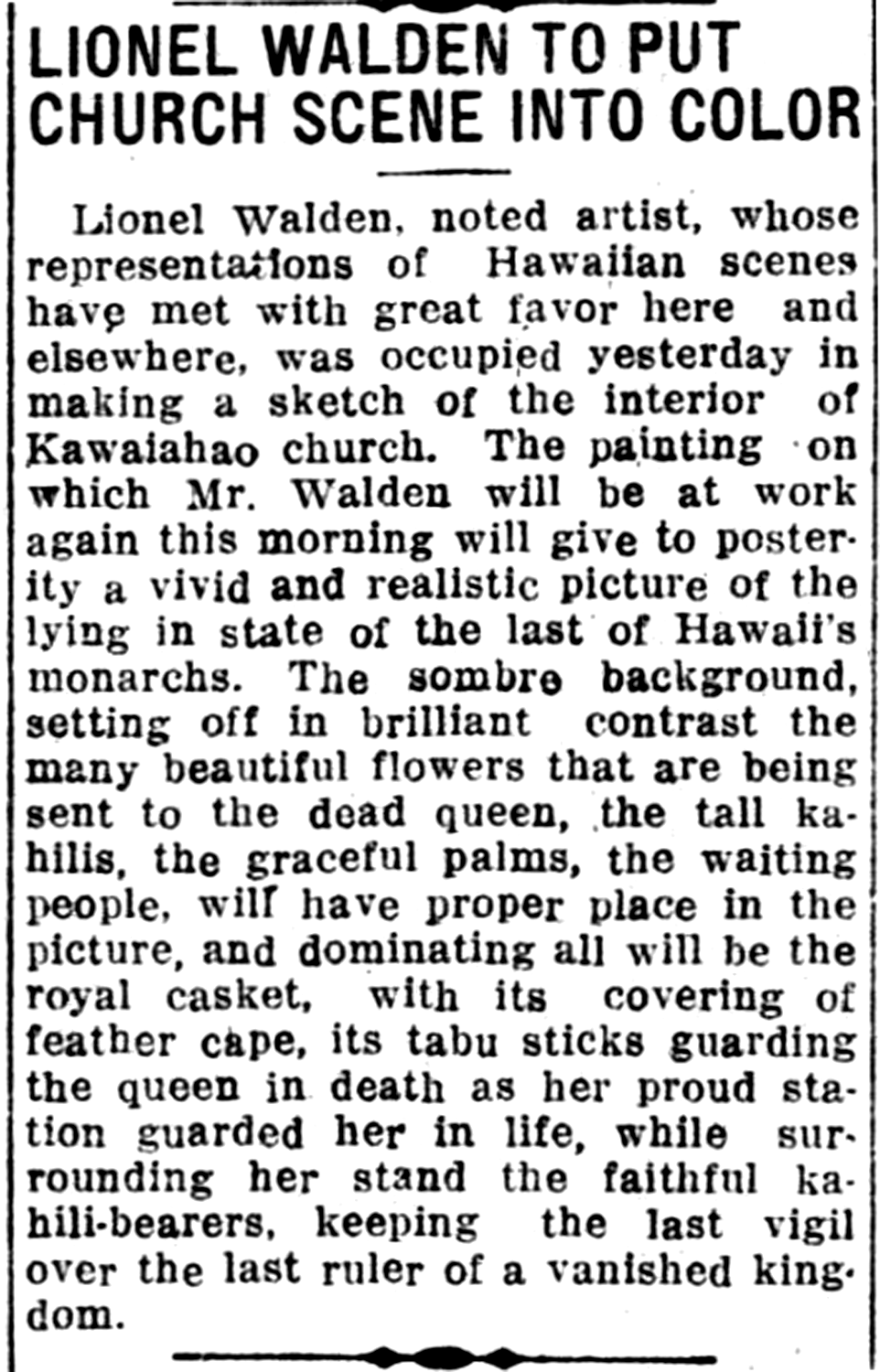
LIONEL WALDEN TO PUT CHURCH SCENE INTO COLOR

Lionel Walden, noted artist, whose representations of Hawaiian scenes met with great favor here and elsewhere, was occupied yesterday in making a sketch of the interior of Kawaiahao church. The painting on which Mr. Walden will be at work again this morning will give to posterity a vivid and realistic picture of the lying in state of the last of Hawaii’s monarchs. The somber background, setting off in brilliant contrast the many beautiful flowers that are being sent to the dead queen, the tall kahilis, the graceful palms, the waiting people, will have proper place in the picture, and dominating all will be the royal casket, with its covering of feather cape, its tabu sticks guarding the queen in death as her proud station guarded her in life, while surrounding her stand the faithful kahili-bearers, keeping the last vigil over the last ruler of a vanished kingdom.

[Wow. Does anyone know if this painting was completed and if so, where it is now?]

(Honolulu Star-Bulletin, 11/15/1917, p. 2)

LIONEL WALDEN TO PUT CHURCH SCENE INTO COLOR

Honolulu Star-Bulletin, Volume XXV, Number 7985, Page 2. November 15, 1917.

Keeaumoku’s ahuula, Eheukani, 1903.

FEATHER GARMENTS

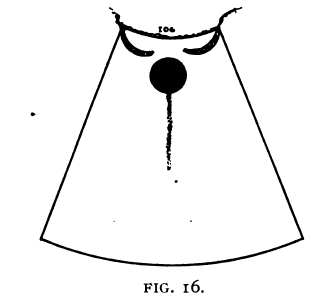
106. A cloak said to have been destroyed in the conflagration caused accidentally in the attempt of the Board of Health to stamp out the bubonic plague in the Chinese quarter of Honolulu. At the time when the claims for losses caused by this great fire were presented to the Commission appointed for the purpose, my assistant, Mr. Allen M. Walcott, obtained from the claimant, Peleioholani, a carpenter by trade, the following particulars: The cloak was called “Eheukani” and was made in the time of Keeaumoku (the father of Kaahumanu) and finished shortly before the battle of Mokuohai (July, 1782) between Kamehameha and Kiwalaó. Keeaumoku’s wife gave it to Peleioholani’s grandmother. Principally mamo* feathers with a small crescent of red iiwi in each upper corner; between the shoulders a round spot of black oo feathers, from which a line of red iiwi led down to a trifle below the middle of the cloak. The cords at the neck were of human hair, an unusual thing. It must be remembered that the design (Fig. 16) as well as the following measurements are from the description given to Mr. Walcott by Peleioholani and are of course only approximate. They are worth recording as differing from any robes described. Length, about 4 feet 9 inches; neck measurment about 2 feet; circumference at bottom about 5 feet 8 inches. It is a matter of tradition that 27,000 birds were captured to furnish the feathers for this cloak. In the left side were seven spear holes that were never patched, and about which were blood stains. Keeaumoku was severely wounded in this battle, and it was rather a fancy with the old chiefs to retain the honorable scars in the ahuula, as in the cloak given by Kamehameha to Vancouver to be taken to England for King George.

*Probably oo, for a genuine mamo ahuula was devoid of any adulteration by other colored feathers. It should be stated that Peleioholani’s claim to be the owner of this cloak was disputed and it was said to have been taken from the palace years ago; but from what I have seen of the observation of natives whose duty it was to care for the royal robes, I do not believe one of them could describe the pattern of the cloaks he or she had seen for years.

[And a note on the note by Brigham. I am not sure the oo instead of mamo feathers comment should be considered true when even the great mamo feather ahuula of Kamehameha Paiea has red iiwi feathers within it…]

(Brigham, William T. Additional Notes on Hawaiian Featherwork. Honolulu: Bishop Museum Press, 1903. pp. 15–16.)

"Eheukani"

Brigham, William T. Additional Notes on Hawaiian Featherwork. Honolulu: Bishop Museum Press, 1903. p. 17.