Kaleimamahu’s ahuula, 1882.

[Found under: “HAWAII NEWS”]

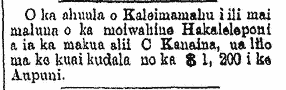
The feather cape of Kaleimamahu which was inherited by the queen, Hakaleleponi, and then to the alii father, C. Kanaina, was purchased at auction by the Government for $1,200.

[Anyone know what became of this ahuula?]

(Ko Hawaii Pae Aina, 8/5/1882, p. 3)

O ka ahuula o Kaleimamahu...

Ko Hawaii Pae Aina, Buke V, Helu 31, Aoao 3. Augate 5, 1882.

Keahu Kealiiaukai, an awesome biography, 1941.

Recalling the Days of Kamehameha V.

KEAHU KEALIIAUKAI

Keahu Kealiiaukai is one of the last Hawaiians left who is not proficient in English. He is a Hawaiian famous for his knowledge of plants, and he is 82 years old. He lives in Lahaina, Maui, the capital of Hawaii in days of yore. Kealiiaukai is now living with his daughter, Mrs. Juliette Pali.

When Kealiiaukai was born in Kaupo, Maui, on the road going to the crater of Haleakala, in the year 1859, this was the fifth year of Kamehameha IV’s reign over Hawaii nei. Kealiiaukai was 4 when that monarch died. He does not recall this.

Remembering the King.

However, Kealiiaukai does in fact remember Kamehameha V, or King Kapuaiwa, his given name; and the last of the Kamehamehas. Kapuaiwa went to Lahaina numerous times, where he was welcomed warmly by his makaainana.

In Kealiiaukai’s eighty and two years of life, he witnessed the passing of the monarchs of his homeland, closing with the overturning of the nation under Queen Liliuokalani’s protection, in 1893. Then the establishing of the provisional government and the Republic of Hawaii, and the joining of the Islands to the United States and the formation of this Territory of America, 40 years ago.

A Religious Man

Kealiiaukai is an important man in Lahaina for the kamaaina there. His wife left this world eight years ago, but she did not however leave behind children. Kealiiaukai is still strong and active. He participates often in works of this Father in Heaven. He spent his life being a member of the Faith of the Latter Day.

Perhaps he is the last medicine man living and practicing from before the times when there was licensing of those in that profession. During his time, it is said that Kealiiaukai practiced healing with plants amongst his own people and healed them due to his expertise in the use of plants growing in the forests of Hawaii, for all types of illnesses.

(Hoku o Hawaii, 3/5/1941, p. 1)

Hoomanao Ina La O Kamehameha V

Hoku o Hawaii, Volume XXXV, Number 45, Page 1. Malaki 5, 1941.

The children are your future! 1909 / timeless.

DON’T DECREASE THE PAY OF THE TEACHERS.

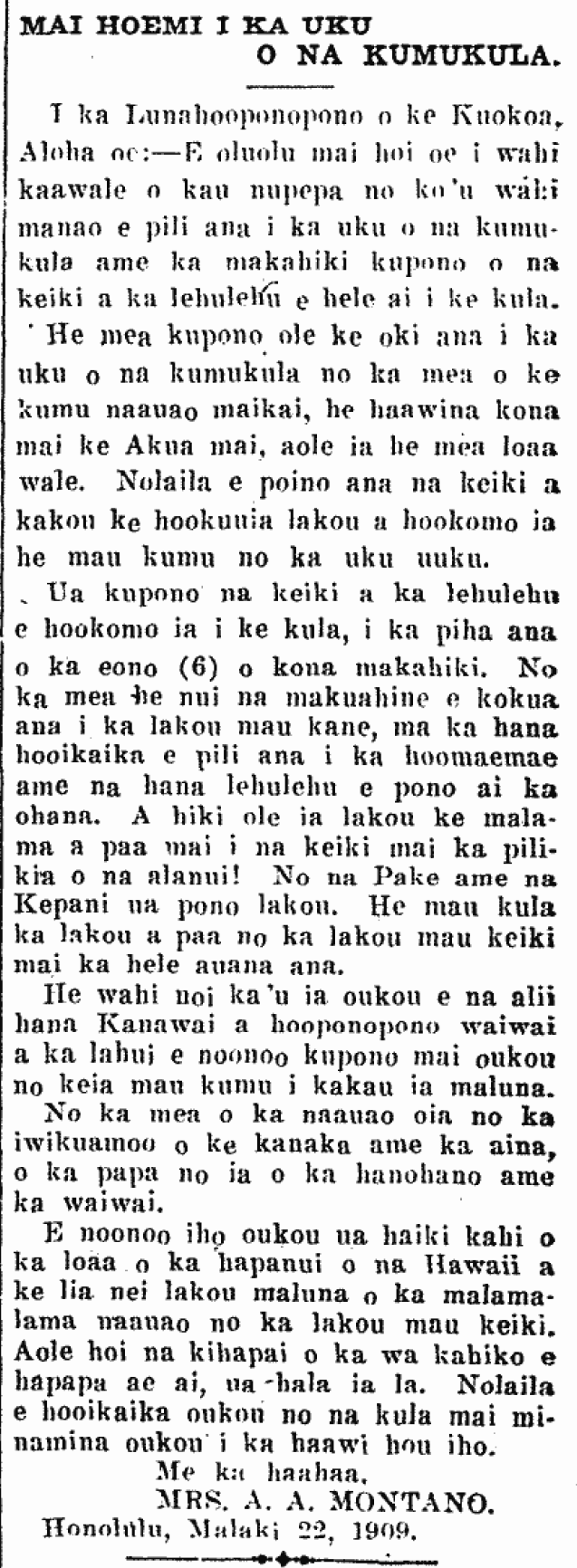
To the Editor of the Kuokoa, Aloha oe:—Please allow me some space in your newspaper for my humble thoughts dealing with the salary of teachers and the age at which children of the public should attend school.

It is wrong to cut the teachers’ pay because a well-educated teacher has a gift from God; it is not something readily gotten. And our children will be hurt should we let those teachers go and employ teachers for little pay.

The children of the people should be enrolled in school when they turn six (6) years of age. For there are many women who assist their husbands by endeavoring to take care of the many duties for the good of the family. And they are not able to care for and keep their children from the harm of the streets! As for the Chinese and the Japanese, they are fine. They have schools and their children are kept from wandering about.

I beseech all of you leaders who make Laws and who regulate public funds, do think carefully about these thoughts written above.

For knowledge is the backbone of man and his nation; it is the basis for fame and wealth.

Consider that the income of the majority of the Hawaiians is limited, and they are counting on the light of education for their children. The plantations of the old days are not to be reached out for, for those days are past. So all of you, please put effort into the schools, and don’t feel hesitant in investing more.

Sincerely,

MRS. A. A. MONTANO.

Honolulu, Malaki 22, 1909.

[Times have changed. Hopefully we learn from the past…

This letter is written by famed composer, Mary Jane Kekulani Montano.]

(Kuokoa, 3/26/1909, p. 4)

MAI HOEMI I KA UKU O NA KUMUKULA.

Ka Nupepa Kuokoa, Buke XLVI, Helu 13, Aoao 4. Maraki 26, 1909.

Hula mounds, shoddy roads, and inclement weather in Hilo, 1887.

Mr. Editor.

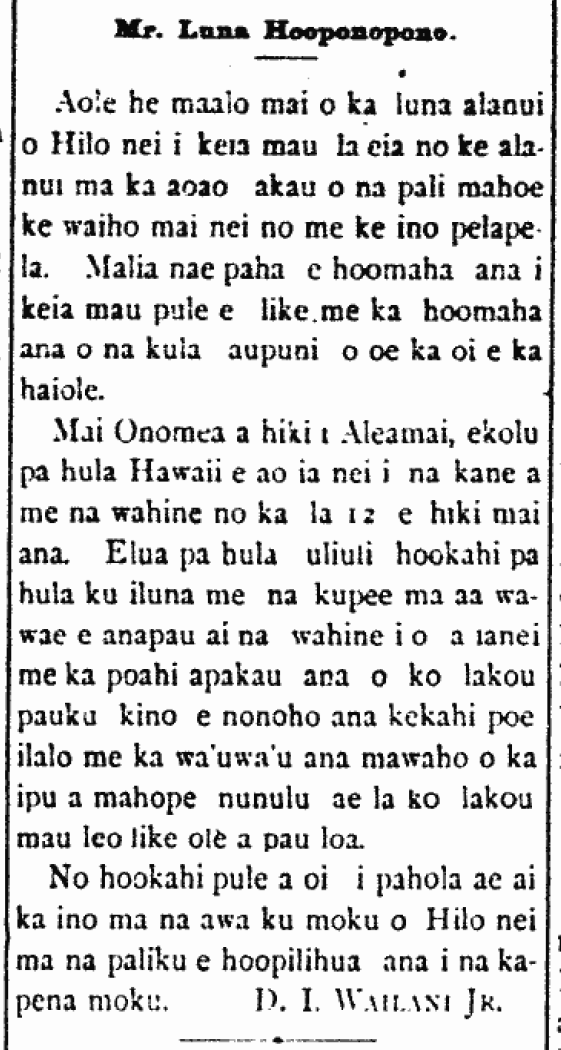
The road supervisor [luna alanui] of Hilo has not passed by these days; the road to the north of the twin cliffs [na pali mahoe] is left damaged and filthy. Perhaps he is on vacation these weeks as the public schools are on vacation; haiole [?], you are the best.¹

From Onomea until Aleamai, there are three Hawaiian hula mounds [pa hula] where men and women are being taught for the upcoming 12th. There are two green pa hula that are got on with anklets [kupee] on the legs as the women turn this way and that, while they rotate about [poahi apakau] their torsos; some people sit below while rasping [wa’uwa’u] against the outside of a gourd and then their various voices reverberate forth.

For over a week, there was a storm covering the docks here in Hilo, bewildering the ship captains on the Paliku side.

D. I. Wailana, Jr.

¹The Road Supervisor in Chief for Hawaii Island that year, according to Thrum, was C. N. Arnold.

(Kuokoa, 4/30/1887, p. 2)

Mr. Luna Hooponopono.

Ka Nupepa Kuokoa, Buke XXVI, Helu 18, Aoao 2. Aperila 30, 1887.

Here is the amendment to the marriage law passed in 1888.

MOKUNA LXIX.

HE KANAWAI

E hoololi ai i ka Pauku 2 o ka Mokuna LVI o ke Kanawai Hoopai Karaima, a e hoopau loa ai i na Pauku 3, 4 a me 5 o ia Mokuna, me na hoololi a pau i ua Mokuna nei.

E hooholoia e ka Moi a me ka Ahaolelo o ko Hawaii Paeaina.

Pauku 1. E hoololi ia a ma keia ke hoololi ia nei ka Pauku 2 o ka Mokuna LVI o ke Kanawai Hoopai Karaima, a penei e heluhelu ia ai:

“Pauku 2. E ninaninau ia, e hoolohe ia, a e hooholo ia e ka Lunakanawai no ia hihia, a ina he mea hiki e hoopau ia ka noho kue ana o laua; aka, ina aole hiki e hoopau ia ko laua kue ana, e hoopau wale ia no ka hoopii. Ina e hoopau wale ia kekahi hoopii, e hooholo ka Lunakanawai e hookaa ia na koina e like me ka mea ana i manao ai oia ka pono.”

Pauku 2. Ma keia ke hoopau loa ia nei na Pauku 3, 4 a me 5 o ka Mokuna i olelo ia  a me kekahi a me na hoololi o ia Mokuna i olelo ia.

Apono ia i keia la 10 o Sepatemaba, M. H. 1888.

KALAKAUA REX.

Na ka Moi:

L. A. Thurston,

Kuhina Kalaiaina.

(NA KANAWAI O KA MOI KALAKAUA I, Ke Alii o Ko Hawaii Paeaina, i Kau ia e ka Hale Ahaolelo Kau Kanawai, i ke Kau o 1888, p. 171.)

CHAPTER LXIX.

AN ACT

To amend Section 2 of Chapter LVI. of the Penal Code and Repeal Sections 3, 4 and 5 of said Chapter with all Amendments thereto.

Be it Enacted by the Kind and the Legislature of the Hawaiian Kingdom:

Section 1. That Section 2 of Chapter LVI. of the Penal Code be and is hereby amended so as to read as follows:

“Section 2. Said Justice shall examine into, hear and determine the complaint and shall secure if practicable, a reconciliation between the parties; but if no reconciliation can be effected, the complaint shall be dismissed. In case of such dismissal the Justice shall adjudge the costs to be paid as in his opinion justice shall demand.”

Section 2. Sections 3, 4 and 5 of said Chapter and any and all amendments thereof be and are hereby repealed.

Approved this tenth day of September, A. S. 1888.

KALAKAUA REX.

By the King:

L. A. Thurston.

Minister of the Interior.

(Laws of His Majesty Kalakaua, King of the Hawaiian Islands: Passed by the Legislative Assembly at its Session 1888, pp. 157–158.)

Pilipo Kamai, Representative in the Legislature, takes a stand. 1890.

OBJECTIVES OF REPRESENTATIVE P. KAMAI.

On the 30th of March, between the hours of 1 and 6 in the afternoon, the representative Pilipo Kamai of here in Hana held a meeting of the makaainana in the old school house adjacent to his residence at Puuomaiai, Kaupo. There were fifty-four Hawaiians, one Portuguese, and one American that showed up. Rev. Mr. Kailioha of Huelo called for the light from the Heavens to shine down. The meeting began peacefully, and our representative revealed his path for the upcoming Legislative session, and the number of his objectives is twenty-three. And here they are, without my clarifications; the 3rd objective is the one he is passionate about.

And this is how he began, “When my feet are firmly planted amongst my fellow law makers, your humble servant will strive to fulfill these objectives:

1. To maintain our nation’s independence.

2. To pay off our nation’s debt.

3. To restore all power of the King.

4. To lessen the wages of all the nation’s officials, from the first to the last.

5. To have the government lands sold at low cost only to Hawaiians who have no land.

6. To block the entrance of the Chinese, Japanese, and Portuguese.

7. To continue the Treaty with the United States of America.

8. To repeal for good the desertion of marriage law passed during the last Legislative Session.

9. To make Arbor Day (La kanu laau) into a day that is recognized.

10. To have voting for the Monarch done by all.

11. To have the Cabinet of Ministers be made up of two Hawaiians and two haole.

12. To lessen taxes.

13. To pay only $25.00 to representatives who win and not to those who lose.

14. To have juries for Hawaiians be Hawaiian, and juries for haole be haole.

15. To bring an end to pensions [uku hoomau].

16. To have clergy teach School children about religion everyday, during school hours.

17. To have makaainana petition to their Representatives of their problems by way of Committee of thirteen selected members, it being signed by fifty names.

18. To get funding for the jail in Kipahulu.

19. To have children under 17 years not be taxed.

20. To get Hana two Judges.

21. To  get Hana two Representatives.

22. To have street taxes levied in each town remain with each respective town, and not be turned over to the Street Funds of the district.

23. These objectives above will be considered carefully before the representatives brings them to motion in the Legislature.

A Committee was selected, and here is who were chosen: Paele, Chairman; Kala, Secretary; Anakalea; Kamoau; Kanamu; Helio; Naehu; Karolo; Nehemia; Haleauki; Anton Paiko; and Kalima. The committee will meet this coming week, on April 12, to think on the problems here in Kaupo, and the entire district.

Before the meeting was adjourned, a letter was read from Ulupalakua asking our representative to go there for a grand party given to honor Mister Wilcox [Wilikoki]. The meeting was adjourned.

Kahupo.

Kaupo, March 31.

(Ko Hawaii Pae Aina, 4/19/1890, p. 1)

NA KUMUHANA A LUNAMAKAAINANA P. KAMAI.

Ko Hawaii Pae Aina, Buke XIII, Helu 16, Aoao 1. Aperila 19, 1890.

Jack Kaleiwahea falsely accused? 1893.

KALEIWAHEA.

Some Explanations pertaining to his arrest.

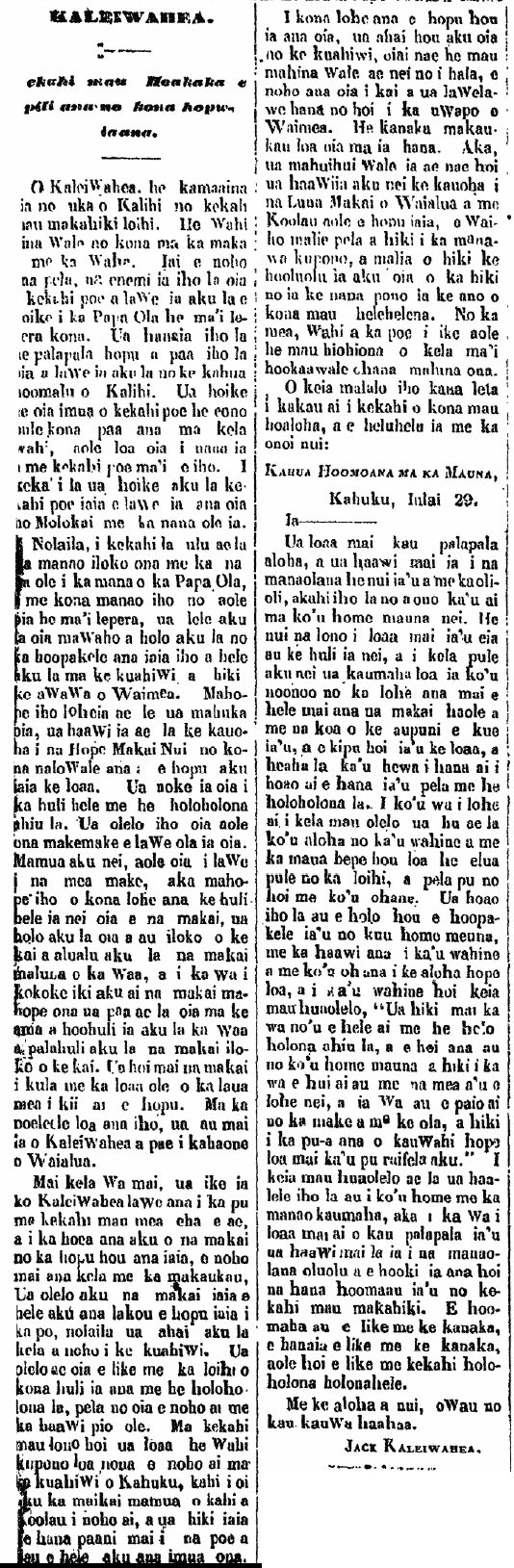
Kaleiwahea has been a kamaaina of the uplands of Kalihi for many years. He has some blemishes by his eyes and mouth. While he was living this way, he was made an adversary by some people and they went to the Board of Health as witnesses saying he had leprosy. A warrant was issued for his arrest and he was captured and taken to the quarantine station of Kalihi. He told some people that he was confined there for six weeks without being examined, along with some other patients. One day some people told him that he was going to be taken to Molokai without being examined.

Therefore, one day a thought grew within him without considering the power of the Board of Health, and thinking of his own accord that he did not have leprosy, he escaped and ran away to free himself and went to the mountains, until the valley of Waimea. Later it was heard that he fled, and the order was given to the Deputy Sheriffs in response to his escape, to capture him if found. He was constantly hunted like a wild animal. He said that he didn’t want to be taken alive. Previously, he did not carry weapons, but after he heard that he was being hunted by the officers, he ran and swam in the ocean, while being chased by officers aboard a canoe, and when the officers were close behind, he grabbed on to the outrigger float [ama] and flipped the canoe, and the officers were thrown into the ocean. The two officers returned to shore without the object of their chase. When it became dark, Kaleiwahea came to shore at Waialua.

From that time, Kaleiwahea was seen carrying a rifle and other weapons, and when the officers came to arrest him once more, he was prepared. The officers told him that they’d come at night to capture him, so he fled to live in the mountains. He said that as long as he was hunted like an animal, he’d not give up. According to some news received, he was living in a very good area in the mountains of Kahuku, where it was better than where Koolau¹ was living, and he could toy with all who appeared before him.

When he heard that he was to be captured again, he fled to the mountains, even if just a few months ago he was living by the sea and working at the dock of Waimea. He was very skilled at that kind of work. But he surmised that the order was given to the District Sheriffs of Waialua and Koolau, not to arrest him, but to let him be until the time was right, then maybe he could be assuaged and his appearance could be looked at. Because according to the people who knew, there were no signs of that disease that separates families [leprosy] upon him.

This below is the letter he wrote to one of his friends, and let it be read with great relish [? onoi nui]:

Camping Place in the Mountains

Kahuku, July 29,

To _______

I received your letter of aloha, and it gave me much hope and happiness, and for the first time, I’ve have an appetite here in my mountain home. I’ve received a lot of news that I’m being hunted after, and last week I was greatly saddened upon hearing that the haole police were coming along with the government troops to go against me, and that they’d shoot me if they can; what is the wrong I have committed that I should be treated that way like an animal? When I heard this, aloha welled up within me for my wife and our newborn baby of two weeks, as well as for my family.  I attempted to go once again and escape my mountain home and give my wife and family my last aloha; and to my wife i said, “The time has come for me to go like a wild animal and return to my mountain home, until i meet with those of which I hear, and it will be then that I fight for life or death, until the very last puffs of smoke from my rifle.” With these words above, I left my home depressed, but when I received your letter to me, it gave me good hope that there will be end to the years of persecution. I shall rest like a man, and my deed done as a man, and not like a beast running through the forest.

With much aloha, me, your humble servant,

Jack Kaleiwahea.

¹The famous one written of in “Ka Moolelo Oiaio o Kaluaikoolau” or “The True Story of Kaluaikoolau,” which is available from the Kauai Historical Society, or a bookstore near you!

[I wish the digital images of this paper were better. This article is even cut off on the left, so I had to guess at many of the words… It is definitely time to rescan the Hawaiian-Language Newspapers!]

(Lei Momi, 8/5/1893, p. 5)

KALEIWAHEA.

Ka Lei Momi Oili Pule, Buke I, Helu 1, Aoao 5. Augate 5, 1893.

More from Dr. Dwight Baldwin on the state of leprosy in Hawaii, 1865.

After reading the previous article in the Kuokoa signed D. Baldwin, read this statement from the same man dated just seven days after the article appeared, which is quoted on pp. 16–17 of “LEPROSY IN HAWAII: A Supplement to the Report of the President of the Board of Health,” 1886. Also, I just noticed that the original English of the Kuokoa article is shown, along with the places where portions were edited out (marked by asterisks) on pp. 15–16.

From Dr. D. Baldwin, Lahaina, April 20th, 1865.

“We have a foul and dangerous disease among us, and must, therefore, not quiet the fears of the public beyond what the truth will bear. The native population are not too much alarmed. In this region the healthy are often seen mingling with the leprous, which thing ought not so to be. In some of the extracts (of my letter in the Kuokoa) which you made, I have expressed myself strongly in favor of the curability of our Hawaiian leprosy, because I wished to turn the attention of natives from their ignorant and dangerous practitioners to foreign physicians. By extracting the paragraphs which utter this opinion, and omitting others, you make me seem to speak more confidently of future success in curing this disease than I intended to do; and therefore, I wish to add a few remarks by way of explanation; and,

“1. * * * The cases I was able to report are sufficient, I think, to encourage us to persevere in efforts to cure the frightful malady, and to banish it from the land. They should lead natives to look to those for help who alone can be supposed to have any means of combating so fearful a disease. They may be permanent cures, or the disease may break out more unmanageable than ever. Similar cures reported in other countries should encourage us.

“2. While I write thus hopefully, I am aware that men of the highest medical talent have studied the disease of leprosy, and they have sought for remedies, and many of them have pronounced it utterly incurable. It is certainly not a little staggering to our hopes in this matter, that while eminent physicians have bestowed so much attention, for many hundred years, and while the very remedies I have now been using have been used for ages in Asia and elsewhere, still there is a widespread belief that leprosy is an incurable disease. But there are authorities on the other side. An English medical dictionary has the finest descrip- I have ever met with of leprosy of the middle ages, which spread over Europe. The author says, recent cases may be cured. An eminent French physician says he has seen a multitude of cases of this disease treated without a single failure to cure. There is no way of accounting for such opposite opinions of great men, only by supposing that they are speaking of different species of the disease. * * * *

“As your China correspondent well observes (Feb. 25), we have now only a mild form of leprosy. But, it will, doubtless, in time assume more terrible features. Indeed, we have already had, in this place, some horrible cases. The disease has been considered in all countries, contagious. It has been so in Lahaina, though it does not appear in a new subject till a long time after exposure to its infection; and we have the proof of it in several families. We are beginning to have a crop of leprous young children.”

[It is important to read the information read by Hawaiians in the Hawaiian-Language Newspapers, but it is also important to read the English documents for a wider perspective on what happened historically.]

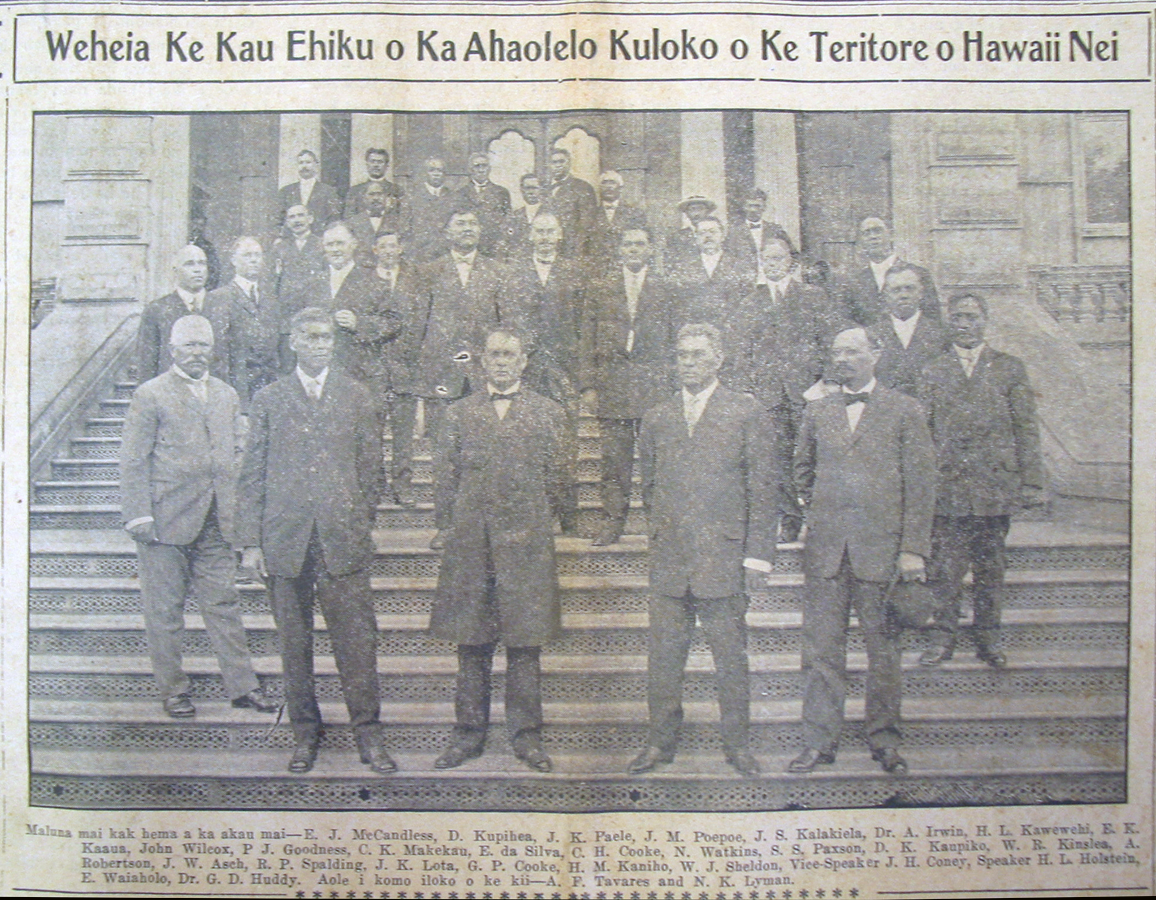
Member districts, parties, and committees of the legislature, 1913.

Members of the Senate by Island

Hawaii—

R. H. Makekau, R. [Republican]
D. E. Metzger, D. [Democrat]
D. Baker, D.
G. C. Hewitt, R.

Maui—

H. B. Penhallow, R.
H. Pali, R.
H. Baldwin, R.

Oahu—

A. Judd, R.
C. Brown, R.
Chillingworth, R.
C. P. Iaukea, D.
Wirtz, D.
Coke, D.

Kauai—

Charles A. Rice, R.
E. A. Knudsen, R.

Standing Committees of the Senate.

Committee on Ways and Means [Komite o na loaa ame hoolilo]—Rice, Chairman; C. Brown, Iaukea, Metzger, Baldwin.
Committee on Judiciary [Hookolokolo]—A. Judd, Chairman; Brown, Makekau.
Committee on Public Lands and Internal Improvements [Na Aina Aupuni ame na Hana Hou Kuloko]—Baldwin, Chairman; Metzger and Hewitt.
Committee on Education [Komite Hoonaauao]—Penhallow, Chairman; Rice, Makekau.
Committee on Enrollment, Revision and Printing [Komite Pai]—Pali, Chairman; Iaukea, Judd.
Committee on Accounts [Komite Papahelu]—Brown, Chairman; Wirtz, Hewitt.
Committee on Military [Komite Oihana Koa]—Chillingworth, Chairman; Coke, Penhallow.
Committee on Public Health [Komite Ola]—Chillingworth, Chairman; Judd, Wirtz.
Committee on Manufactures, Forestry and Promotion [Komite Ululaau ame hooholomua]—Hewitt, Chairman; Baker, Penhallow.
Committee on Rules [Komite o na Rula]—Rice, Chairman; Pali, Baker.

Standing Committees of the House.

Finance [Waiwai]—Watkins, George P. Cooke, Spalding, Lyman, C. H. Cooke, Kaaua, Paele.
Judiciary [Hookolokolo]—Sheldon, Coney, Tavares, Poepoe, Paele.
Public Lands and Internal Improvements [Aina Aupuni ame Hana Hou kuloko]—Huddy, Lota, Kaupiko, Silva, Goodness, Robertson, Kalakiela.
Agriculture [Mahiai]—George P. Cooke, Silva, Goodness, Irwin, Paxson.
Health and Police [Ola ame Makai]—Coney, Makekau, Kawewehi, Irwin, Asch.
Education [Hoonaauao]—C. H. Cooke, Huddy, Spalding, Kinslea, Paxson.
Miscellaneous [Huikau]—Lyman, Waiaholo, Kaaua, Asch, Kaniho.
Accounts and Public Expenditures [Papahelu]—Tavares, Watkins, Wilcox, Kupihea, McCandless.
Printing, Revisions and Enrollment [Pa’i]—Waiaholo, Lota, Kaupiko, Robertson.
Military [Koa]—Kawewehi, Makekau, Wilcox, McCandless, Kaniho.
Rules [Rula]—Holstein, Sheldon, Poepoe, Kalakiela, Kupihea.

MEMBERS OF THE HOUSE OF REPRESENTATIVES.

EAST HAWAII.

G. H. Huddy, R.
A. Irwin, D.

WEST HAWAII.

H. L. Holstein, R.
E. K. Kaaua, R.
D. K. Kaupiko, R.
H. L. Kawewehi, H. R. [Home Rule]

MAUI.

G. P. Cooke, R.
P. J. Goodness, R.
C. K. Makekau, R.
A. F. Tavares, R.
E. Waiaholo, R.
John Wilcox, R.

OAHU.

C. H. Cooke, R.
Norman Watkins, R.
J. W. Asch, D
W. R. Kinslea, D.
A. S. Paxson, D.
A. Robertson, D.
J. S. Kalakiela, D.
H. M. Kaniho, D.
D. Kupihea, D.
E. J. McCandless, D.
J. K. Paele, D.
J. M. Poepoe, D.

KAUAI.

J. H. Coney, R.
J. K. Lota, R.
W. J. Sheldon, R.
R. P. Spalding, R.

(Kuokoa, 2/21/1913, p. 1)

Na Hoa o ke Senate ma na Mokupuni.

Ka Nupepa Kuokoa, Buke L, Helu 8, Aoao 1. Feberuari 21, 1913.