Thomas McCants Stewart passes on, 1923.

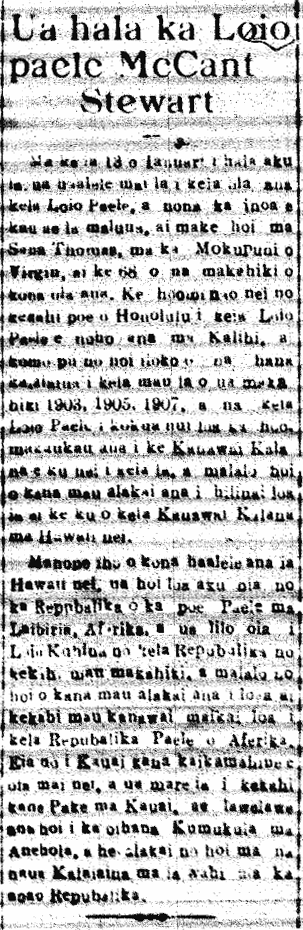
The black Lawyer, McCant Stewart has passed on

On the 13th of January, the Black Lawyer left behind this life, the one whose name is placed above; and he died at Saint Thomas, in the Virgin Islands, at 68 years of age. Some people of Honolulu are remembering him, this Black Lawyer who resided in Kalihi, and participated in politics in those days of they years of 1903, 1905, 1907, and it was this Black Lawyer who contributed greatly to the County Law as it now stands today, and it was due to his greatly trusted guidance that the County Law stands here in Hawaii.

After he left Hawaii nei, he went to the Republic of the Blacks in Liberia, Africa, and he became the Attorney-General for that Republic for a number of years, and under his leadership, that Black Republic of Africa gained some very fine laws. His daughter is currently living on Kauai, and she has married a Chinese man on Kauai, and she is employed as a School teacher at Anehola, and is a leader in politics in that area of the Republican party.

[If you want know more about this fascinating man, drop your plans for Friday night, February 5, 2016. There will be a presentation done by Dr. Albert Broussard, professor in the Department of History at Texas A&M University. It will be from 5:30 to 7:00 p. m. at Aliiolani Hale. Click here for more!]

(Hoku o Hawaii, 2/22/1923, p. 2)

HokuoHawaii_2_22_1923_2

Ka Hoku o Hawaii, Buke XVI, Helu 39, Aoao 2. Feberuari 22, 1923.

Hawaii Holomua, January 18, 1893.

ALOHA

Liliuokalanionamoku.

THE POWER OF THE GOVERNMENT HAS BEEN USURPED!

The Protest Proclamation of the Queen!

“My dear homeland,
It is for thee that I sing.”¹

This past Tuesday, the 17th of January, 1893, will seemingly be notorious forever in our land of birth, for it is the day that a new Nation in the form of a provisional government under thirteen haole was proclaimed.

GUARDS POSTED.

On Monday night, was when many places in town were put under the watch of armed soldiers from the American warship Boston, and on the following Tuesday morning, they were seen going around, and the members of the Honolulu Rifles began to join in and surrounded several places with their weapons, and the appearance of town was terrifying.

NEWS OF THE OVERTHROW.

In the early morning, the rumor was spread on the sides of the streets of town, saying that there is craving to overthrow the kingdom and to make a new government. This news flew on the tips of the winds and reached the countryside, and because of that, the citizens of the Queen gathered in great numbers in the streets, and the greatest number was in the groups in and outside of the Palace Grounds; and right outside Kalakaua Hale there were thousands of people standing and waiting, prepared for orders, should there be orders.

DISCUSSION

At this time, the people were in a state of astonishment, going around the sides of the streets and standing here and there in crowds, discussing and responding. This conditions continue while the peaceful state is preserved, except for the seeing of the soldiers with their guns.

GUN FIRE.

But between the hours of 2 and 3 in the afternoon, the people were shocked at the news spread that Leialoha, an government police officer, was shot and and hit by a haole, while he was carrying out his duties under the power of the law of the land. A disturbance soon started, and it was feared that there would be a riot, but as is our usual nature, we were patient, and held back our ire.

In a short time, Leialoha arrived at the Station [Halewai] held on this side and that with helping  hands, and it was realized that he had actually been shot right in front of his chest below the joint of the collarbone. Immediately he was transported to the Queen’s Hospital.

HIS CONDITION. Continue reading

Invasion, 1893.

The American Troops Landed.

Without knowledge of the Government, and with agreement from the American Minister [Stevens] not to land the troops from the warship while the Government is prepared to keep peace; the American Minister nonetheless ordered the troops of the Boston to be  put in service. This would appear as if it is an attack, and should the government [provisional government] listen to the truth of these actions by its official, this will be something that it will condemn.

(Leo o ka Lahui, 1/17/1893, p. 2)

LeookaLahui_1_17_1893_2

Ka Leo o ka Lahui, Buke II, Helu 624, Aoao 2. Ianuari 17, 1893.

Mele for the Princess Likelike, the new governor of Hawaii Island, 1879.

[Found under: “Ka Huakai Kaapuni a ke Kiaaina Hou o Hawaii: ka Huakai ma Waimea, Hawaii.]

Leo, Boat Song.

1 Aloha Likelike
Ke Kiaaina hou,
Ke pani no S. Kipi,
Nona ke kanikau,
Mahalo ia oia;
Mai Hilo a Kau,
A hiki i Kohala,
Me Hamakua pu.

2 Aloha Likelike
Pomaikai no kakou;
Ua nana i kou maka,
Mahalo piha no:
E komo oli oe,
A hui me makou,
Ke pa’ipa’i nei na lima,
A oli na naau.

3 Ka ke Akua olele,
Oia kou panana,
A oia kou Palama,
A oia no kou La;
E ola e! E ola!
Ke Kiaaina hou;
E ke ‘Lii Likelike
E ola mau loa no.

[Melody, Boat Song.

Aloha Likelike
The new governor,
The replacement for S. Kipi,
Who is mourned for,
She is admired;
From Hilo to Kau,
Until Kohala,
Along with Hamakua.

Aloha Likelike
We are blessed;
We look at your visage,
Full of gratitude:
You come with joy,
And meet with us,
Our hands applaud,
And our hearts are happy.

The word of God,
Is your compass,
And it is your protection
It is your Sun;
Live! Live!
The new Governor;
O Alii Likelike
Long may you live.]

(Ko Hawaii Paeaina, 6/14/1879, p. 4)

Leo, Boat Song.

Ko Hawaii Pae Aina, Buke II, Helu 24, Aoao 4. Iune 14, 1879.

Visitation to the leprosy hospital in Kalihi, 1866.

BY ORDER.

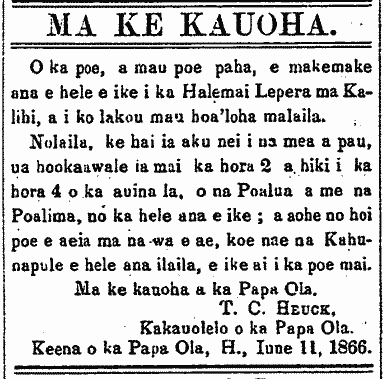
The person or persons wishing to go and see the Leprosy Hospital [Halemai Lepera] in Kalihi, and their friends there.

Therefore, we announce to all; the hours between 2 o’clock until 4 o’clock in the afternoon, on Tuesdays and Fridays, are set aside to go and visit; no one is allowed to go there at any other time to see the patients except Pastors.

By the order of the Board of Health [Papa Ola].

T. C. Heuck,

Secretary of the Board of Health.

Office of the Board of Health, H., June 11, 1866.

(Au Okoa, 6/18/1866, p. 3)

MA KE KAUOHA.

Ke Au Okoa, Buke II, Helu 9, Aoao 3. Iune 18, 1866.

Turn yourself in, turn your neighbors in as well, 1866.

BY ORDER.

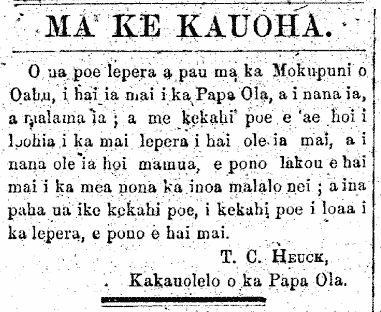
All the people with leprosy on the Island o Oahu, who were reported to the Board of Health, or examined, or under the care of; and the people suffering from leprosy who were not reported and examined previously; they must go and report to the person named below; and if there are those who know of someone with leprosy, they should report this.

T. C. Heuck,

Secretary of the Board of Health.

(Au Okoa, 2/19/1866, p. 3)

MA KE KAUOHA.

Ke Au Okoa, Buke I, Helu 44, Aoao 3. Feberuari 19, 1866.

23 years of independence, La Kuokoa, 1866.

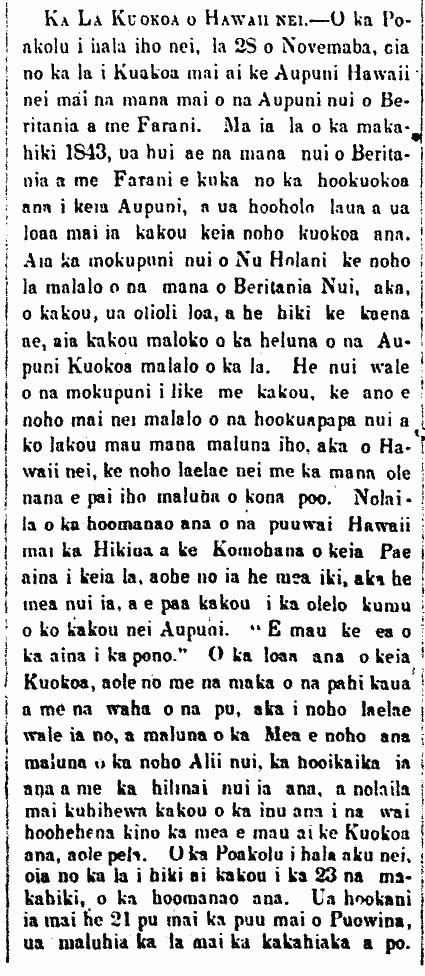
Independence Day of Hawaii nei.—This past Wednesday, the 28th of November, was the day that the Nation of Hawaii gained its independence from the other power of the nations of Britain and France. On that day in the year 1843, the great powers of Britain and France joined together to discuss the bestowing of independence on this Nation, and the two of them agreed to this and we gained this independence. The great island of Australia under the power of Great Britain, but as for us, we are overjoyed, and can boast that we are amongst the few Independent Nations under the sun. There are many islands like us, who live peacefully under the powers over them, but Hawaii lives clearly without any power placed above its head. Therefore the commemoration by the Hawaiian hearts from the East to the West of these islands on this day, is not a small thing, but it is important, and we know by heart the foundational words of our Nation. “E mau ke ea o ka aina i ka pono.” The gaining of this Independence, was not by the point of a sword or the mouth of a gun, but was gotten peacefully, and upon He who sits on the great Throne is our efforts and great trust, and so let us not be mistaken that the drinking of intoxicating drinks is what preserves our Independence, that is not the case. The past Wednesday was the 23rd year of our commemoration. 21 shots were fired from the hill of Puowina [aka Puowaina], and the day went on peacefully from morning until night.

(Kuokoa, 12/1/1866, p. 3)

Ka La Kuokoa o Hawaii nei.

Ka Nupepa Kuokoa, Buke V, Helu 48, Aoao 3. Dekemaba 1, 1866.

Journal of Evelyn Desha and Stephen Desha Jr., 1943.

Our Day

THE CALM SEAS OF KONA

The person who helps me in all sorts of chores at home is Nellie Kakutani. She is a pleasant girl and lively at work.

And these days what we are doing is cooking guava jelly [puhi kele kuawa]. The guava here in Kona is very ripe. There are two types of jelly we are making. One jelly is dark red, and the other is yellowish. The difference comes with the heat at which you cook it. If you want dark red, you cook with on medium heat. So you cook it for a long time. And should you want yellowish jelly, then you cook it on high heat. And you cook it for a short time.

There is a butter shortage, so this is advice to the women of the home; if you haven’t cooked your jelly, you should start these days, right.

On Thursday, the ninth of November, there was a meeting of the members of the Board of Supervisors [Papa Lunakiai] and some other members of the County of Hawaii and some citizens of Kona nei, at the meeting house of Central Kona Union Church that is under the care of Rev. Stephen Desha of Kealakekua. They discussed the Appropriations [Bila Haawina] of the County of Hawaii pertaining to matters here in Kona. They decided to set aside funds for schools, hospitals, and roads. This was one of the few times where the members of the Board of Supervisors met with the citizens of Kona to talk about the well-being of this district. Praise goes to the members of the Board of Supervisors and the other members of Hawaii County.

—–

There are many visitors here in Kona these days. Here with us these days are Mr. and Mrs. Paul Mahi, the daughter-in-law of our elder sister, Mrs. May Haae. This is the first time that Mrs. Mahi has come to Hawaii and to here in Kona. With them came their baby son, Mosely. We took them around sight seeing.

The other day we took the two of them to Kailua and Keauhou. Yesterday we took them to Napoopoo, to our home by the sea. Mr. Mahi is adept at spearfishing, and he caught some fish. My companion caught the sweet-eyed kole. The fish were fried and eaten for lunch. We went to seethe monument to Opukahaia at the cove of Kealakekua.

Today they went to see some of their friends here in Kona.

The women of Kona held a prayer meeting called “The Church Wide Day of Prayer.” This assembly was held at the Episcopal Church, Christ Church, of Kealakekua. The Japanese, Chinese, Hawaiians and Haole participated. After the meeting, a celebration was held, and everyone joined in at the U. S. O. Hall.

[This is a series that seems to continue after another called “Ko’u La” written by Evelyn Desha. I believe that “Ko Maua La: Na Kaimalino” is also written by her about her daily life with Stephen Langhern Desha, Jr.]

(Hoku o Hawaii, 12/4/1943, p. 1)

Ko Maua La

Ka Hoku o Hawaii, Volume XXXVIII, Number 32, Aoao 1. Dekemaba 4, 1943.

Hawaiian birds and the law, 1865.

ANNOUNCEMENT.

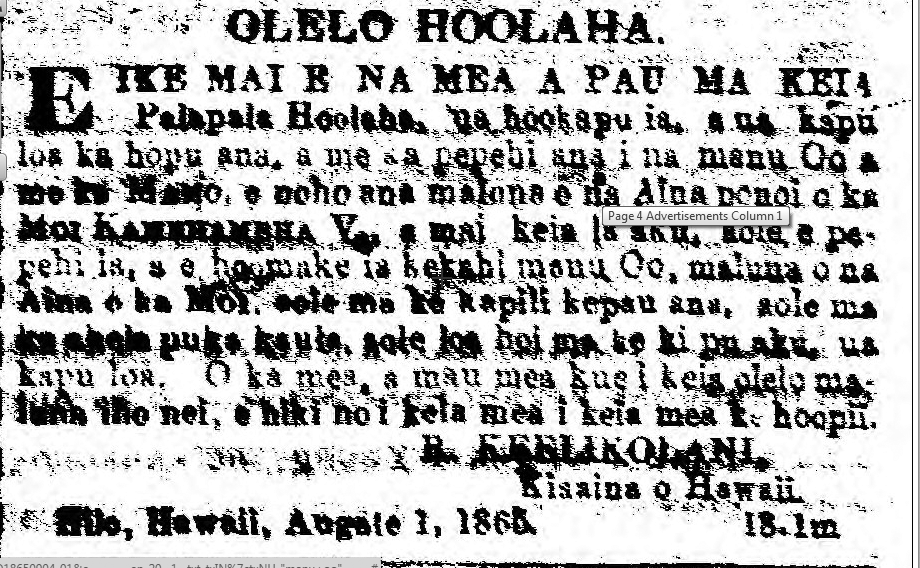
KNOW YOU ALL BY THIS Announcement; prohibited totally is the catching and the killing of Oo and Mamo birds living on the personal lands of King Kamehameha V, and from this day forward, no Oo is to be injured or killed on the lands of the Monarch; not by using lime [ke kapili kepau ana], not by snaring [ka ahele puka kaula], not by shooting [ke ki pu ana]; it is totally kapu. The person or persons who go against the words above, they each can be prosecuted.

R. KEELIKOLANI,

Governor of Hawaii.

Hilo, Hawaii, August 1, 1865.

[Might any of you law people know if there were any Kingdom laws on the books that outlawed the catching or killing of native birds? I have seen laws prohibiting the killing of non-native birds, but not native birds.]

(Au Okoa, 9/4/1865, p. 4)

OLELO HOOLAHA.

Ke Au Okoa, Buke I, Helu 20, Aoao 4. Sepatemaba 4, 1865.

Translation of Edward Lilikalani’s response to the haole Memorial, 1876.

[Translated from the Kuokoa, of Mar. 18.]

The Memorial.

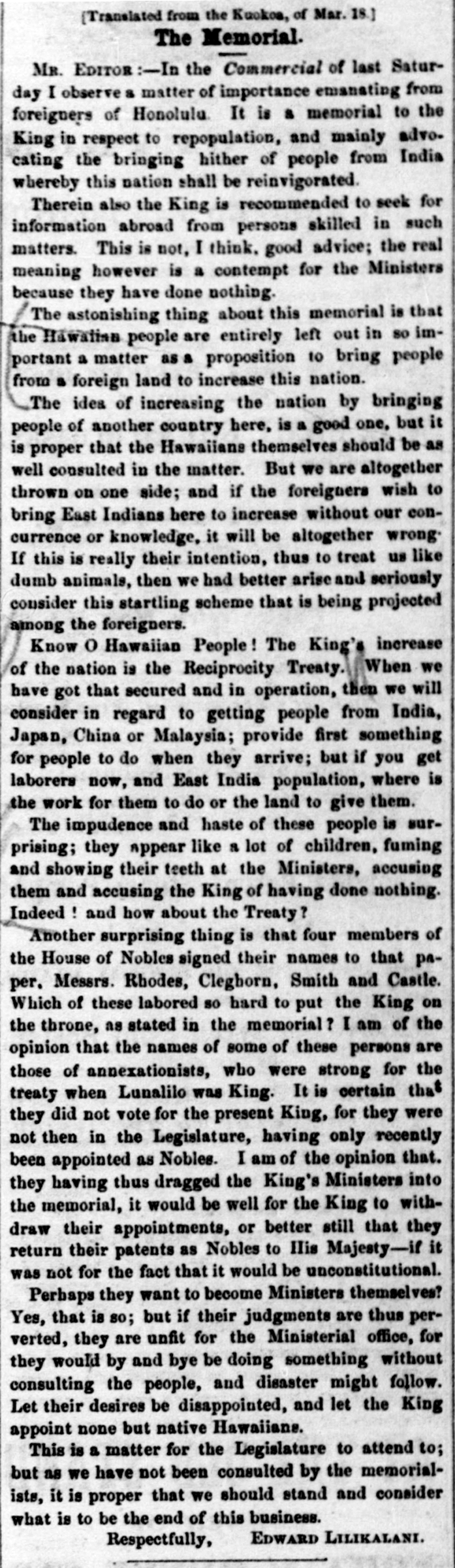
Mr. Editor:—In the Commercial of the last Saturday I observe a matter of importance emanating from foreigners of Honolulu. It is a memorial to the King in respect to repopulation, and mainly advocating the bringing hither of people from India whereby this nation shall be reinvigorated.

 Therein also the King is recommended to seek for information abroad from persons skilled in such matters. This is not, I think, good advice; the real meaning however is a contempt for the Ministers because they have done nothing.

The astonishing thing about this memorial is that the Hawaiian people are entirely left out in so important a matter as a proposition to bring people from a foreign land to increase this nation.

The idea of increasing the nation by bringing people of another country here, is a good one, but it is proper that the Hawaiians themselves should be as well consulted in the matter. But we are altogether thrown on one side; and if the foreigners wish to bring East Indians here to increase without our concurrence or knowledge, it will be altogether wrong. If this is really their intention, thus to treat us like dumb animals, then we had better arise and seriously consider this startling scheme that is being projected among the foreigners.

Know O Hawaiian People! The King’s increase of the nation is the Reciprocity Treaty. When we have got that secured and in operation, then we will consider in regard to getting people from India, Japan, China or Malaysia; provide first something for people to do when they arrive; but if you get laborers now, and East India population, where is the work for them to do or the land to give them.

The impudence and haste of these people is surprising; they appear like a lot of children, fuming and showing their teeth at the Ministers, accusing them and accusing the King of having done nothing. Indeed! and how about the Treaty?

Another surprising thing is that four members of the House of Nobles signed their names to that paper, Messrs. Rhodes, Cleghorn, Smith and Castle. Which of these labored so hard to put the King on the throne, as stated in the memorial? I am of the opinion that the names of some of these persons are those of annexationists, who were strong for the treaty when Lunalilo was King. It is certain that they did not vote for the present King, for they were not then in the Legislature, having only recently been appointed as Nobles. I am of the opinion that they having thus dragged the King’s Ministers into the memorial, it would be well for the King to withdraw their appointments, or better still that they return their patents as Nobles to His Majesty—if it was not for the fact that it would be unconstitutional.

Perhaps they want to become Ministers themselves? Yes, that is so; but if their judgments are thus perverted, they are unfit for the Ministerial office, for they would by and bye be doing something without consulting the people, and disaster might follow. Let their desires be disappointed, and let the King appoint none but native Hawaiians.

This is a matter for the Legislature to attend to; but as we have not been consulted by the memorialists, it is proper that we should stand and consider what is to be the end of this business.

Respectfully,  Edward Lilikalani.

[Here is a translation of Edward Kamakau Lilikalani’s response to the repopulation memorial that was printed in the Kuokoa on 3/18/1876.]

(Pacific Commercial Advertiser, 3/25/1876, p. 3)
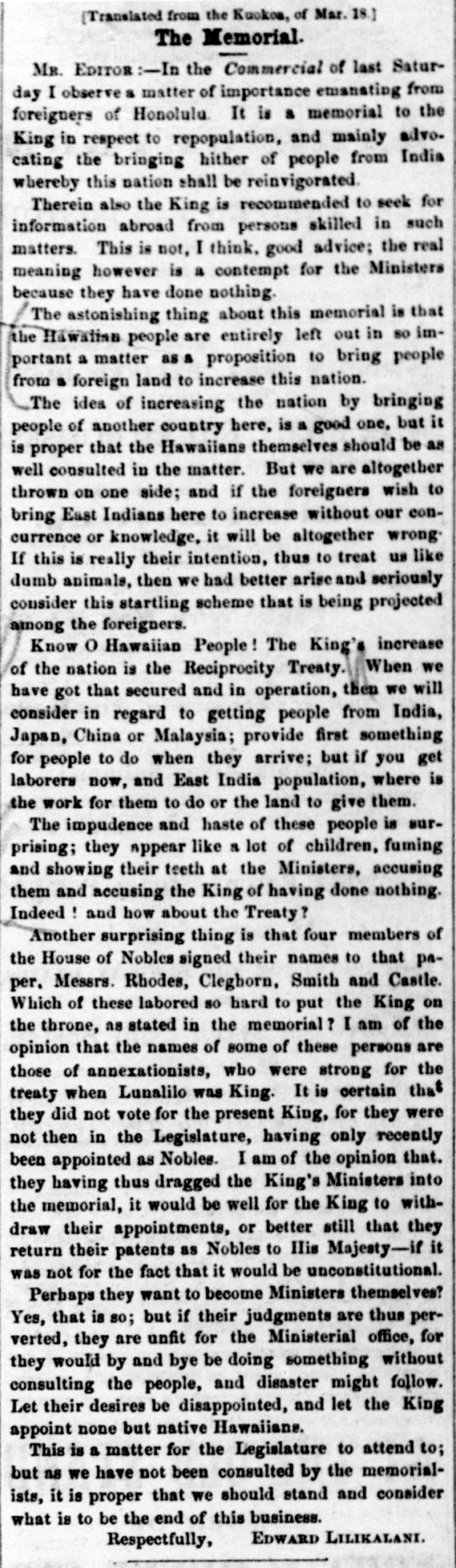
The Memorial.

The Pacific Commercial Advertiser, Volume XX, Number 39, Page 3. March 25, 1876.