The royals in Kona, 1879.

News from Kona.

O Kuokoa Newspaper; Aloha oe:—

At 11 o’clock at night on the 19th of March, landed at the shore of Kailua nei were the King; Queen Kapiolani; Her Highness, R. Keelikolani; Minister of Finance S. K. Kaai; and some others. There were many of us gathered during those days. On the 22nd, the Queen went to the uplands of Kuahewa to see the troubles of Nawai, a blind man, to give him some help for his home that burned down. Continue reading

Pāʻū riding for Kamehameha Day a hundred and ten years ago! 1906.

PA-U RIDERS HONOR DAY

Picturesque Cavalcade Revives Old-Time Custom.

The Hui Holopa-u Maile Alii have every reason to be satisfied with their first parade as a society, which occurred yesterday in celebration of Kamehameha Day.

The custom of pa-u riding is an old and kingly one and it was eminently fitting that the initial gathering of the club should take place on the anniversary of the birth of Hawaii’s greatest king.

About 30 riders gathered at the residence of Mrs. Kainana Puahi at Waikiki early yesterday morning. The costumes, which were uniform, consisted of yellow skirts, white waists, and straw hats encircled with ilima leis. Each rider wore a black ribbon as a sash, bearing the word “Kaonohiokala,” done in gold. The word means “the eye of the sun.” Continue reading

Annie Freitas composition on trip to see Kapiliula, Maui, 1921.

KAPILIULA SONG

Ikemaka i ka nani o Kapiliula,
Hoohihi ka manao me ka makemake;
Ia wai kaulana o ka aina,
Makaikaiia e ka malihini.

Ua inu ia wai ono hu’ihu’i,
Ia wai kahe mai i ke kumupali;
O ka nee a ka ua me ka makani,
Mea ole nae ia i nei hookele.

Ilaila kamau kiaha bia,
Olu ai ka hele ana o ia kula loa;
Ua lei i ka pua a o ka lehua,
Ua ai i ka hua ohelo papa.

He nui na ono a o ia uka,
O ka lua leko me ka hoio;
Ku au mahalo aku o ka nani,
I ka papa auwai a ke aupuni.

Moani ke ala o ke kiele,
E kono mai ana ia’u e hoi;
Kau aku i ke kaa otomobile,
Olapa ka uwila i Kipahulu.

Aina a ka nani me ka maikai,
Kaulana i ka makani lawe huapala.

Kipa aku i ka hale kamaaina,
Ai i ka opae mahikihiki;
Ilaila hoohihi kahi manao,
I ka hanu aala o pua roselani.

E hoi kakou ua ahiahi,
E ike i ka wai a o Kumaka,
Ilaila makou miki wahi poi,
Ohua o ke kai ka’u i’a ia.

Ua lawa ka iini me ka makemake,
I ka ua Apuakea o Hana;
Hainaia mai ana ka puana,
E hoi ke aloha i Kapiliula.

Haina hou ia mai ka puana,
Malihini kaahele puni o Maui.

Composed by MISS ANNIE FREITAS.
1315 Miller St., Honolulu.

[Annie Freitas sounds like she had a really good time on this huakai!]

(Kuokoa, 6/3/1921, p. 3)

Kuokoa_6_3_1921_3

Ka Nupepa Kuokoa, Buke LIX, Helu 22, Aoao 3. Iune 3, 1921.

Visit to Haleakala, 1876.

ABOUT HALEAKALA.

O Lahui Hawaii; Aloha oe:—

Perhaps there are not that many people who have travelled to the top of that famous mountain Haleakala in East Maui. It was the perfect time, because when I awoke this morning at maybe three o’clock and my eyes were set upon that mountain, I was filled with great admiration. I woke up my kamaaina and we got the horses ready, and at my urging, we left Makawao; and soon I’m writing this letter from the high rocks of this mountain at 9 o’clock in the morning. We are looking at the schooner greatly beloved by the friends of this land, that being the Moi, whose prow was rooting through the lapping sea of Kahului, and the famous pond in the cold, that being Kanaha. The mist is moving down to Iao and blanketing Kapela and her beautiful flowers, and the pili of Kakae disappeared, just leaving the hills in view, and it was as if waters were rushing the dam of Iao. The shady valleys at the edge of Nawaieha are imposing, seeming to duel with the rows of waves of Kahului.

105-0568_IMG

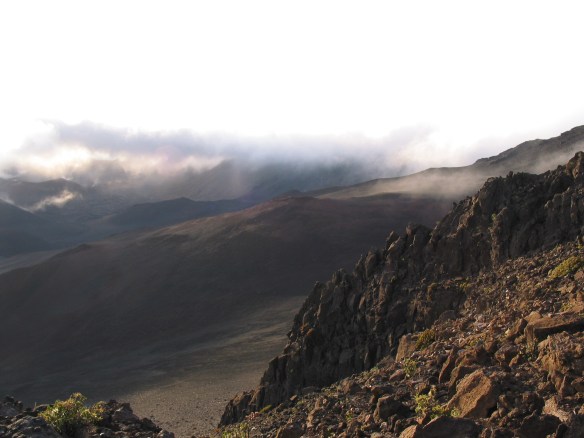
Haleakala 2003. Mau no ka nani hemolele!

Continue reading

Rufus Anderson, “Hawaiian Islands: Their Progress and Condition Under Missionary Labors,” 1865.

Anderson’s Writings About Hawaii nei.

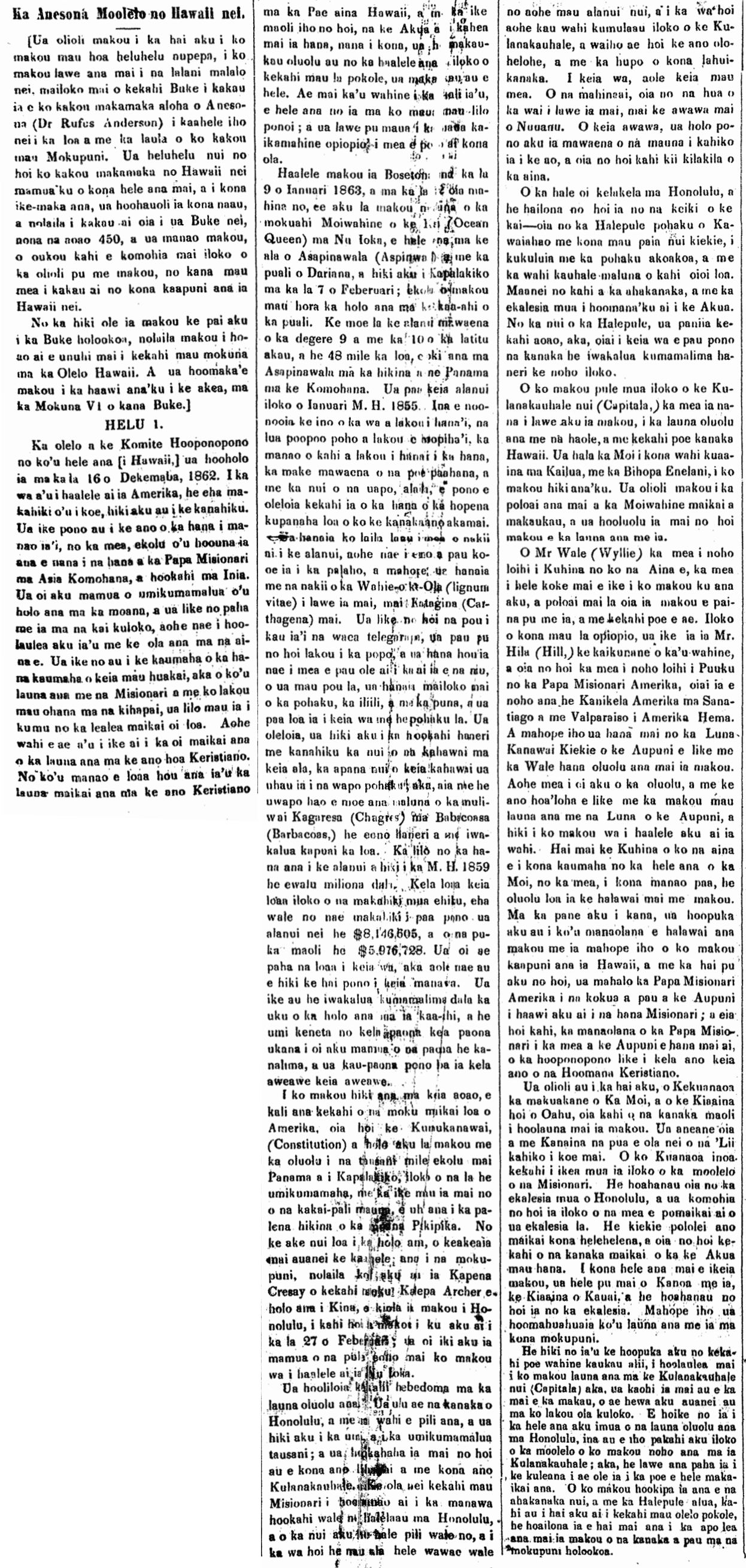
(We are pleased to tell you, our dear readers, that we are taking the lines below from a Book written by our beloved friend, Anesona (Dr. Rufus Anderson) who travelled the width and breadth of our Islands. Our friend read greatly about Hawaii nei before coming here, and when he saw it for his own eyes, his heart was gladdened, and therefore, he wrote this Book of 450 pages, and we believe that you all will also join in the pleasure along with us, for what he wrote about his travels around Hawaii nei.

Because we are unable to print the Book in its entirety, therefore, we tried to translate some chapters into Hawaiian. And we are beginning to provide it for the public from Chapter VI of his Book.)

[This is the introduction to a translation of Rufus Anderson’s “Hawaiian Islands: Their Progress and Condition Under Missionary Labors” which appears as a serial in the Kuokoa from 1/19/1865 to 6/8/1865. The English is available on Google Books here. It is interesting that this serial describing travels through the archipelago is immediately followed by Kamakau’s serial on travels describing famous places, kupua, and ancient alii from Hawaii to Niihau.]

(Kuokoa, 1/19/1865, p. 1)

Ka Anesona Moolelo no Hawaii nei.

Ka Nupepa Kuokoa, Buke IV, Helu 3, Aoao 1. Ianuari 19, 1865.

Lake Waiau atop Mauna Kea is frozen, 1906.

THE FIRST TIME LAKE WAIAU IS SKATED UPON.

When Mr. Eben Low of Waimea, Hawaii, arrived in town, some news about Mauna Kea was heard. According to him, because the ice on the top of Lake Waiau [ka moanawai o Waiau] is frozen solid, it can be walked upon.

The freshwater lake Waiau is a lake atop Mauna Kea, about 15,000 feet above sea level, which is covered with ice, which visitors walked upon. The thickness of the ice was tested by digging, but after digging for two feet, the travellers gave up continuing to dig. Continue reading

Champion follows the Iwalani, 1894.

The Champion [Kamepion] Leaves.

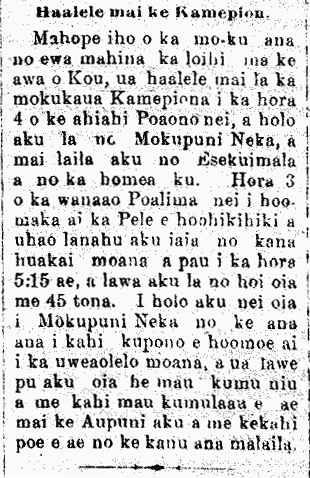
After remaining in the port of Kou for nine months, the warship Champion left at 4 in the late afternoon this past Saturday, and headed to Necker Island [Mokupuni Neka], and from there on to Esquimalt [Esekuimala] and then on home. At 3 o’clock in the dawn of the following Friday, the Pele began to fetch and scoop up coal for its long ocean voyage, and was through at 5:15, and it was filled with 45 tons. It left for Necker Island to map the proper route to lay the ocean telegraph cable [uweaolelo moana], and he took with them some coconut trees  and some other trees from the Government with some others to plant there.

(Makaainana, 8/27/1894, p. 1)

Haalele mai ke Kamepion.

Ka Makaainana, Buke II—-Ano Hou, Helu 9, Aoao 1. Augate 27, 1894.

Hawaiians come to Hawaii for the first time, 1940.

Hawaiian Malihini.

The picture above is a picture of a Hawaiian family who came to Hawaii as malihini to this land. They are Hawaiians by skin, but they are newcomers to the land. This is the first time they are seeing in person the land of their parents and kupuna. Arrived by the Aorangi was Mrs. Antone Pai, who was born in San Francisco, and her children who were born in Portland, Oregon. In the front line is Robert, 3; Sylvia, 6, and Antone Jr., 4. In the middle line is Katherine, 9; Antoinette, 8; and Helena, 11. In the back is Mrs. Pai and her brother, Francis Sylvia, who was born in Seattle.

Hawaiians Visiting Hawaii

Question: When is a Hawaiian called a malihini?

Answer: When they have not seen Hawaii before.

These are two generations of Hawaiians that saw Hawaii for the first time when they arrived in Honolulu last week on the Steamer Aorangi from Vancouver. Neither Mrs. Pai nor her children had seen Hawaii before, nor had her brother, Francis Sylvia, 22, who arrived with this family. All of them were born in America to Hawaiian families.

“It is just so beautiful,” according to Mrs. Pai as her voice choked up.

“You see that everything is green,” said one of her children. Continue reading

Queen Liliuokalani travels to Kalawao, 1891.

Journey of the Alii, Queen Liliuokalani, to the Colony of Kalawao.

To the Editor of the “Daily Ko Hawaii Pae Aina,”

J. U. Kawainui,

Aloha oe:

At 10 at night on this past Sunday, April 26, 1891, the steamship Likelike left the wharf of Ainahou, taking upon her deck beloved Hawaii’s favorite, to see the group of the lahui who are in pain and great suffering. There were three hundred or so people on this tour. Here are the  dignitaries who went:

Queen Liliuokalani, Prince Keliianaole [Kalanianaole], Prime Minister Sam Parker, President D. Dayton, Agent of the Board of Health, Lalana, Hon. J. Nawahi, Hon. L. W. P. Kanealii, Hon. D. W. Pua, Hon. J. K. Hookano, E. Lilikalani, Hon. J. G. Hoapili, French Commissioner, Portuguese Commissioner, Mr. and Mrs. C. Clarke, Joseph Heleluhe, Mrs. Limaheihei, Mrs. Pamahoa Kalauli, Mr. and Mrs. S. M. Kaaukai, Mrs. L. Keohokalole, A. Mahaulu, Bishop Wills, Father Leolono, J. N. K. Keola, G. W. Kualaku, Tamara Meekapu, Mr. and Mrs. Auld and daughters, Mr. and Mrs. Ailau, Band Master Berger and 31 band members, two haole women, Mrs. Makanoe and father, Mrs. Kuihelani, Mahoe, Malaea Kaaipeelua, Lula Kahelemauna, Mrs. Akau and the many others for whom I have don’t have their names.

The ocean was fine, there wasn’t much wind, but there was enough wind to carry the favorite one, landing before her makaainana who suffer in pain. The light of the queen of the night shown down beautifully; the wheel of the princess, the younger sister, Likelike [referring to the ship], pushed against the sea of Kaiwi, the beloved sea, like a child carried before the friends in misfortune; eyes searching the tips of the waves for land, with sorrowful tears for their birth land. At 6 in the morning, on Monday, April 27, 1891 they landed at the harbor of Kalaupapa.

The mast in the aft of the Likelike flew the crown flag, announcing here I am with a heavy heart for all of you. The town of Kalaupapa was spread out before us, from the seaside to the uplands, with cliffs surrounding, lined up on the west side of the town.

The land was astir with people at the harbor wanting to embrace with tears the Queen and her people; and likewise the alii, the Queen, and her people wanted to do the same. Continue reading

Queen Emma on Kauai, 1871.

The Queen’s Travels to the Island to the West.

O Ke Au Okoa;—Aloha oe:

At 3 o’clock yesterday afternoon, Lawai was left by the entourage of

“Maikai ka Waikini he nani ke nana,
Ka hemolele oia uka me ke onaona,
Ua hele a nolu pe i ka lehua maka noe,
Ua ike maka iho nei i ka nani o Aipo.”

[Fine is Kawaikini, beautiful to see,
The uplands are perfect in its fragrance,
The misty-eyed lehua are drenched
Beheld was the beauty of Aipo.]

The travels of Kaleleonalani continued on into dusk; the good home of the Hon. J. Kauai in Waimea nei was visited, and he gave them the entire house for the alii to do as she pleased. That is the fashion in which the well-to-do son of Waimea gave. Continue reading